

My parents, my heroes
On April 30, 1975, almost exactly 50 years ago, the Vietnam War ended — with a traumatic defeat for the United States and a triumph for the Communists. The international protest movement of 1968 finally achieved its goal: peace through the withdrawal of the United States.
But for those in Vietnam who had believed in the US, in a democratic country, it was far from over. They suffered under the repression of the new regime, leading miserable lives in a country devastated by decades of war. Many fled. So did my family.
I wasn’t there — I was the seventh and last child, born only later in Austria. But of course, I have known my family’s escape story for as long as I can remember. It begins as early as 1954. That year, the war between the Vietnamese independence movement and the colonial power of France ended, with France withdrawing. The country was divided: in the north, the Communist part supported by China and the Soviet Union; in the south, the counterpart backed by the US. The Cold War at its purest.
My mother, still a child at the time, fled from the north to the south with her parents and siblings to escape Communist control. These were dark times, and soon the Vietnam War plunged the country back into violence. They settled on the coast in Phan Thiết and tried to build a new life. As best as they could.
The heavy fighting of 1968
The year 1968 stands out vividly in her memory. While people in Western countries tend to associate that year with Flower Power and student protests, in Vietnam the fighting was especially fierce then. To this day, when my mother sees something about war on the news, she is usually reminded of 1968.
She met and fell in love with my father while still in school — he was from the small fishing village of Phan Rí Cửa. They married and had children, but then he was drafted, and in 1972 was sent to fight in Phù Cát, in central Vietnam.
“The soldiers around me died one after another,” he would recall later. So, after two months, he deserted. He hid for two weeks on a ship that took him back home. There, he remained undiscovered until the end of the war.
In 1975, the Communist north triumphed, the US left the country. Those with good connections or financial means were flown out. The rest were left behind, with their dreams shattered — left in hunger and poverty, while the new regime sent hundreds of thousands to re-education camps where torture and death awaited.
Fear of another war
At that time, my father was a fisherman. He owned a boat with a crew of ten. My mother sold the fish at the village market; they managed to get by reasonably well. But fear was ever-present. What new repressions might come and strike them? And when would the next war begin, perhaps one in which their sons would be sent to fight? (In 1978 the Cambodian–Vietnamese War began, followed a year later by the Sino–Vietnamese War.)
Like many others, my family decided to flee. Escaping by land was hardly possible, so they tried by sea. In 1977 my father made a first attempt. The plan was that he would bring the family over later. But he was caught, and spent six months in prison. When asked what it was like there, he remains tight-lipped. Perhaps I do not really want to know.
The most stubborn man I know
My father is a stubborn man — perhaps the most stubborn person I know. In May 1979, a favorable opportunity arose and he tried again, this time with the entire family. With his boat and crew he waited near Saigon, which the Communists had by then renamed Ho Chi Minh City. We Hoangs still say Saigon, like many others.
The rest of the family — my mother and five children — took a bus from Phan Rí Cửa to Saigon. Relatives and friends came along as well. But at the agreed meeting point on the shore that night, there were far more people waiting than planned. Word of the escape had spread. My father tried to fit as many as possible aboard his ten- to twelve-meter fishing boat. He knew all too well that anyone caught would end up in prison.
In the end there were 138 people on board, including three pregnant women — one of them my mother. There wasn’t nearly enough space.
All those aboard thus became part of the so-called “Boat People” fleeing Vietnam by sea. In total, around 800,000 would reach another country; some estimates put the number at 1.5 million or even more. Another 200,000 to 600,000, the UN Refugee Agency (UNHCR) would later roughly estimate, did not survive the journey.
Without wanting to downplay anything — just for context: in the Mediterranean, which for years has been considered one of the world’s deadliest escape routes, the death rate has never even come close to that of the Boat People. No matter which numbers you consider.
Day five: everyone still alive
My family almost didn’t make it either. My mother, heavily pregnant with my youngest sister, was constantly nauseous. She could only lie down and could hardly eat the rice — the only food on board. On the second or third day, the other two pregnant women gave birth. Two healthy boys, who would later live in the US.
Then the Thai pirates came for the first time. They waited in the South China Sea for easy prey: the many Boat People who had taken their valuables with them. Armed with knives and rifles, they searched everything and took the little money, jewelry, and watches.
Only my mother was left alone. Attacking a pregnant woman is said to bring bad luck. My mother knew this, and was able to hide at least a little money under her clothes. It was also lucky, she says, that there were few women on board — it was said that pirates often abducted them.
When my mother talks about the escape, she usually does so in a matter-of-fact, almost emotionless manner. Perhaps that’s the only way; otherwise, it would overwhelm her. Since the escape 46 years ago, she hasn’t slept through a single night.
Thoughts of death during a typhoon
Day four at sea was particularly terrible: a huge typhoon approached. On board, says my devout mother, everyone prayed together — Christians, Buddhists, it didn’t matter. They cried a lot, thinking they would all end up dead in the sea.
On day five everyone was still alive, and a ship approached. They assumed help was coming and deliberately damaged their own boat so that the ship would have to rescue them and take them to a refugee camp. That’s what they’d been instructed to do before fleeing.
But it was Thai pirates again. Finding little to steal, they quickly moved on, leaving the now 140 people behind.
Now water was seeping into the boat through the hole they had made themselves. At the same time, the engine broke down, and another storm arose — though not as bad as the day before. Panic spread. Once again they saw themselves as corpses at the bottom of the sea. But my father and his crew calmed everyone down, patched the hole, and repaired the engine.
The boat must be destroyed
On the seventh day, at six in the morning, they spotted many lights in the distance: a refugee camp in Malaysia. At last, their destination. Two men swam ashore. There they were told that no more refugees could be taken in — they were already over capacity. They would have to sail on. Other refugees, also from Phan Rí Cửa, gave them a tip: destroy the boat. Then no one could send them away. And that’s exactly what they did.
At that time, the Boat People were already unwelcome in the countries of the region — there were simply too many of them. Pulau Bidong, where my family arrived, is a small island of about two and a half square kilometers off Malaysia’s east coast. At its peak, including in 1979, around 40,000 refugees lived there — though it was designed for 4,500. I once read somewhere that, at the time, it was the most densely populated place on earth. That’s where my youngest sister was born, perfectly healthy. To this day I still find that hard to comprehend.
Shortly after their arrival in Pulau Bidong in July 1979, the UNHCR organized a conference in Geneva. The aim was to coordinate an international effort to care for the many Vietnamese Boat People. There was no question that they all had reasons for fleeing their country. The United States and other Western countries finally agreed to accept refugees for resettlement as part of the Orderly Departure Program (ODP).
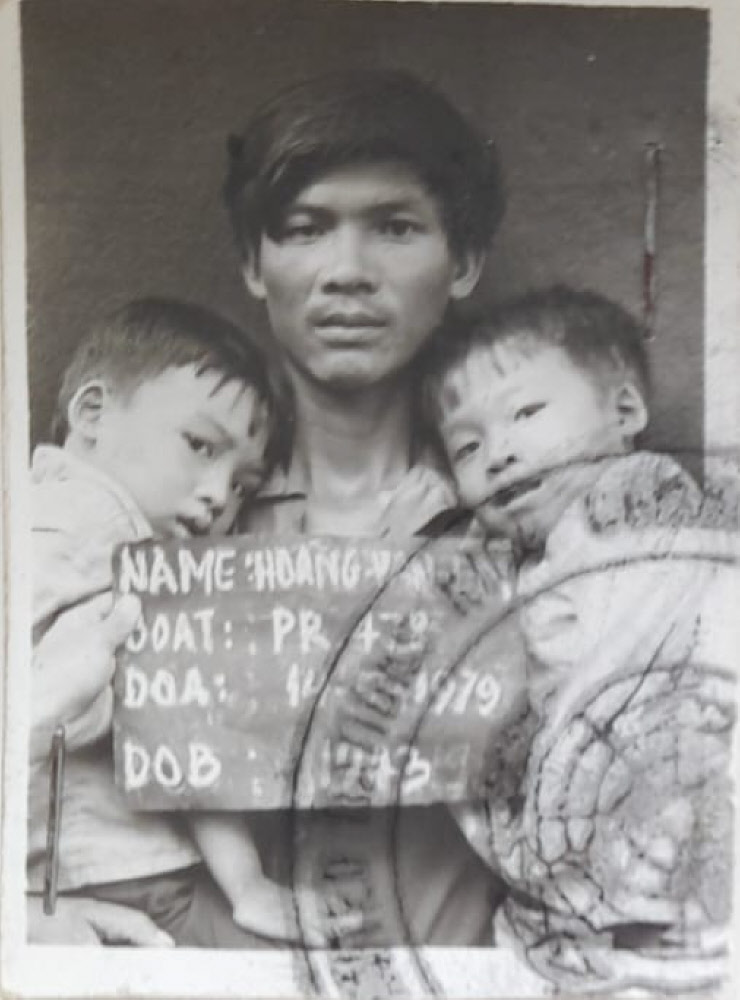
Credit: Hoang
The “Hell Island” of Pulau Bidong
The conditions on Pulau Bidong were dreadful; residents called it “Hell Island.” Many babies and small children died, my mother says. She was terribly worried about my newborn sister and wanted to leave as quickly as possible.
Loudspeakers on the island constantly announced when resettlement places became available. Five spots for the US. Seven for Australia. Twelve for France. It sounded like a bizarre lottery.
My parents were asked where they wanted to go. They said Austria, because they had relatives already living there. My uncle and his family drew Switzerland. Other relatives ended up in the United States, in Arizona. Getting everyone into the same country was simply not possible on short notice.
After about four months on Pulau Bidong, in September 1979, it was finally time. At Kuala Lumpur airport, they waited for their flight to Vienna. There, a woman asked my mother, in full seriousness, whether she could buy the baby in her arms — my sister. You can imagine the answer.
In Austria, their first stop was the refugee camp Thalham, in St. Georgen im Attergau, Upper Austria. Then, parish communities across the country took care of the new arrivals, with help from Caritas as well. In my family’s case, it was the parish of Niederalm near Salzburg. Above all, it was the Novy family who remained at the side of the traumatized and utterly exhausted Hoangs.
Added to this was the culture shock, which of course also had its amusing sides. Among other things, my family wondered: that white stuff on the mountains — is it salt, or do Austrians wash their mountains with soap?
No Krampus — just to be safe
The Novys and other families arranged housing for my family and visited them in Thalham to get to know them better and to tell them they’d soon have a new home. But conditions in the camp were so dreadful that they spontaneously packed all eight Hoangs and two Vietnamese friends into their car and took them to live in their own house. Suddenly, sixteen people were living under the Novys’ roof instead of six.
Sleeping places were set up in the converted attic. The Novys and my family could only communicate with gestures, but they managed. For St. Nicholas Day, they left out the Krampus, just to be safe.
After two weeks, the Hoangs moved into accommodation provided by the Gollhofer family in Niederalm. One day later, my father was already working. The job market for fishermen in Austria was, of course, limited, so he found work in a carpet company’s warehouse. My siblings were quickly given places in kindergarten and school. I can’t even imagine what would have become of my family without all that support.
Then my mother became pregnant with me — it was unplanned, of course. Everyone in the family was shocked, my oldest sister later told me. The last thing they needed in that situation was another baby to take care of. But when I was born at the end of 1980, everyone was happy after all. Because I was so cute. At least that is what my eldest sister says. I am inclined to believe her.
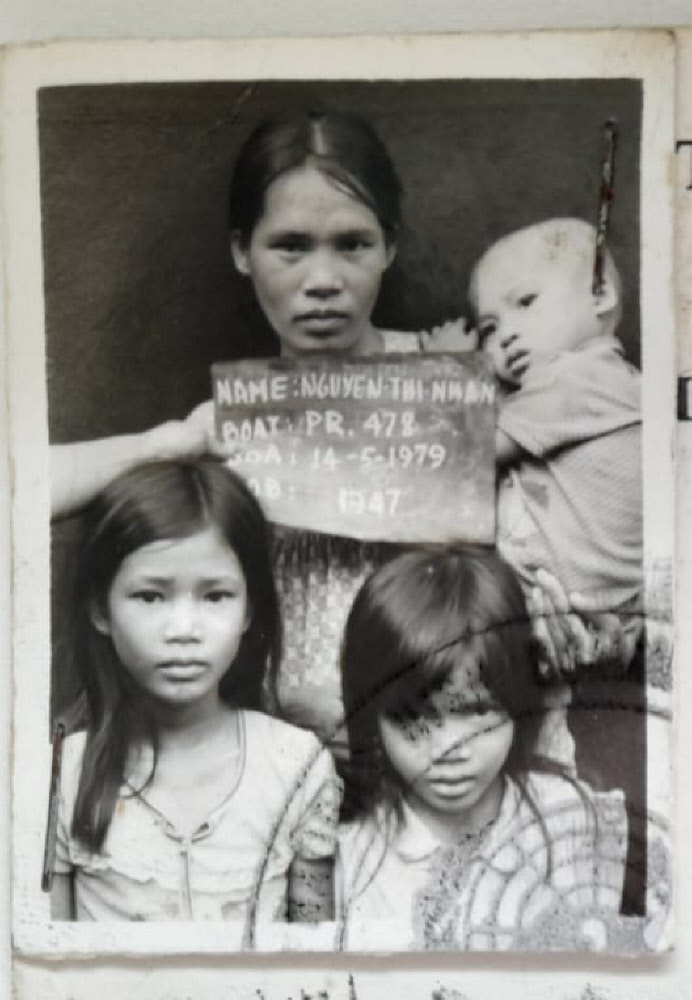
Credit: Hoang
Too small, but it works
In 1982 we moved into a larger apartment in Salzburg. By Western standards, it was far too small for nine people, but we managed. It was a good life, though also hard and full of deprivation. Seven children to care for, a new culture to adapt to, a new language to learn, and a father doing completely different work. I only realized all this later — as a small child, I was just happy to always have someone to play with. And that I always got the most Christmas presents.
At home, my mother took care of everything, while my father worked. She also learned German and got her driver’s license. She organized life for this family of nine, while my father never seemed to really settle in. He only opened up when Vietnamese friends visited — then he was loud, cracking one joke after another. I always tell my wife I got my bad jokes from him (besides, they’re not bad at all).
We children soon spoke only German and integrated, while my parents mostly tried not to stand out. “Better to stay quiet, fit in,” was their motto. Maybe that’s why I liked to rebel and question authority — a quiet protest against that endless bowing and conforming.
That’s why, as a teenager, I clashed with my father more and more often. That changed when he suffered a stroke in 1998. He soon recovered physically, but was never quite the same. The fire in him, it seemed to me, was gone — and it only ever returns in Vietnam.
My father, the sheriff
We have held Austrian citizenship since 1986. We see Salzburg as our home. Only about my father I’m not so sure. Since Vietnam opened up in the early 1990s, my parents have occasionally flown back. And there, he transforms completely. The loud joker returns. “He’s like a sheriff,” my brother-in-law once said after seeing him in Vietnam — confident, taking charge. Just like before.
My parents were also in Vietnam when my youngest brother died in 2009 from a congenital heart defect — a father of two, only 31 years old. My mother had been pregnant with him when my father was in prison after the failed escape attempt. She says that her great fear for him caused my brother’s heart defect.
He had never made it back to Vietnam since the escape. Yet he had desperately wanted to show the country to his two sons when they were older. Whenever I think about it, a dull feeling creeps into my stomach. But it’s getting better.
Never truly left Vietnam
There, in Vietnam, during the few moments I shared with my father, I realized that in his mind he had never truly left that country. That he would have preferred to continue his simple fisherman’s life. And that he endured the escape and all the hardships that followed only to give us children a safe and better life.
All the children completed their education, all of them work, are well integrated and live relatively stable lives. Under those circumstances, that is an achievement that cannot be valued highly enough. We Hoangs often don’t even realize that.
Which reminds me — I’ve never thanked my parents for what they did for us.
Cám ơn. Thank you. For everything.
Unaccompanied children sleep on the floor in shifts in Greece’s ‘Model Camps’. The EU is aware
Unaccompanied children in refugee camps on Greece’s islands are trapped in dire conditions, facing extreme overcrowding, systemic neglect and prolonged confinement, according to an investigation by Solomon, Swiss investigative outlet Republik, and the Swiss research collective WAV.
The investigation is based on internal documents from EU agencies and Swiss authorities obtained via freedom of information requests (FOI), visual evidence from NGOs on the ground, as well as interviews with people with direct knowledge of operations in the safe zones, lawyers, and children who resided in the camps.
The conditions have reached levels so severe that the Swiss government, which funds safe zones for children in island camps, has expressed grave concerns, potentially putting future funding at risk.
When it first opened, the European Union-funded refugee camp on the Greek island of Samos was touted as a “future-proof” facility – one that would guarantee dignified reception conditions for asylum seekers, including the many children who make the perilous journey across the Aegean sea alone. During a heated exchange with a Dutch journalist in November 2021, Greek prime minister Kyriakos Mitsotakis had described the Samos camp as “an impeccable camp with impeccable conditions, … no comparison to what we had in the past,” referencing the dilapidated makeshift encampments on the islands where thousands of asylum-seekers had been previously contained.
But since late 2024, lawyers working on the ground in Samos have documented a severe deterioration in conditions for unaccompanied children. By the end of December, the situation had spiralled out of control, with the designated safe zone for children swelling to more than double its capacity.
A Swiss delegation that visited the camp in early February 2025 found that “essential services like food distribution, hygiene, and psychosocial support” had been “compromised”, revealing that “children often sleep on the floor in shifts”.
“It’s not just bad, it’s tragic”
Dozens of internal documents from European Commission representatives stationed on the islands and staff at the European Union Asylum Agency (EUAA) working in the camps, as well as mission reports detailing the visits of a Swiss delegation to the islands, reveal how disastrously the camps performed when faced with increased pressure.
In one such document, a Commission representative describes the Samos safe zone as “hyper-congested” in October 2024, with children crammed into spaces far beyond their intended capacity.
Built to house 200 children, the zone held approximately 500 by December 2024. With severe bed shortages, many children spent weeks – or even months – sleeping on the cold ground. Some were forced to sleep in common areas, mingling with adults without supervision, the documents state.
Photos obtained from sources inside the Samos camp reveal clogged and unusable toilets, children sleeping on thin mattresses on the floor, trash piling up, broken windows, and a general state of disarray. In February 2025, there were only six toilets for 250 children, and no hot water.
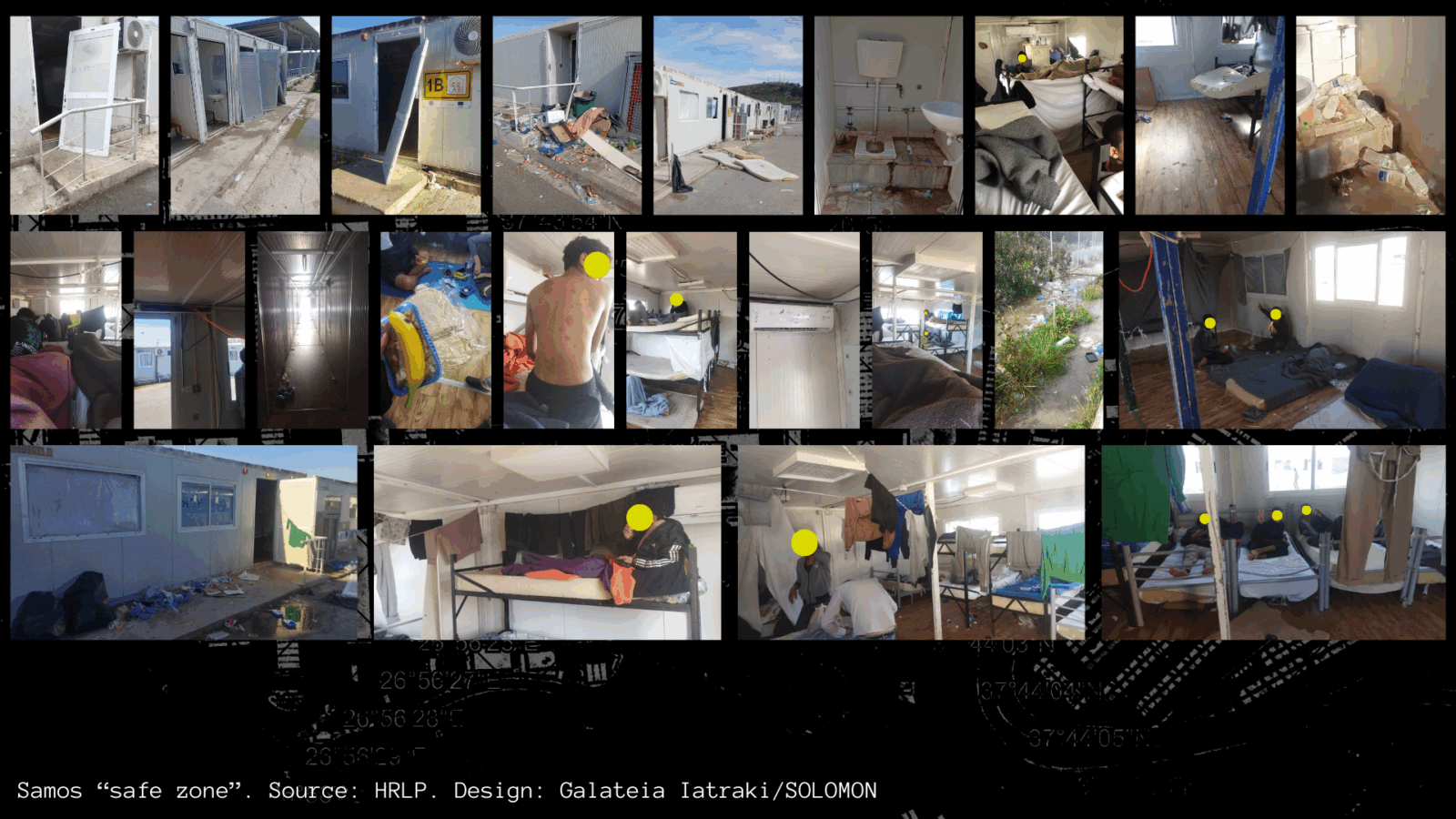
Credit: Galatia Iatraki/Solomon
“This has never happened before – never, never,” said a person with direct knowledge of operations in the Samos safe zone, describing the recent overcrowding. “It’s not just bad, it’s tragic.”
Two minors who resided in the Samos camp in February described to Solomon overcrowded, filthy conditions, scarce food, freezing temperatures, lack of hygiene products, and police violence.
“It’s like prison. You can’t go out, can’t do anything,” said a 17-year-old whose name we are withholding to protect his identity.
While Samos has become the focal point of the crisis, evidence obtained by Solomon shows that similar conditions exist across multiple camps on the Aegean islands – exposing a broader failure of the EU’s flagship refugee camps to protect even the most vulnerable populations.
On the island of Leros, 276 children were squeezed into a space built for 100 in December, with kitchens and classrooms converted into sleeping areas. The situation was no better on Chios and Kos, where minors were forced to sleep in storage rooms, classrooms or on makeshift bedding – in the case of Kos at least through January. In the Lesvos camp, many children were being housed in a former quarantine area, where an EUAA staffer noted that the situation “remains critical, with ongoing challenges and emergency incidents arising throughout December.” The document also stated that in early 2025, limited staff and interpreters hindered authorities’ ability to “properly inform” minors “about their rights, the procedure, and the next steps during their arrival in Greece and Europe.”
The Greek NGO Zeuxis, the only organisation with consistent access to the safe zones for unaccompanied children on several islands, including Samos, has struggled to meet the overwhelming needs. Despite its efforts, limited staffing and resources have left significant gaps in care, with staff frequently expressing frustration.
Several new camps – known officially as Closed Controlled Access Centres, and often described by rights organisations as “prison-like,” de facto detention facilities – were established in 2021 with more than €250 million from the European Commission. They were designed as part of the EU’s strategy to develop heavily guarded and controlled facilities on the islands, where newly arrived migrants, including unaccompanied children, undergo asylum procedures.
With money from the EU’s pandemic-recovery fund, the Greek government has installed in the same camps two surveillance systems – Hyperion and Centaur – which monitor movement, deploy behavioural analysis algorithms, and transmit CCTV and drone footage to a control room located within the Greek Ministry of Migration and Asylum.
From the outset, the camps have been mired in controversy, with conditions that experts, rights organisations, and even the European Court of Human Rights have condemned as inhumane, degrading, and legally dubious. Problems have persisted despite repeated warnings and interventions.
Swiss funders sound alarm as conditions deteriorate
The sanitation crisis in Greece’s refugee camps is just as alarming, sources told Solomon. On Samos, broken toilets forced children to urinate in bottles or directly on the ground.
For weeks, cleaning services struggled to keep up with the overwhelming demand – until February 10, when the camp was hastily cleaned just before a visit from the Swiss embassy, according to a source familiar with the situation.
The Swiss government has funded the safe zones since 2024, but internal documents reveal mounting frustration with the deteriorating conditions. The Swiss embassy expressed “serious concerns over the escalating situation” at the Samos safe area following a monitoring visit in February 2025, according to an internal report. There are indications that the Swiss government has considered withdrawing funding from the project.
Lawyers with the legal aid organisation Human Rights Legal Project (HRLP) on Samos reported that 30 of the 38 minors they represented suffered from skin conditions like scabies and staphylococcus. Others were battling untreated chronic illnesses, including diabetes and kidney disease.
Internal reports from EUAA staff from August 2024 to February 2025 tell a similar story across multiple camps. On Leros, EUAA staff flagged “tremendously dangerous” hygiene conditions, including a lack of running water in toilets and overflowing sewers.
The Malta-based EU agency, responsible for coordinating and supporting asylum procedures across member states, described long-standing medical staff shortages that left camp populations, including children, without basic healthcare.
In February, “multiple issues” persisted in the Leros safe zone, including “inappropriate living conditions… due to overcrowding,” according to documents shared by the EUAA. A doctor warned of the risk of transmission of several diseases, including rheumatic fever, scabies, and staphylococcus, citing “overcrowding and cramped living conditions.”
One particularly troubling case on Samos saw authorities failing to properly handle a chickenpox outbreak, which included infections among unaccompanied minors – raising concerns about broader health management failures in the camp.
In December, an EUAA staffer reported that the vast majority of unaccompanied children they worked to register on Samos were “covered in… skin infections.” The staffer added, “Most of them don’t have appropriate clothing and shoes for cold weather; some of them came to be registered barefoot all the distance from the safe area, and many complain of… problems due to sleeping on the floor without even a mattress.”
In the partially redacted EUAA documents, consisting of bi-weekly updates sent by staff on the ground to the agency’s headquarters in Valletta, Malta, staff expressed growing exasperation at the chronic problems that remained unresolved month after month.
On Chios, one EUAA staff member wrote: “Construction issues reported since spring are still not solved. For example, behind the safe zone for [unaccompanied minors], there is an unstable slope with risk of collapsing.” These concerns were forwarded to Greece’s migration ministry, according to the document.
The internal documents reveal where priorities lie for a Greek government that is pursuing a hard-line migration policy.
While millions of euros in EU funds are funnelled into state-of-the-art surveillance technologies in the island camps – including CCTVs, drones, biometrics, and movement detection algorithms – basic living conditions remain subpar.
Confined in limbo?
Beyond the physical toll, unaccompanied children have also suffered from prolonged confinement and bureaucratic delays that leave them in legal limbo, according to advocates and internal documents.
While safe zones were established as temporary accommodation units, lawyers have documented cases of children trapped in the Samos camp for up to 124 days without being allowed to leave. Meanwhile, EUAA reports reveal that across multiple camps, children remained unregistered for weeks, blocking access to medical care and preventing them from beginning the asylum procedure.
With camp populations surging amid a significant increase in arrivals of children on the Aegean islands in 2024, education and recreational programmes were among the first casualties. In Samos, support programmes designed to provide structure and some sense of normalcy for children who have survived multiple traumatic experiences were suspended indefinitely during periods of overcrowding due to staff shortages.
“There is nothing,” said a source with direct knowledge of the Samos safe zone. “[The children] don’t go out at all. There’s nothing to keep them busy. We did some activities in the past, but now … with so many [kids], we don’t even have time for the essentials.”
“It’s affecting my mental health badly … I see nothing new,” said a 16-year-old residing in the Samos camp during an interview in February.
On Leros, where the typical stay averages two to two-and-a-half months, minors received no formal education, with only a handful of recreational activities to fill their time. “A teacher would be greatly valued,” noted a European Commission report on the Leros camp in October. “There are no excursions or visits outside the camp. Minors clean their rooms themselves in order to educate them and keep them busy.”
In February 2025, legal organisations sent a letter to the EU Commissioner for Home Affairs, Magnus Brunner, condemning the “dire conditions and unlawful detention of refugees” at the Samos camp. Separately, in early February, the European Court of Human Rights granted interim measures to protect four unaccompanied children, recognising the “imminent risk of irreparable harm” they faced inside the Samos camp. The court ordered Greek authorities to provide the children with adequate food, clothing, medical care, and to relocate them to a shelter for minors.
“EU-funded camps on the Greek islands fall far short of the very minimum living standards protected by human rights law, as recalled yet again by the European Court of Human Rights,” said Minos Mouzourakis, legal and advocacy officer at the organisation Refugee Support Aegean (RSA), a Greek non-profit that provides legal aid and advocacy for asylum seekers and refugees.
Transfers to the mainland were severely limited due to a shortage of accommodation facilities. In late 2024, decreased capacity in emergency and long-term shelters for unaccompanied children forced them to remain in the refugee camps of Malakasa and Diavata “for extended periods … where adequate safeguards are lacking”, according to an EUAA report.
Reports of abuse and neglect
Reports of abuse and neglect add another disturbing layer to the crisis. In Leros, a child formally reported being a victim of police violence in August 2024, submitting a medical document as evidence, according to an EUAA document. Greek authorities did not respond to Solomon’s request for comment.
Frequent fights are reported to break out between the children, with older ones said to be bullying younger ones. In some cases, there have even been reports of attempted sexual violence. Commission reports also documented instances of vandalism.
“Confinement causes all of this,” a source with direct knowledge of operations in the Samos camps said.
For many unaccompanied children, daily life in the camps is a battle for survival, according to advocates. All 38 children interviewed by lawyers on Samos reported being malnourished. Food was often mouldy, and some portions were said to contain worms. In Kos, internal EUAA correspondence obtained during this investigation revealed that all camp residents were required to receive all three daily meals late at night. Several documents from late 2024 noted that residents “must consume it all at night because there are no refrigerators”. By early 2025, the frequency of meal distribution appeared to have increased to twice a day, according to subsequent documents.
Solomon reached out to the Greek Migration Ministry, the European Commission, and the EUAA for comment on the conditions in the camps and their responsibility to address gaps. None of the authorities responded by the deadline.
“Dignified reception of refugees is imperative under our legal order,” said Mouzourakis of RSA. “It is also feasible, if the EU restores alternatives to carceral encampment of people seeking protection from persecution.”