

Everyday sexism, sexual harassment and the need for a new feminism
“New feminism carries along the vision of a democratic reconstructing of our societies that are under attack by the forces of patriarchy and oppression.”
Everyday sexism
10/05/2017
It’s now been over eight years since I was first employed as a journalist. The intervening years of relentless output of quite frankly bleak news have blurred memories of my very first news reports and editorial news spots. However, what I do remember very vividly in those early days is how overwhelmed and stressed I felt upon entering an 80% male dominated newsroom. My day would start with a nervous breakdown ritual – reminiscent of Woody Allen films – in front of my wardrobe. My main concern was to be “appropriately” dressed, to avoid generating misunderstandings or misinterpreted signals on the part of my male colleagues. During my shift, my objective was to render myself quasi-invisible whilst keeping as productive as possible, not to react to the verbal or non-verbal brotherly code of communication, not to take a cigarette break, not to let my thoughts drift whilst looking out of the window, and to conceal any signs of menstrual discomfort. This was my way of dealing with the situation and proving that I was worthy to be in their midst. That is not to say that I was unaware of modern feminist theory.
Au contraire. I had already absorbed a large amount of Butler and Kristeva, I had protested against gender-based violence, I wasn’t one for ignoring women crying out in pain behind closed doors and had called the police every time I suspected domestic violence. However, I hadn’t managed to shake off my insecurity or my internal default setting of guilt at being a woman, both legated to womanhood by a resolutely patriarchal society. I responded inadequately to the daily, inferred and diffuse versions of sexism which are so deeply-ingrained in our collective subconscious, that they have become second nature pervading our universe. Many years, elections and memoranda later I managed to establish a more equal relationship with my male peers. Certain “bastions” of inclusivity however could never be conquered; it was never accepted that I comprehended how the offside rule worked.
This is one of my many personal experiences of everyday sexism, and the manner in which it penetrates subjectivity itself, methodically, silently maiming its autonomy. In his book “Racism without Racists”, Eduardo Bonilla-Silva explains how racism stifles the well-being of the black population in the USA and is an obstacle to equality, despite the fact that nobody would freely describe themselves as racist. Conversely, we could apply this principle to the phenomenon of “sexism without sexists”, albeit that in recent times men overwhelmingly repudiate sexism, the phenomenon however subliminally escapes from “pledges of faith” to women’s rights and takes off in all directions. It’s in school text books, it sits next to you during university lectures, it is reflected in the gaze of your employer and colleagues at work, it honks at you as you walk down the road, it squeezes you on the underground, it unashamedly and cynically pops out at you from the TV screen during an evenings’ viewing.
The predominant conceptualization of sexism may have several manifestations and become mainly apparent through the ugly face of gender-based violence; violated bodies and minds, as accounted for in police reports. However, gender-based manifestations of violence are exoteric, and no longer constitute isolated or uncommon derivatives of a sexist culture. There is an entire web of relationships, mechanisms, perceptions and behaviours which collectively form an iron fist serving at the altar of sexism where it prays devoutly, and its devotions relegate women to positions of servitude or inferiority. This belief system albeit taciturn generates and immortalizes gender stereotyping with disarming clarity.
“We have learned to consider certain behaviours as acceptable; this however does not render them less sexist: looks or comments – not necessarily vulgar – in public, references to household chores as being female, phrases like what’s wrong with her, is she on her period? or didn’t she get some last night? The problem with non violent sexism is that it manifests in a way that is difficult to explain. You feel that trust and allegiances are divided, or that you are being spoken to in a different tone, with less respect than when addressing a man”, says Anna Sigalou, student and member of the feminist initiatives ‘No Tolerance’ and ‘Fig Leaf’.
She continues cherry-picking from her personal experiences: “Let’s say I have been lucky, because I haven’t felt that sexism has been hard-hitting in my family life or social circle. This of course does not exclude me from sexism, in the general sense. I have had some bad experiences from men whose advances I rejected; one of them called me for two months, and was very abusive, whilst the other bullied me because I supposedly hurt his feelings. On an outing, a male friend would offer the keys of his car to other males but not to me – at least not without an argument – despite the fact that we were both equally good (or bad) drivers. You will often find that you don’t have an audience if you’re talking about a violent event that doesn’t involve bruising or which merely left you emotionally scarred. Being stared at on public transport or squashed isn’t considered to be serious, because it happens to all women. There is a permanent quashing of womankind in public life”.
Sexism is as endemic as reality and an integral component of power, not only in its oppressive and prohibitive dimension but as an everyday, socialised and embodied phenomenon, as per Foucauldian theory. Gender is by no means a fixed or unchangeable category. It is an arena in which power struggles are fought and it is socially constructed through performativity, in other words during the fulfilment of normative, cultural and largely surreptitious rules. You become female or male through the dynamic re-enactment of the norm for femininity and masculinity. However these social roles do not transition with painless parity to social equality. They are the fundamental vestiges of a patriarchal society. Therefore sexism penetrates our lives at inception and creates a cloud to accompany us on all strata of social life. It becomes normalised.
This image becomes a familiar, albeit distorted and innately worrying, representation of ourselves. We hate it and we feel uncomfortable, it either incites embarrassing coexistence or disciplined assimilation of humiliating behaviour. We are no longer shocked by it because we have simply learned how to live with it. We are programmed, on the road, no matter how sound our driving skills may be, to put up with endless hooting, the menacing winding down of windows, or the barely muffled laments “alas, female drivers!” We know that we are going to have fight for professional advancement. We have trained for this at Olympic speed whilst walking home on an evening. We are fully aware, that for us, the passage of time, getting older, or diverging from stereotypical beauty, is simply unforgivable. Once we hit 40, we become the wrinkled disdained, whilst they become “the cute baldie” or “the sexy grey haired guy”. Our sexual malfunctions are put down to us being unsexy or lacklustre, and of course, their sexual malfunctions are entirely our fault. These are the lessons we are taught as adolescents, enhancing the development of strategic defence and repeal tactics to handle these situations when the time comes. Heaven forbid we should choose to discuss these issues, for we would surely fall into the pit of incomprehension or be exposed to full scale mockery.
“I find it terribly uncomfortable when we are out in a crowd and I am expected to express unqualified approval by showing signs of smiling when somebody is about to make a sexist comment. At that point I have two choices: To act indifferently (i.e. accept oppression) or to start a conversation expressing my discomfort. The first typical one-liners that I will generate as a response are “Don’t be OTT!”, or from the deep thinkers “Political correctness has shut down all conversations”. I work in a testosterone fuelled environment, i.e. with men who want their manliness to be felt. A female journalist must prove herself worthy of the profession and adopt a traditionally male reporting approach. Topics have a default gender setting. It is rare for a male colleague to write on e.g. cultural affairs. It’s also considered weird that I should attend alone at the Moria Refugee Camp following clashes that breakout from time to time”, says Anthi Pazianou, a Lesvos island journalist writing for the local “Empros” newspaper and reporting on “Radio Aiolos” as well as being a correspondent for the national daily newspaper “Kathimerini”.
Anthi’s experience lays bare a facet of oppression experienced by women working in the media sector. “The profession acts as a multidirectional hotspot which clearly operates as an ideological hub, generating and regenerating stereotypes. Consider the naked misogyny of Themos Anastasiadis who has undertaken on behalf of his newspaper the operation of symbolically annihilating women through sensationalist and objectified representation of the female body in lifestyle magazines;
Greek media reeks of sexism. Or the entertainment section where women are portrayed either as sex objects or as “homemakers” and “mothers”, whereas they are almost completely absent from the news section. Panels of commentators on news programs are male dominated with the exception of a few female MPs and ministers. The structure of broadcasting itself in Greece seems to imply that women aren’t capable of serious broadcasting, and should only do cookery, fashion and gossip spots. I feel terribly vexed when sexist crime e.g. femicide or domestic violence is not referred to as such and instead we hear reports of “crimes of passion”; this is deeply offensive and misleading. Perpetrators of such crimes appear to be decriminalized and the patriarchal root which gives rise to these crimes is silenced”, adds Anthi Pazianou.
The truth is that nowadays we are experiencing a revival of true, pure and inbred sexism, and Donald Trump could be considered as embodying all of these attributes, however many men try to avoid being branded as sexist. Their claims, despite very often being affected by informal collective adult learning, stem from the womb of sexism itself. Justifying gender difference within a historical and evolutionary context which defends the gender based distribution of tasks and duties, or seemingly admires “femininity” or “the fair sex”; essentialistic sources of inspiration which reinforce traditional female roles and seek to paternalize female existence, or the conspiracy to represent women as dark and devious creatures with magical powers and men as mere puppets, or the denial of a patriarchy and therefore by extension the need for the existence of feminism, are barely disguised forms of sexism.
These strategies are now being upgraded with new forms of sexism and female oppression, like stealthing, the male practice of removing protection during sex without the consent of their partner, a practice which according to research in the USA is becoming “fashionable”. Also, slut shaming, the social stigma attributed to how women may manage their sexuality or revenge porn, publicizing female sexual content (photos, texts, video) without mutual consent. Two core methods of controlling female sexuality and punishing emancipated women. Huge tension is brought to bear through the omnipresence of social media, besmirching reputations and transforming personalities.
All of this is wonderfully facilitated by the absence of the State itself to convincingly establish an antisexism standard, instead it churns out of its bowels abhorrent effigies of antifeminism. Sexism is ratified in Parliament, it becomes embedded in politics and it is publicly applauded. Political reporting is alive with such examples, from the immortalized comment of Pasok MP Mr Socrates Xynidis to Ms Eva Kaili also a Pasok MP who was pleading for permission to speak in parliament “Pipe down, you garter!”, to Mr Iordani Tzamtzi MP for New Democracy commenting “Even when you marry, you could end up with a wrong’un”, to the way the names of Scarlett Johansson and Georgia Vasileiadou have been added to the toolbox of wisecracks in micropolitical life. Female politicians hardly ever attract attention to their role as public servants, but are often in the limelight due to their gender. Journalist Stefanos Kasimatis blatant misogynistic announcement of Tasia Christodoulopoulou Syriza MP becoming a grandmother “Shudder the thought, you must have become a mother at some point” was later baptized as “humorous” by himself, but nobody was laughing. Politicians partners are often easy targets.
The newspaper Avriani published one of the most filthy pages in Greek journalistic history in their character assassination of Dimitra Liani. The same newspaper, unrepentant years later in 2015, called upon Zoe Konstantopoulou’s husband to “Sort her out”. Greek journalists and the great general public who use the internet don’t see any reason to restrict their comments to the partners of Greek politicians. Sexism knows no borders. Daggers are out for Brigitte Trogneux, Emanuel Macron’s wife. It’s not like couples with a twenty-five year age gap haven’t ever paraded out in public ever before. Many men, whether they are politicians or not, are married to much younger women. No problem with that. They might actually gain in social stature by doing so. A male with a much younger female partner is usually described in terms relating to “swagger”. Trogneux caused an outcry because she breached the gender based hierarchy. The guardians of patriarchy, whether pulling cheap sexist psychiatrization punches with references to the “Oedipus complex”, or overtly criticizing Macron’s love choices – indeed why didn’t he consult them – are shoring up phallocratic support.
Maria Repousi, a woman with a long tenure in feminist regime change and a historian, but also on the receiving end of sexist behaviour as an MP, speaks to Inside Story of her experiences: “Female politicians are on the receiving end of many sexist attacks, intended to politically annihilate them. Our appearance tends to provide ammunition. If you type “Repousi and tights” into Google, you will find a number of photos of my legs at the ballot box in Parliament. Female MPs are very often judged not on their political opinions but on the way they choose to dress, their choice of handbags, shoes, etc. The travesty doesn’t stop there. Its true dimension lies in the fact that regardless of their political affiliations, female politicians aren’t capable of adopting a common stance of solidarity in order to rebut such behaviour. In general, political life in Greece is extremely patriarchal, both in its representation, its formation and of course in its rhetoric. Feminism is but a caricature, even when for reasons of political correctness it defends gender equality. I count amongst the most difficult days of serving as an MP the 8th of March when I have to listen to cheap political debate about women. We are easy topics for controversy because we inevitably bring out gender ideology and therefore targeting us is always completely successful. I have been the target of extreme controversy, as indeed have other female politicians, and in my experience I can say that such controversy threatens our physical integrity. For example a Deputy Minister from the current coalition government with the Independent Greeks called upon Golden Dawn to “crowd” me in Parliament so that I could grasp the concept of crowding. This was not questioned at all when he became a Minister.
Language, which transpires from the dominance of the male gender and which stands defiantly inventing words and labels which universally embrace gender based identities, is a very important determinant for establishing sexism in everyday life. In recent years there have been individual and collective interventions into the field of sexist language but it is extremely telling of the adherence to a sexist culture that these interventions are dealt with as hysterical attacks intended to injure spontaneity. When we ask our co-interlocutors to refrain from making sexist gags, to refrain from criticizing women’s appearance, to refrain from commenting on sexual activity in dominating terms, to use more inclusive language in their writing, they look at us as if we were aliens newly-landed from the planet of political correctness, as if language wasn’t a semantically loaded sector which puts skin on the bones of reality. In fact, in Jacques Lacan’s work, language is intended as the driving force which constructs subjectivity with the phallus taking pride of place.
Dimitris Zachos, Assistant Professor of Pedagogy – Intercultural Education Aristotle University of Thessaloniki, explains that the language of negotiation remains very phallic: The language we use is predisposed given that it reflects social structures, a fact which affects the way in which we grasp meaning and the way in which we think. Sexist language prevails both in public and private discourse and it contributes to the reproduction of sexist ideology and of social practices which emanate from the same. Sexist language manifests itself on a structural, syntactical and semantical level. On a structural level a rule has been established (by male linguists) on the basis of which “male precedes female”, e.g. in the Constitution of the Hellenic Republic the term “Female Hellenes” is referred to just once, whereas the term “Hellenes (male case)” is dominant. On a syntactical level the rule is that when the subjects in a sentence are not both of the same gender, the grammar defaults to the male case, e.g. “Kostas and Nikki were colleagues (male plural) in the past”. On a semantics level, let us just ponder for a moment the meaning attributed to the words: Wifey, womanising, effeminate, vixen and on the other: Bravery, puppet, man-up.
To demonstrate the structural presence of sexism and how the appropriate backdrop is formed for the manifestation of gender violence, the French filmmaker Eleonore Pourriat shot a genius experimental film “Oppressed Majority”. The film presents a reversal of reality with women behaving exactly like men, e.g. running around bare-chested alongside men pushing prams, urinating in urban alleys, chatting up male passers-by, sexually harassing them. It is an exquisite sketch exposing sexist colonization in everyday life and the dangers implied therein. It is encouraging that we are experiencing an international trend of exposing everyday sexism, even in its most deeply embedded form, thanks to a revival of feminism both in the arts and journalism.
Recently a video on periods went viral on ABC, showing an overdue need for normalisation of menstruation in public life, breaking free from disdainful patholigization and signification of profanity. Familiarisation with periods, as a basic and simple function of the female reproductive system and the cessation of trading pads and tampons subversively like we were pushing drugs in Omonoia, constitutes a small victory against sexism. Everyday sexism project is a space where women may catalogue instances of sexism in every day life. The experiences of women, not as individual cases, but as a collective challenge, lie at the core of this modern debate. Moreover, we have learned from postmodernist theory that experience is always political. Therefore for women to speak of their body and their daily life, means that we are exposing personal sites of oppression and abuse. It simultaneously heralds a process of raising awareness which flips the hourglass of tolerance upside-down.
It’s a man’s world: Sexual harassment.
21/03/2017
The majority of straight white men are almost unfamiliar with a category of sounds. It is the sound of irregular breathing on a dark road at night; breathlessness from running all the way home in order to get in safely, the unutterable cursing on the underground or at the traffic lights of a busy junction, the gritting of teeth at work or in a lecture room, the echoing of an extended “no” disappearing after an act of imposing male dominance. I am talking about fear; not of the existential type that is associated with death, the passage of time, or illness, nor of neurotic fear conveyed through objects or situations. I am talking of the fear that women experience. It is integral to our collective memory, an unspoken and painful common experience. It accompanies us solidly from adolescence, initially in an amorphous and hazy manner but later we recognize this to be the shape of a man. He may be a relative, a co-student, or a colleague, a complete stranger on the road, or in a bar, he is every man who sexually harasses a woman. It is all at once the archetypal threat and the epitome of macho culture that so many of us have unfortunately fearfully come face-to-face with at some point.
Dragged centre stage by recent depressing incidents, the topic of sexual harassment is once again at the forefront of international affairs, its most prominent exponent Donald Trump who has been accused of multiple counts of sexual harassment, or publicly manifest through the silent absolution of Casey Affleck accused by two women of sexual harassment, then rewarded by Hollywood with an Oscar for best actor in a male leading role, presented to him by an unimpressed Brie Larsson. Let us not stop here without mentioning Uber. Susan Fowler, formerly a site reliability engineer publicly reported how she became the victim of sexual harassment at the company at the hands of her manager. Before going public with her story, Susan reported the incident to the company’s HR department, but she soon discovered that he wasn’t going to be challenged by HR because he was a high performer and this was his “first offence”. After Fowler went public and the #DeleteUber campaign was reactivated, the company announced that it was hiring the former U.S. Attorney General Eric Holder to investigate the accusation and contribute to creating a better working environment for women.
This is by no means the first time that Silicone Valley has been shaken by a sexual harassment scandal. Colossal hi-tech companies such as Apple and Google have been accused from time to time of propagating a sexist working environment that favours sexual harassment and gender discrimination. Research conducted amongst 200 women working in technology companies found that 60% had experienced unwanted sexual advances, whereas one in three didn’t feel safe. The Guardian newspaper research sheds light on the epidemic of sexual harassment and gender based violence in British universities. In accordance with published information, 300 incidents of staff sexually harassing students has been reported over six years; these incidents were generally not reported by the students for fear of what the impact on their studies or careers might be, or an unofficial “solution” was sought within academia.
Clearly sexual harassment is not a problem specific to the anglo-saxon world. It is a normalised form of gender based violence and it is prevalent everywhere, in every country, both in the public and private sector. Nonetheless it remains notoriously undocumented, clearly the victims choose not to officially persevere with their complaints, maybe because their complaints are clearly not perceived as such, a fact which reflects the established social perceptions of “masculinity” and “femminity”. In 2014, the European Union Agency for Fundamental Rights registered reported sexual harassment in Greece at 15% and in Denmark at 37%. Obviously this doesn’t prove that Denmark has a higher incidence of sexual harassment than Greece, rather it speaks of a diffuse sexist culture in our country, where aggressive male behaviour is so deeply-ingrained that it is accepted as a given.
“The recognition of sexual harassment – as well as other forms of violence – from the victims of sexual harassment themselves as harassing or offensive behaviour, is directly linked to subjective and other social factors. Often victims of sexual harassment do not make a formal complaint either because they are afraid or because they consider harassment as a normal component of gender role play. Gender stereotypes in Greece remain powerful, despite the significant progress which has been made in raising awareness and providing support services to deal with violence against women. It’s enough to surf the internet or follow in the media (advertisements, programs, television series) to discover that traditional perceptions are deeply rooted, often under the guise of “humour”, nevertheless such perceptions strengthen or “sanction” violent behaviour.
Unfortunately there is a plethora of examples. It’s worth mentioning at this point that after our strong reaction to an advertisement that incited gender based violence, we were attacked as lacking a sense of humour and accused of censorship. Our experience derives from operating the Advice Centres, the cases handled by our advisors on a daily basis leave no margin for mirth when it comes to dealing with the phenomenon of violence against women”, VIMagazino is told by Irini Agathopoulou, the President of the Research Centre for Gender Equality.
Recently she had lodged a complaint against her superior whilst working in the public sector in Zakynthos for sexual verbal abuse which had lasted for two and half years. When she finally reacted, she was punished with a revenge change of post. This is the second charge that has been brought against the person in question. The Directorate for Secondary Education in Ileia is handling a parallel case, whereby students reported being sexually harassed by their teacher, whereas reports from female officers at the Venezuelan Embassy of aggressive and abusive behaviour of the former ambassador were very revealing. The common thread which ties all these cases together and many others that remain invisible is that they involve a male authority figurehead seeking to breach the boundaries of his authority by passing into the female body and psychology.
Pothiti Chantzaroula, a historian at the University of the Aegean with a considerable body of research, sheds light on an obscure facet of sexual harassment and abuse which is experienced in domestic work: “Paid domestic work has always been an area where power relationships are played out and this type of employment seems to be sexually charged in the European fantasy. The role of the domestic worker – the “maid” – in Greek cinema expresses and positions gender and class divisions which pervaded Greek society within the context of urban households. On the basis of these class divisions the female employers were cast in the positive role both in respect of social class and femminity (mother-Madonna), whereas the employees were cast as negative roles (by traditionally becoming sexual objects).
This fantasy is an ideological construct and it is so powerful that it is posited as completely normal in the verbal expressions and representations of the dominant class. Power relationships withdraw from public sight, where they become the “norm”. The shame felt by the victims of sexual violence, i.e. female domestics, and their silence stems from the knowledge of what is said about them, and how they are portrayed, as well as from the patriarchal organization of honour, on the basis of which women must prove their innocence in rape incidents. This patriarchal honour culture embraces purity as a control mechanism; it follows therefore that the loss of purity results in the loss of honour and therefore the only destination for women is lost too, i.e. that of the sanctity of marriage and motherhood.
Sexual harassment is a facet of sexual violence, arising from inequality and patriarchal structures in modern society, it is propped up by the culture of rape. A term reminiscent of the feminist drive of the 70s, whereby rape was recognized as an act of violence accompanied by patriarchal dominance and structural inequality and not by what is conveniently termed as male “sex drive”, a term which promotes the logic of absolution and tolerance of sexual violence. Rape, despite being the most marginal version of objectifying and humiliating the human body is the only crime where the victim is paraded around rather than the perpetrator. If we take into account that not a single public prosecutor, has ever enquired as to how the perpetrator was dressed, and is only interested in what the victim was wearing when the crime was committed, if she was inebriated, if she was flirting with the perpetrator, if she was promiscuous, then it doesn’t come as a surprise that this is the crime with the lowest conviction rate (just 2-3%). Judges don’t seem to require evidence of guilt on the part of the perpetrator but evidence substantiating the reliability of the victim. A woman who has been raped is only credible if she is surrounded by evidence of an untarnished life and if she bears serious wounds which prove that she engaged in mortal combat with her rapist.
In Greece in 2015, in accordance with official police data, 122 rapes were recorded and 54 attempted rapes, whereas 134 rapes and 64 attempted rapes were recorded in 2016. The International Organization Equality Now classifies Greece amongst the countries where rape victims are unprotected by the legislative process. However, what is even more shocking is what is recorded in the social conscience, given that a recent European Union study found that 27% of Europeans and 32% of Greeks accept rape “under certain conditions” (if the victim was scantily dressed or was under the influence of alcohol), these perceptions invoke the most anachronistic gender stereotypes. Perhaps the most shameful and sinister expression of misogyny in Greek society occurred in 2006 in Amarynthos, when a fifteen year old Bulgarian schoolgirl reported that she was gang raped by four of her classmates who were also filming themselves committing the crime and that in court forty witnesses came forward in support of the defendants whereas only the mother of the victim came forward for the prosecution.
It is within this framework that the group “sexharassmap” was formed, to record incidences of sexual harassment and gender based violence in Greece: “The aim of the map is to gather all incidences brought to our attention that have taken place all over Greece. We feel that by actually placing them geographically, renders them more visible. We don’t like talking about this type of violence, and if we do, we treat it like something that happens elsewhere. By putting these crimes on a map we highlight how prevalent this type of violence is. The frequency with which these crimes occur prove that gender based crime isn’t committed by men with mental health issues but it’s perhaps closer to home than you think, maybe even next door. Even though we are by no means a professional reporting organization, we have already placed 141 rapes on the map. Information is sought in the media and police reports and often we are contacted anonymously. Talking to friends, relatives, and acquaintances we become increasingly aware of how common this type of crime is. This is a particular type of violence that many of us simply cannot stave off. That is why even unofficial reporting is so important. “Reporting is reacting” this is the mantra of VIMagazino.
This is the story of our lives, it is the bread and butter of our upbringing, whether this was in a conservative or more liberal family environment, we need to be careful, even if this means stifling our desires and our freedom, otherwise we may fall victims of gender based crime. We are destined to carry the stigma of original sin, we need to learn to duck and dive through an assault course of insults, and to suffer in silence. In fact prevention strategies are all about teaching women to avert harassment, abuse and rape. And if the threat actually manifests itself, as it inevitably does, we are taught to go through the trials and tribulations of re-establishing our lives alone, and to reconcile ourselves with fear, so as not to rock the happy families boat, the education system, the world of work, religion and politics.
A sincere approach to equality would reverse the status quo; it would train men not to harass, abuse or rape. And if they chose to do so, it would punish them.
A new type of feminism
02/05/2017
From Madonna to the women of the Sioux tribe at Standing Rock, from Arianna Huffington to the trans activists in Pakistan and from Asli Ergogan to Peru’s forcibly sterilized women under Fujimori, the length and breadth of this increasingly sad and dark world, where the advances of human civilization stand at the precipice of the abyss, women are charging ahead to the forefront and they are doing so with dynamism. Women are the public face of resistance. Resistance, which for many years was sparse, atrophic and inward-looking, is now united in a different dimension, the wonderfully diverse and powerful solidarity of a new type of feminism, capable of shaking the foundations of a dystopian global political conservatism. At this point in history, Walter Benjamin’s, “Angel of History”, has the face of a woman. It might be Saffiyah Khan in Birmingham, defying the EDL with a smile on her face, or Leshia Evans peacefully confronting a line of heavily armed riot police during a Black Lives Matter protest or Nadia Murad, a Yazidi woman who escaped an ISIS camp where she was forcibly held as a sex slave, now the first Good will Ambassador for the Dignity of Survivors of Human Trafficking of the United Nations. Womanhood stands united and sticks two fingers up in the face of those who would subdue it.
Feminism is trendy. Even international fashion houses have upped their game seeking to shake off criticism for seemingly sanctifying the objectification and oppression of the female form in the past. We are all feminist-friendly. This isn’t something that has suddenly fallen to earth, quite the opposite. It has been a long-time coming, staking out workplaces, universities, parliaments, hiding out in interpersonal relationships, which, as Carol Hanisch maintains, remain political. The struggles that women have had to endure are deeply ingrained in our collective memory and at least from the beginning of the 20th century – when a systematic recording of the same commenced – they resurge during intervals of dead calm or recession in order to do battle with omnipresent patriarchy.
Feminism in its new manifestation is high on intensity and dynamism, as conveyed on the great Women’s March, which put a damper on the lips of those who hastened to call a rematch against women’s rights. The truth is that the feminist movement experienced a great, revealing moment of renaissance in the 70s and 80s when it managed to establish a series of institutional changes which improved women’s everyday lives and it left its mark as a moral compass for the future. However, the end of the 80s brought with it a decline. We entered into an arid twenty year period of integration, internal division and derision of the very concept of feminism itself, which was presented in the media as a caricature of an unshaven and unsexy woman. Of course during the years of decline, processes persisted on an intellectual level within groups but their power and reach was limited. Today however, given that the glitz and glamour of lifestyle media has lost its sheen under the burden of a global economic crisis, against the menacing backdrop of growing extreme nationalism and religious fundamentalism, the lay of the land lends itself to the rise of a new type of feminism.
It started emerging in Poland last year alongside a trend towards attacking women’s reproductive rights and self-determination to the female body. It became evident that women weren’t just going to lie down and bear it, no, they were resolute in their decision to protect their rights. It was this reaction that influenced the Polish government into refraining from criminalizing abortion. Donald Trump’s election caused an international storm which drew in female disapproval worldwide, as he is the very embodiment of macho culture. “Trump is empowered by unbridled hatred and sexual activity that doesn’t hang around for consent. From when did we start asking women if we need permission to grope them, why should we? He may not be so explicit, but that is exactly what he means. He has opened the floodgates to anger and hatred. His supporters whether wealthy, poor or from the middle classes feel as though they were repelled or censored by the left, by feminists, by movements in support of political rights and equality, by Obama’s legacy, which permitted a black man to represent the nation”, writes Judith Butler, Professor of Rhetoric and Comparative Literature, University of California, Berkeley and queer theorist, writing on the Trump phenomenon.
The Women’s March on 21st January, was the largest civil protest in the history of the USA and it sparked 700 protests around the globe which involved a total of 4,5 million protesters and set the pink woollen beanie with cat ears against the red baseball hat with the slogan “Make American great again” and heralded the clashing of two worlds; the backward, intolerant, misogynistic, homophobic world, i.e. the stuff of the Wild West’s cowboy wet dreams, against that of the open world which embraces inclusivity, pluralism, like a living metaphor for darkness against light. The pussyhat immortalized this contest and it made the covers of Time magazine and the New Yorker. This was followed by 8th March which didn’t take long to diverge from the soulless, standardized proclamations of government representatives, to denouncing consumerism and attacking female stereotypes, thereby reclaiming the Day as a struggle for women’s rights with mass demonstrations in all major cities.
New feminism is distinctive because of its inclusivity. It joins up stiletto heels to hijabs, it embraces cultural diversity, transgender women, those that feel female or refuse to be categorised on the basis of traditional norms on “masculinity” and “femminity”. The feminist movement of the 70s and 80s was criticized for being a white type of feminism, centred round a western worldview and because it didn’t interact with non-Western typologies of female existence. Albeit its huge contribution it couldn’t surpass surmounting contradictions that have been inherited from the modern world. Today, purified postmodern feminism lays down the terms for gender based engagement, class, gender, sexuality and the formation of identities but also gives rise to cinematic expressions of black feminism, native feminism, the lgbtqi community, it has transformed the previous contract and creates a mosaic of verbal engagement, representation and action.
“Older feminist movements victimized women who didn’t fit into the mould of western feminism. Today the coordinating committee of Women’s March has a woman wearing a hijab. In general terms there is a plurality of voices emerging e.g. black and transgender women who have now found representation. In Greece, this kind of dialogue isn’t so vibrant, given that there isn’t yet an established organization of women wearing hijabs. Recently however there was a concerted effort to welcome female immigrant groups into the Hellenic Womens Movement, as indeed was done with the African Womens Union. Disagreements still persist between older and younger feminists. Porn, slut shaming, BDSM, the hijab, these are the most common grounds of controversy. For the older feminists BDSM is simply not a practice that can be accommodated within feminism. Of course the most controversial topic is the hijab. I must confess that on a recent visit to Turkey, I felt bewildered to see 70% of women, even girls as young as 4 or 6, wearing the hijab.
I am however very interested in hearing the voices of women who say that the hijab is their personal choice. Basically in Greece feminism was for white city women. The world of work remains a hardcore patriarchy. My grandmother, Simela, a worker in a tobacco factory in Kavala, often felt betrayed by male co-workers. They had even gone on strike in protest of women being promoted to superior roles. My grandmother never forgot this”, we are told by Zoe Kokkalou, a social worker and member of the Feminist Initiative to combat violence against women. She maintains that what we are experiencing today is a conjuncture of decompression in a movement with depth and vision: “Crucial work is being done in the feminist movement in the USA. Whereas gender violence is rife in India and we are seeing mass mobilization there. Latin America presents us with some very interesting progress. In Africa we have a resurgence of female politicians. In Greece we have many groups and e-magazines. All this tells us that what we are experiencing is not transitory”, she adds.
The wind of global feminism is blowing over Greece too. The long financial recession intensified the terms of female oppression, e.g. job insecurity, unemployment, the gender pay gap, sexual harassment. Statistics recorded in the crisis show visible gender categorization. Whereas parameters pertaining to gender based violence and trafficking have taken on a particularly dramatic and multi-layered appearance. Despite the institutional background for dealing with gender based violence, we are seeing that there is a chasm between its purported work and what actually happens in daily life. The recent decision by the Court of Kavala to acquit the rapists in Xanthi on arguments which are complete fabrications, is just one endpoint of a sexist regime and the dominance of inequality. This environment has given rise to feminist collectives that re-establish female activism and seek radical interventions in the arena of speech and ideas.
Irini Dafermou, an administrator at Panteion University and a member of the recently launched active group “No Tolerance” speaks to VIMagazino about her experience: “Women who are living through a capitalism crisis and political conservatism are under siege. We have discussions and we are very concerned. The groundwork had been done. Last year in September after the rape case and forced prostitution of the 14year old in Larisa we decided to this form group. We wanted to create a platform which brought female initiatives together. That is how we formed Zero Tolerance. The group has been active for a year now and it is plugged into international developments. Some of its members are long standing feminists from the previous generation but the core members are young women, many 20-22 year olds, without any experience of politicization but who are oppressed and angry. They are angry that they are experiencing a dead end in terms of employment prospects due to the financial crisis. Sexism finds fertile breeding grounds in despair.
Nevertheless, their anger is creative. This year’s demonstration of the 8th March was one of the largest we have known over the past 30 years. I think we are at the dawn of an era where feminism will be called to play a vital role. It won’t be opportunistic but the inception of a new movement, a new type of feminism that will be overwhelmingly inclusive. This is how the movement is described in America too, with a direct reference to the movement Occupy. I am very happy and optimistic. I perceive feminism as a channel which embraces every facet of life, from cradle to grave”, she concludes.
The new face of feminism is defined by a constant osmosis and dialogue with other movements. It embraces Black Lives Matter, it is against Islamophobia, it supports radical environmentalism for the protection of the planet, it fights against job insecurity, it supports a strong social state that will provide a safety net against poverty and despair. With emancipation at its core it is indeed fuelled by women but it reaches out to wider social majorities. In this sense new feminism sows the seeds of a new democratic world order free from the powers of autocracy and patriarchy. This is how civil rights activist Angela Davis, rallied the crowds at the Women’s March in Washington: “At a challenging moment in our history, let us remind ourselves that we the hundreds of thousands, the millions of women, trans-people, men and youth who are here at the Women’s March, we represent the powerful forces of change that are determined to prevent the dying cultures of racism, hetero-patriarchy from rising again. We recognize that we are collective agents of history and that history cannot be deleted like web pages”.
Attention! These images no longer have an emotional impact on you: the victim is stupid, hypocritical, vicious and slutty
A woman falls down from the Saint Paul Cathedral and dies. This is the title of the news before it was discovered that this was a suicide. Our fellow citizens wonder what she was doing on the cathedral. Maybe she was taking a selfie, someone replies. Someone else says that she would not want to face God after having taken her own life and such a crime is the supreme attack to the embodiment of God.

Translation of the Facebook post
A Romanian woman died in London after falling down from the St. Paul Cathedral.The woman who fell from the tower of St. Paul Cathedral on 11 October was Romanian, according to the British tabloid Mirror. The 23 year old woman had been living in the UK for…
– For the relics kissers: I would not want to face God after having taken my own life. And the reason is that in Genesis 9:6, murder is presented as the supreme attack to the embodiment of God […]. Either I destroy God’s embodiment, by killing someone else, or I destroy myself, this is the absolute proof of the lack of faith, and without faith it is impossible to be loved by God.
– God forbid! How did she manage to do such a thing??? Someone must have pushed her… I hope there are cameras over there
– What was she doing up there on the cathedral? Usually people go inside.
– Probably she was taking a selfie.
***
A family was held captive by Talibans for five years. Children witnessed scenes in which their mother was raped by the ones holding them captive.
Ahem. They were “on holiday” (while she was pregnant) in one of the most dangerous countries in the world. Now, he won’t give up that Taliban beard, that’s too “homeland”. 47 persons like that.

Translation of the Facebook post
A man held captive for five years thought that Talibans were making fun of him when they were telling him Trump had been elected president
Joshua Boyle and his wife, Caitlin, were kidnapped by the Haqqani Taliban group, five years ago.
– They were “on holiday” (while she was pregnant) in one of the most dangerous countries in the world. Now, he won’t give up that Taliban beard, that’s too “homeland”.
– The Talibans had enough sex with her in 5 years! The husband was a spectator! Poor guy, when he found out who became president, he asked to go back to the Talibans :)) He would rather have watched his wife feeding the Talibans, instead of living in a country presided by Trump!
– Apparently they had 2 more children while being held captive by the Talibans :)) OMG! CNN? This is nothing compared to you guys!
– So they took a trip to Afghanistan while she was pregnant. Smart enough! That is, like she was going to Yellowstone or something!
***
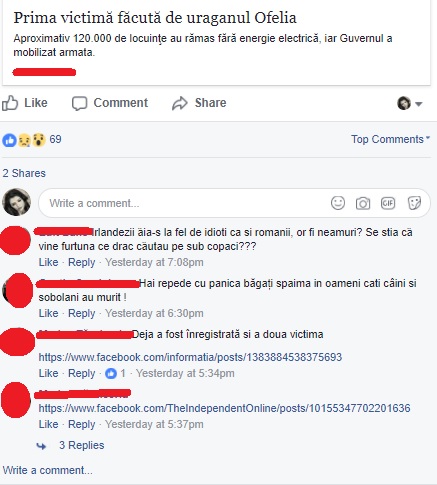
But what do people think about the Irish woman struck by a tree during the Ophelia hurricane? Well, let’s see. Irish people are as idiotic as Romanians, I wonder whether they are related. They knew the storm was coming, what the hell were they doing under the trees? Or: Now, you try to spread panic among people, telling them how many dogs and rats have died!
Translation of the Facebook post
The first victim of hurricane Ophelia
Approx. 120,000 homes have been left without electricity and the Government mobilized the army.
-Irish people are as idiotic as Romanians, I wonder whether they are related. They knew the storm was coming, what the hell were they doing under the trees
– Now, you try to spread panic among people, telling them how many dogs and rats have died!
– The second victim has already been recorded.
***
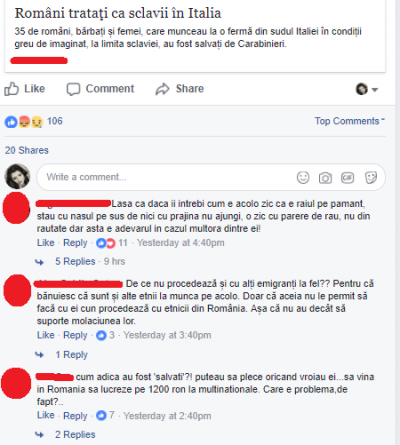
Let’s talk then about the Romanians saved by the Carabinieri from an Italian farm where they were held in slavery. Come on, if you ask them how they are doing there, they will tell you it’s Heaven on Earth, they are so high in the instep… I am sorry to say this, it’s not that I am mean or something, but that is the truth for many of them! And, after all, Why don’t they treat other immigrants in the same way?? Because I suppose people from other ethnicities work there too. But they won’t allow Italians to treat them as they treat Romanians. So they should accept this as a result of their inertness.
Translation of the Facebook post
35 Romanians, men and women, who were working on a farm in southern Italy under conditions that are difficult to imagine, similar to slavery, were saved by the Carabinieri.
– Come on, if you ask them how they are doing there, they will tell you it’s Heaven on Earth, they are so high in the instep… I am sorry to say this, it’s not that I am mean or something, but that is the truth for many of them!
– Why don’t they treat other immigrants in the same way?? Because I suppose people from other ethnicities work there too. But they won’t allow Italians to treat them as they treat Romanians. So they should accept this as a result of their inertness.
– What do you mean “were rescued”? They could have left whenever they wanted… and come back to Romania and work for 1200 RON in a multinational. What’s the problem, in the end?
***
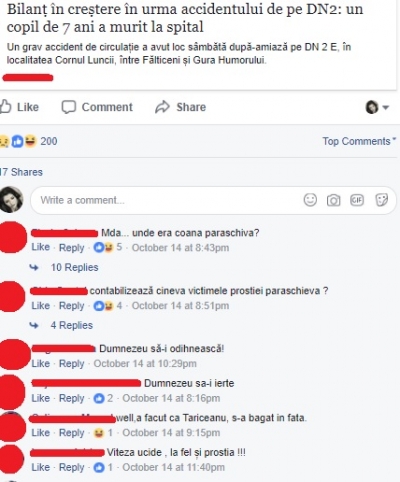
OK, we solved this one too, now let’s move forward. A 7 year old kid died in hospital following the car crash on DN2. Ahem, so where on Earth was Holy Paraschieva? Lol. And, still, does anyone count how many fall victims to the Paraschieva foolishness? Another question.
Translation of the Facebook post
A serious car crash took place on Saturday afternoon on DN2 E, in Cornul Luncii town, between Fălticeni and Gura Humorului.
– Ahem… so where on Earth was Holy Paraschieva?
– And, still, does anyone count how many fall victims to the Paraschieva foolishness?
– May they rest in peace.
– May God forgive them.
– Well, he did like Tăriceanu, he wanted a place in front
– Speed kills. So does stupidity.
***
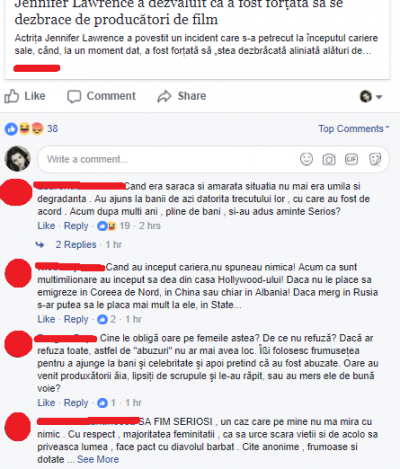
We get to the Weinstein scandal, right where we started from, in order to write this article. When she was poor and a no name, the situation was no longer humble and degrading. They made so much money today thanks to their past, which they agreed with. Now, many years later, full of money, they finally remembered. Really? And, of course, we must take into consideration the fact that LET’S BE SERIOUS, a case that no longer surprises me at all. No disrespect meant, but the vast majority of females, in order to climb the ladder of life and to look down on the world from the top of it, strike a deal with the male devil. The rant continues, I have limited space here, therefore I stop.
Translation of the Facebook post
The actress Jennifer Lawrence related an incident that took place at the beginning of her career when, at a certain moment, she was forced to “stand naked in line next to…”
– When she was poor and a no name, the situation was no longer humble and degrading. They made so much money today thanks to their past, which they agreed with. Now, many years later, full of money, they finally remembered. Really?
– When they started their career, they would not say anything! Now that they have become multi-millionaires, they started to disclose Hollywood secrets. If they don’t like it, they should emigrate to North Korea, China or even Albania! If they go to Russia, they might actually start appreciating the US more…
– Who forces those women? Why don’t they refuse? If all of them refused, such “abuses” would no longer take place. They use their beauty to get money and fame and then they pretend they have been abused. Is it that those unscrupulous producers came and kidnapped them, or actually they willingly accepted everything?
– LET’S BE SERIOUS, a case that no longer surprises me at all. No disrespect meant, but the vast majority of females, in order to climb the ladder of life and to look down on the world from the top of it, strike a deal with the male devil. How many anonymous, beautiful and intelligent…
***
I am curious to see the comments on the New Yorker webpage, where the news was published. I am scrolling down frantically and I can’t seem to find a single negative comment about the victims. OK, maybe it is a target audience issue. I access the Fox News webpage, I scroll down, I see no negative comments about the victims. And I am forced to accept the fact that our nation has a very serious problem. The forced confinement of a family is not something atrocious or, if it is, we don’t care. We care about the fact that they did something wrong and ended up in this situation. Suicide is no longer a macabre accident and it sparkles no trace of empathy in us. We know that the dead person is to blame. Even for natural disasters, someone is to blame – the fool who knew the hurricane was coming and, see, now she’s dead. It serves her right. Just like it serves them right, those stupid and inert Romanians who allowed to be turned into slaves. And that idiot kid died in the car crash on DN2 due to his own fault too. Due to his stupidity, to be more specific. Natural selection, what to do? And, finally, we get to talk about sexual abuse. From Weinstein to #metoo, there is a serious blame there. No, we must not fool ourselves, the predator is not to blame, but the victim. The victim is stupid, hypocritical, vicious and slutty. End of story.
Victim blaming is a phenomenon that has been studied by psychologists and that many persons talk about. Elsewhere. The conclusion they reached is that people blame victims based on the fair world hypothesis. We stubbornly continue to believe that we live in a fair world and, therefore, nothing bad can happen to a good person. Otherwise, this could happen to me too, because, me too, I am a fair person. But this cannot happen to me, therefore the victim surely is to blame. A perfectly valid theory that applies to Romanians. Victim blaming is a generalized phenomenon in our country, it is the natural reaction that most of us have when we hear about an abuse or a tragic situation. And it does not stem from the fair world hypothesis, for the simple reason that we’re still the ones who shout «bribe and corruption» as a leitmotif every time when we have the opportunity. And also when we shouldn’t do it.
All the bad things happening in this country happen because we live in an unfair society where “there’s a lot of corruption”. All the good things that happen to someone who is successful occur because he “was having friends” or “who knows in front of whom she kneeled”. The fair world does not exist, in our point of view, even a seven year old child knows that in Romania “things don’t go their way”. Then, where does our victim blaming instinct originate from?
There are two complementary explanations. The first one is what Hannah Arendt used to call the banality of Evil, and the second one is the need to separate yourself from your own vulnerability. I know, I have written about Hannah Arendt. I write about Ikes, therefore this article has no value, it’s only cheap leftist propaganda. I know, I used the word Ikes, this article has no value, it is only Christianopathic right winged propaganda. And this is the banality of Evil in a shape different from the one described by Hannah Arendt.
We tend to consider the Evil around us as commonplace, not because we got used to it, but because we reached that state where any discussion has two extremes – left and right. And then we no longer talk about rape, we talk about feminism and anti-feminism. We no longer talk about a terrorized, humiliated woman or man, for whom their own body becomes a terrible prison the moment they can no longer control it, they can no longer run and no one comes up to save you, like in the movies. We don’t talk about that person’s nightmares, about the feeling of guilt, the pain, the bruises and the nervous shudder when touched. No, we talk about retard leftists seeking attention. Or about Christianopathic right winged extremists. We take the discussion to the ideological level, and that person, with their bruises and internal pains, becomes a background noise. We argue fiercely, while that person wails and cries. So we turn down the volume, so that it no longer interferes with our ideological argument. We end up banalizing any Evil because it can be reduced to a concept and we clearly know that a sexually abused person is a leftist concept, whereas a child who died in a car crash on a way that leads to holy relics is a right winged concept. After that, we turn off the light and the laptop, satisfied that we have expressed our point of view. Boom.
The second explanation is related to our own vulnerability, to the manner in which we were raised and to our emotional matrix. You are five years old, you are in a swinger, you fall down and hurt yourself. Then you learn for the first time that you are stupid and that it is your fault that you have fallen down, from the parent who yells at you, while you are bleeding. You know it is your fault, therefore it is pointless to whimper. And the fact that that swing should have had some safety systems installed, to prevent this situation, is completely unimportant. Afterwards, after you get more and more bruises and scars, you find out these are “signs of good behavior”. But don’t worry. “It will all pass until you get married.”
When you are a grown up, married or single, you find out that you have lost your savings in a fraudulent financial scheme because you were a fool. No injustice happened to you, there is no aggressor out there, you are a fool and you deserve to pay for it.
Upset, you go home and, in the bus, your wallet gets stolen. You tell this to a friend and the first question is: “Well, why did you keep it in your back pocket?”.
The years pass and you get married. If your partner cheats on you, again you find out that you are a fool. If they beat you, it means you provoked them. If someone rapes you, it means you’ve been asking for it. This is how you realize that you are stupid, impotent, a bitch, a human error from all the points of view. And, because you really wish you could no longer be so, you must change this perception and you must show people that you could never end up in the victim’s position. Clearly, you cannot defend the victim. The more you hit her, the more you praise the aggressor, the more you dissociate yourself from vulnerability, that shameful secret that you hope no one ever finds out. At the end, you die, and people wish you to be forgiven by God. What do you mean, what for? For all the situations in which you were a fool, weak, a bitch and impotent.
This is how we end up in the situation where a woman is raped by seven men and the fellow villagers protect them all and attack instead the woman who ruined the lives of those boys. But we are very puzzled by the situations in which the victim is, apparently, innocent. Nils Christie, a Norwegian criminology professor, theorized the concept of “ideal victim”. An old woman who comes back from a visit to her children and is attacked on her way home is the ideal victim. She is old, therefore she did not provoke the attacker. She had been visiting her children, therefore she is not immoral. She was going home, therefore she was not going somewhere where it was none of her business to be. A young woman coming back from the club or going to her boyfriend’s house is no longer the ideal victim. Surely she was dressed in a provocative way. Surely she shouldn’t have gone to the club or to her boyfriend’s house. For sure, she had deserved it.
Well, we are very puzzled by the victim’s innocence. The more innocent the victim is, the more they become more threatening. But the good thing is that the Romanian is inventive and he has found a solution to this problem too. A seven year old child, symbol of innocence, can be blamed because he is a fool. Irrespective if he dies in a car crash, if he gets hit while playing or if he is lured away by a pedophile to enter a car. He is stupid. And stupidity is the biggest blame, because we are terribly afraid not to be stupid ourselves.
When I was about four years old and we were living in an apartment at the ground floor of a block of flats, we constantly had mice entering our home and my dad was constantly trying to hunt them down. I was not aware that those were pests that I should have been scared of, therefore for me they were “the little ones”. I was following my dad throughout the entire apartment and I was screaming not to kill the little ones and, therefore, he was trying to catch them alive and take them out. One day, a mouse took shelter between the window panes – in those times we did not have double-glazed windows. Father had chased it for hours, he was exasperated, tired, and I was screaming not to kill the little one. I don’t think he noticed that the mouse was between two window panes and tried to grab it; that moment, he fully hit the window, which got broken and my dad got cut. When I saw him bleeding, I ran to the kitchen, I took a piece of cloth and I started to bandage his hand, telling him that the wound will heal. Years later, my father said he was shocked by that gesture of pure compassion from my side.
And this is the natural reaction of a person who finds out about the pain experienced by another fellow being. It is the natural reaction, because it is the one we have when we are children, before we learn it is his fault that he has not seen the glass pane, like a fool. Before we learn that empathy makes us weak and that, the more jokes we make about the tragedy that someone experiences, the cooler we are. Attention! These images can affect you emotionally is the native warning during TV news programs. No chance now, and maybe there has never been a chance. And, yes, I know what a stupid article, are these really our problems right now? Yes, they are. Because this is where the spiral of silence starts, as well as the triumph of the aggressor in any circumstance. Even in that circumstance that cannot happen to you.