Am I allowed to grieve my self-chosen abortion?
The misoprostol begins to take effect on the ferry from the island to the harbour: my uterus contracts, the contractions ripple through my body. The pain is unbearable, unfamiliar. I feel an urge to throw myself into the sea – anything to make it stop. Instead, I curl up against the window, knees pulled to my chest, hood over my head. Only once all the other islanders have left the ferry do I stand up and, unsteady, make my way down the stairs and outside into the pale winter air.
Such is the situation: I’m living on an island off Sweden’s west coast as a Scandinavia correspondent when I discover I’m unexpectedly pregnant. I do want children and am initially thrilled. But my partner lives in Amsterdam, and neither of us has a real income to speak of. We are both writers without steady positions, chronically lacking any real business sense. He can’t leave the Netherlands, and I can’t just leave Sweden. My life is here, for now, and I have no idea how I could upend everything within the timespan of eight months – a baby, moving back, a place to live, a new job.
Alongside the nausea arrives a growing dread. It’s January on the west coast: a constant, biting wind, my island bare and deserted. Gradually, I become entangled in a web of misery – winter blues, hormones, and the fundamental uncertainty of having a child without a monthly salary, without parental leave, without family nearby. After weeks of deliberation, weighing it all up while vomiting incessantly I decide to have an abortion. I see no other option.
Early on 7 March, my partner and I travel to the hospital. The previous times I visited the abortion clinic – first for the ultrasound, which revealed I was already fourteen weeks pregnant and that you were in fact real, already had a face, and later for the first abortion pill that inhibits the pregnancy hormones – I took public transport from the harbour. But this time I insist my boyfriend call a taxi.
We’re assigned a room and a nurse. Still wearing my winter coat, I crawl into bed. The nurse, Åsa, gives me something for the nausea and, without questioning my pain, administers morphine. Then she strips off my down jacket and explains how the day will unfold. Every four hours, I’ll get a new dose of misoprostol, until the abortion is complete. Moving around helps – I’m definitely not doing that – and there’s a bedpan dangling in my toilet. Everything I expel is collected for inspection.
Through the window, I see a rectangle of blue sky. My partner sits silently in a chair in the corner of the room. An indeterminate amount of time later, I wake up with Åsa beside my bed. The pan contains no foetus, meaning I have to go through another round of misoprostol. Alongside the morphine, local anaesthesia is listed as an option. “Go ahead,” I say.
In the treatment room, Åsa inserts a needle into my cervix. As she administers a second injection, she says: “Your water broke.” And then: “Please look away.” My partner presses my face to his chest. Something leaves my body.
The emptiness creates room for tears. I press my nose into my partner’s sweater, I feel Åsa tear the paper from under my bottom, clean up the bloody mess, and make the whole scene seem presentable again before I’m wheeled out of the treatment room. Åsa remarks that this must be my first wheelchair ride, and I have a feeling that all the crocs-clad-staff can see what I’ve done – that they watched me enter pregnant and leave without a baby.
The physical relief is immense, and less than five minutes after the induced miscarriage, my body is screaming for food and fluids. Around five o’clock, after I’ve delivered the placenta and my fever has subsided, I’m discharged from Östra Sjukhuset. Bleeding heavily, yes, but as long as I don’t have to change my diaper-like pad more than three times an hour, it’s not considered alarming. I’ll bleed for weeks and will end up in the hospital twice, where it will eventually turn out that part of the placenta had remained.
I don’t believe in any God. Yet, I interpret this bleeding as a punishment that takes the form of reminding me, over the course of six weeks, of what’s no longer there. It’s the punishment for interrupting the natural course of events, the sublime process for which my body and life are ultimately intended: the making of a new body and new life.
Over a plate of fast-food in the city, on the way home, it seems to sink in for the first time: I was three months pregnant, and now I’m empty. Then: the child I saw on the ultrasound, with that tiny nose and those little fingers – we’ll never know her. Who would she have become? Who would I have become as her mother? Panic rushes to my head. We have to go get her, I think. We have to go back. I cry, but keep quiet, afraid of coming across as melodramatic. It’s just an abortion; everyone has an abortion. Besides, it was your own choice.
Was it my choice? Certainly, in the sense that no one forced me. And also not, in the sense that, had circumstances been different, I wouldn’t have chosen this outcome and would never have wanted to make this choice. The decision, if you will, was driven by hormones and physical suffering, by financial concerns and lack of suitable housing, by the absence of a community, as in: it takes a village. My friends in Sweden would have helped me where they could, but each of them has a busy life, children of their own, a full-time job. At times I prayed for a miscarriage, not to diminish the experience – which must be horrific – but so that I wouldn’t have to make the unimaginable decision myself. Who am I to choose right, I, who know nothing about life?
Let me be clear here: I wholeheartedly support the right to abortion. Opponents will at this point in the story proclaim: if that poor woman had been given a box of diapers, God’s child would have been saved. But this is not a plea against self-determination. I am grateful to live in a country where the right to abortion is enshrined. Where every pregnant person can, up to twenty-two weeks, access a free termination without explanation or external consent. I’m not arguing against abortion, rather against its limited portrayal. Search for abortion stories and you’ll essentially find two flavours: the loud anti-abortion voices under the self-appointed label of pro-lifers, as if those who do not identify as belonging to that group are, by definition, against life. You may Google that cheerful movement yourself.
The pro–choice camp is more diffuse, but essentially just as one-sided. Firstly, abortion is rarely discussed, even though according to statistics, my network is overflowing with women sharing the experience. In the Netherlands, a yearly 30,000 to 39,000 people with a uterus terminate a pregnancy. About one in three pregnancies ends in abortion. No one is obligated to speak out about such an intimate thing, but the silence is lonely: you have no frame of reference, no examples, no one to mirror yourself against.
Thus I turned to the arts, and there, contained in brilliant and less brilliant forms, I found a narrative almost as monotonous as that of the “against” camp: a woman falls pregnant unexpectedly, encounters resistance, gets the abortion she sought, is relieved, and begins a childless future. Examples include the magnificent The Event by Annie Ernaux; the film 4 Months, 3 Weeks & 2 Days by Cristian Mungiu; the recent April, a Georgian art-house film about an illegal abortion doctor in the misogynistic countryside. The lighter films Obvious Child by Gillian Robespierre and Never Rarely Sometimes Always by Eliza Hittman. The storyline depicted in these artistic expressions is as legitimate as it is important. And it’s not a story shared by all.
My experience is messier and doesn’t follow either of the two prescribed scripts. Can I be pro-choice and yet, after the initial relief from nausea, feel no relief? Even more controversial: am I allowed to grieve this self-chosen loss? Not if I’m to believe the canon. You can’t be pro-choice and have conflicting feelings. Still, I experience them all: not necessarily my ratio with its cerebral arguments, but the soft animal of my body, as the poet Mary Oliver so aptly puts it. My body feels regret, misses her unborn child, and avidly and pointlessly tries to turn back the clock. She sheds red tears.
This is not a loss, I admonish myself. You didn’t lose; you relinquished. But the more I insist on my self–determination, on my individual choice, the greater becomes the angst. How could I reject you? Who would you have been today? An open conversation about the complexity of the abortion experience would have spared me so much self-hatred, so much doubt, so much isolation. Not the anti–abortion propaganda enforcing eternal regret and suicidal tendencies, but stories spanning a spectrum of emotions, and of the lack of a right choice. For those who recognise themselves in this piece: you are not crazy, not alone, and it does get better, though I still carry her with me every day. The sense of loss doesn’t necessarily diminish, but life around it will cautiously grow larger.
Daphne Latour–Oldenhof, policy officer at Fiom, the Dutch foundation specialising in unwanted pregnancies, agrees that I’m “absolutely not the only one who feels this way.” Fiom tries to counterbalance the dominant narrative. “For those who haven’t experienced abortion, an uncomplicated story is more appealing to hear,” says Latour–Oldenhof. Moreover, in some pro–choice circles, there is also the belief that any caveat about abortion, any discomfort, fuels the anti–abortion movement. This, apparently, causes self–censorship. “Many women are relieved, yet we also see plenty of women with mixed feelings. Women who step out of the abortion clinic and are not just relieved but are also emotional. That causes confusion: does grief indicate a wrong decision?”
There is apparently an established term for my belief that I have no right to grieve: unacknowledged grief. Latour–Oldenhof: “The choice for abortion is rarely a 100% yes, and almost always a matter of deliberation. Many women who choose the procedure have nevertheless considered carrying the pregnancy to term. Besides the loss of the pregnancy, they often lose something else: their former self–image, sometimes their relationship. These losses can cause grief.”
Let me take a moment here to take the wind out of the anti–abortionists’ sails. Yes, mixed feelings. No, depression and eternal regret. According to the scientific journal Social Science and Medicine, the strong post-abortion emotions gradually subside, and five years after the fact, 99 percent of women support their decision. In other words: the initial ambivalence, fuelled by the process of physically recovering from pregnancy, fades in almost all cases. Post-abortion grief doesn’t indicate a wrong decision. It is simply a choice you would rather not have had to make.
In early September the due date passes and I flee to the tundra. Far away, I long to be, from where I was aimlessly pregnant. A long winter later, it’s March, and I reflect on the day you came and went. I have nothing tangible to remember you by. No ultrasound, no footprint, no flowerpot grave. I feel the need to speak to someone who knows you existed. Who knows that, for a brief moment, I was somebody’s mother.
I contact the hospital and a day later, I receive a call from the nurse, Åsa. The call comes unexpectedly, and I have to compose myself. Does she remember anything? “Your partner spoke English,” she says. She clearly has my medical records in front of her. “You came in at eight o’clock with fever, pain, and contractions. I administered morphine, and in the afternoon, when I administered an anaesthetic, the foetus arrived. Everything went as it was supposed to.”
“Can you remember what I was like?” I ask. “It’s been over a year ago,” she replies. It’s sobering: a traumatic event for me was, for her, just another day on the job. A successful medical abortion at fourteen weeks and two days, the placenta delivered, the fever subsided, the patient was given pancakes and discharged. The normalisation of the absurd, of walking into the ward three months pregnant and leaving without pregnancy or baby.
“Do you feel any moral qualms?” I’ve seen the photos from the anti–abortion movement, the dissected foetuses. Once it concerned my own womb, when something had taken up residence in my body, it suddenly felt wrong – infanticide, as it’s still described in Dutch criminal law. “Your body is trying to protect it,” she explains. “It’s not your reason speaking.” The animal in me wanted to keep that new life at all costs. But Åsa doesn’t hesitate for an instance . “It’s an important right. Nothing more, nothing less.”
Then I ask if that ultrasound still exists, and she says no, unfortunately. A silence. “Where is she now?” My voice breaks. “We cremate the foetuses and scatter them at the Kviberg cemetery, at the minneslund, the memorial plot.” That moves me: a normalised right and a normalised procedure, yet an acknowledgement that this is not the same as having a tooth pulled. That if not the foetus itself, then the person who carried that foetus deserves dignified closure. “There’s a place to lay flowers,” she says. “It’s a beautiful place.”
I thank her – for that day, for her work, for taking the time to call me. I’ll go visit that plot at the cemetery in the north-east part of town. I’ll come see you there, little girl. I think it’s for the best. I really hope it is.
Further Credits:
- Teri van der Heijden – Editor
- Anna Vossers – Editor
- Rosa Snijders – Illustrator
The major crime of USSR was ‘the Soviet occupation of Central and Eastern Europe’
Fifty years ago, the signing of the Helsinki Accords, recognised the inviolability of the borders established after the Second World War.
As we know, the Helsinki order lasted approximately fifteen years. The Soviet Union ceased to exist, and the countries of Eastern and Central Europe, which had been given over to the USSR under the Helsinki Accords, found their way to freedom and national statehood.
What looked to be the end of history has now turned into the return of history in its most brutal form, with Russia’s military aggression on Ukraine, occupation and claims to regional domination.
The future is more unclear than at any time in the last three decades, and the Doomsday Clock is closer to midnight than it has ever been.
Being Russian and digging into Russia‘s past almost my whole life, attempting to expose the roots of the evil my country brought into the world, I think it’s only appropriate for me to speak up, from that perspective, to try to understand what was fatally overlooked.
Both of my maternal grandmother’s husbands were Soviet officers. My biological grandfather, Grigoriy, was a captain in the Red Army, an infantry commander, who was severely wounded three times. The second grandfather, whom I only found out about as an adult, was a vice-colonel in the Soviet secret police, and the head of several GULAG camps.
At first, in my imagination, I pitted them against each other: soldier and executioner, honest man and murderer.
One fought the Nazis, the other oppressed innocents.
One was not awarded anything, only the Victory Medal, which was given to everyone who served in the Red Army. The other received the Order of Lenin, the Order of the Red Banner, the Order of the Red Star, the highest awards of the Soviet Union.
I felt this to be a grave injustice, a contradiction. The morality seemed to be turned upside down.
I no longer feel that way.
In fact, they were both parts of the same machine of violence. The soldier cleared the way, and conquered the land. The state security officer Sovietised it.
So, they were a single entity.
We often hear that Russia’s inability or unwillingness to deal with the crimes of its own past, to take responsibility and restore justice, has led to the restoration of tyranny and the military aggression that we see now.
Such a narrative usually focuses only on internal Soviet deeds: forced collectivisation, the Great Terror of the 1930s, the GULAG system, and so on. Some of these things were nominally recognised as crimes, but no attempt was made to hold the perpetrators to account. Russia’s perestroika democrats were generally opposed to any substantial lustration [the public scrutiny of officials and political political figures regarding their potential collaboration with the communist secret police] or other measures of transitional justice.
But I would dare say that the most politically sensitive Soviet crime is and was nearly always left out of the discussion, and Russia’s failure to address this particular crime is far more dangerous and one that affects the fate of many nations.
That crime is the Soviet occupation of Central and Eastern Europe, which lasted for decades, resulted in many dead and arrested, the destruction of social and cultural life, and the denial of freedom. The injustice was immense.
Internal Soviet crimes, which went unpunished, were at least legally acknowledged and their victims commemorated. External aggression and occupation were not. Аnd even Russian dissidents and liberals never risked raising the issue.
This is why, in relation to Central and Eastern Europe, there are two concepts of memory and history that normally cannot coexist, that clash with and contradict each other. They are totally opposed; they cannot be reconciled by any diplomacy.
That is Soviet liberation versus Soviet occupation.
Credit: Sergei Lebedev
It was only when Soviet troops finally withdrew from Eastern and Central Europe 45 years after the end of WWII that the true liberation came, when the Soviet Union collapsed and occupied nations found their way to independence. But it was easier to restore or establish statehood and independence than to achieve sovereignty of historical memory.
The progressive image of the late Soviet Union, the high hopes of the moment, shielded Moscow from serious criticisms and accusations related to the occupation of Eastern Europe. This restraint was the result of a surfeit of trust or, maybe, just cautionary pragmatism – the desire not to irritate Moscow and undermine its good will, not to burden the losers of the Сold War too much.
But the most important protection Moscow enjoyed was, of course, based on the status of being the victor over Nazism.
Russia, as the successor state to the USSR, has built its international political profile on the Soviet “liberation” myth, which provides moral capital and prescribes to the former occupied territories a debt of gratitude for their “liberation” from Nazism.
This narrative has depicted Russia as the main victim of the German invasion and it has been reinforced by the international dignitaries who have attended the anniversary celebrations in Moscow throughout the years. Russia’s claim has also been supported by the Soviet-built memorial infrastructure left in Europe, which marked its territory as the domain of a conqueror.
There is also a trick here, an intellectual trick which serves to further strengthen the “liberation” version of history. We can call it “the suffering of the oppressors”, or “the victimhood of the perpetrators”. It is a powerful emphasis of the enormous military and civilian losses suffered by the Soviets. The sacrifice was on such a scale that the scale itself is presented as a justification of the cause.
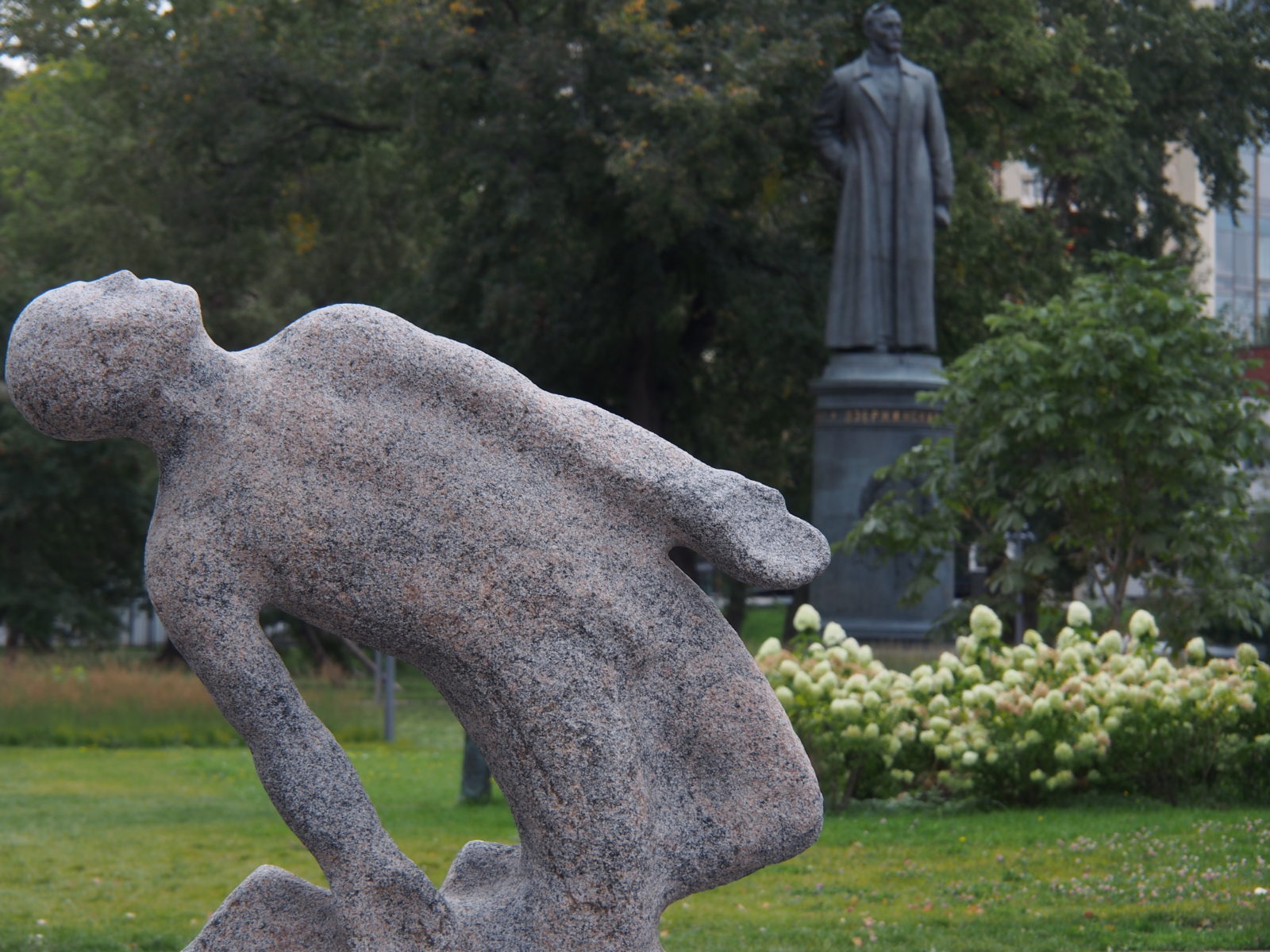
Yes, the losses were real. And yet it is truly tragic that these losses helped to subjugate nations longing for freedom, to replace one dictatorship with another. The Soviet soldier, whose statues still mark the landscape of Europe from Berlin to Sofia, was not a liberator. He was an enslaver. And no amount of blood shed by Soviets to defeat the Nazis can excuse the Soviets’ own role as occupiers.
It is not accidental that the Soviets were reluctant to recognise even the very existence of the Molotov-Ribbentrop pact. In modern Russia, to make any equivalence between the roles of the USSR and the Nazis is criminalised.
In 1939 and 1940, the Soviet Union occupied Lithuania, Latvia and Estonia, and parts of Poland, Finland and Romania. For 22 months it was a faithful ally of Nazi Germany. This first wave of Soviet occupations can in no way be disguised as a “struggle against Nazism” and it reveals the real intention of the Soviets. What then followed, was, in fact, a geographically extended re-occupation. This was a separate aim of the war, not necessarily connected to the one to defeat the Nazis.
Unfortunately, as far as I can see, the understanding of the Soviet occupation as a crime has not become an essential part of modern European history. It is geographically limited to the East, blurred, insufficiently represented, a part of national histories but it does not form a powerful international narrative shared across the continent. Yet, this understanding has a profound bearing on modern European life and is key to European security. Only when you fully grasp the cruelty and consequences of the Soviet occupation, can you comprehend the concerns of Russia’s closest neighbours, their historically grounded fears and their need for safety.
I would even risk saying that the very unity of both the EU and NATO depends on a common understanding of this history, which ultimately includes a readiness to defend the eastern borders if necessary. Without such consensus it is suddenly possible to depict NATO’s eastward enlargement as an unnecessary and provocative move, while it was, in fact, a defensive strategy.
When Russia invaded Chechnya in 1994, using military force to crush Chechnya’s claim to independence, the only thing protecting former Soviet republics like Lithuania or Estonia was the thin line of their fresh international recognition. Their desire to join NATO was utterly justifiable and understandable, given the record of violence coming from Moscow. And if Russia then complains that its interests are somehow being disregarded, it can only blame itself for being such an intimidating neighbour.
Eastern regions of Ukraine are currently occupied by Russian troops. For the first time since 1989, large areas of the European continent, home to millions of people, are under the control of an invading state. But it seems that too many Europeans have already forgotten what occupation means. When they talk about peace, about the need to negotiate, about giving up territories, they avoid the question of what fate awaits the people who live there.
Russia does not only want territories. The population itself is an extremely valuable prize for Putin’s marauding state.
The current occupation zone is a black hole. The recent case of Ukrainian journalist Victoria Roshchyna, who tried to report on the grim reality of the occupied territories, and was tortured to death by Russian state security units, is evidence of this. But what we do know is enough to draw a direct comparison with the brutality of the early Soviet occupation of Eastern Europe.
Russian citizenship is being forcibly imposed. In fact, this is a mass expulsion programme, because those who do not agree will be treated as foreigners and forced to leave. It is another grave violation of international law. It signals that Russia is pursuing the same path as the USSR did, for example, in relation to the Baltic states, aiming to russify the conquered region, rearrange its national composition and make it a part of its state.
Property is being stolen and redistributed. “Settlers” are brought to form the backbone of the occupation regime. The politics of memory is reversed, monuments marking Soviet crimes disappear, streets are given back their Soviet names. All this is part of an attack on national identity, an attempt to erase it.
The Russian state security services use so-called filtration techniques extensively, and anyone deemed politically unreliable can be imprisoned. Severe torture and sexualised violence are widespread. Ukrainian POWs released from captivity report the same torture, abuse and deliberate malnutrition aimed at breaking them physically and mentally.
Anyone who knows the history behind the Iron Curtain immediately recognises the pattern. All this was a grim reality for Poland and Lithuania, East Germany and Romania, and others. Mass deportations, the brutal rule of the secret police, deprivation of property and civil rights… But it never became a real stigma for the USSR and later Russia. It never became something of which a nation is ashamed, something that demands justice and punishment, acknowledgement and atonement.
Credit: Sergei Lebedev
And this is where we are now: the occupier is back.
And the occupier wages the war exactly like the Soviets did.
Here I have another story to share. It is as important as an exemplary case as it is a personal confession and admission of responsibility. My step-grandfather was a soldier in the Soviet army that invaded Finland in 1939. My mother witnessed him talking about his deeds.
She had memorised one particular story of his, told in a low, dispassionate voice. He talked about the granite hill on which there was a small concrete pillbox, strategically very well placed. Deep swamps to the left and right, unfrozen despite the harsh cold, gave Soviets no place for manoeuvre. A Finnish machine gun crew inside the pillbox repelled several infantry attacks; the Soviets retreated, leaving dead and wounded on the icy, slippery slope. Their commander requested support. After a while a Soviet tank appeared.
It tried to drive up the hill for a direct shot. But its caterpillars slipped on the icy granite. It was stuck halfway up, lurching and moving chaotically. A Soviet infantry sergeant, former lumberjack, ordered his sprawled men to find some timber and put it under the caterpillars. But the machine gun was firing at every move, and there was nothing on the slope but the tank and the soldiers, alive and dead. Those killed in yesterday’s attacks were already frozen and hard as timber.
So, the sergeant ordered to use them as timber. To collect those fallen and tuck them under the caterpillars on both sides of the tank, so it could finally move forward.
After a short moment of hesitation, the soldiers obeyed. The tank went uphill, grinding the bodies of the dead into mush, and delivered a deadly shot.
After retelling this part, my mother added:
“He came back from that war. Was captured by Germans in late June 1941, his unit was taken by surprise. Survived the POW camp. Was liberated, then accused of something anti-Soviet and deported to the uranium mines in Transbaikalia. Returned home in the 50s. Imagine what he had seen during these years. But he insisted: the worst thing he remembers is the sound, very specific sound of the comrades’ frozen bodies cracking under the weight of the tank. He was obsessed with it. He heard it everywhere.”
It may seem as if I’m trying to humanise the Soviet aggressors, to present “their side”. No, I am not.
Instead I would like to draw your attention to one specific trait of the Russian or Soviet empire: the extremely low value of human life. This is not just an internal problem. In international relations, a low value of life is an indispensable currency of aggression, a natural resource of sorts, the raw material of war. For an aggressor it can “buy” what nothing else can buy: time.
For decades, Operation Desert Storm, which took place in 1991, epitomised the revolution in modern warfare. Western armies have invested heavily in keeping their personnel out of harm’s way.
Putin’s army, however, is the army of yesterday. And exactly this is its gruesome advantage. It can sustain losses that would be absolutely unacceptable for any Western country. But it is also technically advanced enough to counter Western military technologies.
Western science was first to “dronise” warfare, to minimise the involvement of troops on the ground and use machines for new tasks.
Putin’s army, while also using real drones, “dronises” the human beings as well. It has turned soldiers into dispensable, single-use units.
Artists, writers and filmmakers have imagined future conflicts as a clash of robots, of soulless machines. But the real war of the future instead came as the aggression of humans turned cannon fodder, exactly in the way Soviets waged war in the twentieth century.
With Russia’s full-scale invasion we have entered the era of global moral climate change.
Just as one earthquake can have repercussions all over the world, or a single volcano eruption can pollute the skies above several continents, Russia’s aggression changes the political climate worldwide.
This is another very real, but not yet fully recognised, outcome of the war. Perhaps the most wide-ranging of all the outcomes. With thousands of troops sent into battle and killed by Ukrainians defending themselves, Putin doesn’t just get some pieces of Ukrainian territory – he erodes the political landscape worldwide, upsets alliances, exhausts the patience of voters in NATO countries, and drags us down into the hell of moral relativism. I am not sure it was planned this way, because evidently Putin was hoping for Ukraine’s quick surrender. But he clearly discovered this modus operandi during the war, empirically, to maintain the balance between the thrust of aggression and the burden war puts onto Russian society.
What can be done about it?
The old concept of politics of memory, related to the events of the twentieth century and based on the minimisation of Soviet-Russian responsibility for the occupation of a large part of Europe, has already expired; at the latest it did so in 2014, after the illegal annexation of Crimea and the invasion in Donbas.
Western and Southwestern Europe, which never faced the reality of Soviet occupation, must now listen to the voice of those who experienced it first-hand. To quote Václav Havel’s speech at the NATO Summit in Prague in November 2002.
“If the past centuries witnessed various great powers dividing the small, or smaller, European countries among themselves without asking the latter’s opinion, whether this happened in direct forms such as the Ribbentrop-Molotov pact or indirectly through arrangements such as those at Yalta, the present enlargement of NATO carries an unequivocal message that the era of such divisions is over, once and for all. Europe is no longer, and must never again be, divided over the heads of its people and against their will into any spheres of interest or influence.”
It doesn’t seem that this message was unequivocal, after all.
Russia is waging its war against Ukraine with the Soviet weapons built to intimidate Europe – Soviet tanks, Soviet artillery and rockets, Soviet bombers and jets. The weapons have a long life span, like sharks.
With this war comes an offer to make a deal with the devil – to sacrifice others to save yourself. As a KGB operative, trained to break people, Putin knows that the road to complete surrender and moral failure begins with a small concession, a small betrayal of one’s principles.
The European Union was not built for war. It is easy for an aggressor to take advantage of the EU’s internal imbalances and contradictions, of the fact that the bloody history of long Russian occupations and wars is not fully integrated into a common historical narrative.
It is hard to say whether it will be possible to hold Russia accountable for its crimes against Ukraine any time soon. But to build a future at all, a real future, it will be paramount to develop a cultural and historical concept countering Russia’s attempt to divide and rule.
In doing so, August 23 offers itself as a starting point. At the proposal of Václav Havel, Joachim Gauck and other prominent former dissidents, August 23, the day when the Molotov-Ribbentrop Pact was signed, has been established as the EU’s Day of Remembrance for the Victims of Stalinism and Nazism, or Black Ribbon Day. The significance of this day could and should be drastically increased and its meaning substantially deepened to include a broader perspective on Russian imperialism, which was part of Soviet communist policy but has outlived it.
We need to make this day the focus of a long-term and coordinated politics of remembrance, to strengthen existing institutions such as ENRS – the European Network of Remembrance and Solidarity, which includes mostly Eastern European countries. We must also build new ones, cross-continentally, that are able to carry the message to the South and the West, countering both left-wing and right-wing narratives that continue to make excuses for Russia.
Furthermore, the whole attitude of the EU towards the Russian opposition should be defined by the latter’s acceptance of 23 August as a day of mourning and atonement, by its willingness to break radically with the Soviet myth of European liberation and to accept the grievances and recriminations of those Eastern European nations which are now hosting exiled Russians.
Putin does not just want to subdue and erase Ukraine as a political entity. He wants the collapse of the EU as a revenge for the collapse of the USSR. I do believe this is his very personal obsession.
Tit for tat. Union for Union.
The USSR collapsed because its artificial unity was enforced by violence and oppression. The EU’s endurance depends on the persistence of its voluntary unity. But unity is not a given. It is a product of mutual knowledge and compassion, of many cultural bridges connecting people.
It is time to start building.
This is an edited version of the closing speech Sergey Lebedev held at the Helsinki Debate on Europe, on 17 May 2025.
Credits: Сarl Henrik Fredriksson, editor
Funding partners: Debates on Europe, S.Fischer Foundation