

Enslaved Land
For the complete project – in Spanish – click here
We would recommend everyone to take a look at the online project and its beautiful infographics. Below you can read the uncovering investigation on how the sugar industry in Guatemala has created a cartel linked to offshore companies to avoid taxes.
Guatemala’s Sugar Cartel
By Gabriel Labrador, Ximena Villagrán, Raúl Sánchez and Jimmy Alvarado
On July 18th 2012, a lawyer in Panama and an assistant in Guatemala City arranged the creation of three opaque entities for one of the sugar emporiums of the country.
Fernando Díaz, of the Panamanian company Mossack Fonseca, wrote Mercedes Irving-Bell, assistant of María Eugenia Campollo, a Guatemalan businesswoman and owner of the sugar refinery El Ingenio Madre Tierra, to close the deal: “According to what we talked about, we would be incorporating the companies Roydon Trading Company, Wellon Sugar Commercial, American Trade Incorporated. If you confirm, we will proceed accordingly,” wrote Díaz. The next day, Irving-Bell gave the authorization: “Thank you, Fernando, the names seem good to me.”
That week, Mossack Fonseca registered each company in a different tax haven. Roydon Trading Company, in Panama; Wellon Sugar Commercial, in the British Virgin Islands; American Trade Incorporated, in Bahamas. The business of Wellon Sugar Commercial “is the sugar trade,” wrote another executive of the company in a different email.
As it would happen with the 214,000 entities created in tax havens with the help of Mossack Fonseca, internationally investigated for its operations, the companies related to the Campollo Group would be managed by figureheads, of Panamanian nationality. They would represent the interests of the Campollo siblings: María Eugenia, Ramón, Ricardo and Rosa María.
Between 2007 and 20015, the Campollo Group, owner of El Ingenio Madre Tierra, created 121 offshore companies with an authorized capital of 282 millions of dollars in total. 47 entities were related to the sugar trade, with a capital that adds up to 113 millions. Madre Tierra is behind the 7,2 percent of the total production of milled sugar cane in Guatemala since 1983. It is the seventh biggest producer, of the twelve there are in Guatemala.
The creation of offshore companies in tax havens is legal, even though the authorities suspect that the practice is intended to evade the tax authority of the countries where the entrepreneurial activity of the company owners is concentrated. In the case of sugar, the fact that the business gets out of Guatemala’s borders contradicts the idea of national well-being, which the industry attempts to project with its logo and slogan. “Development for everyone,” say the sugar refineries, who don’t have problems in using offshore companies.
Besides the Campollos’ offshore entities, this investigation found links between nine other Guatemalan refineries and entities in tax havens. The managers, owners and companies who participate as the refineries’ shareholders, appear as executives in offshore companies. This activity has drawn the attention of the authorities, but they claim to be incapable of overseeing it for being outside Guatemala’s borders.
The sugar refineries are a powerful group, traditionally related with the political establishment, in a country with enormous difficulties to collect the taxes of its 2,100 major taxpayers. Guatemala is the country with the lowest tax revenue in Latin America. The authorities recognize, that to guarantee that the “special taxpayers” like the sugar industry pay what they should is, for the moment, impossible.
In Guatemala, there are experts, former directors of the Tax Administration Superintendence (SAT), businessmen, refineries’ employees and international organizations like the Economic Commission for Latin America and the Caribbean (Cepal), part of the ONU, who argue that the sugar industry is clearly a cartel that takes advantage of state weakness, a “collusive oligopoly,” since many companies behave as one to maintain an advantageous position in the market.
Since 1983, seven families have been behind the 88 percent of the milled sugar cane in Guatemala: the Herrera (refineries Pantaleón and Concepción), the Leal (Magdalena), the Botrán (Santa Ana), the García (La Union), the Weissenberg Campollo (El Pilar), the Campollo (Madre Tierra), and the González Bauer-Hertzsch family (Palo Gordo). All of these families have been related with entities in Panama.
The fact that ten of the twelve Guatemalan refineries are directly related with offshore companies fits perfectly with the profile of an industry that has also financed the campaigns of Presidents and deputies, that has placed functionaries in key government positions, blocked laws like the regulation of water use, or promoted other ones, like one to reduce tax payment on exported sugar and other agricultural products.
And in all cases, the Government responds declaring itself incapable of overseeing the industry as it should.
During two months, we tried to arrange interviews with the twelve sugar companies so they could elaborate on their relations with the political establishment, on their labor and environmental conflicts, and on how their managers make use of the companies in tax havens. Except for Madre Tierra, the rest of the refineries remained silent.
Madre Tierra’s response was unequivocal. “We don’t have any interest in going through such an interview, given that the character of the company is PRIVATE, and, as such, its trade and business operations are under its own CONFIDENTIALITY AND JURISDICTION,” wrote the company’s lawyer, Marvin Sandoval, in an email.
The offshore companies of Moncho, Richard, Rosita and Magena
Guatemala is the fourth biggest sugar exporter in the world, after Brazil, Thailand, and India. Without fixed markets, its exports end up with the highest bidder. In 2014, South Korea, the United States, and Tunisia were the principal importer countries.
In Guatemala’s southern coast, bordering with the Pacific Ocean, there are 268,000 hectares of sugar cane fields, according to the agricultural census in 2014. Twelve refineries process all the cane of the country and turn it to sugar, molasses, ethanol, rum, or even electricity.
The refinery Madre Tierra, property of the Campollo family, spreads over 17,000 hectares, the equivalent of some 42,000 soccer fields.
Madre Tierra began growing sugar cane in 1963, and, since the 1982-1983 harvest, it has milled 35 million tons of cane, according to the Guatemalan Center of Sugar Investigation and Training (Cengicaña). The Campollo family also have refineries in Costa Rica and in the Dominican Republic, and investments in oil, African palm, ethanol, electricity generation, and real estate.
MT Holdings Capital INC., an entity in British Virgin Islands, exercises the ownership over the refinery through a network of companies, which can be better explained as resembling a matryoshka, the Russian doll that keeps another doll in its interior, which in turn keeps another doll in its interior, and so on. Madre Tierra is owned by Central Agro Industrial Guatemalteca S.A. (Caigsa). This one, in turn, is owned by two Panamanian companies: Gran Flora Internacional S.A. and Perlino Internacional S.A. And both of them are owned by MT Holding Capital INC.
The Campollo siblings are shareholders in this holding company, according to Mossack Fonseca’s emails. One document shows that on February 13th 2009, the holding company handed 12,500 shares to each of the siblings, “Moncho”, “Richard”, “Rosita” and “Magena”, as they are called, according to the emails, by the family’s lawyer, José Buitrón. “Magena” is María Eugenia Campollo, the businesswoman whose assistant communicated with Mossack Fonseca’s lawyer to agree on the creation of the three offshore companies.
MT Holdings Capital INC is the Campollo family’s second biggest offshore company. It has an authorized capital of 55 million dollars, according to the Panama Papers, a series of documents from the Panamanian law firm Mossack Fonseca, leaked to the German newspaper Süddeutsche Zeitung, and analyzed by more than a hundred media outlets around the world, including El Faro, as part of a year-long investigation coordinated by the International Consortium of Investigative Journalism (ICIJ).
The entities in Panama, a tax haven, don’t have an owner and can be the owners of any asset, concealing its final beneficiaries in a great measure. For instance, the regulation of the Fundación Niño Jesus, an entity created in 2008, has María Eugenia Campollo as the beneficiary of all its assets, and her offspring as substitutes.
Another use that the Campollo family makes of its offshore companies is the loan underwriting. Gala Assets Corporation, a Panamanian entity owned by the Campollo family and dedicated to power generation and sugar trade, was transacting a loan worth 75 million dollars with the Guatemalan banc GyT Continental at the beginning of 2015. An email, from February 5th 2015, shows that Central Agro Industrial Guatemalteca, the company owned by the refinery Madre Tierra, and its offshore owners would provide the 73 percent of the loan with their own capital.
Offshore Sugar
Just like the Campollo and its network of 121 entities in tax havens, the representatives or managers of other nine Guatemalan refineries appear in association with 31 companies registered in Panama, as shown by eldiario.es and El Faro.
Of all the sugar refineries in Guatemala, the only ones of which this investigation hasn’t found any links with tax havens are the small refineries La Sonrisa and Santa Teresa, which since 1983 have only contributed to the 0,5 percent of the cane milling, some 2,2 million tons.
On the opposite end, two corporations (the Pantaleón-Concepción group and Ingenio Magdalena) that have dominated approximately the 47 percent of the Guatemalan cane production during the last five years, are the ones with the most ties with tax havens, according to this investigation. The Pantaleón is an enormous group, formed one hundred and forty-seven years ago, which in 1980 bought the refinery Concepción; and Magdalena, before devoting itself to sugar in 1983, used to produce honey for rum. The names of the related offshore companies are similar to the entities in Guatemala: Ingenio Magdalena S.A., The Pantaleon Group INC, Pantaleon Land Holding…
The owners of Pantaleón are related to eight companies in Panama and the group’s head office is registered in the British Virgin Islands, as shown in a document of the ‘Comisión para la Defense de la Competencia’, in Honduras. Pantaleón has been the biggest cane miller in Guatemala for the last three decades: 91,3 million tons, the 26 percent of the total cane milling. Between 2008 and 2010, the refinery received two loans worth 130 million dollars from the International Finance Corporation (IFC), the World Bank’s private lending sector arm, through its head office in the Virgin Islands, Pantaleon Sugar Holdings Company Limited. In other words, the World Bank granted a loan to an entity in a tax haven.
Some of these offshore companies are used to manage the refineries in Guatemala. For instance, the Trinidad refinery, which merged with the San Diego company in 2010, is leased by the entity Servicios Agropecuarios San Diego, whose owner, by 50 percent, is another one in Panama, called Santa Lucia International Group INC. No decisions, like the suscription of loans, contracts, or the authorization to compete for tenders, can be executed without the offshore company’s approval.
Of all the investigated refineries, only details could be gathered about the entities created by the Campollo family, who was affected by the leaked emails of Mossack Fonseca. The other families created their offshore entities with different law firms.
The monster that flattens everything
If one would put together all the cane fields of Guatemala, that great mass of land would be three times the size of New York City. It is a green monster of some 2,687 square kilometers, the 10 percent of Guatemala’s cultivated area, which is also the cause of social injustice and labor violations.
The sugar farming in Guatemala is sparsely industrialized. The cane plants, which can reach a hight of five meters and consume high amounts of water, grow in the farms for approximately six months. The harvest begins with the burning of the fields to weaken the stem of the cane, which makes the cutting easier and keeps animals away.
After the burning, thousands of workers enter the fields and cut the plants with machetes, getting in constant contact with the soot produced by the fire. They carry the cane to the collection point during long working days, sometimes without access to water sources or health services. The cane is then transported to the refineries in “cages” on board of large trucks. It is in the refineries where the plant is processed, and the sugar and its derivates are produced.
Two government offices of the United States describe Guatemala as a “low-cost” sugar producer, which is explained by the “failure” of the refineries to comply with the labor laws, according to the commercial treaties agency of the White House. Throughout the industry, the labor unions have disappeared, except for one in the Palo Gordo refinery, the eighth largest producer of milled cane, according to data collected in 2016.
Environmental denunciations have also appeared. Between 2012 and 2016, the Environment Ministry received 38 denunciations against nine refineries, the majority of them linked to the deviation of rivers to irrigate the fields.
The environmental outrage is proportionate to the economic revenues generated by the sugar production, thinks Yuri Melini, the director of the ‘Centro de Acción Legal, Ambiental y Social’ (Calas). “Who wouldn’t be competitive, when the state is giving them indirect subsidies as it doesn’t charge for the water they use? Who wouldn’t have that profitability, when they haven’t allowed us to have a general water law?”, asks Melini, a former Presidential candidate for a left-wing movement.
The Madre Vieja river, one of the biggest ones in Guatemala’s southern coast, is frequently deviated to water the cane plantations.
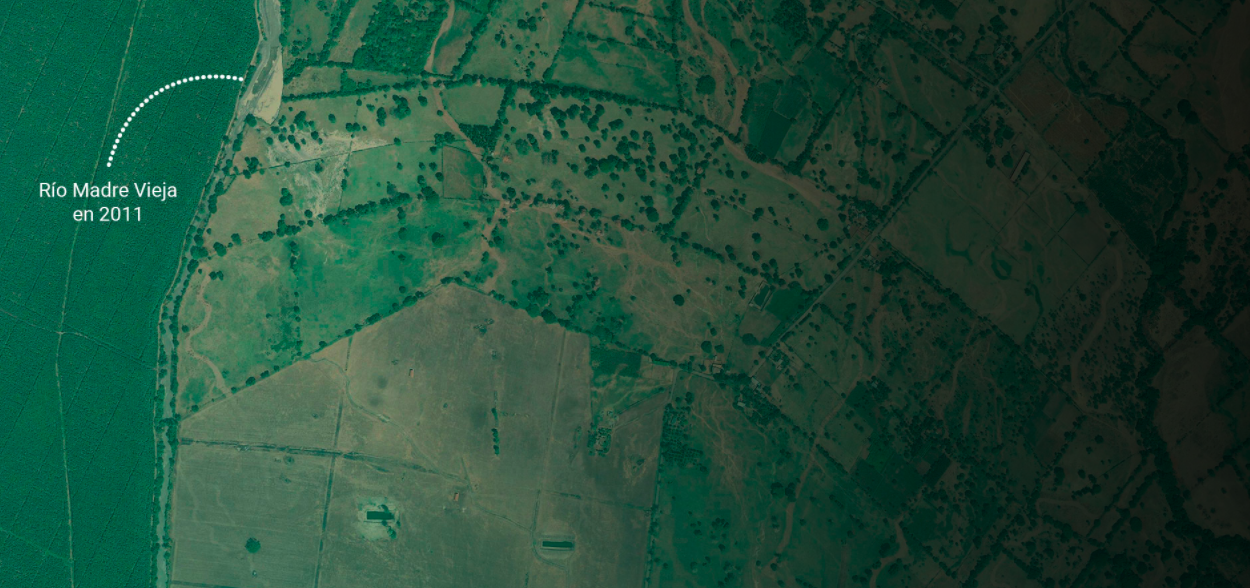
This was the river, at its mouth, in 2011.
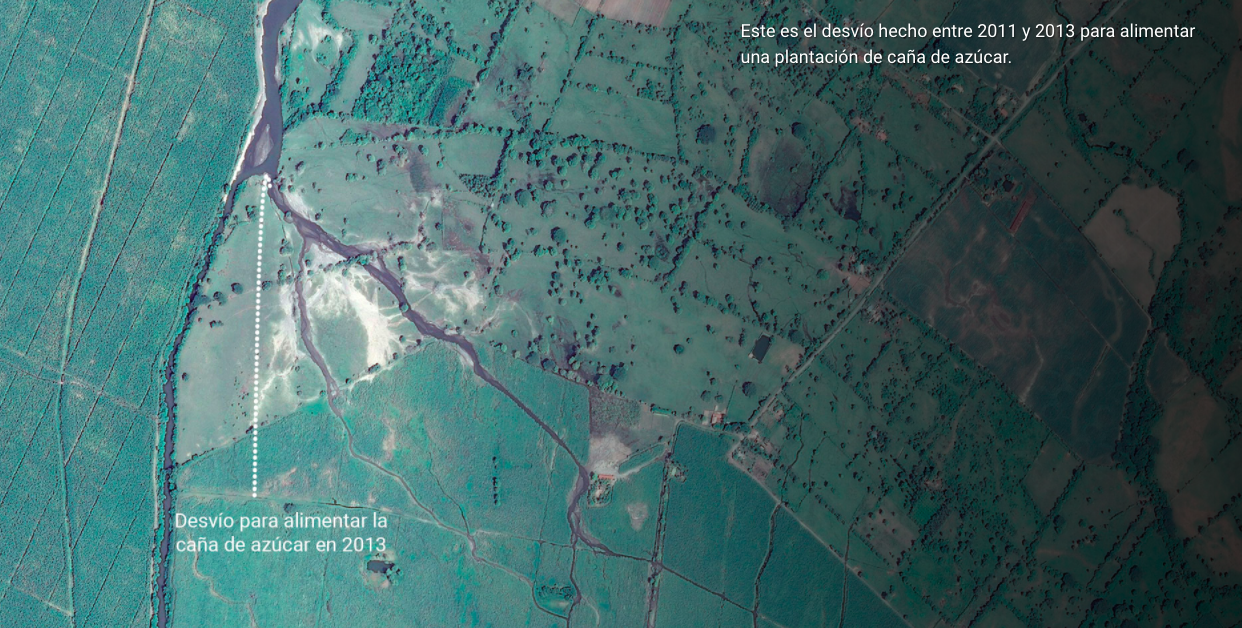
This is the deviation made between 2011 and 2013 to water a sugar cane plantation.
The Guatemalan sugar industry represents the 3 percent of the total economy, around 1,900 million dollars per year, according to the sugar producers, which, for a developing country, is not to be overlooked. Guatemala’s sugar economy is of the same size as Belize’s total GDP, its neighbor. There are twenty-five countries with smaller economies than the worth of the profit produced by Guatemala’s sugar industry.
The groups responsible for this thriving economy are the twelve active refineries that are spread over four provinces along the southern coast. They co-govern with an influence comparable to the one of some five dozen municipalities. Sometimes, they even substitute the local authority, for instance in health concerns, where its hospitals care for more than fifty thousand consultations per year, or in education, where its schools prepare more than ten thousand math teachers.
The monster’s movements are sometimes heavy and clumsy, and they end up provoking disasters. When this occurs, the communities stand up for their rights, try to confront them, but they never end up winning the fight. There have been many outbreaks of social unrest in Guatemala’s southern coast over the last years, among other things, because of water use, pollution, and damage to property.
In January 2014, a community of Mam ethnicity, in Nueva Cajolá, Champerico, threatened to burn the cane trucks that drove through and deteriorated their communal street. The trucks belonged to the Magdalena refinery, which has produced one quarter of the Guatemalan sugar over the past decade. The patience of the community was exhausted when the refinery took down street posts and a fence, in order to shorten the way. The Mam’s attempt to revolt and protest was resolved not through dialogue, but through power. In Guatemala, nothing can stop the industry, which has built two hundred fifty-thousand kilometers of inner roads within its territory to avoid communities like the one in Nueva Cajolá.
Untouchable businesses
Between 2011 and 2016, the sugar refineries paid some 708 million dollars in taxes for the production of sugar and other related products like molasses. But the State cannot tell if that is the real quantity that the industry should be paying.
“The only way to know if the refineries are paying all their taxes is through an audit,” says Abelardo Medina, the former head of the Tax Administration Superintendence (SAT). Its current head, Juan Francisco Solórzano Foppa says it clearly: “We don’t have all the means to control the industry’s taxation.”
“I wouldn’t like to generalize, saying that all of them are defrauding us, because it isn’t true. But I also can’t say that all of them are the best exporters, because it isn’t true either,” he adds.
A data-base of judicial processes, created for this investigation, shows that eight refineries are involved in 78 tax processes. The one with the most processes is the Pantaleón refinery, with 25 cases, followed by the Magdalena refinery, with 15. The access to the content of the cases is confidential in Guatemala.
Solórzano Foppa’s predecessors as heads of the SAT and an engineer who knows about the work of the refineries assure that the sugar industry makes use of offshore companies to reduce the tax payments through legal procedures.
The refineries often use the offshore companies as intermediaries for the end customer of the batch of sugar they are selling. This provides the opportunity to reduce the tax payment on the taxable sales. This is because the invoice that the state takes into account could show a smaller amount or sum than the one that was actually arranged with the end customer for the purchase of sugar.
The former tax superintendent, Abelardo Medina, points out the possibility of circumvention: “It isn’t a secret: subsidiary companies, head offices, and branches are being used to disguise the companies’ businesses abroad and avoid the tax payments. It’s simple,” he says.
The Vice-minister of International Trade, Eduardo Lacs, was asked if the office of the Ministry of Economy, which is constantly mentioned in the offices of Expogranel, has a way of controlling that the refineries’ businesses are not being concealed from the State. Expogranel is a company created by the refineries in the nineties to transact the exportations and manage the warehouses in Puerto Quetzal, the only port in Guatemala for the sugar exportation. “The control of transfer prices or other controls with tax purposes is not our responsibility. This is entrusted to the corresponding institutions, among them the SAT,” he answered. This newspaper also tried to contact Expogranel, for two months, to arrange an interview with the manager Marcos Chang, but there was never an answer.
The head of the SAT, Solórzano Foppa, pointed out in the interview the difficulties to investigate:
– “The trade transactions that the refineries report to us are realized with entities outside the country. That model can be used to defraud, and it is one of the ways to make it impossible for us to access the information.”
– “If we check the invoices for the sugar exports, would we find that half of the sugar is sold to tax havens instead of to the client-countries mentioned by the Ministry of Economy?”
– “I don’t doubt it. Also the form of exportation is very different from the direction where the product finally goes to. But I insist, in the end these are legitimate transactions, and there is a commercial and financial reason for why the offshore companies and other tools are needed. That said, it isn’t true that the SAT has all the means to be able to oversee them.”
“A fully-fledged cartel”
Depending on whom is being asked, the Guatemalan sugar industry can be either a cartel or an oligopoly, or only an industry with a very efficient and profitable business scheme.
Among those who claim that the sugar industry in Guatemala is a cartel, are the Economic Commission for Latin America (Cepal), two former heads of the SAT, a director of the Economic Development Foundation (Fundesa), and various researchers and organizations like the Institute for Agricultural and Rural Studies, and the Coordination for NGOs and Collectives (Congcoop). For them, the industry is defined by several companies that behave as a single one, and that arrange prices and other aspects of the business, taking advantage of a position of power in the market.
This has been clear for the Cepal since 2006. The institution came to he conclusion that the sugar industry is an almost perfect machinery in which the different parts of the production chain reach an agreement on every step, from the cultivation to the distribution. It is a machinery in which “the refineries function as a cartel of distribution within which there is no price competition,” according to a report by the Cepal.
In Guatemala, although there are twelve refineries, there are not twelve different sugar brands competing in the market. All the refineries send their milled grain to a single company, Maquinas Exactas S.A., for its packing and fortification with vitamins, and it is here where the packages of the twelve different brands are distributed to the market.
“We are partners for the consumer’s well-being. The labelling, the exact weight, all these are policies carried out by the ministry, required by the ministry,” justified the vice-president of the Guatemalan Refineries Association (Asazgua), Armando Boesche. When the refineries’ spokespersons are asked for questions, they respond that only Asazgua can speak on their behalf, which also decides how much sugar must be produced by each refinery; in other words, that controls the offer and the prices in the domestic market.
Boesche explains it as follows: “The only control, by constitutional reason, is the exportation, because the Ministry of Economy and me, as Asazgua’s legal representative, must verify that the supply of the national market is being fulfilled with each export,” he says, trying to tinge the power they have over the market.
The former head of the SAT, Abelardo Medina, has a different impression of the sugar market: “As in our countries there is no appropriate regulation, there is also no fulfillment of the domestic market because the exportation comes first, and their surpluses are sold in the local market. And as they don’t have any competitor in the market, they can set the price they prefer.”
Of the 2,7 million tons of sugar produced in Guatemala between 2015 and 2016, the 27 percent stays in the domestic market, according to data from Cengicaña. Another characteristic of the cartel is that the domestic price is highly profitable in respect to its costs. According to Cepal, the Guatemalan refineries compensate with the domestic sales what they lose when the export price is low. Asazgua defends itself saying that, in Central America, Guatemala is one of the countries where the sugar is sold the cheapest.
Experts like Abelardo Medina, argue that to maintain the boom in the domestic market, the refineries protect the entry of sugar from other countries with non-tariff measures and the obligation that all the sugar to enter Guatemala must be fortified with vitamin A. “With this measures, there is no other producer that can get its sugar into the local market,” says Medina.
But the true gold mine, as all of those consulted for this article claimed, lies in the exportation. Around 70 percent of what is produced in Guatemala is sent to other countries. In 2015, the sugar exports to the international market added up to 851 million dollars, according to the Ministry of Economy. This is approximately the 9 percent of the Guatemalan Government’s current budget.
The sugar cartel even controls the exportation, deciding who can and who can’t participate in it. The main requirement is being shareholder in Expogranel, the refineries’ company that manages the sugar exportation. Those who don’t invest in Expogranel can’t export in the country, the fourth biggest exporter in the world. “(It) is a full-fledged cartel, with free hand in a country where the legislation of competition regulation has been ‘frozen’ in Congress for more than eight years,” concluded a report from the Institute for Agricultural and Rural Studies, IDEAR, in 2008. Nine years later, the competition law hasn’t been implemented, and, even then, high officials in the Government still resist calling the sugar cartel by its name.
“We don’t have any legal or economic elements that could indicate that this industry is a collusive oligopoly. In our country, there are fifteen producers and all of them compete on equal terms in the international market,” answered the Vice-minister of International Trade, Eduardo Lacs, per email. In his answer, Lacs included two refineries that have been merged with others, and a third one that is not yet operational.
Bringing down the competition
The landowner and cane grower, José María Rodríguez Briz, was killed twenty-five years ago, on March 23h 1992, from a shot in the head “during an ambush” in his farm, as the local newspaper Prensa Libre wrote in a title. Born in Cantabria, Spain, he confronted, during the last months of his live, the rejection from the Guatemalan refineries to his idea of starting a new sugar refinery in the country, as he had told his relatives. Rodríguez Briz provided cane to the refineries in the southern coast, and, at one moment, they decided to stop buying it from him, as he could become a serious and difficult competition. He had owned a large expanse of land in Escuintla, the province with the largest sugar cane fields in Guatemala.
He had found other obstacles with the banks: “José María also found serious difficulties (…) within the Guatemalan financing system, closely linked to the sugar industry, when it came to receive funding for his new business,” said the former honorary consul of Guatemala in Santander, Spain, Enrique Sánchez, a close friend of the Rodríguez Briz’s family.
Rodríguez Briz’s heirs, who declined giving an interview, moved to Belize, where they found the support they needed and created the Santander Sugar Group. “The family knew about the difficulties to develop a refinery in Guatemala,” explains Sánchez, who accompanied the family in the port of Santander, for the unloading of six thousand tons of sugar from Belize, in August 2016.
“The sugar industry in Guatemala is, almost entirely, in the hands of a few powerful and affluent families, influential in the country, who aren’t pleased by the idea of having to share this business with new refineries,” says Sánchez. The sugar industry is a very closed circle that doesn’t tolerate, and that doesn’t want to expand with, new refineries, and those were the problems that José María encountered,” he added.
The crime was never resolved, and, even today, it is being speculated about the causes of his death. The former consul, Sánchez, refused to blame anybody, which, he says, would be irresponsible, but he pointed out that the rejection from the refineries to a new company was the context in which the assassination of Rodríguez Briz happened. “He gave up… well, he didn’t give up to his illusion of starting a refinery in Guatemala, he wasn’t allowed to finish because he was killed,” he said.
The blocks against the competence have been repeated over time. In 2005, big sugar shipments from Cuba, arranged by the then President of Guatemala, Alfonso Portillo (2000-2004), were suspended when the refineries ordered to do so. The Vice-president of Asazgua, Armando Boesche, has a deep knowledge over this episode, since he was one of the persons who helped stopping the importation of sugar.
The sugar refineries opposed that importation because they hadn’t participated in the negotiation of the treaty arranged by the President Portillo, and because they complained that the Cuban sugar wasn’t fortified with vitamin A, as it was ordered by a law dating from 1992. This law also ordered iodine to be added to salt, to reduce illnesses such as children’s blindness and goiter.
The Cuban sugar was being sold for a cheaper price than those controlled by Asazgua, and Cuba didn’t pay duties, while the sugar that Guatemala sent to the island did. “We only asked, as always, for equal terms, that’s all,” says Boesche.
Boesche traveled to Cuba at the beginning of 2005, when there was already a new President, Óscar Berger Perdomo, who was also related to the refineries. In Cuba, Boesche says that he met with the president of the cabinet Ricardo Cabrizas, a high official close to Fidel Castro. According to Boesche, Cabrizas confessed to him that “a President came here and said that Guatemala would have a shortage of sugar and that you would need imported sugar. One can’t dispute the idea, if a President says that he will need sugar, we give him sugar.”
A Guatemalan businessman who took part in the sugar importation from Cuba maintains that the last importations took place during Berger’s Presidential term. “When Berger won the elections in November 2003, I remember that, on the same night, Asazgua raised the price of the 50 kilogram sack by twenty Quetzals (around 2.50 dollars). That was a way of telling us that their candidate had won, and that we had to get out of the market, we couldn’t bring one boat, risking that we wouldn’t be able to unload,” he said.
The businessman maintains that, far from any corruption plot (Portillo was later condemned in the United States for a misappropriation of funds donated to Guatemala by Taiwan), the former President’s idea was to counter the sugar cartel and to benefit the end customer. “We knew we were meddling with one of the most powerful groups of the country,” he said.
Portillo had refused to arrange meetings with the refineries and had permitted the Cuban sugar to be fortified with vitamin A after arriving to Guatemala. But months after Berger took over the Presidency, his Minister of Health closed the fortification plant. “It was a political decision, nothing but that, there was no justification, the political will to import sugar from Cuba disappeared with Berger,” complained the businessman.
Asazgua admits that it blocked the importation of sugar from Cuba, but maintains that it did it for reasons of public health. “What we were asking for is that, if there was sugar coming in, than it should be fortified, packed, and processed,” said María Silvia Pineda, of Fundazúcar, the social branch of the Asociación de Azucareros, which promotes policies of business responsibility. “If sugar is entering the country, then it shouldn’t damage the people’s health,” adds Boesche, the vice-president of Asazgua.
The land is for the cartel
The 3 percent of Guatemala’s territory is occupied by sugar cane fields. In certain provinces in the south coast, the landscape has been transformed because of the expansion of the cane. Suchitepéquez, for instance, has changed 40 percent of its arable land to grow cane, according to a study by the sociologist Katja Winkler.
When Guatemala finalized thirty-six years of internal war with the 1996 Peace Agreements, the struggle for land distribution began. With the constant expansion of monoculture plantations like sugar cane, African palm, banana tree, watermelon and rubber, the competition for the land grew. In 2002, 1.5 percent of the farms were the owners of 62,5 percent of the arable land, according to the agricultural census of the same year. In 2008, more than 1,500 land conflicts had been registered by the Procuradoría de Derechos Humanos; and today, a weak Guatemalan Land Fund, without enough money to buy land at a fair price and distribute it, hasn’t been able to change the situation.
When peasants without land-ownership have been willing to take over territory of the refineries to settle themselves, as it occurred in 2010 in the Polochic valley, some three hours north of Guatemala City, the answer of the refineries has been to call the State, its most powerful ally.
On March 14th and 19th 2011, 750 families were taken out of their homes by soldiers, police officers and private security guards in the Polochic valley. Some huts were burned, as were the crops for domestic use, and the peasant Antonio Beb Ac was killed without a judicial order. Behind the eviction was the family Widmann, which is related to the former President Berger. The Widmann family wanted to move their Guadalupe refinery from the southern to the northern coast, and the peasants and farmers who had settled there were preventing it.
That episode was sanctioned by the Inter-American Commission on Human Rights for not carrying out the protocol for eviction of settlements, but, to this date, the Guatemalan Government has not responded to the victims, nor has it managed to relocate them and secure them with access to land.
The community is of Q’eqchí’ ethnicity, almost none of them speaks Spanish, but through a translator they explain that they are still waiting for the help from the Land Fund. Until today, only 150 families, from the 750 that were affected, have received a house from the State, and their basic needs are not being taken care of. This is why the community does not intend to abandon the place, six years after the eviction. Despite the hunger, the cold, the lack of food, and the poverty. “We will stay here because Antonio (Beb Ac) died here; here he shed his blood, so this land has already been paid by him,” said José Caal, one of the leaders of the community.
The Q’eqchí’ community will stay on that land until the lawful owners will permit, or until the Government relocates them once and for all. This land still is, and will still be, owned by the Widmann’s, by the SER Chabil Utzaj refinery, and by a cartel of more than 1,900 million dollars that doesn’t let go.
Step-uncle Sam
On the second floor of a brick building in Steglitz-Zehlendorf, where Berlin is plastered and quiet, between urban villas and tall trees, far from the reality of an asylum-seeker life, in room number 202 stands the filing cabinet in which Danilo van der Heide is trying to stow away the madness. The cabinet is cream coloured, compact, head-high, hung in between are green cardboard covers on paper, the lives of 800 refugee children. They are without parents in Berlin, some 10, some 16 years old. They were alone when they got into the dinghy; They are alone when the black dreams come into the bunk beds of their accommodation at night. The file of Ilyas from Morocco hangs in this cabinet, he is 17, for a year in Germany, 30 investigations for theft, robbery, bodily injury, Msd. Now he has an inflamed stomach and urgently needs an examination. Van der Heide is to sign the approval.
Clinton’s file from Ghana also hangs there, he is 15, he doesn’t know who his parents are, he flew from several homes, before he made it a good student and class spokesman by means of the German state. Van der Heide is to allow him a week’s holiday in Majorca.
The file of the boy from Guinea is there, 16, injured on the dealer line at the Gorlitz Park with a knife. The file of Muhammad from Syria, 14, waiting for his family.
They reach out to Danilo van der Heide, these children, they reach for him from this cabinet, they need his care, his knowledge, his signature on asylum applications, library records, fitness tapes, credentials, accompanying notes, they all need something. But van der Heide has nothing more to give. He pulls up his shoulders. He says, “I have to protect myself.”
The official, van der Heide, is a legal guardian of Steglitz-Zehlendorf, responsible for the guardianship of almost all unaccompanied children and adolescents coming to Berlin. His department is the LaGeSo for children, if you will, a center where they should have someone who knows them and can make decisions for them. Once a month van der Heide is to see his ward in person, which is so prescribed. But for months, the rules are no longer applied. “For some, we don’t even know where they live,” he says, “many of them we’ve never seen.”
Van der Heide is 47, a training shoes type, Adidas with blue stripes, he wears a well-shaved bald head, a shaved beard, a short-sleeved shirt and a bold gold-shimmering watch. He could also run a betting shop without having to move around a lot, and his work has to do a lot with gambling these weeks. How many children can an official attend without something going wrong? Without a child in jail, disappearing or dead in a cellar? 50, says van der Heide, “if at all.” 50, says the law too. The reality, however, brings 200 to his table, into his file cabinet. And soon a few hundred more.
Van der Heide and his colleagues have divided the file cabinet. On the right are the older cases, 50 files per employee, they are thick, they document a lot of attention, a lot of time: the children who belong to these files are lucky.
To the left hangs the rest. All the children who came too late. Who reached Berlin when the “welcome summer” turned into autumn and then in winter, and Merkel’s sentence “We’ll manage that” changed into a frightened question.
The files on the left are thin. “This is really dangerous,” says Danilo van der Heide, “we don’t even know the children anymore. We don’t know who is making the contact. They’re lost, they’re going to be criminals, I can imagine everything up to them culminating into sleepers” he says.
On this Tuesday afternoon at the end of January, except for van der Heide, there are also Ms Klieber, Ms Dietze and Ms Schönbeck, who just returned from the magistrate’s court because one of her clients doesn’t have a perspective to stay and he “thieves like a magpie”; The others are sick.
Van der Heide had to take over the management of the department a few months ago. The overtime is building up. His last days off in early summer, he didn’t go anywhere, he slept. He smiles a lot as he speaks, his cheeks then push themselves up, his eyes become small, it’s the protective mask of a desperate person. “The worse it gets here, the quieter I am,” he says, it’s frightening, that’s a strange form of resignation.
When he sits on his turquoise desk opposite Ms Schonbeck, looking down at the Beethoven street, there are usually several cases piled up on his table. On this day there are two Syrian cousins, 14 and 15 years old, who have a court session at which van der Heide is to accompany them. One is to get out of the foster family because he has an aunt who wants to take responsibility for him; The other one cannot be controlled, “he doesn’t go to school, he likes hanging out with Arab guys on the street”.
Then there is a police-known Moroccan who needs a MRI, because he has landed “with recurrent vomiting”, in the emergency centre, so the report says. “He’s spitting blood now,” says van der Heide. He must clarify the assumption of costs. “Is this now necessary for survival or not?”
More than 60,000 unaccompanied minors live in Germany, many are traumatized. Who is to make them into healthy, decent people? Who is to protect them? “We are only reacting from emergency to emergency,” says van der Heide, and a little later this news spreads like a nightmare: According to Europol, 10,000 juvenile refugees are missing all over Europe, 4749 are, according to the Federal Criminal Police Office, in Germany.
Most of them, the people of the Steglitz Youth Office assume, have been moved to other states, to some cousins. Perhaps they also made their way to Sweden, “they don’t unregister from their address.” But what if it’s not like this? “You have your hands full,” says van der Heide, “that keeps me awake at night.”
There was once the case Kevin, the boy had been found in 2006 wrapped in plastic bags in the refrigerator of his drug-dependent foster father. At that time the legal guardian was made responsible. The prosecution accused him of negligent homicide. Since then there is a limitation of the number of cases, maximum 50 children, this is the red line. But it cannot be sustained in these times.
4252 minors with no parents registered in Berlin last year, of which a small third is classified as over 18 and full-year after completion of the clearing procedure. There are still 3000 children and adolescents who need a guardian. Van der Heide has 4.5 places. In order not to exceed the limitation in the number of cases, he would theoretically soon need more than 50 people. “We should be a huge authority,” he says. But when he looks around in the rooms of the Youth Office, there are only Ms Schönbeck, Ms Klieber and Ms Dietze sitting between the file towers, potted flowers, desk sets and coffee cups as the last survivors in the fight against the doom. The red line is far behind them.
“Coffee?” Asks Mrs. Dietze.
Van der Heide rubs his bald head. He exhales loudly and sounds like a kettle from which pressure escapes. Then he tells about his favourite; Clinton, and the story is so good that you would like to visit this Clinton; The trip heads out to Brandenburg.
Clinton is a boy in jogging pants and sneakers, he is standing in front of a pigsty, a bright and a dark speckled pig. Clinton points to the horse standing behind and says: “I always have to dodge the horses. Twice a week is mandatory. I don’t like it, but I have to,” he puts his hands in his pockets.
Clinton is 15 years old, an active boy, friendly, almost 1.90 meters tall, in his heart-shaped face there is something childish. He has shaved off his hair on the sides and gradient up, a footballer, a bit of Boateng.
He’s just finishing school, Clinton is pretty good at school, there are a few low marks in his certificate. This is sensational for a boy who was in a school refusal project until two years ago and who was not allowed to go anywhere without a guardian at his side. One who attacked his carers and kicked the doors. Today Clinton is a class spokesman. Best friends: Thilo and Marie.
The youth welfare project, which saved him, lies behind wide, green fields, in a converted historical sheep-farm with a residential house. Up to eight teenagers live here, girls and boys. The next city is Dahme, 5000 inhabitants, to get to Berlin takes an hour and a half, there is a school bus, but otherwise “there is nothing here,” says Clinton.
He went missing early. As a baby, he was expelled from Ghana to Germany. The woman who took him pretended to be his mother. The test later revealed that this was a lie. No one knows who Clinton’s parents are.
At the age of three or four, he was out in the streets, neglected, starved. The woman, who was not his mother, left him alone in the apartment and had gone to Ghana. Clinton managed to free himself somehow. The people from the youth office took him to a home. There began Clinton’s picture book career of an unaccompanied minor foreigner.
When Danilo van der Heide, his guardian, saw him for the first time, there was a disturbed child, seven years old, perhaps, a small, helpless man. Van der Heide came by motorbike to the youth facility in Kreuzberg, he remembers, a 1000 Suzuki V-Strom, Clinton was allowed to ride along.
It was the beginning of a relationship which still characterises the boy to this day. His guardian and he, then there was still time for that, went on a regular meal together, rode on the motorcycle, van der Heide even took Clinton to his home, there are still presents for Christmas and a birthday. “He’s family,” Clinton says about van der Heide. The term “family” becomes elastic if you don’t know where you come from.
But nothing went smoothly. He had to change facilities all the time. No one could stand him, he wasn’t welcome anywhere. He went ballistic. A clinic for child and adolescent psychiatry diagnosed “posttraumatic stress disorder (development trauma), disturbance of social behaviour and a combined developmental disorder “. He was just eleven years old.
When Clinton flew from the last establishment, van der Heide began to plead with the youth office, so finally he got what he needed. At first Clinton refused to go to the country. Van der Heide took him by the hand and went with him to the closed psychiatry. “Do you want to end up here?” He asked. Clinton chose Brandenburg.
There he was given individual care, was accompanied psychologically. When he went to school, a guard was sitting in the last row, watching him. So Clinton, the Ghanaian foundling child, became probably the most expensive youth of his Youth Office.
In the converted sheep-farm, which is now his home, one could photograph a story for the magazine “Landlust” without moving a stone. In addition to the pigs, the horses and the rescued circus dog, there is a large workshop in which a construction car sauna is being built, there is a group room where the children eat together what the cook has freshly prepared, a piano is in the room, and behind the house, in the “summer land”, the carers live in red and green painted construction site caravans, which they use to take the children to the cinema in Luckenwalde and for swimming.
It’s an idyll, as if left from the time before last September, when desirable things still happened in Germany. Where the case for youngsters was still fought for because society wanted it so. Where no one should be lost, no matter where they came from. But what when 3000 Clintons arrive in one go? When summer fairy tales turn into winter?
It’s lunch time in the Youth Office Steglitz-Zehlendorf, Danilo van der Heide returns from the court. “It was sad,” he says, the two Syrian boys, whose papers he had on the table the day before, are leaving their foster family. The phone is ringing. Van der Heide looks at the orange flashing button and then back to his computer screen. “I only answer the phone operatively,” he says. “When I see that it’s an external number, I don’t pick up anymore.” He knows who’s calling, he says.
There are people who want to help. It’s a few months ago that his superiors didn’t take an emergency call. In the “Tagesspiegel” they talked about the conditions in the Youth Office Steglitz-Zehlendorf and called on citizens to take on voluntary guardianships and to give foster children a home. Within a very short time 1000 people called.
They continue to call to van der Heide every day, his inbox is full of enquiries, all of which sound the same: “Ladies and gentlemen, I would like to express my wish to provide a guardianship for a minor unaccompanied refugee … ” But why doesn’t this man put the earpiece to himself and shout “Welcome”? Why does he bury the e-mails from its inbox in a hidden folder? “I’m not responsible,” he says, “no one is responsible. It’s simply impossible.”
Anyone who wants to take over a guardianship or hospitality for a child, takes a great responsibility, needs to be trained, needs a guidance certificate, needs someone to ask them 1000 questions. Van der Heide cannot be this someone at the moment. And no one else from the department, no one of the political emergency-callers thought of that. That what could be salvation, robbed more time. Van der Heide is in the situation of a starving person, who gets a help pack full of preserves, but has no can opener.
After all, there are independent individual custodians who relieve the office, organisations, who are specialised in guardianship, but they are all full. There is a list of judges and lawyers who are willing to become guardians, but a responsible coordinator is missing. Eight job placement were confirmed to van der Heide, months ago. Now, in February, the first new employee starts. It will take months before they learn the ropes. Van der Heide has no idea when the others are coming.
The Youth Office Steglitz-Zehlendorf has so far been able to provide five nursing families, one of them the Gündoğdus, they have received Muhammad.
The boy is standing with a mountain bike in front of the clearing place in the Wupper street and points to a child in a large red down jacket. “Baby,” says Mohammed, “all by himself.” The boy he points to is maybe six, maybe eight. He was separated from his brother in Germany, because he was over 18 years old and was staying in an accommodation for the year, Mohammed says. He had to cry, he says, when he first saw the little one.
Mohammed comes from Aleppo, he came alone over the Mediterranean, 14 years old. He was beaten and imprisoned on the way by the police, travelled across the Balkan route, on foot, on the bus. On the 20th of August he reached Wupper street in Berlin.
The initial reception for children is in a U-shaped construction, through the windows you can see bunk beds, in front of the gate loungers in jogging pants wasting time, watched by a security man. Actually, the new arrivals are first investigated, questioned, estimated, but in the meantime the Wupper street is so crowded that they distribute the children to hostels and pensions all over the city.
The senate administration has now opened 39 posts, and the social workers can only look after the young people on an outpatient basis. A few months ago Mohammed was still one of them, he lived on Wupper street in Room 227. Sometimes he comes to see if he’ll finds friends again.
He is now a foster child of the Gündoğdus, for eight weeks. Has a bike and a family. The Gündoğdus live on the upper floor of the former director’s office of a school in Zehlendorf. Mr. Gündoğdu is a caretaker, his Mrs Inci is an elderly nurse, they have raised four children. One son is a theologian and married to a priest, the other has just become a father, a daughter still a student. She and the youngest son, the 15-year-old, live at home.
When the three-year-old Aylan Kurdi was laying on the beach in Bodrum and the photo went around the world, the family made a decision. They would take a refugee child. They had also read about the emergency in Steglitz-Zehlendorf. “We were sure, but we were also afraid,” they say.
Origin, skin colour: they did not care. What was important to them: “That he accepts me and my daughter as women,” says Inci Gündoğdu. “Can he accept that we like to drink a glass of champagne in the evening?”, Says Mr. Gündoğdu. “We also celebrate Christmas,” says Mrs Gündoğdu. “And I love Bratwurst,” says her husband.
“When we saw Mohammed for the first time, he was standing in the corridor of his third home in Neukölln, he was trembling. He was afraid that he would never see his biological parents again, when he went to a German family. “He gave us a hand,” says Ms. Gündoğdu, “his lips were closed.”
When they took him home for the first time after the third visit, it took an hour to get him in the apartment. Momo, as they soon called him, saw the labrador of the family and refused to enter. But shortly afterwards he rolled with the dog on the kitchen floor. “Charly has been his best friend ever since,” says nurse Gündoğdu, “Charly treats him.” When we set up the Christmas tree, Mohammed began to put decoration on it. “We had the kitschiest Christmas tree of all,” says Ms Gündoğdu.
He wanted to buy them presents, “we were very relieved,” she says. Momo needs a lot of attention, a lot of closeness. When Mr. Gündoğdu takes his own son in his arms, Momo waits until he is gone, then throws himself in the arms of the foster father. When he realises that someone wants to leave the house, he runs to the wardrobe and pulls his jacket on. After a few weeks, he named his foster parents “baba” and “anne”, papa and mama.
“It is unbelievable how quickly he gets closer to us,” says Ms Gündoğdu, it makes her very happy, but also a bit frightened. “We have to teach him that we also need privacy,” she says.
The worst thing about Mohammed is that he cannot bring his family there as well, at least not immediately. When he learned that it could take a year and a half, he fell into a hole. “There is a big burden on him,” says Gijoğdu. He is afraid his family could not survive the one and a half years.
In the evenings Momo is often sad, sitting on his bed and crying. In the beginning, he sat down at the computer and watched bad videos on YouTube, corpses, decapitations, things that until recently were his reality and which are still the reality of his family at home. The Gündoğdus told him that they didn’t want him to see the videos anymore. “You should be a child, Momo,” they said, “you should look at happy things.” Since then, Mohammed is watching episodes of a Syrian comedy.
Good moments are when they go out together with the dog. Or drive to Neukölln, in streets where all the signs are in Arabic. Then Momo wants to take them to restaurants, order them food, then he is the one who can show the Gündoğdus something, give them something.
On the walls in his room he hung pictures that he painted in his welcome class, with acrylic paints he painted the names of his family on small canvases, “Mama, Papa, Mohammed”, in Arabic characters and “LOVE”. At school, he also created a poster, which says: “I am 14 years old, I come from Syria, I speak Arabic. I love dogs.”
He has drawn up a plan and presented it to his host family. He shows the floor plan of the apartment in which he now lives, on the drawing he has rebuilt the upper floor. When the elder daughter of Gündoğdus leaves the house, that is his idea, his parents can come from Syria and live upstairs with him. This is how he could keep both families, the German and the Syrian. His foster mother, Inci Gündoğdu looks at it a little helpless and laughs. Mohammed does not laugh. The boy from Aleppo, alone, wants to believe in it.