

Marwan Barghouti, the World’s Most Important Prisoner
Find the original publication embedded below. Underneath, you can read the full text as well.
This spring I took a walk through the farming village of Kobar in the West Bank. Its low-rise buildings wound around shrubs and bushes; pale pink blossom was just starting to bloom on the almond trees. On the surrounding hillsides you could see Jewish settlements – neatly ordered rows of identical villas with red tiled roofs. In the months before my visit, armed settlers from places like these had been attacking Palestinian villagers, largely with impunity. The buildings of Kobar were covered in graffiti, some of which read “Death to Israel”.
Yet on the day I was there the mood in the village was cheerful. I was being shown around by the son of Marwan Barghouti, Palestine’s most famous prisoner. Arab Barghouti, a smartly dressed life coach in his early 30s, cuts a different figure to his scruffy, moon-faced father, whose image is stencilled all over the walls of Kobar. Palestinian drivers who spotted us flashed victory signs as they passed by. “One more week!” they shouted. The release of Arab’s father, everyone felt, was imminent.
Barghouti, a Palestinian politician, activist and militant leader, was convicted of murder by an Israeli court more than two decades ago for ordering operations that killed five civilians. Though he has been shut away from the outside world since then, he is more popular with Palestinians than any other politician. A poll published in March 2024 by Khalil Shikaki, a Palestinian researcher, suggested that if there were an election he would win more votes than both his nearest rivals combined. When Hamas seized 250 Israeli hostages during a murderous assault on Israel on October 7th last year, it raised the possibility of a prisoner exchange in which Barghouti might finally be freed.
The Israelis seem to be contemplating such an outcome. Weeks before I was in Kobar, a senior Israeli intelligence officer had come to the home of Barghouti’s younger brother, Moukbil. The officer politely asked if the family had heard any news about the famous prisoner. Moukbil sensed that the Israeli, who obviously knew far more about Barghouti’s situation than the family, was fishing for insights into what might happen if he were freed. Would Barghouti protest? Seek office? Fight?
It is a strange moment in the long-running Israeli-Palestinian conflict. By most measures the situation is bleak. The brief optimism sparked by the Oslo accords in 1993, which were supposed to usher in a Palestinian state existing peacefully alongside Israel, was extinguished years ago. The current round of fighting is the deadliest of any since the state of Israel was created in 1948: nearly 40,000 Gazans are reported to have been killed and around 1,500 Israelis. In both cases the dead are mostly civilians. Binyamin Netanyahu, the Israeli prime minister, shows no inclination to stop the campaign.
Yet Netanyahu remains under pressure to free the Israeli hostages, which will almost certainly mean an exchange. A mediator involved in discussions told me Barghouti’s name is second on the list of prisoners Hamas wants out. If he is released, the dynamics of the conflict could shift. Unlike the lethargic head of the Palestinian Authority (PA), Mahmoud Abbas, he is widely respected. Hamas’s Islamist commanders speak of him with admiration, even though he is from a secular faction. And unlike them, he has a track record of campaigning for a two-state solution. He is said to speak Hebrew flawlessly and without an accent. Several Israeli politicians count him as a friend.
“The only leader who believes in two states and will be elected against any other competitor is Marwan Barghouti,” said Ami Ayalon, the former head of Shin Bet, Israel’s domestic intelligence agency. “It’s in our interest he’ll compete in the next Palestinian elections – the sooner, the better.”
There are many Israelis who believe Barghouti is not interested in peace now – if he ever was – and that his release will come back to haunt them. Yahya Sinwar, Hamas’s military leader, was freed in a prisoner exchange in 2011, and went on to plan the massacres of October 7th. “Barghouti is as bad as Hamas,” said one retired intelligence chief. “He didn’t change in prison. He became more extreme.”
In truth, it is hard to say what Barghouti believes these days. His most recent interview took place almost 20 years ago. The last known photograph of him – shackled, pale, stubbly, with thinning hair – is more than a decade old. Who is the man incarcerated beneath the high walls of Meggido prison? And could he really be, as some claim, the Palestinian Mandela?
***
The region known as Palestine was ruled by the Ottomans for hundreds of years until the British took it over in 1917. The British quickly found themselves enmeshed in a messy intercommunal conflict, exacerbated by the promises they had made to both sides. The land contained holy sites to which both Muslims and Jews claimed ownership, and both groups went on to oppose the British presence – violently at times.
In 1948 the British withdrew and the new state of Israel fought its Arab neighbours in a war for independence. During the fighting Israeli forces drove hundreds of thousands of Palestinians from their homes. They were not allowed back.
When an armistice was reached, Israel established itself within a boundary that became known as the “green line” (supposedly after the colour of the pen used to mark it on a map).
Barghouti was born just over a decade later in the West Bank, which fell outside Israel’s green line and was under Jordanian control. His family of nine lived crammed into a two-bedroom house; the sleek white Bauhaus buildings of Tel Aviv shimmered in the distance. There were few jobs to be had in the village: Barghouti’s father, who was a builder, sometimes travelled as far as Beirut in search of work.
In 1967, when Barghouti was nearly eight, the six-day war broke out and Israeli forces seized East Jerusalem, Gaza and the West Bank. The Barghoutis now lived under Israeli occupation. Their neighbours were beaten up or arrested for flying Palestinian flags. Military bases and Jewish settlements sprang up around their village. Israeli soldiers shot dead the family dog for barking.
According to childhood friends Barghouti became involved in the communist party, which was influential in the occupied territories at the time. While some parties called for the destruction of Israel, the communists believed in non-violent resistance and the two-state solution. After school, Barghouti would march round central Ramallah at the head of protests. When he wasn’t studying or protesting, he helped his father build an extension on their relatives’ house and tried to steal glimpses of the family’s daughter, Fadwa.
Over time Barghouti became frustrated with how little marching seemed to achieve, and began looking elsewhere. There were many different groups jostling to represent the Palestinian cause, mostly from abroad. The best known of these was the Palestinian Liberation Organisation (PLO) which was dominated by the Fatah movement. Fatah cadres operated in the shadows, launching violent attacks on Israel from their base in Lebanon. Increasingly, Barghouti came under their sway.
When he was 18, before he’d had the chance to get to know Fadwa, he was arrested in a night-time raid on his home in Kobar. Prison guards put a filthy bag over his head, stripped him naked and beat his genitals with a stick until he fainted, he later alleged. When he came round they taunted him that he’d be unable to have children.
According to his brother, Barghouti was accused of being part of a terrorist organisation and preparing Molotov cocktails. He spent the next four and a half years in prison.
Many of his fellow inmates were from big towns and, for the first time in his life, the village boy was surrounded by people who read books. Their families and lawyers smuggled them in, and the young prisoners studied together. As the end of his sentence neared, Barghouti told his brother to ask Fadwa’s father for her hand in marriage. After he was released in 1983, the couple tied the knot.
Barghouti enrolled at Bir Zeit, the leading Palestinian university, where he studied history and politics. But he didn’t renounce activism, and spent the next few years leading campus protests against the occupation. Before his first son was born, he was arrested again.
This time he was detained for six months. While there he acquired enough Hebrew to read the Israeli newspapers which were brought to the cells each day and answer his guards back with verses from the Torah. Some of his fellow inmates had enrolled in history classes at Israel’s Open University, and he devoured the textbooks. He read about how Jewish militias had set about creating the state of Israel: setting off bombs in cinemas and hotels in their campaign against the British; unifying splinter groups into a single army; acting ruthlessly in pursuit of their goals.
He was in and out of prison after that. In 1987 Israeli authorities decided they didn’t want Barghouti stirring up any more trouble so they shoved him across the border with Jordan. Fadwa joined him in Jordan’s capital, Amman, with their toddler. He warned her not to expect a conventional life just because they were no longer being harassed by Israeli soldiers. “When Palestine is free, I will be back as a family guy,” he said.
Not long afterwards an uprising broke out across the occupied territories. Known by the Arabic word for “shaking off” – intifada – it was a campaign of civil disobedience, strikes and protests, though it also involved stone-throwing and, later, shooting. Barghouti had by then become a senior figure in Fatah’s exiled leadership and travelled around the world raising money for the uprising. At home his family kept growing, and soon he had four children. The Amman years were the most peaceful of Barghouti’s life and, the way Fadwa tells it, the most boring.
In 1993 he won a reprieve – Yasser Arafat, the PLO’s leader, struck a deal with Israel’s prime minister, Yitzhak Rabin, which ended the intifada. Thanks to the Oslo accords – named after the city in which they were secretly negotiated – exiles such as Barghouti were allowed to return to the occupied territories. Many of them had spent decades abroad and were out of touch with the people they presumed to represent. Palestinians scornfully called them olim hadashim – “new immigrants” in Hebrew. Barghouti, who had been away from Palestine for only five years, acted as a bridge between the occupied Palestinians and their would-be leaders.
For the first time, Fatah was able to operate openly in the West Bank, and Barghouti organised rallies against the occupation without having to fear arrest. Surreally, he also found himself socialising with Israeli politicians. Western governments supported the Oslo agreement by hosting endless peace-building conferences. Israelis and Palestinians were thrown together in English stately homes, airport lounges and fancy restaurants. Some of them developed a genuine rapport.
Barghouti liked putting his fluent Hebrew to use. Following his election to the first Palestinian parliament in 1996, he enthusiastically attended gatherings of Israeli and Palestinian MPs. His infectious good humour at these events won him friends . “Between us we have 145 years in jail,” he said as he waved at the assembled Palestinian delegation at a beachside restaurant in Tel Aviv. “And I was the one who put you all there!” replied Gideon Ezra, a former Israeli intelligence chief.
Meir Shitreet, an Israeli parliamentarian from Likud, the right-wing party currently led by Netanyahu, was particularly taken with Barghouti. He still remembers a joke that he used to tell about Arafat. The Palestinian leader was reluctant to be associated with violence, the joke went, so when his wife prepared him a dish containing the tongues of songbirds, he ordered her to keep the creatures alive. The mutilated birds then perched at the window watching Arafat devour their tongues, and tweeted: “Thun of a thitch!” (It may have been funnier in Hebrew.)
When Shitreet fell ill during a peacemaking conference in Italy, Barghouti sat at his bedside all night. “He supported peace, totally,” recalled Shitreet. “Real peace with Israel. We became really friendly.”
A commander in Shin Bet also noticed the charismatic young activist, and dropped in on his house in Ramallah to introduce himself. The commander, who goes by the nom de guerre Abu Farah, has had many cordial interactions with prominent Palestinians over the years: coffee with Ahmed Yassin, the paraplegic founder of Hamas, a Jewish new year card from Arafat. But it was Barghouti who left the best impression. “He was someone we could work together with in the peace era,” said Abu Farah. Barghouti’s door was always open, said his former assistant, Samer Sinijlawi, a touch pointedly. “He never said no to meeting any Israeli.”
***
Under the terms of the Oslo accords, the Palestinians agreed to recognise the state of Israel, but the Israelis agreed only to acknowledge the PLO as the representative of the Palestinian people. A state would come at the end of an “interim” process, the end date of which began to look hazy.
Islamist groups seeking to derail the peace process stepped up suicide-bomb attacks on Israeli civilians. In their talks with the PLO, Israeli negotiators seemed only to want to discuss clamping down on these militants, rather than charting the path to Palestinian statehood. “Our main concern was how to deal together with terrorists,” said Abu Farah of his many meetings with Barghouti.
Meanwhile, Jewish settlements expanded in the West Bank and Gaza, and brought armed Jewish zealots with them. Deployments of soldiers followed, and Palestinians wondered whether there would be enough unoccupied territory left in which to build their state.
As disillusionment set in, Barghouti toured Israel and Palestine, warning that moderates like him would be marginalised if the Oslo process failed to deliver a Palestinian state. By then Barghouti had been promoted to secretary-general of Fatah in the West Bank, a senior position in an organisation that was trying to be a resistance movement, a political party and a government all at the same time. He was given the task of running the Tanzim, the grassroots activists who had led protests during the intifada and now acted as Fatah’s muscle on the streets. (Arafat’s office paid their budget.)
Arafat, the head of the PA, was growing reclusive – the contradictions of his position were hard to reconcile. He promised the Israelis security and the Palestinians liberation, but struggled to deliver either. Increasingly Barghouti appeared at public gatherings on Arafat’s behalf. Some spoke of the young man from Kobar as a possible successor. “Arafat looked at Barghouti like his son,” said Abu Farah. “He was thinking of him as a future leader.”
In July 2000 Bill Clinton, the American president, hosted a summit to map out a final settlement between the Israelis and Palestinians. The atmosphere was tense from the beginning, and talks broke down over the status of Jerusalem, among other intractable issues. Both sides knew violence would follow. The trigger was a provocative visit by Ariel Sharon, the leader of Likud, to the Temple Mount in Jerusalem, the site of one of the most sacred mosques in Islam as well as Judaism’s holiest place. Barghouti was there waiting for him, with a posse of young men. They furiously denounced Sharon and hurled chairs at his security detail. The second intifada had begun.
***
Riots quickly spread across the West Bank. Barghouti said goodbye to five-star hotels and returned to more familiar territory: dodging Israeli gunfire in the back alleys of Ramallah.
Most mornings he would rally protesters and lead them to the checkpoint at the foot of Beit El, a settlement and military base on the outskirts of the town. Many protesters threw stones; Israeli soldiers responded with rubber bullets and sometimes live rounds. Occasionally Apache helicopters joined in. The protesters kept coming. After several weeks of mounting casualties, Palestinians started shooting back from the rooftops. Unlike the previous intifada, the second quickly spiralled into armed conflict.
Towards the end of 2000, Barghouti helped Arafat set up a military wing of the Tanzim, the al-Aqsa Martyrs Brigade. At first the brigade restricted itself to attacking settlements and soldiers in the occupied territories. This was enough to make Barghouti a target. A former Shin Bet commander said that plans were drawn up to assassinate him, but never carried out. Barghouti had some near misses however. Once a tank fired a shell at his vehicle as he was walking towards it, killing his bodyguard, which he saw as a warning. Each night, he slept in a different house.
His old Israeli friends tried to steer him away from militancy. “I warned him, I called him, I said ‘stay away, don’t touch terror’,” said Shitreet, who was by then justice minister. But Barghouti wanted to prove occupation had a cost. “I’m not a terrorist, but neither am I a pacifist,” he wrote in an editorial in the Washington Post. “I do not seek to destroy Israel but only to end its occupation of my country.”
He claimed to oppose attacks on civilians inside Israel, but within Fatah people were starting to worry the organisation looked weak compared with its Islamist rivals. Hamas and Islamic Jihad, another militant group, were pursuing a relentless suicide-bombing campaign inside the green line. One of the most devastating attacks took place in the summer of 2001, when a militant blew himself up in a nightclub in Tel Aviv and killed 21 people, 16 of whom were teenagers.
Around that time Ron Pundak, one of the Israeli architects of the Oslo process, held a secret meeting with Barghouti in a safe house in the West Bank. According to a Palestinian present at the encounter, Pundak reproached Barghouti for his turn towards violence. Barghouti replied flatly: “We can’t lose the street to Hamas.”
Towards the end of 2001 the al-Aqsa Martyrs Brigade decided to start dispatching suicide-bombers to kill civilians within Israel. There could scarcely have been a less diplomatically astute time to adopt such a policy. Al-Qaeda had just killed nearly 3,000 American civilians on 9/11, and Israel persuaded America that its one-time partner, the PLO, was cut from the same cloth. With what some saw as the tacit acquiescence of the White House, Israeli tanks pummelled Palestinian towns and cities. Many Palestinians began to regret the adoption of violent tactics. By the spring of 2002 Barghouti himself was mulling a unilateral ceasefire, according to a diplomat who spoke to him at the time.
On April 15th Barghouti made the mistake of using a mobile phone that Shin Bet was tracking and revealed that he was hiding in the home of a Fatah official. According to Gonen Ben Yitzhak, the Shin Bet officer who ran the operation to capture him, commandos found Barghouti using his comrade’s mother as a human shield. But unlike other Fatah leaders, Barghouti was not assassinated. Instead his captors led him off in chains crowing, “We’ve caught the head of the snake!”
***
Moskobiya, a prison in the Russian Orthodox district of Jerusalem, has been used as an interrogation centre for over a hundred years. It was here that Barghouti had been held as a teenager. On his return in 2002, Barghouti immediately asked for a meeting with Shin Bet’s head, Avi Dichter, whom he knew personally. Quick to disabuse him of any illusion of status, the Israelis offered a junior interrogator instead.
Questioning began in the early evening and continued till mid-morning, day after day, week after week. Sleep deprivation and blindfolds were de rigueur. According to the account he gave his lawyers he was shackled to his chair in a stress position. When he leant back, nails pierced his skin. Within four months, the interrogators had compiled their case. He was accused of involvement in 37 attacks or attempted attacks. Among them was a shooting in a seafood market in Tel Aviv in March 2002, in which three civilians were killed.
Barghouti wasn’t directly involved in operational matters, so the case hinged on the degree of responsibility he had for enabling these missions. Much of the evidence against him was deemed too sensitive to be made public, but Abu Farah, the Shin Bet officer, said that during his interrogation Barghouti had confessed to ordering the operations. “He didn’t connect the wires of the devices,” said Abu Farah, “but he was the commander. He was the leader for those people.”
But Ben Yitzhak, the Shin Bet officer who helped arrest Barghouti, was surprised at the charge sheet. True, the al-Aqsa Martyrs Brigade was overseen by Fatah’s supreme committee, of which Barghouti was a member. But these cells were only loosely controlled, and other Fatah leaders were more directly implicated in military operations. (Barghouti himself has always denied supporting attacks on civilians inside Israel.) A little dismissively, Ben Yitzhak pointed out that Barghouti had no military background. “I never saw him as a big fighter,” he said. “He was always in politics.” Ben Yitzhak suspected the Israelis wanted to make an example of Barghouti because they felt personally betrayed by his espousal of violence. Abu Farah certainly seemed to feel this, complaining to me: “He did it after sitting with us. He was a partner.”
Barghouti was tried in a civilian court rather than the more opaque tribunals generally used for terrorism suspects. Perhaps by trying him as a common murderer, Israel hoped to make him seem less like a hero. The decision backfired: it gave Barghouti a platform, which he used to denounce the proceedings. From the moment he entered the courtroom, his hands clenched above his head as if in victory, he stole the show. His son Arab, then 13, was the only relative allowed into the gallery, and he leapt over the wooden benches to try to reach his father. Barghouti delivered a rousing speech in which he called himself a “fighter for peace for both peoples” – which prompted the judge to retort that a fighter for peace wouldn’t turn people into bombs.
For much of the two years of his trial, Barghouti was held in solitary confinement, in a cell little bigger than a photo booth. On June 6th 2004 he was summoned for sentencing. He was acquitted on 21 of the counts, but found guilty of involvement in five murders. His sentence was five life terms, plus an additional 40 years. Some still wonder whether his desire to play to the gallery cost him. “He could have got 20 years in prison. By now he would have been out,” said Sinijlawi, his former assistant. “We don’t want a symbol in prison, we want a leader.”
***
Barghouti remained in solitary confinement for several more years. In late 2005 the authorities began to let him mingle with the other inmates, possibly in the hope that he might check the growing popularity of Hamas. Once out of solitary, he turned the prison into a university, organising lectures from 9am to 5pm. “You’ve captured our bodies, not our minds,” he would say to the guards.
External examiners from universities in Israel and Palestine marked the inmates’ papers, and conducted vivas over mobile phones when possible (the prison authorities would sometimes interrupt the process as punishment). Over 1,200 inmates graduated under his programme.
Barghouti himself completed a doctoral thesis in Palestinian democracy, which his lawyer had to smuggle out one page at a time. He lectured, too, often on the books that captured his wide-ranging curiosity – the political economy of China or religious tolerance in classical Islam. Other prisoners called him “professor”.
Wardens usually allowed visitors to bring two books each time they came, but Barghouti traded other inmates’ allowances for chocolates he had bought from the prison shop. He managed to assemble a library of more than 2,000 volumes. “He loved history. He loved to read about Israelis, about the leadership,” said Yuval Bitton, who oversaw intelligence collection in prisons at the time. More recently Barghouti is said to have enjoyed Yuval Noah Harari’s “Sapiens”, a bestselling history of humanity.
Barghouti had a kind of celebrity status. Israeli politicians visited his cell. It was much harder for Palestinians to do so. If his wife wanted to see him she had to go through the arduous process of applying for a permit to enter Israel. She would get up at 5am on the appointed day, then undergo humiliating searches at checkpoints and prison gates – all for a 45-minute conversation behind glass that the authorities might cancel on a whim. For more than 20 years Barghouti’s family have seen him only in occasional glimpses.
***
In 2004 Arafat died. He had not been a particularly effective leader, but he had been a talisman for the Palestinian cause. His successor, Abbas, was a different figure. He had no background as a fighter, and his instincts were those of a cautious bureaucrat. According to one of his former ministers, he was anxious about angering the Israelis.
Under Abbas’s watch the PA started to resemble the bloated security states of the Arab world. Money donated by the Japanese government helped build a sleek compound for the presidential headquarters. Inside were barracks for Abbas’s 2,800-strong bodyguard and a helipad. Abbas acquired a private jet, but since his realm had no airstrip he was obliged to keep it in Amman.
Abbas hasn’t been associated with as much corruption as some Arab leaders, but for Palestinians struggling in refugee camps his life seemed a world away from theirs. “We’ve seen so little of him he might as well be in prison with Barghouti,” said one Palestinian journalist in Ramallah.
Barghouti had always been more outspoken than most about corruption in Fatah. After Arafat died he twice toyed with the idea of running from prison as an independent candidate in Palestinian elections, but was persuaded to return to the Fatah fold both times.
In 2006 his ability to work with other blocs in Palestinian politics was urgently needed. That year Palestinians were given a chance to choose their government for the second time. Hamas won the election by a crushing majority, shocking the world. Abbas had no desire to invite the Islamists into government, but it looked undemocratic for him to ignore the result.
Barghouti was well-placed to broker a solution. The prison he was in at the time, Hadarim, had been built to house Palestine’s political elite. Its main block had 80 inmates and contained both Fatah and Hamas leaders, including Sinwar, the future mastermind of the October 7th attacks. Together with Hamas representatives, Barghouti thrashed out a programme for reconciling the two factions, checking how Israel might respond to different kinds of power-sharing arrangements by discussing the proposals with his Israeli visitors.
In May 2006 the group released a statement that came to be known as the Prisoners’ Document. It called for a national unity government and “resistance” to Israel but, crucially, only in the territories it occupied beyond the green line. The document drew up the constitutional outlines of a Palestinian state: democratic, with equal rights for all, including women, and conforming to the pre-1967 borders. With Barghouti’s encouragement, Hamas seemed finally to have accepted a two-state solution.
Abbas, desperate to re-establish authority after Hamas’s election win, accepted the first step of the Prisoners’ Document and agreed to a national unity government. It comprised Hamas, Fatah and a smattering of independents. Salam Fayyad, an economist who had worked at the International Monetary Fund, was to be the finance minister.
But opponents of working with Hamas prevailed. America helped a Fatah warlord in Gaza set up new PA battalions designed to crush the Islamists. Hamas counter-attacked and Abbas’s forces had to flee. The national unity government collapsed.
In his rump fief, Abbas became paranoid. Poll after poll showed his unpopularity. Barghouti meanwhile became so beloved that Abbas’s allies could not be seen to undermine him, however much they would have liked to, and paid the requisite lip-service to his heroism. “No one can criticise him,” said one.
***
On October 7th 2023 Hamas and other factions breached the security barrier separating southern Israel from Gaza. Their fighters stormed kibbutzim, towns and a music festival, slaughtering more than 1,100 people. It was the bloodiest day the state of Israel has ever experienced.
It responded with unparalleled ferocity, not just in Gaza but also in the jails where Palestinian prisoners were kept. According to a prisoner who was released in February, inmates of one institution were forced to strip naked, kneel down and kiss the Israeli flag before mealtimes. “The sadism made Abu Ghraib [an Iraqi prison where American forces abused inmates] look like a picnic,” said the prisoner. At least ten Palestinians have reportedly died in custody.
According to his lawyer, Barghouti himself was put in solitary confinement, at times in complete darkness. Israel’s national anthem was piped into his cell at top volume all day. His books, television and newspapers were confiscated, and food and water severely rationed – he lost 10kg. The Israeli press reported that Itamar Ben Gvir, Israel’s hard-right security minister, suspended a prison guard for giving Barghouti food. The Israeli authorities say that Barghouti and other prisoners have been treated according to the law.
Barghouti’s wife and spokesperson, Fadwa, stopped speaking to journalists. “I don’t want to say anything to provoke anyone because I don’t want to put him in danger,” she told me in the only interview she has given since the start of the war in Gaza. “I’m very worried about his life.”
In recent weeks the families of the Israeli hostages in Gaza have stepped up their campaign for a prisoner swap. Some have protested outside Netanyahu’s home. Even as it tries to crush Barghouti, the Israeli security establishment is having to grapple with what his freedom might mean for Israel.
Shitreet, the former justice minister, is convinced that Barghouti’s release would be in Israel’s interests. “If it would depend on me, I would release him, I would pardon him and give him the possibility really to be a leader and arrive at a Palestinian state, living in peace with Israel,” he said.
Abu Farah can’t make up his mind. “He would be a very good leader, he is very clever, he is very intelligent,” he said. “I think that we could make peace with such a leader.” Then he backtracked. “We don’t trust them. How can you choose somebody that was a terrorist to be the president of the Palestinian people?”
Fadwa said that her husband still believes in the two-state solution, and that this fact was inconvenient for Israelis who wanted to dismiss him. “The Israelis would prefer someone who says ‘we don’t want Israel’,” she told me.
The question is what he might be willing to do to achieve a Palestinian state. Opinions differ on this. Some Palestinian journalists say he now espouses non-violent resistance alone. Others, including the manager of the campaign for his release, Ahmed Ghneim, reckon he thinks violence is necessary under certain circumstances. “We’re not being occupied by soft power. It’s brutal occupation by force,” said Ghneim.
One Western diplomat who has exchanged messages with Barghouti said he has prescribed strict limits on militant activity, for instance, not targeting women and children and not conducting operations outside “the area of occupation”.
What is clear is that Barghouti is less inclined than Abbas to wait patiently to be handed a state. In 2016 a political ally unveiled papers smuggled from prison which he claimed contained Barghouti’s plans. They hinged on mass disobedience.
According to the papers, Palestinians should march in their hundreds of thousands on Jerusalem, the settlements and Israeli army posts, with young and old people in the front line. The occupation’s infrastructure – its walls, road-blocks, checkpoints and electricity pylons should be destroyed. Sure, the Israeli army might open fire. But, said Ghneim, “You can’t get your liberation for free. Abbas is afraid of the price.
***
The past nine months have been deadly for Palestinians in the West Bank as well as those in Gaza. In the aftermath of October 7th, the Israeli army has been carrying out raids in its towns and cities, while settler violence has increased. Around 500 Palestinians have been killed.
When I went to Kobar, Israeli soldiers had recently pulled down the poster of Barghouti from the billboard in the village square. Nonetheless, when the intelligence officer visited his brother Moukbil in January he behaved with exceptional friendliness. At the end of their conversation the officer saluted Moukbil as “the brother of the future leader of Palestine”.
Up the road in Ramallah, I saw Abbas’s supporters gathered in restaurants beneath clouds of sheesha smoke, gaming out what they would do if Barghouti got out. What, if buoyed by the celebrations, he led the crowds to march on Abbas’s compound? “There will be a Palestinian civil war,” predicted a Fatah security chief, staring glumly into his coffee cup.
Officially, Abbas’s aides told me that Barghouti would have a “very important” role in the PA were he to be freed. But the current leader seems to be in no hurry to get his potential successor out of prison. Those close to the hostage negotiations said Abbas urged Qatari mediators to remove Barghouti’s name from the list of prisoner exchanges.
There is a reason that Hamas wants him released, apart from the prestige it would bring them. They see Barghouti as crucial to their political survival in post-war Palestine. A veteran Western diplomat thinks that Barghouti could broker a deal whereby the Islamists become members of a national unity government in exchange for recognising the state of Israel.
There is something bizarre about all the plotting going on around a man no one has seen for so long. Nelson Mandela emerged from his decades in prison wiser and more self-disciplined. No one knows what kind of transformation Barghouti has undergone. Most visits were cut off in 2016. Even his wife has not seen him for more than a year.
Bitton, the Israeli prison-intelligence officer, suggested that the Barghouti he knew in jail was less impressive than the icon whom Palestinians celebrate. He didn’t muck in with ordinary prisoners the way that Sinwar did. “He thought he was the big figure of Fatah. He always says he’s number one,” said Bitton. He added that Barghouti’s influence with other prisoners was quite limited.
Even if Barghouti doesn’t disappoint Palestinians, they might disappoint him. How many would heed him if he called for a march on Jerusalem now – especially given the greater tolerance that the Israeli army has shown for Palestinian casualties since October 7th? “People are with the movement in their hearts but with the company in their pockets,” said one Palestinian journalist, referring to the network of patronage through which the PA maintains its power.
For all his popularity, Barghouti lacks a base. His Tanzim are now led by an Abbas loyalist. “He essentially has no organisation,” said Shikaki, the pollster.
But for the peaceniks, there’s no one else who has Barghouti’s potential. “I don’t know if he’s Mandela, but he’s Barghouti, and he will be our partner in negotiations,” said Haim Oron, a former Israeli cabinet minister. “He spoke about the right of the Palestinians, and when I spoke about the right of Jews, he understood.”
Barghouti’s allies told me he has resisted the urge to despise his enemies, even after all these years of war and incarceration. “He wasn’t driven by hatred and revenge. He was purpose-driven,” said Qadura Fares, a former adviser. “He always knew that even with two states we both have to find a way of living in this bit of land together.”
ILLUSTRATIONS : DEBORAH STEVENSON
SOURCE IMAGES: GETTY, NEW YORK TIMES/REDUX/EYEVINE, BRIDGEMAN, REUTERS
Further Credits:
- Abigail Fielding-Smith, deputy editor of The Economist’s 1843 magazine
- Jonathan Beckman, editor of The Economist’s 1843 magazine
- Deborah Stevenson, the illustrator
René Damgaard Is Saying a Final Goodbye to Life and to His Niece
To view the translated publication in scrollytelling format, please visit this link. Also find the full text and photos below.
René Damgaard, 67 years old, lies in a hospital bed in the Palliative Care Unit at Hvidovre Hospital. It’s the first evening of May, and the window is open, letting in mild air and the sound of a blackbird singing into room 14.
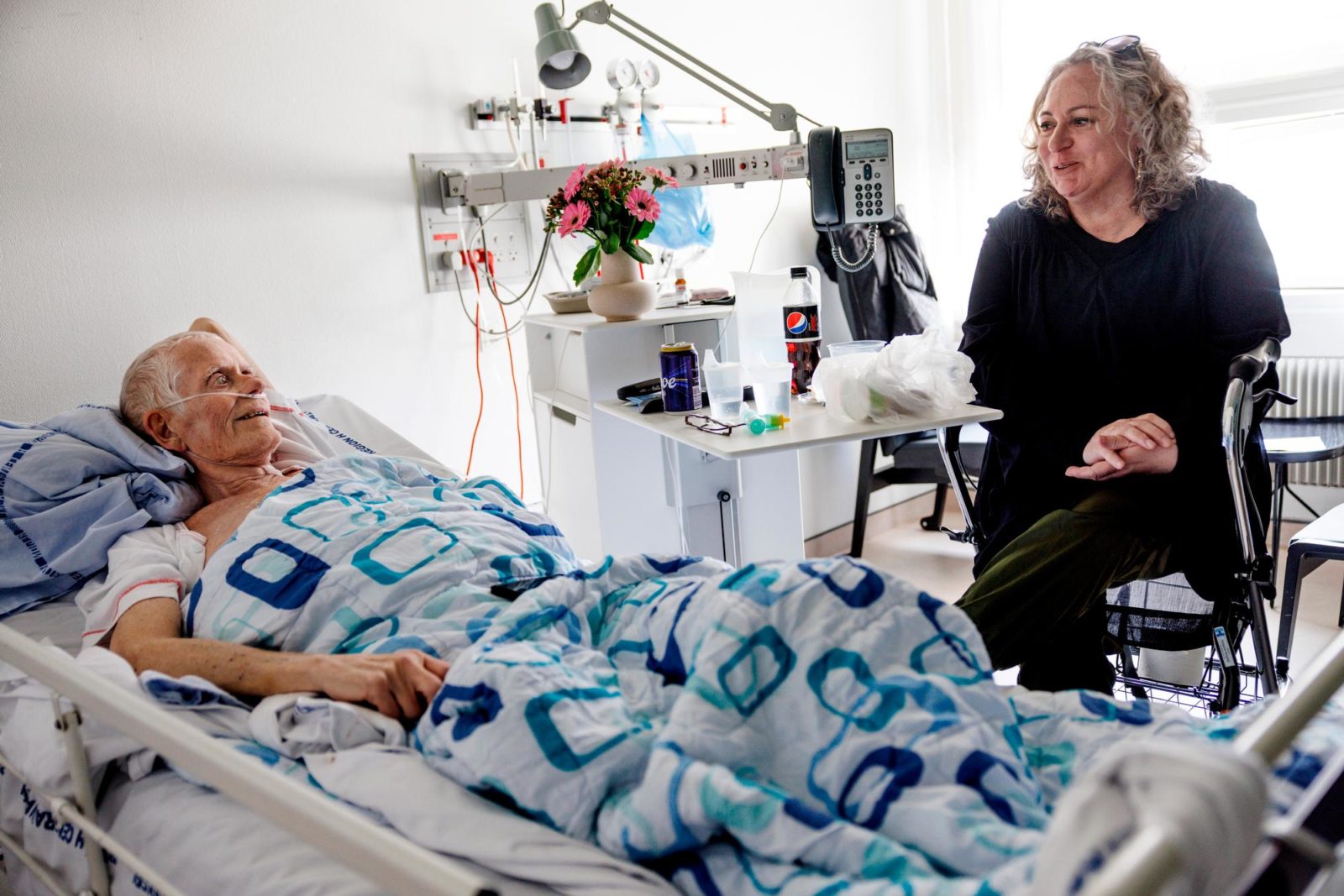
»This is the kind of weather you love the most. When you usually stand and fish at the sandbank,« says his niece, 53-year-old Mette Damgaard. She is leaning over the bed, her face very close to his. She has been sitting like this for a long time.
René Damgaard has his eyes closed, and his mouth is slightly open. The evening light falls across his gaunt face, and he looks as though he is sleeping. He is not, but he is dying.
»I will take care of you«, Mette whispers.
He nods. She strokes his hand and squeezes it.
»You can let go now, René«
There is a moment of silence. Then he whispers:
»Remember to say goodbye to everyone from me«.
»I will, René. I promise«.
Total pain
The way we die is a topic of a heated debate in Denmark. The government wants to introduce medical aid in dying and last year set up a committee, which has just presented their various opinions. Palliative care is often highlighted as a counterweight to the possibility of aid in dying. To describe the treatment terminally ill patients, Politiken was given access to the Palliative Care Unit, section 126, at Hvidovre Hospital for ten days in April and May 2024
Unlike the rest of the hospital, Section 126 isn’t focused on cure, but on relief. In this unit, terminally ill patients like René Damgaard receive help to meet their pain, nausea, and other symptoms from doctors and nurses specializing in palliative care.
But the staff in this section don’t just administer morphine and methadone through IVs and injections. They also assist patients and their families with the grief of saying goodbye, the pain of leaving life, and the fear of death.
»Many of the patients we receive are referred due to physical pain, but they can also experience breathlessness, anxiety, and existential suffering. We call this ‘Total Pain’«, says Dr. Johan Randén, with Swedish accent. Originally from Malmö and trained as a general practitioner in 1996, he has been working in palliative care for over 10 years. He has encountered several patients who talk about medical aid in dying:
»Some of them think, upon receiving their diagnosis, that they want to end their life then and there and might as well get it over with. But they can also live. And I find that when they receive the right support, they let go of that thought«.
The experienced nurse Sigrid Nielsen, 65 years old, adds:
»It’s healthy people who want to introduce medical aid in dying. But the patients we meet here want to live. They do not want to die«.

Photograph: Jacob Ehrbahn
In a deep crisis
Every morning in The Palliative Care Unit starts with a meeting in the staff room at the end of the hallway. This Monday in April is no exception, with doctors, nurses, the unit’s psychologist, and social worker gathered around a table talking over the patients. A middle-aged man is in such severe pain that he can barely be touched; another needs to be discharged to a hospice; a third patient requires a Polish-speaking interpreter; and then there’s a male patient who is in a very bad psychological state. He feels lonely, hasn’t slept all night, and wants to hold hands all the time, says nurse Sigrid Nielsen.
»He is really in a deep crisis«.
The man is not psychotic or suicidal, but he needs someone who listens.
»We can’t change his life circumstances, but I’ve told him, ‘You need to stay here until you feel safe’«, says Sigrid.
The psychologist has made an appointment with him, and he has also been offered to talk to a priest.
After half an hour, everyone gets up. An alarm flashes above the door, nurses are needed in several rooms, and doctors are preparing for rounds. Some of them are going on home visits with the Unit’s palliative mobile care team.
Photograph: Jacob Ehrbahn
Photograph: Jacob Ehrbahn
Pain like fire
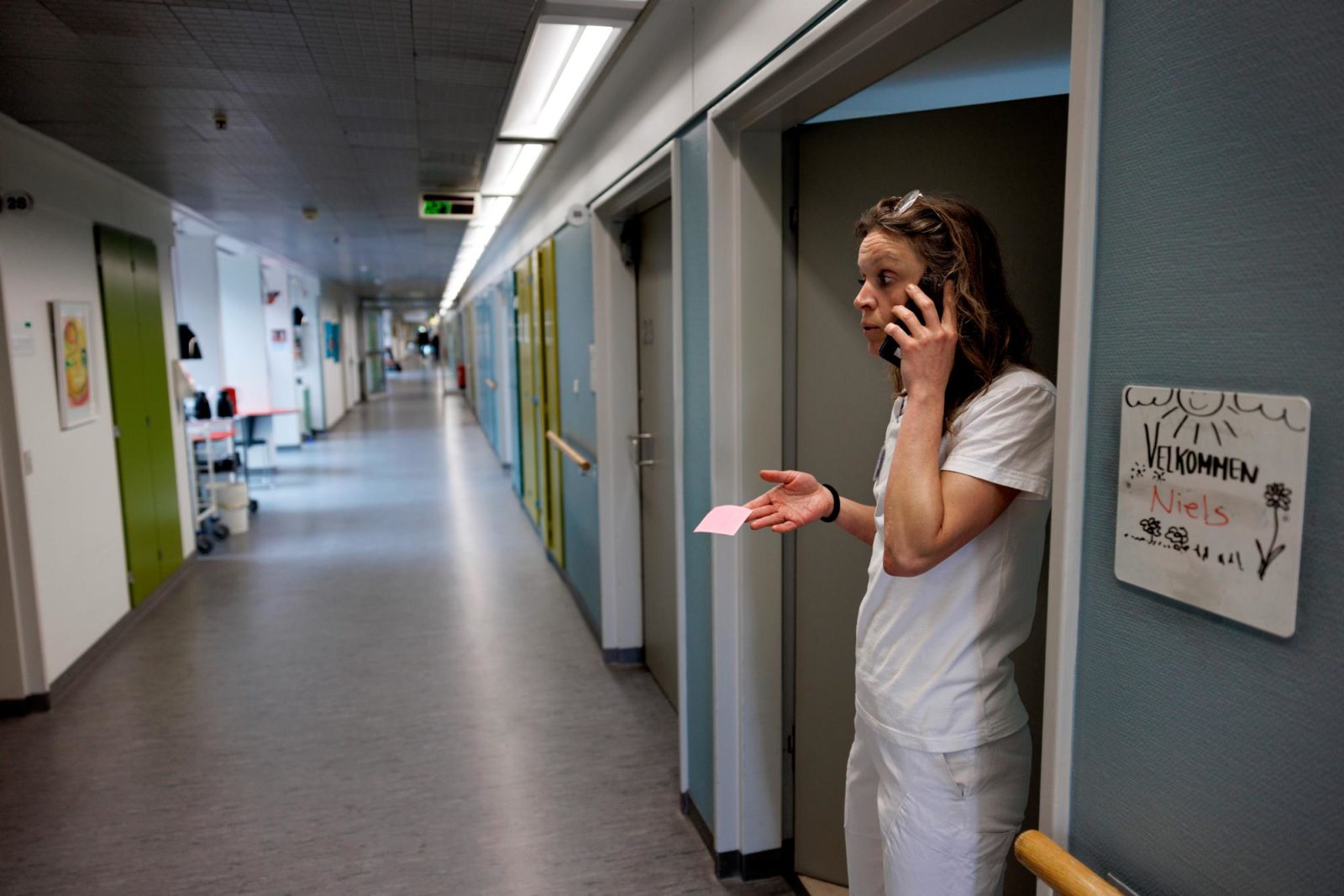
A small sign outside each room has a handwritten message, name, and a drawing. ‘Welcome René’ it says outside Room 14, next to a drawing of a tree. 67-year-old René Damgaard was admitted Monday morning. He came from the hospital’s pulmonary unit, where he had been lying for almost a month.
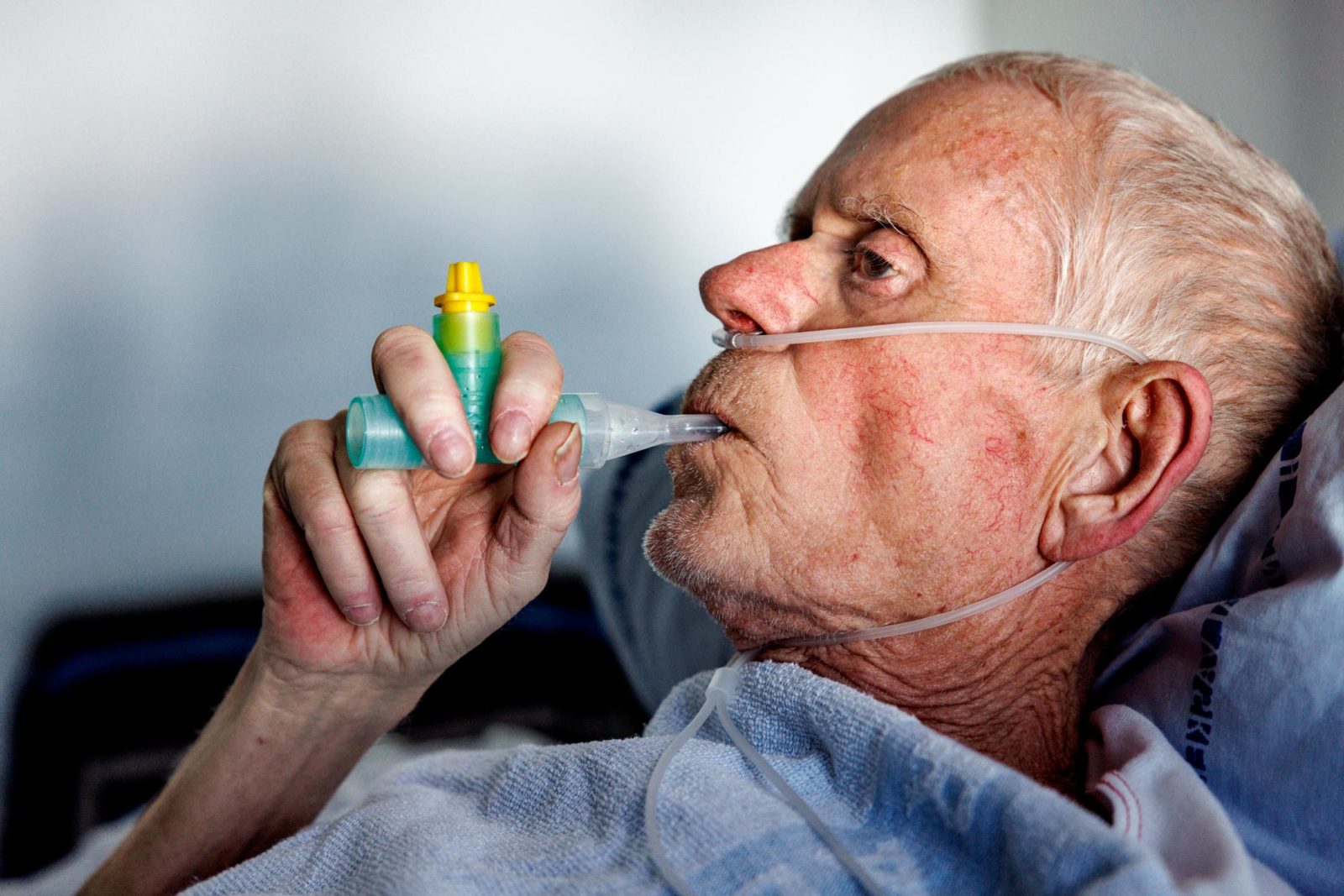
René’s eyes look large in his hollow face, and his hair is a bit disheveled. His bones are prominent at his shoulders and wrists, and his muscles have shrunk.
He started having back pain before Christmas, and the doctor thought it might be a herniated disc. He also got tired and felt colder than usual. He was sent to a physiotherapist, who couldn’t help him, and one day in late March, an ambulance brought him urgently to the hospital with severe pain. The paramedics thought it was intestinal obstruction.
»But then they found cancer everywhere«, says René. The disease had started in his lungs but had spread to his liver and bones.
Sigrid Nielsen enters the room and reminds him to drink more. He promises.
»As long as it’s just water or an energy drink«, says René.
He doesn’t drink alcohol anymore. He quit in 1996, he tells Dr. Johan Randén, who has just sat down next to him on the bed.
»Well done«, says Johan.
The doctor asks how they can help René. He’s short of breath, lacks appetite, he says, and then there’s the pain. It sits under his shoulder blade.
»A burning sensation«, says René, adding that otherwise he’s doing fairly well.
»I know what’s going to happen«, says René.
»What’s going to happen?« asks Johan.
»My life is coming to an end«, says René.
»What do you think about that?« asks Johan.
»It’s too early, but it is not up to me to decide«, says René.
He was offered chemotherapy but declined. He doesn’t know if he has a week or a month left to live.
»And chemo makes you really sick. I’d rather spend my time feeling good«.
Johan understands, he says.
»That’s not how you should spend your energy«.
»No, now it’s all about eating ice cream and popcorn whenever I want«.
The doctor explains that it’s important to speak up as soon as he feels the pain.
»Pain is like fire«, says Johan. »You can easily blow out a candle. But if the fire spreads and the whole kitchen is on fire, it’s hard to extinguish. It takes time for the medicine to work, so you need to tell us, as soon as you feel the first flame«.
René nods.
»I’ve never been good at demanding help«, says René.
As soon as the pain is under control, he wants to move back to his apartment in Glostrup, where he lives alone. His niece has rearranged his apartment, and everything is ready for him to spend his final days there.
»Do you have any children?«, asks Johan.
»I have a son«, answers René.
»Do you have a good relationship with him?«
»No«.
»Does he know you’re sick?«,
»No«.
Out in the hallway, Johan Randén stops and talks with Sigrid Nielsen.
»Maybe we should ask René if he wants to write a letter to his son«, suggests Johan.
Preparing for death
Not all patients are at peace with death as is René Damgaard. Even though most of the unit’s patients are dying, they don’t always realize when they’re admitted. And sometimes not even then.
»We don’t tell our patients it’s the end of the line. But when they come to us, it is their last lifetime«, says Sigrid Nielsen.
Some can live for a long time after coming here.
»But only few of them are that lucky, and we need to help them handle it«, she says.
Johan Randén says one of his most important tasks is to listen to the patients.
»You can run all kinds of blood tests and scans, but if you don’t talk to the patients about what they want, it’s pointless. You must talk to them. And touch them«, says Johan Randén.
Johan Randén and his colleagues in the palliative care unit often experience that no one else in the healthcare system has talked to the patients about the fact that the treatment could extend life, yet diminish its quality, especially towards the end. The lack of courage and time to initiate that conversation means that the people dying end up missing out on quality time with their loved ones.
»Many doctors shy away from talking about death. They keep treating the patients until the very last moment before they finally say: ‘Now there is nothing more we can do.’ But then there is no time left for the patient to prepare themselves for death«, says Johan.
There are three things that are important for someone dying to get the opportunity to say to the right people, Johan Randén says:
»Forgive me. I forgive you. And I love you«.
Photograph: Jacob Ehrbahn
Someone who listens
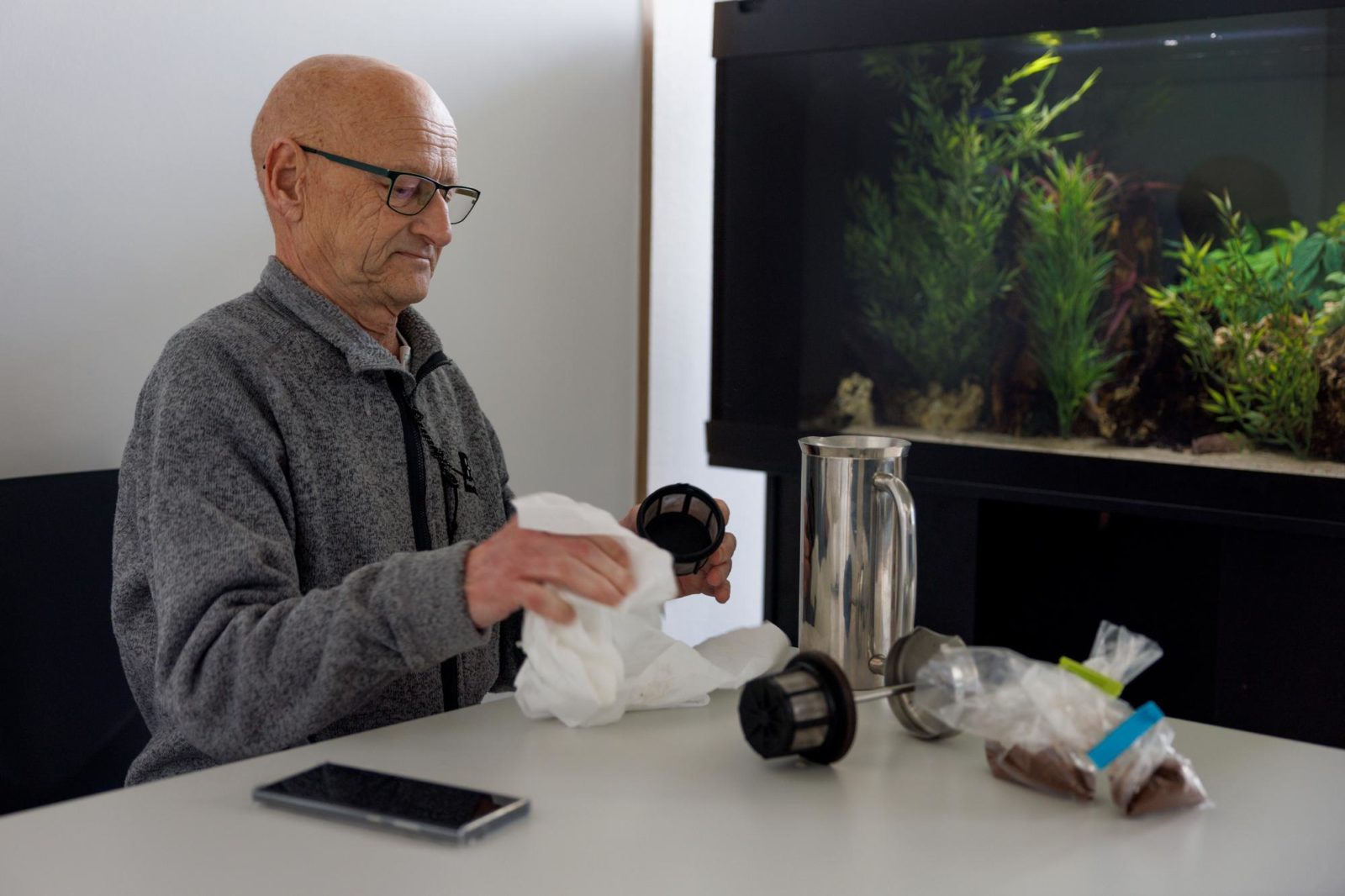
»Life is too short for bad coffee«, says Niels Abrahamsen, 63 years old. He pours freshly ground coffee into a glass pot from a small bag his wife, Rikke Abrahamsen, has brought. He smells the freshly ground beans and says, »Ahhh«. On his bedside table is a box of filled luxury chocolates. According to Niels, life is also too short for bad chocolate.
Niels often uses that phrase. He is a bon vivant. But it is also literally true for him. He was diagnosed with stomach cancer in January 2020, but even with a death sentence hanging over him for four years, he has not lost hope, he says.
In February, however, he had a stomach bleeding, and after radiation therapy to stop it, he experienced severe pain. In recent weeks, there has been a buildup of fluid in his abdomen, and a few days ago, he was admitted to the Palliative Care Unit to relief his discomfort.
Photograph: Jacob Ehrbahn
Niels Abrahamsen’s approach to illness is holistic, he explains. On his bedside table are various “exquisite” dietary supplements – as he puts it.
He does not like medication – especially not chemotherapy, of which he has had around 30 treatments.
»I’ve stopped counting«.
Niels is a trained physiotherapist and well-read in nutrition, body, and mind.
»I’m always two steps ahead of the doctors«.
He likes the palliative unit compared to the gastro unit in the hospital where he was initially admitted, and where everything was »complete chaos«
»They are more professional here, more experienced, and they have time to sit down and hold your hand«, he says.
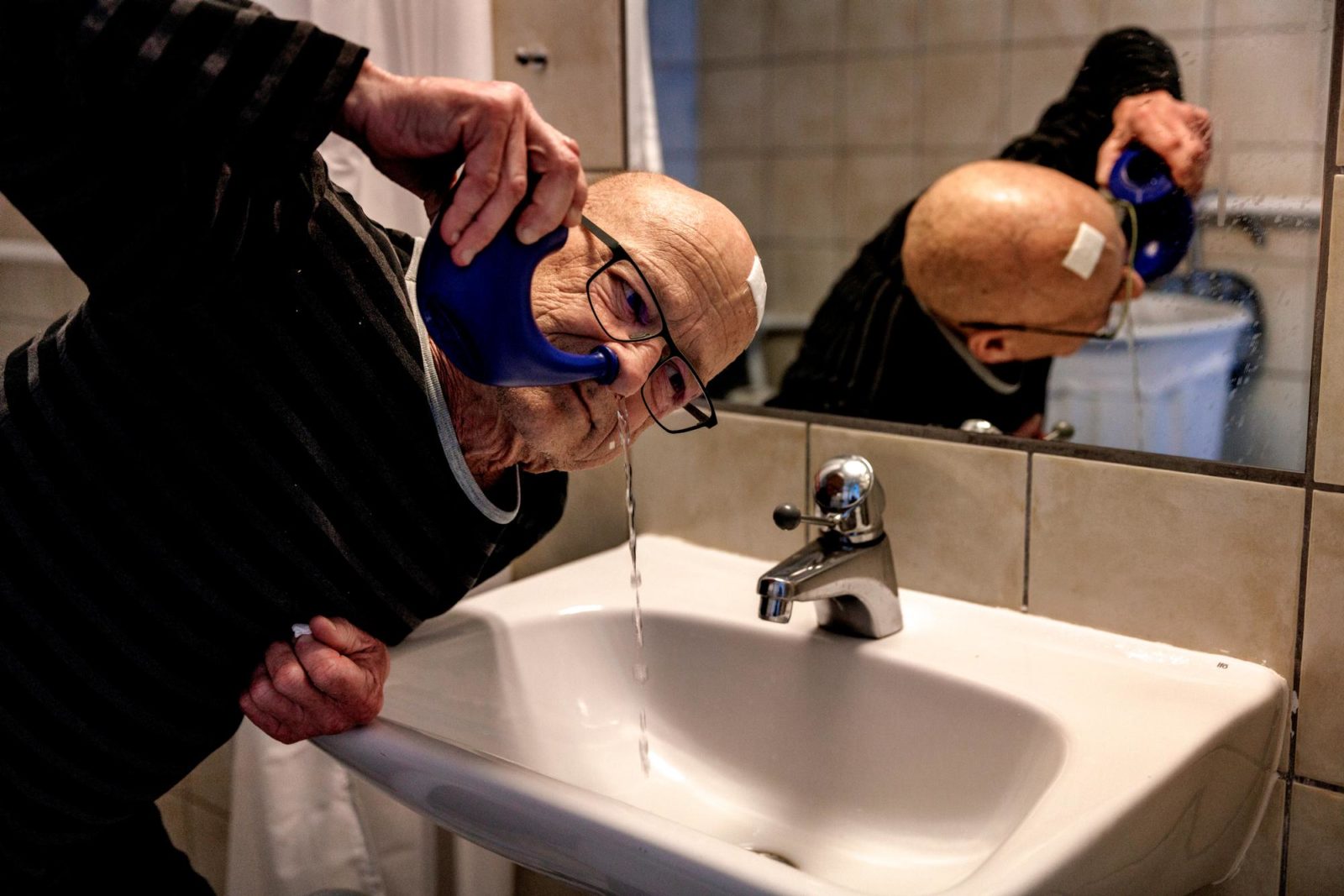
He has settled in to his room with a yoga mat, a nasal pot, and a stack of special magazines. He also unpacks a bluetooth speaker his wife has brought around so he can listen to good music. Because life is also too short for bad sound, says Niels.
Photograph: Jacob Ehrbahn
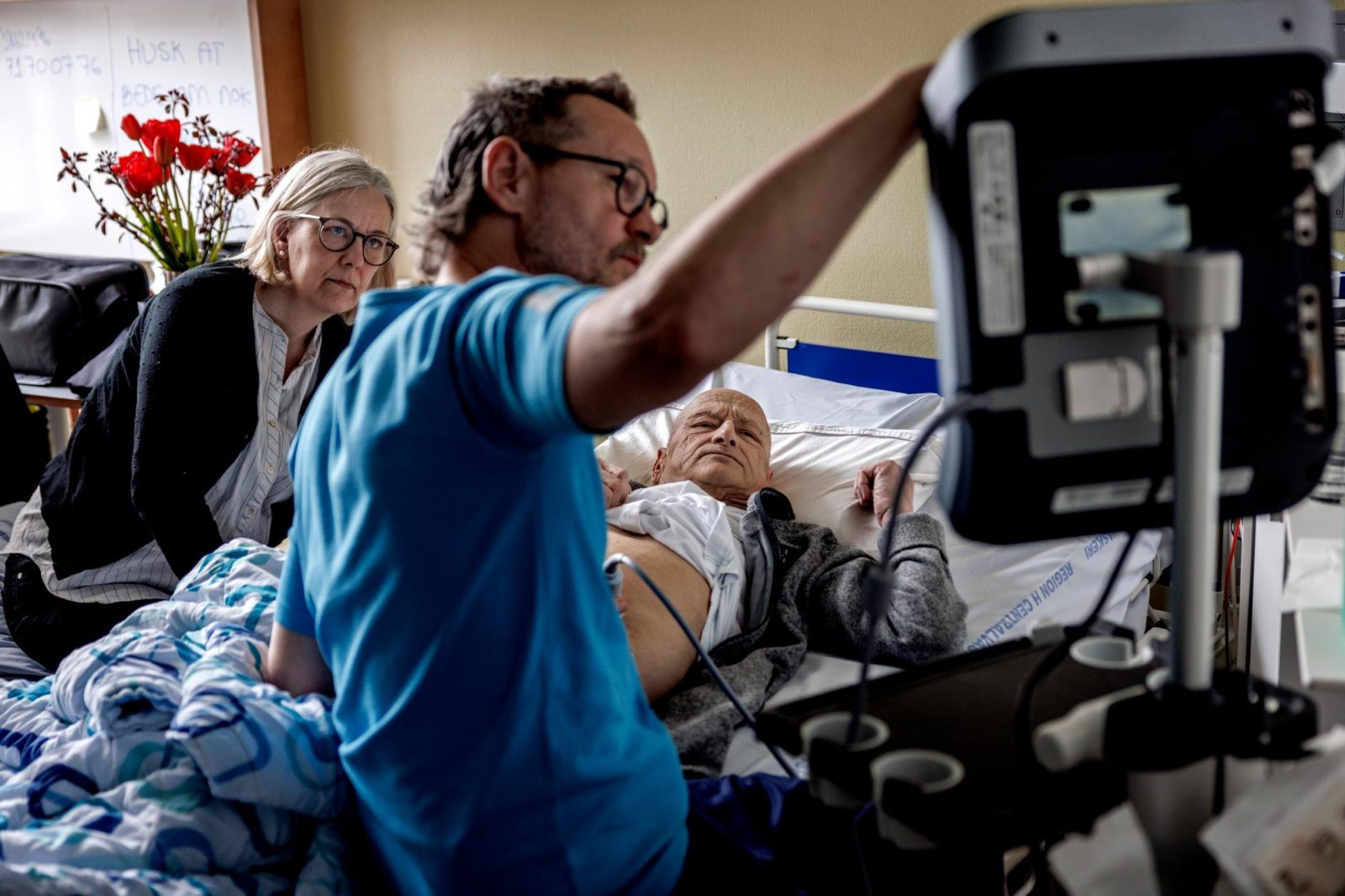
Doctor Johan Randén enters to check on Niels. His abdomen is swollen with fluid, and during the night he paces the hallway restlessly because he can’t find and rest. Johan wheels in an ultrasound machine, sits on the edge of the bed, scans, and gently feels Niels’ stomach.
»I know my body quite well«, says Niels and tells Johan about a range of breathing techniques.
They discuss whether to try to drain some of the fluid or wait a while.
Photograph: Jacob Ehrbahn
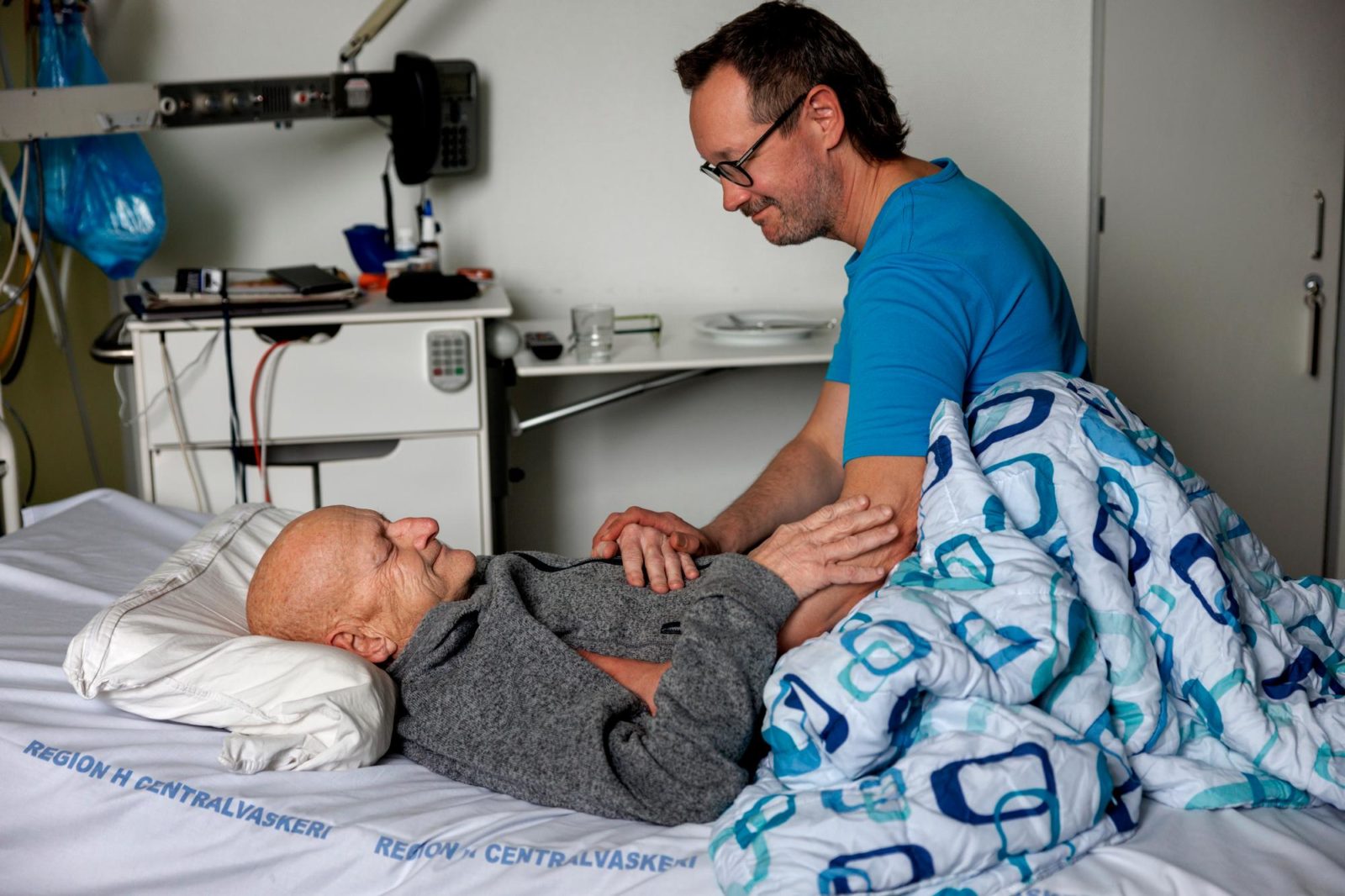
»We’ll take it step by step and see what we can do for you,” says Johan when he has turned off the machine. He sits for a moment, quietly, patting Niels’ hand. Suddenly, Niels begins to cry.
“You are moved. What’s happening?” Johan asks.
“It’s you, Johan. You are the most attentive doctor I have ever met,” says Niels.
He covers his face with his hands as tears stream down.
“It’s not easy, I know” says Johan.
After the doctor leaves, Rikke leans over the bed and kisses Niels.
“When another person listens, it gives security and hope,” says Niels and continues.
“But now I need something to eat and drink.”
He empties the contents of a food box Rikke has brought to him onto a plate: eggs, bacon, and a slice of bread.
“I don’t eat much, but what I do eat has to be of good quality. And I don’t use sea salt because of microplastics,” says Niels as he sprinkles his food with rock salt stored in a small orange tin.
Photograph: Jacob Ehrbahn
Cakes from relatives
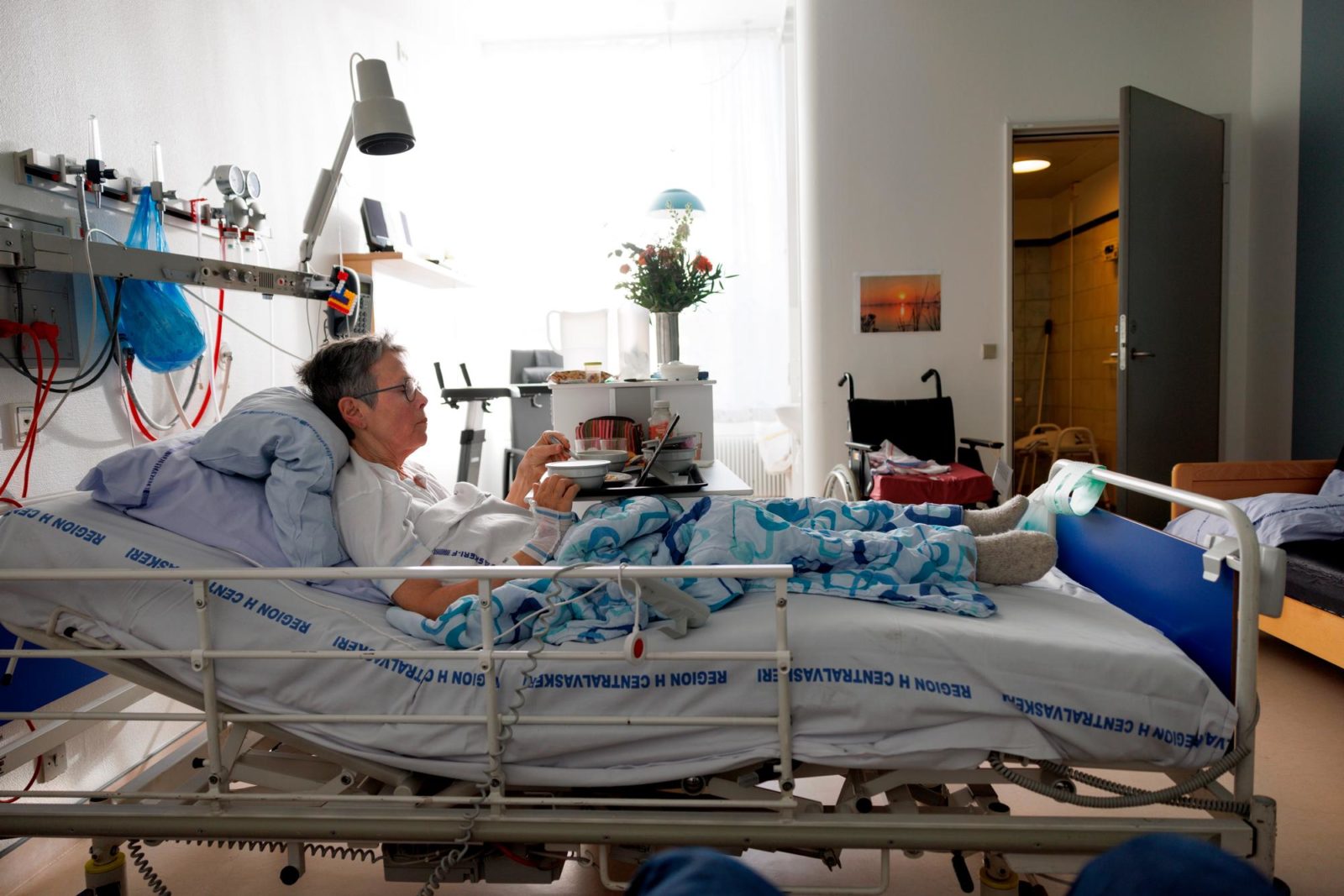
The nurses move quickly down the corridors, keeping an eye on both the clock and flashing alarms. However, when they enter the patients’ rooms, the pace is often different. They speak softly and take their time. Both patients and relatives talk about a unique calm atmosphere in the unit – a stark contrast to the hospital’s other departments, where most patients have been admitted during their illness.
One afternoon, a middle-aged man enters the corridor. In his hands, he holds two large boxes with cream puffs, which he places in the nurses’ office. His wife died in the unit a month ago. They were admitted together up until her death.
»We had talked about her coming home to die, but she felt most secure here«, he says.
Now he wants to say thank you.
»I promised my wife that I would come back and properly say goodbye to the staff«.
But it was difficult to walk through the door to the unit.
»This is where I saw my wife for the last time«, he says.
The man gets a cup of coffee and talks at length with two of the nurses. One of them places a hand on his shoulder. His eyes filling with tears.
»We don’t just take care of the patients; we also take care of the relatives, their emotions, and their grief«, says Sigrid afterward.
In a plastic basket she has saved some of the many thank-you cards and letters she has received over the years. There are also several memorial folders from patients’ funerals she has attended.
»You don’t just distribute food, make the beds, and give medication. You also embrace them and care for them«, she says.
Photograph: Jacob Ehrbahn

Photograph: Jacob Ehrbahn
Photograph: Jacob Ehrbahn
Married Couple Admitted Together
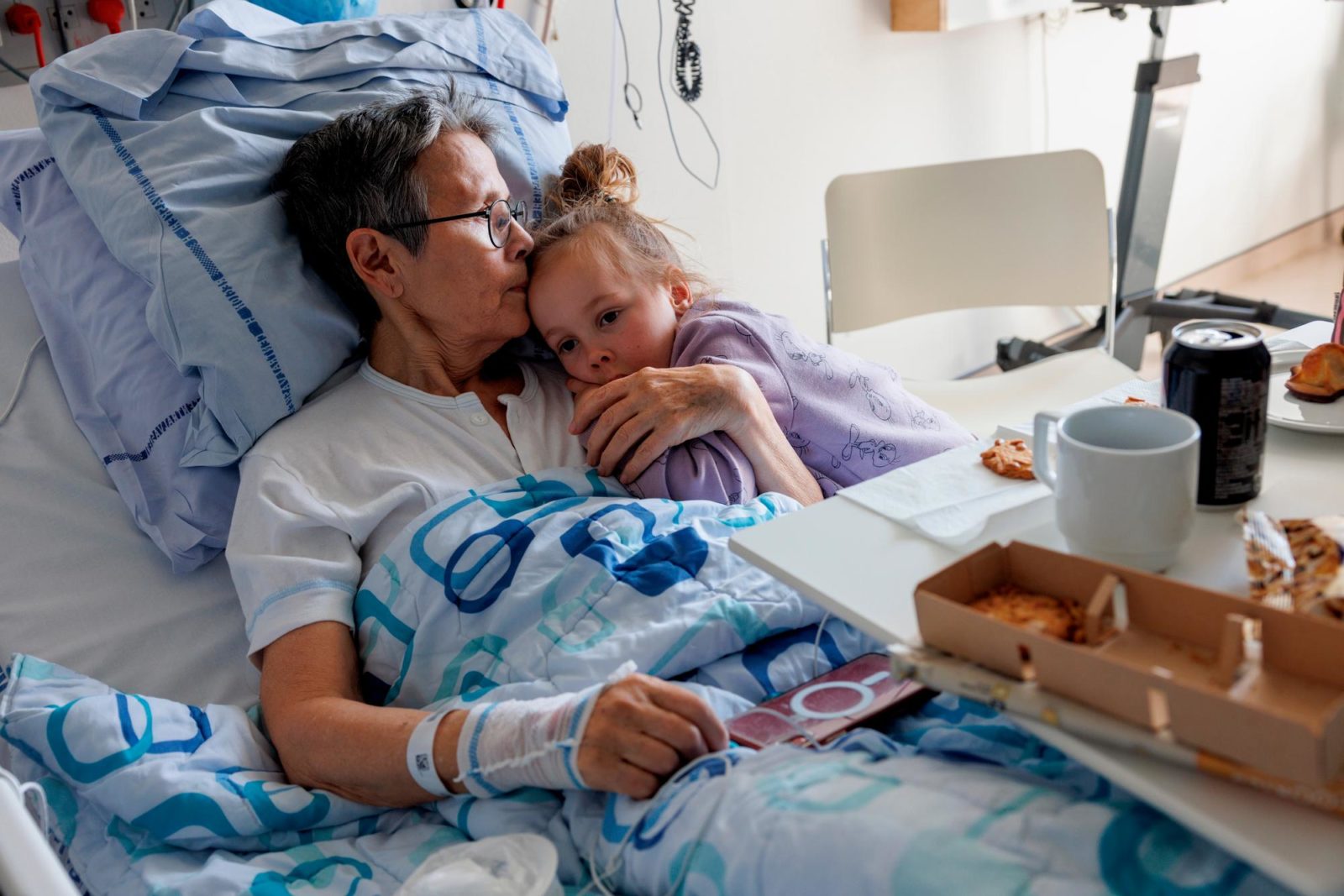
In room 11, Liv Simonsen is being paid a visit by one of her three daughters and two grandchildren. The youngest crawls into her bed and cuddles up to her. The girl doesn’t say much but shows with her hand how old she is. Five fingers. On the wall of the room hangs a child’s drawing of a princess in a castle.
Liv is 70 years old and had just retired from her job as a speech therapist when she was diagnosed with breast cancer in 2020. She was declared cancer-free in 2021. But in January, she experienced back pain.
»The doctor thought it was muscle pain and just wanted to give me pills«, says Liv.
But when she was urgently admitted to hospital with severe pains, they sent her for further examination. It turned out that the cancer was back and had spread to her spinal cord and bones. Now it is incurable. When Liv was admitted to the Palliative Unit last week, the pain was so intense that she couldn’t get out of bed. She has never been able to sit still. Three months ago, she was swimming, playing volleyball, and padel.
Photograph: Jacob Ehrbahn
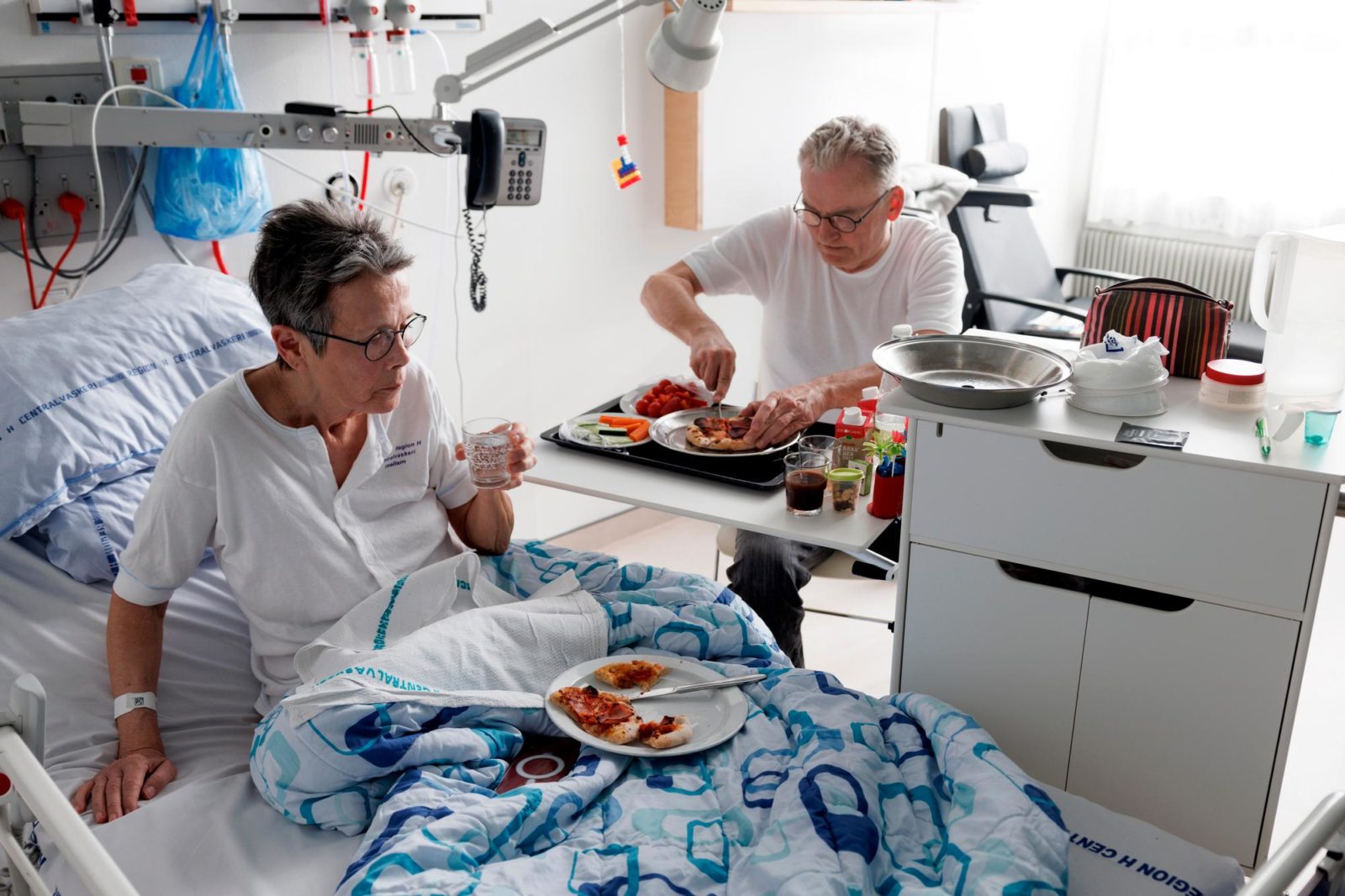
»And now here I am«, Liv states quietly. She lives in a townhouse in Albertslund with her husband Jens. Together they have five children and ten grandchildren. He is also admitted in the room – his bed is placed close to hers.
The oncologists’ plan is to keep the disease at bay with oral chemotherapy. But only if Liv recovers strength enough to move around. Otherwise, they will have to stick to life-prolonging treatment, she explains. And first, the pain must be under control.
A nurse brings a small brown pill that Liv needs to take to muster the strength for later when her sister comes to visit. Doctor Johan has prescribed the morphine-based drug Oxycodon. Initially, Liv didn’t want to hear about it.
»I freaked out when he mentioned it because I’ve heard on TV how people can become addicted to opioids«
Johan explained to her that it was for the pain. Not for fun.
»And now I’m glad. It’s really nice not to be in so much pain«.
But when the pain is under control, you start to think.
»And then you get sad. I told Sigrid earlier that if I start crying, it feels as if I can’t stop«, she says and adds, »But when my grandchildren are here, I don’t cry«.
Soda popsicle in bed
Johan looks at the CT scan pictures of René Damgaard on a computer. It looks like a map – his bones, lungs, and other internal organs depicted like islands in a sea of white and gray. Johan Randén scrolls, zooms in, and points to numerous small and large black spots and shadows. Cancer.
»There, there, and there. It’s everywhere and it’s causing him pain«, Johan explains.
Even though they can’t cure or treat the cancer, there is plenty they can do to relief him, he says.
In room 14, René has dozed off with a Cross & Quiz magazine in front of him on the duvet.
»It’s the same with books. It takes too much effort to hold them up with these arms«, he says, waving his thin, bony hands.
Photograph: Jacob Ehrbahn
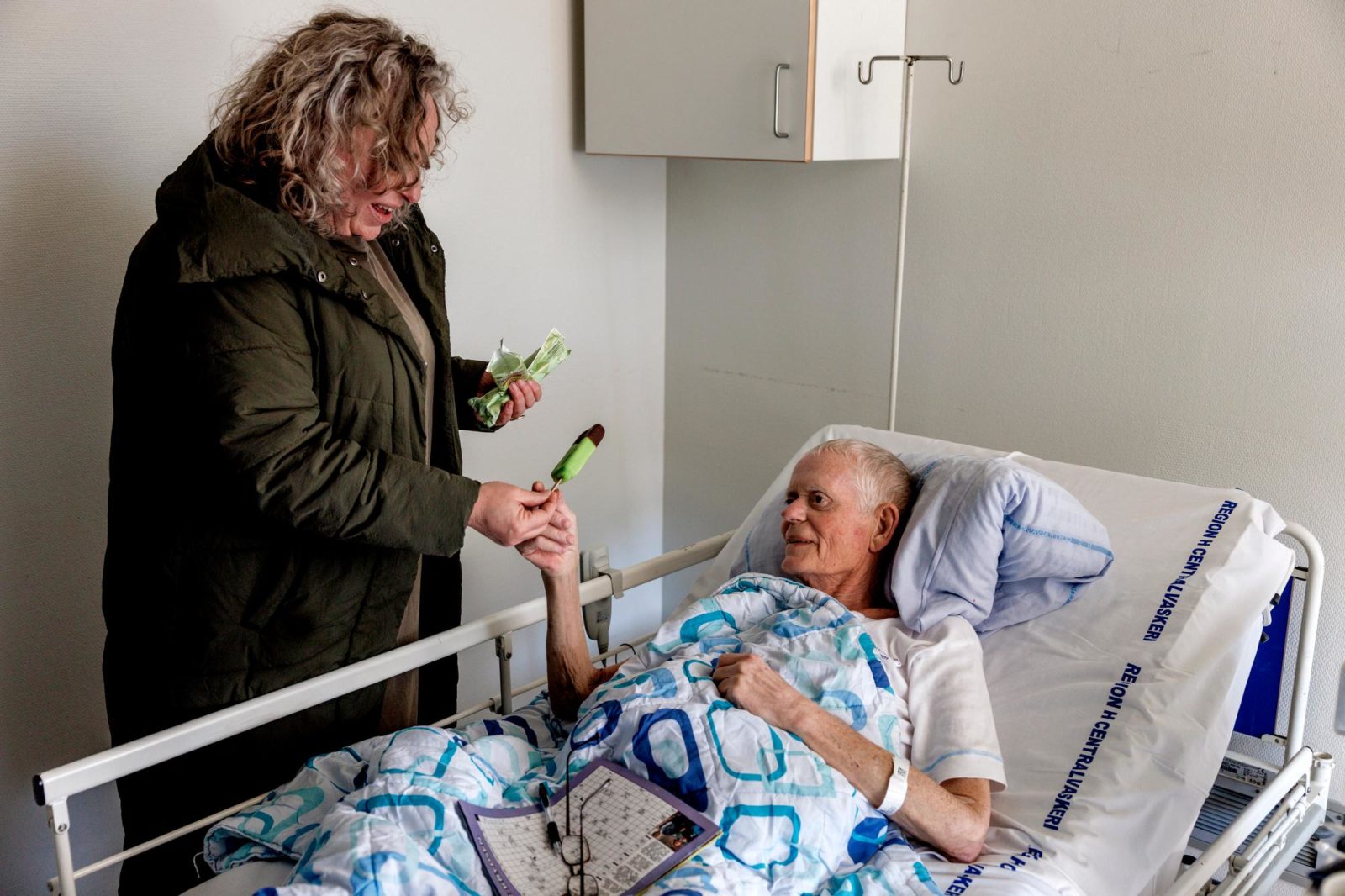
His niece, Mette Damgaard, drops by straight from her job as a department head at a school nearby. She has brought a soda popsicle for him called ‘Champagne’.
“This is the only type of champagne we use to celebrate«, she says. They both laugh. She has big, curly hair and smiles a lot. She is the daughter of René’s older brother, and there are only 14 years between uncle and niece.
»I changed her diapers when she was a little girl«, says René between bites of his ice pop.
Her father died of cancer.
»When René is no longer here, there won’t be anyone around anymore who has known me my entire life«, says Mette.
René has worked in shipping, as a hospital porter, and in IT. While he has been in the hospital, he turned 67 and is now officially retired. He was supposed to spend all his time now on his hobby, fishing.
Instead, he is scheduled to be discharged on Monday to die at home, and Mette has applied for care leave so she can be with him as much as possible.
»You can sit by the window and see the new leafs on the beech hedge, and we’ll eat good food. I’ve stocked up on frozen meals«, she says.
She has arranged home care from the municipality up to 12 times a day. Still, she worries about her uncle being in pain. When she talks about it, tears well up in her eyes. René sees this and says:
»It’s hard for you too, Mette«.
»When you’re in pain, it breaks my heart«, she says.
»I’ll make sure the discharge goes well«, promises nurse Sigrid. »But you need to tell us when you’re in pain«,she says, looking a bit sternly at him.
It’s difficult, René admits.
»I don’t like to complain«, he says.
»We’ve talked about this. You’re a fighter. You always have been«, says Mette.
When Sigrid gets up to leave, she gives René’s feet a kind squeeze.
For the doctors and nurses in the unit, it’s important to prepare both the family and the patients for death, so it doesn’t end in helplessness and chaos. But it’s not always possible, says Johan Randén. The patients hardest to handle are those who don’t want to talk about death and do everything they can to avoid facing it.
»Especially young people, and mothers with small children. They fight with everything they have, understandably«, says Johan.
Photograph: Jacob Ehrbahn
Even though most dying people want to be at home, both patients and relatives can become uncertain or overwhelmed in the final days and hours. And then the dying person gets admitted to hospital, stabilized, and perhaps sent home again, only to end up in the hospital again a few days later.
»Sometimes it ends up in what I call ’emergency-light deaths,’ where a patient is rushed in by ambulance, dies on the way, is resuscitated, and maybe doesn’t regain consciousness and never gets a chance to say goodbye. That’s not a dignified death«, says Johan.
A 60-year-old man is admitted to room 23 from another ward in the hospital. But just a few hours after his bed is wheeled through the door, he passes away. He had terminal cancer for many months and was admitted to the Palliative Care Unit several times. His plan was to die at home, but his family felt uncomfortable with the situation, so he was admitted and discharged multiple times.
The nurse who was with the family when the man died recounts how he kept fighting, even though a few days earlier he had told his family he was ready to go. She felt powerless and wished she could have done more for both the patient and the family. But there wasn’t enough time. Afterwards, she takes a moment to collect herself in the nurses’ office. Tears well up in her eyes. A doctor places a comforting hand on her knee and reassures her that she did her best.
She finds brochures for the relatives titled “When Someone Dies.” The man died just as her shift ended, and although the nurse is technically off duty, she stays to help prepare the deceased.
The people who choose to work with the dying are often a special type, says the head nurse of the unit, Trine Andersen.
»They are in touch with things that not everyone is in touch with. The existential. And to be allowed into that space with the patients, you need to have a broad filter«, she says, adding, »We don’t see it as a sign of weakness here if someone gets emotional«.
Chasing the good days
During the night just before the weekend, René Damgaard gets a fever. He wakes up with chattering teeth. The next morning his skin is still sweaty. Johan Randén examines him immediately, even before the morning meeting.
»I think you have pneumonia. So, take it easy – no dancing today«, the doctor says, prescribing antibiotics.
»We need to get you back on your feet. You still want to go home on Monday, right?«.
René struggles through a handful of pills with the help of a protein drink. Sigrid Nielsen arrives.
»I’ll open the curtains so we can get some sunlight in. It’ll make the day a bit better«, she says.
She starts preparing everything for his discharge, so he will get all the help and care he needs for his final days. Wound care for his bedsores, a terminal declaration so all medication is free of charge. She also notes down the phone number for the emergency nurse, so René and his niece Mette have someone to call. But Sigrid doubts he will make it until Monday morning. Pneumonia is serious in his condition.
»He might die over the weekend«, she says, adding, »I’m just being realistic«.
The most important thing is that he is not in pain.
»We are chasing the good days«.
No sugar-coating
For Liv Simonsen in room 11, it’s a bad day after several good ones. She feels nauseous and sits up in bed with a small plastic pill cup of medicine in front of her and a smoothie beside her bed. She can’t get either of them down due to her upset stomach. It started last night.
»I threw up and got really tired. Like I was hit with a hammer«, she says.
Three small pills remain. Johan enters and sits down on the edge of the bed. He listens to her stomach with a stethoscope.
»Nausea can have many causes. Sometimes it’s an imbalance in the body. Sometimes it’s the medication. Sometimes it’s anxiety. It all feels the same«, he says.
Sigrid has joined them. She wants Liv to get out of bed.
»You need to get up and brush your teeth, and then we’ll get you in the wheelchair and wrapped up so you can sit on the terrace in the sunshine. It’s better for your appetite, and your mood«, says Sigrid.
She speaks firmly, leaving no doubt that this is how it will be.
Liv is grateful for the way she is treated. That Sigrid constantly reminds her to make the most of the time she has left.
»And she’s optimistic about what I can do. Not that they’re sugar-coating things here. They tell it like it is. But in a good way«.
Shortly after, Liv falls asleep. In front of her on the duvet, between her hands, lies a vomit bag.
Reborn After Exercise
Physiotherapist Niels Abrahamsen has had trouble sleeping. He usually stays active with physical exercises but hasn’t had the energy in recent days. He is increasingly worried that the fluid in his abdomen is due to cancer spreading. He has asked for a CT-scan.
»We’ll see where it leads. I plan to cheat the grim reaper again«, says Niels. »But this bloated stomach is a bit ‘complicato’«, he adds.
Photograph: Jacob Ehrbahn
He keeps up with music – both big stars and new names, and he has tickets for both a Bruce Springsteen concert in July and a local music festival in August. He also bought tickets for the Euro 2024 football games in Germany, which he hopes to attend with his 19-year-old son who graduates from high school in a couple of months.
»It’s going to be huge. I must be there«, he repeats, emphasizing the word »must«.
However, he knows he can’t travel in his current condition. He takes more morphine than he’d like.
»And then my stomach gets constipated, and I get sluggish and forgetful«, he says.
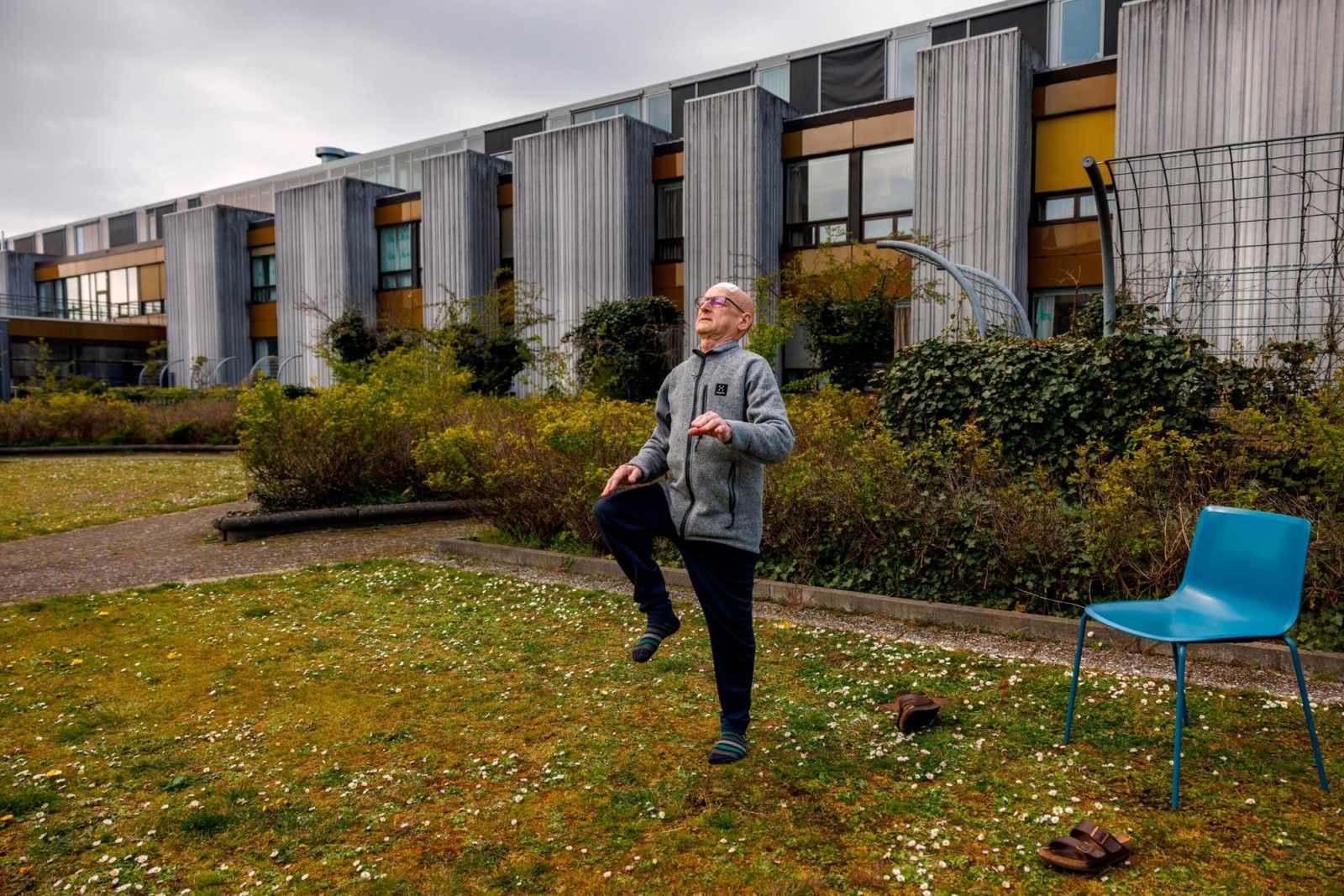
He takes a walk on the grass outside the hospital and performs a gymnastics routine in his socks among daisies and bushes. He does this every day year-round at home in his own garden, he says.
»Now I feel almost reborn«, he says afterwards.
Frightening shadows
René is scheduled to be discharged Monday morning. But that doesn’t happen. Over the weekend, he gets delirium – a condition with hallucinations that often affects the dying and very sick. He has seen visions of both his mother and father, and when Sigrid arrives, he is crying.
»Ouch, ouch, ouch«, he says. »I’m so confused«.
Sigrid doesn’t think he’s well enough to go home.
»What are you afraid of? Are you afraid to die?«.
The way she says it sounds like a mix between a question and a statement. René doesn’t respond.
»I will make the decision for you now. I can’t send you home when you’re in a state like this» she says.
René cries so hard the bed shakes and raises his hands to his face.
»Bullshit«, he finally says.
»It’s good for you to cry. It’s okay to let it out«, says Sigrid, stroking his short, gray hair. A little later, she gives him a shot of sedative and makes a call to cancel the transport home. She also gets hold of René’s niece, Mette.
René was supposed to get a visit from his son at home, whom he hasn’t seen in years. Mette arranged it. She promises to make sure the son pays a visit to his father at the unit instead.
Johan has just arrived. He hasn’t even taken off his backpack when he goes in to see René. He is still crying and upset about canceling the transport home.
»I’m causing so much trouble. Sorry«, he says.
»We’re used to it, and we have to do what’s best for you,” says Johan. “Don’t be so hard on yourself.”
Johan explains the hallucinations. Eighty percent of the dying patients experience them. It’s fells like dreaming while awake.
»It’s similar to lying on the beach and seeing a cloud in the sky that looks like an elephant. It’s not an elephant. But it looks like one«, explains Johan.
Sometimes the patients see people from their past. It can be frightening.
The room is quiet. Johan holds René’s hand and just sits there. For a long time. Eventually, René calms down. The medicine is working. Meanwhile, Sigrid walks down to the nurses’ office with the bag of medication René was supposed to take home.
»I had packed everything. But things never go as planned here«, she says.
She talks about a young female patient who was severely troubled by hallucinations before she died.
»It was very scary. She saw shadows that wanted to take her. They surrounded her in the room«,
Sigrid then moved her bed into the hallway and lay down with her, holding her.
»It was the only thing that helped. She was terrified«,
The last visitor
Every Monday, a musical duo visits the unit to play for the patients. It consists of a male guitarist and a female singer who knock on each room and ask if they may come in to sing a song. They are welcomed into three different rooms. They play ‘Somewhere Over the Rainbow’ to an 80-year-old woman, who has been in the ward for a few days. She appears to be asleep, and twenty minutes after the musicians leave, she takes her last breath.
Later that day, René’s niece, Mette, arrives. He feels better, after the decision has been taken about staying in the ward. He has eaten two cups of yogurt, and in a few hours, his 36-year-old son, whom he hasn’t seen in four years, will visit. They did not have an argument; the contact just faded.
It was the ward’s social worker who inquired about their relationship, approaching the topic cautiously, René recalls.
»And before I knew it, it seemed like a good idea«.
Now that the meeting is approaching, he is worried that his son might be angry with him.
»But he wouldn’t come if he was very mad, I guess«, René reflects. Although he has been sober since 1996, many things remain unsaid between them.
»And I know I was a jerk at some point«, he says.
»But a lot of good things have happened since«, Mette reminds him.
Photograph: Jacob Ehrbahn
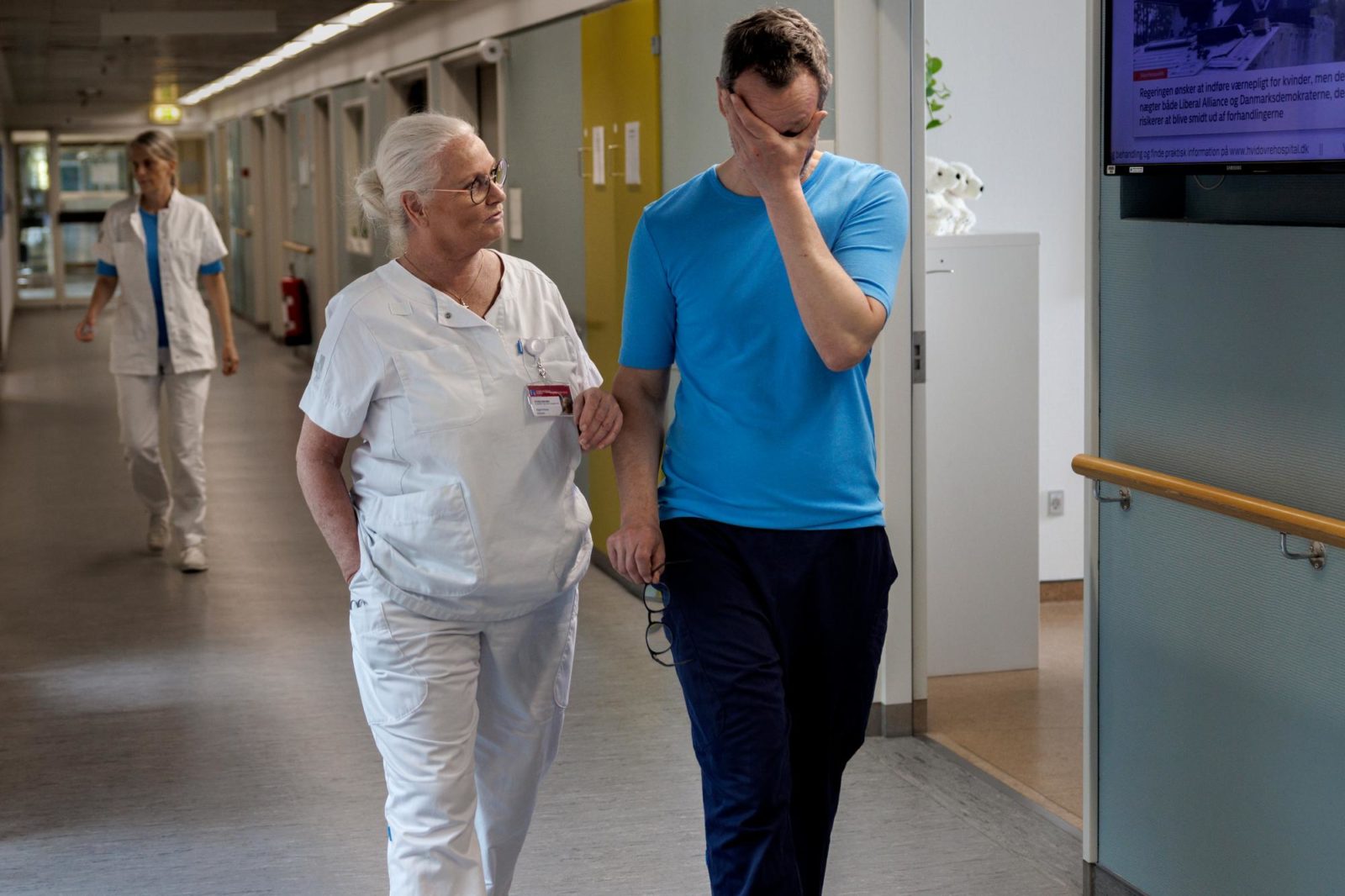
René’s son arrives precisely at the agreed time. Johan and Sigrid greet him at his father’s bed. When they leave, Sigrid shows that she has goosebumps on her arm. Johan takes off his glasses and wipes away a tear. Sigrid and Johan hug.
»They get to say goodbye, and it’s good for the son and good for René. He can leave in peace with himself«, Johan says.
He often finds himself crying:
»I’ve seen many things that are both sad and beautiful. It works for me to take it in. It shouldn’t take over, of course. But sometimes, I need to wipe my eyes«.
René’s son stays for a long time. When darkness falls, he is still there.
Strong voice
Liv Simonsen in room 11 has felt better over the weekend. The pills are working, reducing her nausea. She has been out on the hospital’s roof terrace in a wheelchair several times. She has eaten Solero ice cream and had many visitors.
»When the pills work, I become weightless«, she says.
Johan and Sigrid want to persuade Liv to accept a temporary stay at a hospice facility, where she can regain more strength before possibly going home. They sit down in her room.
»Last week, we talked about apathy. You were very sad, but it seems like you’re in a different place now«, says Johan.
»Yes, it was a valley moment. But I feel better. I can talk about the future«, she says.
»You are no longer in pain, and it’s good to see that you are strong in your voice and gaze«, says Johan.
»There are good things amid all the darkness«, says Liv.
Her home is not set up to provide the necessary help yet, so she accepts the suggestion of receiving care at a hospice facility.
Johan walks towards his office to write the referral. As he makes his way down the hallway, he performs small, joyful dance steps.
The Worry Line in His Forehead
The next day, René’s condition has worsened. His hallucinations have intensified during the night, and now he is crying again, feeling frightened. After a conversation with Johan and Sigrid, he agrees to a combination of sedatives and painkillers that might cause him to fall asleep and not wake up.
»We talked to him about the possibility that he might not see Mette and his son again. But he was completely at peace. He wants to go to sleep now«, says Sigrid afterwards.

Photograph: Jacob Ehrbahn
This process is known as ‘palliative sedation,’ when terminally ill patients are given medication to relieve pain and reduce anxiety and distress, with the possible side effect of shortening life and causing loss of consciousness.
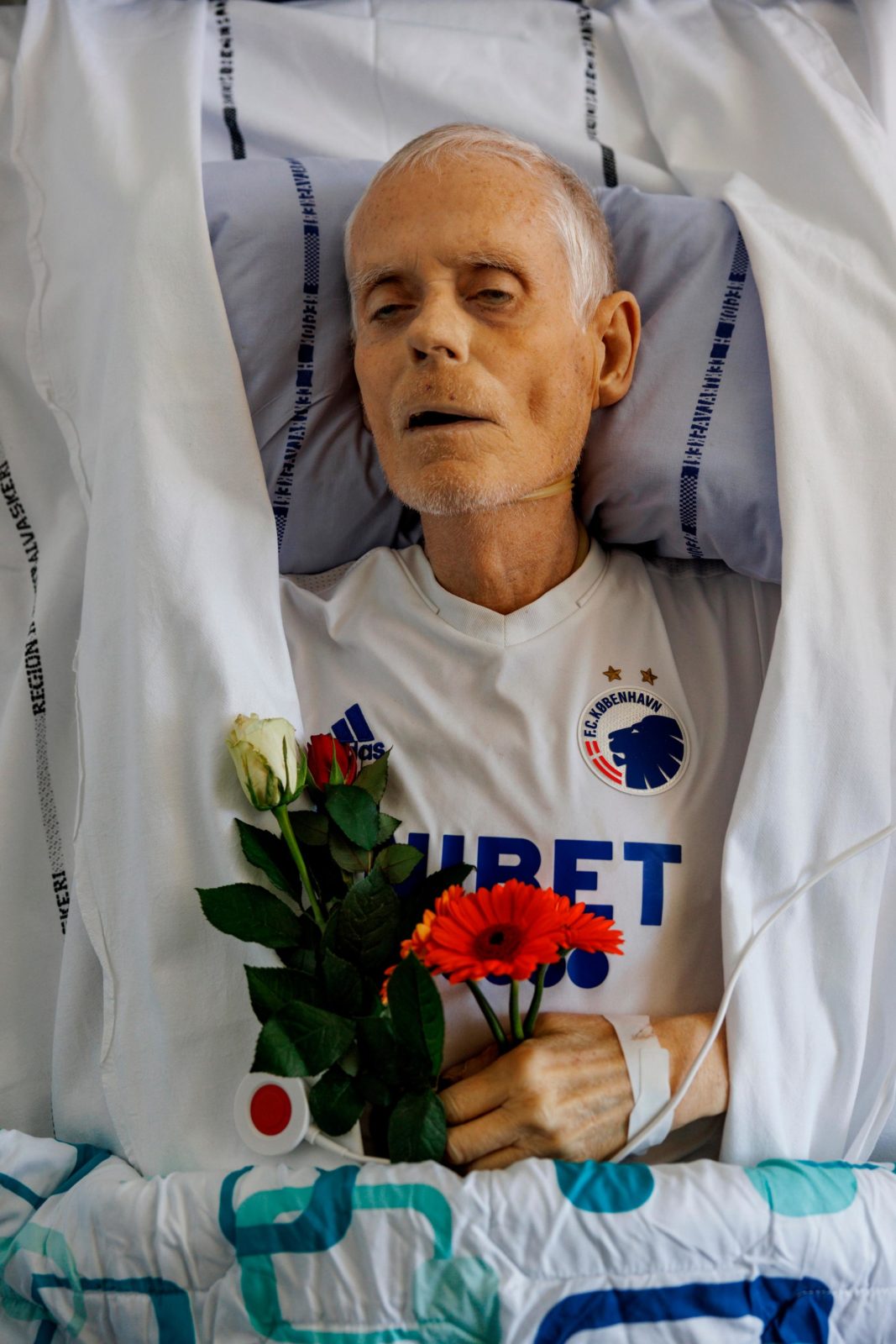
»He shouldn’t have to experience what he went through last night again. It’s too cruel«, says Sigrid as she prepares the mixture in the medication room. She sets up a pump by René’s bed that will provide him with a continuous dose around the clock. She inserts a drip into his upper arm just above a tattoo of the logo from Football Club København – the silhouette of a blue lion’s head. The once swelling muscle and the lion has shrunk.
René opens his eyes. She strokes his hair.
»Are you in pain?«.
He shakes his head and points to his mouth.
»But your lips are dry…«
Sigrid fetches small sticks with foam tips, which she dips in water and uses to moisten his lips and tongue.
He says something. It’s hard to hear. He repeats it in a barely audible whisper: »I’m sorry«
»No need to apologize. Now sleep«, she says.
He lies with his mouth open, head slightly tilted on the pillow, his breathing is shallow. Sigrid calls his niece and explains what is happening. On his way home, Johan passes by René’s room. Now René is breathing calmly.
»The frown line on his forehead is gone«, says Johan.
Photograph: Jacob Ehrbahn
The Worst Scenario
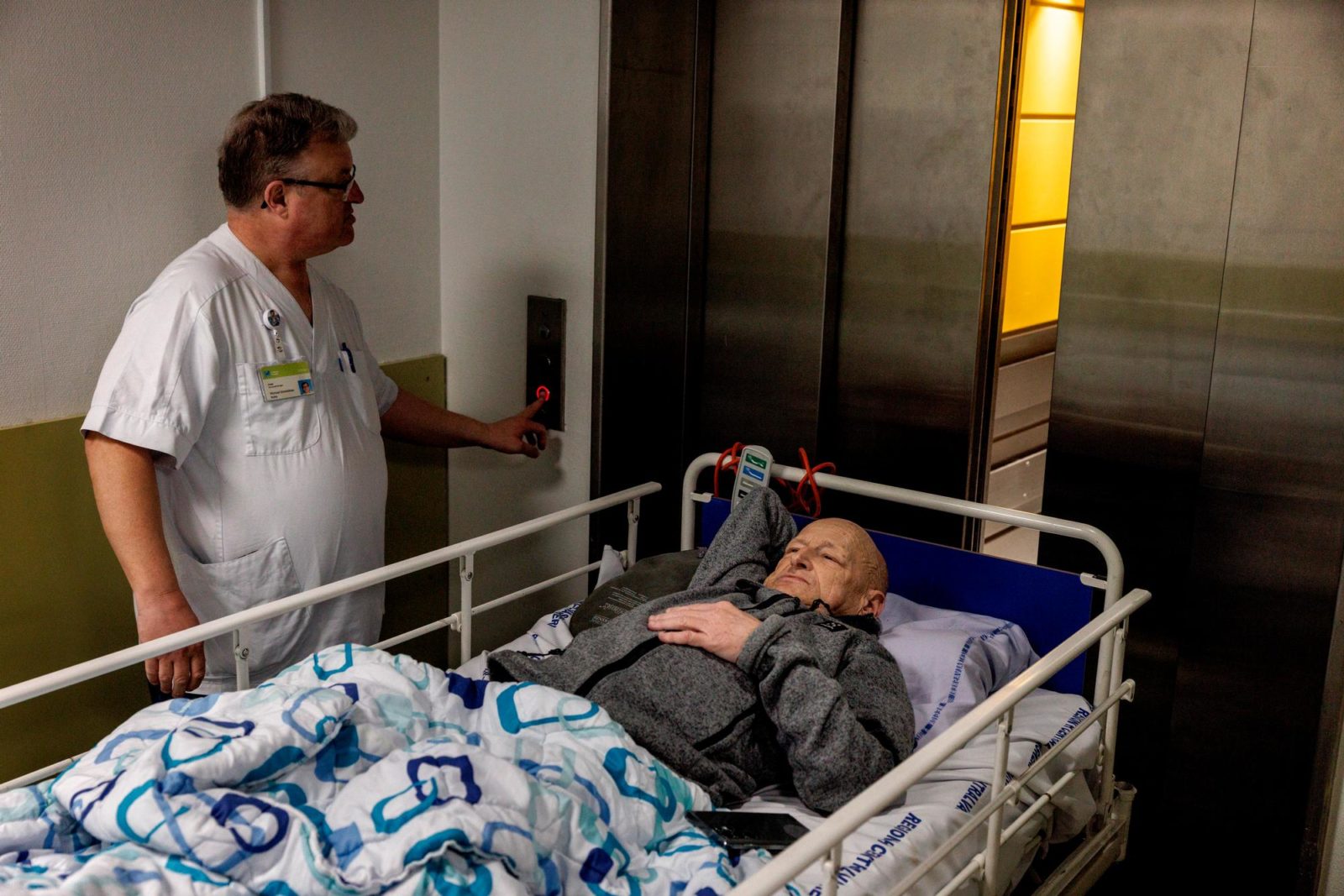
After a few frustrating days of waiting, Niels finally gets the CT scan he requested. It takes place in the hospital basement.
»Hello, sir«, says the radiologist. »Is this Niels Abrahamsen?«.
»Yes, what’s left of me«, Niels replies.
The radiologist looks at his file, calls him »an experienced gentleman«, and reads out his social security number:
»That’s correct. Mozart’s birthday«, says Niels.
He performs stretching exercises against the machine before lying down on the bed and being rolled into the scanner tube.
»Soon I’ll find out if it’s the worst scenario. If the cancer has gone wild. Or if it’s just fluid accumulation«, he says when he gets back to his room.
After rinsing his nose, he lies down with a music magazine in bed while Pink Floyd’s music washes over him. The next day, Niels is informed that the cancer has spread. He is offered a place at a hospice facility, which he accepts.
Where the Water Shines Like Gold
Just before midnight, the night nurse assesses that René doesn’t have much time left. She calls Mette, who, along with her husband, arrives at the hospital and sits by her uncle’s bed. René’s breathing rattles slightly, but otherwise, the room is quiet, with only a single lamp lit.
»There’s not much left of you«, says Mette, stroking his bony hand.
When the nurse called, René was restless. But as soon as he heard Mette’s voice, he calmed down. She feels his feet. One of the first signs of the body’s systems shutting down is that the blood is drawn to the central organs, causing the feet and hands to become cold.
»You’re still nicely warm«, she says.
A few days ago, they talked about the funeral. Mette suggested that René’s ashes be scattered over the sea at the sandbank where he used to fish.
»So, you’ll be out there when we swim and sail«, she said. René liked the idea.
She reminds him again. She tells him to imagine fishing at sunrise – the water shimmering like gold.
»And you’re in your boat sailing towards the sun«, she says.
Time passes in silence. René’s breathing is bubbling and rasping, but behind his chest, his heart is still pounding hard. He has trouble letting go, Mette thinks.
»Yesterday he said he would miss all of us«,
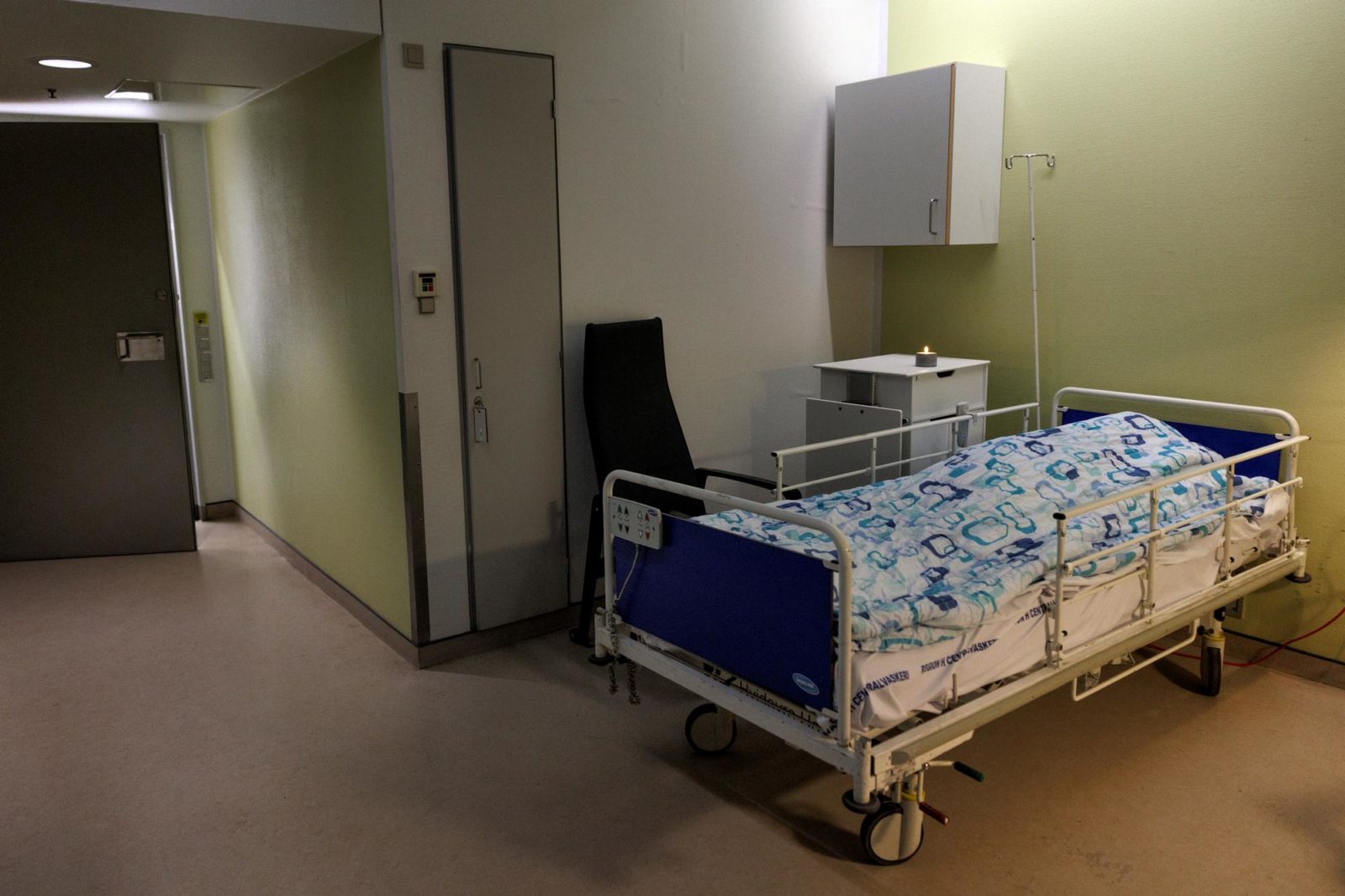
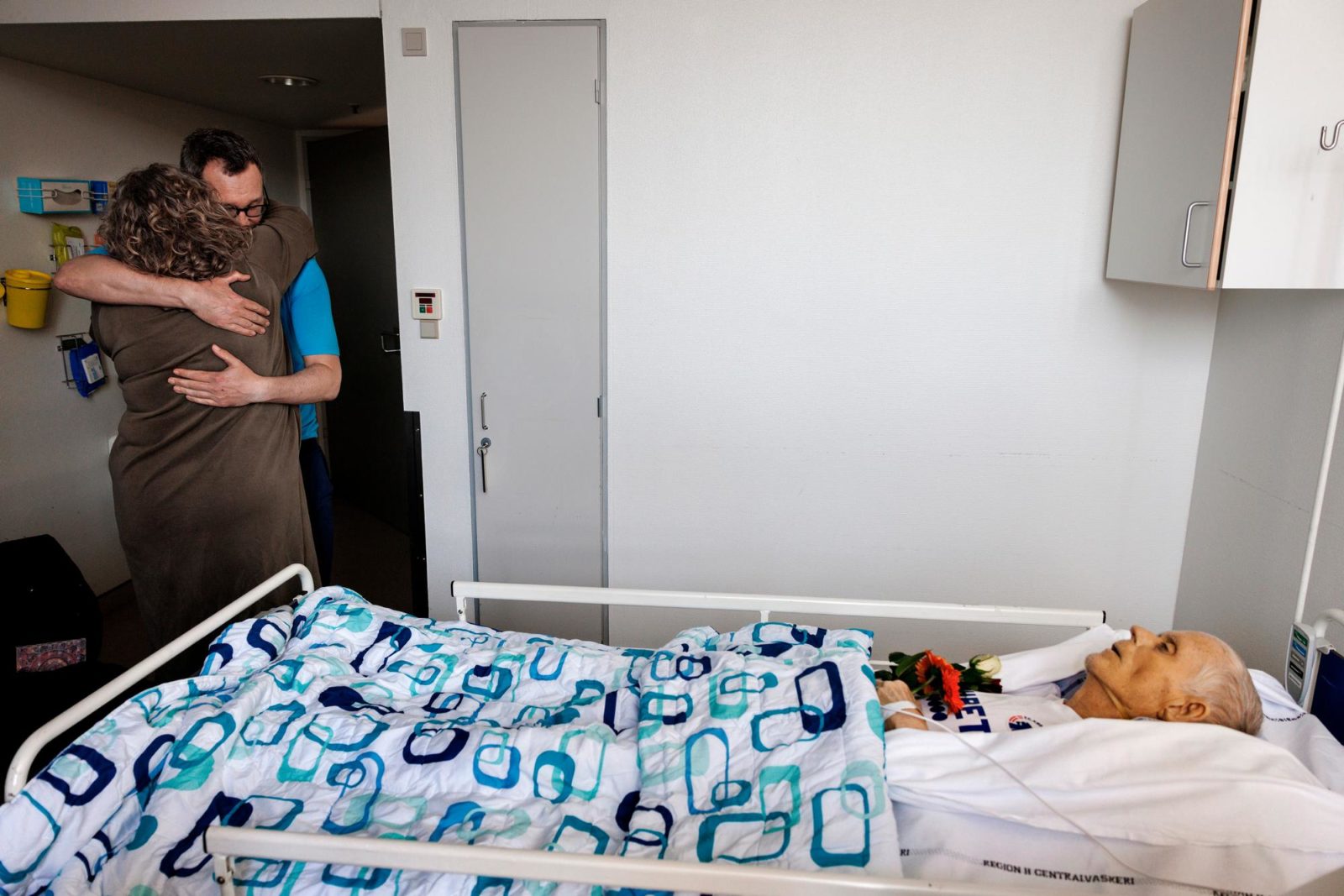
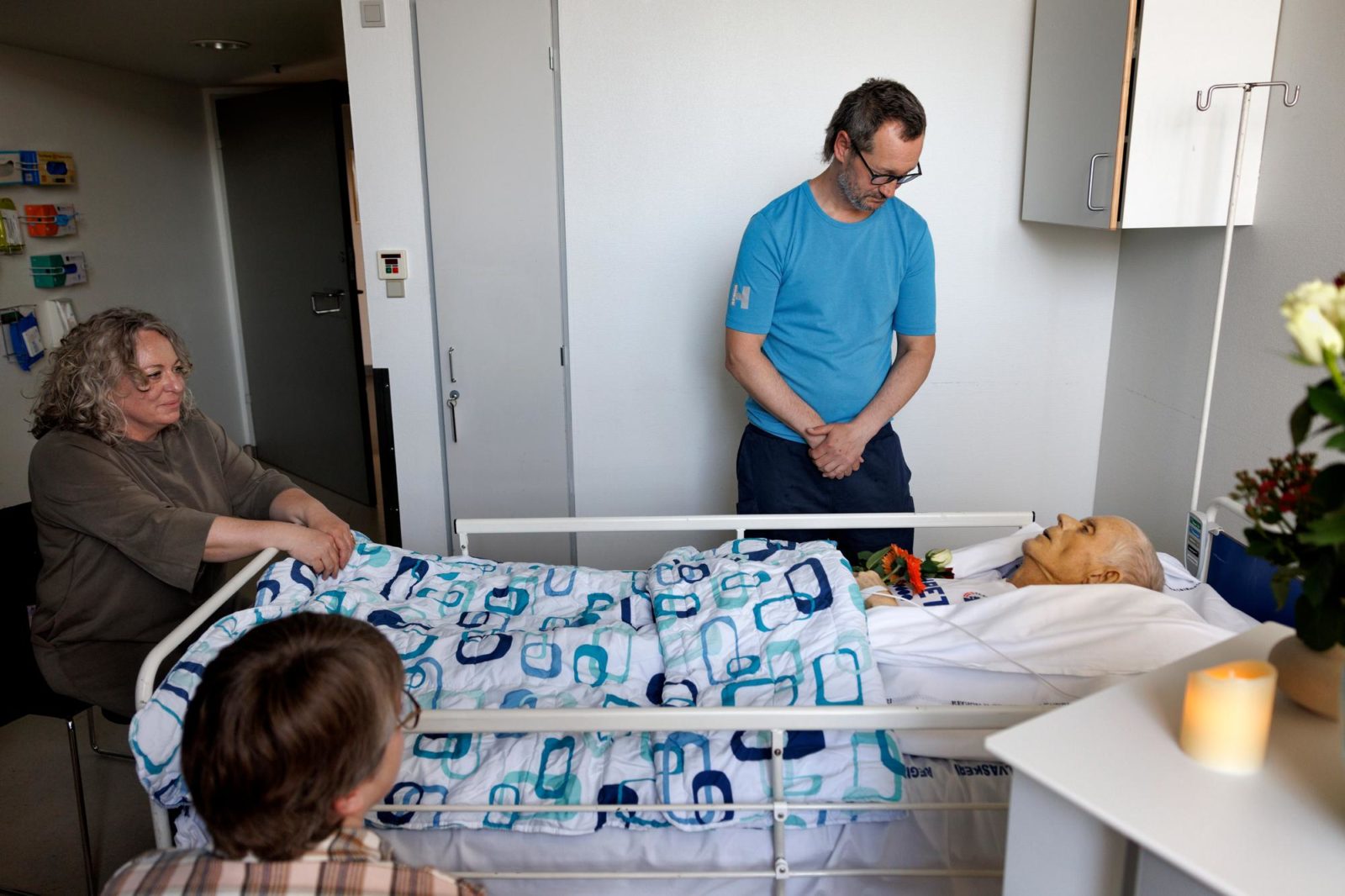
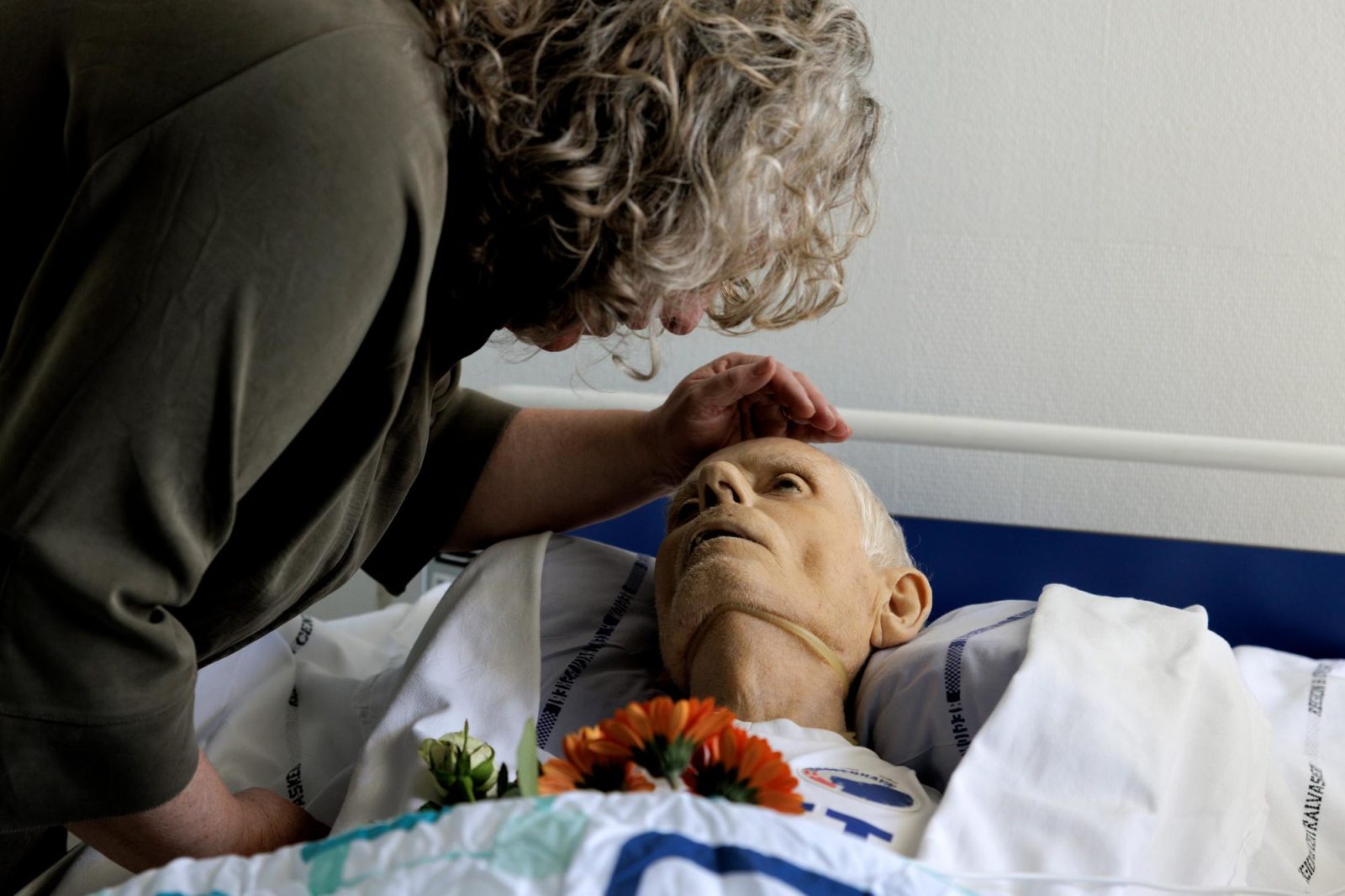
René Damgaard dies just after sunrise at 05:57. Afterwards, he lies peacefully in bed with a slight crooked smile. The morning light shines into the room, but behind René’s eyes, there is darkness.
Photograph: Jacob Ehrbahn
Photograph: Jacob Ehrbahn
Photograph: Jacob Ehrbahn
Dr. Johan Randén stops by to say goodbye before René is taken away. He stands for a long time, looking at René with his head bowed.
»He was a wonderful man«, he says.
Mette cries as she hugs the doctor.
»You have been so fantastic«, she says.
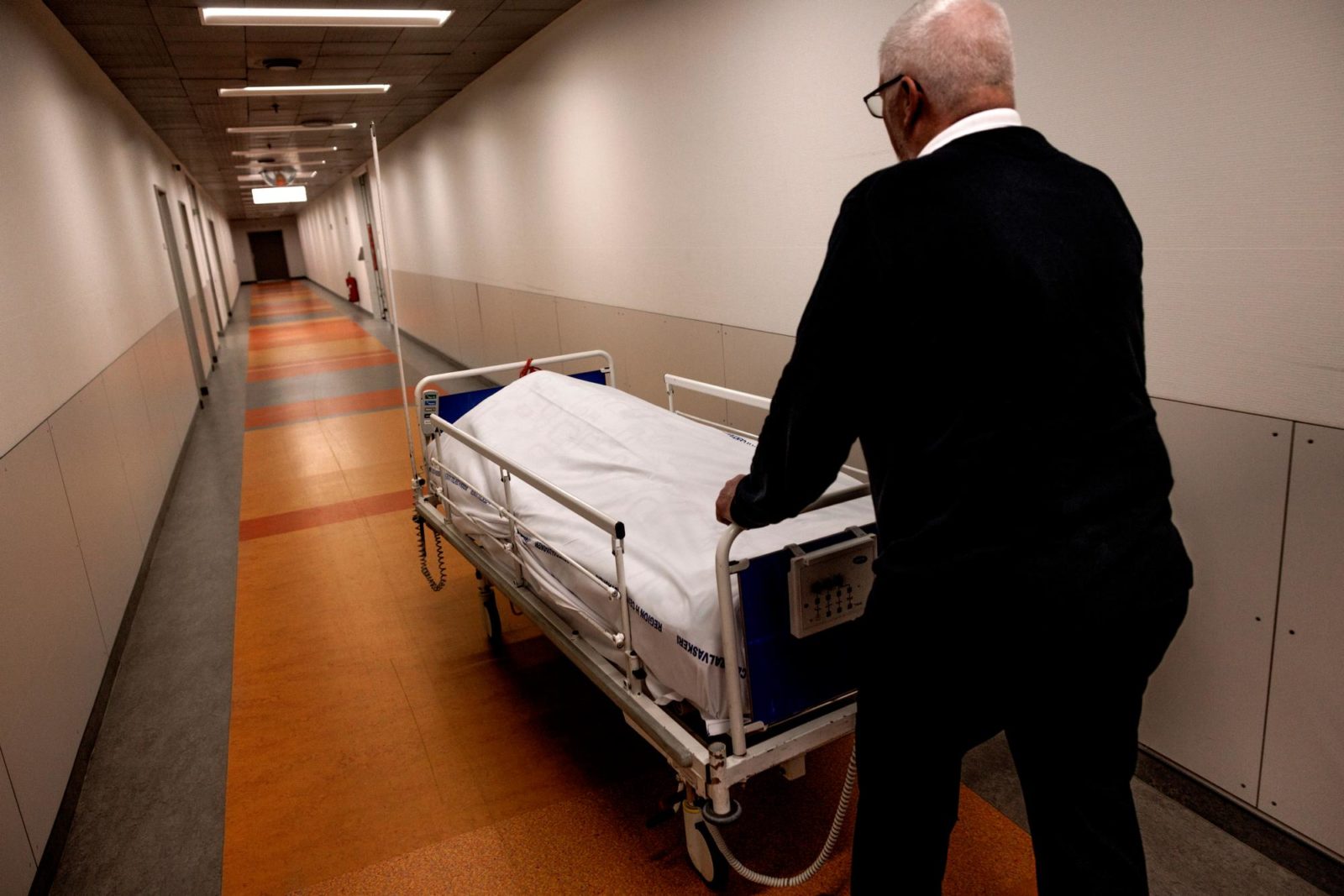
Mette’s sister has also arrived, and they stand side by side as the porter takes René to the chapel. He has been dressed in his Football Club København jersey. Between his hands, he holds roses and gerberas.
Photograph: Jacob Ehrbahn
Photograph: Jacob Ehrbahn
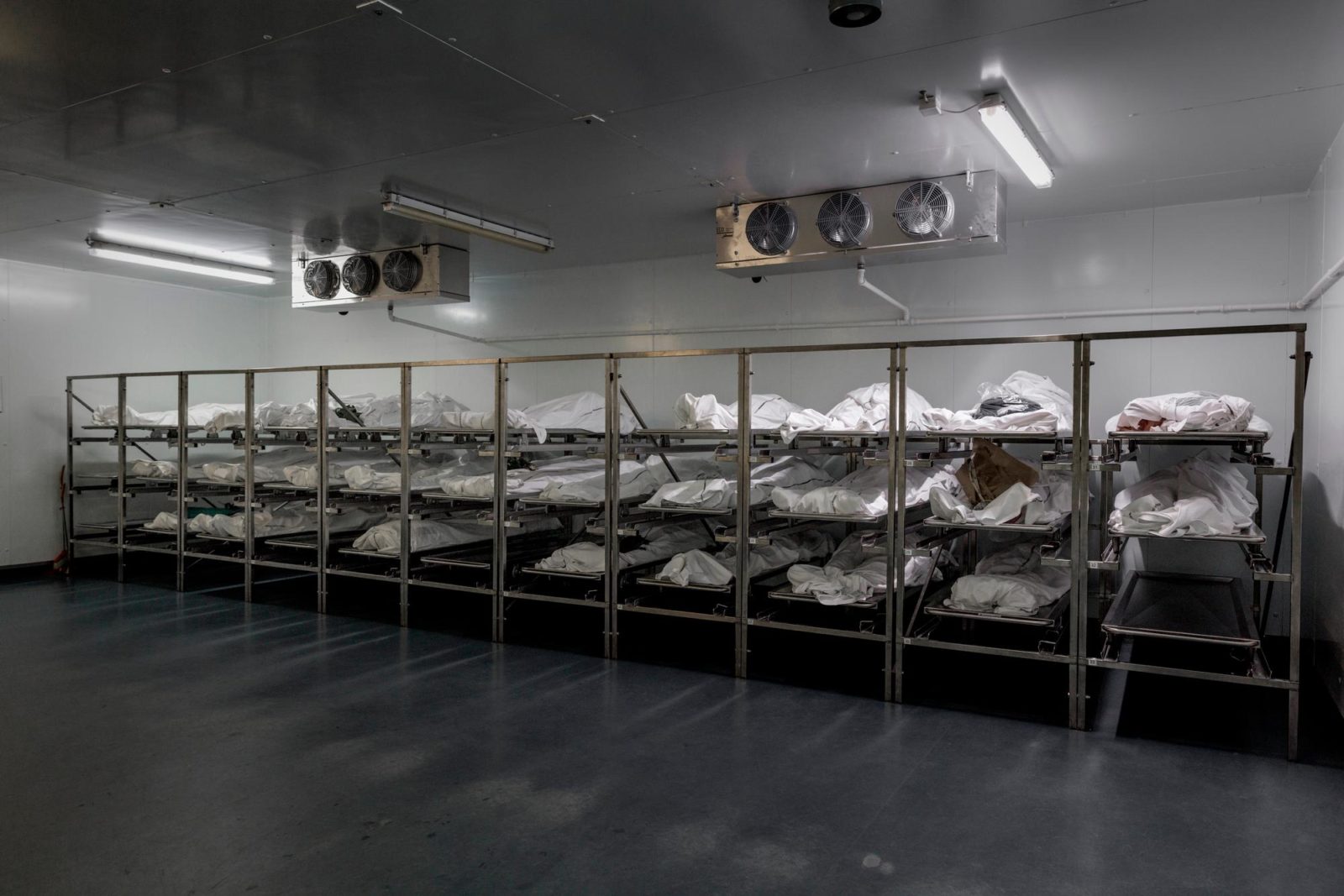
Photograph: Jacob Ehrbahn
René Damgaard was buried on May 15th.
Niels Abrahamsen died at the hospice on May 31st.
Liv Simonsen has returned home after a stay at the hospice.
Further Credits:
- Photojournalist, Jacob Ehrbahn
- Digital editor: Karina Kofoed
- Editor, Peter Schøler
- Editor, Christian Ilsøe
- Head of Digital Storytelling: Johannes Skov Andersen
- Leading editor in chief, Christian Jensen