

Vietnam Town
During the war against criminal elements at Moscow markets, the Moscow police have arrested more than 3 thousand illegal migrants since the end of July, most of whom are Vietnamese. How did these citizens of distant Asian countries end up in the basements of the Ancient Capital – The New Times investigates.
A concrete wall topped with a web of barbed wire extends far into the horizon; iron gates big enough for a wagon to pass through open a couple of metres, just wide enough for journalists in a narrow column to file into the tent camp in Golyanovo. About 513 Vietnamese citizens live here in khaki army tents, awaiting deportation. The press tour resembles a small African safari, where tourists are asked to take photographs only from the vehicle and not to stick their heads outside and remain close to their tour guide. During the “safari,” you occasionally encounter the broad-shouldered silent warriors of the OMON special mobile forces, and if you manage to get close to the “victim” you unsuccessfully try to talk to it. The people huddling on the other side of the metal fences do not understand Russian (or pretend not to). The well-dressed correspondent of TVC television channel on her high heels and with white make-up on her face insistently asks one and the same question: “Do you want to work in Russia?” The migrants nod their heads, until someone finally gives the long-awaited answer, “yes.”
Shower, laundry and fresh air…
“Shower, laundry, field kitchen, fresh air,” Anton Tsvetkov, the human rights activist and deputy chairman of the Public Commission of the State Directorate of the Ministry of the Interior in Russia, constantly praises the camp. He claims that the camp is much better than the temporary custody centre for foreign citizens where they have “no shoelaces, no fridges and all exercise is according to a timetable.”
The Vietnamese do not look unhappy, they are playing cards and badminton, washing their clothes, smoking tobacco from a long metal pipe, clearly meant for something else. The journalists are impatiently waiting for their “military interpreter” in order to speak to the residents of the camp. Not all of them, however. The TVC team filmed the official part and are ready to leave. But then something terrible happens: The press secretary of the State Directorate of the Ministry of Interior, Nataliya Safonova (sunglasses, flower print dress) catches journalists from the online site lenta.ru red handed. They found an interpreter from the Vietnamese embassy working in the camp who politely agreed to help them. Natalya begins to shout hysterically and literally pushes the journalists out of the camp. “The press conference is over for people like you. For you and for the other journalists. Take them away. Give me the contact details of your managers; they’ll explain everything to you.” The TVC camera crew gets involved and starts filming their colleagues from lenta.ru with the commentary: “Just look how the representatives of the so-called Mass Media are infringing the rights of journalists.”
Finally, Pavel, the “right” interpreter, turns up. We were banned from filming him and he spoke bad Vietnamese. He even had to use his dictionary for the word “religion”. When the journalists asked if there were any complaints, the Vietnamese answered in detail in a single voice. Pavel translated calmly: ‘Everything is fine, they have nothing to complain about.’ Perhaps Pasha was not telling the truth; perhaps the Vietnamese really were saying that they were happy with everything in the camp, it was impossible to understand. They answered the other questions as though they were being interrogated. “I came to Moscow as a tourist; I liked it and stayed here. I lost my passport and if I get deported, I’ll come back again…”
The uncatchable
Between 60 thousand and 1 million Vietnamese are living in Moscow according to different assessments. However, it is not an easy matter to find someone ready to talk to the press, even anonymously. Unlike migrants from Central Asia, Vietnamese migrants prefer to keep to each to other and not show themselves in public.
“I don’t see any benefit in talking to you, but I do see a lot of danger,” a Vietnamese businessman told The New Times. He has lived in Russia for a long time and really has nothing to be afraid of. “I don’t understand. Closed,” a Vietnamese guard angrily shouts at us at an industrial zone in the North of Moscow, where one of many sewing factories is situated. “The director’s not here. He doesn’t speak Russian. He’s busy. He’s leaving today,” the sales manager of the same factory who arrived at work that morning lied blatantly. The majority of the traders in the “Moscow” trade centre in Lublino silently nodded their heads when they realised that their visitor was not interested in jeans. The ones who were caught were those who didn’t manage to “forget” Russian in time.
Lio Din Thang who works as a security guard in a business centre not far from the Golyanovo camp told The New Times that even in his small village 400km from Hanoi there was an agency that sent workers to Russia. It was too expensive for most Vietnamese to visit the agency direct from the street; they tried to find friends or relatives to negotiate a reduction. Lio Din Thang was lucky. When he came to Moscow seven years ago, his uncle was already working here. He had found work as a security guard in the hostel where his compatriots from the famous Cherkizovskii Market lived. The market was closed and Russian entrepreneurs came to the business centre. Lio Din Thang remained living in a tiny 2×5 closet with shared facilities. Since his uncle found work for him, Le Din paid only 2000 dollar for a one year student visa and tickets. Now Lio Din earns about 15 thousand roubles per month and sends most of it home. In Vietnam the average salary is $40-50, but that’s just in theory because there isn’t any work there.
“In Vietnam everything is on a conveyor belt,” the chairman of the Society for the Protection of Rights of Migrants, Irina Zisman, explains to The New Times, “When two people are interested in each other, then there will always be a mediator who will help them find the path to each other. If you want to go to Russia to work, you can’t just go to the Russian Embassy. There are people who will sort out your passport, others will wait at the consular department, where they will offer to send you an invitation, others will help you find work. Can you do this yourself? We have a very popular “all inclusive” service. The entire process from getting the passport to the sewing machine can cost up to 5000 dollar. 2000 dollar is paid there, and the rest is paid on arrival.”
The future tailors and traders are met at the airport by representatives of the mediation companies. They help them cross the border and take them to their work place in the industrial zone. The doors are closed behind them and they might spend a year behind them not leaving the confines of the factory. But why? In the Vietnamese towns everything is Vietnamese. You don’t have to speak Russian and you have everything you need in order to live. A canteen, baths, shops with Vietnamese goods, medical facilities, Internet, Vietnamese books and newspapers, there are even karaoke and billiard events.
Of course, 5000 dollars is a fortune for most Vietnamese, so ordinary families can afford to send one or a maximum of two people abroad and they will feed the rest of their family in Vietnam. The money is borrowed, often against a property pledge. The interest rates are high, sometimes up to 20% annually. If the family is not too big and there aren’t any gaps in their salary in Russia, (sewers usually earn $300-$400, and market traders $500-$700), then the debt is paid off in about five years.
“If this had been organised in Russia, then there would have been “scams” at every step,” Irina Zisman says, “But the Vietnamese aren’t like that.” The salary is agreed in advance, most of it is immediately sent to Vietnam, the employer arranges accommodation, the volume and work and timely payment.
People in terms of quota
Tin Vu from the “Moscow” trade centre in Lublino proudly shows off his passport and tells The New Times that the annual extension of his visa and work permit costs him 1300 dollar. “We do it all through a firm,” he explains.
Of course, Tin Vu could have saved money if he had gone directly to the Federal Migration Service: Officially the cost of the quota for each worker is 6000 roubles per year plus the tax for issuing the work permit – 2000 roubles and the cost of the visa – 80 dollar, which amounts to 10 500 roubles. However, it is practically impossible to get the documents issued directly,” says Lin, a compatriot of Tin Vu, the manager of a Vietnamese restaurant. In her words, the FMS previously issued quotas easily but now they have begun to refuse them without any reasons or to issue far fewer than are necessary, forcing businessmen who want to work legitimately to turn to mediators or to force their workers to work illegally. “I know of some examples where the owner of a sewing factory received the necessary quota of 500 workers one year. He brought in the people he needed, then the next year he was given a quota of only 90. What was he to do? He couldn’t send them all back, could he?” Lin said crossly. “That’s why mediators are used to get work permits for everyone, even prostitutes. It’s just a question of paying!” In Lin’s opinion, quotas and all the documents need to be issued for a “minimum of three years, otherwise it’s impossible to plan and conduct business.”
Tin Vu came to Russia 23 years ago, under the rule of Gorbachev, and during that time has witnessed all the stages of development of Vietnamese business.
The first workers from socialist Vietnam started coming to the USSR after the signature of an agreement in 1981 with Hanoi allowing the appointment of Vietnamese to Soviet enterprises and universities. Tin Vu was allocated to a factory in Tver (although he worked there for more than a year, he has forgotten the name of the factory. He says he was employed as an engineer). After the collapse of the USSR, some returned home, but many remained in Russia, getting places in colleges to ensure student visas, but at the same time trading with whatever they could. Tin Vu did not go to college; he started working as a trader on a wholesale market, and he stayed in trade, having worked at almost all the Moscow markets over the past 20 years.
“Vietnamese like to imitate each other,” Lin smiles. “In 1993 the first wholesale market was opened, and a year later there were a number of such markets.” Chinese, Polish and Turkish goods were imported by Vietnamese and Chinese travelling traders and brought to Moscow. The Moscow Vietnamese sold these goods to Vietnamese in the regions. Markets were opened in former hostels or hotels, where the rooms served as both shops and homes.
Two years later in 1995, the first Vietnamese retail markets started sprouting out of the ground like mushrooms, almost half of Moscow bought their clothes from them. “In 2000 they realised: why bring Chinese and Vietnamese clothes here when it’s more profitable to bring the Vietnamese girls who make the clothes here,” says Irina Zisman. In recent years most of the sewing and trading hostels have been closed down, so the Vietnamese now live under ground. “In Moscow there are about twenty semi-underground Vietnamese towns, where about 600,000 people live. Everyone knows where they are,” Irina Zisman continues. “Administrative or manufacturing buildings that are either closed for reconstruction or officially demolished, are easily rented out to Vietnamese businessmen who fill them with thousands of their compatriots.”
They’ll never leave
The peace and calm of the residents of the Vietnam towns depends on the mood of the local police, representatives of the FMS and other services. Raids are a very rare event. They are normally restricted to planned and announced visits by representatives of the authorities, during which for appearance’s sake they check the documents of the exemplary workers and collect a “tribute” from all the others. Depending on the region the cost of peace and calm can cost between 1,000 and 3,000 roubles per person per month. Taking into account that up to 500 people work in the largest factories, this is not an insignificant catch.
“But if someone is picking on you and for some reason of statistic or policy you need to be arrested and deported, like the case in Golyanovo, then there are a load of ways of getting out of it,” says Irina Zisman. When foreigners commit a breach of residence terms in Russia, an expulsion mark should be placed in their passport and for a period of five years they cannot obtain a new visa, which means that all the money paid is simply wasted. Therefore, everything has to be done to avoid such a stamp in the passport. This can be done by leaving the Russian Federation and returning with a new invitation. The companies that acquire visas and work permits can also procure an exit visa without expulsion. It costs 500 dollar, but a ticket needs to be purchased, and then a new Russian visa is obtained in Vietnam. For many people this takes too long and is too troublesome. “You can get a visa and work permit in Russia, and send the passport back with an official of the Vietnamese embassy, who will place a stamp in the passport for crossing the border in Hanoi and Sheremetievo,” says Irina Zisman, “This service costs about 1,000 dollar.”
However, if you don’t have the money, you can just “lose” your passport, like the 513 “prisoners in Golyanovo” did. The Russian authorities cannot by law expel such a migrant, since his citizenship cannot be established. In this case they can obtain a certificate from the embassy allowing them to return home. They use it to return home and get a new passport and come back to Russia the same way as the first time. Or they can get a new passport directly from the Vietnamese embassy, but it costs a little more.
“In Vietnam the importance of a consul in any country is defined by how many clean passport covers he is given to take with him,” says Irina Zisman, “because if you want to obtain a passport in compliance with all the formalities, you will have to wait about three months, while the embassy sends an inquiry to your village and obtains an answer. Or you can pay 300 dollar and get everything done in three days.” The new passport does not contain any stamps relating to arrival, and so there can be no infringement of the period of stay. The holder can leave and come back again.
Actually it seems that the Golyanovo migrants have decided to ask the Vietnamese Embassy not to hurry to issue the certificates to return home. In the words of the human rights lawyer, Anton Tsvetkov, it is difficult even to determine the names of the arrestees since they use invented names. “All assumptions of the Russian officials about when they (the migrants) will be deported carry no weight, since everything depends on the Vietnamese embassy” says Anton Tsvetkov during the press tour of the Golyanovo camp. The Russian authorities once again appear to have overestimated their force when they made such a fuss around the arrestees. The 513 migrants hung around in Golyanovo, until the moment that Edward Snowden, who leaked the NSA documents, got stuck in Sheremetievo airport.
Irina Zisman knows a lot about the world of migrants and she says confidently, “Do you know why the Vietnamese were arrested? You can’t get a lot from the Uzbeks, and the Vietnamese are always willing to pay; either they or their employees always have set aside resources for such purposes. So you see, they will never leave.” •
The Organized Crime and Corruption Reporting Project
One of the articles written published by The Organizes Crime and Corruption Network is The Russian Laundromat. You can read this story here.
The Russian Laundromat
Call it the Laundromat. It’s a complex system for laundering more than $20 billion in Russian money stolen from the government by corrupt politicians or earned through organized crime activity. It was designed to not only move money from Russian shell companies into EU banks through Latvia, it had the added feature of getting corrupt or uncaring judges in Moldova to legitimize the funds. The state-of-the-art system provided exceptionally clean money backed by a court ruling at a fraction of the cost of regular laundering schemes. It made up for the low costs by laundering huge volumes. The system used just one bank in Latvia and one bank in Moldova but 19 banks in Russia, some of them controlled by rich and powerful figures including the cousin of Russian President Vladimir Putin.
It may be the biggest money-laundering operation in Eastern Europe — a virtual laundromat operating through banks and companies connected to powerful people in the region.
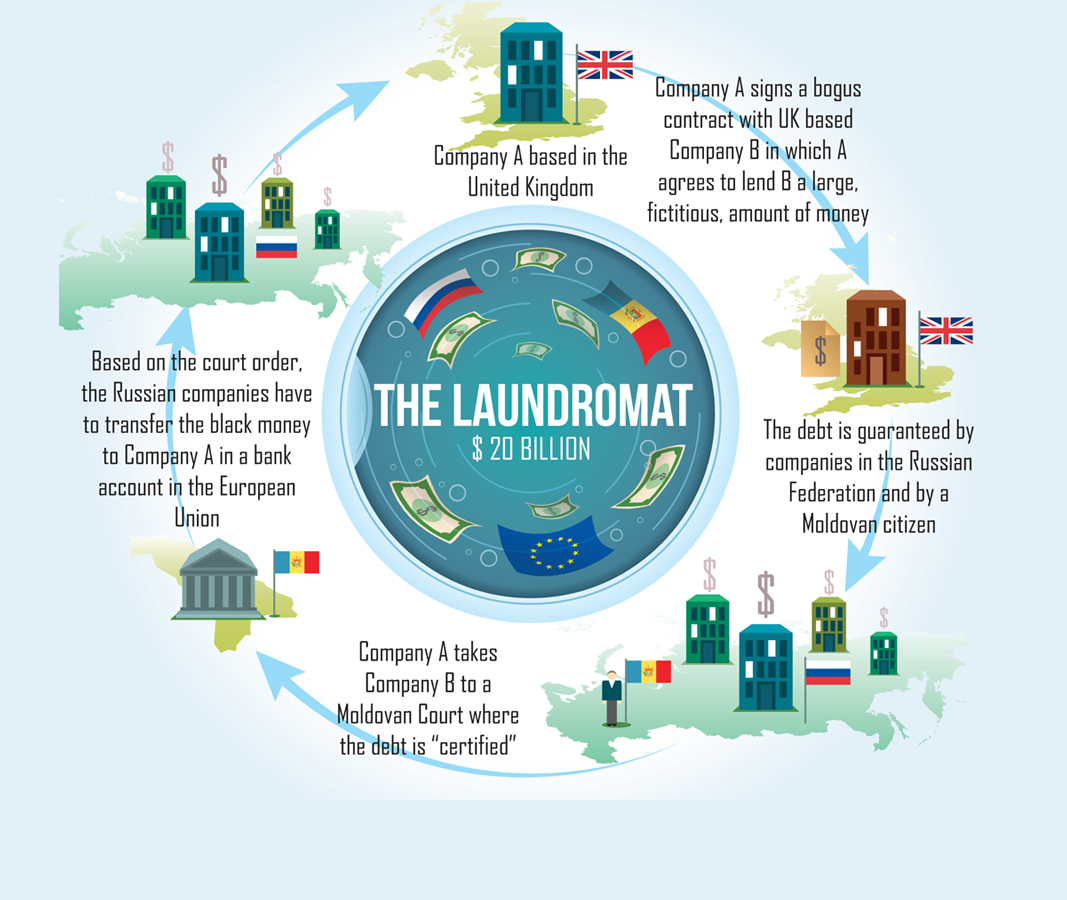
Between 2010 and early 2014, organized criminals and corrupt politicians in Russia moved US$ 20 billion in dirty funds through this laundromat’s complex cleanse-and spin cycle made up of dozens of offshore companies, banks, fake loans, and proxy agents. The process was then certified as clean by judges in the tiny Republic of Moldova. The newly cleaned funds were then spread across Europe.
Now law enforcement and prosecutors in Moldova are investigating the system. “Many judges and executors may go to prison” said Vasile Șarco, the head of the Money Laundering Prevention Unit in Moldova, which has been looking into the case since December.
The Organized Crime and Corruption Reporting Project (OCCRP) has worked through the system’s intricacies to uncover the methods and the partners who ran The Laundromat. The banks and companies involved are run by managers and board members that include well known businessmen, a cousin of Russian President Vladimir Putin, and persons said to be close to the KGB.
The key to the system was the involvement of Moldova, a country caught between its aspirations to join the European Union and its history of close ties to Russia. The scheme used Moldova to both provide legal protection against regulators through the country’s judicial system and a means to inject the illegal money into the European Union’s financial systems.
The Cleaning Cycle
The eternal problem with dirty money is explaining where it comes from. Crime is mostly a cash economy, and mobsters or dirty government officials can end up with massive piles of cash they don’t want to explain to anybody—especially tax officials.
The Laundromat was designed to create the illusion of business activity to explain the source of the money, backed by a court which signed off on the transactions to make them legitimate. The businesses, however, were phantom companies shielding the real owners.
A typical transaction began with two companies, often based in the United Kingdom and with their true ownership obscured in the offshore mists of a tax haven. The companies sign a bogus contract in which one agrees to lend the other large sums, although no money ever actually changes hands. It is likely that both companies are owned by the same owner but that ownership is hidden behind “proxy” figures.
The tax haven of choice in this operation was Belize, and the sums involved in each transaction were huge, ranging from US$ 100-800 million. The contracts in each case stipulated that the debt was guaranteed by companies in the Russian Federation, almost always run by a Moldovan citizen. This Moldovan gave the operation access to the courts in Moldova, which would ultimately permit the movement of the dirty money into the legitimate banking system.
The next step was for the “borrowing” company to refuse to repay the debt to the “loaning” company, thereby shifting the debt to the Russian companies who had guaranteed the loan. The “loaning” company then would take the matter to court in Moldova where a judge would issue an order “certifying” the debt as real and ordering the Russian company to pay.
Then the Russian company would transfer dirty money into an account set up by the “loaning” company. For every case, the money was sent to an intermediary bank called Moldindconbank—an institution connected to one of the country’s most powerful businessmen.
Finally the money was wired to the “loaning” company’s account, which was always at the Latvian-based Trasta Komercbanka.
And once it is in Latvia, voila! It is in the European Union, backed by a court order and clean and ready to use.
The OCCRP investigation found that 19 Russian banks, some already being investigated for money laundering, used The Laundromat.
Judging the Judges
More than 20 judges in 15 Moldovan courts helped launder the money. Over three years, they issued more than 50 court orders certifying about US$ 20 billion in debt. This is a staggering amount for a country such as Moldova that had a GDP of just under US$ 8.5 billion in 2013. Some of these judges are now under investigation while others have resigned.
The Laundromat opened for business on Oct. 22, 2010, when a British company called Valemont Properties Limited filed suit in a court in the Moldovan capital of Chișinău against the guarantors of a loan it had made to another UK company. The holders of that guarantee were a Moldovan man, Andrei Abramov, and two Russian companies: OOO LaitaM and OOO Spartak.
OCCRP found Abramov at his workplace, the Chișinău Airport. He said that he got involved with the Russian companies in 2010, right after he completed his civil aviation studies and was looking for a job.
“A friend from Canada put me in touch with a Ukrainian citizen whose surname I don’t recollect. We met in a Chișinău restaurant and he told me he has companies in Russia, Ukraine and the United Kingdom.” – Andrei Abramov
Abramov said the man told him he had a consultancy firm and wanted to open a branch in Moldova with Abramov as the manager. “It never happened though. I worked for them for four months and all I got was $100.” Abramov said he was directed to go to Chișinău’s main bus station, where he received packages of documents from Ukraine. Then he would send them onward to Russia. He said he was disappointed that the promises made about his new job were not kept. “I signed a document once for a court in Rîșcani where I said that I don’t have any objection regarding an ongoing trial,” he said.
OCCRP found out from border police documents that Abramov visited Ukraine four months before the Valemont Properties court case. Other Moldovan citizens used in Laundromat operations frequently travelled on the Chișinău-Moscow route.
The court case involving Abramov was tried by a Moldovan judge, Gheorghe Gorun, who certified the debt and ordered the Russian companies and Abramov to pay up. Gorun’s decision was enforced by a Moldovan judicial executor, Anatolie Chihai, who acted as a go-between.
Chihai opened an account with Moldindconbank to receive money transferred from Abramov’s Russian company, which was then transferred again into the Trasta Komercbanka account of Valemont Properties in Latvia. This money route—Russian banks to Moldinconbank to Latvian Trasta Komercbanka—was to be used in all of The Laundromat’s money transfers.
Trasta officials refused to comment on the cases.
OCCRP obtained banking statements that show multiple money transfers into Chihai’s bank account. Both Russian companies, OOO LaitaM and OOO Spartak, transferred billions of rubles that were exchanged for British pounds and sent onwards to Valemont. The money came to Moldova from accounts in two Russian banks, EB Transinvestbank OOO and KB Inkredbank.
Valemont Properties is involved in other Moldovan court cases aimed at recovering debts. In each case, the British company was represented by Ukrainian Bogdan Kuchay, 32. He is a director of OOO Prime, a Russian company founded in 2012, which lists as sole shareholder a Belize offshore company called Denison Limited. Denison has sued debtors in the same manner as Valemont.
Kuchay is involved in other controversial court cases as well.
Ukrainian Bogdan Kuchay became a main actor in another judicial case in Moldova in 2013 after he and fellow Ukrainian Roman Rybchenko, 22, acquired seven shares or 0.00014 percent of the share capital of the Moldovan insurance company, Compania Internațională de Asigurări S.A “ASITO”.
Investigators say they acquired these shares for the sole purpose of suing the company and blocking its bank accounts so that ASITO could not pay pensions to more than 8,000 Moldovan retirees.
A Chișinău judge, Svetlana Garstea-Bria, accepted Kuchay’s suit as valid and pensioners stopped getting money. The case is still on trial while the Moldovan National Commission for Financial Oversight asked the Superior Council of Magistrates, the governing body over Moldovan courts, to sanction the judge who accepted the case.
Bad Loans
The Superior Council of Magistrates (SCM) concluded in a May 27 statement that many rulings in debt recovery cases were issued illegally. The SCM says that the judges based their judgments solely on documents that had not been properly authenticated or notarized, a practice contrary to normal court procedures.
OCCRP reporters met with Valeriu Gîscă, one of the judges who issued five judgments for The Laundromat, in a parking lot next to the Moldovan Government building. He came to the meeting in a black SUV, wearing casual clothes. His rulings certified no less than US$ 2.1 billion that left Russia for offshore company accounts before he resigned in 2012. According to SCM, Gîscă put in his resignation request on grounds of ill health on Nov. 22, 2012.
On Dec. 18, Gîscă issued one final Laundromat judgment for half a billion US dollars, and three days later he was relieved of his duties. Now a lawyer, Gîscă says his rulings followed the law and did not hurt the Moldovan financial system or any bank and just affected one citizen.
“Each time, a guy from Chișinău presented me with paperwork showing that the parties involved had no objections in the court case. These documents were authenticated at the highest possible levels,” he said adding none of his rulings have been overturned.
“If someone laundered money and used us, it is up to the Moldovan law enforcement to prove it. I don’t know who could possibly be behind it and I had no idea that other judges issued the same kind of rulings in Moldova,” Gîscă said.
OCCRP tried to talk with Svetlana Mocan, a judicial executor who enforced many of The Laundromat rulings. Nearly US$ 17 billion in transfers went through her bank account. Mocan would not meet with reporters or answer questions. She said only in a phone conversation: “I don’t have the right to give you information. I won’t give you any.”
Șarco, who leads the Money Laundering Prevention Unit, said the rulings did not follow the law and were not based on proper documents. “We are also going after persons in the banking system. We have three ongoing penal cases and another two are about to be initiated. There are two penal cases opened in Latvia and Estonia, too.”
Șarco said his office started a case against an executor in February of this year and in March arrested another executor.
On July 22, Moldovan Prime Minister Iurie Leancă proposed a set of laws that, if Parliament passes them, would end impunity for judges implicated in money laundering.
Russian Companies, Moldovan and Ukrainian Proxies
Moldovan law enforcement believes that more than 90 companies registered in the Russian Federation were involved in The Laundromat system, making thousands of transfers into bank accounts in Moldova and, from there, onward to offshore companies’ bank accounts.
OCCRP investigated the ownership of some of these companies. It found a number of cases in which directors and shareholders were citizens of Moldova and Ukraine. They appear to be proxies, fronting for the real people behind the money schemes. One example was OOO Proffstandart, a Russian company, listed with four other commercial entities in Moldovan courts with a debt of half a billion US dollars to the Scottish company, Westburn Enterprises Limited.
The majority shareholder of OOO Proffstandart is Ruslan Siloci, 31, from Căușeni, a small town 70 kilometers from the Moldovan capital and 40 kilometers from Tiraspol, the main city in the separatist region of Transdniestr. Căușeni is the hometown of a powerful businessman, Veaceslav Platon, whose father, Nicolae, is head of the local Moldindconbank, the main Moldovan bank engaged in The Laundromat’s money transfers.
Siloci lives in the outskirts of the city in his grandparents’ home. When OCCRP reporters visited on June 19, the door was locked.
“He comes and goes,” said a saleswoman in a nearby shop. “He is a good boy. Are you here to take some money from him? I owe him US$ 100.”
Just then the women pointed out Siloci in a blue Mercedes.
Siloci lit up a cigarette and asked if we’d tried to get in touch with him day before. “My wife told me someone was looking for me,” he said. “I just got back from Ukraine. I went to Odessa to pick up some goods. I’ll make US$ 300-400 for this.”
Siloci said Proffstandart has been closed. “I have different businesses now. I’m dealing with construction materials. It’s hard, not easy to start over.”
OCCRP asked Siloci why his company got entangled in debt. He said he was approached by “clients” who offered him a money making deal.
“I’ll clarify one thing for you. This is how business is done in Moscow. There’s nothing new about it. They looked me up, they found me for the transfers. It wasn’t just me, there were many others.” – Ruslan Siloci
Siloci would not talk about how much money he earned as a proxy. “It’s confidential, a trade secret. Nobody will tell you how it worked. I know there is an investigation on this in Moldova but nobody called me up from the prosecution.”
OCCRP found that Siloci is also sole shareholder of a Moldovan company, Prodpozitiv SRL, against which authorities lodged a criminal case in 2009. He and his firm were suspected of smuggling meat. “This case is in court now. It will take forever to judge,” he said. “I just brought pork instead of chicken from Russia. That was all. I’m reorganizing the company right now. I have a few shops right now here in Causeni.”
If I Had Half a Billion…
Evgheni Vîborov is another Moldovan citizen involved in the Westburn scheme. The 33-year-old driver for an express delivery service in Chișinău is listed as a shareholder and director of the Russian firm OOO Komtehkomplekt. He denied doing anything wrong and was worried to hear about his involvement in a suit over The Laundromat.
“I was in Moscow in 2009 when someone I knew there advised me to buy a company,” Vîborov said. “I was taking care of computers and other technical equipment. In about 2012 I shut down the company and came back to Chișinău. I believe I have given power of attorney to someone but it was long ago and I don’t remember.
“Nobody gave me money and nobody looked for me,” Vîborov said. “I wouldn’t have had to mortgage my house, I’d have my own car and I wouldn’t be working as a driver if I had received money. It never crossed my mind that my company is involved in such a court case,” said Vîborov.
“If I’d had half a billion I’d have donated it to an orphanage.” Moldovan Parliament member, Nae-Simion Teodor Pleșca, bought Vîborov’s neighboring apartment for US$ 53,500 to expand his own apartment. Vîborov still uses it as his official address. “Evgheni is a troubled boy. I believe he was used in money laundering. I think someone tricked him,” Plesca said.” •