

The Cowardice of Nigel Farage
Nigel Farage is a coward, yet Cameron and Miliband are too gutless to attack
At Rochester, the main party leaders showed they are too frightened to take on Ukip’s rabble-rouser in chief
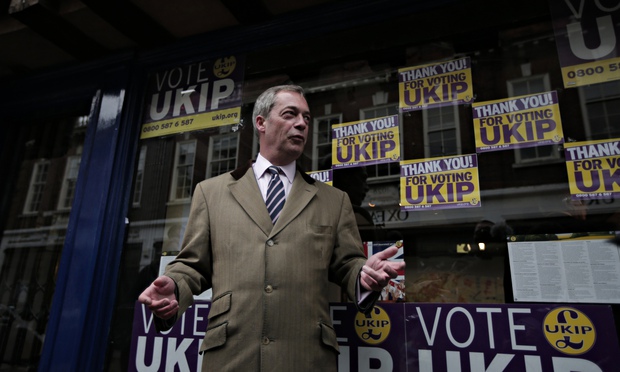
©Lefteris Pitarakis/AP
You cannot describe Ukip as a far-right party without running into trouble. Respectable commentators tell you that, while individual members may be neo-fascists and that while Ukip had indeed allied with far-right parties in Europe, it does not come from fascist tradition. And I just about accept that.
Hardly any commentator, respectable or otherwise, notices that Nigel Farage has created his own stab-in-the-back myth. The treacherous “Westminster elite” so despised the decent people of Britain that it flooded the land with foreigners who “took our country from us”. This is the manure in which far-right movements have always grown. But, once again, if anyone objects, I accept that Farage is not a führer or duce.
Rather than arguing about labels, let us agree to allow the facts to speak for themselves. Farage is a rabble-rouser and a coward. He plays with racism, the way Ian Paisley used to play with sectarianism: whips it up, then backs off just before he can be accused of inciting violence.
He does not attend the meetings of the European parliament to defend British interests but pockets the money of the “hardworking taxpayers” he affects to represent and skips away. He claims to be a patriot while defending Britain’s enemies in the Kremlin. He claims to be the friend of the working man, while slapping down his economics spokesman for proposing tax rises that would hurt his backers in the City.
As for the men and women he leads, Ukip candidates and donors have suggested they want to drive Lenny Henry out of Britain because he is black, bar women from the boardroom and stop gays from having sex because as, everyone knows, God punishes the sin of Sodom by flooding the Thames Valley.
If you cannot call Ukip a far-right party, you can at least say that it is an alliance of the septic and the geriatric: a movement of the empty-headed led by the foul-minded.
It tells you everything about the absence of principle in the mainstream parties that they don’t even try to beat Farage. Political commentators could not have been more foolish when they believed David Cameron’s promise to “throw everything” he had at stopping Ukip winning in Rochester.
Cameron may have thrown money and marketing strategies, but he did not throw punches. The Conservative attack on Ukip’s ideas never came. Cameron, who once presented himself as a moderate, instead conceded acres of ground to the extremists, no more so than on the immigration question.
As late as March 2013, Cameron was careful to preface a speech proposing restrictions on immigration by praising “Polish heroes who fought for us during the war, West Indians who helped us to rebuild afterwards, those who’ve come to our shores seeking a safe haven from persecution”.
He understood the dangers of provoking hatred and worked to ensure that no racist party or thug, and no employer or landlord looking to exclude blacks, could find comfort in what he said. You no longer hear Cameron insist that most immigrants are good and hardworking people. He has abandoned the centre and veered to the right. The good manners he learned at Eton have deserted him on the way – and what is the point of having an old Etonian if he doesn’t know how to behave? The new Cameron wants to show Ukip voters that he is just as right wing as Farage. Even when Mark Reckless proposed the repatriation of immigrants living in Britain, the Tories did not hammer him for fear of appearing soft.
Alex Massie of the Spectator brilliantly summarised Cameron’s strategy of never allowing Farage to outflank him on the right by saying that it came down to the slogan: “Ukip are right: don’t vote for them!”
The funeral of Cameron’s gutless strategy came when a desperate prime minister appealed to the centrists among Labour, Green and Liberal Democrat supporters in Rochester to vote tactically to stop the extremist Ukip candidate winning. Reasonable people could not see the difference between the extremist Cameron and extremist Farage and ignored him.
Cameron’s capitulation carries a warning. He won’t fight Ukip not only because he is frightened of Farage but because he is a prisoner of his party’s right. If he wins the next election, we now know that he will keep capitulating because he is a leader without honour or inner strength, whose own cynicism defeats him.
Not that Ed Miliband is any better. Cameron has tried and failed to pull the political insiders’ “triangulation” trick, practised by Bill Clinton: get close to your opponent (Ukip in this case), steal his votes and victory is yours. Miliband has tried to follow the “core vote” trick of George W Bush and Barack Obama: get out Labour’s “core” – about 30% of the electorate – throw in old Lib Dems, who cannot forgive the Tory alliance, that’s another 5%, and, eureka!, our strange electoral system will deliver victory. Like a child building a house out of Lego bricks, Miliband thought he could pick up the handfuls of voters he needed for victory and forget about the rest.
A friend should have told him that astounding condescension lay at the heart of his “35% strategy”. Labour assumed that its “core” supporters would not listen to anyone else; that, even at a time of economic distress and political disintegration, Labour “owned” them.
For years now, I and others have been waiting for Miliband to launch a sustained attack on Ukip with whatever vigour the poor thing could manage. But even in this year’s European elections, he preferred to ignore a radical rightwing party, which was heading for victory, and emptied his revolver into the corpse that was once Nick Clegg. You see it was more important for Miliband to remind his Lib Dem Lego bricks that they should stick with Labour rather than fight a foul stain in national life.
Ukip will not be beaten until those in all parties, who know that most immigrants are not the scrounging scum of Ukip nightmare, say clearly that the debate must be about numbers, not race. It will not be beaten until people who believe in maintaining Britain’s place in the world accept the need for reforming the European Union, but tell the electorate that we will founder if we leave.
It most certainly will not be beaten by David Cameron and Ed Miliband, who give every appearance of believing that you can win a battle without fighting it. •
Nigel Farage is a phoney. Scrutinise him and he’ll crumble
Instead of tearing into the preposterous Ukip leader, Britain’s famously aggressive media have made him a celebrity
Allow me to sketch you a portrait of a political leader. Even by the lax standards of the powerful, he is England’s greatest living hypocrite. He courts popularity by warning that tens of millions from the dole queues of Europe are coming to take British jobs, while employing his German wife as his secretary. He denounces “the political class” for living like princes at the taxpayers’ expense while pocketing every taxpayer-funded allowance he can claim for himself, his wife and his colleagues.
He says he represents “ordinary people”. But he is a public school-educated former banker, whose policies will help him and his kind. He claims he is the voice of “common sense”, while allying with every variety of gay-hater, conspiracy crackpot, racist, chauvinist and pillock. The only sense he and his followers have in common is a fear of anyone who is not like them.
You might expect that Britain’s famously aggressive media would tear into his multiple deceits. Yet so tame has their treatment of Nigel Farage been, so indulgent and complicit, viewers were surprised when the BBC’s political editor found the courage last week to raise a timorous voice and ask him why he was employing his German wife rather than giving a British job to a British worker. Broadcasters are ferocious when they tackle mainstream politicians, but are as eager to please as wet-tongued labradors when they meet Ukip. To understand why, you need to grasp how the political culture of modern democracies encourages both conformism and zealotry.
Broadcasters say they give Britain’s representative of Europe’s rightwing wave such prominence because Farage is good on television: a cheeky and witty guest rather than a formulaic political pro. As Hollywood doesn’t cast ugly actors as romantic leads and radio producers seldom hire presenters with stammers, accusing broadcasters of double standards because they favour people who are good on television feels as absurd as accusing Brendan Rodgers of bias because he picks gifted footballers to play for Liverpool or publishers of prejudice because they commission authors who write well.
Media managers would have every right to sneer at bland “professional politicians”, and promote exciting alternatives, had they not helped create the soundbite-spouting robots they are so keen to denounce. With the arrival of 24-hour news, they had to fill hours of empty schedules. Every ill-considered statement by a politician became a “gaffe”; every disagreement with the leader a “split”. Ambitious politicians responded by saying nothing that might be used against them. Social media and mobile phones have accelerated their desire to march in step with the herd. Now a public figure must behave as if they are on camera whenever they are in a public space.
I am not trying to excuse our leaders. Political parties, private companies and public bureaucracies need to relax if they want a hearing in the 21st century, and stop treating the smallest deviation from the party line as an “unprofessional” affront. But it is rich of broadcasters to preach against professional politics when they were its midwives, and sinister of them to promote fanaticism as a cure for the boredom it generates.
For in the kingdom of the bland, the intolerant man is king. British and US TV have turned newspaper pundits into minor celebrities: a curious addition to the Z-list that makes little sense until you realise that the pundit is free to posture and foam and provide the gladiatorial aggression that will keep the audience from reaching for the remote. Extremist politicians such as Nigel Farage and George Galloway serve the same purpose. They don’t have to worry about breaking party lines because their parties are their own private personality cults, which believe whatever they tell them to believe.
Mainstream politicians, who have abandoned plain speaking, should blame themselves when viewers turn away, of course. But they cannot be blamed for the broadcasters’ abnegation of the basic journalistic responsibility to ask questions without fear or favour.
To pick one of hundreds of examples, Ukip had a party political broadcast featuring “ordinary people” last week. A builder complained that foreigners had taken his job. As you might have predicted, the builder turned out to be an obsessional creep, who thought that Ed Miliband wasn’t British because his parents were refugees from Hitler. My friends in the anti-fascist group Hope Not Hate have files the thickness of telephone directories on how Ukip recruits every species of bigot from women-haters to neo-Nazis. They are open for journalists to inspect. But when Farage announced that he was suspending the builder from his party, the media were satisfied and did not ask him why he attracts and retains thousands more like him. They would never let a mainstream leader escape so lightly.
The English have a strong desire to avoid seriousness, a character trait that makes England both an attractive and a remarkably gullible country. We too easily dismiss people as performers putting on a show. “He can’t really mean that,” we say as the far-left politician salutes Saddam Hussein after he has ordered the genocide of the Kurds, or defends Bashar al-Assad as his forces torture civilians. “He isn’t being serious,” we say, as the far-right politician declares his admiration for Vladimir Putin and signs up members who want to kick out the blacks.
Experience has taught English media managers in particular to believe that no one means what they say. Editors demand opinion pieces that confirm their readers’ prejudices and find willing hacks who will write as required, regardless of whether they believe what they say or not. In broadcasting, BBC researchers call and ask thousands of journalists and intellectuals to take a genuinely held belief and reduce it to absurdity. “Would you come on and say that 2+2=5?” they ask. You refuse. They hang up and phone round until they find someone so desperate for attention that they will say it.
When considering Ukip, we should remember the advice of Lord Renwick, a Foreign Office mandarin and Labour peer. He told young diplomats from good families that their background made them suckers for “the Wykehamist fallacy”. When they went abroad, they were in danger of believing that foreign potentates merely struck blood-curdling poses for effect. For all the bombast, they would think that, underneath, these must be civilised men with an ironic sensibility who might have been educated at Winchester. “They haven’t,” said Renwick. “Actually, they’re a bunch of thugs.”
The same should be said of Ukip.
Ukip’s rise threatens the left as well as the right
That Nigel Farage can speak to former Labour voters ought to be a matter of shame to the British left and a call to arms
The British centre-left has been tempted to ignore Ukip – the most powerful movement of organised stupidity in recent British history – even to welcome it in a quiet way. Conventional wisdom holds that Labour’s hopes of winning the next election depend on the rightwing vote splitting. Ukip are the splitters, who will let the left come through the middle in marginal seats.
Beyond electoral tactics lies a regard for populists who are anti-establishment. George Galloway may have crawled up the posteriors of half the dictators on the planet, while Alex Salmond may want to place barriers between the English and the Scots where none has existed for 300 years, but at least they are sticking it to the “system”. Likewise, Farage is a card, who hounds the professional politicians – and all those other pampered elitists who rip us off and ruin our lives.
A look at January 2014 shows that you have to forgive and forget a great deal before you can treat Ukip with anything other than hostility. Farage disowned the entire 2010 Ukip manifesto – and not in the open manner of an honest politician admitting to past mistakes. Instead, he pretended he knew nothing of his party’s promises for a dress code for taxi drivers and a state-enforced repainting of the nation’s trains in traditional colours. Imagine if anyone else in public life said that a document they had put their name to, and called their own, was “drivel” and tried to avoid awkward questions by pretending that they had never read it. At a minimum, they would be greeted with guffaws of incredulous laughter.
Not knowing when to stop, Farage, who has the nerve to pose as a politician who is tough on crime, went on to opine that the ban on handguns after Thomas Hamilton murdered 16 schoolchildren in Dunblane was “ludicrous”. It was left to John Crozier, whose five-year-old daughter, Emma, was among the fallen, to say that the disarming of angry men had meant no other family had to hear that their children had died in a gun massacre since.
Beyond the Farage farragos, one Demetri Marchessini, a Ukip donor, paid for an advert in the Telegraph to announce his abhorrence of homosexuality. He praised the opportunist homophobia of the Putin regime and added that “homophobic” was not be a real word in any event. “Anyone who uses it is uneducated because it mixed Latin and Greek.” It says much about Ukip’s failure to uphold traditional standards that the half-educated oaf did not know that “homo-” and “-phobic” both derive from the Greek.
I could go on. Ukip’s obsession with what gay men do with their bodies was manifest in the remark of an Oxfordshire councillor that the recent floods were God’s punishment on England for allowing homosexuality. Meanwhile Arthur Misty Thackeray, Ukip’s Scottish leader, claimed that Glasgow council was run by a hitherto unknown conspiracy of “gays, Catholics, and communists”.
For all that, Ukip still attracts 17% of the vote in our poll this week. It is not only a large political force in its own right but has large effects on all around it. How many of the 90 or so Tories tearing their party apart are de facto Ukip supporters is unknowable. A few hate David Cameron so much they form a Faragist fifth column. Most, however, are frightened. If they don’t rebel on Europe, immigration and human rights, they know that Ukip may deprive them of their seats by using their failure against them. A “revolt” out of fear isn’t a revolt but a capitulation.
And Cameron is capitulating too. He is frightened of taking on his own backbenchers, who are frightened of taking on Farage, because he does not want the public to see what he is: the John Major of the 2010s. You could argue the capitulation extends to the centre-left, which is relearning the old lesson that in hard times people look to themselves and their families rather than wider notions of the common good.
In other words, Ukip’s success as fearmongers has sent a flood of fear cascading down the political system.
For 100 years, the most reassuring feature of British society was that it did not vote for extremist parties. Far left and far right have pushed their conspiracy theories and shouted their slogans until they were hoarse: all in vain. But Ukip is breaking with the past. Hope Not Hate, which had campaigned with great success against the BNP, discussed last year whether it should fight Ukip too. On one hand, it reasoned, Ukip is not a neo-fascist party with origins in European totalitarianism. On the other, well, just look at the bigoted rabble. Hope Not Hate decided to go for them because it understood that Ukip has made extreme hatreds respectable.
Xenophobic voters who wouldn’t have supported tattooed men with beer bellies hanging over their belts will vote for Farage. As local, European and parliamentary election results make clear, many of them once voted Labour. That Farage, a City man, who offers nothing that might improve their living conditions or job security, can speak to them ought to be a matter of shame to the British left and a call to arms. On some issues, there can be no compromise: racism and other phobias.
But a toning down of political correctness would be most welcome, as would an abandonment of the jargon-filled language of the intellectual left, which ordinary people cannot understand, and know without needing to be told are not meant to understand either. A robust campaign to tell Ukip supporters and, indeed, business leaders who foolishly ally with the Tories, that Britain cannot afford to leave the EU would also be in order. So would an attempt to build a populist social democracy, which, for all their faults, Ed Miliband and his supporters are trying to do.
In their forthcoming Revolt on the Right, the academics Robert Ford and Matthew Goodwin will present convincing evidence that in the long run Ukip will hit the left harder than the Conservatives.
Even if they are wrong, and even if in the short term Farage sends Miliband to Downing Street, it is not good enough to stand by while chancers sell millions of our fellow citizens every prejudice known to man and invent a few new ones besides. Left and right are not divided by some Berlin Wall. The one affects the other. A successful far right will poison the whole of politics. The best course is to hit early and hit it hard. •
How to produce dead guerillas
“So you are the mother of the narcoterrorist leader”, the prosecutor of the city of Ocaña told her.
“No, sir. I am the mother of Fair Leonardo Porras Bernal.”
“One and the same, then. Your son was the leader of a guerrilla group. They had a shoot-out with Mobile Brigade 15 and he died in combat. He was wearing a guerrilla uniform and was holding a 9-millimetre gun in his right hand. The evidence shows that he used the weapon.”
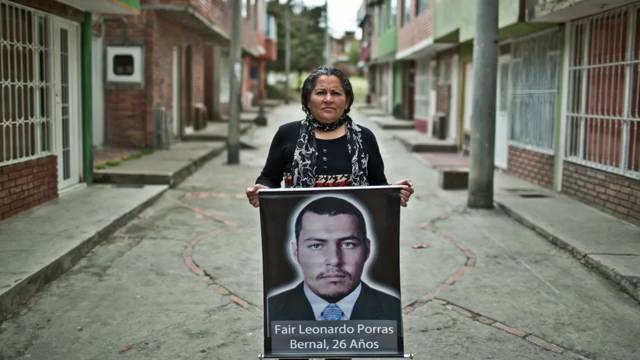
©Pablo Tosco (Oxfam Intermón)
Luz Marina Bernal pointed out that her son Leonardo, age 26, had been mentally limited since birth, that his intellectual capacity was that of an 8-year-old, that he had never learnt to read and write and that he had a certified 53% disability. She told the officer Leonardo suffered from paralysis on the right side of his body, extending to the hand they said he had used to shoot the gun. He disappeared on January 8 and was killed on the 12th, seven hundred kilometres away. How could he be the leader of a guerrilla group?
“I don’t know, ma’am, this is what the military report says.”
Around twenty soldiers were guarding the mass grave where Luz Marina went to retrieve her son’s body, blocking her view. They gave her a sealed coffin. Eighteen months later, during the investigation, the coffin was reopened. It contained a human torso with six vertebrae and a skull stuffed with a t-shirt replacing the brain. They were, indeed, the remains of Leonardo Porras.
This is one of the cases that helped uncover the scandal of the false positives: members of the Colombian military were kidnapping young men from the slums, taking them hundreds of kilometres from their homes, killing them and passing them off as guerrilla fighters shot down in combat, in order to collect the bounties that had secretly been offered by the government of President Álvaro Uribe. The term ‘false positives’ refers to this fabrication of evidence.
Nineteen women whose sons were kidnapped and murdered by the military in early 2008 created the group Mothers of Soacha, demanding justice. By mid-2013, the Chief Public Prosecutor’s Office had received 4,716 reports of homicide allegedly committed by public officers (among them, 3,925 were cases of false positives). Navanethem Pillay, the United Nations High Commissioner for Human Rights, has reported that the investigations are few in number and very slow, that the soldiers linked to the crimes remain in service, are even promoted, and that their crimes are granted ‘systematic impunity’.
“We picked the dimwits”
Leonardo Porras disappeared on 8 January 2008 in Soacha, a slum on the outskirts of Bogotá. The city has been flooded with thousands of people that have become displaced by the Colombian conflict and hosts thousands of immigrants from around the country. Over the last twenty years, Bogotá’s population has increased from 200,000 to 500,000 inhabitants, many of whom are crowded into brick shacks with tin roofs, stuck in shanty towns crossed by invisible borders between paramilitary groups and traffickers.
At noon on January 8, Leonardo received a call. The only thing he said to the person on the other end of the line was “Yes, boss, I’m on my way”. After he had hung up he told his brother, John Smith, that he had been offered a job. He left their home and was never seen again.
In Soacha, everyone knew Leonardo, the ‘special education’ kid who always signed up for community work, who cleaned the streets and parks, worked at the church and ran errands for neighbours in exchange for tips. Some would take advantage of his enthusiasm: they made him haul bricks or mix cement at job sites, only to give him a thousand-peso bill (38 Euro cents) at the end of the day.
“He had no grasp on the value of money”, says Luz Marina Bernal, “but he really liked to help people, he was hard-working, very sociable and affectionate. Whenever he earned a few pesos he would bring me a red rose and a chocolate bar and tell me: ‘Look, mama, I thought of you’.”
Alexánder Carretero Díaz did understand the value of money: he accepted two hundred thousand Colombian pesos (around 75 Euros) in exchange for tricking Leonardo and handing him over to the military. Carretero lived in Soacha, a few streets away from the Porras Bernal family, and had been promising Leonardo a job as a palm sower on a farm for several weeks. On 8 January, having been the one who phoned him, he met with Leonardo and the next day they took the bus together to the city of Aguachica, some 600 kilometres away, in the department of Norte de Santander. There, he left Leonardo in the hands of soldier Dairo Palomino, of Mobile Brigade 15, who took him to Ábrego, another 150 kilometres away. “The boy was not normal, he didn’t talk much and he had a funny look”, Carretero told a judge almost four years later. The soldiers called Leonardo ‘the dummy’, he explained.
Carretero was one of the recruiters who supplied the soldiers with victims. Another recruiter, a 21-year-old man who was a protected witness during one of the trials, explained that they would mislead unemployed young men, drug addicts, petty thieves: “We would choose the dimwits, the ones wandering the streets, who were willing to go to other regions to earn money in weird jobs”. He confessed to deceiving and handing over more than thirty young men to the military, receiving 75 Euros for each one, the standard rate. He also did some business re-selling guns and bullets from the black market to the soldiers in Battalion 15, who would place these weapons on their victims to make them look like guerrillas.
Carretero handed Leonardo over to the military on January 10. After they took his papers of identification away, the boy became one more unidentified body of the alleged guerrillas that Mobile Brigade 15 claimed to have killed in combat at 2:24 AM on January 12, 2008, in the municipality of Ábrego. He was just another bullet-riddled body placed in a plastic bag and thrown into a mass grave. For the next 252 days there was no person, dead or alive, that was named Fair Leonardo Porras Bernal.
Luz Marina Bernal spent those 252 days searching for her son at police stations, hospitals, courthouses and morgues, getting up at five in the morning to scour the neighbourhoods of Soacha and Bogotá, in case her son had lost his memory and was sleeping on the street. Her son was probably partying, the civil servants would tell her, he must have run off with some girl. In August, bodies found in a mass grave in Ocaña were slowly began to be identified. These were the bodies of young men from Soacha, who had disappeared around the same time as Leonardo Porras. On September 16, a medical examiner showed Luz Marina Bernal a photograph.
“It was my son. It was horrible to see him. His face was disfigured by several bullet holes but I recognised him.”
The officials wanted five thousand Euros to exhume and transport the body, an exorbitant amount for a poor family from Soacha. In eight days, Bernal came up with the money by asking for loans. She rented a van and travelled to Ocaña with her husband and their son, John Smith. There, the prosecutor told her that Leonardo had been a narcoterrorist and that he had died in combat.
Uribe: “They didn’t go to harvest coffee”
Luz Marina Bernal, 54, is a woman of deliberate gestures with a quiet manner of speaking studded with piercing truths. Her pain and loss have evolved into rock-solid determination. She lives in one of the small brick houses of Soacha. Leonardo’s bedroom is now a sanctuary in memory of her murdered son, a tiny museum with photos, newspaper clippings and candles. Luz Marina holds up a framed portrait of her son: a young man with broad shoulders and an elegant cut, dressed in a black jacket, white shirt and light blue tie, who is looking at the camera with a firm jaw and bright light-coloured eyes. They are the same eyes as Luz Marina’s, who brings the portrait near her own face.
The smell of corn cakes drifts in from the kitchen, where John Smith Porras, Leonardo’s brother, is making breakfast. John Smith comes home occasionally, but has moved out of the house after receiving death threats. These threats are taken seriously. John Nilson Gómez, whose brother Victor was one of the Soacha victims, was killed “for not keeping his mouth shut.” Gomez was determined to find out who was responsible for his brother’s kidnapping and murder, despite the court’s passivity. After receiving threats over the phone and being ordered to leave town, someone drove up on a motorbike and shot him in the face. The Porras Bernal family is receiving similar threats to make them stop talking. Besides the phone calls, notes are slipped under their door and they have even been threatened face to face, out in the open.
Luz Marina opens an album. She collects the stories published in the newspapers over those days in September 2008, when the bodies of the Soacha men were found. She points at one of the headlines: “Grave found with 14 young FARC recruits”.
President Álvaro Uribe confirmed to the press that the young men from Soacha had been killed in combat: “They didn’t go to harvest coffee. They were there for criminal reasons”. Luz Marina Bernal slowly repeats the sentence, with a pained smile: “They didn’t go to harvest coffee. They didn’t go to harvest coffee. It was horrible to hear the president say that our children were criminals”.
Luis Fernando Escobar, representative for Soacha and defence lawyer before the administration, condemned the suspicious irregularities of these deaths. Three weeks later the scandal could no longer be covered up. It became clear that these young men were killed very far away from their homes, only two or three days after disappearing (rather than a month later, as Uribe had asserted to defend the idea that they had set up a gang). Furthermore, mistakes were made in an attempt to cover up the crimes: some of the victims were wearing boots of different sizes; others had bullet holes in their bodies but none in the guerrilla uniforms they were wearing when found; some of the bullet-riddled bodies were discovered in places where there was no evidence of gunshots having been fired. The soldiers claiming that the leader of this group was the mentally disabled young man was the straw that broke the camel’s back.
Faced with this avalanche of contradictory evidence, Uribe had no choice but to appear again, this time accompanied by some generals and the Minister of Defence, Juan Manuel Santos (who is currently the President of Colombia). Uribe stated that “in some cases, the army has been negligent and has not followed procedures correctly, and this has allowed some people to commit crimes”. He subsequently announced the removal of 27 members from the military.
However, these removals were a mere administrative gesture. No investigations were carried out following the hundreds of reports of extrajudicial killings. In fact, the State did everything it could to hinder investigations. When General Mario Montoya, head of the army, had to step down over the Soacha scandal, Uribe sent him away to become ambassador in the Dominican Republic. Due to the growing number of reported and documented cases, Philip Alston, Special Rapporteur of the United Nations Commission on Extrajudicial Executions, travelled to Colombia in June 2009. “Although the Soacha killings were flagrant and obscene”, he declared at the end of his stay, “my investigation shows that they are just the tip of the iceberg”. The term “false positives”, Alston observed, “provides technical cover for a practice that is, in reality, the premeditated and cold blooded murder of innocent civilians for the sake of profit”. He described the misleading recruitment, murders and cover-ups in detail and confirmed that the victims’ family members had been threatened when they dared to file reports. He furthermore rejected the claim that these were isolated crimes committed by “a few bad apples within the armed forces”, as Uribe’s government insisted. The large number of cases scattered throughout the country and the diversity of the military units involved indicated a “systematic strategy”, carried out by “a significant number of elements within the army”.
A growing number of reports from United Nations envoys, international observers and Columbian human rights groups revealed that forced disappearances and extrajudicial killings were common practice among the armed forces and that the State was protecting the assailants. These reports detailed systematic errors in investigating the crimes and exposed malpractices in forensic examinations and the gathering of evidence. The sheer amount and repetitive nature of these errors clearly indicated an intention to hinder the inquiries and cover up the crimes. The reports further demonstrated the utter abandonment of those looking for their disappeared relatives, the threats to those who investigated, and the manoeuvres that were used to keep these cases out of court. Dozens of accused members of the military were released and given tributes with banquets served by the Ministry of Defence. As the Foundation for Education and Development (FEDES) in Bogotá put it: in Colombia, impunity is State policy.
President Uribe responded by claiming that “the majority” of the accusations were false and that they came from “a bunch of lawyers paid by international organisations”, filled with “hate and ideological bias”. He repeatedly expressed his support for the military: “We are saddened to see how our men are detained for questioning, when there is no threat of their escaping. We must defend our men from false accusations”.
Whereas the president made use of public funds to defend the members of the military accused of the murders, the family members of the victims received only silence from the institutions. The Mothers of Soacha decided to set up a monthly demonstration to garner support from the authorities, but when they told their stories to the press, they started receiving threats. On March 7, 2009, María Sanabria was walking along a narrow street when two men approached her on a motorcycle. The one on the back, without taking off his helmet, got off, grabbed Sanabria by the hair and pushed her up against the wall: “You old bitch, we want you to keep your mouth shut. We’re not playing around. If you keep on talking, you’ll end up like your son, with your face full of flies”.
María’s son, Jaime Estiven Valencia Sanabria, was a 16-year old secondary school student in Soacha when he was kidnapped, taken to Norte de Santander and murdered. When his mother started searching for him, one prosecutor told her that she was making a fool out of herself by crying over his disappearance while her son was probably out partying with some girlfriend. When she arrived at Ocaña to retrieve his body from the mass grave, she was told her son was a guerrilla. Now, six years after the murder, no judicial investigation has even been opened, María does not know whether the case is being decided in the courts of Cúcuta or Bogotá, because no one in the Public Prosecutor’s Office will talk to her.
“We know that our sons were killed in exchange for a medal”, Sanabria says, “in exchange for a promotion, in exchange for money paid by the State”.
1,400 Euro per corpse
The State paid the murderers bounties. A few days after Uribe had asserted the military’s “negligence” and “failure to follow procedures correctly”, the journalist Félix de Bedout uncovered a secret directive by the Ministry of Defence. Directive 029, dated November 17 2005, authorised rewards for “the capture or death in combat” of members of illegal armed organisations. The rewards were divided into five categories: from 1,400 Euros per foot soldier to 1.8 million Euros for senior officers. Moreover, a six-page table listed the rewards for material confiscated from guerrillas, ranging from aircraft to camouflage pants, from machine guns, missiles, mines and bullets to hard drives, telephones or mess tins.
In January 2008, around the time when soldiers from Brigade 15 were kidnapping and murdering the young men from Soacha, a former member of this unit, Sergeant Alexánder Rodríguez, told the press about the false positive practices. Earlier, in December, he reported the killings and cover-ups to his superiors; before being removed from his post three days later. Rodríguez told Semana magazine that his colleagues in Brigade 15 had killed a farmer, put up money to buy a gun that they would later place on the victim and that they were given five days leave in exchange for their collaboration in the crime. But the reports by Sergeant Rodríguez were silenced by senior officials. And thus, at no risk of exposure by their former colleague, the soldiers from Brigade 15 kidnapped and murdered the young men from Soacha during the following weeks.
The rewards listed in Directive 029 encouraged a macabre business within the military: the fabrication of guerrilla corpses. As a result of the installment of the directive, reports of extrajudicial killings multiplied: by 2007 the number had tripled since 2005 (73 to 245, according to the Colombian Prosecutor’s Office), even before the wave of reports spurred by the Soacha scandal in 2008. Fingers began to point at President Uribe’s policies.
Álvaro Uribe established the so-called Democratic Security Policy, as a mainstay of his terms between 2002 and 2010. This State-governed, primarily military offensive was intended to defeat the guerrilla groups (which, though having suffered major defeats, still had some nine thousand members), the paramilitaries (which had agreed to demobilise but had actually evolved into gangs) and battle drug trafficking (a phenomenon that remains entangled with the Colombian conflict).
For the Democratic Security Policy, Uribe increased the military’s budget and activities. Under the banner of the “fight against terrorism,” arbitrary and mass arrests of civilians were carried out. According to reports from human rights groups and the United Nations, seven thousand people were illegally arrested within the first two years. These reports contain stories of soldiers detaining large groups of people under generic accusations of collaboration with guerilla fighters, lacking evidence or grounds. To uncover any possible connection to the guerilla fighters, whole villages would be arrested and investigated. In the early hours of 18 August 2003, the police arrested 128 people in Montes de María, accusing them of rebellion. Prosecutor Orlando Pacheco ordered the release of the detainees after observing the lack of evidence and the many errors in the police reports. The Prosecutor General of Colombia then immediately removed Pacheco from office and placed him under house arrest for two and a half years. Three years later, after the Colombian Supreme Court was condemned by by international legal associations, Pacheco was exonerated. But no one was punished for the mass illegal arrests.
In Arauca, an area with a heavy guerrilla presence, President Uribe made this statement on December 10, 2003: “I told General Castro that in this area, we should arrest two hundred people every Sunday rather than forty or fifty, so as to speed up the jailing of terrorists. Thousands of people were arrested without evidence or a fair trial, spent long periods of time in jail and were later released, where they suffered under social stigma. “Uribe’s Democratic Security Policy has been a systematic, widespread, and permanent breach of the right to freedom”, the team of international observers from CCEEUU (Coordination between Colombia-Europe-United States) declared.
At the same time, a systematic persecution of political opponents set in motion. In 2009, Semana magazine revealed numerous cases of illegal spying, recordings, phone taps, harassment and criminalisation of journalists, judges, politicians, lawyers and human rights defenders. DAS, the secret body service under Uribe that was carrying out these persecutions, had already been associated with another scandal in 2006. Back then, Jorge Noguera, the head of the unit and one of Uribe’s confidants, was accused of collaborating with paramilitary groups, providing them with information about labour leaders and human rights workers, who would later turn up dead. In the midst of this uproar, Noguera stepped down from his office at the DAS. But Uribe, determined to stand by Noguera, appointed him as consul to Milan. When in 2011 Noguera was sentenced to 25 years in prison for homicide, conspiracy to commit a crime, disclosure of secret information and destruction of public documents, Uribe twittered: “If Noguera has committed any crimes, it pains me, and I offer my apologies to the people”. Some of the crimes Noguera was accused of, such as spying on journalists and judges, were statute-barred due to the drawn out legal procedures.
At the end of his eight-year term, Uribe’s Office of the President published these figures to prove the effectiveness of his policies: 19,405 fighters had been “brought down” (a euphemistic way of saying “killed”), 63,747 were detained and 44,954 demobilised.
The total sum comes to 128,106 people, an astonishing figure. The FEDES Foundation has calculated that in 2002 there were some 32,000 members of illegal armed organisations in Colombia, including guerrilla and paramilitary groups. Therefore, if the numbers published by the Office of the President are correct, these illegal armed organisations were either all “brought down” and replaced four times over, or “the so-called Democratic Security Policy was not aimed exclusively at members of these groups but rather at a broad spectrum of the civilian population, which consequently became the victim of crimes such as false positives”.
In response to the need to present figures on the military’s progress, and spurred by the secret bounties established in 2005, during the Uribe years, the number of extrajudicial executions skyrocketed. The team of international observers from CCEEUU documented 3,796 extrajudicial executions between 1994 and 2009, 3,084 of which occurred during the second half of this period, when the Democratic Security Policy was in force.
A blow to impunity
The Porras Bernal family did not have enough money for a grave in Soacha. So a friend gave them a place in La Inmaculada cemetery, a vast prairie with a scattering of small gravestones to the north of Bogotá. From Soacha, at the southern-most edge, it takes Luz Marina two hours by bus each time she goes to visit Leonardo’s grave.
At the entrance to the cemetery, she buys three bouquets of carnations and daisies. She walks across the soft grass, lays the flowers on the place where Leonardo’s remains lie, sits on the grass and strokes the ground. She cries in silence and speaks in whispered tones, looking at the ground.
“I bring him news about the family. I tell him how we are doing, what we are up to, how much we miss him. And I tell him that the Mothers of Soacha are fighting. I tell him that the nineteen murdered boys have to ask the Lord to give us strength, that we are fighting for them, so that justice is served. I tell Leonardo everything, and then I go home feeling calmer and stronger.”
Luz Marina has another date to keep with Leonardo and the murdered boys: the meetings with their mothers at a park in Soacha on the last Friday of every month. María Sanabria helps her carry a large poster condemning the cases of torture, forced disappearances, cover-ups and mass graves, accusing Presidents Álvaro Uribe and Juan Manuel Santos of being responsible for more than 4,700 crimes against humanity. The Mothers of Soacha wear white tunics. They carry photos of their murdered sons around their necks while they hold up signs.
When they started having meetings, started to demand the truth, they were threatened, harassed and attacked. But they never stopped. And their cries and their songs broke the silence: the press told their stories, Amnesty International sent them 5,500 roses and 25,000 messages from around the world and arranged a European tour for them in 2010 to denounce their cases. In March 2013, at the proposal of Oxfam-Intermon, they received the Constructoras de Paz prize from the parliament of Catalonia.
“We are still being harassed -says Luz Marina Bernal- but the international community is keeping watch and that is our protection. If anything happens to us, fingers will be pointing at the State.”
Colombia has been on the International Criminal Court’s (ICC) list of countries under observation since 2005 due to the suspicion that it does not properly investigate or bring to trial crimes against humanity committed by FARC, the paramilitaries and the members of the armed forces. The case of false positives is one of the things that are being investigated. In a report published in November 2012, the ICC asserted that there were ‘reasonable grounds’ to believe that these crimes were part of a state policy which had been known for years by senior members of the military and that they were at least ‘covered up’ or ‘tolerated’ by the senior members of the State.
The efforts of Luz Marina Bernal and the Mothers of Soacha were compensated with a major triumph on 31 July 2013. The Supreme Court of Cundinamarca (the department where Soacha is located) increased the sentence passed on the six soldiers accused of killing Leonardo: from 35 and 51 years in prison under their original sentence to 53 or 54 years. More importantly, in addition to considering them guilty of forced disappearance, falsification of public documents and homicide, as established in the first trial, the Supreme Court added that this was part of a systematic criminal scheme by the military imposed on the civilian population and that, therefore, it must be considered a crime against humanity. This, it was concluded, should then apply to all the false positive cases.
Crimes against humanity
This decision hit like an earthquake because crimes against humanity cannot become statute-barred and can be tried in any country. This was the first blow to impunity. Through the cracks that were now showing, light can be shed on the 4,716 cases of extrajudicial executions reported to the Public Prosecutor’s Office of Colombia, many of which would otherwise have been destined for oblivion in a sealed tomb.
But it won’t be easy. Uribe’s lawyers filed an appeal against the sentence, which will take some time to be reviewed. International observers insist that the investigations are few and slow-moving. And while the murder of Leonardo Porras was the most flagrant, there are still many deaths that have received no attention at all. Like Jaime Estiven Valencia, son of María Sanabria, a 16-year-old student who wanted to be a singer and veterinarian, but was killed instead.
“They killed my son on 8 February 2008, going on six years now, and no investigation has been ordered” –she says-. “They killed my boy and no one cares. This impunity makes me sick. The sadness is killing me. But I carry on so that our sons have not died in vain. Because by telling our stories we can save many other lives.”
“We need the truth in order to go on living” -states Luz Marina Bernal-. “And knowing who pulled the trigger is not enough. Right now they are only sentencing low ranking soldiers, but we want to know who was organising everything, who gave the orders and who paid the killers with State money.” •