

Scam empire
Key Findings
- Financial records in the leak show that, in four years, two groups of call centers based in Israel, Europe, and the country of Georgia raked in about $275 million from would-be investors.
- These operations have all the hallmarks of a massive scam: The call center agents use false identities, forged paperwork, and deceptive advertising; “investors” were systematically prevented from withdrawing their money; and almost all of the investment “products” on offer were unlicensed and had official warnings from authorities.
- Over 20,000 hours of leaked phone calls between scammers and their victims across dozens of countries give unprecedented insight into the brutality, efficiency, and global reach of the investment scam industry.
- Many victims are left penniless; some express suicidal thoughts. But the scammers — who adopt false identities and use software that can be manipulated to create illusory profits — keep coming back for more.
- The leaked files show the call centres are professionally run, with HR departments, corporate parties, and offices in slick office buildings. Marketing firms, payment service providers, and software companies enable their operations.
- The call centres have twisted corporate strategies, running leaderboards for top scammers and issuing performance-related bonuses — including a Rolex watch awarded after a particularly lucrative swindle.
When Annika Gustafson and Anthony Adams first started chatting over the phone, they hit it off immediately. He told her to call him “Tony.” To him, she was always “dear.” He shared his dream of seeing the Northern Lights before he died, and promised to visit her in Sweden one day.
Annika, a retired journalist in her late 60s living in the country’s north, had been feeling anxious about money. She needed expensive dental work and didn’t have the cash to cover it. When she responded to a Facebook ad touting a new investment scheme in October 2023, Anthony got in touch.
He told her he was a senior financial adviser based in the U.K. who loved working with “beginner” investors. He said that, backed by an expert team, he could help Annika make money investing in stocks and cryptocurrency. Annika quickly came to trust him.
But within five months she had lost all her savings, been plunged into debt, and was considering suicide.
“Anthony Adams” wasn’t an urbane British investment adviser at all. He was a professional scammer based out of a call center in Tbilisi, the capital of Georgia.
Scammers like “Anthony” have been operating with relative impunity for years, emboldened by the ease of setting up call centers in the internet age and the fact that law enforcement agencies struggle to follow complex scams across borders. Estimates of their prevalence vary widely, but experts agree that hundreds of billions of dollars are lost annually to online scams like the one Annika fell prey to.
“The laptop, so to speak, is now the sharpest sword in the arsenal of criminal groups,” said Jürgen Stock, the former secretary general of Interpol.
But now, a team of journalists has obtained an inside view of how these scams operate, thanks to an unprecedented leak from two groups of call centres.
The massive archive contains internal documentation, records of money flows, screen recordings of the scammers’ computers, and even over 20,000 hours of audio-recorded phone calls, allowing reporters to listen in as scammers gained their victims’ trust before destroying their lives.
The leaked files analysed by OCCRP and partners came from two separate scam operations, one based in the country of Georgia, and another with offices in Israel and multiple European countries. Though reporters found no evidence that these operations are controlled by the same group, they operate in very similar ways — and at a massive scale.
According to financial records maintained by managers of the Georgian operation, it received $35.3 million from more than 6,179 “clients” between May 2022 and February 2025.
The Israeli/European operation recorded much bigger numbers: It received $240 million from would-be investors between January 2021 and December 2024, according to internal transaction sheets. The money came from over 26,000 people in 33 countries, with most clients living in Canada, Spain, Australia, the U.K., and South Africa.
But reporters didn’t just get a glimpse of the scammers’ finances — they entered their world. They were able to watch as scammers chatted with each other on Telegram and Skype, swapping jokes and cheering each other on with animated GIFs when they convinced an unwitting victim to send more money. Internal chats also show scammers gloating over clients’ distress once they realise they’ve been scammed, at which point victims are often passed on to other agents who impersonate law enforcement and tax authorities and trick them into paying even more, supposedly to release their lost funds.
The leaked files also reveal that these merciless scams are enabled by an entire ecosystem of service providers that make it possible to set up — and scale up — these operations.
Some of these providers are legitimate businesses that scammers can easily exploit, like online “neobanks” and voice-over-IP services. Others appear to largely cater to scammers, like a firm we uncovered that helps people avoid banking compliance efforts by making fake invoices and providing scammers with details of ready-to-go shell companies and bank accounts. A thriving online marketing sector helps ensnare victims with fake ads, collects their contact details, and sells them to scammers.
“These call centres are extremely professionally structured and organised and are managed accordingly,” said Nino Goldbeck, a senior public prosecutor in the German state of Bavaria who specializes in cybercrime.
“Well equipped, good IT, good equipment…We’ve often been really amazed at how well they work, how well everything is monitored and recorded. In our opinion, the accounting in such companies is sometimes almost better than in many completely legal companies.”
The industry also thrives because of its ability to elude law enforcement by crossing borders — scammers can open companies in minutes, move money through a web of international transactions, and target victims in far-away countries.
For crime groups looking to turn a profit, operating a call centre can be more lucrative than trafficking drugs, since the margins are higher and the risks of being caught much lower, according to an investigator from Spain’s Mossos d’Esquadra, the Catalonian police, who specializes in investment fraud networks.
“The profits they make without risking anything are enormous,” said the investigator, who was not authorised to speak on the record about his work.
On the other side of the phone line are people who are pushed to the brink of financial — and often psychological — ruin.
Reporters reached 182 people targeted by the Georgian and Israeli/European call centres, using information within the leak to find them. More than 90 percent of them, or 166 people, said they had been scammed. Their total confirmed losses exceeded $21 million, and 85 of them told journalists that they had gone to the police.
Though many of these victims lost relatively small sums, some were cheated out of life-altering amounts of money. One of them was Annika, who is living on a pension and says she will never financially recover from her run-in with Anthony.
“I was devastated, absolutely devastated,” she told OCCRP. “I felt so stupid, betrayed and ashamed. … I didn’t tell anybody for a long time.
“I didn’t want to live any more.”

Credit: James O’Brien, OCCRP
Gaining Victims’ Trust —Then Destroying Their Lives
Like dozens of other victims we spoke to, Annika got reeled into the scammers’ universe through an advertisement she saw while browsing Facebook. Formatted like a news story, it claimed that a famous Swedish television host had found a way to “earn money while she sleeps.”
“At first I thought, ‘This is a hoax,’” she told SVT in an interview. “But then I saw that it was some serious journalist at Aftonbladet who had checked this out … and I thought yes, why not?” After all, Annika was desperate to fix her teeth, and she didn’t know where else she would get the money. She entered her contact information into the page.
It was a fateful decision. Annika was now a “client” of “Golden Currencies,” a completely fake investment platform.
Although Golden Currencies had a logo, a website, and a motto (“Get more for less”), reporters were unable to identify an actual company behind the branding. (British regulators issued a warning in November calling it a “clone” firm set up to spoof a licensed company.)
Instead, a marketing company was behind the Facebook advertisement. When she filled out the contact form, Annika became a “lead” that the marketing firm could sell to a scam call center.
The Scam Empire data reveals that this is a typical tactic: Hundreds of marketing firms feed the names of people like Annika to scam centers, who then call them directly to pitch their products. In exchange, the marketers get a payment for every “lead” who can be converted into a “client.” The going rate for a Swedish victim was around $1,350, the second-highest rate in the world, according to spreadsheets of marketing payments found in the leak.
There is no evidence these firms were aware they were servicing scammers, but there were several red flags about the operations, including the fact that the financial platforms being advertised were in many cases unlicensed, and some had been flagged by regulators around the world. The promoted ads often used fake celebrity endorsements and fake news sites — as in Annika’s case — and the compensation per lead was also extremely high for the industry.
Annika’s name ended up with the Georgian scam operation, run by a company called A.K. Group. With three offices in Tbilisi, the country’s capital, it was staffed by young, multilingual Georgians who had received intensive training in how to pretend to be “financial advisers” who could help their clients get rich quickly.
The Marketing Company
Internal records from the Georgian scam operation show that Annika’s name was provided to scammers by a marketing firm called Oray Ads Limited, which directed hundreds of potential “clients” to the call centres in this project.
Oray Ads’ website lists its owner as Haibin Lin, and the company appears to be based in the U.S., though it’s unclear precisely where: It publishes a New Jersey phone number on its website and lists a Colorado number on its invoices, while its website and LinkedIn profile say it is in Delaware.
According to records found in the leaked data, Oray Ads first started working with the Georgians in October 2023, making Annika one of their first successes. The company initially concentrated on Swedish and Norwegian target audiences before refocusing on Canada, Ireland, and the United Kingdom. Some months, the company earned between $20,000 and $30,000 from the Georgian call centre.
Neither Oray Ads nor Lin responded to a request for comment.
Diamond Jewellery, Lavish Holidays, Range Rovers, and Porsches
Along with the other agents, Anthony likely worked in A.K. Group’s largest office on Kavtaradze Street, a leafy thoroughfare that runs through a Soviet-built residential neighbourhood in the west of Tbilisi.
Internal documents and communications reveal an office life that, in many respects, wouldn’t look out of place at a normal company. The call centre staff clocked in and out of work, enjoyed office parties, underwent performance reviews, and exchanged memes and GIFs of Hollywood celebrities in office chat groups.
But there are also clues that something darker was happening. Employees used code names in their chats and even in official internal spreadsheets. Their office has no signage and was rented on A.K. Group’s behalf by a company owned by a proxy — an internally-displaced person from the breakaway region of Abkhazia.
And when the employees received bonuses, their rewards were linked to the amount of money they had extracted from their “clients.” An internal spreadsheet shows that high-performing staffers made over $20,000 some months in a country where the average monthly income hovers around $750.
These earnings afford them a high-flying and sometimes decadent lifestyle, replete with diamond jewellery, lavish holidays, ostentatious weddings, Range Rovers and Porsches.
Earning all that money required an organised workflow. Like many sales operations, the Georgian scam organisation was divided into “conversion” and “retention” teams.
The “conversion” team was filled with fresh recruits. After receiving batches of leads from an affiliate marketer, their job was to call them one by one, gauge their interest and level of expertise, and quickly pass them on to a more experienced agent if they proved willing to make a small initial investment.
They were instructed to present this as an opportunity. “[Sell] the senior, presenting them as a figure of authority,’” reads an instructional manual found in the leak.
It was actually a deeper trap. The most skilled salespeople sit on the “retention” team, where their job is to extract as much money as possible from their clients.
Divided up into different language “desks,” the call center agents use fake names that match the country they are tasked with calling — in the Georgian call center, agents calling Spain had names like “Esteban Fernandez,” while the Russian desk was led by “Kseniya Koen” and the English desk employed “Mary Roberts.”
Along with the pseudonyms, they gave themselves impressive titles — usually “financial advisers” — as well as detailed back stories and fake identity documents they could send to clients who doubted their legitimacy. Some of the female agents sent male clients photographs of a beautiful green-eyed woman, claiming to be her. (The images were actually taken from the social media account of a Ukrainian woman.)

Credit: James O’Brien, OCCRP
Scammers Flatter Their Victims — But Trash Them in Private
After submitting her information, Annika first received a quick phone call from a man who spoke poor English — internal records show that he was a conversion agent using the alias “Lucas Hoffman.” He convinced her to make a small initial payment of around $250 to join Golden Currencies and promised to connect her with a colleague in London for further guidance.
“It didn’t take many minutes and this one called,” she recalled. “Anthony Adams.”
Recordings of Anthony’s calls with Annika show that he had a smooth, polished pitch and a deft handle on his backstory as “senior financial adviser,” although his English was accented to the point where she asked him if he was really from the U.K. (Anthony’s ready answer? He was born in Toulouse.)
In reality, the man behind the pseudonym writes and speaks in fluent Georgian with his colleagues, the leaked files show. On his desktop, reporters found a copy of a British passport that was clearly doctored, using an AI-generated image available online.
On that first call with Annika, Anthony asked her what she would do with the investment windfall she was sure to receive — a tactic scammers learn in training. “I love when my clients are motivated,” he said, suggesting she might want to buy a new car or take a holiday.
Annika replied that after fixing her teeth, she dreamed of giving her profits to the homeless. Anthony complimented her effusively, calling her a lovely woman. He also had good news for her: She had already made a “profit” of $19.
But the scammer’s sweet side frequently dropped away in internal chats with colleagues, and even in some conversations with clients when they did not cooperate. In one case, he prank-called a man who had caught on to the scam, claiming to be a delivery man bringing a sex toy to his wife.
“Family full of dickheads,” Anthony wrote in a note on his internal customer relationship management software, which the scammers used to track approaches to potential victims.
On another occasion, he left a string of expletive-ridden comments in the software to denigrate a target: “She is a fuckin bitch // said that doesn’t want calls every month // thinks that I’m gonna trade for her like a slave // said that has investment plan for whole year and isn’t willing to invest more // … hope all her properties will fuckin burn down // dumb bitch.”
Gaining Access to Victims’ Computers
During the months Annika was in touch with Anthony, she was in poor health and he pestered her with incessant contact, sometimes ringing several times a day. Recordings of the dozens of calls he made to her create the impression of a woman bowled over by his confidence and persistence.
Early in their relationship, Annika allowed Anthony to walk her through the process of downloading a remote-access software program called AnyDesk.
Although AnyDesk has many legitimate uses, call center scammers frequently use it to gain access to vast amounts of personal information from their victims’ computers.
In thousands of screen recordings of scammers’ computers reviewed by OCCRP, it was very common to see AnyDesk open on one side of the screen so that scammers could keep an eye on their victims.
Reporters even saw scammers chatting with their victims while watching through AnyDesk as they typed their responses, creating a haunting mirror image.
AnyDesk told OCCRP that it was “tirelessly working to prevent” the use of its software by scammers and worked closely with law enforcement to fight against scam call centres. “We even have a warning in place for first-time connections from suspicious accounts where the end user has to type, ‘I read this,’ said a spokesman, Matthew Caldwell. “Unfortunately, a large portion of these attacks involve social engineering where a victim is coached around these automated countermeasures we put in place.”
After Annika installed AnyDesk, Anthony began to guide her even more closely, explaining in minute detail where she should click in the Golden Currency-branded trading platform to secure her profits.
“I want you to move [the] mouse to the right side,” he said in one phone call. “Okay, to the bottom right now. Go below. Down. Go down. Stop, no, not so much.”
Eventually, he directed her to click on a red “close” button: “You see $30? That’s our profit for today. … Congratulations. So, we have closed the positions and we have made this profit.
After these initial “gains,” it was time for the real “investing” to begin. In mid-January 2023, Anthony called with news of a fantastic VIP deal: He had inside information on the electric vehicle company Tesla, and if Annika sent him just $2,500, he could help her make a “risk free” investment in the firm.
“Oof,” she said when she heard the amount, which was far more than the $650 she had at her disposal. But he promised she would recoup her investment, and more, after just three days. She agreed to send the money. (Internal logs from the call center confirm that she made this payment.)
Three days later, Anthony called with great news.
“Let’s check our platform,” he told her, watching through AnyDesk as she moved to the Golden Currencies website. “All right, here we are,” he announced. “You see on the bottom there? $6,288. So we made an amazing profit. We made approximately $2,700 on a Tesla deal. So that was something amazing.”
In fact, none of Annika’s money had been invested in Tesla at all. (Even if it had been, she couldn’t have doubled her money on Tesla stock, since the company’s share price was falling in January 2024.)
Things moved faster after that. Immediately after her successful Tesla deal, Anthony proposed another one — a much larger investment in Bitcoin.
Annika had nowhere near enough cash to afford what he proposed, so Anthony suggested she take out a loan. Call logs show how he logged into her bank’s website and filled out a loan application on her behalf. When that didn’t work out, he helped her apply for several other loans, before a Swedish provider finally agreed to lend her the equivalent of around 9,000 euros.
Then it was time to send him the money.
Neobanks, Cryptocurrencies, and Shell Companies
Annika can’t recall precisely how she made her payments to Anthony, but internal records from inside the call center show they arrived through cryptocurrency exchanges.
This was typical of the cases examined by reporters in both call center operations. Victims would be instructed to convert funds to crypto and send it to wallets, or to set up accounts with online-only “neobanks” or online payment service providers to speed up their transactions.
From there, the money would be whisked away through a series of shell companies registered in different jurisdictions, often set up and owned by proxies to disguise their ownership. OCCRP found victims’ money moving through companies owned on paper by a fashion model and a perfume vendor, among others. Some victims were even used as “mules,” unwittingly sending money to other victims who scammers were trying to reel in with small payouts.
In order to send her second, larger payment to him for the so-called Bitcoin investment, Anthony walked Annika through the steps of opening an account at Wise, a major “neobank.” But her attempted transfer was blocked.
(In response to a request for comment, Wise said its verification processes, transaction monitoring, and account deactivations “help us prevent, detect and stop potential instances of financial crime and abuse of our services.”)
Giving up on that approach, Anthony then told Annika to simply wire the money from her bank to an obscure cryptocurrency exchange, Cratos. (Its X.com profile, which has just one follower, says it is based in Estonia, but its website says it is operated by a licensed Canadian firm, Blue Whale Tech Inc.)
He coached her carefully in what to say if this transaction was questioned:
“If they will ask you, did anybody help you with the registration on WISE? Tell them, no, I did it by myself, okay? And there’s a chance that they can mention AnyDesk as well, for example, okay? Or any screen sharing application. Tell them that you’re not using anything like this, okay? You did everything by yourself. And you’re just simply moving the money to your personal account, all right? … So if they will start questioning you a lot, don’t be afraid of being a little bit strict, okay? The money is not the bank’s money. The money is yours, all right, Anika? If they will ask you something. So you know the whole story right now, right? … Even if they will tell you, there were the cases, to be honest, where some of the banks told to my customers that it’s a crypto, it’s a scam, you will lose this money, and blah, blah, blah, just to threaten them, okay? Because they don’t like when you’re moving the money out of the bank. So don’t be afraid of that.
But it apparently never was.
Cratos is listed in internal documents as the source of nearly $350,000 sent by at least 40 clients of the Georgian call center operation, including Annika.
In response to a request for comment, Cratos wrote: “Cratos is a crypto exchange platform, providing clients with exchange services like fiat to crypto or crypto to fiat and we are not informed where the crypto or fiat goes after the transaction … we do not deal with any call centres or business clients as our clients are 100% individual clients.”
When reporters attempted to send a follow-up message to the firm a day later, its email account had been disabled.
“I’m Considering Suicide”
Not long after Annika’s big investment, the shutters came down.
Completely out of money, she asked Anthony to withdraw 74,000 euros she thought she had made through his investment advice. Suddenly, Annika received an official-looking notice claiming that the transaction had been flagged for potential money laundering. To get the funds, she would have to make another large payment to a “cold wallet,” Anthony helpfully explained.
It was money she didn’t have.
“I’m considering suicide,” Annika said bluntly when Anthony told her that the transfer was blocked.
“Okay, you need to keep calm for a moment, please. The suicide is not going to be returning your money or it’s not going to be making you to feel better,” Anthony said, before encouraging her to borrow more from anybody she could — relatives, friends, neighbours or colleagues — in order not to “lose” her fictitious investment.
“I’m on the verge of crying and I’m scared,” Annika said.
“Scared of what?” Anthony asked
“I’m scared that I’ve lost all my money and I still owe 100,000 [kronor] that I’ve borrowed,” she replied.
OCCRP and our partners reached out to hundreds of people like Annika who were listed in the call centres’ databases as “clients.” Many had harrowing stories of having been pushed to their mental and financial limits by voracious scammers who wouldn’t take ‘no’ for an answer.
Victims spoke of emptying their savings accounts, taking out bank loans, and borrowing from friends and family in desperate attempts to regain what they had lost. They told of crippling debt, trauma, and an inability to trust strangers. Several said they had contemplated suicide.
The leaked recordings reveal scammers’ utter contempt for their panicked victims, sometimes subjecting them to horrifying verbal abuse, or taunting them for falling for a con.
In heart-rending calls with the scammers, many victims who expressed desperation or suicidal thoughts were pushed even further.
After one scammer urged a Danish man to borrow money from his brother, he told her he didn’t want to live anymore. “I lost everything I’m going to do something stupid but I can’t take anymore I lost everything,” he wrote in a Telegram message, sending her a photograph of a noose.
She immediately called him — and began to berate him for being “pessimistic” and bringing his misfortunes on himself.
“This is too much drama right now,” she said. “Things happen, it doesn’t mean you need to kill yourself.”
The People Behind The Scam
Who is actually orchestrating these scams? Both the Georgian and Israeli/European operations exposed in this leak hide behind many layers of misrepresentation. The call center employees use pseudonyms even in their internal communications, use proxy company owners to pay their bills and rent, and create false documentation to justify money flow.
After months of examining internal communications, reporters managed to establish that the Georgian operation that took Annika’s money is run by a man named Akaki Kevkhishvili. On paper he has no connection with A.K. Group, the company that operates the call center, but employees there frequently refer to him as their boss. Internal chats reveal that it is Kevkhishvili who decides on the workers’ salaries and whether they will be promoted.
He is also the one who moves money out of A.K. Group’s accounts, according to internal financial spreadsheets, which show him taking out over $130,000 from February to May 2024. He has a private security detail paid for by the company, the finances show.
It is unclear whether Kevkhishvili, 33, is the ultimate boss or whether he may be taking orders from someone else operating from behind the scenes. Although he owns shares in furniture and nut businesses, they were acquired recently, and he doesn’t have a record of wealth or business activity. A woman who appears to be his close friend, Meri Shotadze, is the official owner of A.K. Group in the Georgian business registry. Leaked chats show that Shotadze also helps manage agents at the call center. Neither responded to requests for comment.
Files from the larger Israeli/European operation show that it is much larger and more diffuse, but still highly organised. Spreadsheets of staff costs list employees in Israel, Bulgaria, Cyprus, and Ukraine who have a wide variety of roles, including working in HR, marketing, compliance, quality control, and IT, as well as the agents who deal with would-be investors. Salary sheets for August 2023, which show incomes for all the network’s units, put the number of employees at 480.
Managerial roles — including a “CTO” referred to as “Mark,” who earns around $20,000 a month — are listed in the data as based in Israel, and evidence suggests that the network has operated an office out of a glittering skyscraper called the Sapphire Tower in the city of Ramat Gan. But it is not clear who owns this network, who ultimately profits, or whether it even has an official name.
‘They Seek New Channels to Find Their Future Victims’
Like many victims, Annika initially did not report her losses to Swedish police, as she retreated into her shell.
“I haven’t had the strength,” she said.
Experts told OCCRP that this kind of underreporting is just one of the challenges in investigating and prosecuting investment scams.
“Obviously, the international element makes things hugely difficult,” said Michael Skidmore, Head of Serious Crime Research at the Police Foundation, a U.K.-based policing think tank.
”Your victims aren’t necessarily where your offenders are. So the more dispersed geographically [the scammers] are, the less likely [they] are going to get targeted unless you get some kind of joint [police] operation that crosses different countries.”
And the scammers know how to stay ahead of the game.
“They adapt, they create new methods, they seek new channels to find their future victims,” said Audrius Valeika, deputy director of Lithuania’s Financial Crime Investigation Service.
“The criminals adapt to the measures applied by the law enforcement, by the AML [anti-money laundering sector], the banking system and the financial institutions. When they realise that a method they use no longer brings instant benefit, they replace it very swiftly.”
A Finnish detective told reporters that many scammers have turned to psychological tricks of the kind used to ensnare Annika precisely because other methods have become more difficult.
“Pure phishing frauds, where you can steal a person’s credentials … have been reduced by technical measures,” said Sakari Tuominen, Detective Superintendent of the country’s National Cyber-enabled Crimes Unit. “But then there’s this crime of fraud through social engineering, where a person first builds a trusting relationship … and of course, no technical tools or inhibitions help [in that case].”
Spanish lawyer Mauro Jordan de la Peña said that in his own country, there is a lack of urgency among the police and judiciary to pursue the cases of online investment scam victims, because it is not an issue that triggers as much social alarm as other crimes.
“In Spanish society there’s a sense that, hey, if you are scammed because you wanted to earn a lot of money, then that’s on you,” Jordan said in an interview with OCCRP.
Jordan represents more than 70 plaintiffs who claim they were victims of investment fraud in a criminal complaint that has been admitted by the nation’s High Court. That means that it will be assigned to prosecutors for further investigation, but does not equate to an indictment.
But although this case has made it to the High Court, Jordan said many other victims’ complaints have fallen on deaf ears.
When police do investigate, they take the wrong approach, he added. “It doesn’t make sense to investigate these crimes in a traditional way, or within a particular geographic area, which is what they do.”
A lack of knowledge within the judiciary about how to pursue an international investigation is also an obstacle, he said.
Annika said she felt helpless about her situation until journalists from SVT got in touch to interview her.
“But it has made my life worth living again,” she said of the fact that they were featuring her case in a story. “Because it feels like I’m being vindicated. And above all, the warning goes out to all the Swedish people to watch out.”
She was even able to accompany journalists to Georgia, where she and another scam victim consulted with local lawyers and filed a formal complaint against Anthony and the A.K. Group with Georgian prosecutors. (They told OCCRP this week that they are looking into the call center, though they stopped short of saying they had launched an investigation.)
She also went with SVT to the Tbilisi call center where Anthony is based. The reporting crew was thrown out by a security guard, but Annika left a letter for her tormentor.
Asked beforehand what she would put in her letter, she said: “I would like to ask him: ‘What do you think will happen when you die?
“I’m not a religious person and I don’t believe in hell, but I would like to ask him…do you think you can die peacefully and rest assured that you will have a beautiful afterlife?
“Because I don’t think he will care if I tell him I’m now a poor person. But I think using that particular question, maybe it’ll make him wake up.”
Journalists: Lorenzo Bagnoli (IRPIMedia), Sophia Baumann (Paper Trail Media), Lars Bové (De Tijd), Tom Bolsius (Follow The Money), Julian Bonnici (Amphora Media), Jacob Borg (Times of Malta), Inese Braže (Re:Baltica), Luc Caregari (Reporter.lu), Lindita Cela, Šarūnas Černiauskas (Siena), Maria Cheresheva (OCCRP), Atanas Chobanov (Bird), Riccardo Coluccini (IRPIMedia), Andreas Cosma (CIReN), Turgut Denizgil (CIReN), Paul Émile d’Entremont (CBC/Radio-Canada), Victoria Denys (Le Monde), Pamela Duncan (The Guardian), Karim El Hadj (Le Monde), Ester Eriksson (Qurium), Margaux Farran (OCCRP), Eiliv Frich Flydal (VG), Juliette Garside (The Guardian), Michael Goodier (The Guardian), Simon Goodley (The Guardian), Mariia Horban (Radio Free Europe/ Radio Liberty), Eva Jung (Berlingske), Sanna Klinghoffer (SVT), Minna Knus-Galán (YLE), Remy Koens (Follow The Money), Lukas Kotkamp (Follow The Money), Miglė Krancevičiūtė (Siena.lt), Moritz Kudermann (ZDF), Damien Leloup (Le Monde), Tord Lundström (Qurium), Christodoulos Mavroudis (CIReN), Gur Megiddo, Bastian Obermayer (Paper Trail Media), Gisle Oddstad (VG), Marta Orosz (ZDF); Stelios Orphanides (OCCRP), Greete Palgi (Delfi), Begoña P. Ramírez (Infolibre), Daiva Repeckaite (Amphora Media), Florian Reynaud (Le Monde), Laurent Schmit (Reporter.lu), Graham Stack (OCCRP), Holger Roonemaa (OCCRP), Iulia Stănoiu (Context.ro), Tom Stocks (OCCRP), Dimitar Stoyanov (Bird), Nora Thorp Bjørnstad (VG), Alexis Troma (Le Monde), Björn Tunbäck (SVT), Kornelija Ukolovaitė (Siena.lt), Romy van der Burgh (Investico), Linda van der Pol (Investico), Dewald van Rensburg (AmaBhungane), Simona Weinglass (OCCRP), Zoe Wood (The Guardian), Emma Wright (OCCRP), Jeff Yates (CBC/Radio-Canada), Frédéric Zalac (CBC/Radio-Canada), Kira Zalan (OCCRP).
Six Georgian journalists contributed vital reporting to this project but cannot be named for security reasons.
The OCCRP Project Team
- Writing and Editing: Peter Jones, Ilya Lozovsky, Sally Mairs, Laura Mannering, Miranda Patrucic, Julia Wallace
- Lead Data Journalist: Malina McLennan
- Research and Data: Alina Tsogoeva, Eric Barrett
- Lead Fact-Checker: Bojana Pavlović
- Fact-Checking: Ia Asatiani, Birgit Brauer, Ivana Jeremić, Olena LaFoy
- Video: Sergiu Nicolae Brega, Brindusa Nastasa, Matt Sarnecki
- Design and Graphics: James O’Brien
- Photo Editing: Erika Di Benedetto
- Web: Fabienne Meijer
- Social Media and Promotion: Sam Brooke, Amber Crossen, Lauren Jackman, Fabienne Meijer, Ekaterina Selivanova, Nils Weisensee
- Logistics: Nadia Ouddane
Scrap wars: How child labour and conflict feed Turkey steel boom
Ahmad is 11 and has lost his hacksaw – or rather, it was stolen by a man whom he recognises as a former soldier of the toppled Syrian regime. Only now, the man haunts the ruins of Damascus’s periphery with a pistol, clad in civilian clothes.
Without the hacksaw, the day’s haul is paltry. He and his friend Basel*, two years his senior, used the fine-toothed blades to weaken the steel rods sticking out of building debris, then twisted them until they snapped. They must now resort to picking up scrap off cuts, but after months of scavenging among the same mounds of grey rubble- once opposition suburbs turned battlefield during the 14 years of war – there is only so much left.
To them, steel scrap fetches only 500 Syrian pounds per kilo – the equivalent of four US cents. On a good day, their harvest might come to 25 kilos. On a bad day, a meagre ten. It’s a risky business, and they know it, but it reportedly pays more than picking up plastic.
While Ahmad and Basel’s day is slow, around them, others are swarming across the blasted land. They drift in and out of the scene, swallowed by the open bellies of the buildings, only to resurface in their gouged-out undergrounds, as they pick their way across a pale blanket of shattered masonry, perhaps just inches away from the next sleeping mortar round.
They are covered in multiple layers of clothes and white chalk, their faces half-hidden by dusty rags: men and women distinguishable only by their eyes, bloodshot with fatigue, and by the forms of their white, calloused hands, which they would not shake with visitors. Almost every day, they scavenge from morning until sunset, amid the reek of burnt plastic, asbestos dust, and broken concrete.
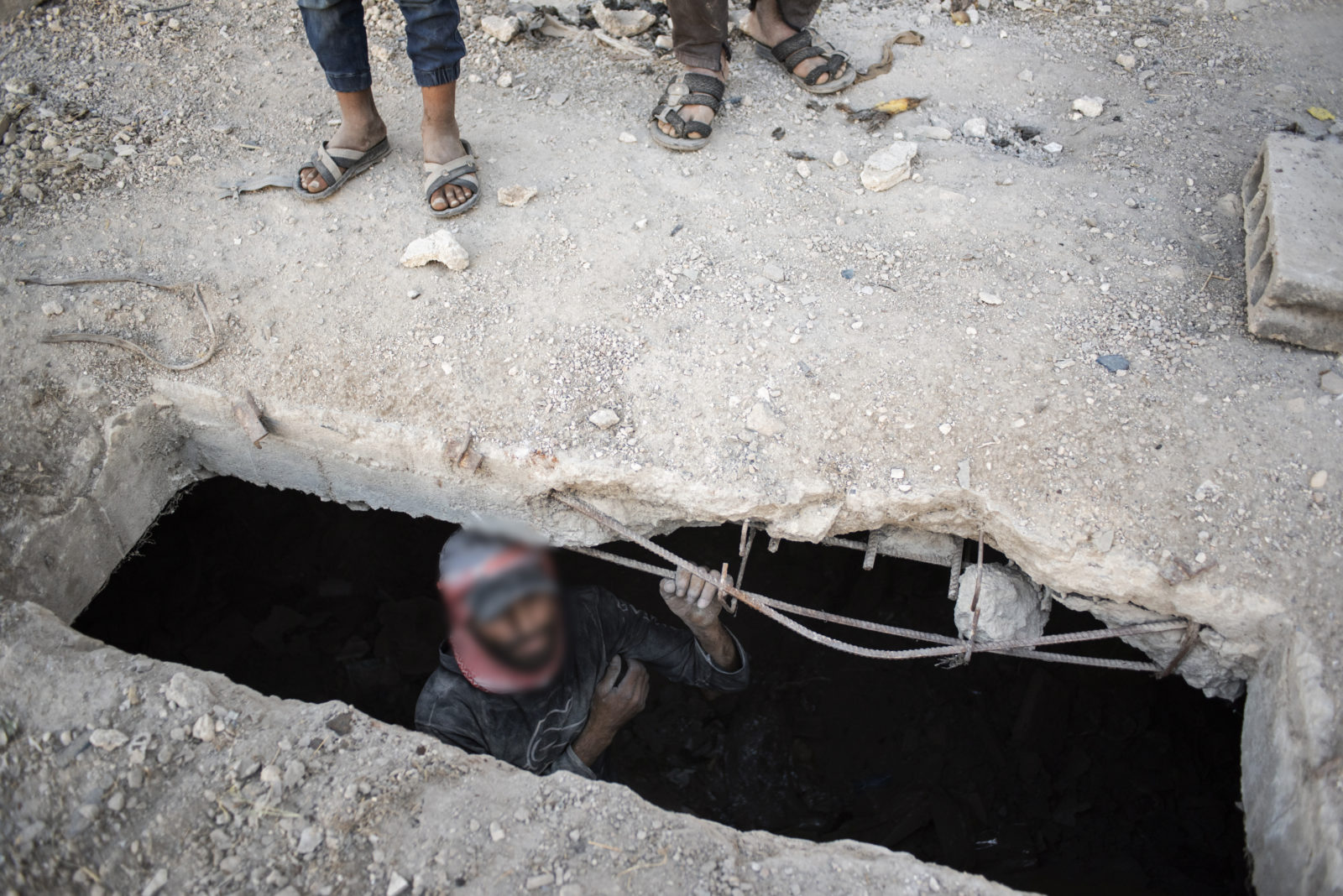
Photos: Sergio Attanasio
For years, long before rebel troops marched over the capital in December 2024, poor displaced families and their children have come to the ruined peripheries of Damascus to collect scrap rebar, aluminium cables, and twisted pieces of iron plates. Under the Assad regime, most of these lands were no go areas. For the past four years of war, Ahmad and Basel’s families have had access under a special agreement: they would be among the many that made up Assad’s personal army of scrappers.
“The Fourth Division would grant you permission to enter here to work and sell to them,” said one of the men that gathered around us during a break from scavenging through the rubble, the face hidden by an ashy rag, “you couldn’t sell to anyone else.”
A scene that should haunt us all: one piece of this steel scrap – bought for a mere 500 Syrian pounds per kilo by desperate families during and after the war, with the covert backing of local warlords – may have been used to build a stadium in Brazil, the Hong Kong International Airport or Dubai’s most famous luxury hotel, the Jumeirah Burj Al Arab; it may also have ended up in a brand-new building apartment in Germany, or found its way into motorways in Romania.
Ahmad and Basel are at the bottom of a supply chain that is indispensable for ‘cleaning’ one of the dirtiest industries in the world: steelmaking.
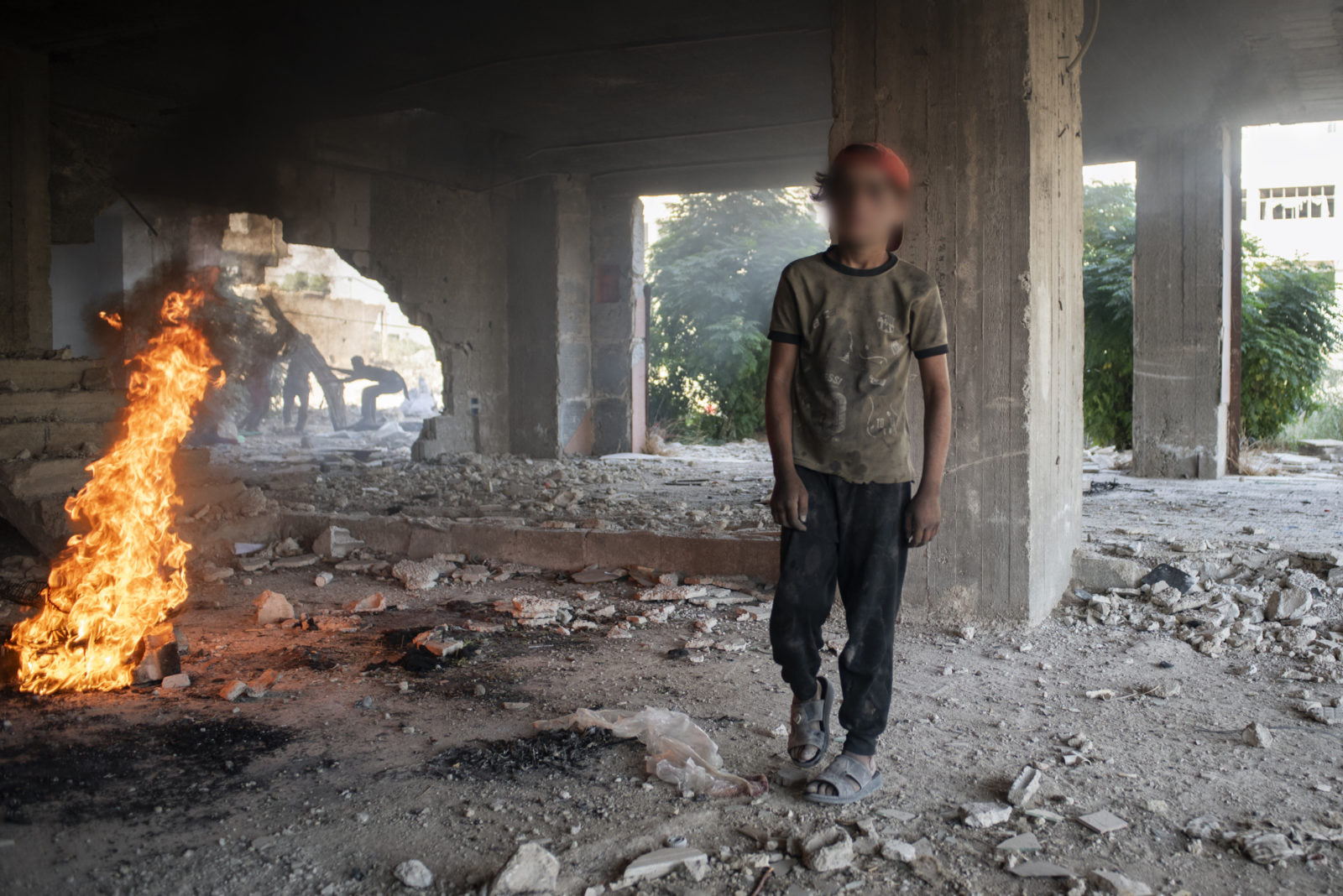
Photos: Sergio Attanasio
‘Clean’ steel
Steel forms the backbone of industrial society: from railway lines and ships to the beams that support our buildings, and the weapons that can destroy them. The process of producing this durable material from iron ore, carbon, and various other metals is responsible for almost 11% of the global CO2 emissions.
In the last decade, new technologies to produce recycled steel have garnered the industry’s interest: it is cleaner and, most of all, cheaper; electric arc furnaces, under the correct conditions, consume around 70% less energy than traditional iron ore-based blast furnaces. Turkey’s producers were particularly compelled: in two decades they turned recycled steel production into the fifth largest contributor to the national economy. Turkey is now listed among the major steel producers in the world, with a steel export value estimated at $16.1 billion USD.
The issue with scrap metal, indispensable for the production of recycled steel, is that it is limited. There is barely enough of it in the world to meet the demand. As production volumes of steel are surging worldwide, ferrous scrap is now treated as strategic for the future of many national metal industries.
As the world’s largest importer of ferrous scrap, Turkey has turned it into its humble gold. Yet, not all is known about the country’s discreet sourcing network, which experts and researchers we spoke to described as opaque, unmonitored, and hard to trace.
In economies that industrialised early, scrap metal is abundant. Europe’s scrapyards are overflowing with end-of-life ferrous goods, which are the source of more than half of Turkey’s imported scrap. When the corridors of Brussels filled with whispers of a possible export ban – meant to protect the continent’s bleeding supply -Turkish companies began to look elsewhere to keep the imports flowing, sources in the sector told us. And as it happens, few events generate metal waste as swiftly as war.
We estimated that over the last five years, between 6 and 10% of the scrap recycled in Turkey came from countries we can define as in conflict: Syria, but also Libya, Lebanon, Ukraine, Russia, and Israel/Palestine.
Despite the pittance paid to vulnerable people in conflict zones to dismantle entire battle-scarred neighbourhoods, the scrap metal trade represents a $46 billion market. Because of a lack of international monitoring and an opaque supply chain, Turkey – and the world’s – hunger for scrap predictably attracts exploitative individuals hoping to bankroll their wars.
The New Arab (TNA) documented the journey of steel scrap headed to Turkish mills from war-torn countries. We searched for documents in abandoned Assad-era checkpoints, sifted through tens of thousands of maritime traffic records, examined satellite images for shipments, and pieced together leads through dozens of conversations with workers and experts across multiple countries.
This year-long investigation proves that, during the last decade, roughly one tenth of Turkey’s ferrous scrap was sourced from war economies. Under Assad’s order, scrap-loaded trucks exited the country from Lebanese border crossings, to eventually turn up in Turkish private companies’ scrapyards.
Trade data show that several Turkish steel mills ship their finished products to European clients – meaning that conflict-sourced steel is most likely used across the continent.
Opaque due diligence
TNA contacted human rights officers within large European construction companies. Though they requested anonymity, they admitted that human rights abuses in the scrap metal supply chain can go overlooked within due diligence processes. They justified this by pointing to the complexities of the trade, notably its fragmented procurement and limited traceability.
Other sources from Artimet, an independent Turkish inspection company monitoring various stages of the scrap supply chain, confirmed to TNA that their quality controls consist of merely visual inspections.
Artimet representatives added that inspections would not probe how the scrap had been collected or who had profited from it. They told TNA that the end client would not care.
Many of the steel companies in Turkey declined to speak to us or ignored our requests for comment. These include Diler, Kroman, Mescier, Yazici, and Yesilyurt Demir Çelik, companies which this investigation found to be involved in procuring scrap metal from conflict countries. TNA also contacted Turkey’s Ministry of Customs and Trade, inquiring about the controls in place to detect conflict-linked scrap metal. We received no response in time for publication.
The general director of one of Turkey’s major steel companies candidly admitted, during a conversation on background, that scrap may be sourced from war-ravaged territories, including Lebanon, Israel/Palestine and Libya: “The steel of the destroyed buildings [there] will become scrap.” The company publicly declares exporting to more than 60 countries.
Many in the sector seem to be mostly clueless about the possible implications of their tainted supply chains.
The Foreign Trade Department of one of Turkey’s major scrap-dealing companies told TNA that they didn’t have specific policies in place to rule out links between imported scrap and warring factions. “We only purchase scrap from places we know and have worked with for many years,” they explained. The same scrap may then be sold to European countries like Germany, Italy, and the Netherlands.
While the Turkish scrap-dealing company claimed it was not importing scrap from Syria, they admitted to buying from both eastern and western Libya. Our investigation shows that this is not uncommon: Syria and Libya are just some of the many countries in conflict where the scrap metal trade has been exploited to feed the region’s war machine. Turkish companies are even trading with entities with which the Ankara government has been at loggerheads for years.
Trading with entities in conflict affected countries is not inherently illegal, but in some cases trade is restricted or banned under sanctions, laws or embargoes. Specifically, for cargoes of steel scrap coming from Haftar’s Libya or Assad’s Syria, the habitual supply standards and procedures are not enough, a senior researcher at the Business & Human Rights Resource Centre (BHRRC), Blanca Racionero Gomez, explained to TNA.
“It’s not so important if you have suppliers coming from war-torn countries. What’s important is if their supply is financing conflict, is exacerbating human rights abuses and is causing environmental damage. That’s what’s important, and what needs to be addressed through due diligence processes,” said Racionero Gomez.
“Because it’s a conflict-affected area, you need to […] be more vigilant than in other areas where information is easier to access,” explained the BHRRC researcher, calling on any company downstream the steel scrap trade to be held accountable.
Syria’s 4th Division and its army of scrap pickers
Wherever Assad’s special army of scrap collectors went, only cement would remain.
Most of Qaboun, a suburb in Damascus, long contested between opposition and loyalist forces during the civil war, has been reduced to a grey wasteland of pulverised cement. There are paths to walk through the mounds and the waste is partitioned into small islands of debris. Anywhere outside these beaten trails may be unsafe: unexploded ordnance lays below the surface, sleeping but only lightly.
The horizon of desolation, sentenced by the low, uneven expanse of crumbling concrete, is betrayed by cut-outs of lush green, disorienting against the opaque haze that surrounds us. Life is flowing back in, now that the Assad forces can no longer prevent residents from returning to the hull of their homes.
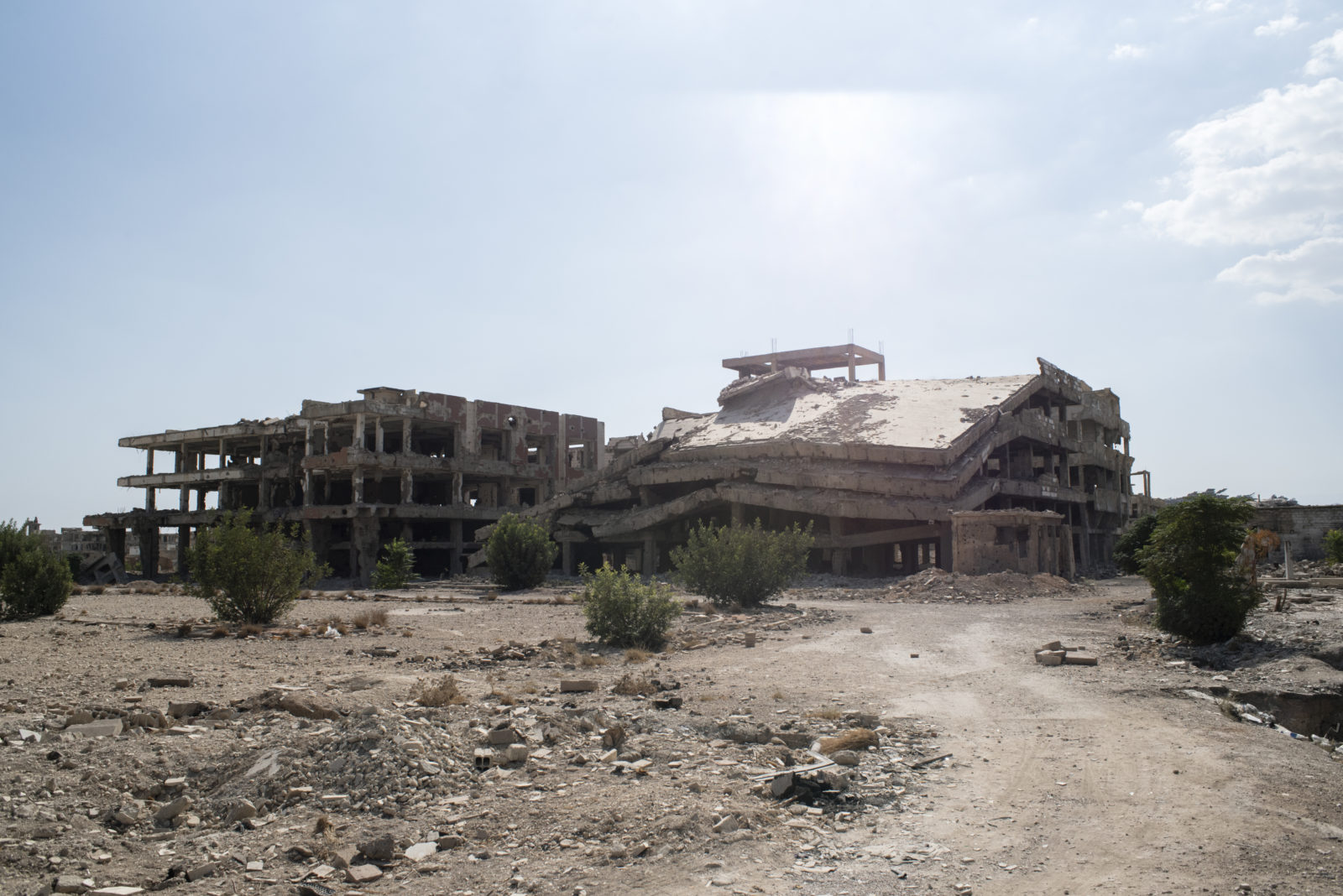
Photos: Sergio Attanasio
As in many of the areas that bore witness to years of fierce battles, none of the buildings’ roofs remained: not because of the fighting, but because the steel rebars had been stripped from the supporting columns. Some recognised what remained of their home only by the pattern on the floor tiles, recalled Mohammad al-Imam, an activist from Daraya, another gutted town south-west of the capital, which rose to prominence as an iconic arena of civil resistance during the early phase of the uprising against Assad.
As Mohammad walks us through Daraya’s barren streets, ringed by the husks of roofless buildings, he regularly points at floors hanging in the void, pinning it on Assad’s forces: “This one was taken down, you see, look, its iron was removed – but this is not detonation, this has been taken down to take the iron.”
They wouldn’t say anything about the children; anyone could work, confirmed Ahmad’s mother, recalling the four years where they had no choice but to toil as steel pickers for the 4th Division, the Syrian military’s elite unit. Her large blue eyes gleaming over a face powdered in white dust by a day of sifting through rubble. “They used to buy it cheaply, [but sold it] expensively,” she told TNA, “it’s known.”
Formed in the 1980s, the 4th Armoured Division effectively served as a praetorian guard for the Assad family, charged with protecting the regime from internal and external threats. Over the course of the civil war, Western sanctions cut Syria off from the global financial system and the 4th Division became central to the regime’s war economy, developing into an amorphous parastate towering over strategic – and mostly illicit – businesses in Syria (such as the manufacture and smuggling of captagon).
It operated under Major General Maher al-Assad’s command, the brother of toppled President Bashar al-Assad and arguably the second most powerful man in the regime. Their intimidating checkpoints were pervasive across the country, yet the Division’s true circle of power clustered around Damascus’s peripheries.
It’s no accident that Qaboun and Daraya, among the areas to suffer the most extensive pillaging, were under the Division’s control. The scrap metal trade – mostly extracted from plundered private properties and infrastructure in former rebel-controlled areas – was one of the unit’s economic revenues.
Bashar al-Assad used to layer relatives, proxies, and front companies between him and his revenue sources. The Syrian Minerals and Investment Company – a private entity founded in 2018 – worked as one of these fronts through the 4th Division.
In 2019, the Assad regime issued Resolution No. 3061, granting the company the right to import and export key materials, including metals, iron, and aluminium. The firm was in charge of issuing permits for contractors, who would purchase scrap on its behalf.
Two years after its establishment, it had already been sanctioned by the US Office of Foreign Assets Control (OFAC) for its connection with businessman Khodr Ali Taher, a man with long-standing ties with the 4th division. Taher was also known as the “Prince of Crossings” in national media, for the ease he would be wending his way across regime and rebel-controlled areas.
Western sanctions and arrest warrants hang over the heads of many businessmen and military commanders who were part of the 4th Division’s network that capitalised on the bloody scrap metal trade.
Previous investigations have already exposed how the Assad regime and its cronies had been profiting from looting iron scrap from opposition areas that would feed the country’s steel plants. Yet little is known about how scrap has turned into a profitable export commodity sold to Turkish companies; a discreet trade that lasted years, while Turkey-backed opposition militias and Assad’s army have been battling each other.
Burn the evidence
The road winding through the Masnaa-Jdeidat Yabous passage, connecting Beirut to Damascus, is lined with Bashar al-Assad’s faces. Most have been removed from billboards and posters, but those that could not be taken down have been crossed out.
Next to the traffic highway, amid sallow mountain ridges, vehicles laden with goods and people thread the main Beirut-Damascus crossing. An unassuming and doorless single-storey structure stands on the side of the road. Another of the President’s crossed-out faces, plastered over the outer wall, greets passersby.
The place is trashed, full of torched, half-burnt documents. Perhaps, as the news that Assad’s forces were crumbling, someone returned to the checkpoint in a bid to destroy evidence of the regime’s activities, a story often heard in Syria after December 8, 2024.
This was a 4th Division checkpoint located near the Yafour Bridge, in a rural area west of Damascus, along the M1 highway to Beirut, just 20 kilometres from the Lebanese border crossing. One of the many under the 4th Division’s sway, racked up across major domestic and international highways, part of a strategy to take control of vital export routes.
When Assad’s many faces still towered over these lands, this checkpoint was expecting to see a hundred scrap metal trucks cross in just one month. (We can’t know when exactly – part of the page was burned. The date was lost). Each lorry had to pay its due, the amounts spelled in black ink in an exclusive “pre-feasibility study” we photographed. In just one month, the 4th Division was planning to extract a total of roughly 125 million Syrian pounds [$9,615] from 100 scrap metal trucks en route to Lebanon.
For years, this unremarkable checkpoint quietly collected proof of a major export route for scrap pillaged by regime forces and its transfer to Lebanon. Scrupulous workers amassed records detailing the passage’s ins and outs. Most of them are lost in the arson. But the few pieces we were able to photograph provide insights into how Assad’s economic machine was moving metal scrap and other goods across the country. The documents also offer a rare glimpse into the hundreds of thousands of dollars in revenue likely generated by this checkpoint. Some of the most recent records date back to September 2024.
On 10 April 2024, the Yafour Bridge checkpoint received a fax from another crossing. “For your information, no commercial convoy crossed the post.” Written in a few lines of black printed ink and signed twice, the headed notification passed from Colonel Louay Ahmad Habib, who was in charge of the Manbij crossing (also known as al-Tayhah crossing) between the regime and the Kurdish-led Syrian Democratic Forces (SDF), to Major-General Ghassan Bilal, Maher al-Assad’s right-hand man. Bilal is also on the EU and US sanctions lists for his affiliation with the Assad regime. By the time we found the document, he had likely already fled.
Documents we photographed confirm that scrap trucks, given their high value, were escorted by units of the 4th Division from the industrial centres of Hasiya, al-Matalla, and Adra across the border to Lebanon.
“They [i.e. the 4th Division] would give you permission to transport the materials to the factory. If you didn’t inform them, the vehicle, materials, and driver would be seized. This is the rule,” said a scrap reseller we talked to in Damascus.
According to the documents, the entity in charge of authorising the deployment of the 4th Division to escort scrap trucks was the Syrian Presidency’s General Secretariat, headed by Mansour Fadlallah Azzam, who is under Western sanctions for his role in the violent repression of the Syrian uprising. He was also Minister of Presidential Affairs between 2009 and 2023. The current whereabouts of Azzam are unknown.
Across the Syrian-Turkish border
The Masnaa passage isn’t the only corridor we were able to identify. Although to a lesser extent, evidence suggests that another crossing enabled metal scrap exports to Turkey.
Under a makeshift tent, nestled by mounds of grey waste and twisted metals that rest along the road connecting the small village of Killi with Idlib, in northern Syria, a collector we interviewed in a crowded scrapyard recounted the days during the war when larger players selling to Turkey would buy material from these very piles.
“This scrap iron comes from homes, and we buy it from local collectors” he explained. “The [local] iron companies buy it from us, export to Turkey, and also sell scrap within the liberated areas (i.e. areas under opposition control before Assad was toppled).” At a distance, young men press large chunks of iron scrap inside a deafening machine.
Turkey’s trade data indicate that, between 2021 and 2024, over 200 thousand tons of metal scrap entered the country from areas under rebel control in northern Syria. Most transited from the Bab al-Hawa border gate, which was manned by Hay’at Tahrir al-Sham (HTS), the hardline Islamist paramilitary group which is leading the new Syrian administration.
The Idlib deputy governor, Qutaybah Khalaf, told TNA that, over the years, Turkey-bound scrap may have passed through the rebel-controlled border crossings. But he described this trade as “private work” that saw no involvement from local authorities.
However, experts do not discount the likelihood that entities loyal to the regime could have collaborated with opposition forces in facilitating the scrap trade.
“Even for the captagon trade, for example, there were some people inside opposition areas who were working with the 4th Division and Hezbollah,” said Ayman Aldassouky, a researcher at Syrian think tank Omran for Strategic Studies, who focussed on the 4th Division’s economic network.
Nonetheless, statistics show that only marginal amounts of scrap flowed to Turkey via Syria’s northern land crossings. Turkish customs data may capture just part of the trade, and the 4th Division may as well have used those routes to smuggle scrap directly. But inland roads were fraught with opposition factions, which likely made Lebanon the main route – an off-book trade some deny exists, given the lack of official records. Were it not for a small anomaly in those same data.
The Lebanon route: numbers don’t add up.
There is no trace of the trucks loaded with metal scrap flowing in through the Masnaa crossing in Lebanese public statistics. Yet something may give it away: the quantity of scrap metal generated locally seems not to keep up with the export volumes listed in national and international statistics. An unregistered source of metal scrap, slipping through the border, could explain the irregularity.
Most Lebanese workers and companies we spoke to deny dealing directly with Syrian scrap, but it seems no secret that Lebanon is a corridor for this trade. A source from the city of Baalbek – a known hub for smuggling, northeast of Beirut – with personal knowledge of these networks, reported they were offered Syrian steel for a construction project by a contractor once.
Antoine Srour, a scrapyard owner in Beirut, explained to TNA that, in the aftermath of the latest Israeli war on Lebanon, “metal from the South all went to traders from the South. And metal from Dahiyeh [i.e. Beirut’s southern suburbs] all went to traders down there, to Shatila in particular. […] Northerners […] profited from Syrian metal.” In early 2025, media reports described residents of the marginalised northern area of Wadi Khaled, near illegal border crossings, complaining about convoys of trucks entering Syria loaded with cement, fuel, and other Lebanese goods, and returning with vegetables and scrap metal. Detection would be hard: smuggled goods are often mingled with Lebanese ones, said the anonymous source.
In the Bekaa valley, tribal networks smuggle anything that has value – weapons, drugs, and stolen goods – in collusion with Hezbollah, the Iran-backed Shia Islamist political and military group.
The anonymous source doesn’t believe the traders who denied having dealt with Syrian smuggled metal scrap are telling the truth. Hezbollah has had longstanding ties to Assad.
“Now, after Bashar al-Assad’s fall, I’m not sure how things are – they’re still bringing in stuff and taking stuff out, but it’s not the same as it used to be,” commented the source, “back in the day, when Hezbollah was in Syria, […] if you had permission from Hezbollah, you could just walk in and out whenever the hell you wanted without even an ID.”
International sanctions made the use of ports for exports difficult in Syria, with only a handful of vessels permitted to dock, explained researcher Ayman Aldassouky. This turned Lebanon into the perfect backdoor for the regime, allowing it to save face while doing business with an enemy in war such as Turkey.
Scrap iron and steel are Lebanon’s fourth largest export. UN Comtrade statistics show that over 2 million tons of iron scrap have left Lebanese ports headed to Turkey since 2013. Part of this may have consisted of re-exports from areas under the Assad regime’s control in Syria. The main customers of Syrian scrap exported through Lebanon were reportedly Turkey, India, and the United Arab Emirates, Ayman Aldassouky told TNA.
The other part comes from local production. Here too, waste pickers are often minors, many are Syrians. After Israel’s latest war on Lebanon, districts hit by airstrikes are also turning into a source of scrap, according to locals we talked to and media reports. With no active steel recycling mills in the country, a large part of this locally collected scrap is recycled in Turkey.
Scrap fleet
Iskenderun, southeast Turkey, is a city tailored to industry: the outer roads are jammed with trucks, factories and their piers flank the highway, and a smoky chimney is always fixed on the horizon. Here, bulk ships carrying scrap from war-torn countries have been docking at the steel companies’ private piers for years.
In the Turkish companies’ furnaces, where a soup of metals and alloys is cooked at around 1,600 °C, the trail of the iron scrap’s origins melts away. Turkey’s finished steel ends up all around the world. Major destinations include Spain, Greece, Italy and Romania, but also Yemen, Egypt, Morocco, and Iraq.
Based on data provided by MarineTraffic, a ship tracking and maritime analytics provider, TNA analysed tens of thousands of entries for bulk carriers docking at Turkey’s various ports. As none of the governments of the countries involved in this business would grant us detailed access to customs and trade data, we verified their cargo through satellite images obtained through Maxar and Planet. We could verify at least forty ships in 2023 alone: not only scrap-loaded ships sailing from Lebanon, but also vessels departing from ports in Libya, Russia, Ukraine and Israel/Palestine. In most of these countries, Turkish companies purchased scrap metal from both parties to the conflict.
What we identified is likely to be only the tip of this unknown trade, a fraction of the number of vessels whose tainted cargoes help bankroll conflict internationally.
Libya: rebuilding armies ‘scrap by scrap’
Following the toppling of the Gaddafi regime in 2011, Libya has been mired in conflict for around a decade. Despite the signing of a fragile ceasefire agreement in 2020, the country remains politically and militarily torn between two competing powers: the UN-recognised Government of National Unity (GNU) in the west and the so-called Libyan National Army (LNA) led by Field Marshal Khalifa Haftar in the east.
In mid-April 2023, a bulk carrier going by the name Nezha, approached the port of Benghazi in eastern Libya to fill its cargo with scrap. Two weeks later, it would unload the scrap at the Iskenderun pier of US-sanctioned MMK Metalurji, the Turkish subsidiary of Magnitogorsk Iron and Steel Works, a Russian steel manufacturer that ranks among the largest in the world. The Nezha was previously identified as having violated EU, US, and UK sanctions by docking at ports in Russian-occupied Crimea in 2019 and subsequently had its license revoked.
In the last decade alone, Turkey imported over 3 million tons of scrap steel from Libya, according to UN Comtrade data – more than even petroleum.
Although official data do not specify which of the two rival authorities the exports derive from, satellite images show that in recent years one of the most active ports for loading scrap has been Benghazi, in Haftar’s zone of control – a confirmation of Turkey’s most recent rapprochement with the rulers of eastern Libya. All the while, Ankara continues to support the GNU in the west, both militarily and politically.
According to human rights’ groups and the UN, forces under Haftar’s control have committed “horrific crimes” – including torture, sexual violence, and forced labour – against Libyans and migrants alike. Forces under the GNU command have likewise been accused of gross human rights violations.
Experts highlight that scrap metal export revenues have helped fund the rearmament of General Haftar’s forces, as they fight against their rivals in the west of the country.
“They started […] in the mid-2010s. Haftar used the money from the scrap to rebuild his army. Used the scrap from war-devastated Benghazi. Then even when Turkey intervened against Haftar, [he] still continued selling his scrap to Turkey,” said Tarek Megerisi, a policy fellow at the European Council on Foreign Relations.
Despite a Libyan ban on scrap exports, imposed to support domestic steel production, cargoes of steel waste continue sailing from all ports.
All the ships loaded with metal scrap sailing from ports in Ukraine, Russia, Israel/Palestine, Lebanon and Libya that this investigation was able to identify, bear the risk of being associated with conflict financing and human rights violations.
Rubble and mortar rounds with no end in sight
That day, Basel and Ahmad’s workday ended early – the sun was already setting over their rubble realm. They spent the remaining hours lingering unpredictably, waiting for the middlemen’s truck to come and pick up the scrap.
“Are there bombs here?”
“There’s plenty,” Ahmad quickly replied. He wanted to show us one, but we convinced him to desist. His uncle was digging and a rocket exploded on him, the families would later tell us.
Buyers would pay less for scrap originating from war zones, as there might be a chance that bombs and ammunition would show up in their load during inspections at border checks. There is no cheaper scrap than the Syrian one.
Our presence agitated the two kids. In the deserted yard shadowed by once-lively apartment complexes in a suburb of Damascus, they started playing with the shell of an improvised explosive device. With a twist of his arm, Basel threw it in a perfect arc two metres away, back into the rubble where it came from. Earlier that day, standing over a pile of rubble as kings, Basel and Ahmad had claimed proudly that they knew how to stay safe from war’s leftovers.
Assad or not, their lives haven’t changed much. They had been coming here since they were five or six, almost every day from dawn till dusk.
Ever since the HTS-led government has taken over, many of the men of Assad, involved in the scrap metal monopoly, have fled; some of them made deals with the new ruling forces and were reintegrated. The offices of the Syrian Minerals and Investment Company are open again, nestled in the industrial city of Adra. TNA contacted the company, seeking comment on their activities under the Assad regime and on whether scrap-related controls were introduced under the new administration. We received no response in time for publication.
Last June, the new rulers in Damascus imposed an export ban on scrap metal – now valuable for the country’s reconstruction – though it’s hard to say whether it will be respected: provisional statistics for 2025 reveal that minor exports of scrap have continued until a few months ago.
The people managing the scrap trade in Syria may change; Ahmad, Basel and their families will not. Tomorrow, they will still be here, together with the unexploded munitions, the broken cement, and the scrap for which they are paid only 500 Syrian pounds per kilo.
Credits:
- Richard Salame – reporter
- Sergio Attanasio – photographer
- Ornaldo Gjergji – data visualization designer
- Andrea Glioti – investigative editor, fact-checker, supervisor
- Jonathan Cole – copy-editor & fact-checker
- Ibrahim Fakhri – creative manager
- Moataz Aboamer – designer
Funding partners:
- Journalismfund Europe
- The New Arab