

How Orbán played Germany, Europe’s great power
In October 2017, important figures of German and international business and political life gathered at a reception in a glass-walled hall on one of the upper floors of Frankfurt’s tallest skyscraper. At the event, one of the top executives of a German automobile manufacturing group, warmed and loosened up by some glasses of wine, started entertaining those around him with anecdotes. After some time, the conversation was directed to Hungary.
The senior automotive manager bragged about the fact that the executives of his company could call Hungarian Foreign Minister Péter Szijjártó at any time if they had any requests regarding their factories in Hungary. He then added that if necessary, they could even speak directly to Viktor Orbán – in fact, he said, the Hungarian Prime Minister had already helped them with a specific case.
Two years earlier, in September 2015, Germany’s automotive industry was hit by its biggest scandal ever. It was found that Volkswagen Group’s (VW) diesel cars used software manipulation to cheat on emission tests for many years (later several other German and non-German companies were found to have manipulated their data in a similar way). As a result of the scandal, the price of VW shares began to plummet and it looked like several companies could be seriously endangered, forcing them to close factories and cut jobs.
At the reception in Frankfurt, the German automotive executive claimed that the diesel emissions scandal had become so embarrassing for the federal government after a while that they felt the German state was starting to back out from behind them. Executives of his group of companies then turned directly to Viktor Orbán, asking him to represent the interests of car manufacturers in the European Council that was currently discussing the matter. Viktor Orbán agreed to help and kept his promise, the German automotive executive said with satisfaction.
Since the beginning of 2016, the European Council, which represents governments of European Union member states, has repeatedly addressed the reform of vehicle emission rules. However, Germany has been trying to soften stricter regulations in alliance with Italy and Eastern European member states with significant German automotive investments. In September 2017, a new regulation finally came into force but it was full of loopholes, applied only to new cars not yet on the roads, and made many other concessions to automakers.
A German business source present at the Frankfurt reception told Direkt36 about the lobbying and the role of Orbán, adding that there was nothing glaring about it. “Representatives of every important company say they have Szijjártó and others’ phone numbers,” the source said, adding that top executives of several German carmakers told similar stories, and that “they all absolutely feel that the Hungarian government is in their pockets.”
“They all absolutely feel that the Hungarian government is in their pockets.”
The spokesperson of Viktor Orbán and the Ministry of Foreign Affairs and Trade headed by Szijjártó did not respond to our request.
However, a former senior official in the Orbán government confirmed that “Viktor Orbán defends the interests of German car manufacturers in the European Council”. Nevertheless, according to the source, there is nothing surprising in this, as Hungarian governments have always been accommodating to German carmakers. Following the outbreak of the diesel emissions scandal, Mihály Varga, Minister of Finance of the Orbán government, said that 2-2.5 million of the Volkswagen Group’s 11 million diesel cars with cheating engines were manufactured at the Audi plant in the city of Győr and that “the government’s most important goal is maintaining jobs in the automotive industry and preserving the stability that the automotive industry provides in Hungary”.
The above story is a good example of how a relationship based on mutual benefits and dependence has developed between German policy makers, influential companies in German industry and the Hungarian government over the years and decades. German carmakers are the number one engine of Hungarian economic growth and, through this, of the Orbán government’s political successes. According to data by the Hungarian Central Statistical Office, car manufacturing accounts for 4.5% of Hungary’s GDP and suppliers working for large car manufacturers account for another 5-8%. This means that every eighth to tenth forint produced in Hungary has to do something with the Germany-dominated car industry.
Now is a particularly sensitive period in Hungarian-German relations. In the coming months, political issues determining the long-term European bargaining power of the Orbán government and Hungary will be settled in the European Union. In these debates, Viktor Orbán’s German allies will have the final say, and although they have repeatedly criticized decisions of the Hungarian government, they have so far refrained from acting really hard.
Direkt36 uncovered details of this intricate system of relationships, the interests that drive it, and the key players in a months-long investigation. We found how decades of personal relationships control Orbán’s maneuvers in Germany; how German companies give up much-talked-about democratic values if it is in their business interests; and, for example, that the Hungarian government was able to prevent Jewish leaders in Budapest from sharing their concerns with Angela Merkel.
In our research, we had in-depth background conversations with two dozen sources — current and former government officials, diplomats, political intermediaries, business executives, and analysts. Most of them shared information about behind-the-scenes events if we did not write down their names.
I. Orbán’s German patrons
Source: kormany.hu
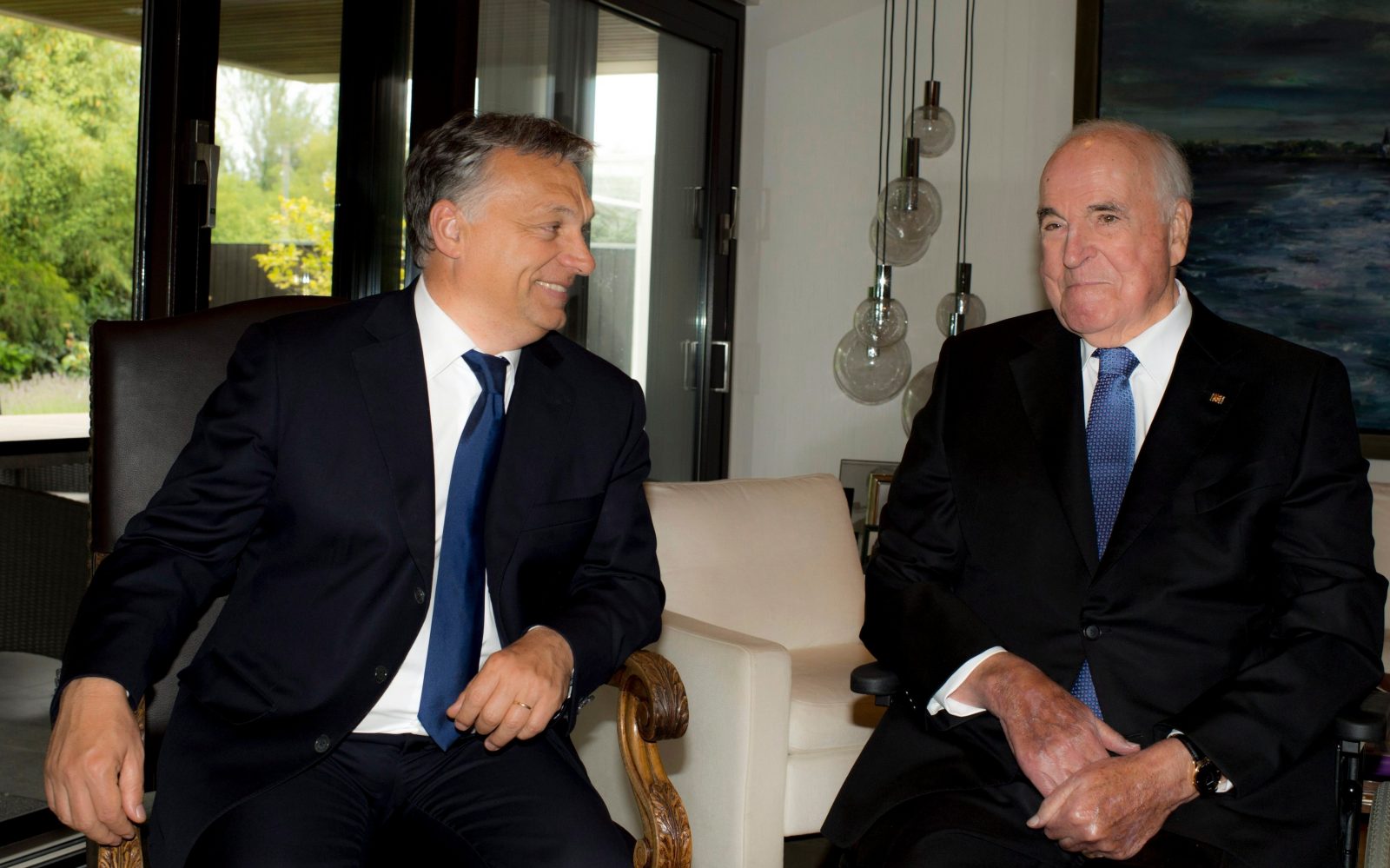
“Call the Count and tell him we’d like to visit him!” This is the task Viktor Orbán gave Gergely Prőhle on the night of his first election victory, on May 24, 1998. Prőhle was the head of the Budapest office of the Friedrich Naumann Foundation (ie the party foundation of the German Free Democratic Party, the FDP). Four days later, the new prime minister-elect was already in Bonn, where executives of German industrial giants like Audi, Bosch or Siemens were waiting to meet him. Orbán reassured them, according to the Hungarian state news agency’s report, that a predictable economic environment awaits them, moreover, his government wants to increase foreign investment, primarily in manufacturing.
The meeting, which was organized in only matter of few days, was thanks to to Otto Graf Lambsdorff, the influential liberal politician and honorary president of the FDP, who was most often referred to by his acquaintances only as “the Count”. Lambsdorff had known Orbán for a long time, he led the Liberal International when Fidesz became a member in 1992. During Orbán’s visit, Lambsdorff proudly talked to the German press about the future prime minister and boasted that he “has been watching Orbán’s political career since the regime change in Hungary and is very happy to support him”. Gergely Prőhle, who later also served as ambassador to Berlin and deputy secretary of state for foreign affairs under the Orbán government, told Direkt36 that “Lambsdorff had already started traveling to Eastern Europe before 1989 and had become Orbán’s first German patron. He was an infinitely smart person from whom much could be learned. The count saw the economic-political ties in light of a full historical context, he was a formidable personality”.
The relationship between Orbán and Lambsdorff was so close that it even survived when Fidesz broke ties with the European political family the Count represented. Prőhle also wrote an article on Lambsdorff for Valasz Online. According to him, the Count watched Orbán’s politics turn conservative in the mid-1990s with some disappointment, but accepted the political realities. He also observed, how over time, leader of the Christian Democratic Union (CDU) Helmut Kohl became the most important point of reference for Orbán. At one point, Orbán explained to Lambsdorff that “in order for him to maximize votes in Hungary, the liberal slogan is not good, and the Count understood that.”
“In order for him to maximize votes in Hungary, the liberal slogan is not good, and the Count understood that.”
However, the two politicians remained close friends, and later in 2009 Orbán was the only foreign guest at Lambsdorff’s private funeral.
During his visit to Germany in May 1998, Orbán not only spoke to company executives, but also spent an hour and a half meeting with German Chancellor Helmut Kohl, then head of government for 16 years, who was facing a really close election a few months later. At that time, officials from the Hungarian foreign ministry, which was still under socialist leadership, advised Orbán to also meet Kohl’s challenger, Gerhard Schröder, because he seemed more likely to win the election. However, because of his loyalty to Kohl, “Orbán rejected this idea, while for example, the Polish Prime Minister did meet with Schröder. Schröder and his people didn’t forget this later, neither for the Poles, nor for us,” a former Hungarian foreign ministry official told Direkt36.
It was a tight race, but Schröder eventually defeated Kohl. According to Sándor Peisch, who served as Hungarian ambassador to Berlin under the Socialist MSZP governments between 2003 and 2010, this was also the end of an era when the German leadership still looked at Hungary with gratitude for its role in the country’s reunification. An important milestone in the process leading to the fall of the Berlin Wall, was the opening of the Hungarian-Austrian border. It started in the summer of 1989 and was officially announced in September, paving the way for East German refugees to travel via Austria to West Germany. But “the SPD was never enthusiastic about reunification. At one of our meetings, for example, Chancellor Schröder began to complain about how much money it had costed,” Peisch told Direkt36.
Viktor Orbán and Helmut Kohl thus ruled simultaneously for only a few months. While Lambsdorff was a true mentor and teacher to a young Orbán, Kohl, who had just fallen out of power, was more of a “living legend, a role model” for him with his political career spanning many decades, another former diplomat who served under the Orbán government said. By the time his relationship with Orbán became closer, “Kohl had already become a human wreck by then and had lost his political influence,” the source said. After Kohl’s defeat, the first Orbán government had to rethink its German relations after failing to forge a close relationship with Schröder’s Social Democratic-Green coalition in Berlin. “We had to go down to the state level and build an alliance there, especially with the two conservative southern states,” a former diplomat from the Orbán government recalled the strategy of building ties at a lower level rather than a federal one.
The Southern Germany connection dates back to old times. Along the Danube, the economically and historically closely linked states and countries of Baden-Württemberg, Bavaria, Austria and Hungary form a bloc. A former diplomat from the Orbán government said Kohl also spoke to Orbán about this geostrategic cohesion. “These two southern provinces account for more than half of Hungarian-German economic relations, the first consulate general of Hungary has opened in Münich, and most of the ethnic Germans deported from Hungary live in Baden-Württemberg,” Sándor Peisch said.
Among the major German companies who invest in Hungary, Mercedes and Bosch are headquartered in Baden-Württemberg, while Audi and BMW are based in Bavaria, where several significant figures in the local economic and political elite have ties to Hungary. One example is the former Volkswagen Group CEO and one of the protagonists of the diesel emissions scandal, Martin Winterkorn. He was born in Baden-Württemberg, but his parents were Swabians displaced from Zsámbék, Hungary, a former diplomat from the Orbán government emphasized. Winterkorn played an important role in the development of the Audi project in Győr and also received Hungarian state awards.
During his first term as prime minister, Orbán established a close relationship with this conservative South German elite. In politics, he found important allies in Austrian Chancellor Wolfgang Schüssel, Bavarian Prime Minister Edmund Stoiber of the Christian Socialist Union (CSU) and Prime Minister Erwin Teufel of the CDU in Baden-Württemberg. In 2000, they all eventually became part of the same party family after Fidesz left the Liberal International and joined the European People’s Party (EPP).
This good relationship was not only based on personal connections. According to several sources who previously worked for Orbán or were in contact with his people from the German side, the Hungarian Prime Minister considers Hungary’s political, economic and military dependence on Germany to be a geopolitical necessity. It is a recurring idea in Orbán’s public speeches that Hungary exists in a “Berlin-Moscow-Istanbul triangle”. In addition to these, he sometimes mentions Washington and Beijing. In private conversations, however, Orbán narrows this further. According to a former high-ranking American government official, Orbán explained to him that Hungary has only two really important points of reference, Russia and Germany. Hungary gets its energy from one and jobs from the other.
Orbán also added that the United States only has values, but “we have our values too.” In a material sense, Hungarian politics depends only on Berlin and Moscow.
“With German patronage, Orbán grew up and became an important politician, he has great respect for Germany,” a German expert who has a close relationship with several members of the Orbán government and is well acquainted with Hungarian affairs told Direkt36. “Helmut Kohl became the number one political father figure for Orbán, Kohl was the one who told him how to do politics,” the source explained, adding that although many compare Orbán to Miklós Horthy or János Kádár, he is actually more “like Kohl, who was otherwise accused of corruption and everything else too”.
The source was referring to the CDU donations scandal that erupted in 1999 and ended Kohl’s career. It turned out, for example, that throughout the years, Kohl had secretly accepted cash of 2 million German marks as party donations from private donors. Kohl refused to disclose the donors’ identities even after the case made headlines. This scandal eventually led to Kohl and his supporters being sidelined by Angela Merkel, who took over the leadership of the CDU in 2000, and became Chancellor in 2005.
Although Orbán met her several times also and they developed a well-functioning working relationship, it was much less based on personal sympathy or friendship. And when Orbán returned to power in 2010 and took over managing the crisis-hit Hungarian economy, a new phase in German-Hungarian relations began.
II. The new deal
Source: kormany.hu
In the spring of 2012, Deutsche Telekom’s Hungarian subsidiary, Magyar Telekom, was in crisis mode trying to gather support in their fight against the Hungarian government’s latest plan. The Orbán government wanted to impose a telecommunications tax on text messages and voice services, which would have hit market leader Telekom the hardest.
In the German-Hungarian Chamber of Industry and Commerce, Telekom executives tried to garner support for their cause from German car manufacturing companies, knowing that their presence in Hungary was extremely important to the Orbán government. While in most countries, lobbying is carried out by, commercial attachés of the embassies, in the case of Germany, it is primarily the chamber of commerce that is tasked with representing the interests of German investors. But Telekom’s initiative failed. “Senior personnel from Audi, Mercedes and other companies didn’t even show up at the meetings, and they didn’t join a conference calls.. They never supported us when we had a dispute with the government, neither then, nor any other time”, one of Telekom’s executives at the time complained about the lack of solidarity between German companies. “It was not only about us, German energy companies that were also targeted with special taxes, had similar experiences with them,” the source added.
The special tax on Telekom was not the first economic conflict in Hungarian-German relations. After his election win in 2010 following an economic crisis, Orbán wanted to revive the stagnant Hungarian economy in a way that would have led to an increase in the already large budget deficit, which was actually not that dramatic compared to that of other countries. However, after the economic crisis, it was important for the European Union and the German government that smaller member states, including Hungary, manage their budgets prudently. Germany was preoccupied with the Greek crisis and with trying to keep the troubled eurozone together. European Commission President José Manuel Barroso and Angela Merkel did not agree with Orbán’s plan, so the Hungarian government was forced to balance their budget and reduce public debt.
Despite the controversies, Orbán gained recognition in Germany for eventually shaping his economic policy to Germany’s taste. A former Hungarian senior government official described this situation to Direkt36 as follows: “Who adheres to the Maastricht criteria [ensuring the stability of the eurozone]? The Italians do not, the small Hungarians and the Poles do”. The most influential member of the then German government after Chancellor Angela Merkel, Minister of Finance between 2009 and 2017 “Wolfgang Schäuble has always been our important ally, he appreciated Hungary’s compliance with economic norms and austerity,” the source said.
However, this compliance came at a serious cost: as the EU and Merkel did not allow a larger deficit, the Orbán government tried to raise money through imposing a crisis tax and sector-specific special taxes. German-owned banks, telecommunications and energy companies as well as retail chains were also affected. This decisive action surprised German economic players, as they were not used to it before. “After 1989, Hungarian governments always pampered the Germans. The cracks at the beginning of the second Orbán government, and then in 2015 (during the refugee crisis), stemmed from the fact that the Germans did not understand when the Hungarians suddenly began to advocate their own interests,” a German expert helping the Hungarian government said.
According to the source, the government’s aspirations can be summarized as “there should be a strong Hungarian presence where it’s possible, but let the Germans dominate where it isn’t. Audi, Mercedes, BMW all know that they can count on Hungary’s stable, long-term support”. After imposing taxes which mostly targeted foreign companies in the early 2010s, Viktor Orbán later declared that his goal was to increase Hungarian ownership in areas dependent on state regulations, such as energy, media or the banking sector. Here, previously strong German players have been replaced by Hungarians with close ties to the Orbán government. For example, as a recent Tagesspiegel article on Hungary’s media situation points out, Axel Springer and Deutsche Telekom sold their interests in Hungarian companies, including county newspapers and news site Origo.hu, to buyers with close ties to Fidesz. However, in export-driven sectors that require technological know-how, foreign investors did not have to worry.
In addition to rigorous budget management, the Orbán government balanced the burden of special taxes mainly in the automotive industry and began pouring state subsidies into German automotive companies. “Large German car manufacturers received all the help and subsidies and benefited extremely well,” a Telekom executive at the time recalled, adding that companies like Telekom were coming under increasing pressure in the meantime. “There were the evil multinational corporations, and there were the good multinational corporations,” the source noted, referring to the fact that they thought they belonged to the first group.
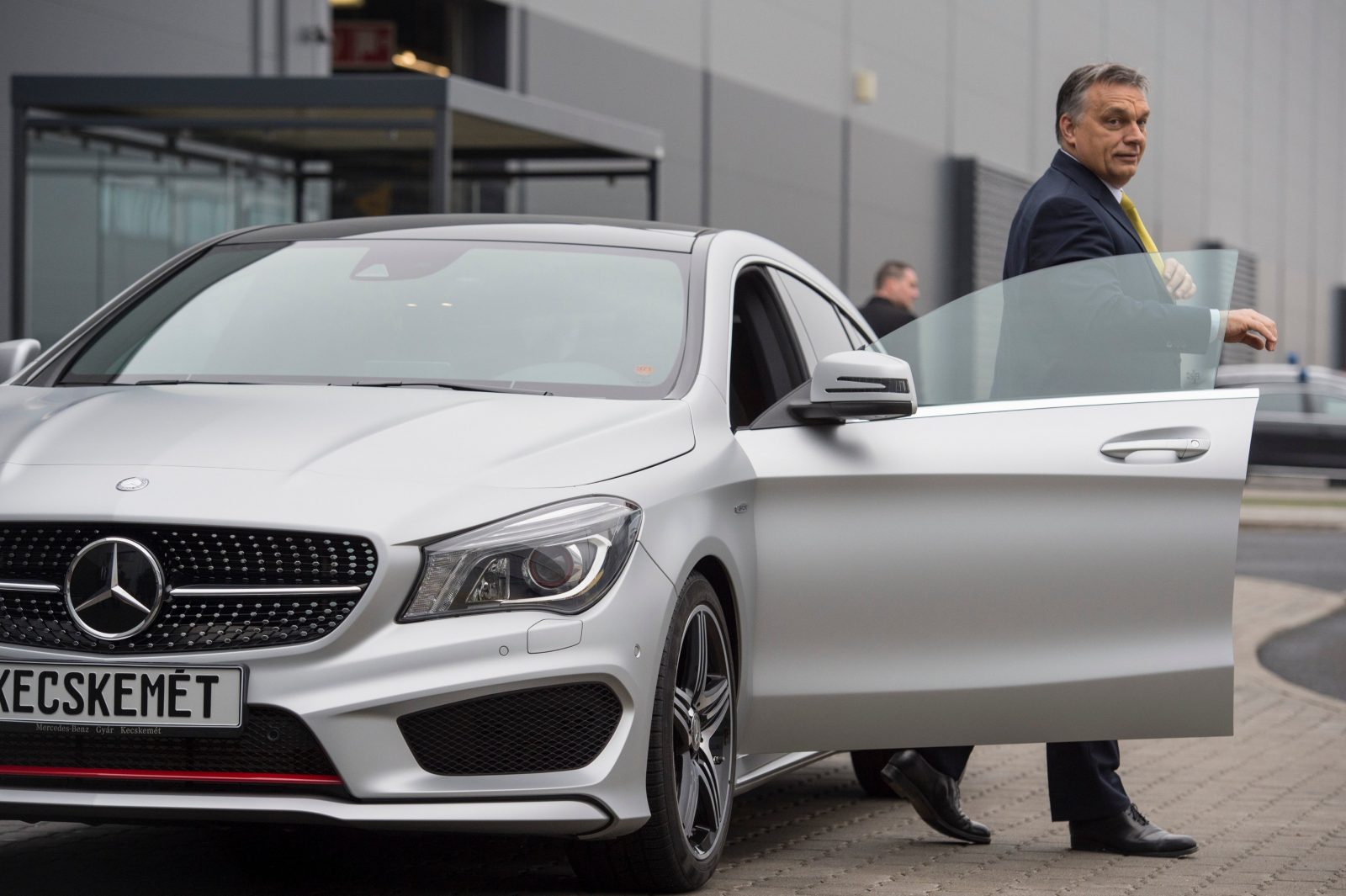
Car manufacturers have indeed done extremely well, thanks to the economic strategy of the Orbán government. The oldest German car factory in Hungary, Opel – which now only produces engines in Szentgotthárd – received 5.5 billion forints (15.3 million euros) in state support in 2011. Mercedes already received 22 billion forints (61 million euros) for its first plant in Kecskemét in 2009, 13 billion forints (36 million euros) for the second factory in 2016, and more than an additional 600 million forints (1,7 million euros) in 2017. Audi has been supported by the Hungarian government with a similar amount in the last ten years, 36 billion forints (100 million euros). However, these amounts do not include local subsidies and infrastructure developments serving the factories. For example, while the BMW plant under construction in the city of Debrecen will receive 12.4 billion forints (34.4 million euros) in direct state support, including the related infrastructure developments, the actual support will be around 130 billion forints (361 million euros).
In addition to larger, more famous German corporations, countless large or medium-sized German suppliers less known by the public have also benefited fromm significant tax cuts and state subsidies. Viktor Orbán himself spoke at a conference of the Konrad Adenauer Stiftung about the fact that Germany’s trade with the Visegrad region countries is already much larger than, for example, with France, Italy or Great Britain.
“Germans and other member states are making good money on us, they should not complain and neither should we,” the Prime Minister said.
Over time, key players in German politics also understood the logic behind Hungary’s special taxes. A German source working for the CDU said he believed it was reasonable for the Orbán government to crack down on energy, retail and telecommunications companies and banks that had “made good money in Hungary in the previous decade” and thus were able to pay extra taxes. In addition, the government’s goal was to create new jobs, while the financial sector or the energy sector, for example, were not really capable of doing so, according to the source. Meanwhile, car factories still provide 2.6% of Hungarian jobs and their suppliers another 3-5%, according to CSO data.
The special relationship between large German companies and the Orbán government is well illustrated by the fact that the Hungarian state returned to them as direct subsidy 44 billion forints (122 million euros) of a total of 303 billion forints (840 million euros) which was collected in corporate tax last year, while Hungarian companies received only 26 billion forints (72 million euros) in subsidies. During the ten years of Fidesz’s rule, Audi, for example, has received four times as much support in proportion of jobs in Hungary as in Germany, according to an article by Hungarian economic site G7. The Ministry of Foreign Affairs and Trade did not reply to our questions regarding justification of the above financial support rates.
According to a CDU source, large German investors in Hungary did not build relationships on a party basis, they just wanted to be on good terms with whoever was currently in decision-making positions. “If Gergely Karácsony becomes the next Prime Minister, he too will have to maintain a good relationship with Audi or BMW. Of course, these companies build and use political relationships, but they don’t need to be involved in party politics. Big German corporations are not dependent on the goodwill of German politics either. These companies are big enough on their own, you don’t need a German ambassador to contact Viktor Orbán,” the source said.
At the same time, several stories reveal that the relationship between the Hungarian government and German companies is delicate. And in return for a close relationship, many German business executives simply accept the rules dictated by the Orbán government and adapt even if they otherwise disagree with them.
III. Values and interests
Source: kormany.hu
Senior editors of Magyar Hang (‘Hungarian Voice’), one of the few independent Hungarian newspapers that still exist, have been unsuccessfully hustling for advertisements from large foreign corporations for a long time, being turned away everywhere. “Usually we didn’t even get to a face-to-face meeting until we were finally welcomed by one of the big German car manufacturers,” newspaper director Csaba Lukács told Direkt36, refusing to name the corporation because of the private nature of the discussion.
The German carmaker participated at Hungexpo in the first half of 2018. Lukács sat down with a German representative of the company in a meeting room behind their exhibition stand. “I showed him readership statistics and surveys of our readers. They really liked it and also said that we would fit their profile completely,” Lukács said. But the conversation then took a turn:
“On the way out in the hallway, the representative told me frankly: please understand, they can’t advertise in our paper because they don’t want to risk the state subsidy given to their factory.”
Not long before this episode, Csaba Lukács and editor-in-chief Zsombor György were still working for the then largest daily newspaper, Magyar Nemzet (‘Hungarian Nation’), but the paper was closed immediately after Fidesz’s election victory in April 2018. Magyar Nemzet was owned by Lajos Simicska, who had been at war with Viktor Orbán since 2015. After Fidesz achieved another two-thirds majority in the election, Simicska capitulated by handing over his business interests to owners close to the government. Soon after this happened, former journalists of Magyar Nemzet founded their own paper, Magyar Hang, which quickly became the number two public affairs weekly in Hungary. However, advertisements of large companies kept avoiding them.
According to György and Lukács, most foreign companies simply did not even respond to their request, but they also had worse experiences. Back in 2015, after the conflict between Simicska and Orbán escalated in public, German-owned retail chain Aldi took Magyar Nemzet off the shelves of its shops and started selling pro-government Magyar Idők (‘Hungarian Times’) instead, a newly created daily meant to replace the other paper. It took a lot of effort from György and Lukács to somehow manage to get their papers back on Aldi’s shelves. However, the whole story was repeated with Magyar Hang, and they had to threaten Aldi with a lawsuit to finally get them to start selling their newspaper.
In the autumn of 2019, the German Embassy in Budapest invited Hungarian journalists working for several independent outlets for an off-the-record discussion to talk honestly about the media situation in Hungary. After several journalists complained about the attitude of German corporations doing business with the government toward Hungarian media freedom, a high-ranking German diplomat reacted by saying that he is fully aware of this and ashamed of himself. “But please understand that this is Germany, which is a democracy where the Federal Foreign Office cannot put pressure on German companies,” the diplomat responded, according to a participant. Separately, a diplomat from the German embassy later visited the editorial staff of Magyar Hang. “He sat with us for two hours, listening carefully,” recalled Zsombor György, who said that their guest understood the gravity of the situation. The next day, the German embassy subscribed to one copy of the paper.
In reply to our questions about this episode, the German Embassy in Budapest wrote that the German government “is bound to respect freedom of speech and freedom of press. The constant dialogue with press representatives regardless their possible party affiliation is part of our day-to-day business. The federal government of the republic of Germany has no influence on the advertising policy of companies.”
Those who know him say that Viktor Orbán is exactly aware of the interest-driven nature of large German corporations. “According to Orbán, Germans are too rational to decide against their interests. One can always count on the rationality of the Germans,” a German expert with ties to the Hungarian government said when asked about the ideas the Hungarian government’s leadership holds about Germany. According to the source, tensions between the Hungarian and German governments are also explained by this assumption.
“When they see German criticism, the Hungarian government thinks: what do they want? If we gave a few billions for the Mercedes factory, why are they complaining about ‘dictatorship’? What do they want to achieve? After all, they are rational people, they must definitely have a purpose!” the expert said.
The Orbán government has been doing much more beyond tax breaks and pouring out state subsidies to fix cooperation, especially since the end of 2014, when the Ministry of Foreign Affairs became the Ministry of Foreign Affairs and Trade. According to a lobbyist working for German and other large foreign companies, doing business with foreigners has since become “even more centralized. Already during preliminary talks in the ministry they suggest working with local companies close to Fidesz, using phrases like such and such subcontractor is the guarantee of quality in Hungary,” the lobbyist said.
According to a former Orbán government official, Hungary’s system to lure in investors “has been crafted deliberately, but the Germans are not stupid or innocent either”. He recalled when on a joint trip, for example, German businessmen had already switched to a more informal tone and started praising the Orbán government to the skies. “After a bottle of wine, you will also be told that Hungary is a wonderful place, for example, because you don’t have to let Turkish workers go to the prayer mat at noon,” he said. During the private conversation, the same German businessmen also agreed with Hungary’s pro-Russian foreign policy and criticized EU sanctions imposed on Russia due to the conflict in Ukraine, because they believe sanctions did a lot of harm to German companies.
After 2010, the Orbán government has developed such an intimate relationship with many German companies that it managed to resolve disagreements and possible conflicts directly with the senior management of German parent companies, according to business and foreign ministry sources talking to Direkt36. According to a Telekom executive at the time, János Lázár, who was one of the most influential members of the Orbán government between 2012 and 2018, negotiated directly with the German parent company, Deutsche Telekom. Local executives at Magyar Telekom were only following decisions made at a higher level.
One of the most important intermediaries between the Hungarian government and German corporations is a man named Klaus Mangold, a former top manager at Daimler AG, who is often referred to in German press simply as Mr. Russia (Direkt36 wrote about him earlier several times). According to a former diplomat of the Orbán government, Mangold was already active under the Socialist MSZP governments as a “man beyond party lines”. “Mangold has always represented German big capital in Hungary and in Russia. He is primarily in the service of German industry,” former ambassador Sándor Peisch said about the lobbyist.
Mangold’s activities in Hungary also provided an example of how business and politics are intertwined in Hungarian-German relations, and how there are no purely business or purely political issues between the two parties. In 2016, 444.hu found out that the lobbyist had flown his good friend, German EU Commissioner Günther Oettinger to Budapest on his private jet. However, commissioners were not allowed to accept private gifts worth more than 150 euros. Oettinger, a CDU member, played a key role in authorizing the Russian-led Paks II nuclear power plant project in Hungary. He has known Viktor Orbán for a long time. Oettinger, who also has an extensive network of contacts in the German political and business world, was officially employed by the Hungarian government after he retired from the European Commission. He became co-chair of Hungary’s new National Science Policy Council, established in February.
Although German press frequently reports on corruption cases in Hungary, according to a source affiliated with the CDU, many German investors simply do not feel that the Orbán government is particularly corrupt. “If Orbán himself led a completely different lifestyle with girlfriends and luxury cars, Hungary would be a completely different story in Germany,” the source added.
IV. Not a love story, a working relationship
Source: kormany.hu
The Hungarian government was anxiously awaiting the last stop of German Chancellor Angela Merkel’s visit to Budapest on 2 February 2015. Merkel, accepting the invitation of the largest Hungarian Jewish organization, the Federation of Hungarian Jewish Communities (Mazsihisz), wanted to visit the Dohány Street Synagogue before returning home. The Orbán government considers Mazsihisz to be a critical organization, not least because they frequently raised the issue of anti-Semitism appearing in pro-government circles. (We wrote about the Hungarian-Israeli relationship and the role of the Hungarian Jewish community in an earlier article.)
To keep the situation under control, Prime Minister Viktor Orbán tried to get Merkel to let him accompany her to the synagogue, they asked Frank Spengler, one of the most important liaisons in Hungarian-German relations, to convey the request to the Chancellor’s staff. Spengler is sympathetic to the Orbán government, and he is the head of the Budapest office of the CDU party foundation, the Konrad Adenauer Stiftung (KAS). According to a source familiar with the German version of the story, Spengler agreed to convey the message despite knowing that the answer would be a rigid rejection. That is exactly what the reply was, according to reports shared with Direkt36 by sources familiar with the details of the visit five years ago.
Meanwhile, Mazsihisz leaders were also nervous about the visit, according to sources familiar with the internal affairs of the Jewish organization. Mazsihisz president András Heisler wanted to tell the German Chancellor something that no one else could hear. “We were still before the anti-Soros campaign, the crackdown on NGOs and the persecution of the Central European University, but even then we already felt in our bones that something was being prepared and that it could have a negative impact on the Jewish community. András wanted to express these fears to the Chancellor,” a source familiar with Mazsihisz’s internal affairs recalled.
The problem was that the main buildings of Mazsihisz were under national security protection if leading foreign politicians and other influential figures came to visit them, meaning they could eavesdrop on their talks as well. Moreover, since Merkel is one of the most protected people in the world, leaders of Mazsihisz accepted the heightened attention of the Hungarian intelligence services as an unavoidable fact. Therefore, they tried to create a situation in which Heisler could talk to Merkel in a way that no one else could hear.
Heisler and his staff finally came to the conclusion that the appropriate location for the private exchange, would be the corridor that would open from the ceremonial hall where the meeting with several other Jewish leaders was planned. After that official meeting, when entering the corridor, there would be only the two of them. Moreover, they saw the corridor as technically very difficult to be eavesdropped on.
Because every such visit has a minute-by-minute scenario and the high-ranking visitor’s route is tested with a stopwatch in hand, Heisler and his people knew they would have about three minutes to talk from the door of the meeting room until they reached Merkel’s car parked on the street.
Eventually, the Chancellor’s visit to Dohány Street went well, and after Heisler concluded the meeting, he stepped to the door on Merkel’s side to finally share with her the concerns of the Jewish community.
But when the door opened, to their surprise, Levente Magyar, a senior official from the Ministry of Foreign Affairs and Trade, stood there and said with a big smile, “Chancellor Merkel, let me escort you down to your car!”
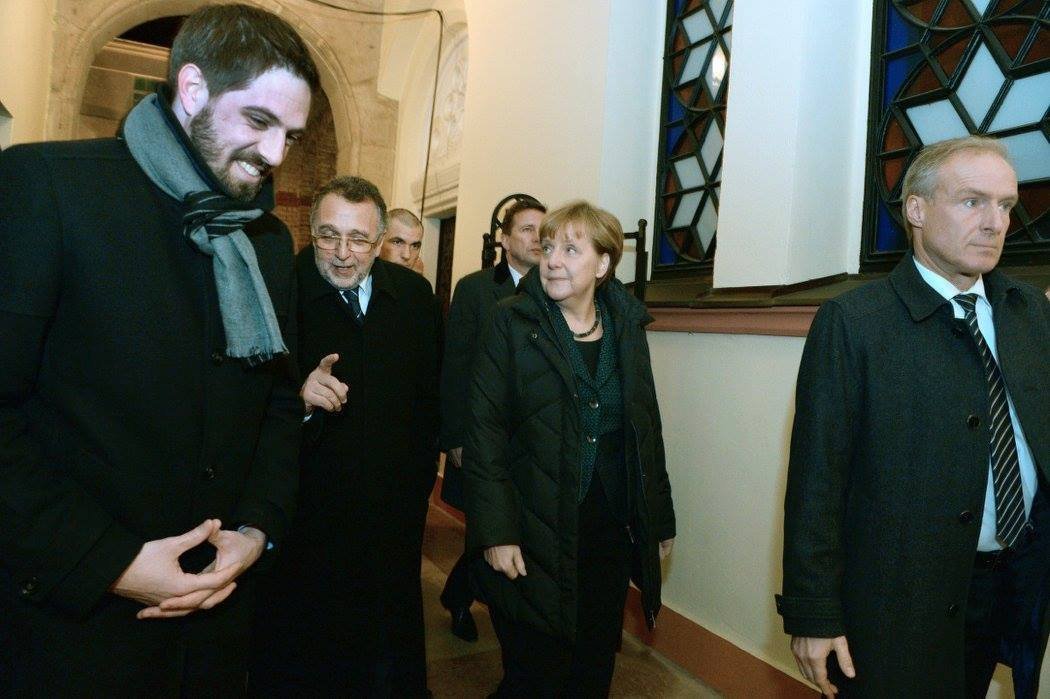
Levente Magyar, András Heisler and Angela Merkel Source: Mária Krasznainé-Nehrebeczky / Facebook page of MAZSIHISZ
“It was shocking. It’s like a rabbi sneaking into a government building and stealing Viktor Orbán’s guest,” a source familiar with the details of the visit added. Mazsihisz leaders were convinced that they had been careless and that their plan had been leaked to the government. However, the story reveals not only distrust and caution between the government and Mazsihisz, but also between the Hungarian and German governments and Viktor Orbán and Angela Merkel.
According to several sources who were close to Prime Minister Orbán, he believed Merkel was not only driven by political interests and her own career goals when she turned against Helmut Kohl, but that she also waged a political-ideological campaign within the CDU against Kohl’s legacy. “Kohl is not respected by the Germans enough, you have to come all the way to Budapest to hear something nice about him. The CDU and later its Bavarian sister party, the CSU, have shifted to the political center, Kohl is no longer a point of reference for them,” the German expert with ties to the Hungarian government told Direkt36. The source also recalled it being an important event, when in 2017, the former chancellor’s widow cited Kohl’s will and wanted Orbán to speak at the funeral instead of Merkel, but the German government eventually prevented this from happening.
Several sources agreed that Orbán and Merkel could never have become close confidants because “Orbán is a masculine man and deep down in his soul he really thinks that politics is not for women,” the German expert said. “There is full respect between Merkel and Orbán. It’s not a love story, it’s a pragmatic working relationship,” a source affiliated with the CDU said.
The relationship between Orbán and Merkel is well characterized by how it unfolded during the 2015 refugee crisis. “According to Orbán, Merkel represented a kind of ideological imperialism. They are the protagonists of two opposing sides of our civilization’s struggle,” a former diplomat of the Orbán government said about this period. They saw that Merkel practically wanted to force multiculturalism on Europe, and only those were considered good Europeans who supported immigration. According to the former diplomat, the Orbán government also strongly attacked Germany’s refugee policy because the idea of migrant quotas – to distribute refugees among all EU member states based on their economic strength and size – came from Berlin, and therefore the German government had to be “politically crippled in public to make them understand that this is dangerous”.
But Orbán’s criticisms and harsh stance on immigration did not hurt Merkel at all, for example in German domestic politics. A former official of the Orbán government recalled that in the televised debate of the 2017 German elections, for example, Merkel and her challenger, Martin Schultz, mentioned Orbán many times, showing that the Hungarian Prime Minister became an important figure in German public discourse. According to him, in the case of immigration, Orbán and Merkel “bashed each other in public just because they both benefited from making the other an enemy.”
Orbán and Merkel “bashed each other in public just because they both benefited from making the other an enemy.”
Meanwhile, the Orbán government has been heavily criticized by the German press from early on, and because of this, made lots of efforts behind the scenes to improve its image. After the extremely negative German response to the new Hungarian media law, the Orbán government began to translate new laws into German in advance, and they even sat down regularly with senior editors of major German newspapers. These were proposed by Frank Spengler, head of KAS, according to several sources familiar with the communications strategy at the time.
However, criticism has intensified once again in 2015 when a European debate started on immigration. The Hungarian government also tried to win over the German public through the tabloid press, with the help of Leslie Mandoki, a German musician of Hungarian origin who received Hungarian and Bavarian state awards. According to a former Orbán government official, Mandoki “is an important event organizer in the CDU […], for example, through his contacts, he helped ensure that the German tabloids would write beautiful things about Hungary, Budapest and Orbán at the most critical moments”. Meanwhile, the musician received two billion forints (5,5 million euros) of Hungarian state support for various projects. Mandoki has also worked as a music director for Volkswagen and Audi for a long time.
Moreover, following the refugee crisis, while the Orbán government’s own media continued to criticize Merkel and glorify the rising anti-immigration party, the Alternative for Germany (AfD), in confidential talks, the CDU liaisons of Fidesz (Zoltán Balog, Gergely Gulyás and Katalin Novák who speak fluent German and know German politics very well) hit a different tone. “We know that the AfD will never be in power and for us, the CDU will always be the guiding star, that’s what Orbán’s people told me,” a German foreign policy expert recalled one of their conversations. A source affiliated with the CDU spoke of the same thing: Fidesz has abandoned not only the AfD but also the far-right FPÖ in Austria and Marine Le Pen in France since the 2019 EP elections, “because they see that they won’t be in power”. “The problem is that it will never be possible to form an alliance with the AfD, so the CDU will always be very important,” an Orbán government official acknowledged the same from the other side.
The way the Hungarian Prime Minister maneuvered among recent developments in German politics was a good example of the pragmatic relationship between Orbán and Merkel. Although the Bavarian CSU used to be Fidesz and the Orbán government’s the closest ally among German conservative parties, in 2019 Orbán turned against and withdrew support from CSU member Manfred Weber, the European People’s Party candidate for president of the European Commission. After the European parliamentary elections and the negotiations that followed, the top position was eventually filled by CDU politician Ursula von der Leyen, one of Merkel’s closest confidants. Weber failed because French president Emmanuel Macron rejected the entire Spitzenkandidat system (where parties in the European Parliament campaigned with pre-selected candidates for Commission president), and in the ensuing conflict, Merkel did not hold on to Weber and sacrificed him instead. According to a former Orbán government official, since the anti-Weber campaign was publicly led by Orbán, the Hungarian Prime Minister skillfully maneuvered and gained leverage.
V. Orbán’s prospects
Source: kormany.hu
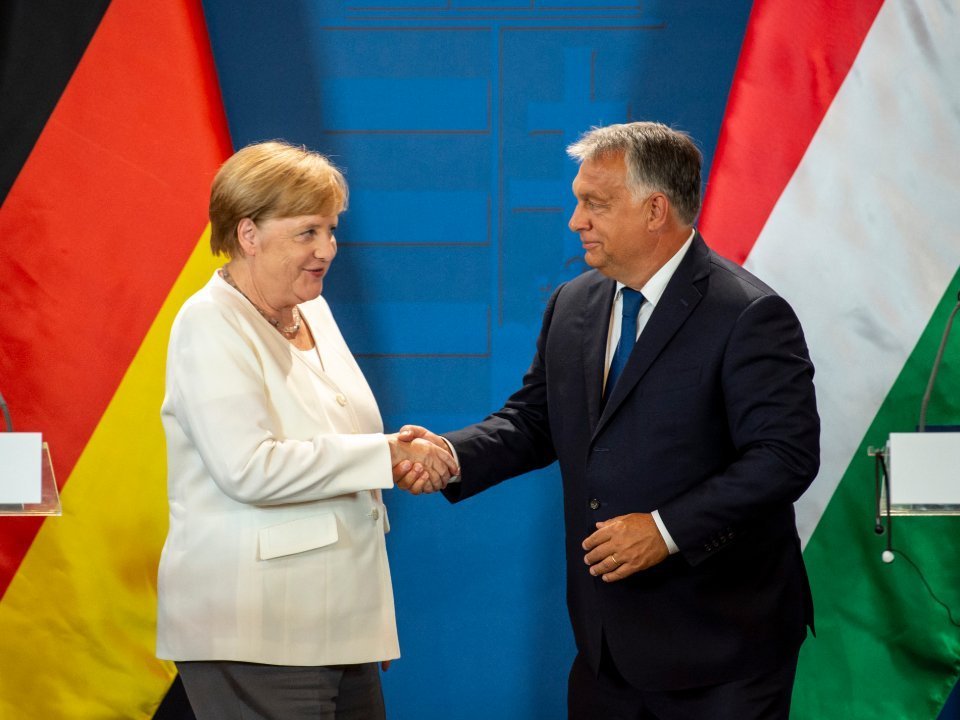
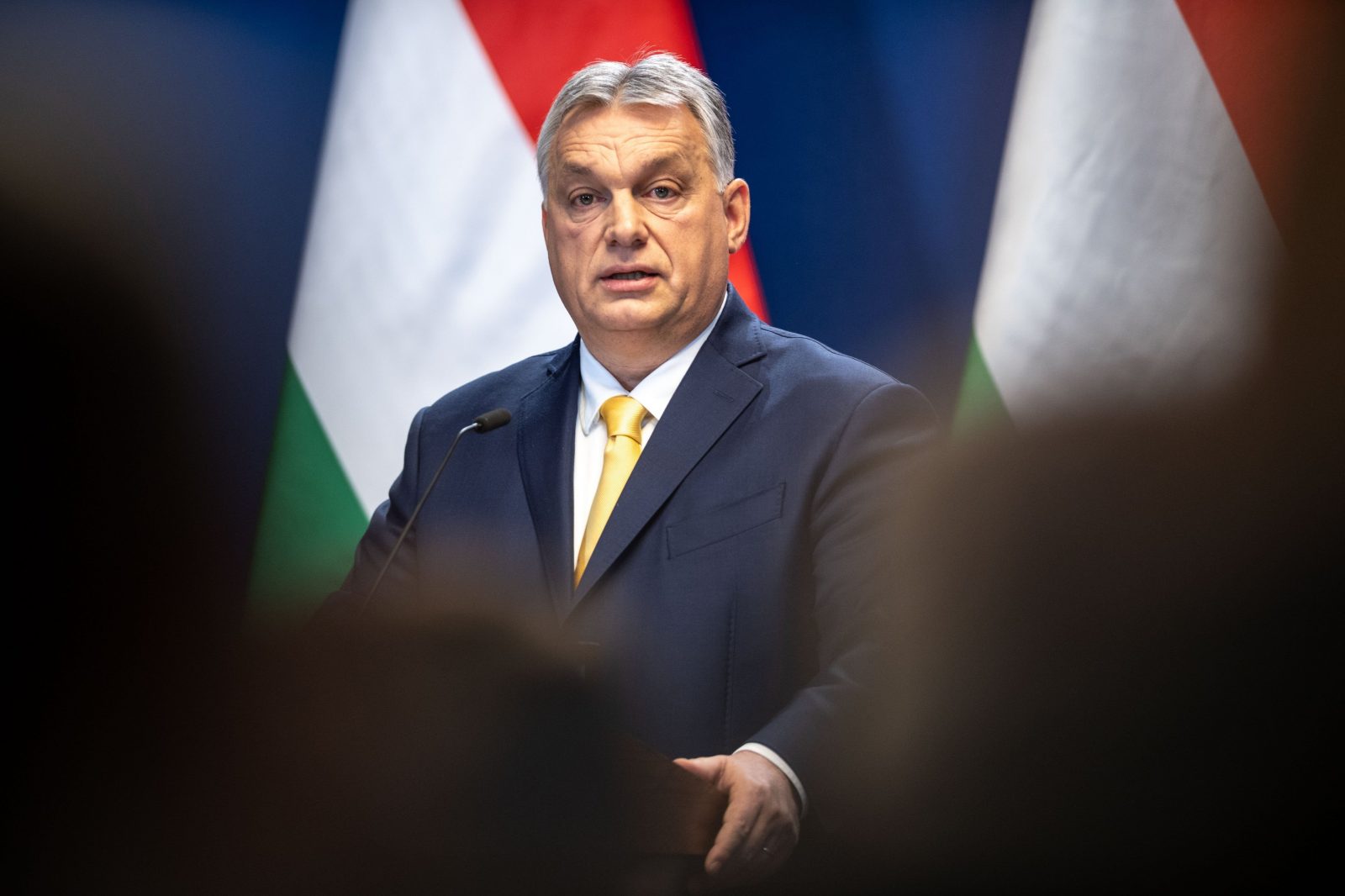
These friendly gestures were also returned by the German Chancellor. During her visit to Sopron on 19 August 2019, Angela Merkel praised how EU funds were being spent in Hungary. “If we look at Hungarian economic growth rates, we can see that this money has been well invested by the country, that it benefits the people, and Germany is happy to be able to participate in this growth by creating jobs in Hungary,” the chancellor said.
“When Merkel says that EU money is well spent in Hungary, maybe she didn’t pick the right words, but she was trying to say that fiscal and economic policies are going well according to Germany’s liking,” a former Orbán government official said, labeling the Chancellor’s visit last year a turning point.
Indeed, tensions between the leadership of the two countries have visibly eased recently. In addition to political gestures, the Hungarian side also tried to work on resolving problems through business deals. One of the most spectacular examples of this was that last year Hungary became Germany’s number one arms buyer. “We bought more weapons from the Germans than the Bundeswehr itself,” the former government official said. The largest Hungarian orders were the purchase of 44 new and 12 used Leopard 2 tanks and 24 Panzerhaubitze 2000 self-propelled guns, which are predominantly manufactured in Bavaria. Since then, an agreement on the joint production of German Lynx infantry fighting vehicles has been announced too. Those Airbus helicopters purchased in 2018 also came in part from the Bavarian factory of the multinational European company.
When deals on helicopter and tank purchases were closed, Germany’s Minister of Defense was Ursula von der Leyen, who later took over as President of the European Commission. She had a thin majority in the European Parliament dependent on – among others – Fidesz’s votes. According to a German source affiliated with the CDU, “buying German weapons is a long-term commitment. Von der Leyen was aware of this and also regarded Hungary as a reliable ally”.
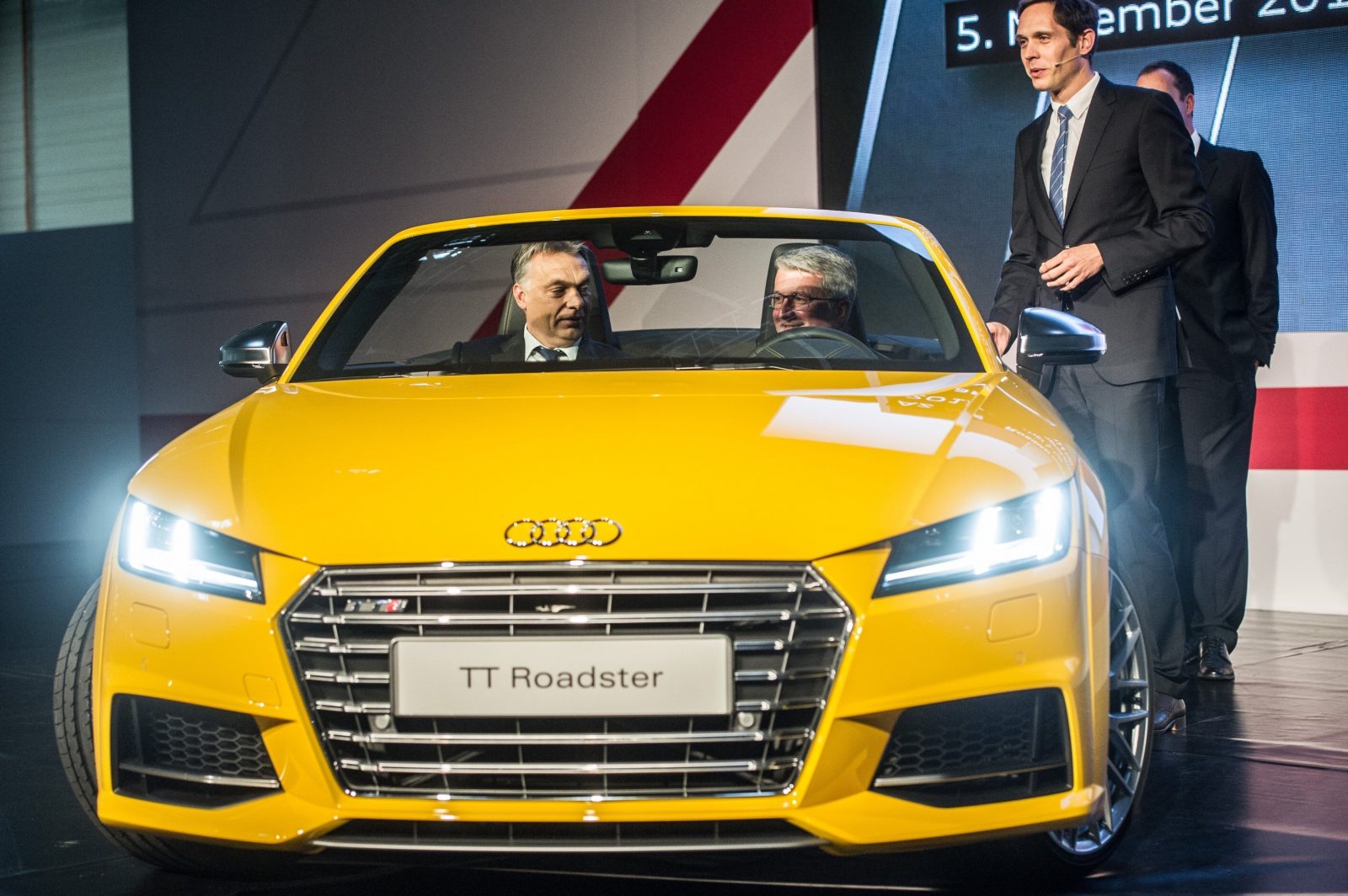
But in addition to the German military industry, the Orbán government has also reaffirmed its commitment to the crisis-stricken German car industry. In June, during a visit to Audi’s factory in Győr , Viktor Orbán promised another state subsidy, this time citing the economic downturn due to the coronavirus. In early July in Stuttgart, Péter Szijjártó advertised the latest Hungarian employer tax cuts to German company executives .
These agreements, deals and the close relationships that have developed in the past will be of great importance in the coming months. There are two heated issues that will determine the Hungarian government’s European advocacy power.
The first is about the EU’s budget for the next seven years from 2021 to 2027 and how EU funds should be spent. One of the most important debates around the budget is that certain member states as well as the main party groups of the European Parliament want to link the allocation of EU money to compliance with certain rule of law criteria. This is an explicit attempt to put pressure on Hungary and Poland, because they think that rule of law institutions in these countries have been weakened. The other issue is Fidesz’s membership in the European People’s Party, which has been suspended since March 2019. The political family should have decided in the autumn whether to exclude or readmit Viktor Orbán’s party. 14 other member parties have initiated the expulsion of Fidesz, citing that the party has been consistently violating the EPP’s values.
According to a CDU source, it is completely unrealistic to link EU funds to the rule of law during Germany’s EU presidency in the second half of 2020. The negotiations of member state leaders over the summer resulted in a deal that would make it rather complicated to actually withhold EU funds from member states disregarding the EU’s core values. However, the European Parliament wants tougher action, which has supporters in the German government as well: Social Democrats heading the Federal Foreign Office, Minister of Foreign Affairs Heiko Maas and Minister of State for Europe Michael Roth strongly support rule of law stipulations.
German players also have a decisive role in Fidesz’s membership in the European People’s Party, as CDU and CSU have the most votes in the party family. However, according to a source affiliated with the CDU, the German party is “divided on the issue of Fidesz because the CDU is also divided on what direction they themselves should follow. The question is, how broad should the European People’s Party be?” Moreover, according to a German expert working for the European People’s Party, while the more liberal CDU party organizations and politicians of West Germany are typically critical of the Orbán government, the Hungarian Prime Minister is often seen as a hero by the East German CDU.
There have been several high-level meetings in recent months to reconcile on contentious issues. In the summer of 2020, Orbán’s chief of staff Gergely Gulyás visited Berlin to meet CDU and CSU leaders, and then in mid-July, CDU party chairwoman and German Minister of Defense Annegret Kramp-Karrenbauer traveled to Budapest. Direkt36 was informed by multiple Hungarian and German sources that these negotiations have been successful for both parties., The Orbán government is confidently looking forward to developments in the autumn in regards to the EU budget, the Article 7 procedure initiated due to rule of law problems, and Fidesz’s EPP membership. According to a former Hungarian government official, following recent talks on new arms deals which were discussed in Budapest in July, the main problem for the Orbán government regarding the EPP membership is just Polish EPP chairman Donald Tusk, who repeatedly attacked the Hungarian Prime Minister. However, Tusk has announced that the EPP will yet again not hold a vote on expelling Fidesz at the end of September.
“One should understand that the CDU, the largest member of the EPP, has an interest in keeping the EPP together and sees that the political family is extremely divided on the Fidesz issue,” a German expert with the EPP said. “They are afraid of a split, afraid of losing relative influence in the European Parliament and think that they still have some influence over Orbán” – the source added. According to a source affiliated with the CDU, it is simply not a priority for his party to take a stand and finalize the question of Fidesz’s EPP membership.
“Everyone expects the Germans to show the way, but it’s a myth that the Germans should lead. We have better things to do, why should we deal with the Fidesz problem? These struggles within the EPP have to be decided by the party chairman and the leadership,” the source argued why they are not engaging in more conflicts with Orbán.
“One of their arguments is what Fidesz would be capable of doing if they were expelled. […] They are afraid that the expulsion from the EPP would radicalize Fidesz,” the German expert working for the EPP said. “They no longer have any influence over what Orbán does in Hungary, but they are not interested in it either. They say that the EPP is still able to influence Orbán in Strasbourg and Brussels, and that’s what matters to them,” the source added.
The conflict avoidance of German politics and the difficult, but always pragmatic working relationship with Merkel over the past decade has been so convenient for the Hungarian government, that only a shift in power in German politics can pose an actual risk. Orbán himself has publicly indicated that, despite all their previous conflicts, he would really be happy if Merkel changed her decision and did not retire from politics.
At a conference a few months ago, for example, the Hungarian prime minister said that he tried to persuade Merkel to stay: “If you look at the politicians of the European Union today there are only a very few active politicians who were active and who contributed at the time of the downfall of the Soviet Union and the changes of the history of the continent, but we were there. The only Western European politician who made a major contribution and is still active is Chancellor Angela Merkel, who is just about to leave“ Orbán said, adding that “in brackets, I tried to convince her not to do so, but I was always rejected.”
Among the Taliban
The first contact. A voice on the mobile phone crackles through the speaker. It sounds resolute, but also young, fresh, almost vulnerable. The voice gives us our final instructions, even as we are already on the road. Our destination is the Ghazni province in central Afghanistan, a four-hour drive from Kabul. On our journey along the National Highway, we have passed by destroyed army bases and the wrecks of burned-out military vehicles. For long stretches, the road is ripped open by blast craters every hundred yards. The voice then orders us to turn off the main arterial, directing us further and further away from the National Highway. Deeper and deeper into a region where there are almost no roads, only goat paths. The tires of the Toyota spin in the sand and the car bottoms out on the rocks. A short time later, we pass the last government outpost, a fortress on a hill with an Afghan flag flying above it. Then, the connection breaks off.
“Is this the right place?” our driver asks a moment later. We wait nervously in a village square. It is completely empty, the village apparently deserted. Our driver looks at the phone, which continues to indicate we have no signal. We were told on the phone that we would meet in the first settlement on the other side of the government lines. A few meager mud huts. The people here fled in fear years ago. No man’s land. “I don’t know if this is the right place,” our driver says again. We consider whether to turn back when seven armed men suddenly stride out onto the square. “Peace be with you,” one of them says. It’s the same boyish voice we know from the phone.
He smiles, but it fades quickly. He introduces himself as Nisar, a name he knows we know is not his real one. He will be our escort for the next few days. We, reporters from ZEITmagazin, spent months preparing for this journey. But we’re still nervous. We are putting our fates into the hands of people we previously feared would kidnap us.
Western journalists have only ever spent a few hours at a time with the Taliban for security reasons. We are the first reporters in years to entrust ourselves to them for a few days. We want to report on the people who fought the most powerful military in the world to a standstill, the people who established a country that is not officially on any international map, the Taliban state. The Taliban are feared by many, and yet they are revered. People are willing to die for the Taliban, to be tortured and imprisoned on their behalf. For many, the Taliban are a beacon of hope.
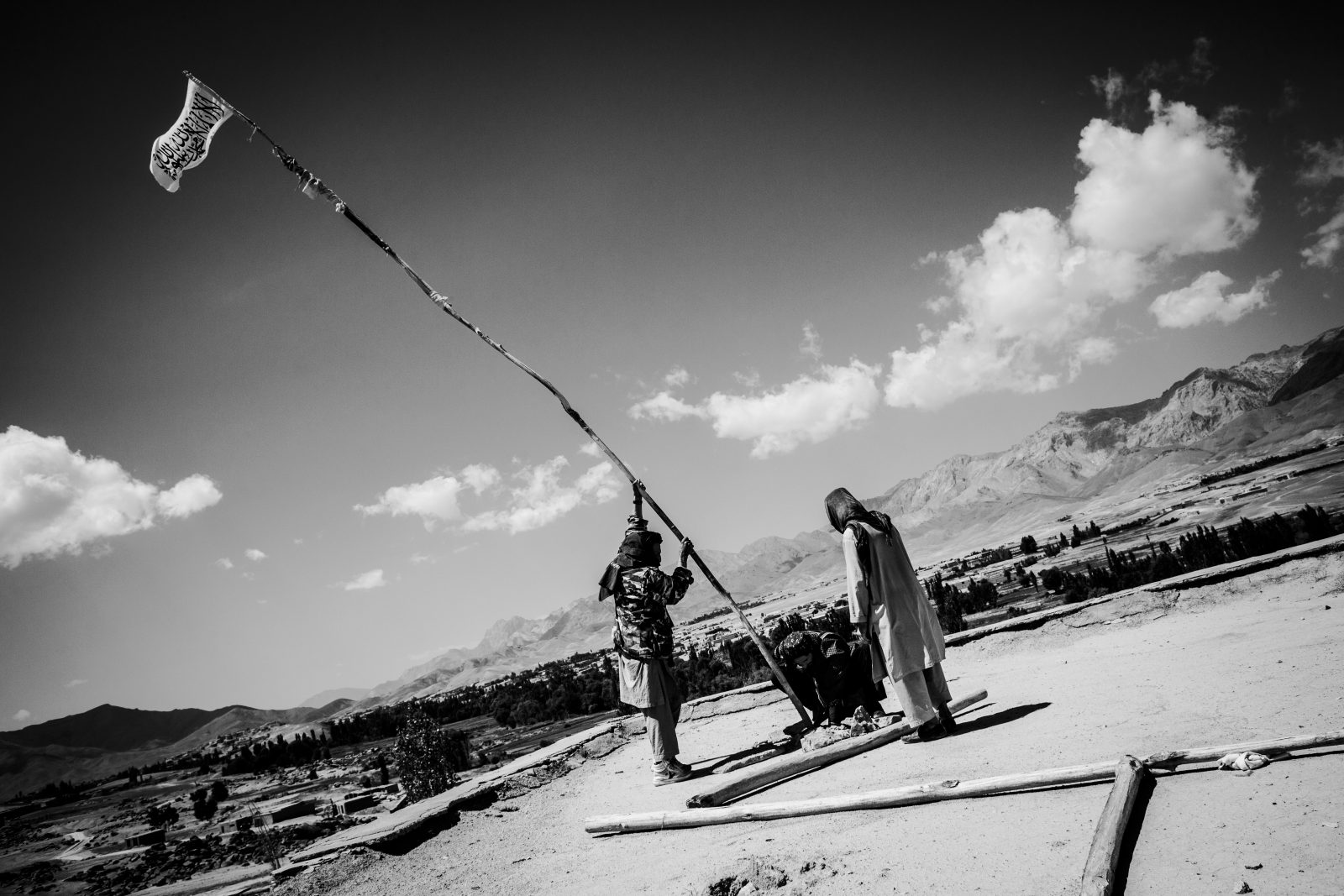
Rashidan, Ghazni province, Afghanistan – 01.09.2020: Taliban are rising the white Taliban flag on the roof of the former district and police headquarter of Rashidan district. Photo: Andy Spyra
By fall 2020, the holy warriors are once again in control of 80 percent of Afghanistan. The government of President Ashraf Ghani has been driven back to the provincial capitals and to the national capital of Kabul, essentially a rump state that continues to shrink. The Taliban, in fact, has already reached the suburbs of Kabul, and all the refugees who fled the provinces for the capital in recent years are crowded into an ever-smaller space. The United States is withdrawing its troops after a two-decade presence in Afghanistan, while the level of corruption inside state agencies is reaching an appalling scale. Everywhere, people are trying to get as much money out of the country as possible in preparation for their own exile. The state is on the verge of collapse. It is feared that the first army units will soon begin to defect. In Doha, delegations from the government and the Taliban have been negotiating a cease-fire since mid-September, but many believe the true outcome will be capitulation.
Nisar, the young Talib, is dressed entirely black, complete with a black turban. With his Kalashnikov slung over his back, he leads the way on his motorcycle. The road heads into the mountains, steeper and steeper. We pass by the last fields of green and are suddenly surrounded by bare white cliffs, the narrow road carved into the mountainside, with a steep cliff on the valley side. Rocks dislodged by our tires plunge hundreds of meters. Nisar, a diminutive silhouette in black, waits for us at each switchback, turn after turn, all the way to the summit of the pass, an altitude of just under 3,000 meters.
Shortly before our trip, our arrangements with the Taliban threatened to fall through. Even just establishing contact is tenuous. There is considerable mutual distrust, and a number of journalists who thought they could rely on the word of Taliban commanders wound up getting kidnapped. The feeling you get when leaving the government’s sphere of influence is one of complete loss of control. Like stepping out the door of a spacecraft into the blackness of space. Our only guarantee of not disappearing into the barren landscape is a voice message on WhatsApp. It’s our lifeline: again a voice, this time an older one. It’s the voice of the spokesman for the highest-ranking Taliban. An audio message guaranteeing our safe passage.
Those who are otherwise notorious for kidnapping Westerners are now our protectors – or so we hope. At around noon, we reach the valley floor on the other side of the mountain range. The Taliban have been in control here for almost 10 years without interruption. The Rashidan District is relatively small, but strategically important because it borders directly on the provincial capital of Ghazni. A dozen villages are nestled in a green strip of fields and copses of trees that follow the course of a river at the bottom of the valley. Otherwise, it’s just a barren region of dust and stone. Nisar is guiding us to the district center, which is located in the village of Hussain Khel. It is also home to a market, where you can still see traces of past battles. Nisar stops at the high school, where the students curiously peer out of the windows. A retinue of 20 men in black turbans is standing in front of the entrance. They’re waiting for us.
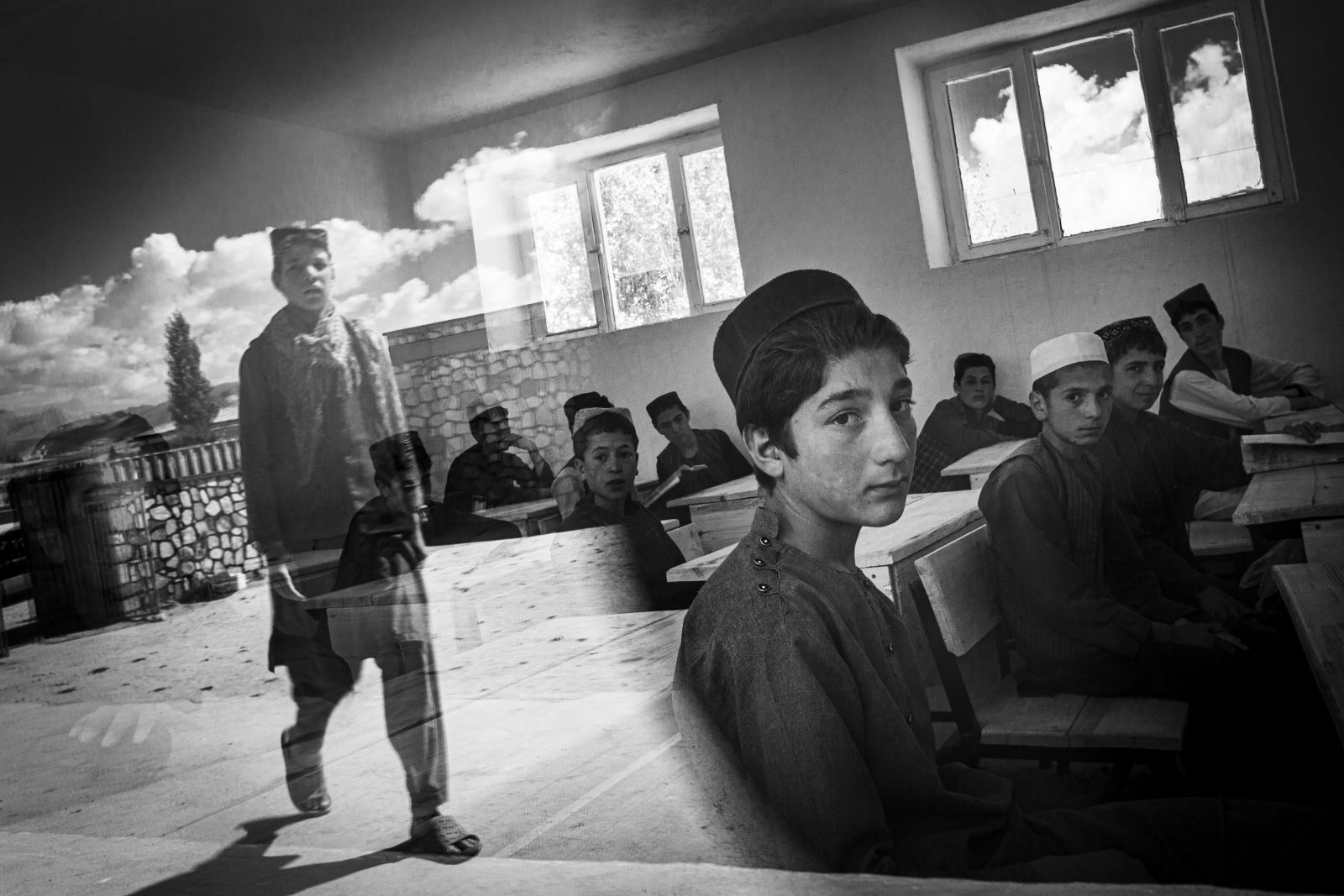
Rashidan, Ghazni province, Afghanistan – 01.09.2020: Scene in the high-school of the Rashidan District of Ghazni Province. The salary of the teachers is being paid by the government, despite the school being in Taliban territory. According to the teachers of the school, there is little interference of the Taliban with the curriculum of the school as worldly subjects such as history, maths and science are being taught. It’s a gender-segregated high-school, the high-school of the girls is located at the other side the valley. Photo: Andy Spyra
“I welcome you to the Islamic Emirates,” says Maulavi Nasrat, the Taliban commander of Rashidan. His handshake is unsteady; he hugs us tentatively according to Afghan custom. “The Americans and you, the allies of the Americans, have attacked our country,” he says. “We were only defending our country. You forced this war on us.” Nasrat invites us in. The Taliban sit down with us on the floor of the teachers’ lounge. They have never met journalists from the West. Some look upon us with hatred, while others – most, it seems – are just curious.
Provincial councilors have gathered in the room, judges from various courts, several deputies from the morality police, who check villages for compliance with the prescribed beard length and Islamic dress code, the education officer who oversees schools, a tax collector – essentially a cross-section of the Taliban bureaucracy that has grown up in recent years. The government in Kabul has been rendered to the history books for many years. “Take a look around our district,” says Nasrat, the commander, who is in his early thirties. “Talk to the people. They’re happy because we abide by the Koran and Sharia law. The government in Kabul, which you foreigners have installed, indulges in corruption. It is morally corrupt. There is no corruption here. We serve Allah and solve people’s problems.”
No one in Afghanistan had thought the Taliban would be back. They were crushed. The U.S. forces had bombed them into irrelevance within just a few weeks of the terrorist attacks in New York in 2001. It has been estimated that 20 percent of all Taliban fighters were killed at the time. The rest fled to Pakistan or went into hiding. To prevent Afghanistan from being dominated by radicals once again, the international community decided to undertake a massive effort. Fifty countries sent in soldiers and development workers. The U.S. alone is said to have invested $1 trillion in the effort. The aim was to use the example of Afghanistan to prove that it is possible to change a country for the better and wrest it from evil. And that evil had a name: the Taliban.
Not much is known about the early days of the Taliban. Its founder Mullah Mohammed Omar is shrouded in myth, a man who lost an eye fighting the Soviets in the 1980s. Only one photograph existed of him until his death in 2013. Omar taught in a mosque near Kandahar after the collapse of the communist regime in 1992. The country had fallen into the hands of hundreds of warlords and their fighters, the mujahedeen, who were organized into dozens of different alliances that fought against each other. Those were the bloodiest years of the country’s civil war, and Afghanistan sank into anarchy. In early 1994, a local warlord kidnapped two girls, shaved their hair, and held them at his base, where they were raped. Omar called together the 30 students at his madrassa, his “Taliban” – the word Talib simply means “student.” They armed themselves with 16 rifles and went to the warlord’s house, where they freed the girls. They then hanged the warlord from the barrel of a tank’s gun.
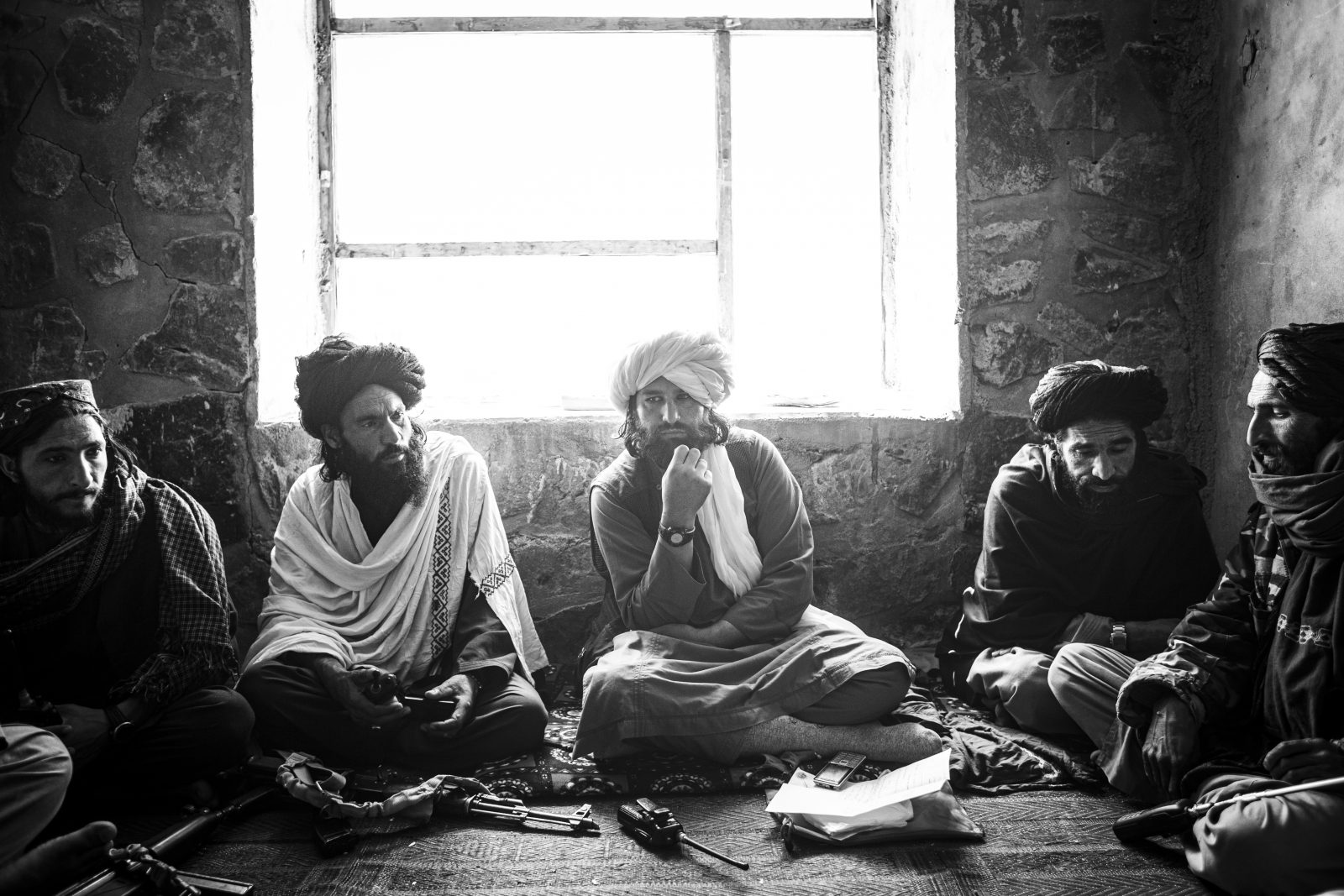
Rashidan, Ghazni province, Afghanistan – 01.09.2020:
Meeting of the Taliban’s justice court in the only remaining intact room of the former district and police headquarter of Rashidan district. The Taliban have managed to establish their own elaborated sharia-based justice system with several levels of conflict resolution. Maulawi Shakir (middle) is presiding over the local court in Rashidan district of Ghazni province. Photo: Andy Spyra
The history of the Taliban, which the world would later come to know as a movement that oppressed the women of an entire country, ironically began with the liberation of women. More and more people began seeking out Mullah Omar after that to ask for his help when warlords attacked. Students from other madrassas also joined him. Within months, they controlled entire provinces. By the end of the year, Mullah Omar had 12,000 followers. Soon he was calling himself Amir-al Mu’min, “the leader of the faithful.” Money began flowing in, with mujahedeen factions giving him money in the hopes of leveraging the Taliban against their opponents. Pakistan, which had supported the mujahedeen in the fight against the Russians, gave the Taliban money in the hopes of exerting control. The Taliban started out in Afghanistan as bearers of hope. They seemed to be the power that could finally, after 25 years of war, bring peace to the broken country.
But they only brought another bloody war. Afghanistan has now gone for 42 years without peace.
“We have learned from the mistakes of the past,” says Nasrat, the commander in Rashidan. In the past, they would have conquered a district and installed one of the fighters as governor. “They didn’t know how to deal with the population,” he says. “It’s different now. We have many experts.” He keeps looking uneasily at Nisar, who has taken a seat at his side. The young Talib who picked us up was assigned as our escort by the Quetta Shura, the Taliban leadership body in Pakistan. He wears kohl around his eyes, which in Pashtun culture is supposed to protect him from the evil eye. He is just 23, his beard not yet full. Nasrat, who towers over him by a head, is 10 years his senior and has the calloused hands of a man who is used to hard labor, a peasant turned revolutionary. “We have so many experts,” says Nasrat, the commander, “that we can manage all of Afghanistan. We are now familiar with the world.”
“Tell them that we do a better job now of listening to the people,” Nisar urges. “We are paying more attention to what the people want,” Nasrat says. “How about,” Nisar suggests, “you tell them that we will have peace once all the foreign troops have left.” Nisar provides the answers, openly and unapologetically. He’s part of the Taliban’s press department, which operates radio stations in most provinces, publishes newspapers and manages social media platforms. Men like Nisar are the young elite of the Taliban. They are fluent in modern technology and film young suicide bombers before they blow themselves up in crowds.
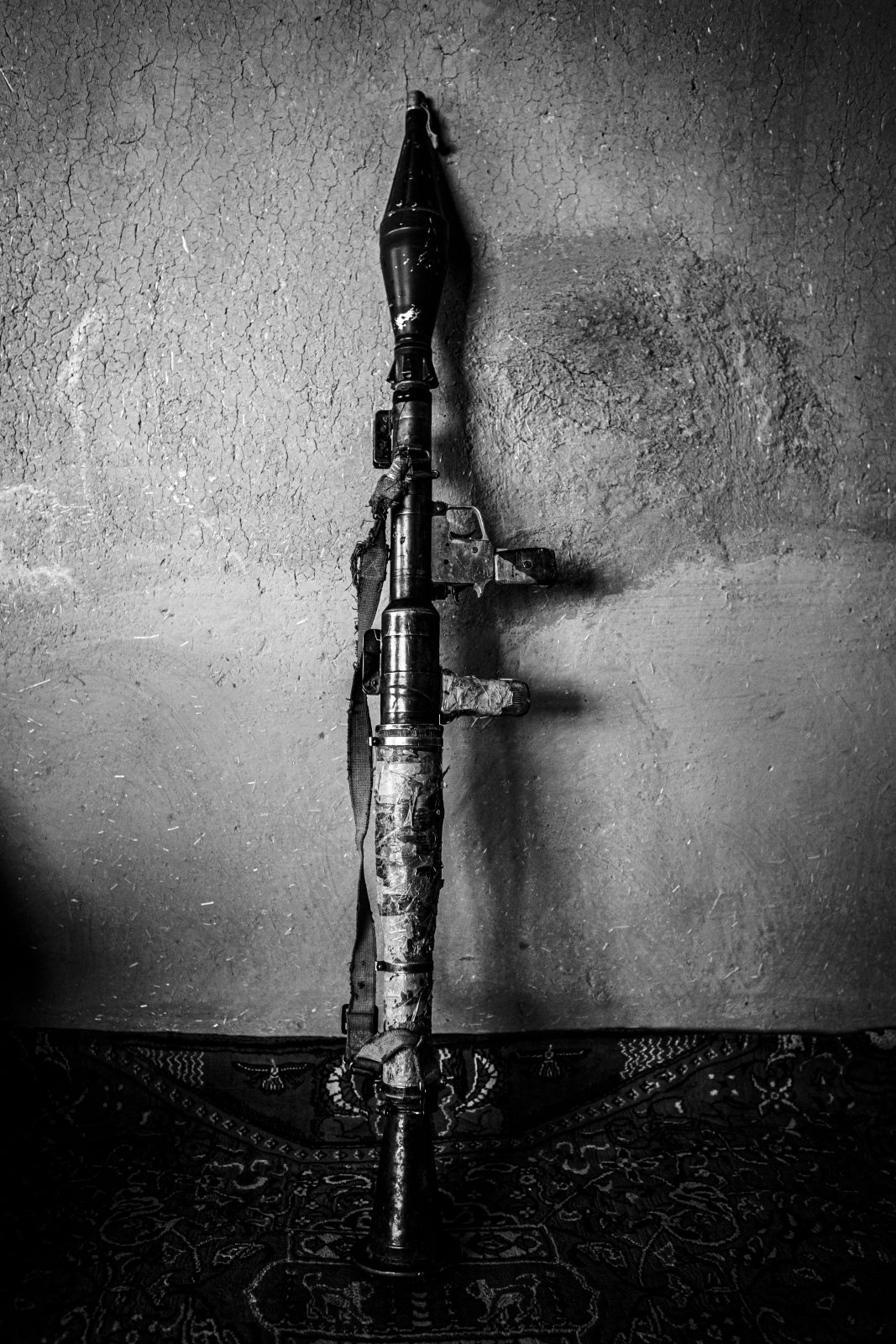
Nawur district, Ghazni province, Afghanistan – 02.09.2020: An old RPG (Rocket-propelled-grenade) of the Taliban, wrapped in Tape. Photo: Andy Spyra
The symbol of their victory is perched on a hill above the village. Nasrat and Nisar leave the school and cross the market on foot. It officially belongs to the government, but the vendors have long been paying their rent to the Taliban. There are three pharmacies, several mechanics, who mainly repair Taliban motorcycles, grocers and a few tailors. Of 250 stores, 50 are open. Only very few men dare not wear a full beard and turban. The Taliban has reinstated its old dress code. The beards can be no longer or shorter than a fist, just as the prophet wore his. Shopkeepers and customers look at us curiously, unable to tell if we’re hostages or guests.
And then we are standing in front of the ramparts of the district headquarters, a fortress high above the valley. “It was my greatest victory,” Nasrat says as he steps through the gate. The place is in ruins. Grass is growing in the courtyard, the wall surrounding the structure has collapsed in several places, and the two main buildings have been blown open by explosions. Eight years have passed since Nasrat’s group stormed the facility, destroying three tanks, he claims, and killing 46 policemen. There are still traces of the final desperate attempts to ward off the attackers: The windows of the buildings have been sealed with clay and the holes in the walls reinforced with sandbags. “Look at how they treated their prisoners,” Nasrat says, showing us a concrete bunker dug into the courtyard. The police, he says, would lock away dubious villagers in the pit and leave them there. “It’s a violation of human rights,” Nasrat says, ignoring the fact that the Taliban also lock up their prisoners in cattle pens and caves. A Taliban flag, white with black lettering, flies from the roof: “There is no God but Allah, and Muhammad is his messenger.”
Only a single room in the complex is still intact, a bare, bleak room with raffia mats on the floor. This is our headquarters now, Nasrat says, but it’s not really true. The Taliban rarely stay in one building for very long out of fear of drone strikes. This was also the case during our trip. Meetings are short and hurried. They are constantly in a hurry, arriving on a dozen motorcycles. Nasrat, as commander, is the only one with a car. Then the group scatters, all going in different directions without saying where and when we will see them again. At night, we are left to do our own thing, with no one watching us. And yet we’re still certain that Nasrat will be informed of all our movements. At night, the darkness in the mountain valley is almost completely impenetrable. The nearest public power supply is in the provincial capital of Ghazni, 88 kilometers away. Our first host, who is a bit better off than his neighbors, has a car battery as his only source of electricity, powered by a solar panel on the roof. It’s enough to run two light bulbs at the same time.
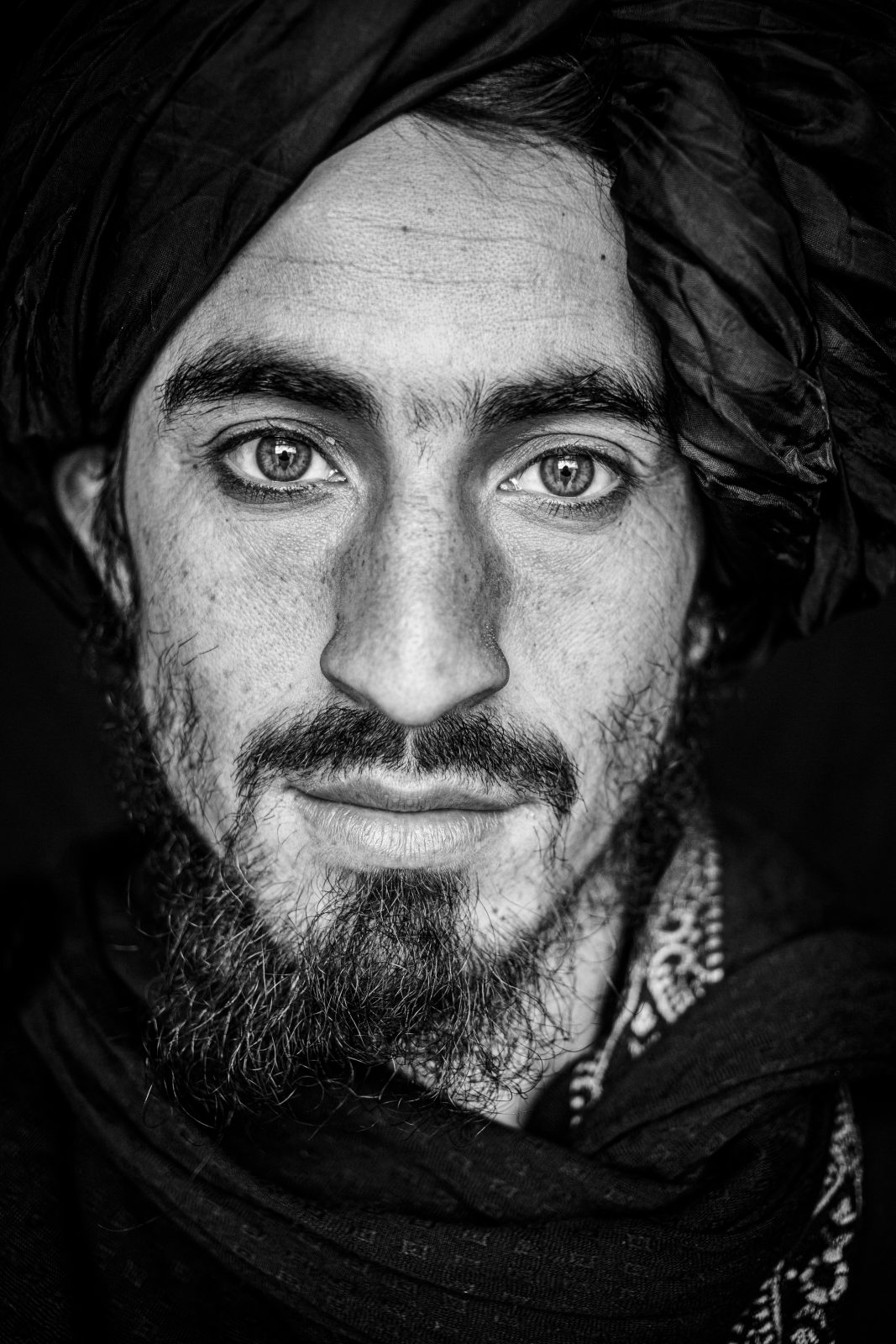
Rashidan, Ghazni province, Afghanistan – 01.09.2020:
Portrait of Nisar, the media representative of the Taliban of Rashidan district in Ghazni province. Photo: Andy Spyra
We talk to the villagers under the cover of night. We meet with others in Kabul after our trip so as not to endanger them. We want to know what life is really like under the new Taliban.
An educated man of around 40 who was born in Rashidan says:
“In the first years after the fall of the Taliban government, no one thought war would return. We were optimistic. Everyone was tired, even our local Taliban were tired. They had returned to their families and became farmers again. They weren’t fighting against the government. At first, the Taliban also weren’t opposed to the international aid organizations that built bridges and irrigation canals in our valley. But today, almost everyone is against the government. The government brought violence to us again. They came to our valley and hunted down former Taliban. Then the foreigners came. They arrived at night with helicopters and arrested people in their homes. They arrested a lot of innocent people.
The government and the foreigners only listened to Commander Chalil. He held power here as a warlord in the 1990s and had to flee from the Taliban. Then he came back with the Americans. Chalil is not a good man – he wasn’t before and he isn’t now. He stole a lot of land. All he had to do was accuse someone of being with the Taliban and they would have to flee with their family, and Chalil got the land. In one village, he wanted to steal so much land that the residents took up arms. They wanted to defend themselves against the thief. Fifteen people died. But the government didn’t arrest the actual thief, but those who tried to protect themselves. That’s why most here are pro-Taliban. The government may have sent us aid organizations, but with Chalil they took away our land.”
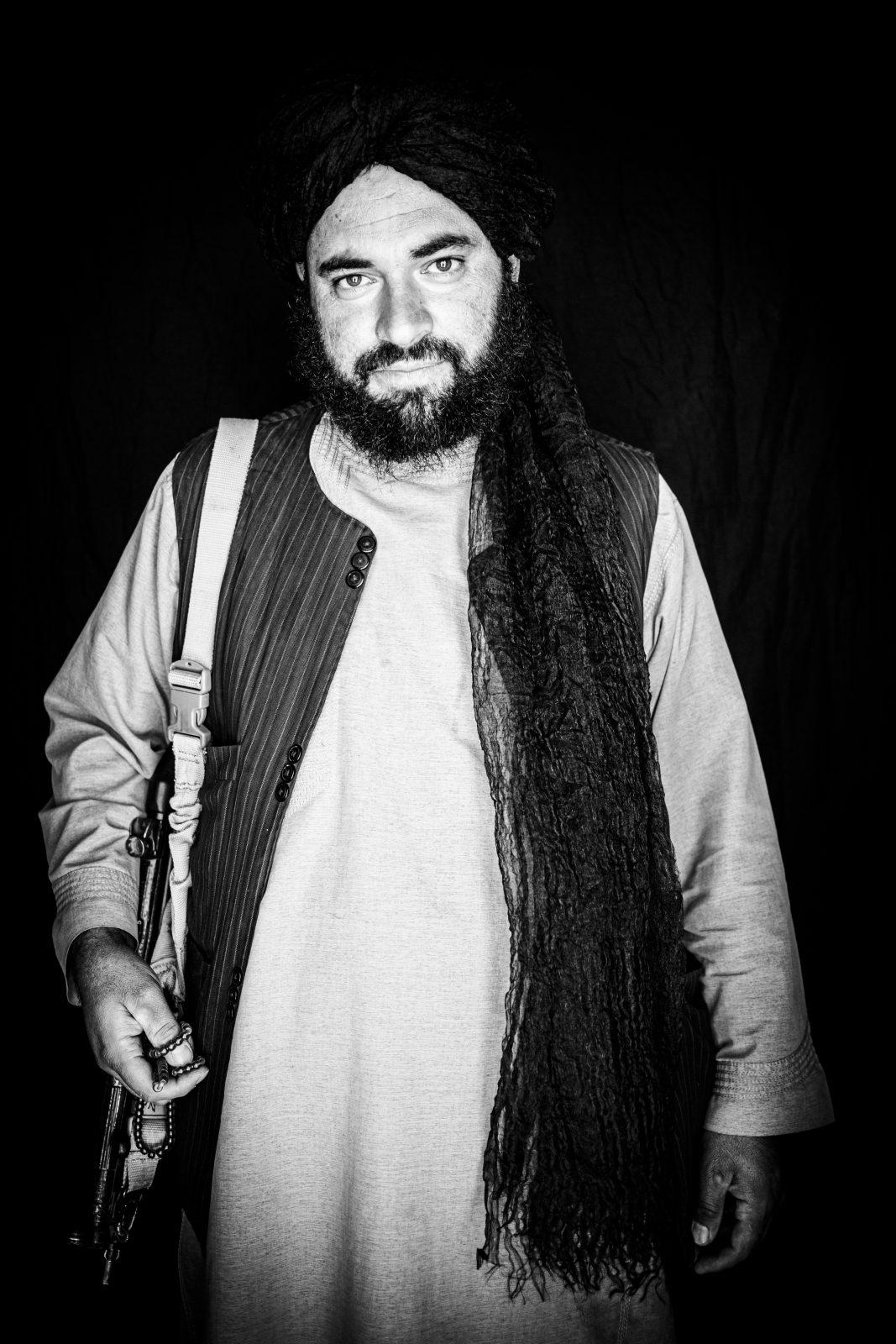
Rashidan, Ghazni province, Afghanistan – 01.09.2020:
Portrait of Maulawi Shakir, the leader of the council of Rashidan district in Ghazni province. Photo: Andy Spyra
The rebirth of the Taliban followed a similar pattern almost everywhere. The West brought back the old warlords, who were often hated by the populace. Men who had spent their lives doing nothing but fighting – through decades of war that left 1.5 million dead. They formed the pillars of the new government under Hamid Karzai, which the West backed with billions of dollars. As the warlords took power in the provinces, the central government remained too weak to control them. The warlords had themselves elected to parliament, bought political offices, became governors, ministers or generals in the new army. Their sons founded companies that received lucrative contracts from the U.S., NATO and many development aid organizations. They didn’t pay taxes, they crushed competition through violence and corruption and snatched up real estate abroad.
The Taliban tried to reorganize as early as 2002, but failed. Most Afghans rejected them, hoping for a better future with Karzai, and reported their identities to the Americans and government forces. In exile, in the vast refugee camps in Pakistan, the Taliban broke into three different factions called shura. One shura was formed in the city of Quetta, led by parts of the old Taliban elite. A second one formed in Peshawar. A third one, the most radical, emerged in Miran Shah. It was under the firm control of a clan, the Haqqani, a name that would soon be widely feared because the Haqqani family maintained the largest training camps for suicide bombers in Afghanistan. By 2015, the Haqqanis had reportedly deployed 1,160 suicide bombers, 843 of whom had “successfully” completed their missions.
As disenchantment with the government grew among the populace over the years, the Taliban strengthened. The Quetta Shura dominated in the early years, before momentum shifted to the Peshawar Shura and then swung back to Quetta, which continues to be the dominant force today. The fighters from the three Taliban shura have fought against each other at times and also captured territory from each other. According to the analysis of international conflict researchers, Pakistan restarted its payments to the insurgents in 2004, about $20 million annually, before increasing that amount to as much as $500 million a year. Pakistan is in a bind in the region: There is nothing the country fears more than an alliance between its neighbours Afghanistan and India. Afghanistan has claims on the Pashtun territories in western Pakistan, which were given to Pakistan by the British. India, meanwhile, has territorial claims on part of Kashmir in the north. Indeed, Pakistan has been in danger of disintegrating ever since its founding in 1947. A Taliban-ruled Afghanistan, from which there is no danger because it is entirely dependent on support from Islamabad, would mean the end of Pakistan’s existential angst.
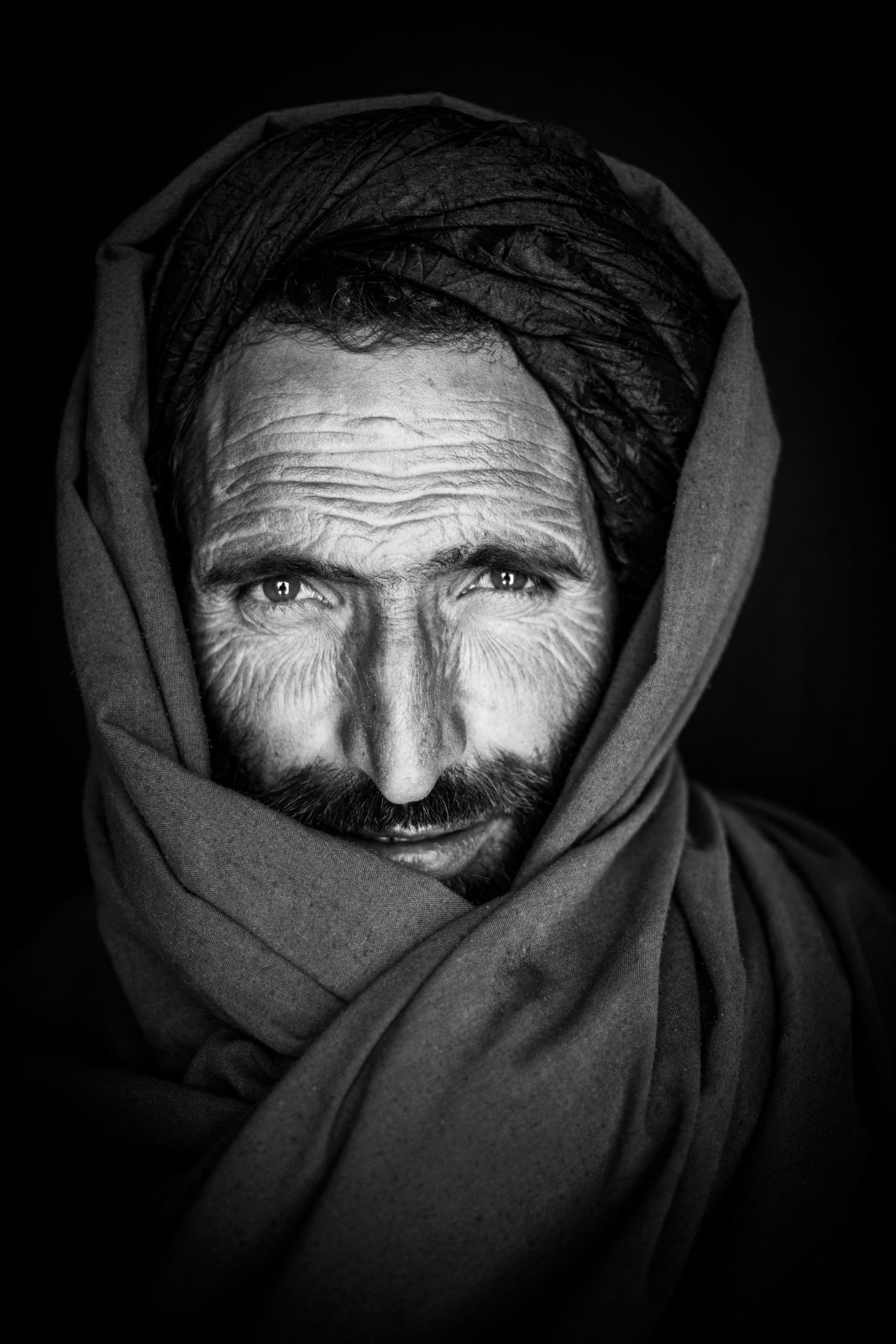
Photo: Andy Spyra
Nasrat and Nisar are waiting for us again the next morning at the district headquarters they captured. “We’ll show you how we establish peace,” Nisar says. A group of men has gathered this morning in the only intact room. It’s the Taliban’s district court. Maulavi Shaqer , the court chairman, is sitting at the front of the chamber. He is only 26 years old. “Don’t mention Pakistan,” Nisar tells him in a whisper that is still clearly audible when Shaqer starts talking about what Koran school he attended. “I studied in Ghazni,” he says. He also has dark kohl around his eyes. Before him are two merchants, one of whom has lent money to the other. The creditor claims to have given the equivalent of 800 euros, but the debtor says it was only 520 euros. “Do you have any witnesses?” asks Shaqer. The man doesn’t. “Do you have any witnesses,” he asks the other. He doesn’t either. The debtor pulls up WhatsApp messages in which the creditor has threatened him. They start yelling at each other until Shaqer says: “Enough.”
He rummages around in the plastic bag filled with papers he has placed on his Kalashnikov and pulls out a form. A strip of paper with the Taliban logo and letterhead that reads: “Ghazni Province, Rashidan District, Civil Administration.” He writes down a few lines on the sheet and refers the case to the provincial court. They’ll find a solution, he says, as the two men leave the ruin. Presumably, he says, the higher court will mediate to find a compromise between the two. “Even people from the government-controlled areas come to us with their disputes,” he says. “They have to pay a lot of money there and still don’t get justice. No case is solved there. We solve the cases.” And that’s even more important in Afghanistan than it is elsewhere, because disputes here can quickly turn into blood feuds.
The most important weapon in the Taliban’s battle against the government alliance is the Sharia courts. They also don’t always get it right, but they do pronounce law, they issue verdicts and enforce them. In contrast to government-controlled areas, where judges often take large sums of money from both parties, leaving them with the feeling that they are stuck in a morass of bribery and threats. Judges change their rulings based on favoritism, delay rulings for long periods of time and are then unable to enforce them.
As we leave the former district center on the hill, there is a sudden buzzing above us. It’s the sound of a drone cruising the valley looking for targets. The majority of the Taliban commanders killed in recent years have been victims of drone strikes. Nasrat and Nisar both look up, but they can’t see the drone. Its coloring makes the device almost invisible in the sky. They stop for a moment and then the buzzing fades away.
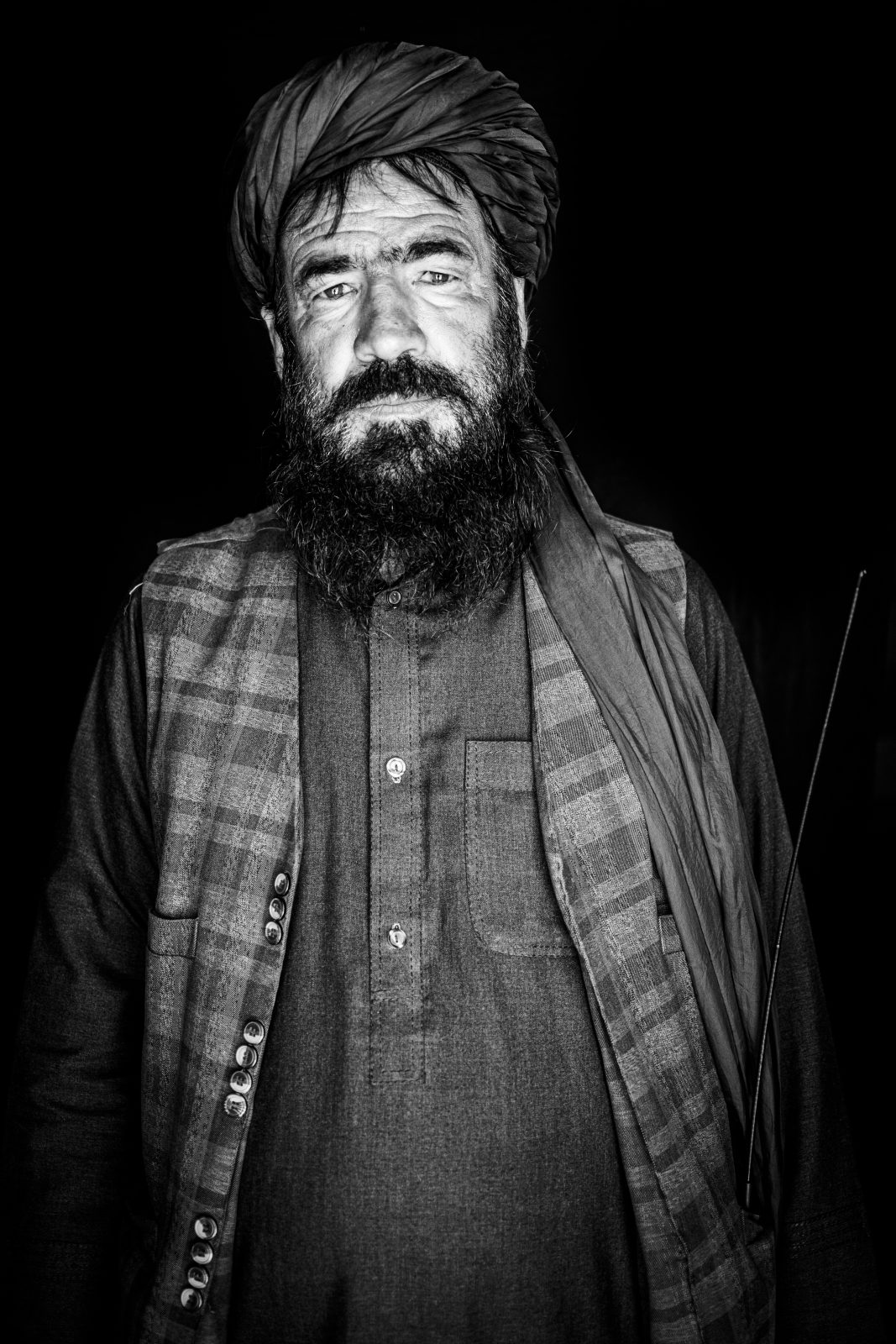
Rashidan, Ghazni province, Afghanistan – 01.09.2020:
Portrait of Maulawi Nisar, the chief of civilian affairs of Nawur district in Ghazni province. Photo: Andy Spyra
At the bazaar, the Taliban show us the small clinic, the only one in the entire district, serving 42,000 residents. Built of untreated, virgin stone, the structure was erected 16 years ago by the development agency USAID, to which a fading sign at the entrance still bears witness. We are welcomed by the director, who looks at Nisar with every sentence he utters. “We have nothing to protect people from corona. We have no masks, no gloves.” It is only a stroke of luck, he says, that the district has thus far been largely untouched by the pandemic, with just a single positive case having been identified. Cholera is a much more pressing issue, he continues. “Of 100 people, 20 have cholera,” he says, blaming the water. The washrooms in the mudbrick houses are still traditional, with just a single, clay depression where the latrine and wash bin are right next to each other. Wells in the villages have produced less and less water recently and there is no sewage system.
“I don’t know,” responds Nasrat when asked how he intends to alleviate poverty in the valley once the war has been won. He says he would build a new mosque and a new Koran school. But after that? Nasrat considers the question for a time, before responding: “I’m a fighter. I’ve been fighting my entire life. I don’t have a plan for what comes after.”
Nasrat and his staff bid farewell to us in the early afternoon. They have to prepare for an attack on a police station in the center of the provincial capital Ghazni, as we later learn. The operation will be yet another humiliation for the government. Three policemen die in the attack, while the Taliban get away with rifles and grenade launchers, allegedly without suffering any casualties of their own.
We hear explosions in the night and climb up to the flat roof of our house to listen into the darkness. The sound of shelling is coming from far away, at the end of the valley. We are told the next morning that government artillery fires randomly into villages where they believe Taliban to be. To get revenge.
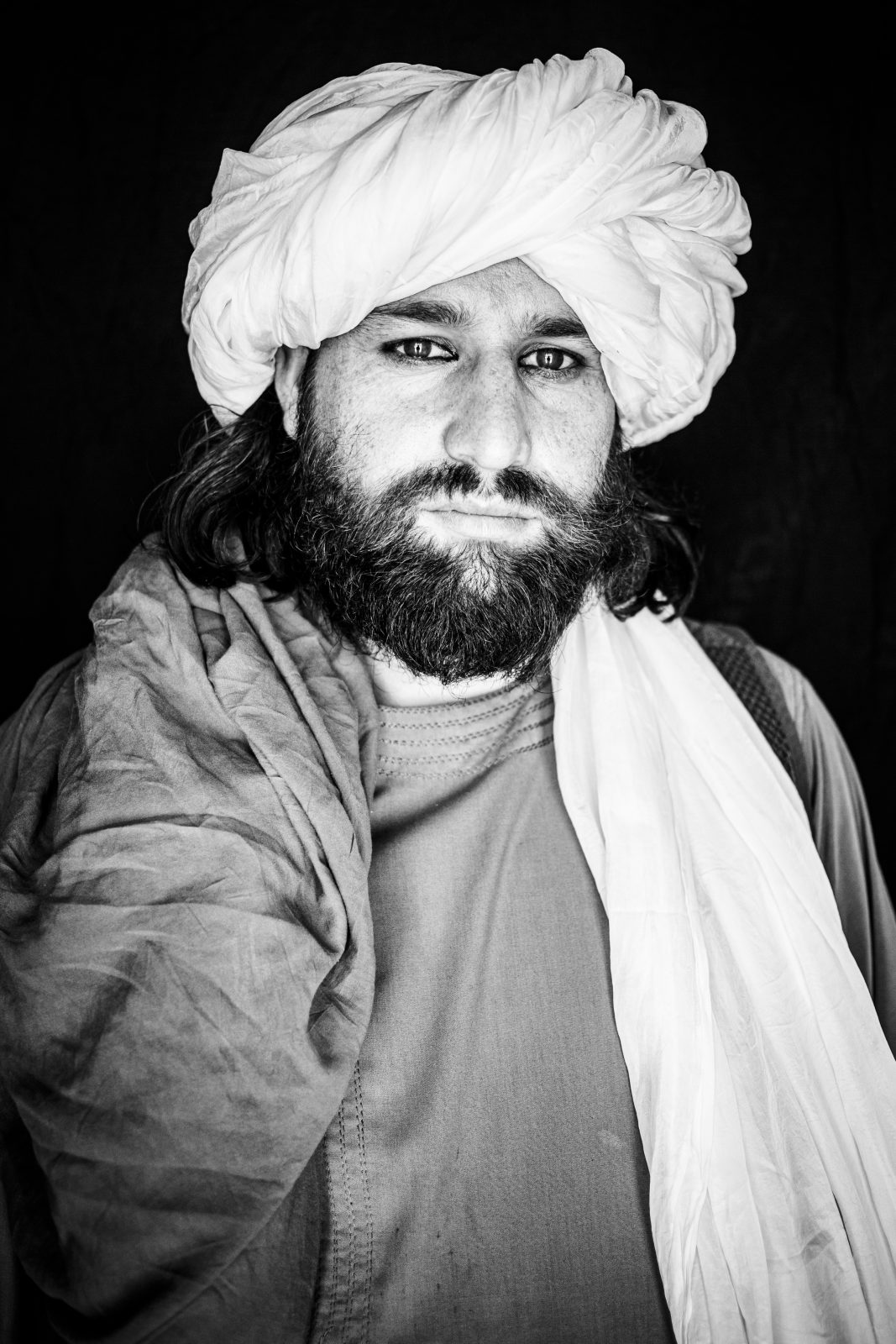
Rashidan, Ghazni province, Afghanistan – 01.09.2020:
Portrait of Maulawi Shakir, the district governor of civilian affairs of Rashidan district in Ghazni province. Photo: Andy Spyra
On this night, too, we speak with residents. We meet an older man who is also from Rashidan:
“The Taliban say they have everything here under control, but that isn’t true. In early August, a teacher was murdered. He was dragged out of his home in broad daylight by unknown people and shot to death in the fields. Some say it was because of a conflict in his family. Others say it was the Taliban. There are bad people among the Taliban as well. In general, though, it is much safer than on the government side. We are all happy that the Taliban have taken over district headquarters. We suffered immensely under the police. They would just shoot aimlessly into the valley. They would shoot at farmers who went out at night to water their fields because of the drought. They killed two children who were watching sheep. The government sent us Uzbeks and Hazaras as police, and they detest us. It was so bad that everyone kept their distance from the district center and the market was almost completely deserted as well. Since the Taliban have returned, there’s no fighting anymore. The vendors have returned, and life has improved somewhat.
Most people here in the valley still don’t support the Taliban. They just keep quiet, waiting to see what happens. Our young men who are with the Taliban went to madrassas, Koran schools, in Pakistan. We have four madrassas here in the valley. The teachers all received their training in Pakistan. The Taliban only take the best. Boys go to the Koran schools at age seven, and they sleep there too. We also have state schools. Recently, the high school got laptops, but the Taliban took them all for their madrassas. Now, the Koran schools here are better equipped than the state schools and they have better food. Students hardly learn anything at the state schools. The teachers are bad. But the ones who go to the madrassas quickly learn to read and write very well.”
The next day, the sky appears to be clear of drones. Since the U.S. has begun pulling out of its bases, the number of airstrikes has fallen significantly, with the Afghan Air Force still just as weak as it has always been. Despite all the military aid coming in from the West, the Air Force was kept small, with a limited number of planes and munitions – apparently out of concern that an Afghan general might one day use it without sufficient restraint. Nisar calls and asks if we can continue our conversation over lunch. The site he has chosen for our meeting is the home of a prosperous farmer. We find Nasrat and his staff of 25 men sitting in the room set aside for guests, which has a vaulted, mudbrick ceiling. The food is plentiful for the region, with lots of meat. Nasrat and his men never have to pay for lodging, with the people of the village having to pay for their upkeep.
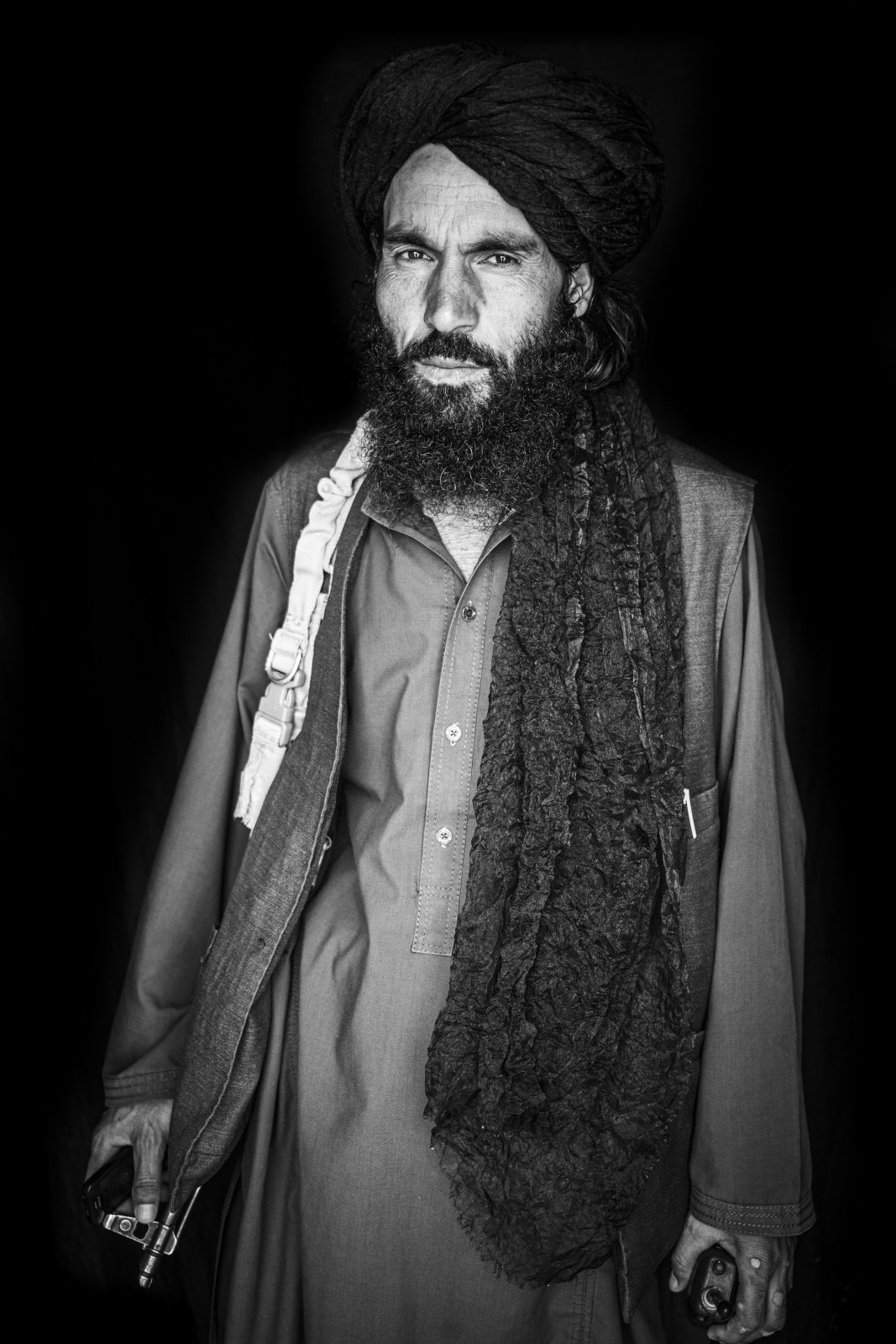
Photo: Andy Spyra
“What else should I say?” Nasrat says as he leans over to Nisar. – “Tell them that we are now united and represent all ethnicities.” – “We have members of all tribes in our ranks,” says Nasrat. “We don’t have any problems with any of these tribes.” Afghanistan is a multiethnic country made up of nine nationalities – a situation which has been the primary source of the violence in the country, with conflicts between the various ethnicities frequently fueling the violence. And despite their propaganda, all of the Taliban we meet during this trip are members of the largest ethnic group, the Pashtun.
The Rashidan Valley marks the border between two ethnicities that have lived in enmity for centuries. On the riverbanks of the valley floor, where the soil is most fertile, live the Pashtun, out of whose ranks the kings of Afghanistan came for centuries. On the scant slopes above and far into the mountains is where the Hazara live, descendants of the Mongols. The Pashtuns are Sunni, while the Hazara, like the Iranians, are Shiite. Even the Pashtun kings used to launch raids on the Hazara, plundering their villages, forcing them to pay the highest taxes, keeping them in poverty and killing tens of thousands of them. The Hazara and the Pashtun have never grown together to form a state, and in the 1990s, the Taliban continued the subjugation of the Hazara. No ethnicity welcomed the 2001 downfall of the Taliban more than the Hazara.
But now that the U.S. is withdrawing, are the two peoples facing a renewed tragedy? We hope to find answers in the neighboring district of Nawur, which is almost entirely populated by Hazara and which has been ruled by the Taliban for years.
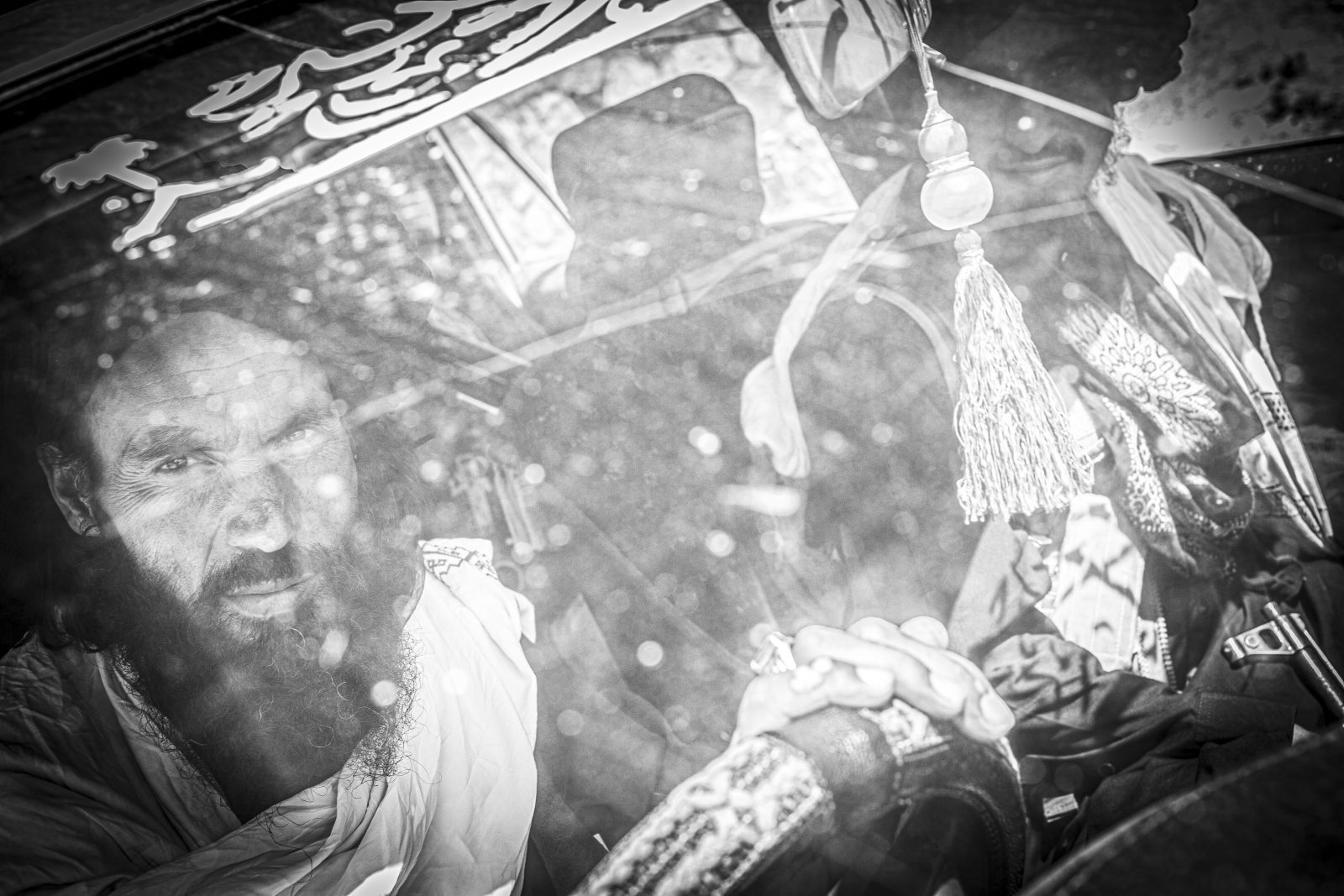
Rashidan, Ghazni province, Afghanistan – 01.09.2020:
Maulawi Nasrat (left) and Nisar in their car. Photo: Andy Spyra
The roads to Nawur are even worse, with the main arterial through the district just a lane of white dust – limestone that has been ground down over the years by the tires of heavy trucks. The villages almost seem abandoned, with more than 80 percent of the population having fled abroad in recent years, we are told. Most left for work, with Iran the primary destination. It is estimated that 3 million Afghans are now living in the country, sending money back to those who have remained – though recently it has been less and less, with Iran suffering from an economic crisis.
Shortly before the road disappears between the rock walls into a gorge, a school has been built into the hillside. It is a school of the kind that shouldn’t actually exist in areas under Taliban control. “Come on in,” the rector says after a brief discussion – Bibi Seinab High School, with 150 girls divided among six classrooms. The Taliban tolerate the girls attending school until the 12th grade because they are Hazara, but among the Pashtun in Rashidan, girls are only allowed to go to school until the sixth grade, if at all, because that’s what parents want – claim the Taliban. Many Pashtun families view education with suspicion, believing that women are supposed to help out around the house and marry young. Young brides, after all, command a higher dowry.
The girls at the school in Nawur don’t wear burkas, just headscarves. “Twenty percent of our graduates,” the rector says proudly, “go on to university.” Most study medicine in Ghazni, he says, or train to become nurses. There is no heating in the school and the panes of glass are missing from many of the windows, which means that classes are suspended in winter. In many cases, three girls have to share a single schoolbook. The rector, who founded the school just a few months after the fall of the Taliban, is an old man with thick glasses and a hunched back. But he beams when he talks about his school.
So far, he says, the Taliban have only complained about the building being too close to the main road and about the lack of a wall. The girls, they say, are thus not protected from the looks of men driving by. Plus, half of all subjects in the school are taught by men and not women. That was the excuse used by the Taliban back in the 1990s when they closed all schools for girls. We ask if he is worried about what might happen with his school if the Taliban were to take over complete power. The rector looks down for a moment before then raising his head again. “The world has forgotten us,” he says.
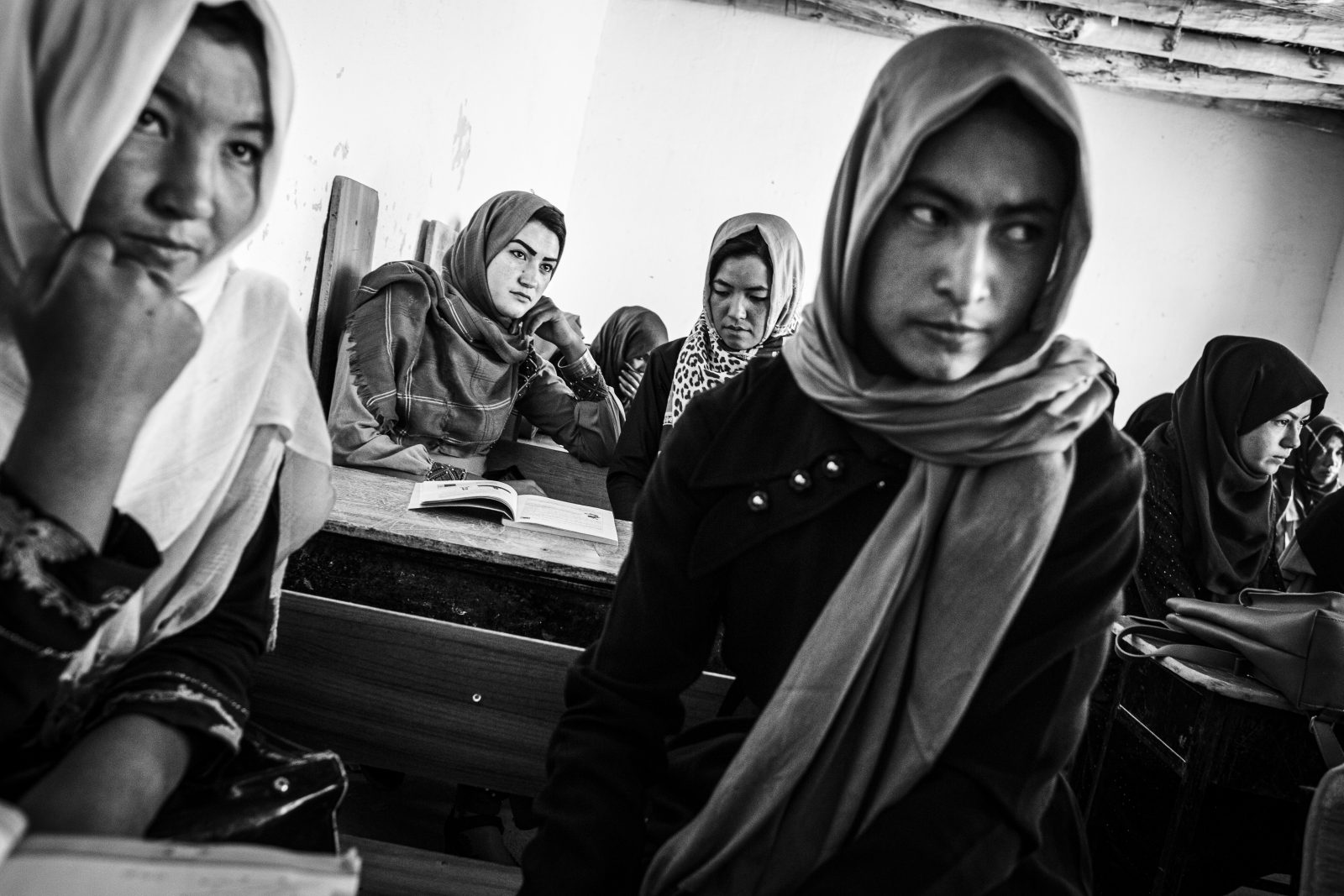
Photo: Andy Spyra
We continue following the road down into a narrow gorge, with rock walls on both sides and the sky above narrowing to a slit. The Taliban leader from Nawur has summoned us, a man named Maulavi Ahmadi. He was actually supposed to join us with Nasrat in Rashidan, but he never showed up. It is said that he was avoiding Nisar, the representative from Quetta. Which raises a question that others have wondered about as well: How unified are the Taliban actually?
For our meeting, Ahmadi has chosen a village in a remote valley. Heavy rainfall, which triggered catastrophic landslides across Afghanistan last summer, badly damaged the dirt road to the village. The place is called “the valley of the waterfalls.” The air is thin. The village is comprised of a dozen mudbrick houses huddled beneath a 700-meter cliff wall. The mountaintops above the village reach an altitude of almost 4,000 meters.
A small boy is hunkered down in the shade of one of the houses, but otherwise, no one can be seen. The boy doesn’t greet us, but looks at us with a serious expression on his face. Ahmadi shows up an hour later, accompanied by two bodyguards. “Look how beautiful our country is,” he says jovially in greeting. In his mid-30s with a white turban and a full, dark beard, Ahmadi has none of the rural characteristics of Nasrat or the solicitude of Nisar. His father, who used to be a mullah in Rashidan, he says, sent him to the madrassa as a young boy. Ahmadi speaks quietly, choosing his words carefully, his voice remaining soothingly soft even when saying something harsh. He is the epitome of the Muslim cleric – of the kind even celebrated by Osama bin Laden.
He leads us into the small mosque in the mountain village, a spare, carpeted room. Four or five village elders – Hazara – also show up, hesitantly sitting down with us. Their bodies look haggard, their cheeks hollow. It is an extremely difficult district, says Ahmadi, a Pashtun ruling over the Hazara. He says there are a total of 125,000 residents, and 75,000 of them are under his control. The government only holds power over the district center, six hours from here. “But we are working on changing that,” he says. Recently, he says, he took control of the gypsum mine, the district’s most important source of revenues. Now, the mine owners are paying their taxes to the Taliban.
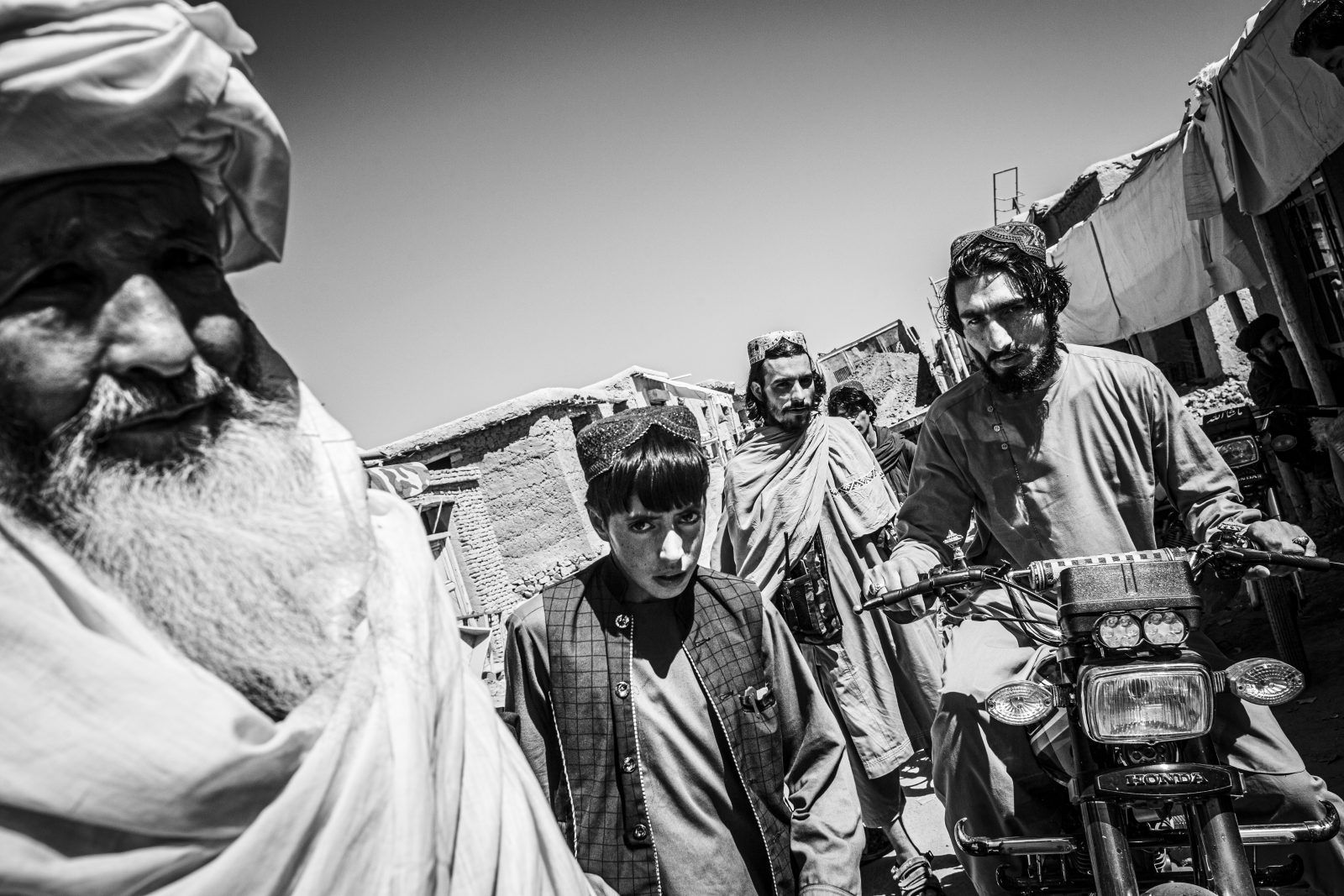
Rashidan, Ghazni province, Afghanistan – 02.09.2020:
Scene in the market of Rashidan district. So far, since the takeover of the Taliban of Rashidan and Nawur district around ten years ago, only 50 of the 250 shops have reopened. Photo: Andy Spyra
The war, it seems, has almost been won by the Taliban, but how do they intend to win the peace? In the long run, Afghanistan’s poverty will destroy almost any attempt to impose order, and Ahmadi is fully aware of that. But he has plans for his district. “We need to modernize the mines,” he says. He wants to build a dam in the valley so that more fields can be irrigated. He also hopes to upgrade the roads – but for the fact, as he readily admits, that he has no money to do so. “We want the foreign NGOs to return” he says. “We will guarantee their safety. For a time, we will continue to be dependent on them. They are welcome to come back, but we’re not going to beg.”
During a break in our conversation, with Ahmadi briefly out of the room, the elders ask us to tell him of their suffering. “Tell them that they should help us. The rain destroyed our roads. It washed away our fields. Our harvest has been destroyed.” Ahmadi, who hadn’t spoken a word to the elders, repeatedly ignores our ensuing questions before finally saying: “We don’t have any money. The only thing we can do is encourage aid organizations to come.”
Ahmadi is also hoping for assistance from refugees in Germany. “There are a lot of experts among them. We need them to build up our country.” Nothing will happen to them, he insists. But those who committed crimes on behalf of the government can expect severe punishment, he says. “I can’t call them Afghans anymore.” He earnestly thanks Germany for taking in the refugees, but also accuses the Germans of having done great harm in Afghanistan with their military. The troops, he said, killed innocent people, and it is still too soon to forgive the soldiers. “I still feel hatred toward them. Yes, I hate them.”
Noon has arrived in the mosque and the elders ask Ahmadi if the 10 guests can be divided up in pairs for the midday meal among several families to share the burden. “No,” Ahmadi says, “we’ll eat in the mosque.” As such, despite their privation, the elders must serve the guests alone. In the coming week, their families will have hardly anything to eat because their supplies will have been used up on our meal. Silently, they watch as we and the Taliban eat.
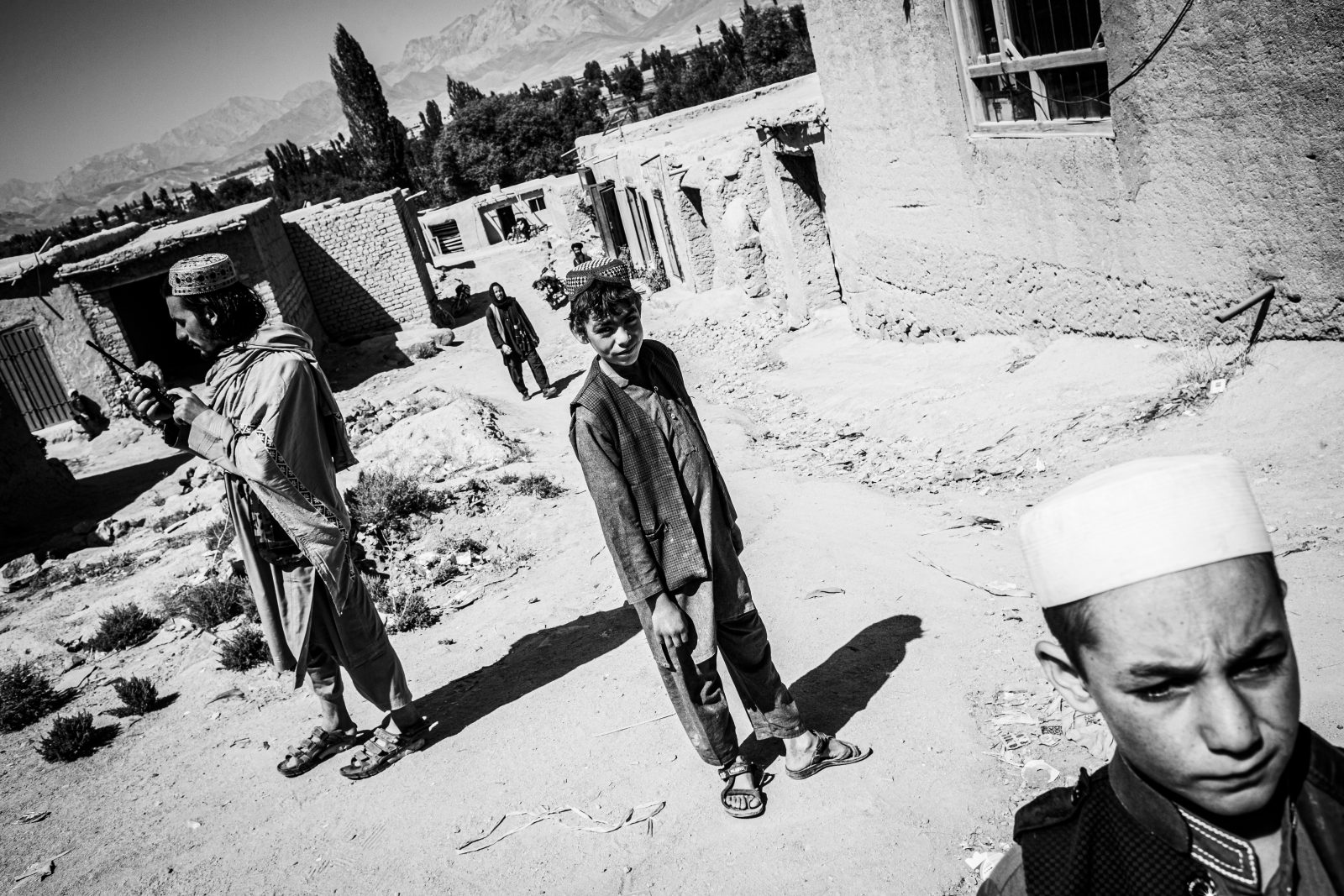
Rashidan, Ghazni province, Afghanistan – 02.09.2020:
Scene in the market of Rashidan district. So far, since the takeover of the Taliban of Rashidan and Nawur district around ten years ago, only 50 of the 250 shops have reopened. Photo: Andy Spyra
In parting, Ahmadi invites us for a bit of target practice behind the village. We politely decline, but Ahmadi is looking for a bit of diversion. He accompanies us to the waterfall, a holy spring that can allegedly alleviate mental illness. One of his bodyguards fires off an American M16, an assault rifle that he claims to have taken from a U.S. soldier a year and a half ago. “First, I shot him, and then I took his weapon,” the man says with a grin. The second bodyguard relates that they had celebrated the release of one of their fighters a couple of days earlier. The Afghan government, under pressure from the U.S. and militarily weaker than ever, has had to release 5,000 Taliban this year. One of them is from this area, the bodyguard explains. He was taken prisoner in 2004 after murdering Bettina Goislard in Ghazni, a 29-year-old French woman working for the UN Refugee Agency. “We celebrated his return until late into the night.”
None of the three managed to hit the patch of grass high up in the rocks that they had chosen as their target.
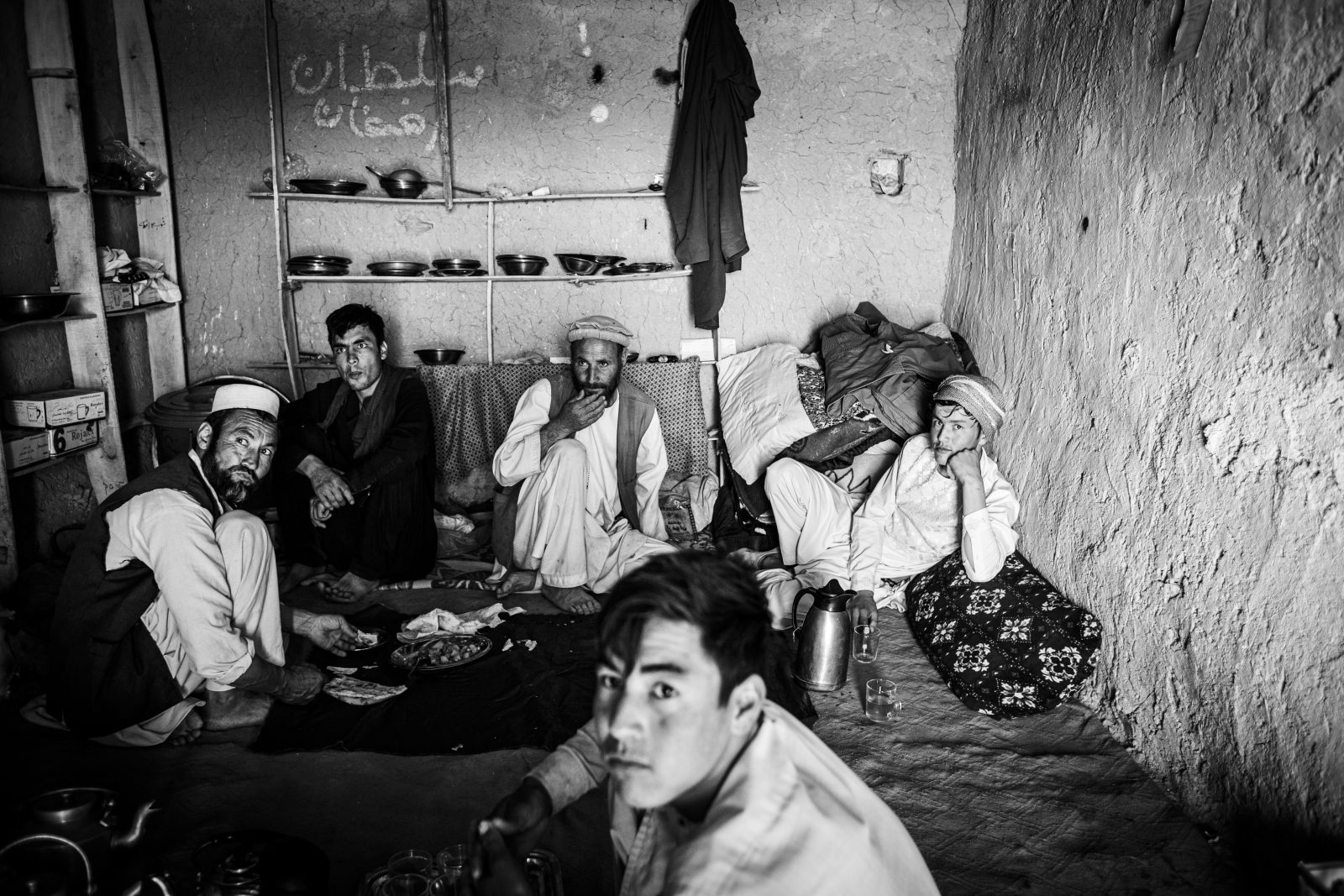
Nahur district, Ghazni province, Afghanistan – 02.09.2020: Scene in a tea house at the Nawur – Ghazni main road. Photo: Andy Spyra
Once again, we spend the night down below in Rashidan. And again, we listen to stories told by the villagers:
“Up until two years ago, the Taliban here were extremely strict. They would stop us in the street and search us, looking for smartphones. You’re only allowed to have normal mobile phones. If you are one of them, though, they let you have a smartphone for access to the internet. Now, though, they are more relaxed. Still, it always depends on who the commander is at the moment. Ahmadi used to be very strict, but you could always talk to Nasrat. The worst is when Taliban come to us from the outside. When that happens, we remove our satellite dishes from the roof and put them in the yard. Otherwise, they would beat us and destroy our satellite dishes with an ax. Why are you watching the channels of the infidels, they ask?
The Taliban have changed a lot. They have become much more corrupt. Recently, they all got new mopeds. Many of them have two or three wives and send their families to Ghazni or Kabul. Here, the people who suffer most are those who live near the mosque. Big groups of Taliban spend the night there, and the neighboring families have to feed them. They say things like: We’re fighting against the infidels, and what are you doing? You don’t even want to give us a meal? Forced marriages are a big problem. The families cannot refuse when a Taliban leader wants to marry one of their daughters. They take advantage of our poverty. It’s a taboo here, people don’t talk about it.
Poverty here has grown worse. In recent years, there has been very little rain. We have only been able to irrigate a third of our fields. There is no longer any work in Iran and our relatives there are only able to send us very little money. A lot of families are unable to pay the dowry and there are 90 percent fewer marriages than just two years ago. The fathers of the girls are asking for far too much money. They are too greedy. Here in our region, they used to want an average of 10,000 euros. We spoke with the Taliban, and a year and a half ago, they announced in the mosques that the dowry could not be higher than 3,500 euros. But that is still too much. The Taliban are refusing to further reduce the amount. There are so many couples here who run away to Kabul.
The Taliban don’t really care about us. They only care about themselves. It’s almost the same as it was with the warlords. We’re lost. We don’t know what is better, the government of the warlords or the Taliban.”
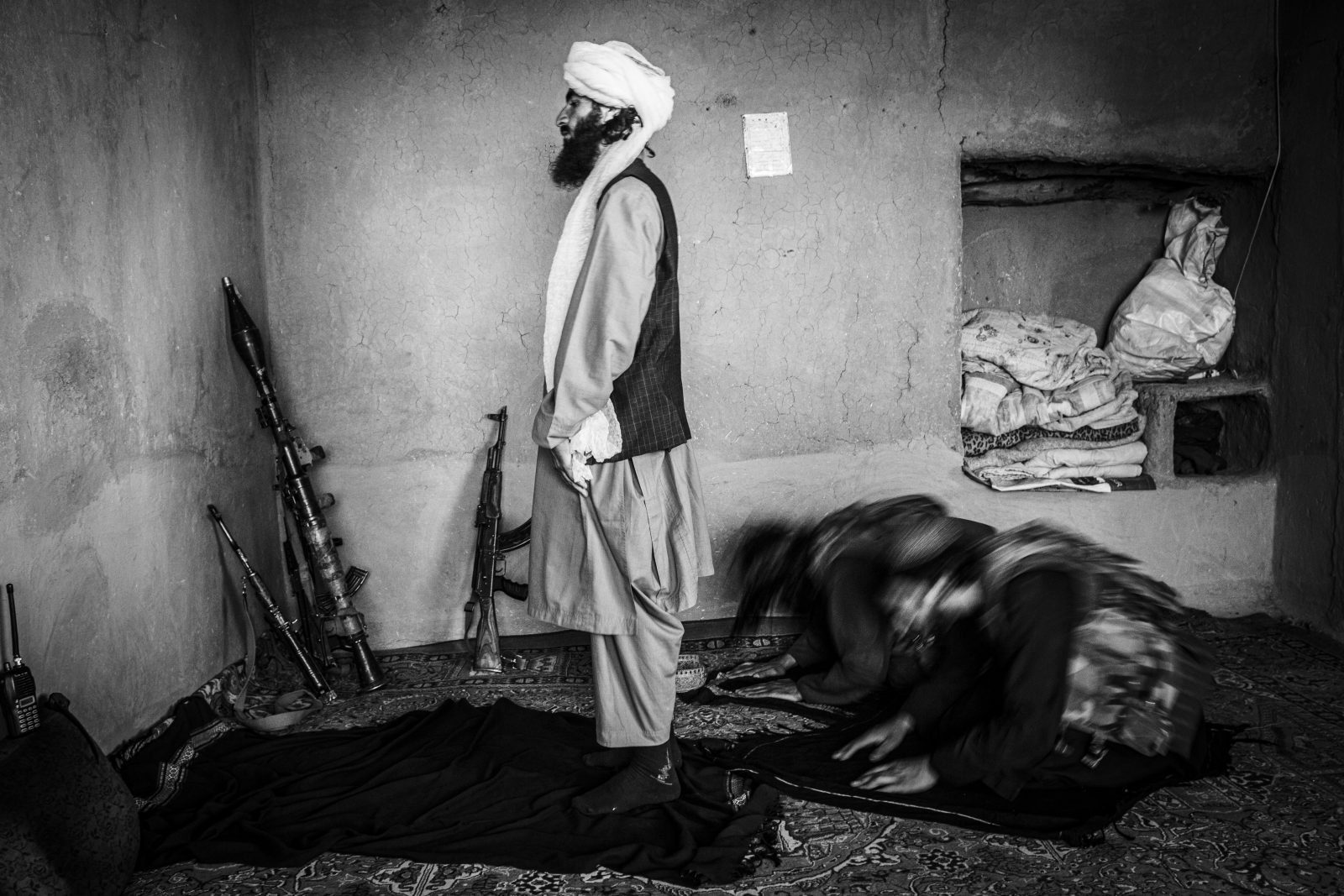
Nawur district, Ghazni province, Afghanistan – 02.09.2020: District commander Ahmadi prays alongside his bodyguards in the ‚Hotel Said’ along the Nawur-Ghazni road. Photo: Andy Spyra
For many years in Afghanistan, it looked as though no side was able to achieve a decisive military advantage. The three shura of the Taliban began fighting each other, and then Pakistan arrested the leader of the Quetta Shura, Mullah Baradar, allegedly because he wanted to conduct peace talks with Kabul and Pakistan didn’t approve. His successor, Akhtar Mohammad Mansour, began looking for alternative sources of money. According to numerous studies, he found it in drug smuggling, and under his leadership, Afghanistan once again became one of the world’s largest producers of opium. In the years 2014-2015, drug revenues for the Quetta Shura are thought to have amounted to $285 million. The situation for the government in Kabul grew particularly tenuous when Iran joined Pakistan in supporting the Taliban. The more threatening the U.S. was in its stance toward Iran, the more Tehran intervened in Afghanistan. In 2012, Iran established its own shura in the city of Mashhad, called the Mashhad Shura. With Iranian help, the Taliban was able to conquer large swaths of northern Afghanistan. According to studies, Iran jacked up its funding for the Taliban from $30 million in 2006 to $190 million in 2013 – which did not, however, prevent Tehran from continuing to pay millions to the government in Kabul. It wanted to continue to wield influence there, too.
The Taliban have long accused Kabul of being little more than the puppet of foreign powers. But in fact, they find themselves in a similar situation. Many different powers are pulling on the Taliban, and while they used to all pull in different directions, at the moment they apparently share the same goal: minimizing Western influence in Afghanistan. The improved coordination of external assistance has allowed the Taliban to tighten up internal organization, and at the peace negotiations in Doha, they were able to show a united front. But nobody knows for how long this unity will last. Already, groups are deserting to an even more radical organization – one which wants to continue fighting and does not intend to stop at the borders of Afghanistan: the Islamic State.
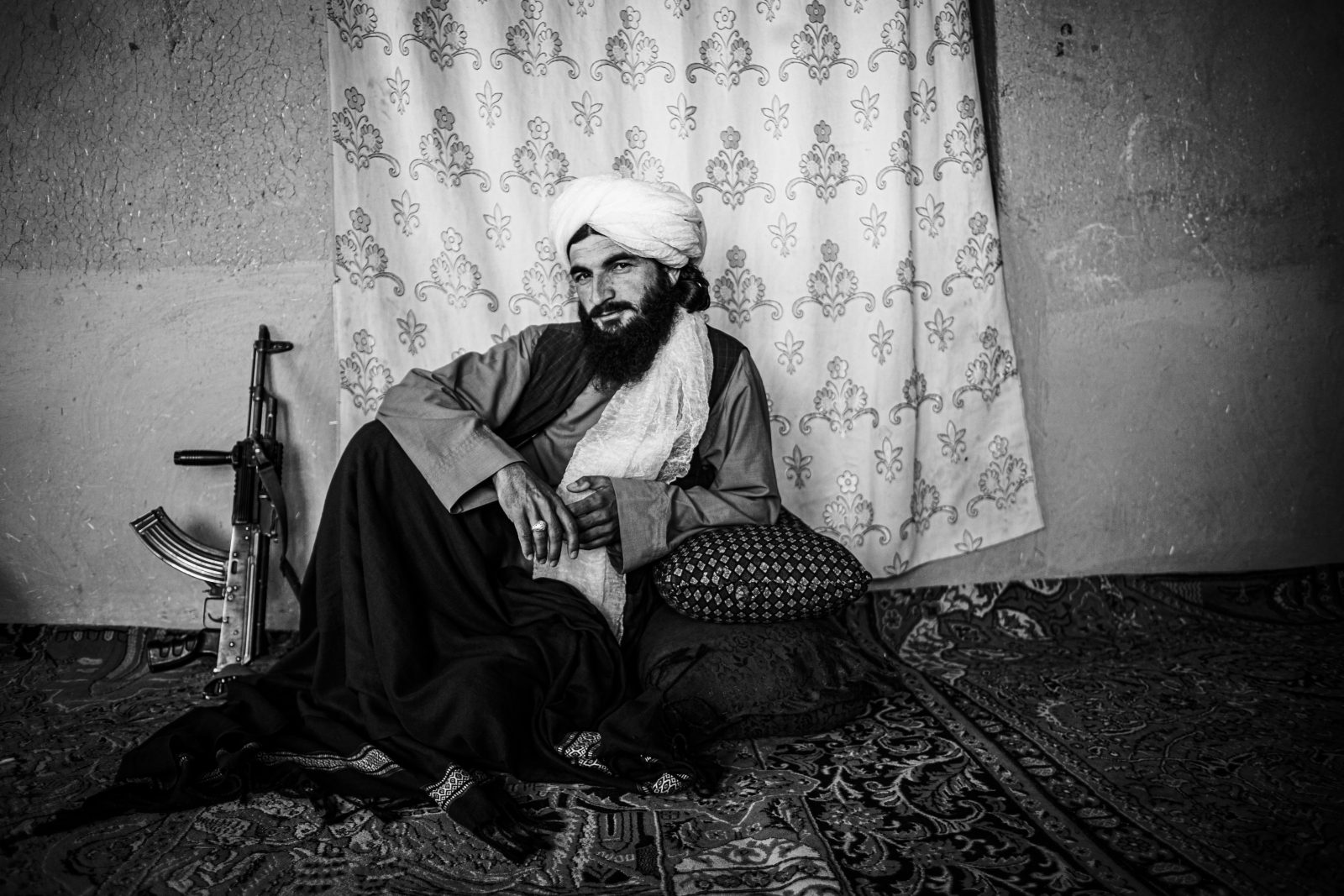
Nawur district, Ghazni province, Afghanistan – 02.09.2020: Portrait of Nawur district commander Ahmadi. Photo: Andy Spyra
On the morning of the fifth day, we leave Rashidan shortly after sunrise. “Be careful,” says Nisar, who accompanies us to the edge of Taliban-held territory. “There are a lot of government spies among us.” We are eager to avoid being arrested as Taliban supporters during our return trip by over-eager Afghan security personnel. Nisar leads the way on his motorcycle, using roads that he knows are not patrolled. He smuggles us through the peripheral villages and into Ghazni, easily avoiding all of the roadblocks – just as the Taliban do when they attack the city. We wave at each other, and then he disappears into the dust of the dirt road.
Once again, the future of Afghanistan is completely uncertain. Most observers believe the peace negotiations will soon collapse. The wounds on both sides are still deep after so many years of war, and many Taliban commanders don’t want to relinquish part of the power when they might be able to have it all. That, though, could turn out to be a significant miscalculation. Conquering Kabul, with its several million inhabitants, would be far bloodier than the fighting in the villages. Holding it could be even more difficult. The rift dividing Afghan society’s conception of values has simply grown too deep. What does unite them is precisely what is dividing them: the injuries, the mourning, the hate. Reconciliation will take time – time that the country doesn’t have.
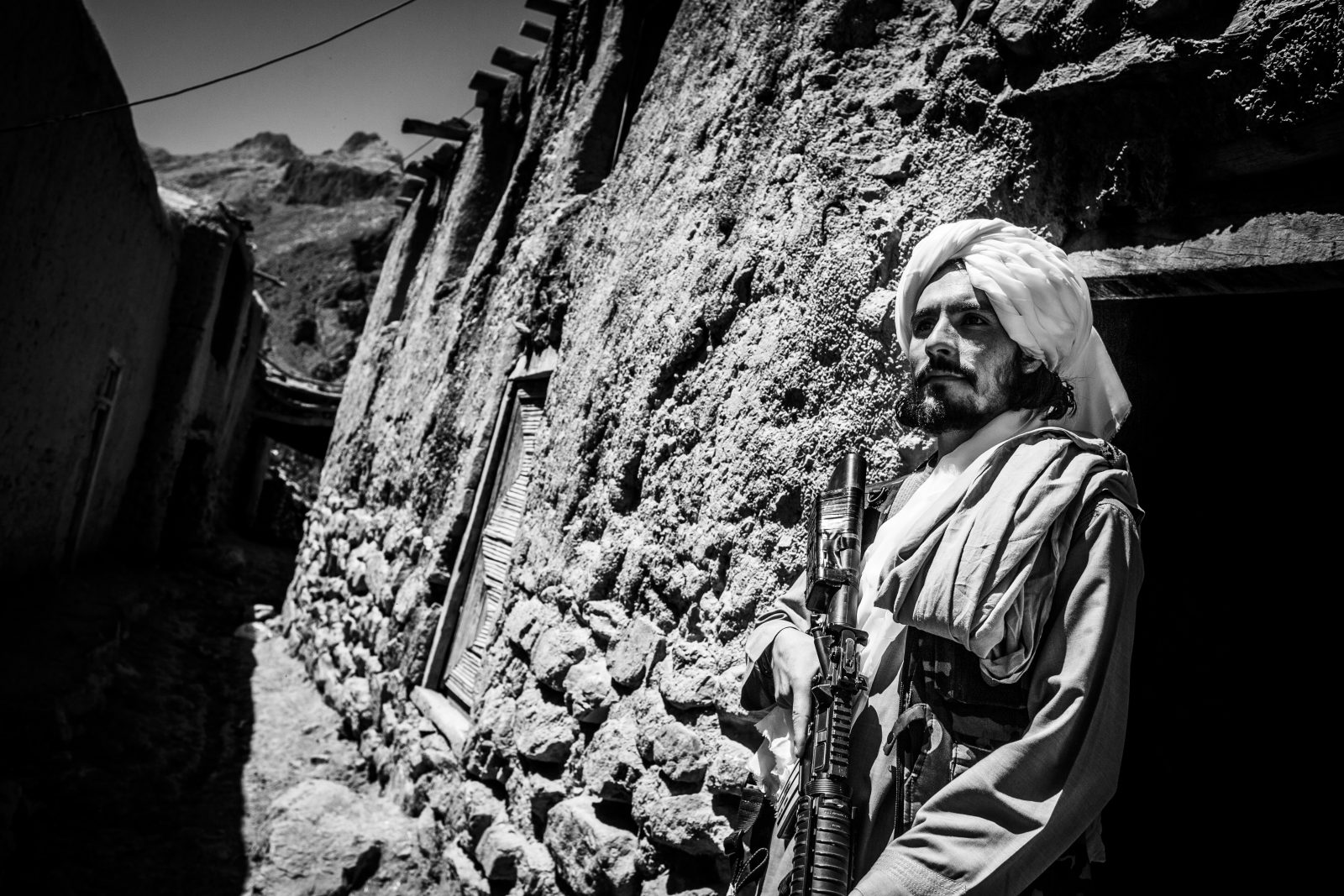
Allauddin Village, Natur district, Ghazni province, Afghanistan – 03.09.2020: Omar Sadiq, the bodyguard of military district governor Ahmadi, can be seen guarding the entrance to the local mosque where Ahmadi is present during a meeting. Photo: Andy Spyra
On our return trip to Kabul, we again see the remains of an almost defeated army – the army of a government for which the West, until recently, had high hopes. It is an endless series of burned-out wrecks and stormed military posts. A field of rubble stretching for 170 kilometers. Village residents have begun trucking away the clay from the old defensive wall to sell it for construction.
“How could it have come to this?” asks a high-ranking Afghan diplomat on one of our last days in Kabul. It is a beautiful, balmy evening. He has invited a group of senior officials from different ministries to his terrace for an opulent buffet with delicious dishes. Red wine glasses in hand, the officials listen intently into the night. Heavy fighting is underway not far away. The shooting has been going for hours and assault helicopters continually fly over the terrace. The officials begin frantically calling their contacts in the security services, but they are told it is just an exercise. The security forces don’t want any panic. “We should go,” says one of the guests. “I’m afraid that all of the arterial roads will soon be blocked.” But it’s much too early, the host complains. “Please stay,” he says. It’s not yet time to go.
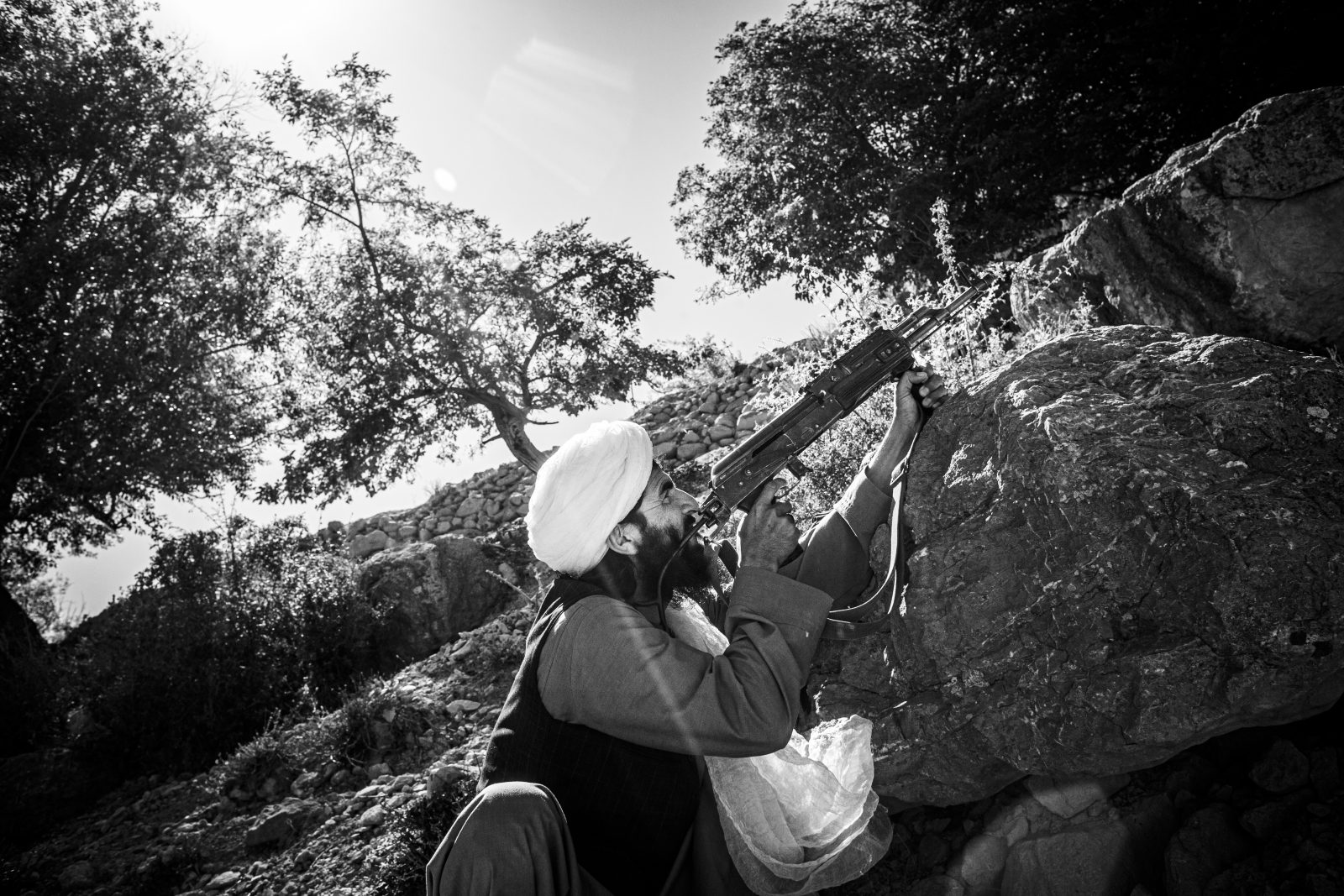
Allauddin valley, Nawur district, Ghazni province, Afghanistan – 03.09.2020: District commander Ahmadi during a shooting practice in the Aladdin Valley in Nawur district. Photo: Andy Spyra
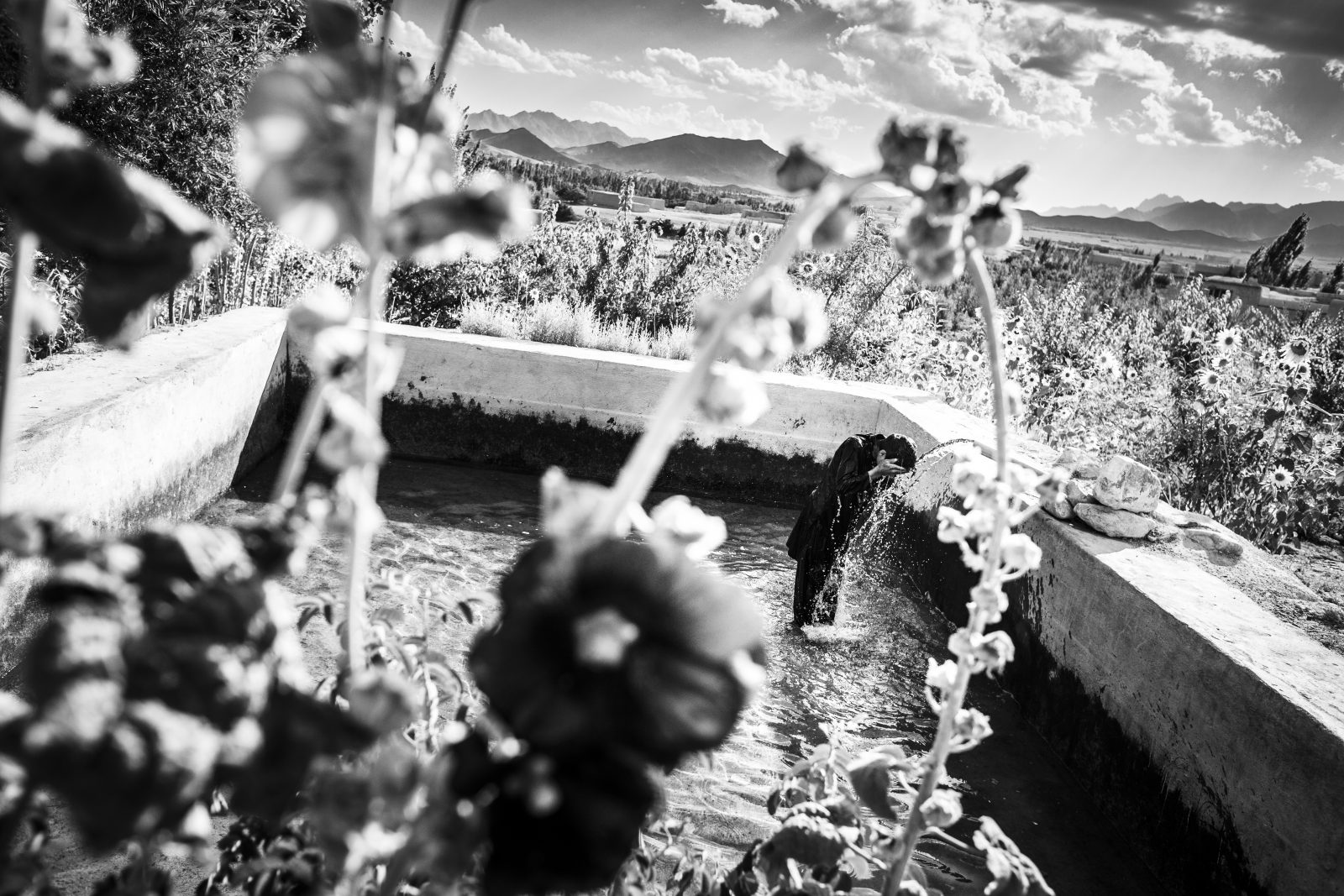
Rashidan, Ghazni province, Afghanistan – 01.09.2020:
A young boy is washing himself in a well in Rashidan district. Photo: Andy Spyra
Behind the Story
Only after months of negotiation did the Taliban’s senior military council agree to allow our reporters to visit. They were supported in the effort by British filmmaker Najibullah Quraishi, who has been reporting on the Taliban for years and joined us on our trip as a translator.
Translators: Charles Hawley and Daryl Lindsey