

Sarajevo-Jerusalem
SARAJEVO-JERUSALEM 1 | 6
The Ordinary Heroes of the “Jerusalem of Europe”
Through the history of Sarajevo’s Jews, a journey in two cities on a quest for universality, symbols for the people of the Book, and epicentres of modern conflict. A journey towards a certain idea, real or imaginary, of coexistence. Today we look at the courage of a handful of men and women during the wars of the 20th century.
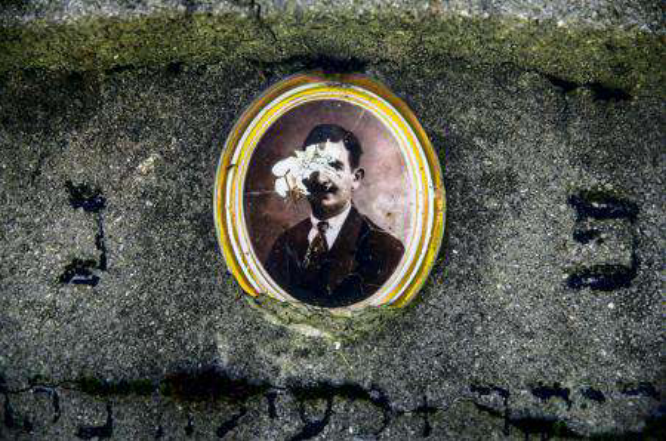
A stele in the Jewish cemetery in Sarajevo in May.
Photo: Damir Sagolj for Le Monde
It’s a day like any other during the Siege of Sarajevo. A Saturday in February with no snow or rain. A morning a little on the cold side, like any other morning in winter, and a little sad, like any other morning of the siege. Accompanied by her daughter Aida, her son-in-law and her granddaughter, Zeineba Hardaga has just got onto a bus that will take her away from her birth town forever. Servet Korkut has also got on this coach. No one knows if these two women know each other. Yet an invisible thread connects their lives.
It’s an ordinary Saturday in 1994, among the 1395 days of a besieged city at the edges of a Europe that is, at the end of the 20th century, overwhelmed with war, carnage and drama. That day could have been forgotten, like so many before and after. In Sarajevo, it was not.
Around midday, a Serbian army gun position launches a round of mortar shells from one of the surrounding hills. After grazing a roof, the 120mm mortar shell comes crashing down on the Markale market, on Marsala-Tita street. The explosion rips apart the bodies of the sellers and the onlookers. Not that there was much on sale that day in the surrounded and starving city but, when the morning is calm and even if they know the bombing always returns, Sarajevans walk around, share a cigarette and discuss the news from families and frontlines.
That mortar shell enters into History as being the deadliest of the war: 68 dead, 144 wounded. While the lengthy investigation of the International Criminal Tribunal concludes that it was a deliberate strike by the Serbian army on Markale market, and some of its generals would later be sentenced for the war crime, the gunner himself probably has no idea that on this day he will set a gruesome record in artillery history: 212 people scythed by one single mortar shell.
The horror of the carnage and the international reverberations divert attention away from what was happening right at the same moment, that February 5th, 1994, just five hundred metres away on Dobrovoljacka Street. Buses are setting off, transporting Zeineba Hardaga, Servet Korkut and three hundred other Sarajevans away from the city. While the journalists are busy rushing from the market to the hospital, from the hospital to the morgue and from the morgue to their satellite phones, this story goes unnoticed.
That day could have been forgotten, like so many before and after. In Sarajevo, it was not.
A lot of the passengers on this bus know each other: they are the last Sarajevan Jews fleeing hell, thanks to this eighth and final evacuation convoy of the war. Zeineba Hardaga has a particular status amongst the group. Not only can she not name any Jewish ancestors amongst her relatives but she is a Muslim and the only passenger to be an honorary guest of Israel, the final destination of these refugees. She is due to be met by Prime Minister Yitzhak Rabin. The other elderly woman, Servet Korkut, is also a Muslim with a particular attribute but, as opposed to Zeineba Hardaga, she doesn’t know it yet. Her destination is Paris, where her son Munib has taken refuge at the end of the first year of the war.
If, on this morning, these two women find themselves with hundreds of others fleeing the “Little Jerusalem” or “Balkan Jerusalem”, as some of them like to call Sarajevo, it is because this is not their first war.
The other conflict they have lived through also started in April, when the German army and its Croatian Ustachi allies entered Sarajevo in 1941, fifty-one years before the collapse of Yugoslavia. The city is used to invaders, and is used to not worrying too much about them. Its Ottoman then Austro-Hungarian past has shaped a very particular identity, between East and West. The Sarajevan natural inclination towards indolence means that they have always viewed each new pretender to power with wariness, without hate or prejudice towards them. The other trait of this provincial city with a majority of Muslims, tucked away in the mountains and neither possessing the strategic or economic attractions of Constantinople or Salonika, is that it is a very Jewish city.
The good neighbour as way of life
The story of the Sarajevan Jews is that of the Spanish Sephardim – before some Ashkenazi Jews joined them coming from the north during the Austro-Hungarian Empire. A little after the end of the Reconquista and the Catholic armies’ entry into Toledo in 1942, the Spanish sovereigns, Ferdinand and Isabelle, offered Jews the choice of either conversion or exile, brutally drawing to a close what Sephardi history holds as its Iberian golden age. As a community fleeing Christian Europe, they went on to take refuge in the heart of Muslim lands, from North Africa to the Balkans and to the Middle East.
The first fifteen Jewish families of Sarajevo are merchants from Salonika who arrive in 1565. They speak Ladino (also called Judeo-Spanish), a language close to Castilian which they will retain as a community and family language until the 20th century. The Ottomans allocate them a neighbourhood in the old town and permit them to build their first synagogue (the town would have up to six sites of Jewish worship in 1941). The neighbourhood, which translates as “The Courtyard” (Cifut Han in Turkish, Il Kurtijo in Ladino) is not a ghetto and is populated only by the poor. Other Jews come and live in the Bjelave neighbourhood, then elsewhere in Sarajevo.
Over the centuries, even though some of the administrative rules are discriminatory, no political power, be it Ottoman, Austro-Hungarian or Yugoslavian, persecutes the Sarajevan Jews.
In April 1941, the German army and its Croatian Ustachi allies, enter Sarajevo. The tracking of the Jews begins
By all accounts, this is a town that welcomes them. And far from the modern terminology making Sarajevo a “multi-ethnic” symbol during the war of the end of the 20th century, its inhabitants have always cultivated what they call komsiluk, which is to be a good neighbour. Nothing here (the nation, the community, or religion) in times of peace and even during periods of political tension or war, can take precedence over the relationship with komsije, with the neighbours. Generally accepting about whoever is in charge in Constantinople or Vienna, it reflects how Sarajevans live side by side with respect for each other’s communities, religions and traditions.
In that month of April 1941, Zeineba Hardaga is with her husband, Mustafa Hardaga, and she barely gives a thought to what is going on in the capitals of their new masters, Berlin and Zagreb. In any case, how could they imagine the unimaginable? Especially since this town like a lost island is where, above and beyond its Muslim, Christian and Jewish traditions, the real religion could only ever be the gentleness of co-existence, the only city in Europe able to claim to have never had a Jewish ghetto. Who could imagine Auschwitz here? The Hardagas have only ever worried about their family, and their neighbours.
In their case, their neighbours are called the Kabilios, and they are Jewish. Mustafa Hardaga and Josef Kabilio like to sit and talk together, they have become genuine friends. In When Neighbours Were Real Human Beings (University of Sarajevo, 2010), the historian Eli Tauber gives an account of the good neighbour relationship that is typically Sarajevan: “Each family maintains a high level of respect for the customs of the other. The Hardaga family women would not clean or dust their rugs on the shabbat, in order not to disturb the atmosphere of rest and celebration that reigned in the synagogue next door. The Kabilios were careful not to have too many festive activities during Ramadan, mindful not to make fasting any more difficult for the Hardaga family.”
When the persecutors begin hunting down Jewish people, the Hardagas take the Kabilios into their home. Josef Kabilio quickly gets his family to safety in Mostar, in the Italian occupation zone. There, in Herzegovina and Dalmatia, Jews are discriminated against and put in detention camps but they are not exterminated and the majority will survive the war. But Josef Kabilio becomes overconfident and returns on his own to Sarajevo. He is arrested by the occupiers, manages to escape and yet again takes refuge with the Hardagas, who hide him for months before he can get back to his family.
Atheists, communists and not very Jewish
After the war, Zeineba Hardaga spoke about how they and the Kabilios formed “one single family” during those troubled times, how the women took off their veils for the first time in front of a stranger, and received into their home a neighbour who had become a brother. When the Kabilios return to Sarajevo in 1945, they stay with the Hardagas again. They find their hidden-away box of rings carefully watched over for them, ensuring they can emigrate to Israel and start a new life. Josef Kabilio will give his testimony to Yad Vashem, the Jerusalem memorial paying tribute to Gentiles who saved Jews during the Holocaust, and Mustafa and Zeineba Hardaga will be awarded, in 1984, the honour of “Righteous Among the Nations”.
The story of the Hardagas and the Kabilios is far from being a unique one in Sarajevo. On that bus of 5th February 1994, Servet Korkut’s life is also an echo of Zeineba Hardaga’s, again casting a light on the Second World War.
They find their hidden-away box of rings carefully watched over for them, ensuring they can emigrate to Israel and start a new life
One morning in the winter of 1942, after having spent a night sleeping on a bench in Sarajevo, a young Jewish woman called Mira Papo meets a neighbour from before the war. As opposed to the huge majority of Sarajevan Jews, hers is a unique story. She has managed to evade the roundups and deportations through escaping to the mountains and joining the Partisans, Tito’s communist guerrillas. One day, her commander made the decision to expulse the thirty-two Jewish fighters in the unit, ordering them to return to occupied Sarajevo. “Apparently it was a one-off event in the Partisans and when told about it, Tito himself gave the order that it should never happen again”, the son of Mira Papo, Davor Bakovic, explains. Today, he lives in the Moshav (community village) of Neve Ilan, in Israel. “Of those thirty-two Jews, only my mother survived.”
The neighbour insists that Mira Papo waits in the park for him. He comes back accompanied by a very elegant man wearing a fez. The man introduces himself: he is called Dervis Korkut and is the librarian of the museum. He lives with his wife Servet and their newborn, Munib. He offers to conceal Mira Papo and takes her back to his home. To neighbours and visitors, they make out that she is a cousin from the countryside, who has come to help Servet look after the house and baby. The young woman cannot say a word in front of anyone, because the Korkut family only speaks Albanian, Servet’s native language, at home. People would be confused if the cousin from the countryside were to speak Serbo-Croatian. “My mother gave Mira Papo a Muslim veil and together they would walk around Mejtas”, a neighbourhood in the centre of Sarajevo, Munib Korkut explains in his house perched upon a rock overlooking the Adriatic sea, in a village north of Dubrovnik called Zaton, in Croatia.
The young woman hides with the Korkuts for six months. After this, another neighbour, also party to the adventure, supplies her with false documents to leave the city and re-join the resistance movement, where she will stay until the end of the war.
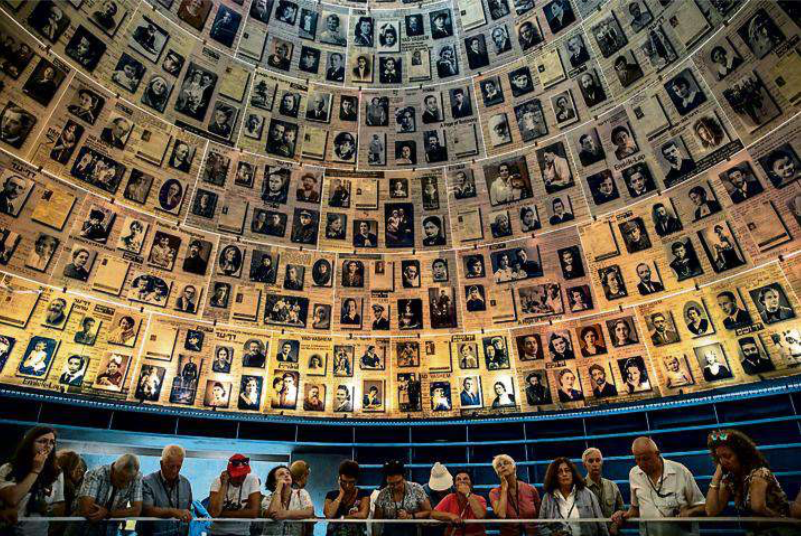
Museum of the History of the Shoah, Jerusalem, May 28.
Photo: Damir Sagolj for Le Monde
Escaping the deathly grasp of a Holocaust that killed 10,000 in Sarajevo, both the Kabilios and Mira Papo eventually headed for Jerusalem, in different eras and for different reasons. Not all Sarajevan Jews responded in exactly the same way to the founding of Israel. For some, it was an immediate call to leave a genocidal Europe, for others, the temptations of a new life, a promised-filled adventure. In Mira’s case and others like her, who were atheist, communist and not very Jewish, it proved to be a long journey towards their rediscovery of Judaism.
Mira had two boys, Daniel and Davor, with her officer husband Bozidar Bakovic only to become widowed soon after the war. Afterwards, Mira devotes herself to Tito’s Yugoslavian project, continuing her career in the army. An officer, she is transferred to Split, then Zadar, before settling for two decades in Rijeka, where she raises her children. It is there, on the Dalmatian coast, that she discovers her Jewish identity. It is not that this hardened socialist suddenly finds God or that she begins to attend religious services fervently. It is more about the pleasure she takes in educating her sons through contact with the community’s cultural activities, so much so, after their military service and university studies, when they are at an age to make the decision, they emigrate to Israel. Davor remembers his mother’s discovery of Jerusalem. “It was a dream for her. She lived there for the last twenty years of her life. The city reminded her of Sarajevo, and mostly, she spent her time with Yugoslavian friends.”
What her son has no idea about for a long time, is that Mira harbours a secret pain, “the great regret of her life”, he says. In 1945, in Sarajevo, a woman had stopped her in the street. It was Servet Korkut who revealed to her that her husband, Dervis Korkut, who had been such an honourable man and had saved Mira, had been arrested by the Yugoslavian police and was about be tried for collaborating with the Nazis. “The truth is my father was an anti-communist and did not hide it”, Munib Korkut says. Mira promised to come to the trial to testify in his favour but her son, Davor Bakovic, explains: “My father, an officer, convinced that she would be executed if she dared to contradict the official version, forbade her from going to the courthouse and locked her at home for several days. My mother was sure that Korkut was an extraordinary man and that he would be unfairly executed. She lived with the guilt of never having testified.”
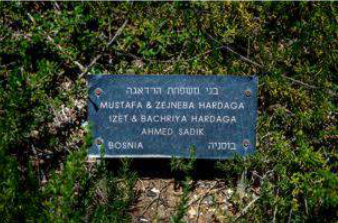
Yad Vashem memorial in Jerusalem: the plaque dedicated to the Hardaga family, who hid their Jewish neighbors during the Second World War
Photo: Damir Sagolj for Le Monde
“Righteous among the nations”
It is only at the end of her life, when war once again ravages Sarajevo, that Mira Bakovic learns by chance, from a newspaper article about the Sarajevo museum, that Dervis Korkut had not been condemned to death. In fact, he was freed from prison six years later and passed away peacefully in 1969. Still eaten away by guilt, and in the meantime having learnt of the existence of Yad Vashem memorial, she writes her testimony.
In its archives, Yad Vashem preserves all documents relating to the Righteous and the people they have saved. Recorded on a typewriter and signed by hand, Mira Bakovic-Papo’s letter, dated 20th February 1994, recounts the adventure of how her life was saved thanks to the Korkuts. Ten months later, on December 14, 1994, after an investigation, Yad Vashem bestowed the title of “Righteous among the Nations” to Dervis Korkut posthumously and to Servet Korkut, who will be handed her medal by the Israeli ambassador to France. Her son lived in Paris at the time and she was joining him as she steps on that bus in Sarajevo. Munib Korkut then receives a phone call from Jerusalem, from Mira, who shares with him how she “carried this weight all her life” and how happy she is that his father is honoured in this way, even if many years after his death.
And by these bonds forged through five centuries of communities living together, through some people’s heroism during the Second World War, the rescue operation of Jews during Sarajevo’s siege and the buses carrying the Righteous Zeineba Hardaga and Servet Korkut along with many other towards new horizons, something else was forged. Above and beyond the waves of immigration between the cities, it created a special tie between Sarajevo and Israel.
“My son, we didn’t save Jews, we saved our neighbours”
– Zeineba Hardaga, Muslim from Sarajevo
These individual destinies, and so many others, make you go on a journey through the history of Sarajevo’s Jewish community and then on to a certain idea, real or imaginary, of coexistence. To explore these two cities is to understand their symbolism for the people of the Book but also for the fractured world of today: Sarajevo, the last “Jerusalem of Europe”, the first place to have been a target of the return of nationalist ideology in Europe thirty years ago, a city besieged at the end of the 20th century; Jerusalem, the centre of the world, holy city of three monotheistic peoples, the epicentre of the tumult in the Middle East and of the Israeli-Palestine conflict. Two Jerusalems both on a quest for, but also refusing, a hypothetical notion of “cosmopolitanism”. Two cities often mired in hatred, war, nationalist division and religious intolerance. Depending on the era, two cities that embody the destruction or gentleness of life. Two cities at the ends of the world, islands but also bridges. Two cities that attract the world’s attention and tell a universal story.
Zeineba Hardaga died in the Holy Land, which, in principle, had never been promised to her. “When she arrived in Israel, we, as Jews of the former Yugoslavia, went to the airport to greet her, recalls Eliezer Papo, the rabbi of Sarajevo, who lives in Jerusalem and at the time was a student in Judaism. A minister made a fine speech on how Israel would never forget those who had rescued the Jews during the worst time in history for the Jewish people. Zeineiba had these words for the minister: “My son, we did not save Jews, we saved our neighbours.” We were all deeply moved. It was magnificent, so humble, and it was the truth.”
Her daughter Aida, born from Zeinaba’s second marriage, converted to Judaism and became Sara, a name chosen as a homage to Sarajevo. She works in the archive department of Yad Vashem, the institution which praised her mother and allowed her family to escape the hell of Sarajevo and come to Jerusalem in search of a better life.
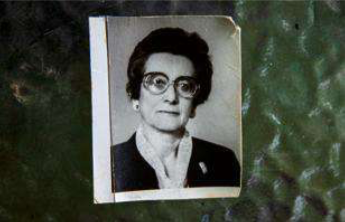
Portrait of Mira Papo, a Jew from Sarajevo who was saved by the Korkuts, a Muslim Sarajevo family.
Photo: Damir Sagolj for Le Monde
Full circle
As for the Korkuts, it did not take long before their descendants also took the road to Jerusalem. Having married the Kosovan Vllaznim Jaha, their eldest daughter, Lamija, lived in Pristina, unaffected by the siege of Sarajevo. But then the war reached her in 1999, when Belgrade, fighting against Kosovan guerrillas, deported non-Serbian Kosovans on a massive scale.
Having sent her children in advance to safety with a friend in Budapest, she flees to Skopje, Macedonia, with her husband. On her arrival, she shows leaders of the Jewish community the Yad Vashem certificate honouring her parents. The Jewish centres of Skopje and Budapest work together to organise the couple’s passage to Israel, their children following a few days later. As they arrive at Ben-Gurion Airport, amongst the crowd of officials and journalists, an unidentified man steps forward and addresses Lamija Jaha in Serbo-Croatian. “Hello, my name is Davor Bakovic, and I am the son of Mira Papo.”
One war later, destiny has come full circle. Fifty years after Dervis Korkut met Mira Papo on a bench in Sarajevo and took her into his home, Davor, a Sarajevan become Israeli, receives Lamija, a Sarajevan become Kosovan, in the land of Israel. The Bakovics help the Jahas to settle in. “For the only time in my life, I felt a closeness and an immediate friendship”, says Davor, in an emotion-filled voice.
And yet it is not for Mira Papo’s rescue that the museum librarian Dervis Korkut, dead long before his name was inscribed on the Wall of Remembrance in Yad Vashem’s Garden of the Righteous, remains in the memory of the city. It is an act far more mysterious and today much more famous that propelled him into the legend of Sarajevo.
SARAJEVO-JERUSALEM 2 | 6
Saving the Sarajevo Haggadah
Coveted by the Nazis in 1942 then threatened by Serbian bombs in the Bosnian War, this fabled 14th century manuscript recounting the Hebrews’ exodus from Egypt had to be hidden several times. Today, it takes pride of place in the town’s national museum.
When the German General Johann Fortner introduces himself to Jozo Petrovic, the director of the Sarajevo Museum in 1942, he knows exactly what he is looking for. His orders are clear: in the name of Nazi Germany, the general must lay his hands on the Sarajevo Haggadah, the museum’s masterpiece and one of the most precious Hebrew manuscripts in the world.
In Berlin, three competing institutions share the task of plundering Jewish treasure across Europe: The Reichsleiter Rosenberg Taskforce, led by Hitler’s close associate and chief ideologue of national-socialism, Alfred Rosenberg; the Ahnenerbe presided over by the Reichsführer Heinrich Himmler; and last, the Sonderkommando Künsberg. Under the guise of archaeological, cultural and anthropological studies, their objective is to prove the Aryan race’s superiority. Suffice to say, although he is already handling the deportation of six thousand Sarajevan Jews and the communist resistance rearing its head in the surrounding mountains, General Fortner, Commander of the 718th Infantry Division based in the region and mandated by the Einsatzstab Rosenberg, is undoubtedly not taking it lightly.
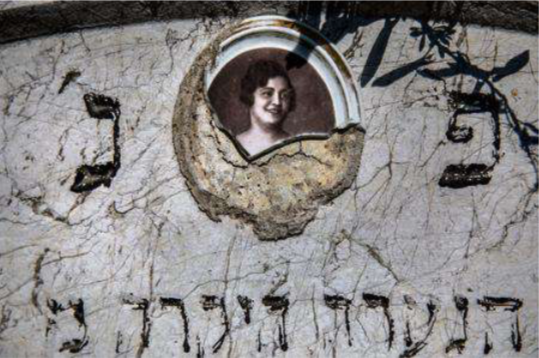
A stele in the Jewish cemetery in Sarajevo in May.
Photo: Damir Sagolj for Le Monde
The Sarajevo Haggadah is an illuminated manuscript containing the text of the Haggadah, the story of the Hebrew exodus from Egypt, read for two thousand years on Passover, the Jewish Easter. Its richness and perfectly preserved illustrations make it the most precious Sephardic Haggadah in the world.
Its story is one of a thousand mysteries and it inspires as many legends. Even its place and date of creation are unknown. According to experts, it was most likely created in Aragon, in the north of Spain, in the 14th century. The details of how it survived the Expulsion of 1492, which saw the Catholic kings drive the Jews out of Spain and destroy their heritage, are equally unknown. No doubt a family took it with them as they headed for exile towards the east. Historians have put forward possible theories about its passage to Dubrovnik or Salonika, without ever being able to furnish evidence. The only viable information that has emerged since its re-apparition in Sarajevo is that it passed through the hands of a catholic priest, Giovanni Domenico Vistorini, in the Venice region, in 1609. He appended his signature to the manuscript, saving it from the Church’s censorship.
It is a man named Josef Cohen who brings the Haggadah to the Sarajevo Museum, in 1894. Poor and needing to feed his family, it is with a heavy heart that he decided to give up the book after the death of his father. He sold it to the museum for 150 Austro-Hungarian crowns. The manuscript is then sent to Vienna to be evaluated. Viennese curators concluded it was masterpiece, one of a kind, which did not stop them from giving it a brand new and tacky cover. At least the evaluation ensured the book acquired the name it bears to this day, Die Haggadah von Sarajevo. The Hebrew manuscript was returned to its place in the Sarajevan museum collection, where it would seldom be exhibited for a century.
When, in 1942, General Johann Fortner presented himself to Jozo Petrovic, the museum director, unable to speak German, asked the librarian Dervis Korkut to join them in his office. The German officer’s visit having never been officially reported, the only account of it is that given by Dervis Korkut and his wife Servet, after the Second World War.
Its story is one of a thousand mysteries and it inspires as many legends.
Dervis “Efendi” Korkut is a man of a certain status in Sarajevo. His integrity and erudition have earned him the trust of both the museum’s director, Petrovic, and its curators. Before becoming guardian of the books in the museum, he had studied Islamic theology in Istanbul and Oriental languages in Paris. He speaks twelve languages. He loves history and traditions. “He was a living encyclopaedia and he was very respected in Sarajevo”, his son, Munib Korkut, says. Before the war, this pious man, decent and respectful of others, had written a text warning of the rise of antisemitism and praising his city’s inter-community relations.
So, when General Fortner asks to see the Haggadah, for Korkut, no worse fate could have befallen him. The museum’s director and the librarian know perfectly well of the priceless value of the manuscript. Dervis Korkut, a courageous man with profound anti-fascist convictions, loathes those who lack culture, who profane the sacred and who hunt down Jewish treasures. He cannot hand over the Haggadah to the Nazis.
Nestled amongst the Korans
In Zaton, a village by the Adriatic sea, where he retired after having been a refugee in Paris, Munib Korkut opens — after having served a welcome loza (grape brandy) — a bottle of dalmatian white wine and recollects. “My father told me the story of the Haggadah when I was an teenager, after the war. He said to me: “One day, a German officer arrived at the museum, and as Jozo Petrovic could not speak German he called me. The officer asked to see the museum. During the visit, he requested to see the Haggadah. So, I answered: “I’m sorry but another German officer came two hours ago and took away the Haggadah.” Furious, the officer left.”
What became of the Haggadah after General Fortner, who must have searched for ever for the identity of the other officer who had taken the treasure, left? “My father brought the Haggadah to our house, explains Munib Korkut, still wandering through his adolescent memories. A few days later, he entrusted it to a hodja (imam) who hid it in a village mosque near the Treskavica mountains. After the war, the hodja came to return the book and my father brought it back to the museum.”
In Sarajevo, countless stories circulate the city about the fate of the Haggadah during the Second World War. The mosque referred to by Dervis Korkut was said to be in Treskavica, or Bjelasnica or Igman, all three neighbouring mountains west of Sarajevo, however no one has ever found the village, the mosque or the imam.
“My husband had returned home with the Haggadah hidden under his jacket. He said to me: “No one should know, or they will kill us and destroy the book”.”
– Servet Korkut
Popular legends gladly add intriguing details: the Hebrew book could have been hidden in the mosque’s library, amongst the Korans, a Holy book among other Holy books, or have been buried in the mosque’s garden under a tree. When met and asked about it in Jerusalem, Eliezer Papo, the Rabbi of Sarajevo says, “Dervis Korkuk was an intellectual, an erudite man and would have never buried the Haggadah under a tree”.
Dervis Korkut was not a man to boast about his achievements. In fact, after the war, he never spoke to anyone about his act of hiding the young Jewish woman Mira Papo which would see him honoured as “Righteous Among the Nations” posthumously in Jerusalem. Nothing indicates that he ever spoke about his rescue of the Sarajevo Haggadah either, other than to his wife and on one occasion to his son Munib.
The other known details come from Servet Korkut, who spoke about the story after her husband’s death in 1969, first to her children, then in the last ten years of her life to a range of visitors, journalists and historians as the Sarajevo Haggadah became famous worldwide due to the Bosnian war (1992-1995).
In particular, she met the Australian journalist and novelist Geraldine Brooks who, before writing a novel inspired by the story of the Haggadah (People of the Book, Viking Penguin, 2008) published the interview in the New Yorker (“The Book of Exodus”, 3rd December 2007). The version recorded by Brooks matches with that given by the son: “My husband came back home for lunch with the Haggadah hidden under his jacket. He told me: “Say nothing to anyone. No one must know or they will kill us and destroy the book.” That afternoon, he went to Visoko, where one of his sisters lived, under the pretext of visiting her. From there, he took the book to a village tucked away in the Treskavica mountains, where his friend was the hodza of a little mosque. The Haggadah was hidden among the Korans and other Islamic books for the duration of the war”.
The youngest daughter of Servet, Lamija Jaha, lived, between two exiles in Israel and then in Canada, in Sarajevo with her mother during the last four years of her life. She often heard her mother telling the story to visitors. However, she recounts a detail that contradicts previous versions on one point, which would throw light on why the location of the Haggadah’s hiding place has never been found: “I always heard my mother say my father brought back the Haggadah to the house, hidden in his clothes. She then said that he had entrusted it to a friend who lived near the village of Travnik.” The fact that Dervis Korkuk was born in Travnik, a small town in central Bosnia and previously the Pachaluk (headquarters) of Bosnia when it was part of the Ottoman empire, gives credence to the hypothesis that he entrusted the treasure to a childhood friend who had become an imam is not an implausible one.
Sarajevo on the brink of collapse
The really funny side to the story is that while Sarajevo is a city brimming with one legend more spectacular than the next about the Haggadah, a great number of museum professionals do not believe a word of the Korkut family’s story. It is as if they cannot bring themselves to admit that their predecessors, such humble and serious professionals, could have let this jewel slip through their hands during a few troubled years. Mirsad Sijaric, the current director of the museum, who fought to defend the city during the siege before returning to his history studies, bats away all such stories. He wants it to be known: “I am sure the Haggadah never left this museum. We have a library of over 350,000 books and had maybe 100,000 books during that era. What better place than here to hide a book? We do not have any official documents proving the Haggadah was hidden elsewhere.”
This opinion, founded on the absence of archived documents, does not explain why Servet Korkut remembers her husband bringing home a book so precious that it could endanger their lives, or why Dervis Korkut, a man of integrity, would have lied to his adolescent son. Either way, the Sarajevo Haggadah is part of the museum collection in 1945. After having survived the destruction of Jewish treasures in Spain in the 15th century and eluding the Nazis in the 20th century, this was not, however, the end of its tumultuous destiny…
In the spring of 1992, war comes back to Sarajevo. This time, no enemy officer is on a quest for Jewish treasures, but the Serbian army bombs the city relentlessly. Sarajevo shakes, burns and threatens to collapse. The Haggadah is once again in danger as the national museum finds itself on the frontline. While, all around the city, those laying siege have positioned their canons on the surrounding hills, this is the place where the frontline descends to the city centre and skirts the Miljacka river, at the edges of the Grbavica neighbourhood. To reach the frontline, rather than crossing areas exposed to sniper shots, the city’s defenders pass by the museum’s gardens. If the Austro-Hungarian building just about survives the war’s mortar shells, it is nevertheless hit, gutted, and progressively abandoned in the death throes of the conflict. Pipes explode, water invades the basement. The museum is in a state of absolute desolation. Five hundred centuries of national history risk being washed away.
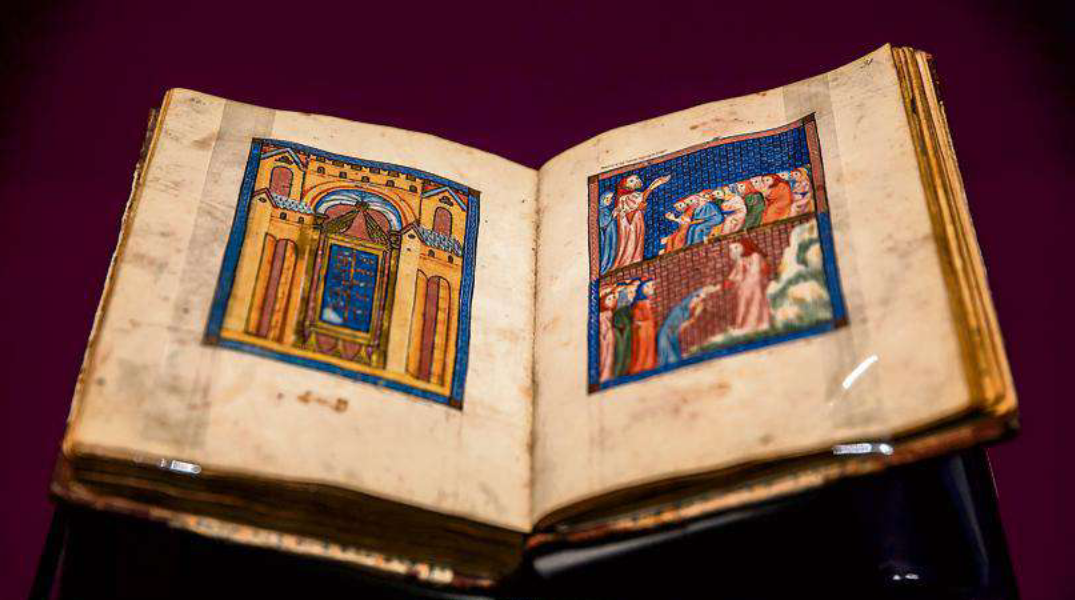
The Haggadah of Sarajevo is today preserved in the National Museum of Sarajevo. The richness and preservation of its illustrations make it the most precious Sephardic Haggadah in the world
Photo: Damir Sagolj for Le Monde
Enver Imamovic is an archaeologist and historian who teaches at the philosophy university next door to the museum. After two months of war, he is the first person to have the idea and the courage to try, at all costs, to save the Sarajevo Haggadah.
One June morning, he runs into Hamo Karkelja, a museum curator. He shares his idea of rescuing the Haggadah and asks the curator to join him. Both know that, after its extraordinary adventure in the Second World War and in addition to at least one theft attempt during the Yugoslav era, it is now kept in a secret place only known to the museum director, who, ill and bedridden, has now disappeared. Enver Imamovic therefore needs an ally who knows every nook and cranny of the building, to find where the manuscript might have been hidden.
The two men first go to the Ministry of Culture and Sciences where another professor from the philosophy faculty, acting as deputy minister in that period’s chaos, signs a document giving an official character to the mission. They then go see a police captain, asking him to assign them a combat unit to assist getting to the museum, and if necessary break open any safe. “The police officer asked me: “What is this damn book? Is it really worth someone dying for it?!” I replied that in my opinion, yes”, says Enver Imamovic.
This is why, as dawn broke on June 6, 1992, the historian Imamovic, the curator Karkelja, the officer Hajrudin Alispahic and two other policemen set off for the Marindvor neighbourhood and the museum. The bombings are intense. They get to the museum around 8.30am and find two other curators as well as the guard, Meho Mulic. Having continued to live there with his two young children, he has devoted the first weeks of the war single-handedly transporting antiquities and works of art from different pavilions down to the basements, to shelter them from the bombs.
“What is this damn book? Is it really worth someone dying for it?!”
The historians start their investigation in the director’s office: a safe has already been opened and pillaged; a policeman promptly opens a second safe. In it, they find antique gold and silver jewelry, as well as a Haggadah. Enver Imamovic, who has never seen the real Sarajevo Haggadah, quickly realises, because of the paper’s texture, that it is a reproduction.
Their trek continues to the museum basements, one room at a time, in the dark, with water up to their ankles. “Then, in a little room, I saw an old Austrian safe”, remembers Enver Imamovic. The policeman cannot do anything when confronted with this ancient safe with an unknown mechanic device. His keys and modern tools are powerless in the face of its Austro-Hungarian robustness.
The improvised commando unit of police and intellectuals are forced to attack the safe with chisels and axes. After a couple of hours, around 4.30pm, the door finally yields. Inside sits another safe also closed by key. The policeman is able to force open this lock without too much difficulty. Using a lighter, Enver Imamovic takes out the Haggadah and studies it, leafing through its illuminated pages. He touches the paper. “I sniffed the book and said: “Guys, this is the real Haggadah!””.
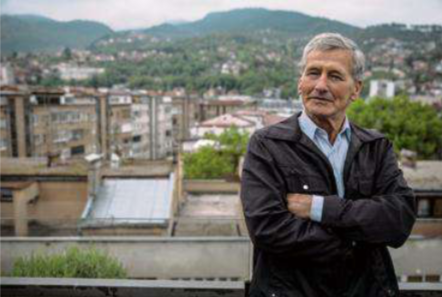
Archaeologist and historian Enver Imamovic teaches at the Faculty of Philosophy, next to the museum. In the spring of 1992, when the Serbian army bombed Sarajevo, he was the first to have the idea and the courage to try, at all costs, to save the Haggadah. Here in Sarajevo on May 15.
Photo: Damir Sagolj for Le Monde
Its rightful place in the museum
After a night under guard in the police headquarters, the Sarajevo Haggadah is placed by Enver Imamovic and his fellow accomplices in a safe of the central bank — the most secure place of the besieged city — where the new independent Republic of Bosnia & Herzegovina keeps its treasures, its money, and where, apparently, on certain nights of particularly violent bombardment, the president Alija Izetbegovic (1925-2003) sleeps for a few hours, sheltered from the war.
The problem is that, at the time, no one knew this story. A policeman indeed went the next day to notify the city’s Jewish community leaders Ivan Ceresnjes and Jakob Finci that the Haggadah was rescued but the Jewish representatives did not see it or talk to anyone about it. Hence, during the siege, as in the Second World War, the Haggadah is once again deemed to have disappeared, at least to the common man.
Because disappearances prompt fantasies and mysteries sometimes lead to lies, the unknown fate of the Holy book even caused a journalist to rashly write that the Muslim Bosnian authorities had sold it to buy arms. Rumours spread so quickly that, in the last year of the conflict, Ceresnjes and Finci suggested to President Izetbegovic to authorize a public display of the Haggadah for Passover.
“Izetbegovic asked me: “Where is it, this Haggadah?” I replied to him: “We have been told in a safe at the national bank”, Jacob Finci recalls. As Izetbegovic didn’t know who could get access to it, he called the Culture Minister, Enes Karic, who didn’t know either. Then he called the Prime Minister, Haris Silajdzic, and told him he had to sort out finding the Haggadah. Silajdzic oversaw the operation. We presented the Haggadah in the synagogue for Passover in April 1995, in the presence of Izetbegovic.”
The precious manuscript arrives at the synagogue in an armoured military vehicle. Rarely had so many military security forces been deployed during the siege in one place, even for the visit of a foreign head of state: the Bosnian special forces’ soldiers and policemen, the president’s security officers, UN “blue helmets” and US embassy guards.
In April 1995, the Sarajevian Jews take back ownership of a missing treasure, saved by a Muslim historian from bombing, and brought to the Synagogue by a Muslim president.
On that day, many of the officials present, including Jewish dignitaries, see the Haggadah for the first time in their lives. Before the Hazzan of Sarajevo, David Kamhi, celebrates the religious service and leads the prayer, many cannot help but leaf through the pages of the book, so long hidden from sight. The emotion of Jewish Sarajevans is palpable. Once again, they are taking possession of a lost treasure, rescued from the bombing of the museum by a Muslim historian and brought to the synagogue by a Muslim President. It is one of the siege’s powerful moments, a brief respite of peace during the war, and a symbol and testament to the fact that the city’s inter-community relations have been perhaps stronger than its attackers’ fascism.
Two rescues in a century
Today, the Haggadah has finally found a proper home, in room 37 of the national museum. It is on show on some of the visiting days. Touching and leafing through its pages as occurred in the spring of 1995 is out of the question. Sophisticated security protects the manuscript. Mirsad Sijaric, the director, opens the room and shows how the manuscript, kept under glass, can disappear, thanks to a special mechanism, and be replaced by a reproduction in two minutes.
The story of this Hebrew manuscript is then the story of the exceptional bond between a book and a city. Mirsad Sijaric still smiles remembering the amazement of the most recent expert who came to examine it, Israeli art historian, Shalom Sabar, from the Hebrew University of Jerusalem and author of “The Sarajevo Haggadah: History and Art (The National Museum of Bosnia Herzegovina, Sarajevo, 2018).
After a few days in the city, the historian confided to the museum director: “Which Londoner, Parisian or Viennese knows the value of the manuscripts buried within the depths of their city’s museums? In Sarajevo, I have not yet met a taxi driver who doesn’t talk to me passionately about the Haggadah!”
Many in Sarajevo are certain they know where Dervis Korkut hid the Haggadah during the Second World War, or how Enver Imamovic saved it during the Bosnian War. The most incredible tales circulate about the illuminated Jewish Sephardic manuscript’s two rescues in one century, illuminated again because of a Muslim librarian and then a Muslim historian. Even when the truth is sublime, this is how legends are made.
***
Parts 1 and 2 are translated by Sarah Robertson for the European Press Prize
SARAJEVO-JERUSALEM 3 | 6
The Jewish musketeers of the siege of Sarajevo
Throughout the Bosnian war, Sarajevo Jews find themselves at a new crossroad of history and their community launched an incredible humanitarian operation, organizing the evacuation of 2500 Sarajevans and providing assistance to the besieged. Israel, on the other hand, witnessed the arrival of hundreds of Sarajevan so little Jewish.
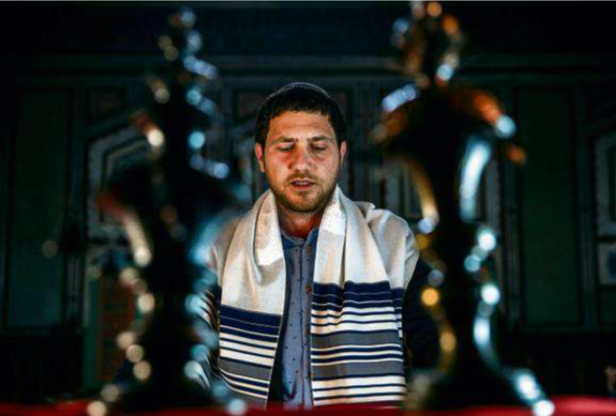
Igor Kozemjakin, whose father, Boris, was one of the organisers of the evacuation in the Bosnian war. Hazzan of his community, every Friday, Igor officiates for the Sabbath, in the only synagogue still in operation in Sarajevo.
Photo: Damir Sagolj for Le Monde
SARAJEVO-JERUSALEM 4 | 6
The peculiar customs of Sarajevo’s rabbis
Similar to the last Yugoslav rabbi Cadik Danon, a line of religious leaders, today personified by Eliezer Papo and Igor Kozemjakin, takes liberty with Jewish laws and traditions and represents, according to the current rabbi, “the true values of Judaism”. A vision of Judaism adjacent to Sarajevo’s spirit.
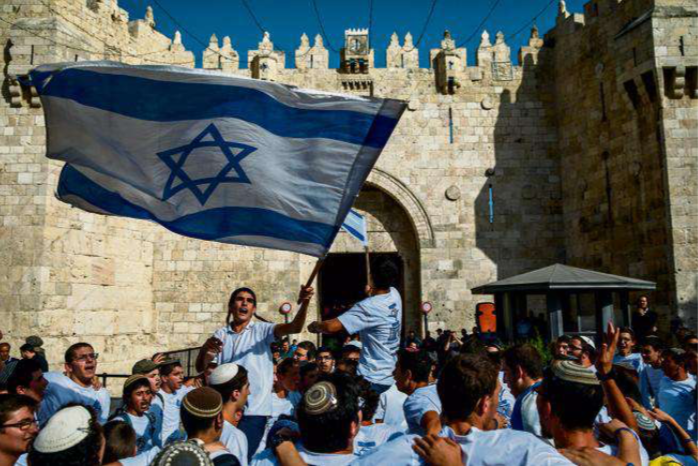
Young Israelis – outside the Damascus gate – celebrate the ‘Jerusalem Day’, which marks the takeover of the Holy City by the Israeli army during the 1967 war.
Photo: Damir Sagolj for Le Monde
SARAJEVO-JERUSALEM 5 | 6
From “Sarajevan education” to the Palestinian cause
A daughter of a Bergen-Belsen survivor from Sarajevo, Amira Hass has been the only Israeli citizen living in the Palestinian Occupied Territories for the last 25 years. Very critical towards Israeli colonizers, the journalist and columnist of the daily newspaper Haaretz continuously defends the Palestinian cause.
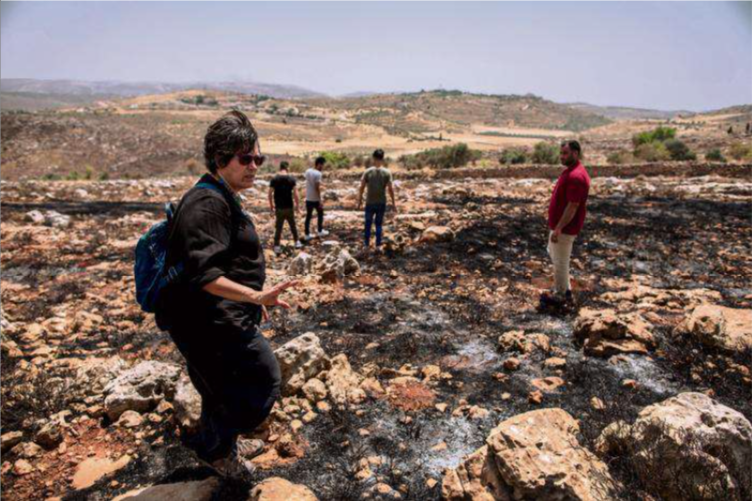
Amira Hass, Israeli journalist famous for her reports and editorials published in the daily newspaper “Haaretz”, chose to live in Ramallah, in the West Bank. Here, on June 7, she discovers the fields of olive trees of the Ibrahim family burned down by Israeli settlers the day before.
Photo: Damir Sagolj for Le Monde
SARAJEVO-JERUSALEM 6 | 6
Sarajevo-Jerusalem, two cities, two destinies
As opposed to Sarajevo which resisted the ethnic division of the city with the strength of despair, the inhabitants of Jerusalem live separately today, and the holy city is more fractured than ever.
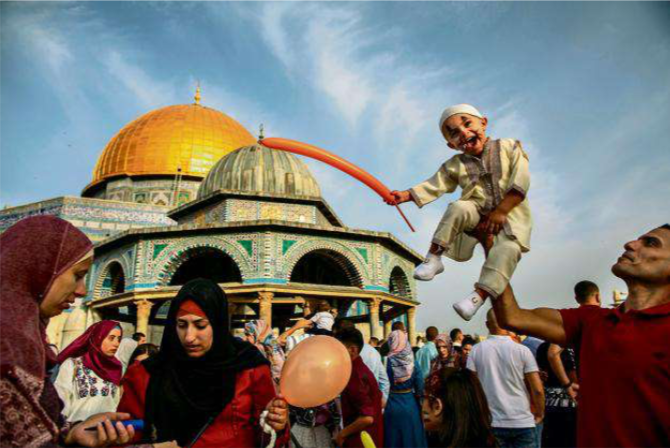
Palestinians celebrate the end of Ramadan at the Dome of the Rock in the Old City of Jerusalem on June 5.
Photo: Damir Sagolj for Le Monde
More goals, finer ankles
How we talk to and about women in sports matters.
In December 2018, at a press conference during the European Women’s Handball Championship, Russia’s coach Yevgeni Trefilov was asked which players stood out to him from the Romanian team, Russia’s opponent in the Paris semifinal. The 63-year-old man’s answer regarding women athletes two or three times younger than him was, “Many of them have nice legs and pretty eyes”, sparking a ripple of laughter in a room half-filled with reporters, of which four or five, me included, were women.
It may not seem that important that people laughed or that this is how a man chose to answer a question about the semifinal game of a competition for which some women athletes had worked their entire lives or struggled to get back in shape after giving birth, or where they suffered severe injuries, but it’s a telling example of how we relate to women in sports. This is an issue I’ve been following closely since I learned – from women athletes and coaches I’ve talked to, from my own experiences as a reporter and from the way women athletes are portrayed in the media – that sports, like many other fields, is not a place where women are seen and treated the same way as men.
If you are a woman and you want to be an athlete, chances are your journey will be different from that of a man. You’re likely to be paid less, to play on smaller or emptier arenas, on synthetic grass. You might lose your sponsors or your coaching position if you get pregnant, people in the bleachers might yell at you to chest the ball or swap T-shirts, someone might steal photos from your phone and post naked pictures of you on the internet. You might have to field sexual advances and the media might cover you saying you’re sexy, you have nice legs or pretty eyes or you’re dating someone famous. And if the sport you want to practice, manage or coach is football, then chances are even higher that you will hear things like: you know nothing about this, it’s complicated when you’re a woman refereeing a men’s sport, or football will make your legs ugly, how about you try dancing or ballet instead?
All this happened to women I have talked to, have written or read about. It happened to Liubliana Nedelcu, a 39-year-old agent, in talks with men in football. “Get a load of this, she’s telling me what I should do,” some coaches objected when she told them they hadn’t worked well with junior players or they hadn’t used a certain player in the best position. Liubliana, who has loved football since she used to go to matches with her father, a supporter of the local team in her hometown of Rosiorii de Vede, always knew she would have to put in double the work to prove she understands football just as well as men do. Even though she’s worked in the field for 12 years, she reads books on football and follows the statistics of players she represents, she still feels that “no matter how well you do your job, you’ll never be seen the same way as a man”.
It happened to coach Irina Giurgiu, whose colleagues at coaching school included former football players who laughed and elbowed each other during her presentations, who asked if she’d had her hair done or made jokes she doesn’t want to repeat but which “were not very nice”. Sometimes she smiled and pretended not to hear. Other times she went home crying, feeling “left out, small and useless”, wondering what she was doing there. Now, at 28, she coaches at her own club and the U17 national team, is an assistant coach at the seniors’ national team and was recently the first woman to be admitted to the UEFA PRO License Course, which would allow her to coach in the Romanian First League.
It happens to tennis players, who are invited to twirl after they win a match or are penalized if they change their T-shirts on court. Racing driver Cristiana Oprea was told she would get more media coverage if she posed naked by the car and at the defense of her BA thesis, about an excellence center for motorsport, professors at the University of Architecture asked her why she had chosen “a project for boys”. In 2017, at the press conference ahead of a Fed Cup match between Romania and the UK, Ilie Nastase repeatedly asked rival team captain Anne Keothavong what room she was staying in. He was then suspended during the game, after player Johanna Konta told the referee the Romanian had called her a “fucking bitch”.
I myself, as a sports reporter, have had to deal with some prejudice. While reporting the story of a junior team, the coach said I couldn’t ride the team bus to the stadium before the game, although I had been to practice multiple times. I then learned from the photographer I documented the story with that he was allowed on the bus but women weren’t, because they were bad luck. When he and I visited the players’ high school, the PE teacher who met with us greeted him first and seemed surprised to learn that I was, in fact, the reporter. One coach barked at me for waiting outside the changing room, was I hoping to see the players in their underwear or what? A football player answered my phone call saying “mommy, stop bothering me”, and at my ten-year high school reunion, when I said I was a sports reporter, my former head teacher was surprised that women, too, could be interested in sports. Then he asked if I knew the history of football championships of the past few years.
“No matter how well you do your job, you’ll never be seen the same way as a man”.
That sport, like the society it reflects, is not a world that welcomes women with open arms is something we’ve known since ancient times, when women risked being thrown into the river if they were seen on the Olympic stadium. They were also denied participation at the first edition of the modern Olympics, the most important competition on the planet. Until 1972, women were not allowed to run marathons and until 2011 they were not welcome at the Ski Jumping World Cups because of a myth that said it could be harmful to their reproductive health. Women’s football was also banned in some countries and in Romania it’s been played as an organized sport only since 1990. In Iran, even today women are not allowed at football matches and many of them resort to dressing up as men to enter stadiums.
That women’s participation in sports is on the rise – 45% of athletes at the 2016 Olympics were women, the highest percentage until then – is mostly due to women who fought to bring down the barriers. Former world number one tennis player Billie Jean King, founder of the Women’s Tennis Association (WTA), fought for equal prize money, and all Grand Slam tournaments now offer the same prizes to women players as they do to men; only some of them hand out plate-shaped trophies to women instead of the cup-shaped trophies they give to men. Kathrine Switzer signed up for the Boston Marathon in 1967 using only her initials and became the first woman to run the Boston Marathon as a numbered entrant, although the organizer tried to forcibly remove her from the course. This year, the U.S. Women’s Soccer team filed a gender discrimination lawsuit against the U.S. Soccer Federation, saying that although they are World and Olympic champions, they are paid less, they practice and travel in worse conditions and have more matches than the men’s national team, which didn’t qualify for the latest World Cup.
2019 marked European records in terms of audiences, with over 60,000 people attending women’s football matches, and saw the launch of development strategies, campaigns and media platforms dedicated to women’s sports. Mid-August, Stéphanie Frappart became the first woman to referee a major men’s match, the UEFA Super Cup between Liverpool and Chelsea, and said she wasn’t nervous because football is the same. “Finally, I think it’s time,” said coaches of both teams about UEFA’s decision, which they deemed historical.
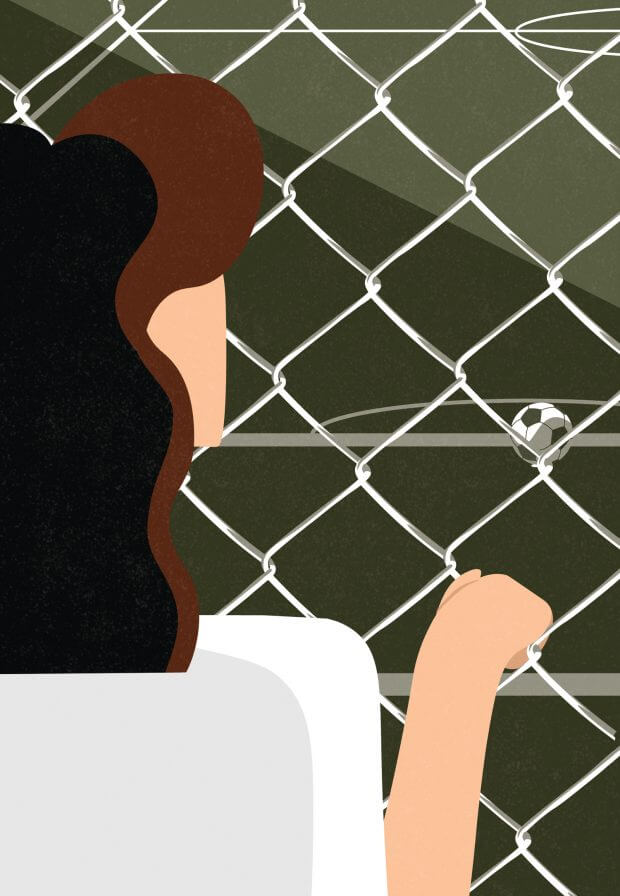
Illustration: Irina Perju
In Romania, the Football Federation introduced a rule requiring clubs in the First League to have women’s teams starting the 2021/2022 season in order to be licensed. It’s an attempt to develop women’s football – the approximately 2,000 women players enrolled cannot make a living from playing football –, but not everyone welcomed it. “When I see women playing football, I immediately switch channels or turn off the TV. How can you force me to have a women’s team if I don’t like it?”, FCSB owner Gigi Becali told news agency AGERPRES. FCSB is the only club that voted against and challenged the federation’s rule at the Court of Arbitration for Sport.
Despite all the progress, the world of sport remains one where women have little representation: on stadiums, on technical benches, in management or in the media. At the latest European Women’s Handball Championship, just one team out of 16 was coached by a woman. Out of the 74 sports federations in Romania, just seven were run by women in 2018. International statistics show more than 80% of sports reporters are men, a reality I witness at the international competitions I attend, where sometimes just one or two of 15 Romanian journalists are women. Women athletes see it, too: American football player Megan Rapinoe recently said there should be more women reporters, that the players’ stories would be more complex if they were told from different perspectives. At the beginning of the year, a reporter asked Imke Wubbenhorst, the first woman to coach a men’s team in Germany’s top five leagues, if she had to wear a siren so that players in the dressing room could hear her coming and put pants on. („Of course not,” she responded. “I am a professional. I pick my team based on penis size.”). All this, while women’s teams are almost exclusively surrounded by male coaches, doctors or massage therapists and no one asks them how they feel and whether they cover up in the changing room.
There are also subtler ways that sports show girls and women that the world they want to be part of was not designed for them: there are no foosball tables with female figurines and most sports toys target boys by means of packaging; scientific studies started including women in research only in recent years and started looking, for instance, at the way bio-mechanical differences or hormonal fluctuations impact injuries (women athletes suffer torn ligaments in the knee more often than male athletes). This year, for the FIFA Women’s World Cup, it was the first time since Nike began working with WWC in 1995 that kits were designed especially for the female form, rather than as derivations of the uniforms made for men. Research and consultations with the athletes revealed which areas were more susceptible to sweating and where to use more breathable materials, and that while men preferred tighter designs that made them feel strong and superhero-like, women preferred their gear looser and more comfortable.
But it’s not just about access, it’s also about the way girls are treated once they enter the sports world. How they are talked to and how safe they are. Gymnasts, judokas and handball players spoke in recent years of the physical and verbal abuse they suffered during practice. In the U.S., over 200 gymnasts were sexually abused by the Olympic team’s former doctor Larry Nassar, who was sentenced to 175 years in prison. In Romania, seven girls aged between 11 and 14 were raped by their 65-year-old handball coach, who was sentenced in 2017 to 19 years in prison. Also in 2017, a coach in Sânnicolau Mare, the westernmost town of the country, was fired from handball for sexually harassing two female students. In August 2019, a 47-year-old policeman in Sibiu, a city in Transylvania, who taught boxing in his spare time, was placed under preventive arrest for the attempted rape of a 12-year-old girl and the sexual assault of a 17-year-old girl, both of whom he was coaching.
This type of abuse doesn’t occur in a vacuum. It is allowed by a culture that often cares more about medals than child safety.
It doesn’t just happen to girls, even if they report such incidents more often – in the UK, over 350 former football players spoke about sexual abuse they suffered at junior academies – and it doesn’t just happen in professional sports. This spring, a physical education teacher in Alba Iulia, a city in the west-central part of Romania, was indicted for acts of a sexual nature (“hugs and fondling, including touching private parts”, according to the indictment) against several under-age students, during PE classes. In class, he called his pupils names like “idiot, inept, handicapped, fatso, cow, slut”. It’s a language similar to the one used by famous Romanian handball coach Gheorghe Tadici towards Crina Pintea, the line player of the Women’s National Handball Team, voted the best line player in Europe, during the first six years of her senior career. There were years when Crina, who recently won Champions League with Győr, says she was hit, stepped on, insulted, spit on and humiliated by the former national team coach who still sits on the board of Romania’s Handball Federation.
This type of abuse doesn’t occur in a vacuum. It is allowed by a culture that often cares more about medals than child safety. It happens because most coaches are men who are given absolute power and authority and because many children leave their homes early, with dreams of winning medals, and move into dorm rooms and academies, away from their parents. It happens because, for a long time, the results in which we take such pride were obtained through violence and in a climate of fear, and even today there are athletes and coaches who believe you can’t succeed without a “spartan training”.
But this myth of success obtained through sacrifice and suffering, which is alive and well in sports gyms around the country, can easily become a shield that allows and protects much more dangerous behaviors. Our national pride and passion for sports shouldn’t let us forget there is a world of difference between a “spartan training” meant to push athletes to overcome their limits, and acts of abuse or violence. Slapping, hitting, swearing should not be considered acceptable behavior in women’s sports or in men’s sports.
“I practiced gymnastics out of fear, like animals at the circus,” Gabriela Geiculescu, a former gymnast, now aged 53, told me in an interview last year. She had nightmares for years after retiring due to untreated back problems and only in the United States, where she now coaches at her own gym, did she learn that gymnastics can be practiced with joy. “They were both harsh,” she said of her coaches at the Triumf School Sports Club in Bucharest. “But of course he was worse. She only pinched us, hit us over the legs with a water hose, but we only worked with her for balance beam. With him we worked at three events, acrobatics, uneven bars and vault, and he was really cruel. (…) He beat me the most, every day. Not a day went by without getting hit, and he hit me alright.”
Many gymnasts I’ve spoken to said they were never slapped but some, in informal talks, told me how they were pulled by the hair and hit across the legs with sticks or shoes, how they were told every day that they were fat, until they could no longer see anything else in the mirror, how they were “treated gently and then not so gently” when they didn’t perform well, or how they were afraid to say they were in pain because they were not believed. The boyfriend of one, himself a gymnast, said it’s the same with boys but “they’re different, they don’t take it to heart; girls are more emotional.”
Many of them are afraid to speak openly, especially after seeing how the ones who did speak were treated, including by people in sports. When former gymnast and Olympic gold medalist Maria Olaru wrote in her autobiography Prețul aurului, sinceritate incomodă (The price of gold, uncomfortable honesty) about the slaps and insults she had received from several coaches, including Mariana Bitang and Octavian Bellu, other gymnasts from her generation, people in the federation and other athletes said she was hurting gymnastics, that they hadn’t been hit, that she was talking about it too late or that she shouldn’t reveal such details about the coaches who helped her become an Olympic champion.
It’s a culture of silence that perpetuates such behaviors, in a society where girls are taught at young ages to hold their tongues, to endure, to obey and not rebel.
“Even if they had tread on me, if I were asked about it today, I would never tell,” said in a TV show on Digi Sport Elisabeta Lipă, the most decorated rower in history. She was at that time Minister for Youth and Sports, the very leader who could have elicited change, at least in terms of discourse. Instead, she added: “Professional sports is like a marriage. You don’t air your dirty laundry in public.”
It’s a culture of silence that perpetuates such behaviors, in a society where girls are taught at young ages to hold their tongues, to endure, to obey and not rebel, as Crina Pintea said she used to react when she was abused, or as Gabriela Geiculescu says about how she couldn’t fight back. “When you see my only act of rebellion is to cry, that I can’t talk back, I can’t say how I feel, I can’t do anything else; when you say ‘Ten more repetitions’, I well up and start crying, and you think you’re helping?” said Gabriela. “The federation knew, the other coaches in the room knew what was happening and no one said anything, who was I to complain to?”
Precisely because they are still few, it’s important that when women athletes find the courage to speak out they are listened to and believed. It’s important to talk about abuse in sports, as well as in society, and to offer them as many platforms as possible. That’s what they want as well. “I wish other girls would speak out, too. They have no reason to keep it all inside, no reason to be afraid or ashamed,” said Crina, who understood while playing abroad that if more women athletes protested, retorted or refused to continue training, things would be different for future generations. “How are we going to stop this if we don’t talk about it?” said Gabriela, who doesn’t understand why some athletes are still afraid. “When I read Maria Olaru’s book, how can anyone imagine a child is to blame for being beaten? What kind of a society is this?”
I often watch admiringly how confident women athletes in other countries are, like tennis player Serena Williams or soccer player Megan Rapinoe, how openly they speak about their experiences as women in sports, as LGBT athletes or as athletes of color, and how persistently they demand equality and respect because they understand they can be a voice for those who are more vulnerable. I wish for more Romanian athletes like them, but maybe more time needs to pass before Romanian sport, which is part of a society used to sweeping anything that’s painful under the rug, is ready for such complicated debates; not just about violence and discrimination, but also about mental health, body image, sexual orientation or bullying.
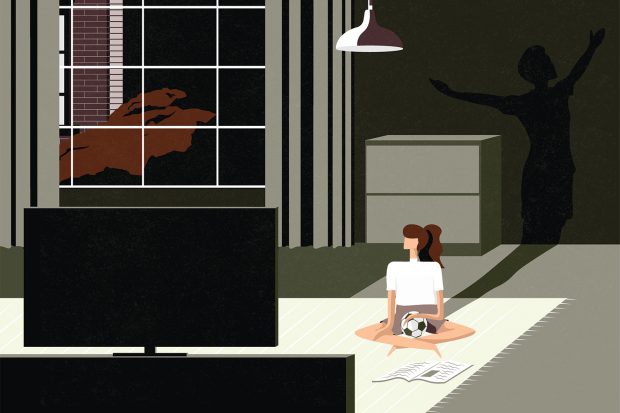
Illustration: Irina Perju
There are some women athletes trying to create systems, platforms and opportunities they do not see around. Andreea Răducan, former gymnast and current president of the Romanian Gymnastics Federation, had individual talks with gymnasts on the Olympic team and gave them her phone number and her personal e-mail address. Tennis player Simona Halep, two times Grand Slam winner, supports, through her own foundation, a women’s hockey team and a rhythmic gymnastics competition because she knows how hard the journey to success is and “there is much to be done to keep girls active in sports,” as she said in an interview for The Telegraph. Two high school girls talk about their experiences as football players on a blog they started, Footballiciousgirls, because they want to change people’s opinion that football is only for men. Racing driver Cristiana Oprea created a website about women in motorsport, because she felt the need for more representation in a field where women are seen as exceptions.
But beyond more representation, we also need fewer stereotypes. If a girl wanted to watch the FIFA Women’s World Cup this summer – the most popular in history –, she would have seen on TVR, Romania’s national television station, a promotion clip that said, in a male voice of course, that “it’s not just boys who are having fun, girls are at the World Cup”. On the screen, she would have seen women’s legs in red shoes sticking a pointy heel into a football ball, followed by the same booming male voice saying: “More goals, finer ankles”. (Centrul FILIA, a local NGO, filed a complaint over the clip to the National Audiovisual Council, but the board ruled it had not breached audio-visual law.)
If a girl were to pick up a sports newspaper on any given day, she would see 42 photos of male athletes and just eight of women, including a bikini-clad star and one of Lionel Messi feeling up his wife in a nightclub. She would read an article titled Women, on stadiums or in the kitchen?, where she would learn that “none of us think football is the most fortunate form of manifestation of women’s skills”. On TV she would see news stories about the sexy and fast girl chased by all the boys on the track or about the sexy and mean referee who puts men football players in their place, and on sports websites she would read about where the sexiest handball players spent their vacations; yes, sexy is a word used very often in media coverage of women’s sports.
Besides getting little media coverage, when they are being covered, women athletes are often portrayed in ways that minimize their athleticism and highlight their femininity, sexuality and physical beauty, says Nicole LaVoi, an American professor of sport psychology and sport sociology who studies gender equality. And this “tells us it’s more important what you look like than what you can do. Sexualized images of girls and women do little to increase interest in or respect for women’s sports. (…) Sexualized images of girls and women tell young men and boys that female bodies are objects of sexual desire, to be consumed rather than to be honored and respected.”
This type of media coverage occurs even though in recent years Romania’s biggest successes in sports were brought by women in sports like handball, tennis, fencing, table tennis or rowing. And yet we see them too rarely and we give them too little depth when they deserve much more. As do the hundreds of young girls who dream of following in their footsteps and who need to see that it’s worth it, especially since in Romania success is too often due to individual effort (including financially) and not to a strong system in place.
It’s important to view women’s sports – and the presence of women, in general, in traditionally male-dominated environments – as normal, not as some rarity, an exception, something exotic or amusing.
Even if not everything that’s written about them is in those terms, Cristina Neagu, the only handball player named World Player of the Year four times (a record in men’s handball as well) deserves more than stories about how she has her eyes on boys (because she said in an interview that she watches men’s handball), or where she is compared to Messi or Ronaldo. Simona Halep, Romania’s biggest tennis player, deserves more than articles about the breast reduction surgery she had when she was 18, or about her boyfriend and when she plans to get married, although she has asked the press for more discretion and respect for her privacy. Former Olympic champion Nadia Comăneci, who radically changed the world of gymnastics, deserves more than a headline like “Perfect 10 in a bikini”. Any woman athlete who fights to win a match deserves more than photos of her bare breasts and headlines like “Accidental striptease, player’s breasts exposed”.
These are newspapers for a male audience, I’ve been told, and that is unfair not just because it excludes us, as women who love sports, but because it normalizes a wrong way of thinking and of talking about women. Because it’s not just about women athletes, but about the message we’re sending women – and men – about women’s place in society. It’s about raising strong, brave and confident girls in an unsafe world, where sports could be such a wonderful tool to teach them confidence, self-esteem, self-defense techniques and leadership skills. Ninety-six percent of women in top management positions played sports as teenagers, according to a 2013 study by Ernst&Young, and many said it has helped them in their careers. “[Sports] has taught me to see the limitations that girls place on themselves as false and that the stories we often tell ourselves of what we’re capable of aren’t necessarily true,” said Alison Glock, an award-winning American journalist and writer. “When you play sports, you transcend those self-imposed limitations.”
But if we exclude them, with direct or subtler messages, if we show them that their looks are all that matters, if we portray women athletes as sex-bombs or assign value to them only in their roles as girlfriends, wives or mothers (while men are athletic, strong, fast and competitive), if they hear adults in the school yard or in parks telling their boys that they “run like a girl” when they want to embarrass them, we’re essentially telling them sports is not for them. And if we consider the fact that the number of girls quitting sports before the age of 14 is double compared to that of boys, according to the Women’s Sports Foundation, or that Romania ranks at the tail end among EU countries in terms of mass sports participation, maybe we wouldn’t laugh it off.
For this message to change, we need more representation and more women role models because they can help society take a step forward in its understanding of gender roles and the concepts of femininity and masculinity. Women role models matter, said Nicole LaVoi, author of a book about the low number of women coaches. “They matter to girls, and they matter to boys, because who and what you see tells you what’s relevant, valued and important. And what is not.”
That’s why the stories we tell matter. That’s why how we talk to and how we treat women athletes matters – on the court, in press conference rooms, in interviews –, what headlines we write, what we click on or how we react to a so-called joke. It’s important to view women’s sports – and the presence of women, in general, in traditionally male-dominated environments – as normal, not as some rarity, an exception, something exotic or amusing.