How the news took over reality
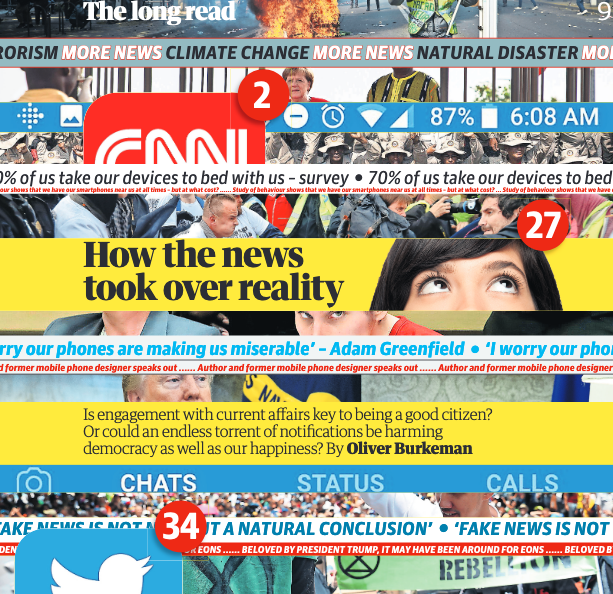
Composite: Christophe Gowans/Guardian Design/Getty/AFP/Alamy/AP/Reuters
The afternoon of Friday 13 November 2015 was a chilly one in Manhattan, but that only made the atmosphere inside the Old Town Bar, one of the city’s oldest drinking haunts, even cosier than usual. “It’s unpretentious, very warm, a nurturing environment – I regard it with a lot of fondness,” said Adam Greenfield, who was meeting a friend that day over beers and french fries in one of the bar’s wooden booths. “It’s the kind of place you lay down tracks of custom over time.” Greenfield is an expert in urban design, and liable to get more philosophical than most people on subjects such as the appeal of cosy bars. But anyone who has visited the Old Town Bar, or any friendly pub in a busy city, knows what he and his friend were experiencing: restoration, replenishment, repair. “And then our phones started to vibrate.”
In Paris, Islamist terrorists had launched a series of coordinated shootings and suicide bombings that would kill 130 people, including 90 attending a concert at the Bataclan theatre. As Greenfield reached for his phone in New York, he recalls, everyone else did the same, and “you could feel the temperature in the room immediately dropping”. Devices throughout the bar buzzed with news alerts from media organisations, as well as notifications from Facebook Safety Check, a new service that used geolocation to identify users in the general vicinity of the Paris attacks, inviting them to inform their friend networks that they were OK. Suddenly, it was as if the walls of the Old Town Bar had become porous – “like a colander, with this high-pressure medium of the outside world spurting through every aperture at once.”
It wasn’t the first time that Greenfield, a former designer for Nokia, had guiltily worried that mobile phones might be making our lives more miserable. But the jarring contrast between the intimacy of the bar and the news from Paris highlighted how vulnerable such spaces, and the nourishment they provided, had become. Suddenly, the news was sucking up virtually the whole supply of attention in the room. It didn’t discriminate based on whether people had friends and family in Paris, or whether they might be in a position to do anything to help. It just forced its way in, displacing the immediate reality of the bar, asserting itself as the part of reality that really mattered.
If we rarely notice how strange such interruptions are, it is because for many of us these days, this situation is normal. We marinate in the news. We may be familiar with the headlines before we have exchanged a word with another human in the morning; we kill time on the bus or in queues by checking Twitter, only to find ourselves plunged into the dramas of presidential politics or humanitarian emergencies. By one estimate, 70% of us take our news-delivery devices to bed with us at night.
Suddenly, the news was sucking up virtually the whole supply of attention in the room
In recent years, there has been enormous concern about the time we spend on our web-connected devices and what that might be doing to our brains. But a related psychological shift has gone largely unremarked: the way that, for a certain segment of the population, the news has come to fill up more and more time – and, more subtly, to occupy centre stage in our subjective sense of reality, so that the world of national politics and international crises can feel more important, even more truly real, than the concrete immediacy of our families, neighbourhoods and workplaces. It’s not simply that we spend too many hours glued to screens. It’s that for some of us, at least, they have altered our way of being in the world such that the news is no longer one aspect of the backdrop to our lives, but the main drama. The way that journalists and television producers have always experienced the news is now the way millions of others experience it, too.
From a British or American standpoint, the overwhelmingly dominant features of this changed mental landscape are Brexit and the presidency of Donald Trump. But the sheer outrageousness of them both risks blinding us to how strange and recent a phenomenon it is for the news – any news – to assume such a central position in people’s daily lives. In a now familiar refrain, the New York Times columnist Nicholas Kristof bemoans his social circle’s “addiction to Trump” – “at cocktail parties, on cable television, at the dinner table, at the water cooler, all we talk about these days is Trump.” But Trump’s eclipse of all other news is not the only precondition for this addiction. The other is the eclipse of the rest of life by the dramas of the news.
It’s easy to assume that the reason you spend so much time thinking about the news is simply that the news is so crazy right now. Yet the news has often been crazy. What it hasn’t been is ubiquitous: from its earliest beginnings, until a few decades ago, almost by definition, the news was a dispatch from elsewhere, a world you visited briefly before returning to your own. For centuries, it was accessible only to a small elite; even in the era of mass media, news rarely occupied more than an hour a day of an educated citizen’s attention.
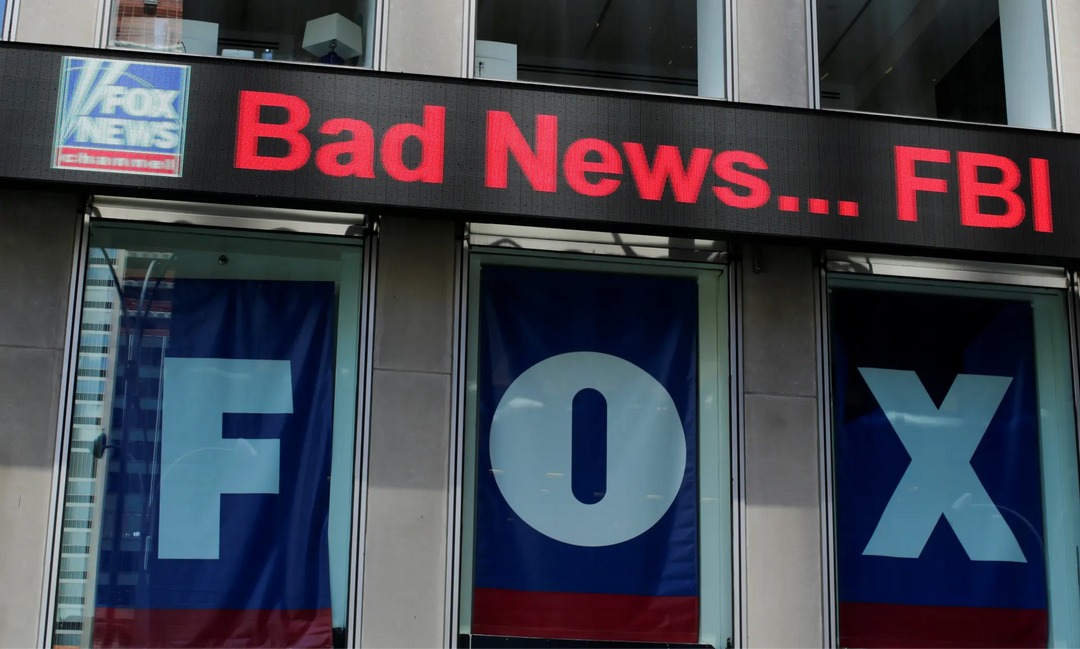
Photo: Eduardo Munoz/Reuters
The profound experiential shift we have recently experienced is not merely down to the fact that the news is now available around the clock; CNN pioneered that, way back in 1980. Instead, it arises from the much newer feeling of actively participating in it, thanks to the interactivity of social media. If you are, say, angry about Brexit, it is possible to be angry about Brexit almost all of the time: to encounter new and enraging facts about Brexit, and opportunities to vent about Brexit, in ways that would have been unthinkable as recently as the mid-2000s. If you had fulminated then to your family and colleagues as even respected peers, novelists and philosophers now routinely fulminate on Twitter, you’d have alienated everyone you knew.
One crucial difference is that raging on Facebook, or sharing posts or voting in online polls, feels like doing something – an intervention that might, in however minuscule a way, change the outcome of the story. This sense of agency may largely be an illusion – one that serves the interests of the social media platforms to which it helps addict us – but it is undeniably powerful. And it extends even to those who themselves never comment or post. The sheer fact of being able to click, in accordance with your interests, through a bottomless supply of updates, commentary, jokes and analysis, feels like a form of participation in the news, utterly unlike passively consuming the same headlines repeated through the day on CNN or the BBC.
And yet, as you might have noticed, this changed relationship to news is not a recipe for a greater sense of happiness or personal efficacy. To live with a part of your mind perpetually in the world of the news, exposed to an entire planet’s worth of mendacity and suffering, railing against events too vast for any individual to alter, is to feel what Greenfield, author of the book Radical Technologies: The Design of Everyday Life, calls “a low-grade sense of panic and loss of control”, so normal it has come to feel routine.
We may be familiar with the headlines before we have exchanged a word with another human in the morning
Of course, not everyone has the freedom to spend hours each day scrolling through social media, and to this extent, overidentifying with the news is by definition a problem of the privileged. But the creeping colonisation of our personal sense of reality by “current events” has also seen the emergence of a strange new moral imperative – a social norm which holds that ignoring the news, or declining to grant it preeminence in our lives, is an irresponsible indulgence, available only to the fortunate.
According to a principle dating back to the Enlightenment, responsible democratic citizens are those who strive to keep informed about the nation and the wider world – a duty that has been held to be especially critical during times of rising authoritarianism. Today, though, this principle is often taken to imply a duty not to turn away from the news. The instinct to look elsewhere is treated as both a sign of privilege and an obliviousness to that luxury. If you’re not outraged, you’re not paying attention. It is increasingly taken as a given that in order to help, or even just signal solidarity with, those most directly affected by the events reported in the news – undocumented immigrants facing the Trump administration’s cruelties, say – it is morally obligatory to remain immersed in the news itself.
It’s becoming clear, however, that there is a problem with this attitude, quite apart from the impact on our personal happiness. There are reasons to believe that a society in which so many people are so deeply invested in the emotional dramas of the news is far from the embodiment of an ideal democracy – that, on the contrary, this level of personal engagement with news is a symptom of the damage that has been done to our public life. This raises a possibility alien to news addicts, committed political activists and journalists alike: that we might owe it not only to our sanity, but also to the world at large, to find a way to put the news back in its place.
This changed relationship to news is not a recipe for a greater sense of happiness or personal efficacy
Many of us can still remember when the news used to be a pleasant distraction from everyday life, the desk-bound office procrastinator’s preferred form of escapism. Five years ago, the essayist Alain de Botton wrote a book called The News: A User’s Manual – and even then, it was still possible for him to locate the appeal of the news, in part, in its role as a haven from our daily troubles. To consult the news, De Botton wrote, was to discover “issues that are so much graver and more compelling than those we have been uniquely allotted, and to allow these larger concerns to drown out our own self-focused apprehensions and doubts. A famine, a flooded town, a serial killer on the loose, the resignation of a government … such outer turmoil is precisely what we might need in order to usher in a sense of inner calm.” It is remarkable how rapidly things have changed. Today, the news is very bad indeed at ushering in a sense of calm. More and more, it is not a source of escapism, but the thing one yearns to escape.
This feeling represents a new and acute phase of a long-term historical shift: we used to live in a world in which information was scarce, but now information is essentially limitless, and what is scarce is the supply of attention. The first people to make serious money from providing news, according to the historian Andrew Pettegree, were a group of well-connected citizens in 16th-century Italy, who sold a handwritten briefing to a handful of wealthy clients. What enabled them to turn a profit was information scarcity: it wasn’t easy to find the information in their bulletins elsewhere. The coffee houses of 17th-century London, often credited with creating the first public sphere in which ordinary people could discuss politics, worked the same way. In exchange for a small admission charge, customers received access to other people who were up to speed with events, and to a plentiful supply of pamphlets and newssheets. Such opportunities to engage in informed political conversation were hard to come by, and thus worth paying for.
But as advances in technology made it easier to distribute news – and more news providers began to compete for readers – a subtle inversion began: the reader’s attention, not information, became the truly valuable commodity. Beginning in the 19th century, entrepreneurs such as Benjamin Day, the founding publisher of the New York Sun, hit upon a revolutionary business model: sell a paper for less than it cost to produce, pack it with lurid stories, then make your money selling space to advertisers, who were effectively buying access to readers’ attention. This naturally encouraged exaggeration and fabrication; Day once ran a series of articles claiming that the leading astronomer of the era, Sir John Herschel, had discovered a population of bat-winged humanoids on the moon. But serious political and investigative reporting thrived too, by exploiting the inefficiency of the arrangement. Advertisers needed readers, and most readers might be drawn by the gossip columns or sports reports – but an editor, as broker of the relationship between the two, could siphon off some ad revenue for higher-minded coverage.
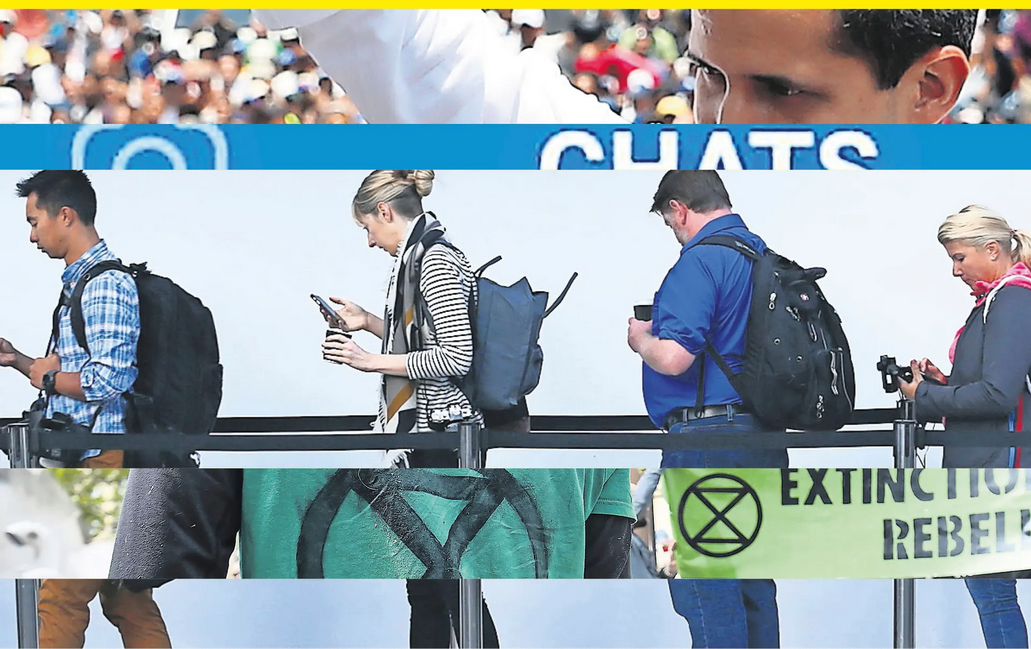
Illustration: Guardian Design/Reuters/AFP/Getty/Alamy
The entire subsequent history of mass media, as Tim Wu explains in his book The Attention Merchants, might be seen as a process of improving the efficiency with which the available supply of attention could be mined. Success accrued to those who discovered undiscovered seams of it (as when radio invaded the living-room, co-opting attention previously used for reading or conversation) or found ways to seize it more aggressively (as with the debut of colour newspapers). And a smartphone with Facebook or Twitter installed on it represents the apogee of this trend. It is a device designed to soak up the tiniest remaining pockets of attention – on the train, in the bathroom, in bed – while monitoring your every click and swipe, recording what you linger on or scroll past. Social media platforms use the vast quantities of data thus generated to ensure that you see exactly the kind of content that people like you can’t resist engaging with, presented in as compelling a fashion as possible. Meanwhile, advertisers can be charged a premium to reach such highly targeted, and thus more valuable, segments of the audience.
As more and more users understand, this use of data to tailor content algorithmically is the force driving the addictiveness of digital technology: software companies are locked in an arms race, fighting to discover ever more hyper-efficient means of extracting a share of the same finite resource of attention. So their survival and growth depend on getting you hooked on their products. But it also explains why the news has come to dominate larger and larger tracts of the public mind.
In a situation of information scarcity, the news is content to remain a psychologically separate world, which people access only at intervals; indeed, it needs to remain separate, like a fenced-off theme park or a private members’ club, if anyone is to make any money by charging admission to it. But in a world of information surplus and attention scarcity, the reverse is true. In an attentional arms race, every news provider – and ultimately, every news story – competes against all others to worm its way into consumers’ minds. This race, Wu writes, “will naturally run to the bottom: attention will almost invariably gravitate to the more garish, lurid, outrageous alternative, whatever stimulus may more likely engage [what psychologists call] our ‘automatic’ attention.” What all this means is that as news comes to dominate public consciousness, extreme, lurid and even false stories come to dominate the news.
We might owe it not only to our sanity, but also to the world at large, to find a way to put the news back in its place.
News fares well in an attention economy – after all, it has a claim to being inherently more worthy of attention than, say, movies or sports; it is ostensibly the serious stuff happening in the world. And the spectacle of a mentally unstable president with his finger on the nuclear button are guaranteed to make millions click, as is the prospect of wartime-style disruptions to food and medicine in the event of a “no deal” Brexit.
But there is also ever more pressure for every story to pull its own weight by going viral, and ever less incentive to divert a portion of a news organisation’s (diminishing) revenues to slower and more serious reporting. These new incentives favour horse-race politics and hot-button culture-war issues, plus rapid-fire argumentative “takes”, designed to confirm readers’ existing prejudices, or trigger scandalised disagreement. In the final analysis, the commercial imperatives don’t even necessarily require a story to be true, so long as it is maximally compelling: fake news is not an aberration from, but rather the logical conclusion to, a media economy “optimised for engagement”.
It’s worth stepping back to notice how strange it is, considering the underlying purpose of news, to spend this much of our time thinking about it. If our interest in news has evolutionary origins, that’s because there are obvious survival advantages in staying aware of local and immediate threats to one’s own life and tribe. One major achievement of civilisation is that we’ve expanded our capacity for caring to include news that doesn’t affect us personally, but where we might be able to make a difference, whether by voting or volunteering or donating. But the modern attention economy exploits both these urges, not to help us stay abreast of threats, or improve the lives of others, but to generate profits for the attention merchants. So it pummels us ceaselessly with incident, regardless of whether it truly matters, and with human suffering, regardless of whether it’s in our power to relieve it. The belief that we’re morally obliged to stay plugged in – that this level of time commitment and emotional investment is the only way to stay informed about the state of the world – begins to look more and more like an alibi for our addiction to our devices.
We used to live in a world in which information was scarce, but now information is essentially limitless, and what is scarce is the supply of attention
The resulting sense of alienation is familiar to any online news addict, even if we don’t always grasp its causes; it makes itself known in the deflating sense that so much time spent online is time wasted, although we apparently can’t stop ourselves from wasting it. (Surely even users of cigarettes don’t hate themselves for their dependency as much as the users of Twitter do.) Slowly, we are beginning to understand what it really means to say that attention is a scarce resource: that it is radically finite, so that every moment spent paying attention to a given news story is one spent not paying attention to everything else.
When you “pay attention”, in the words of the Google employee turned philosopher and technology activist James Williams, “you pay with all the things you could have attended to, but didn’t … with the heart-to-heart talk you could have had with your anxious child, [or] the sleep you didn’t get and the fresh feeling you didn’t have the next morning”. The stories that dominate the news don’t merely wrench attention away from other news stories. The resource being depleted is your life.
But if this remains hard for some of us to see, one reason is the assumption, prevalent in the social media age, that there is an inherent moral virtue in keeping up with the news, especially political news, and that failing to formulate a position on the major issues of the day is to fail in one’s highest duties as a citizen. Perhaps you have felt that ridiculous yet discernible pressure, on social media, to emit an official opinion about every natural disaster, celebrity death or Trump administration policy announcement, as if each of us were the ambassador of a small nation, from whom silence might be interpreted as callous lack of concern.
“Telling people to ignore the news feels wrong in today’s chaotic world,” concedes the self-help author John Zeratsky, although he nonetheless recommends it. Staying engaged just seems like “the ‘right thing to do’ for grown-up, informed citizens and savvy, growth-oriented professionals”. And when engaging with the news is an article of faith, the idea of disengaging, even partially, naturally sounds like heresy. But it may be a heresy we urgently require, and not only for our personal sanity. The proper functioning of democracy may depend on it.
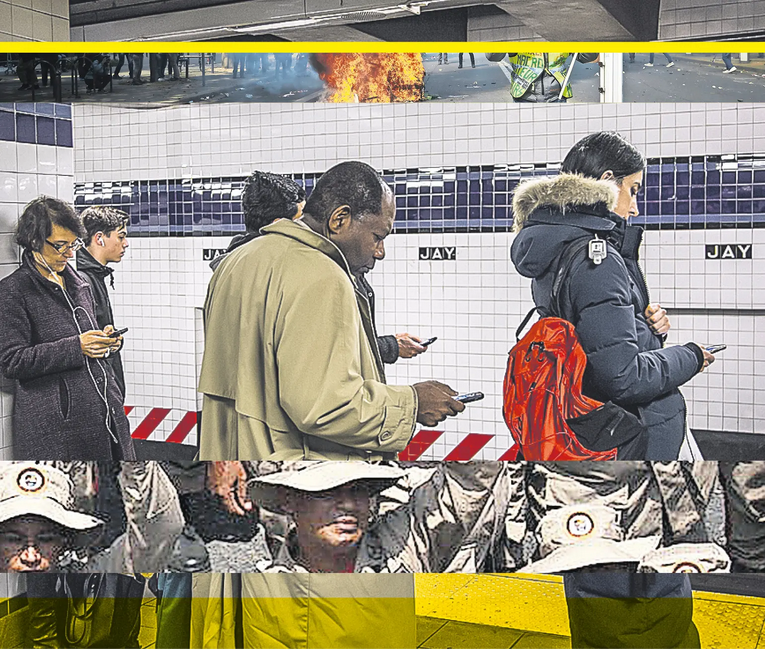
Illustration: Guardian Design/Getty/Alamy
One reluctant heretic is Robert Talisse, a political philosopher at Vanderbilt University in Tennessee, who until recently held a belief that is naturally common among political philosophers: that politics is really important and thus there is no upper limit to how much time you should spend on it. On this theory, “the way to do democracy is to do it perpetually”, as he puts it, “and if we find that democracy has any troubles or problems, there’s always the solution of: more democracy.” Recently, though, watching his own and others’ growing fixation on news, he has been haunted by a contrary thought. For one thing, it is highly debatable how much it truly counts as democratic participation to engage with the news online, or whether it merely feels that way. But even if it does, who’s to say that’s always a good thing?
What if participation in politics is a virtue in the same way that, for example, staying fit is a virtue? A person who visits the gym occasionally is doing something good; if she goes regularly, she’s being really good. But if she spends every free moment at the gym, so that her friendships and work are starved of attention, she is doing something pathological. That is because physical fitness is a largely instrumental virtue. It is good because it enables you to do other things, so if you do it to the exclusion of all else, you have missed the point. If you do it so strenuously you injure yourself, you have missed the point in a different way: now you can’t pursue fitness well, either. There is a case to be made that our fixation with the news might work the same way. By according political news such centrality in our mental landscapes, we may be squeezing out the very things politics was supposed to facilitate, and simultaneously doing injury to democratic politics itself.
To see the damage more clearly, consider what has happened to the “public sphere” – the place where democratic debate is supposed to unfold – in the era of social media. In the dreams of its hippie pioneers, the internet was supposed to expand this sphere massively, creating a new global agora, where people who had previously lacked a voice could participate in the decision-making process, leading to better and fairer decisions, which would garner much wider support. But it is becoming ever clearer that what the internet is really doing is eroding the boundary between the public and private spheres, making measured conversation, let alone consensus, increasingly difficult. Our changed relationship to the news seems to be making the news itself worse.
The spectacle of a mentally unstable president with his finger on the nuclear button are guaranteed to make millions click
In 2013, when Donald Trump was still a mockable reality TV star, and Twitter wasn’t yet known affectionately among its users as the “hellsite”, the German-Korean cultural theorist Byung-Chul Han published a prescient book entitled In the Swarm, which argued that digital communication was gradually rendering politics impossible. Healthy political debate, he argued, depends on respect, which requires that participants retain a sort of mental distance from each other: “Civil society requires respectfully looking away from what is private.” But digital connectivity collapses distance. Social media blurs the distinction between making considered public comments on the news and impulsively emitting snatches of one’s half-formed private impressions of it; and it rewards and amplifies the most extreme expressions of emotion. When there is a direct pipeline running in both directions between the news and the deepest recesses of everyone’s psyches, the result – obvious in hindsight, perhaps – isn’t that it is easier to reach consensus or resolution. It is that every topic of public disagreement spirals rapidly into psychodrama.
A functioning public sphere also depends on collective access to a shared body of facts about reality, to serve as the stable ground on which to hash out our differences of opinion. But with such an enormous surplus of information, filtered on the basis of what compels each user’s attention, that shared basis of facts is soon eroded. Meanwhile, the algorithms of social media invisibly sort us into ever more separate communities of ever more similar people, so that even if you are discussing, say, movies or sport, you’re increasingly likely to be doing so with those who share your political affiliations; the more you engage with politics, the more everything becomes political – and, research suggests, the harder it becomes to understand your political opponents as fully human. This is a situation ripe for exploitation by demagogues, who understand that their power consists in turning the whole of life into a battleground divided along political lines, thereby maximising their domination of public attention.
Given all this, the idea that being ceaselessly preoccupied with the news might be a useful way to defeat authoritarianism, or to achieve any other laudable political goal, begins to look extremely unconvincing. If you spend hours each day on social media fuming about your opponents, you are still participating in the corrosion of democracy, even if you are participating from a morally impeccable position. And so the conventional wisdom among the politically clued-in – that what this moment calls for is more engagement with the news – may be the opposite of the truth.
The belief that we’re morally obliged to stay plugged in begins to look more and more like an alibi for our addiction to our devices
To disengage from current affairs, though, is still mainly to court accusations of selfishness and unexamined social advantage. A year ago, the New York Times profiled Erik Hagerman, an Ohio man who had imposed a news blackout on himself since the 2016 election, even going so far as to pipe white noise into his ears while visiting his local coffee shop, to drown out talk of Trump. The article went viral – of course it did – and Hagerman was widely met with moralising scorn. (Or would have been, anyway, if he had ventured online.) “Not everyone gets to be ignorant,” the writer Kellen Beck, speaking for many, fumed on Mashable.com, in an article labelling Hagerman “the most selfish man in America”. “People whose families are being torn apart by the deportation tactics of US Immigration and Customs Enforcement don’t get to be ignorant. People who are affected by gun violence don’t get to be ignorant.” But “as a white male who had the opportunity to make (and save) a lot of money, [Hagerman] isn’t directly affected by many of the things that happen inside his country and to his fellow citizens.”
But the assumption behind this argument – that choosing to pay less attention to the news is automatically a reprehensible indulgence – is a holdover from the era of information scarcity. When the news is hard to come by, there is virtue in putting in the effort to seek it out. But when news is everywhere, and when marinating in it seems to make things worse, what demands effort is avoiding it, or at least some of it. In an age of attention scarcity, living a meaningful life entails not paying attention to almost every important issue; the greatest saints in history were never asked to care about as many instances of suffering as you’ll see if you scroll through a feed of international news today.
Whether or not withdrawing your attention is a selfish act depends on what you do with the time and energy freed up as a result. (Hagerman bought 45 acres of wetland at the site of a former coal mine, the Times reported, and was engaged in restoring it before donating it to the public, a project that he predicted would take the rest of his life and most of his savings. There are more selfish ways to spend your time.) But screening out much of what matters may simply be the precondition for making any kind of difference at all.
In light of the domination of so many people’s thoughts by politics, Talisse argues in a forthcoming book, Overdoing Democracy, it may even be that one critical form of activism is to spend time not doing politics – or, in the case of social media, things that feel like doing politics – and instead to dedicate attention to nurturing domains in which politics cannot intrude. From this perspective, to decline to talk about Brexit or Trump at the pub or the watercooler isn’t a matter of burying your head in the sand, but of proactively protecting some parts of life from becoming overwhelmed by current affairs. It is often suggested that the cure for our societal divides is to spend more time with people from the “other side”. But Talisse advises consciously engaging in social activities that are not driven by your political commitments at all – in which the question of political sides doesn’t arise to begin with. Talisse, who lives in Nashville, spends his free time these days attending bluegrass gigs with his wife. “I have no idea what the people sitting beside me [at the gig] are like politically,” he says. “It’s not that, as a Democrat, you go somewhere where you know that Republicans hang out. It’s that you immerse yourself in activities where there’s no occasion for politics to be part of what’s going on.”
When news is everywhere, and when marinating in it seems to make things worse, what demands effort is avoiding it, or at least some of it
As a prescription for rescuing constructive democratic engagement, Talisse knows this sort of advice is liable to sound rather mundane, even naive. But when you are building a sanctuary from the horribly addictive dramas of national and international politics, that is probably inevitable: precisely because the news is so addictive, you should not be surprised if the alternative feels rather humdrum by comparison at first. And he stresses that he isn’t suggesting people stop engaging in more conventional forms of activism: “I’m not saying don’t go to protests. But it can’t be the only thing that you do. So, actually, I’m saying that democracy is more demanding than you think it is, because you have to do this other thing, too.” We have to protest. But we also have to weave the social fabric that politics is meant to support.
After Trump’s election victory, he recalls, numerous US publications ran articles giving advice for handling political arguments over Thanksgiving, concluding that, if civil political discussion with your Trump-voting uncle threatened to become too stressful, you should probably just stay home. Yet this, Talisse points out, is to accept the unspoken premise that, when all is said and done, political commitments are more important than family life. And that’s upside-down: one primary purpose of democratic politics is precisely to help guarantee the universal enjoyment of things such as a family life. At Thanksgiving with your Trumpist uncle, the point is not to seek agreement or compromise, but to grasp that we are not fully defined by our political allegiances – and that, as Talisse puts it, “in order to treat each other as political equals, we must see each other as something more than citizens”.
Of course, it isn’t especially fair that we should have to give this matter any thought at all – that we, as individuals, should have to take the lead in reducing our immersion in politics and news, when the problem results from an attentional environment structured to maximise the profits of the technology corporations. But it may be the only practical way for us to begin to foster a change. If the colonisation of everyday life by the news is damaging both to ourselves and to democratic politics, we ought not to collaborate unthinkingly with that process. Far from it being our moral duty to care so much about the news, it may in fact be our duty to start caring somewhat less.
The Curse of Poverty
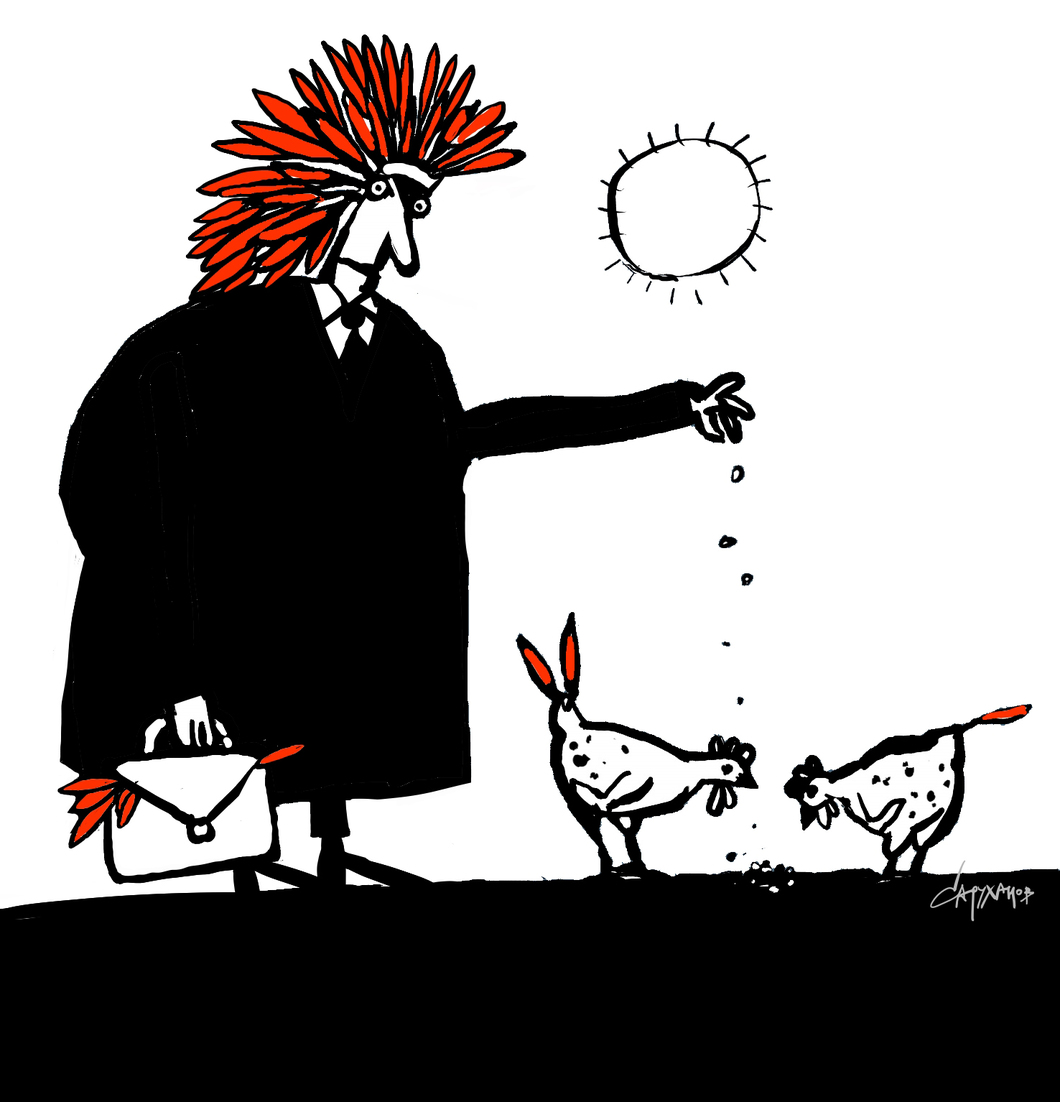
It is as if the poor, as calculated in the tables of Rosstat [Russian Federal State Statistics Service – Trans.] and split up into Excel boxes, had ceased to be people and had turned into ciphers and columns of figures. People fall ill, but figures don’t, people go hungry, but figures don’t beg for bread. Statistics, based as they are on percentages and millions, lose sight of the specific and unique individual. But he doesn’t vanish somewhere, he is here on the next street, in the next block or flat.
Petr Sarukhanov – Novaya Gazeta
We can see poverty right next to us, all you have to do is look. It comes in various guises, it’s the old lady who takes a long time counting out her coins at the till in the supermarket, suddenly it appears in the accordionist playing “The Waves of the Amur” behind a cardboard box, it screams and wails from the shabby façades of five-storey blocks of flats a hundred miles from Moscow, the joints of which are smeared with tar, and it lives in our pockets and our souls in the form of despondency, submissiveness and fear.
5,5% of the inhabitants in Russia are in receipt of an income of less than 7,000 roubles. Translated from percentage terms into millions, that is 8 million people with an income of less than 7,000. These figures are perfectly fine, they keep themselves to themselves, in official statistical tables and do not prompt any government crisis (we don’t have any anyway), debates in the Duma (in the absence of a Duma), or heart attacks for civil servants, who, knowing about such figures in their own agency, should be tearing their hair out and be wracked with heartache. But nothing of the sort happens and cannot happen in today’s Russia, where the defining characteristic of the government is a complete and absolute indifference to everything, except itself.
7,000 roubles a month as recorded by the dry figures of Rosstat is an outrage and the absolute bottom of the pit – one which it is impossible to clamber out of. If you start thinking of how someone can live on 7,000, you quickly find yourself on a dead end, because it is very difficult, indeed almost impossible, to comprehend. It means a life of poverty, life in a padded jacket, life with a leaky tin bucket, a life of bread and spuds, life punctuated only rarely by the purchase of the cheapest sausages, because they are a luxury. A life of lengthy reflecting on whether or not you can afford to buy a packet of Jubilee biscuits with a packet of tea. You don’t hear about people who live like this in the media, they don’t appear on TV, or join demonstrations – in fact it’s as if they didn’t exist at all.
They are a pain and a problem, and problems are something the government doesn’t deal with. Obviously, there is no room for them in the heads of those who are busy trying to belittle America or raising hell in the UK.
35,2% of people in employment in Russia live on less than 21,800 roubles a month. That means that one in five Russians doesn’t get enough to eat, gets sick because of wrong or poor diet, walks around in old clothing and does not get normal health care, because he can’t afford expensive medicines and private medicine.
These figures demonstrate the nature of our State better and clearer than all the numerous articles of journalists or speeches by oppositionists. It shows up the State as an unfeeling force which is indifferent to people and couldn’t care a toss about their suffering and pain.
(The data cited in the text are taken from tables found on the Rosstat site. These are mainly statistics for 2017; later statistics are not always available on the site. This in no way changes the assessments of the situation or the conclusions.)
We can see poverty right next to us, all you have to do is look.
The American dream is about being successful through work. Traditional German values are based on hard work being properly remunerated. In Russia it’s different. Work to be poor, work harder so that from being poor you end up as a beggar, work until retirement on a pension you can’t live on, work blindly and senselessly, with no hope of either prosperity or well-being – that’s how things are in today’s Russia.
7,9% of Russians get a wage of 10,600 roubles. 41% of Russians get a salary of less than 20,000. This translates into tens of millions of people with empty pockets, who have no savings and who are continually racking their brains about where to get money, at the same time as being dogged by hopelessness, because there is nowhere to get it from.
At best it means a straightjacket of credit, at worst – a lifetime of poverty on the verge of hunger, eking things out with the last banknote left before payday. Poverty is bequeathed as an inheritance to children, because there’s no way out. 40 or 50 million Russians work like convicts and yet live stupefied and exasperated by poverty.
They used to blow up atomic bombs on the Semipalatinsk testing-ground so as to check out the impact on buildings, military hardware, animals and people. But the radiation affects not only the people who were there at the time, but travels through time and penetrates the bodies of the next generation, as demonstrated by the fact that on the register of recipients of monthly allowances there are “children up to 18 of the first and second generations of citizens who received time-integrated (cumulative) effective radiation doses in excess of 5s3v (rems) who suffer from diseases resulting from the radiation impact on any one parent as a result of nuclear tests on Semipalatinsk testing-ground”.
What a terrifying sentence, and a terrifying expression: “effective dose”, not to mention the deadly repetition of “resulting from…as a result of” – but better not linger over the language of bureaucracy, even if it is a reflection of what is going on in the minds of bureaucrats. Let’s look at the figures instead: the allowance comes to 677 roubles and 14 kopecks.
That is: your dad or your mum were sent to, or just happened to live in, a place where the State exploded atomic bombs, a place where the earth melts and horses tethered to trees catch fire together with the trees, and the State didn’t protect your mum and dad from the effect of such explosions and that past experience has been transmitted to you, has entered your being, your genes and your bloodstream. You were sick from birth. Your life became the victim of a bomb that blew up long before you were even born. As if that weren’t enough, you were even examined by multiple doctors and passed before commissions and maybe even courts of law and you managed to prove that you weren’t just sick, but sick as a result of the radiation your parents received on the testing-ground. How is the State going to redeem its guilt for that, how should it assist you? Exempt you from payment of medication for the rest of your life? Award you a free life-insurance policy to consult any clinic of your choice? No, it will give you 677 roubles a month. But wait! Where are you going? You forgot the 14 kopecks! How many roubles and kopecks does it cost a month, I wonder, for the ruling élite of the country to eat through all that black and red caviar? How much whiskey do they get through? That’s secret data though, Rosstat doesn’t have access to that.
It’s impossible to comprehend how in a European country with museums and internet, with cars and planes, allowances of 3 euros can be paid to people.
If a child grows up without a father, his mother needs support. The State acknowledges that by the mere fact of paying out allowances to mothers. But saying that it acknowledges it is one thing, when it actually gives it, it becomes a mockery. The amount of the allowance varies from region to region, in Kursk region it’s 312 roubles, in Kostroma 230, whereas in Novgorod it’s 400, although it hasn’t gone up in either Kostroma or Novgorod over the last three years. This is a sad business, but not much worse that the increase of 12 roubles on the subsidy in Kursk. Looking at figures like these, you begin to numb over, because it’s impossible to comprehend how in a European country with museums and internet, with cars and planes, allowances of 3 euros can be paid to people. It can’t be so! But it is and has been like that for a long time now, so much so that we are used to it and keep mum, whereas we should be screaming.
The more you look at these endless tables of figures, the more you learn about the amounts involved in wages, pensions and allowances, the more you get the feeling that yes, this is indeed a mockery. That behind all these figures there is someone maliciously giggling away. There is no other way of explaining that the allowance for a woman looking after her child is 50 roubles; moreover, one that is paid not by the State, but by the employer. It is impossible to understand the monstrous rule which has it that if a woman goes out to work before her child is 18 months old, she loses her allowance. Why? What for? Do you begrudge the fact that she will receive both a wage and an allowance? That is the logic not of a humane social state interested in people having enough to live on and being in good health, but of a prison guard darting his eyes this way and that to make sure that no-one gets an extra ration. It is impossible to explain the fact that the minimum level for a pensioner is 8,615 roubles and the pension for someone who has been a very serious Grade 1 invalid since childhood is 13,341 roubles, except in terms of a mockery.
You can’t live on money like this. On this kind of money you can only suffer and drag yourself towards your coffin.
Or is it that the people living in the beautiful world of glistening white palaces on the banks of the river, with their private planes and smiling flight attendants and their gilded apartments the size of football pitches, have simply lost any understanding of the value of money and of how much things cost?
50 roubles a month for a woman looking after a child; 230 paid to single mothers and 430 allocated towards feeding a pregnant woman – after she has made an application, submitted two documents and three medical notes; and 8,000 that they insist a pensioner must live on; and the increase in college student grants for academic years 2018-2019 of 34 roubles and as much as 62 for students at higher educational establishments – is proof of the senselessness and insanity of the state.
Attacking your neighbour and tormenting him for long years, lying to all and sundry, doing nasty stuff on a global scale, threatening people with poison and nuclear weapons, keeping drugs in the embassy storeroom, boasting about your Swiss watches, transporting money off-shore in double-basses, hunting wild animals on the Red Book of Dying Species from helicopters, foisting on the Senate not a horse but a murderer, ranting unimaginable guff about the death of democracy and the demise of the West at the same time as passing each other under the table suitcases, briefcases, trunks, full of money, more and more and quicker and quicker – that’s no state, but more like a den of thieves.
It’s not that there is no money. There is money, in colossal, stupefying quantities. Rather the case that money goes on anything but people, or creating conditions and opportunities for them. Money is thrown into the stoke-hole of adventures, burnt in Donbas and Syria, squandered on the salaries of football- and hockey-players, money is spent on organising junkets for the entire world and on carving out pleasant little nooks where you can live quietly and cosily behind four-metre high fences. The money which the country needs to live and develop is instead spent on closing the country up, putting the brakes on and making it a pariah. The money that is missing from people’s pockets can be found in abundance in the pockets of civil servants and rabid propagandists. Neither is there any lack of money for hiring murderers of opposition politicians and puppets for presidential elections.
On this kind of money you can only suffer and drag yourself towards your coffin.
If you can’t live on your wages; if on your pension you can only die; if your invalid child receives only a tiny donation from the state; if the graduate, who is expected to make a break-through in science, receives a stipend of 7,000 roubles; if the monthly pension of thousands of pensioners comes to the price of a car that an insolent boy from a family of nouveaux riches heedlessly crashes into a column – that means that the money belonging to all these people has been grabbed by somebody. It didn’t just disappear or vanish into thin air or wing off to Mars, no, – it migrated into the pockets of senior civil servants, oligarchs, members of the Duma, FSB generals, their bodyguards and menials. It was spirited abroad and sits there on their accounts. Instead of being used for cheap housing, cheap food, medication for the sick, rehabilitation for invalids, social housing, free internet and cheap computers for those who can’t afford to buy them at full price (as well as a lot of other good and useful stuff), this money is put to buying – in front of our very eyes – luxury apartments for KGB agents, fabulous Maybachs for well-fed tycoons, English palaces and Italian villas for those who sing of eternal war with the soulless West.
This money should be returned to the State. Money is the lifeblood of the economy, blood has to be transfused back into the lifeless, inert body so that it can revive and regain consciousness after decades of horrendous ailing and fainting. What we need is a state controlled by the people and working for the people, a state where the managers every day start their planning with the question: What can we do today so that by the end of the day, the month and the year, the people in the country are better off? We need a state that doesn’t boast of its incredible greatness, which in fact of course does not exist, but one which realises its pathetic place in the world economy and tries to change it.
Americans eat twice as much meat as Russians, but we eat twice as many potatoes. Austrians eat 2.5 times more fruit than Russians. Europeans spend 11% of their wages on food, whereas we spend 30%. The average wage in Switzerland is 5,564 euros, or 437,000 roubles, whereas the average wage in Russia (according to data for November 2018) stands at 42,595 roubles, or 540 euros, i.e. ten times less. A cleaner in Finland gets 2000 euros and an engineer in Russia 700.
Life expectancy in Japan is 82, in Norway 82, in Israel, which is always at war, also 82, in Albania which survived the gloom of the most boorish communism, 76, in modest Honduras which lays absolutely no claims to greatness, 75, and in great Russia 72. So in what, pray, lies our greatness? That we die more often and quicker than the Germans, Americans and Hondurans?
These are the really important figures about our life and country, which, deploying all their efforts, they try to distract us from, clouding our heads with tall stories about the unbelievable hostility of the surrounding world, the difficulty of our unique path and the need to be patient and pray.
Every unhappiness has its own history, as does every form of poverty. The reasons for poverty in India, Africa, Latin America and Russia are different. In Russia, whose wealth is not a secret, poverty is artificial, man-made. It is the direct result of mismanagement, cynicism and the hypocrisy of its rulers, the gangsters in government and of a colossal autocracy which spanned four centuries, without interruption, up to the present day.
We are dealing with an inveterate and chronic disease which has warped and broken the souls and bodies of generations throughout the whole of Russian history. We feel this poverty, breathe in its musty smell when we read Radishchev, Nekrasov, Nikolai Uspensky and Leo Tolstoy. We experience it as an invariable of Russian life, as an everlasting curse that does not let the country become what it could and should become. This poverty that has lasted centuries is the main product of autocracy, whether it be Tsarist or Stalinist, the former communist or the present KGB type – and has ground itself into our souls and minds, has been absorbed by our way of thinking, tormented and exhausted us.
The State in Russia creates and supports poverty. They need poverty as a basis for governance, a premise for their power. They need to keep people in a half-strangulated, half-conscious state so that we drag ourselves from birth to death along the appointed path without wriggling and vote correctly and empty out our pockets when the moment comes. For all other eventualities they have the Rosgvardiya [the National Guard of Russia – Trans.], the OMON and the FSB. And they don’t begrudge the money paid to secret agents and death squads either.