The future of journalism in conversation
In April, at the International Journalism Festival in Perugia, four Judges of the European Press Prize sat on stage and talked about the state of the journalistic profession. Not with careful, rehearsed answers, but with the kind of directness that comes from people who have been doing this work for a long time and have thought hard about where it is going.
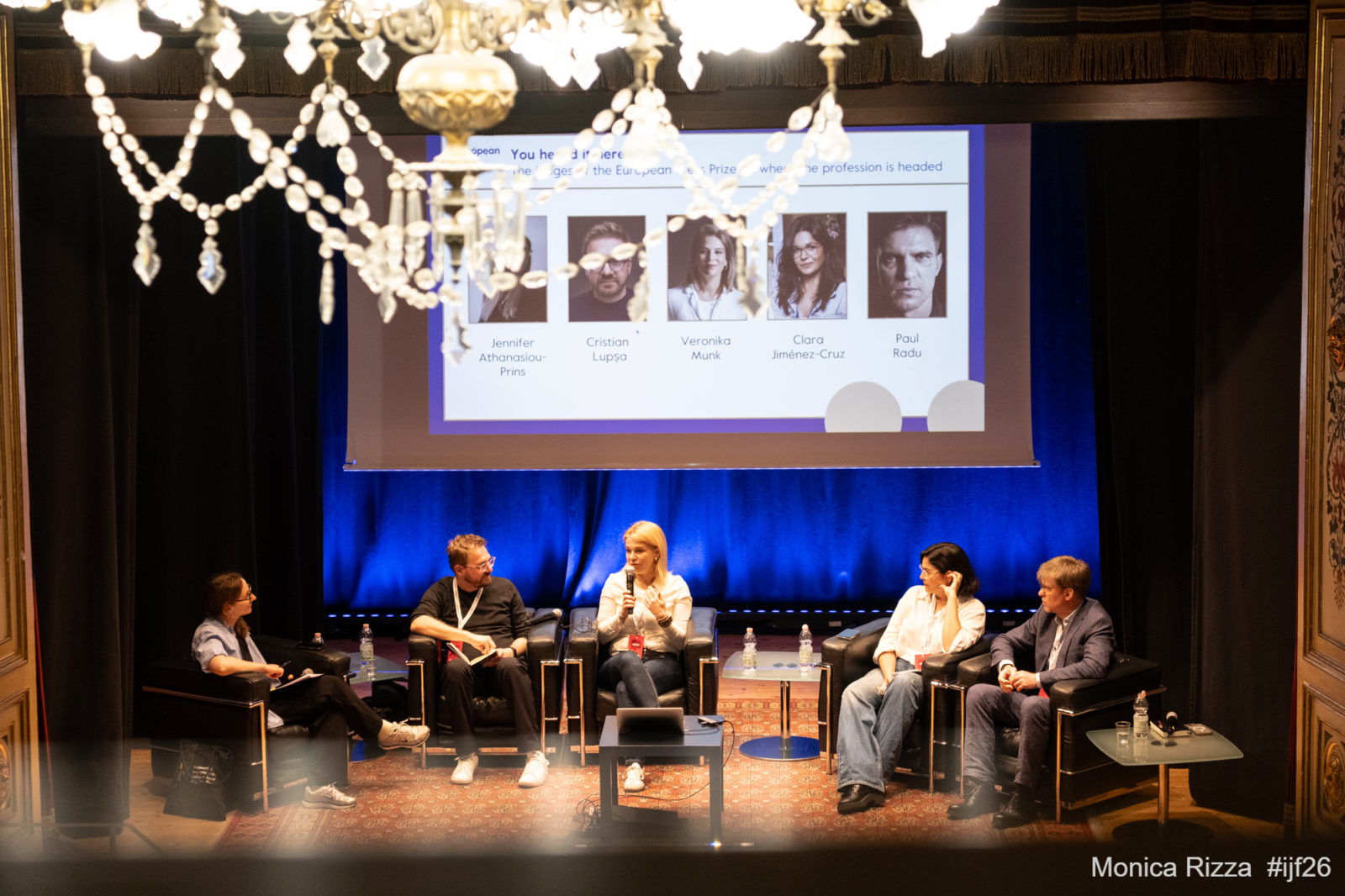
The conversation has stayed with us. As we get ready for Lisbon on 3 June, where the 2026 Winners will be announced, we wanted to share some of what was said as it connects directly to what the Lisbon programme is about and why we built it the way we did.
Adapting without losing what matters
The panel opened with a question about pressure: is journalism adapting fast enough to the forces pulling at it from all sides?
Cristian Lupșa pushed back on the framing from the start. “Racing to adapt should not be a strategy as a way to ensure survival,” he said. His concern was specific: that a race to adapt risks becoming a race to the bottom, where well-resourced media organisations grow more dominant, the newsrooms that already get grants get more grants, and the community-oriented or niche journalism that is hardest to fund gets left further behind. What he would rather see, he said, is journalism optimising for solidarity and sharing rather than survival.
Veronika Munk took a longer view, grounded in her own experience. She spent nearly two decades at large Hungarian news organisations before the political pressure became impossible, walked out with her colleagues, and helped build something new. The same happened at Denník N in Slovakia a decade earlier. Her point was not abstract: “Good journalism finds its way to its audience, ultimately.” Audiences in Hungary had spent 16 years watching their media restricted. When Peter Magyar spoke at rallies about freeing the media, she said, it got the loudest applause. That, to her, is evidence that sticking to the core values of journalism, being fair, balanced, impartial and transparent, is not naivety. It is a strategy.
Paul Radu agreed that journalism was doing its job. The problem is reach. “We are in tune with the public. We understand what the problem is and we perform really great journalism. The issue is we don’t have the numbers, we don’t have the reach.” His answer is to go beyond journalism, to connect investigative reporting to film, television, gaming, to inspire more people to become investigators and to build infrastructure others can use. Not to make money from it, he was clear about that, but to show that honest journalism pays off for society and to scale up from there. Hungary proved it works, he said. The problem is it took 16 years.
Clara Jiménez Cruz, Co-founder of Maldita.es, a Spanish nonprofit built around fighting disinformation and promoting information integrity, brought an interesting angle into the discussion. From her position within the world of fact-checking she has watched the fact-checking world navigate the same pressures as the rest of journalism, and her view is that it is better placed than most to adapt. The fact-checking community outside the US, she said, has been innovative from the very beginning in how it does the work and how it delivers it and measures impact across different audiences and markets. Fact-checkers are already evolving into platform accountability investigators, and that is a natural path. But she also said something more uncomfortable: journalism may need to do more advocacy, to work with prosecutors and legislators in ways that the profession has traditionally resisted. On platform accountability specifically, she argued, it may be the only way to create real impact.
Who gets to define excellence?
The second part of the conversation was harder. As journalism changes, who decides what good journalism looks like? And what does that mean for how we judge it?
Cristian was direct about how much his thinking on this has shifted. “I thought five years ago when I started judging for the European Press Prize that this was an easy question. It’s no longer an easy question, at least not for me.” The daily reality of excellence in Moldova is completely different from Spain. The same words mean different things across cultures. “We use the same language but we mean different things.” His conclusion was not that this is a problem to be solved but a conversation to be kept open, and he asked a question that has stayed with us: can we bring the public into the judging process? If journalism is supposed to make a difference in people’s lives, is there a way to actually learn from audiences about whether it did?
Veronika’s answer was about flexibility. Her 15-year-old daughter wants to learn about the world in three-minute explainers from her peers. That is not a failure of journalism. It is a different kind of journalism, and the people judging it need to understand it and be open to it.
Clara raised something that will feel familiar to anyone who reads a lot of submitted work. The things submitted look more and more alike. Long articles, long investigations, always in writing. “There’s never a podcast or many other forms of journalism.” She is thinking more about what gets missed because of that convergence. And she said something else: over the years, the human factor has become increasingly significant to how she judges. “It’s become especially significant to me how much something moves me. I’ve cried with some of the shortlist work this year, to say the least.” That, she said, is partly because the wider world has detached itself so much from emotion and empathy that when a piece of journalism finds it, it stands out completely.
Paul returned to the question of the back end. The finished article is the front end. What very often matters more is what it took to get there: the editing, the fact-checking, the legal process, the constraints journalists were working under in their particular country or context. “In Switzerland, you can’t really use leaked banking data. That’s considered a criminal offense.” Understanding what it took to do the work, given those constraints, is part of what the judging process tries to do.
On our way to Lisbon
We did not design the European Press Prize Lisbon 2026 programme as a direct response to the Perugia conversation. But reading back through the notes from that panel and looking at what we had built for 3 June, the connections were clear.
The day programme at the Calouste Gulbenkian Foundation is called Collective conscience: A case for the human perspective. It opens with a live journalism performance by Stéphane Horel and Raphaëlle Aubert from Le Monde, the coordinators of the Forever Lobbying Project, one of this year’s shortlisted works and a piece that has been decades in the making. It is a reminder that some of the most important journalism takes time.
Another conversation that reflects this year’s themes of collaboration and collective thinking is On collaborations, moderated by 2026 Migration Journalism nominee Lydia Emmanouilidou of Solomon. Bringing together Elisa Simantke of paper trail media, Lisa Kreutzer of andererseits and Sofia Cherici from the team behind Scrap Wars, the panel explores how journalists increasingly work across borders, organisations, disciplines and formats as a practical necessity and a way of strengthening public-interest reporting itself. Three different models of working together, and three different answers to what collaboration actually means in practice. Given what Cristian said about freelancers in Romania and across Europe holding multiple jobs just to stay in the field, that last model is not a footnote.
The team from Civio, María Álvarez del Vayo, Carmen Torrecillas and Adrián Maqueda, will then take the room inside their shortlisted investigation Mole or Cancer?, a piece about an AI diagnostic tool that missed one in three melanomas. Their session is about what happens when technology is at the centre of the story and the journalism has to be rigorous enough to match it. It connects directly to what Clara said in Perugia about fact-checking as an investigative skill, and about the difference between automating journalism and doing it.
The morning closes with three talks on covering human suffering. Nidžara Ahmetašević and Andrew Connelly will speak about reporting on Bosnia’s mine-laden migration route. Ana Patrícia Silva, our 2024 Laureate, will share her latest work with women in Portuguese prisons. Bastian Berbner, Maud Effting and Willem Feenstra will reflect on what it meant to report on Gaza without being able to be there, one of the more difficult editorial questions of the past two years. Clara’s point about the human factor in journalism, about the pieces that move you, will be in the room for all three of those talks.
What Perugia pointed toward
Something Veronika said in Perugia is worth returning to. Real innovation in journalism is not about technology. It is about mindset, about building trust with audiences and finding ways to remain financially independent. Without that foundation, independent journalism does not hold together regardless of the tools available.
The questions that came up in Perugia do not have clean answers. Who gets to define excellence? How do you judge fairly across 48 countries and dozens of journalistic cultures? How do you scale journalism’s reach without losing what makes it worth reading? The European Press Prize Lisbon 2026 programme does not immediately resolve those questions but it puts the people best placed to work through them in the same room.
Some of them are on the 2026 Shortlist. Some of them helped shape it. All of them are doing the work.
The European Press Prize Lisbon 2026 programme opens on 3 June at 11:30 with Collective conscience, setting the tone for conversations around journalism, responsibility and public trust.
In the evening, guests are welcomed back from 18:00 before Mensagem de Lisboa presents Lisbon Live, a performance that leads into the European Press Prize Lisbon 2026 evening programme and celebration of this year’s Nominees, Winners and Runners-up.
See the full programme and register here.
What it actually takes to judge European journalism
Every year, before the European Press Prize Shortlist is announced, something less visible happens. A group of journalists and media professionals from across Europe spends months reading. Hundreds of submissions, in dozens of languages, covering stories from war zones and courtrooms and hospital wards and street corners. They argue, reconsider, and argue again. Then they decide.
Most of that process has stayed behind closed doors. This year, we wanted to change that.
Ahead of the 2026 Shortlist announcement, we asked members of our Preparatory Committee to share what the judging process actually looks like from the inside. What they look for. Where the hard calls are. What separates a powerful story from a piece of excellent journalism.
Their answers say as much about the state of European journalism as anything on the Shortlist itself.
All stories have a chance
The European Press Prize receives submissions from newsrooms of every size, in every corner of Europe. One of the things that makes the judging process distinct is that scale is not a criterion.
Cristian Lupșa , Chair of the Preparatory Committee, puts it plainly: “All stories have a chance in this competition. And by that I mean stories from large outlets, small outlets, big international cross-border collaborations, but also poignant, well-written, and relevant stories that are of local importance to the place they’re told in. That came up again and again in the discussions, and it will be something visible in the Shortlist, too.”
This is not a small thing. In a media landscape where cross-border investigations with dozens of partners and terabytes of data attract significant attention, the commitment to judging a tightly reported local story by the same standard is a deliberate choice. It reflects what the European Press Prize means by quality journalism: not scale, not resources, but independence, public interest, and craft.
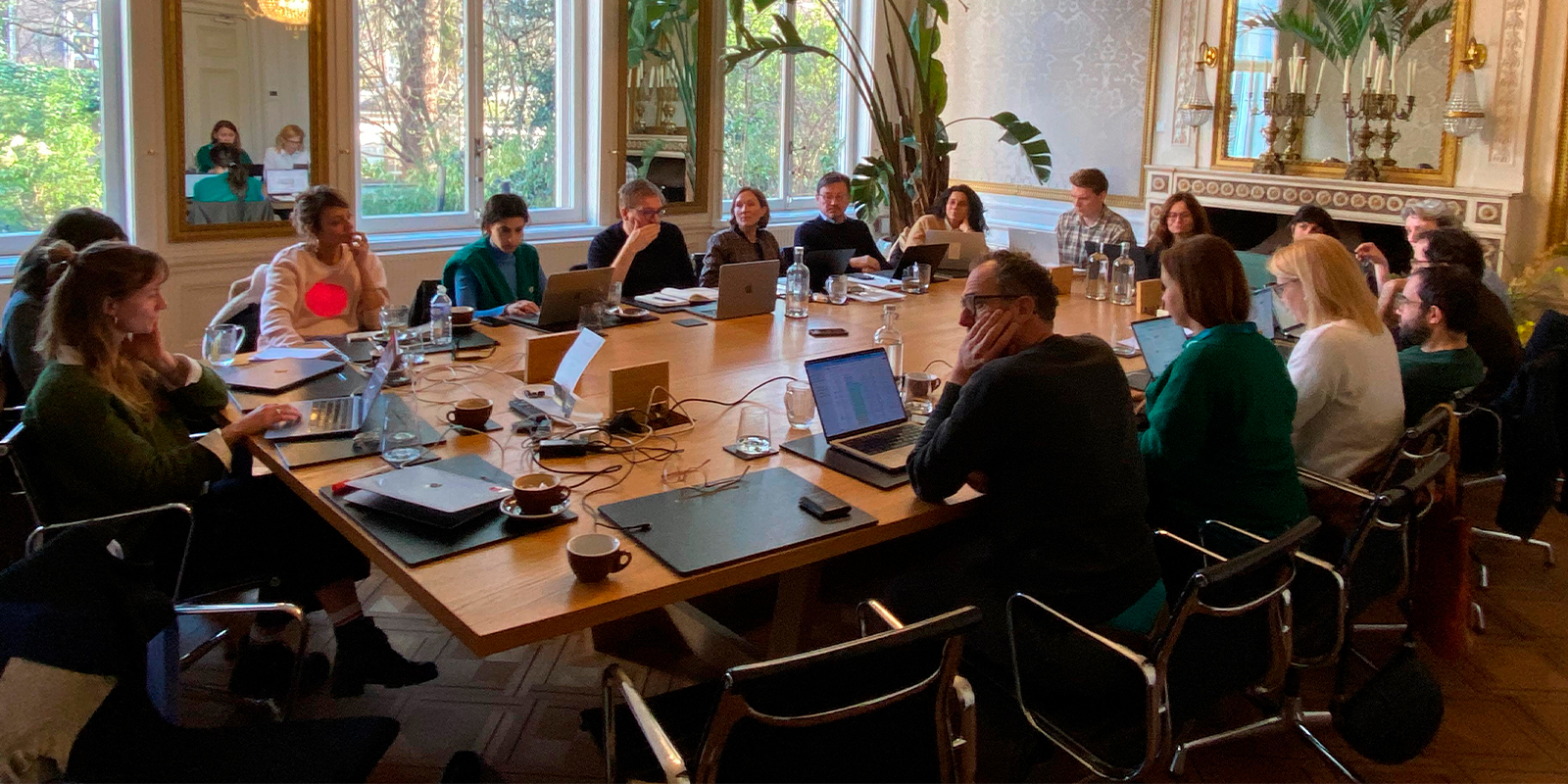
The European Press Prize PrepCom meeting, Amsterdam, 2026.
Emotional impact is not the same as journalistic excellence
Some of the submissions the PrepCom reads are harrowing. War reporting, stories of abuse, accounts of people failed by the systems meant to protect them. The emotional weight of the material is real. But feeling moved by a story is not the same as recognising it as excellent journalism.
Şebnem Arsu, a member of the Preparatory Committee, describes how she navigates that distinction: “Figures and statistics can be a dazzler but only up to a certain point. Data should serve to enhance a story, not replace it. I seek a balanced narrative that weaves rich datasets together with a strong human perspective. Achieving such balance requires a deliberate effort on the side of the journalists, constantly reminding themselves why their story mattered to the readership.”
Juliette Garside, also a PrepCom member, describes what she is looking for in simpler terms: “When judging I am looking for work that stands out. Either through fine writing, or a subject that feels relevant, urgent or surprising, or a powerful narrative. Hopefully all three. But above all, I look for reading that draws me in and absorbs me, for stories I want to share and retell.”
Reading across languages and cultures
The European Press Prize is pan-European in the fullest sense. Submissions arrive in dozens of languages. Judges read work from journalistic cultures with very different traditions, styles and relationships to the reader. Translation makes this possible, but it also creates its own challenges.
Veronika Munk, director of innovation at Denník N and a PrepCom member, has thought carefully about how to judge fairly across linguistic borders: “Great journalism has a specific heartbeat that translation cannot quiet. To judge fairly across cultures, I focus on structural integrity: does the narrative architecture hold up? I look at how the journalist handles evidence, the pacing of the reveals, and the logic of the argument. Good thinking is universal.”
But she is honest about where the limits lie. “The limits are most palpable in linguistic texture. Humor, slang, and cultural shorthand are the first things to get lost at the border. There is a specific kind of wordplay-driven brilliance or poetic rhythm inherent to languages like French or Hungarian that can feel flattened in English. In those moments, I rely on my colleagues who speak the original tongue to tell me: is this prose as breathtaking in the original as the facts are on the page?”
This is what peer review looks like in practice. Not a single arbiter applying a universal standard, but a group of professionals with different reading histories and language backgrounds, pooling their attention on the same body of work.
How a story is read matters as much as what it says
One of the more unexpected things to emerge from this year’s judging discussions is how much attention the PrepCom paid to the reader’s experience of a piece, not just its content.
Cristian Lupșa again: “We are increasingly paying attention to how a story actually feels from the point of view of the readers, who will most likely encounter it on their mobile phones. So we ask: how is that experience? How does it reach them? How easy is it to understand and to interact with? Of course, that is just one component of what we are looking at, but it is one that matters.”
This is a quiet but significant shift. Journalism has always been about reaching people. But in a media environment where a long investigation competes for attention with everything else on a phone screen, the question of how a story lands, not just what it contains, is increasingly part of what excellent journalism means.
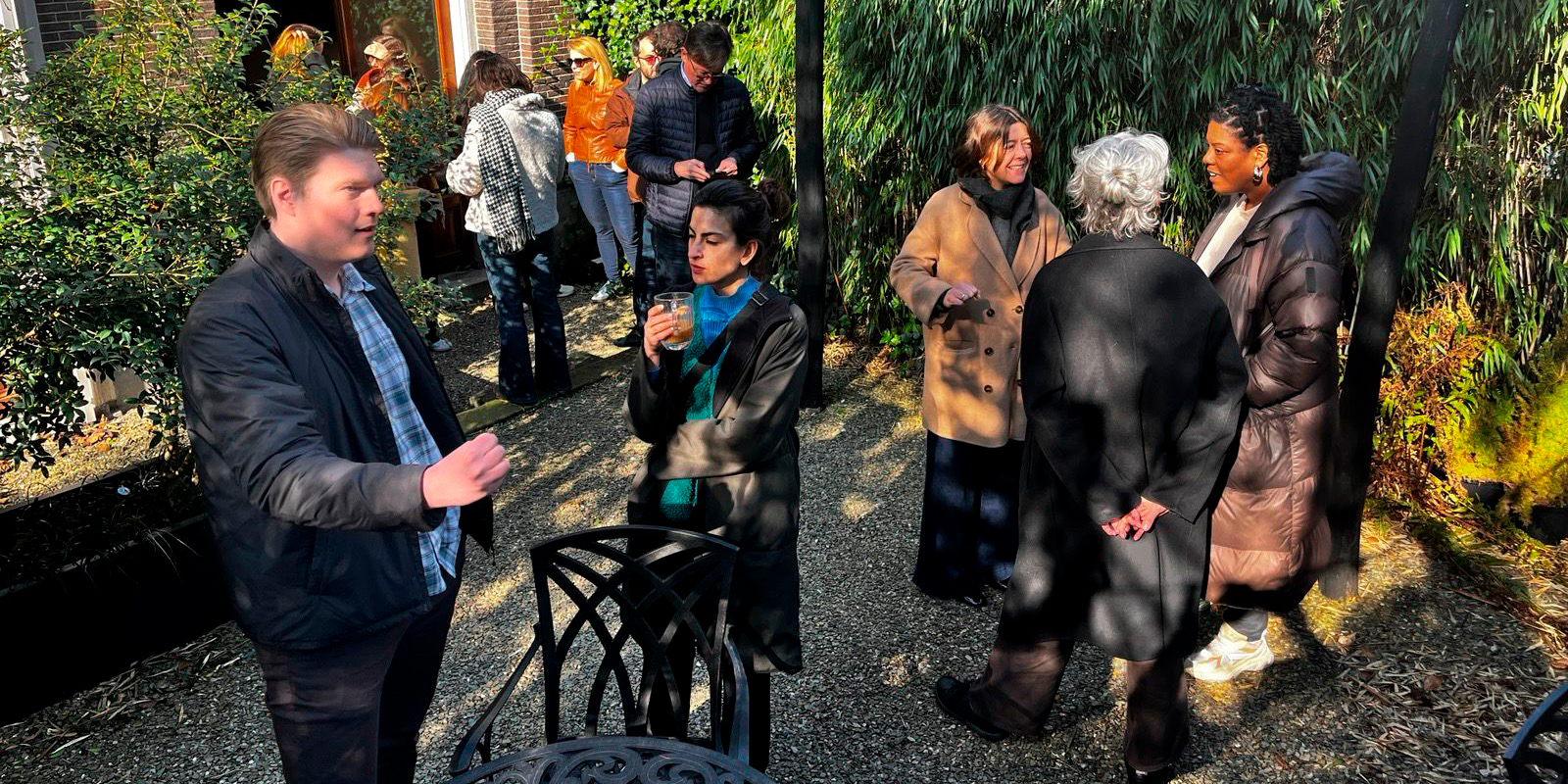
The European Press Prize PrepCom meeting, Amsterdam, 2026.
What the Shortlist will show
The 2026 Shortlist will be announced on 16 April at the International Journalism Festival in Perugia. What it will contain, by design, is a range. Large collaborations and solo investigations. Data-driven work and personal essays. Stories with continental reach and stories that matter most to the communities they were written for.
What connects them is not their scale or their subject matter. It is the standard they were held to: independent, in the public interest, clearly told, and honest about how and why the journalism was done.
That standard is what the PrepCom spent months applying. The Shortlist is the result.