

One Night in Bakhmut: Civilians Wait for the End as Russia Draws Closer
The original publication of the project is embedded below. Underneath, find the full text.
BAKHMUT, Donetsk Oblast – Moments of quiet are few and far between in the near-empty city of Bakhmut. Not only is the sound of incoming and outgoing artillery fire constant, but the variety in volume and texture of the sounds shows just how much firepower is being brought to the battle on both sides.
At times, long bursts of rifle and machine gun fire ring out from the eastern outskirts of Bakhmut.
Just two kilometers from the center, Russian Wagner mercenaries continue to inch forward toward the city in costly but methodical squad-sized assaults.
As we swung into a nondescript courtyard behind a Stalin-era apartment building in central Bakhmut, we found Hryhorii Ostapenko right where we had left him three days before. Sitting on a bench next to the garage, he was hacking away with a little axe at broken window frames, salvaged to fuel the wood-burning stove inside his home.
We had met residents Ostapenko, 63, and Valentyna, 59, who declined to give her last name out of fear, on a previous trip into Bakhmut a few days earlier, asking for permission to stay the night in their building’s basement with those residents who remained.
After having exchanged seasons’ greetings and handed over a bag of food and hygiene products we brought from Kramatorsk, our accommodation was confirmed.
“Not a problem at all,” said Ihor Selenov, a 50-year-old neighbor with a boisterous manner and a Cossack-style haircut, coming out the front door to greet Ostapenko. “Pop in later and we’ll have some tea.”
As we headed back to the car, promising Ostapenko to return before sunset, a Ukrainian soldier came out from behind a gate, walking slowly and deliberately toward us with arms crossed in front of his rifle. We told him of our plans to spend one night here with the remaining residents.
“You can if you want, I just wouldn’t stay with these people,” he replied quietly, directing a contemptuous glance over our shoulder.
“Most of them say openly that they’re waiting for Russia.”
We thanked the soldier and went on our way. There was little time to find a new host. The sun would be going down in just a few hours and our colleagues were taking the car with them back to Kramatorsk. Walking the city aimlessly while shells and drones flew ahead was unwise at best.
Besides, if the people in Ostapenko’s building were waiting for Russia, whose artillery worked day and night turning their city into rubble and forcing them into a cold and dangerous life in and out of basements, I wanted to understand why.
Russia’s invasion overwhelmingly united Ukraine against the aggressor, sweeping aside the old pro-European/pro-Russian divide that dominated politics before 2014, and was still present to a lesser extent after.
A September 2022 Gallup poll conducted across Ukraine showed that only 0.5% of the population viewed the Russian leadership positively.
Absurd as it seems, it is often places like Bakhmut, the very settlements which have endured the most suffering from Russia’s onslaught on Ukraine, where people belonging to this rough 0.5% can be found.
In Ukrainian slang, these people are sometimes called zhduny, meaning “those who wait” in Russian.
For older generations here, nostalgic for the area’s flourishing industry in Soviet times, and who largely voted for former president and Kremlin ally Viktor Yanukovych, the reality of months of brutal war can be difficult to process.
According to Ukrainian police, around 5,900 civilians are understood to still be in Bakhmut as of Feb. 2, including over 200 children.
Starved of any information on the outside world, and with no savings or connections to help them if they evacuate, the remaining residents of Bakhmut are frozen in inaction as the fighting draws closer.
Whether out of apathy, hopelessness, or dreams of the made-up propaganda idea of the “Russian world,” many make the simple but often deadly choice: to wait.
Last bastion
Before settling in for the night, we pay a visit to the local fire station, officially the headquarters of the Ukrainian State Emergency Service in Bakhmut. With barely anything else working in the city, this proud white building just off the central square is one of the few functioning arms of the civilian state left in Bakhmut.
With a large wood burning stove and generator, the sunken main hall of the fire station is a refuge of warmth and relative comfort.
Christmas lights and a signed Ukrainian flag do more to lift the mood, while a large dog, jokingly named Skabei after the Russian propagandist Olga Skabeyeva, greets visitors with enthusiasm.
Deputy commander Artur Spytsyn, 31, and his colleagues complete various chores around the building while waiting for the next call.
“Our first task is to protect the lives of the team and the residents,” he said, “and by now there is little reason to care about property.”
“We don’t cross the (Bakhmutka) River anymore, there is very little left unruined on the other side.”
Almost if not all the first responders still working at the fire station are locals, from Bakhmut and the surrounding villages.
When not on shift, they return to home lives which often differ little from that of the other residents.
In homes with blown-out windows, there is no water, electricity, or gas, only a choice every night between the relative comfort of the apartment or the relative safety of the cellar.
Volodymyr Hruienko, a 42-year-old fire truck driver, took me around the back of the fire station to an apartment building that was hit on Dec. 26. Several apartments were burnt out in the place where the shell hit, and only a handful of windows remained unbroken: nothing out of the ordinary for Bakhmut.
A group of half a dozen residents, mostly of pension age, were milling around the entrance: some chopping firewood, some cooking on makeshift brick stoves, and some just standing in silence.
A younger man approached Hruienko, asking for urgent help finding water. Hruienko advised him to take a large plastic tank that still stood behind an abandoned supermarket about half a kilometer away.
“It fits around half a ton of water, four of you should be able to carry it over,” Hruienko said. “If you can do that, we can fill it up for you.”
Maintaining regular contact, and trying his best to help with basic necessities like the water, Hruienko has gained the trust of many of the residents on the block, but not all. As we returned to the station, a middle-aged man in a black leather jacket passed opposite.
“Thank you,” he said, sarcastically, looking Hruienko in the eye and pointing at the building’s devastated facade. “Thank you for this.”
“Some certain percentage of people left probably love Putin,” said Spytsyn of the so-called “zhduny” living in Bakhmut.
“Personally I had nine friends before Feb. 24 who thought ‘it wouldn’t be bad’ if Russia arrived, but now there is only one such person left.”
Unwanted
The winter sun was already setting by the courtyard where Ostapenko, Selenov, and Valentyna lived when we returned. Nobody was outside and the doors were locked shut. Circling around to the front of the building, we got the attention of a blurred face, dimly lit by candlelight, sitting by the window.
It was Iryna Ostapenko, Hrihorii’s wife. Coming outside to meet us, she called Valentyna up to let us into the basement.
We quickly realized there had been a misunderstanding. There was a place to sleep for us in another, empty basement, but not where Valentyna and her son, Dmytro, were staying.
“I’m sorry,” she said. “I want to help you but I hope you understand it’s very hard to trust strangers here,” she said to us.
Valentyna lit a candle and led us down to where we would be staying. Clean and orderly, the cellar had two beds, a table, and a shelf with some stored food supplies. Lacking a stove of any sort, the space was cold, and the bedding available damp throughout.
Frightened and emotional, Valentyna declined to show us her basement or introduce us to her son, but before she left, we spoke by the flickering light of her candle.
Before the full-scale invasion, she lived with her son in Yakovlivka, a village 15 kilometers northeast of Bakhmut that was taken by Russian forces in December. The area was the scene of heavy fighting, the prelude to the assault on Soledar, Russia’s first capture of a major Ukrainian settlement since summer 2022.
“Friends from my village tell me, crying,” Valentyna recalled, “’Valya, we would go back to our ruins, if only just to kiss the bricks, but let it be home, we only want to go home’… but there are no homes left.”
Valentyna did not come straight from Yakovlivka to Bakhmut, instead first spending several weeks in the central Ukrainian city of Kropyvnytskyi, where she says she was treated with suspicion because she was from Donbas.
“Everyone was looking at us like wolves,” she said.
“My friend told me how when she went to the hairdresser’s and told them that she was from Donbas, they kicked her out angrily, saying ‘Our guys are dying because of you, go back, you can be killed instead’.”
The discrimination in Ukraine of people from Donbas due to language or political prejudice is a cornerstone of the propaganda narrative used by Russia to justify the invasion of Ukraine.
While frequent Russian claims of a “genocide” of the people of Donbas or bans on speaking Russian in Ukraine are complete fiction, the full-scale war has raised some internal tensions.
Valentyna’s case, of having fled to safer parts of Ukraine only to return to an active war zone, is not a rare one.
According to the latest UN figures, 5.9 million people have been internally displaced within Ukraine by Russia’s invasion. Many of these people have been able to settle and begin to build new lives in cities all over Ukraine.
But with meager monthly government assistance of only Hr 2,000 ($54) per person and Hr 3,000 ($82) for a child or person with a disability, those without any savings or support networks often find it impossible to make a new start.
“I am afraid, but now I feel that judgment must come on my own land,” she said. “May whatever happens happen, we are not wanted anywhere else anyway.”
Sobbing and overwhelmed, Valentyna politely excused herself, taking the candlelight away and wishing us a good night.
Those who wait
Locked up alone in the basement, we were deciding on our next move when someone started shouting at street level.
“Press! Where are you?” came the male voice, followed by “ratatatata!” a poor imitation of a rifle burst. It was Selenov.
It was hard to tell what kind of mood he was in, but we had little choice but to come out and meet him.
Energetic as ever, Selenov dragged his wife Olena, drunk and half-asleep, out of a parked black 4×4, and together the four of us climbed to his second-floor flat for tea.
Plastic plates and cutlery, some adorned with leftover beetroot salad, were cluttered in between shot glasses on the family’s living room table. The apartment was homely, but had seen better days, with the windows blown out and no water or electricity to speak of for months.
Olena, calling for more to drink, was in a provocative mood, making expletive-laden requests for us to leave.
“Tell me,” she said with a snarl, “how much are the Americans paying you?”
In Olena’s worldview, any journalist working in Ukrainian-controlled territory must be on the payroll of Washington.
Embarrassed, Selenov manhandled her to bed, where she stayed.
With a rough but loving touch, Selenov stroked a young ginger cat as we sipped black tea by the light of a portable LED lamp. Outside the window, the sounds of artillery and rocket fire rolled on.
“If you are sober, maybe you start thinking that’s the end,” he said of the constant shelling of his city, “you wonder where you can hide, but if you’ve had a few, you can sit back and enjoy the ‘concert’.”
Selenov was open from the beginning about his position on the war.
“We are one nation, we are all Slavs,” he said of Ukrainians and Russians, repeating one of the most popular narratives of Russian propaganda. “They (the U.S.) are training us to kill each other like rats, making Ivanov, Petrov, Sidorov (Russian surnames also common in Ukraine) fight against Ivanov, Petrov, and Sidorov.”
With soldiers and civilians situated close together as the urban warfare intensifies, tension naturally builds between those defending the city and those watching their homes being destroyed in the battle.
“At first we got on well with the soldiers,” Selenov said, “and now they look at us, speaking Russian, and ask openly, ‘why did we travel a thousand kilometers to fight for you?’”
“I answer them, ‘Why are you fighting for me, why are you destroying my city?’”
Civilians here are repeatedly encouraged to evacuate and given the means to do so.
Those who choose to stay are caught in a world where laws, trust, and social norms quickly start to crumble, together with the buildings themselves.
Selenov holds that Ukrainian soldiers tried to loot the apartments in his building, thinking they were abandoned.
“The day after they first came, we were hit closer than ever, my garage was destroyed,” he said, “and then they checked again to see if we had gone yet.”
Imitating the soldiers, Selenov, who like most residents of the area is a native Russian speaker, tries with difficulty to speak Ukrainian. “’We are searching… clearing the area, we know that the Muscovites had a secret weapons dump here,’ they said to me.”
“Then they broke down my neighbor’s door and started looking for gold and other valuables.”
In almost any war, soldiers often have to use empty dwellings as frontline accommodation, sometimes breaking in forcefully.
Though it is possible that what Selenov described was the truth, there have been next to no documented and verified instances of Ukrainian soldiers looting homes or businesses for profit, one rare example being the Kyiv Independent’s own investigation into alleged misconduct in the International Legion.
In contrast, practices of mass looting have accompanied the advance of Russian forces throughout Ukraine, with countless well-documented cases of theft of Ukrainian property, from washing machines to entire museum collections.
For people like Selenov, existing biases against Ukraine are often made worse by the situation.
Failing to connect the destruction of their city exclusively to the Russian invasion, conclusions are instead made based on what they can see.
“When the battles started for Popasna and Lysychansk, our city started to get hit from our side, from Chasiv Yar,” he said. “Later of course, the Russians started shelling as well, but at first, this city was messed up by our own.”
Russia’s assault on Donetsk Oblast has practically destroyed dozens of settlements with artillery, rocket, and tank fire. In over six months on the front line, Bakhmut has joined the likes of Volnovakha, Popasna, Sievierodonetsk, and most famously Mariupol, as cities ruined beyond recognition by Russia’s war.
“There are people who just don’t have the intellectual capacity to understand what’s going on,” first responder Spytsyn said of beliefs like this.
“Propaganda has destroyed any ability to see what is happening in front of their own eyes, which cannot tell who is shelling their city.”
City of the living
Excusing ourselves from Selenov’s apartment, we returned to the freezing basement Valentyna had opened for us, and quickly decided it was no place to spend the night.
Reluctant to bother any more of the residents at this hour, our only option remaining was to return to the fire station.
On foot and wearing bulletproof vests and helmets, walking around Bakhmut in the evening was a dangerous prospect, with Ukrainian sentries likely on the lookout for suspicious activity. Luckily, the fire station was only three blocks away.
The streets were empty, but lit brightly by a near-full moon through the clear skies. Sticking to the shadows, we hurried.
Just as we stepped onto the central square, the sound of incoming Russian Grad rocket launches made us crouch close to the wall. The sky briefly glowed orange as the rockets thudded in not far behind the Palace of Culture.
We arrived at the fire station to find it empty and locked. Only Skabei answered our banging on the large doors.
For 20 minutes, we sat on the steps like children waiting to be picked up after school, listening to the Battle of Bakhmut. Finally, the noisy Soviet-era fire truck lurched into the driveway, back from an evening job.
Acknowledging our presence, the helmeted silhouettes emerging from the truck walked past us and opened the door. Within minutes, the truck was back inside, and the firefighters had undressed, bathing with a bucket of hot water left on the stove.
The crew had been out fighting a fire near Ivanivske, a settlement on the way to the recently captured Klishchiivka to the south, that has since become the next target for Russia’s advance. One elderly woman reportedly died, her home burnt to the ground.
As the firefighters decompressed, a middle-aged man with a puffy red face paid an unannounced visit. Funeral services worker Oleksandr, 57, who wished to keep his full identity private, was no stranger, greeting the men with a familiar smile.
Having spotted the fire himself, Oleksandr had come to alert the team, only to find they had already done their job.
Oleksandr did not wish to speak about his profession. “What do you think it’s been like? I’ve worked alongside the first responders, I’ve pulled corpses from the rubble,” he said. “Ask me about anything else.”
Oleksandr’s children are living safe in a village near the city of Dnipro, where he said they are treated with respect and care. Still, he was also saddened by the treatment he has faced personally in other parts of Ukraine.
“I don’t understand, they all shout all the time in the west that we are a united Ukraine,” he said, “but when you arrive and say you are from Donbas, they can call you a separatist without knowing anything about you.”
“I am Ukrainian, we all live in Ukraine, there needs to be this human understanding.”
Oleksandr eventually left for home, and the others slowly retired to their quarters. Only Hruienko remained, fixing something under the gearbox of the truck.
“Check this out, I found this song just yesterday on (Russian social network) VK,” he called to me.
The track from 2012 was an amateurish but warm ode to Artemivsk, the old Soviet name of Bakhmut, before decommunization returned the city’s original name.
Entitled “City of the Living”, the song’s optimistic Russian-language rap lyrics rang out through the empty hall of the Bakhmut fire station:
There are fewer troublemakers these days, culture is developing;
Everything is being sorted out, but some people are stuck in the previous century;
They sit in their chairs and never change anything, but at least the rest of us are thriving!
People, let’s show them our city of the living!
Don’t hide in your apartments, it’s time to show our city to the world;
Not just a spot on the map but the pride of our country.
Approaching storm
Protected from both cold and shelling in the basement, the night at the fire station passed calmly.
As we waited to be picked up by colleagues the next morning, small teams of journalists and volunteers mingled in front of the fire station building. In one van, two British volunteers were traveling with a Ukrainian priest.
I spoke briefly to one of them, a softly-spoken forty-something man who introduced himself as Andrew. He had been working for months in and around Bakhmut, evacuating dozens of civilians from some of the most dangerous front-line areas.
A few days later, the news broke that British volunteers Andrew Bagshaw, 47, and Chris Parry, 28, had gone missing in Soledar, caught up in Russia’s assault on the town while on a mission to evacuate an elderly woman. Photographs matched the face of the Andrew I had briefly met.
On Jan. 25, their families confirmed that both men had been killed, though the exact circumstances of their deaths remain unknown.
On the road out of Bakhmut, excavators could be seen digging fresh trenches on the western edge of the city.
The fate of Bakhmut is far from predetermined. Russia’s reported losses are staggering, with the Ukrainian military estimating around 150 are killed and as many wounded on an average day of Russia’s grinding attacks on the city.
Even with heavy casualties, Russia has so far failed to make significant inroads into the urban area of Bakhmut.
To the north and south of the city, the picture is very different. The mercenary Wagner Group’s capture of Soledar in mid-January has brought the northern highway into Bakhmut under Russian control, while the capture of Klishchiivka in the south has placed the last main Ukrainian supply route under serious threat.
While the battles rage for the territory of Donbas, stories like those of Valentyna, Oleksandr, and even Selenov show that a separate struggle continues, no less difficult, for the hearts and minds of its people, even in the face of Russian brutality.
While most of the first responders plan to leave if Bakhmut is occupied, Hruienko vowed to stay in his hometown.
“I won’t go anywhere, even if they come,” he said, smoking a cigarette in the winter sun.
“I was born here and I will stay. Who will help people here if we all leave? I’ll take my car and start bringing people water… maybe I’ll even fight some fires.”
Kazakhstan-Xinjiang, the Border of Tears
Kazakhstan
When she returns home after an absence of two years, Ajar* no longer looks like herself. With hollowed cheeks, gray hair, and a distant gaze, she is nothing but a shadow that breaks into tears at the sight of her children. “My son shouted ‘Mummy, Mummy,’ but my daughter didn’t recognise me because she was too young when I left Kazakhstan. Even my husband stared at me for a long time after I walked through the door,” she recalls. Ajar had just turned 34 and had just left a re-education camp in Xinjiang.
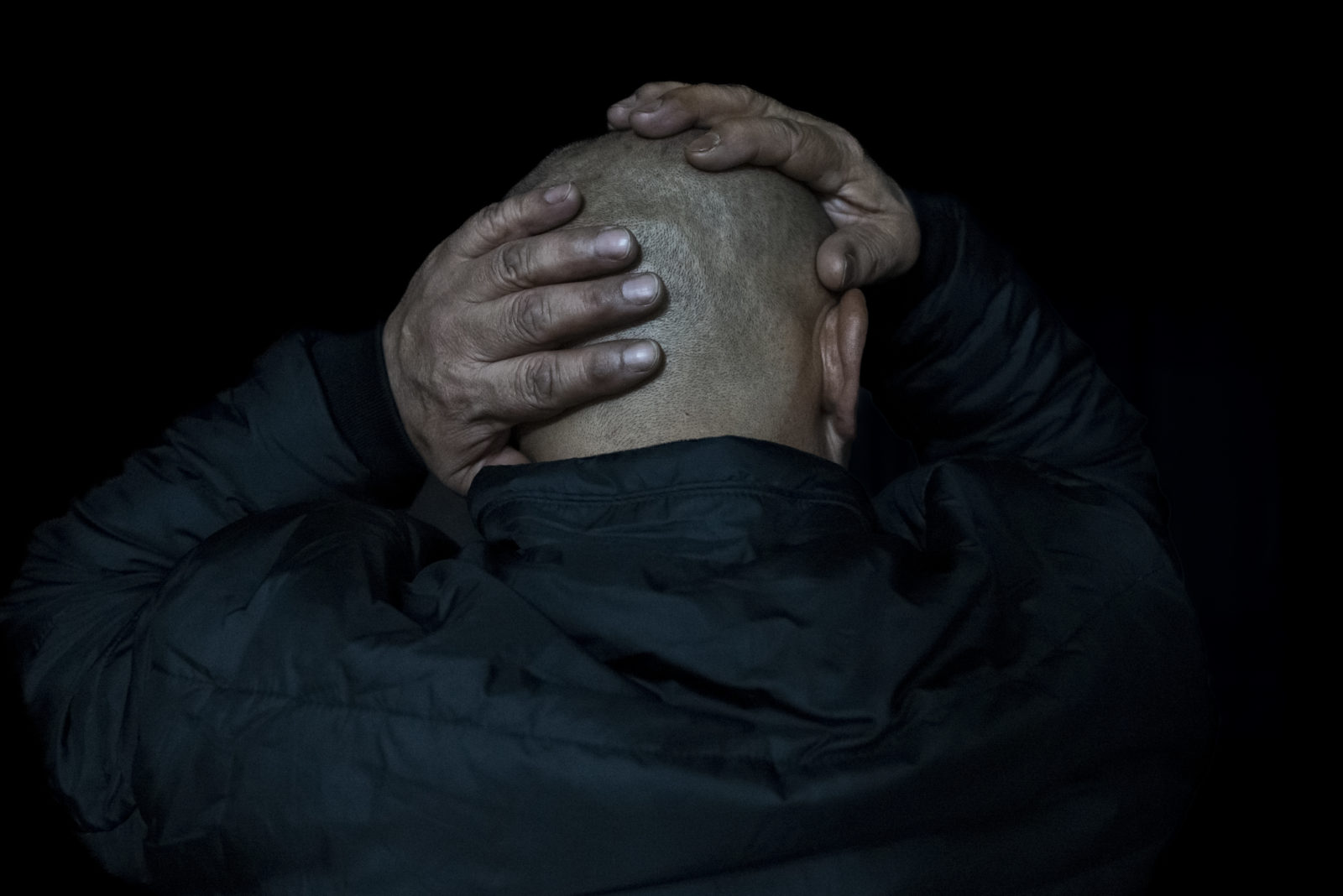
by Robin Tutenges
Arrested at the border by Chinese authorities during a business trip, she had emigrated just a month earlier from China to Kazakhstan to set up a new home and guarantee her children a Kazakh education in line with the traditions of her ethnic background. Today, the new life she had dreamed of has become her burden.
“At first, I was afraid of everyone and everything. My husband asked me if I was relieved to be back, and I said ‘I don’t know.’ For a whole year, I stayed at home with the children, not wanting to go anywhere. The Chinese police often asked me what I was doing; I was being monitored even in Kazakhstan,” Ajar recalls.
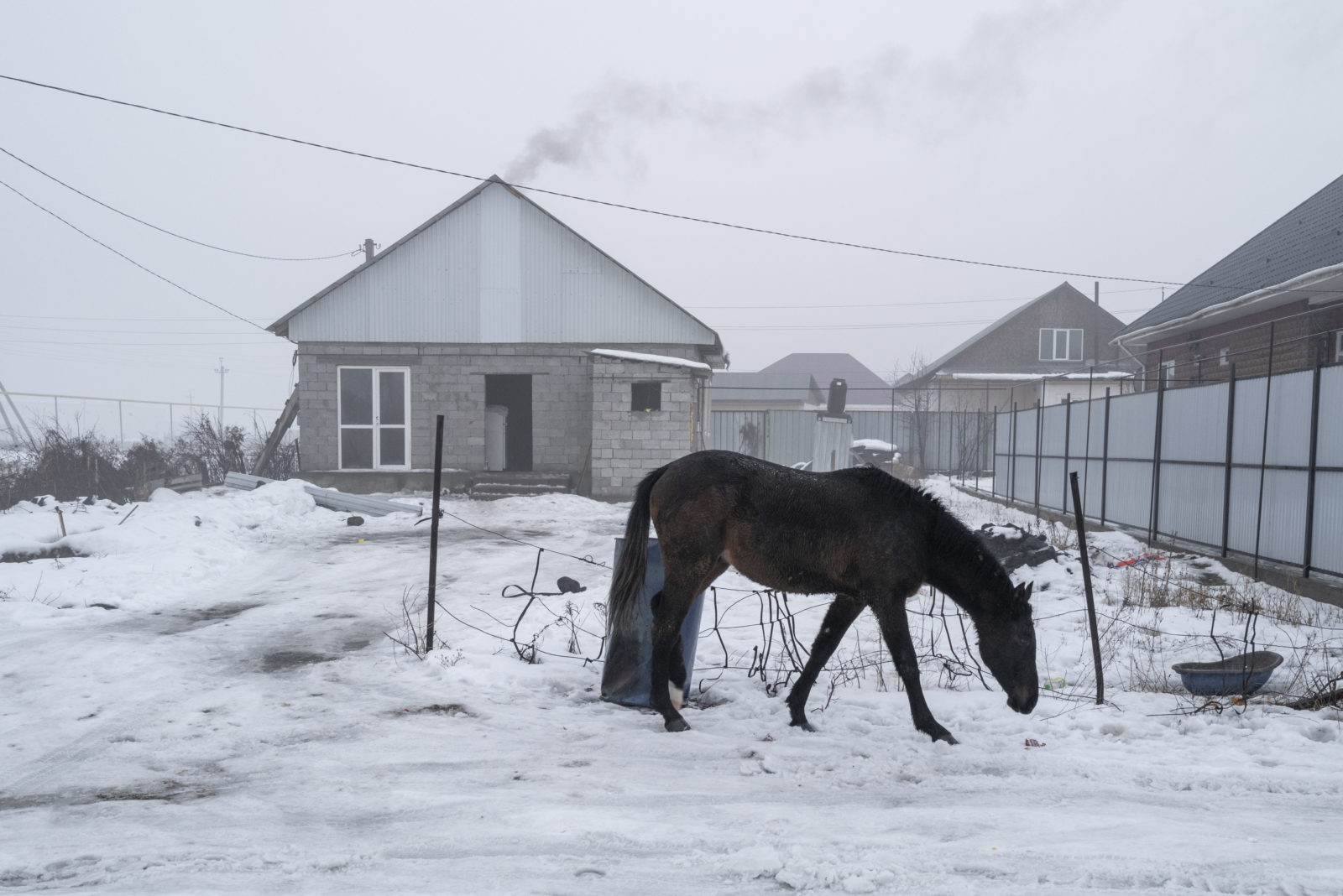
A horse passes through a village in Kazakhstan that is home to several survivors of the Chinese camps, 9 January 2023. | Robin Tutenges
Remembering in silence
Like many Xinjiang survivors, Ajar finds it hard to see her release from the camps as a “liberation.” Three years later, the memory of endless days moving from one cell to another, from one anxiety to another, is still deeply ingrained in her.
The Chinese authorities, for their part, are doing their utmost to censor these memories. Each “released” prisoner has to sign a form promising not to disclose any information about their detention. Some are forced to claim voluntary attendance in the camps for professional training, while others must confess to imaginary crimes (terrorism, extremism, treason) when their only fault, according to the Chinese government, is belonging to an ethnic minority, such as Uighurs or Kazakhs. This is done to enforce silence and maintain pressure.
Saule*, incarcerated at the age of 76 and released after one year and nine months, had to make nearly 50 relatives from her hometown sign a document vouching for her loyalty to the Chinese regime and holding them responsible for her “betrayal” if it were to occur. Even outside the camps, the survivors know that they and their loved ones are under the scrutiny of the Chinese state.
Faced with these threats, many remain silent and, once reunited with their families, find themselves isolated with the weight of their traumas. Even if they are willing to speak, the victims often face incomprehension or helplessness on the part of their loved ones, whose best efforts are not enough to erase the violence they have suffered.

Rahima Senbai, who returned to Kazakhstan over a year ago from the Chinese camps, still hasn’t emptied all her suitcases, which are lying on a piece of furniture in her living room. 31 December 2022, Kazakhstan. | Robin Tutenges
Living with ghosts
There are nightmares that return incessantly, intrusive reminiscences that abruptly recall the sessions of torture experienced or witnessed. There is also the body’s memory, always aching from the abuse suffered. And then there are other ghosts: those of lost loved ones.
In Yerke*’s eyes, cold anger follows tears as she thinks back to her last months in detention. Sent to a re-education camp in 2018 at the age of 64, her health deteriorated rapidly, and as the seasons passed, the cold in the cells caused her to lose the ability to use her legs. Authorised to receive visitors, she asked her son to bring her warm socks the next time he came. Days went by, but he never came back.
On the fifth day, a guard told Yerke that she was going home. “I was happy,” she chokes, before continuing: “When I was taken back to the village, I wasn’t wearing a headscarf, but just before I got there, I was suddenly offered one, which started to make me doubt. There were people gathered outside my house, some of them Uighur neighbours; they came up to me, and I realised that something bad had happened. They told me that my son had died. After that, I don’t know how I entered the house. I asked them to show me my son. When I saw him, he seemed to be asleep. In the corner of the room, I saw a parcel with warm socks and everything I’d asked him for.”
Under the pressure of the interrogations, Yerke’s son committed suicide. As for her, she was taken back to the re-education camp. “I don’t remember the funeral. My children told me that there had been a Muslim funeral, but I don’t know if it was allowed. Maybe they told me that to comfort me. In any case, all the imams are in camps,” she says.
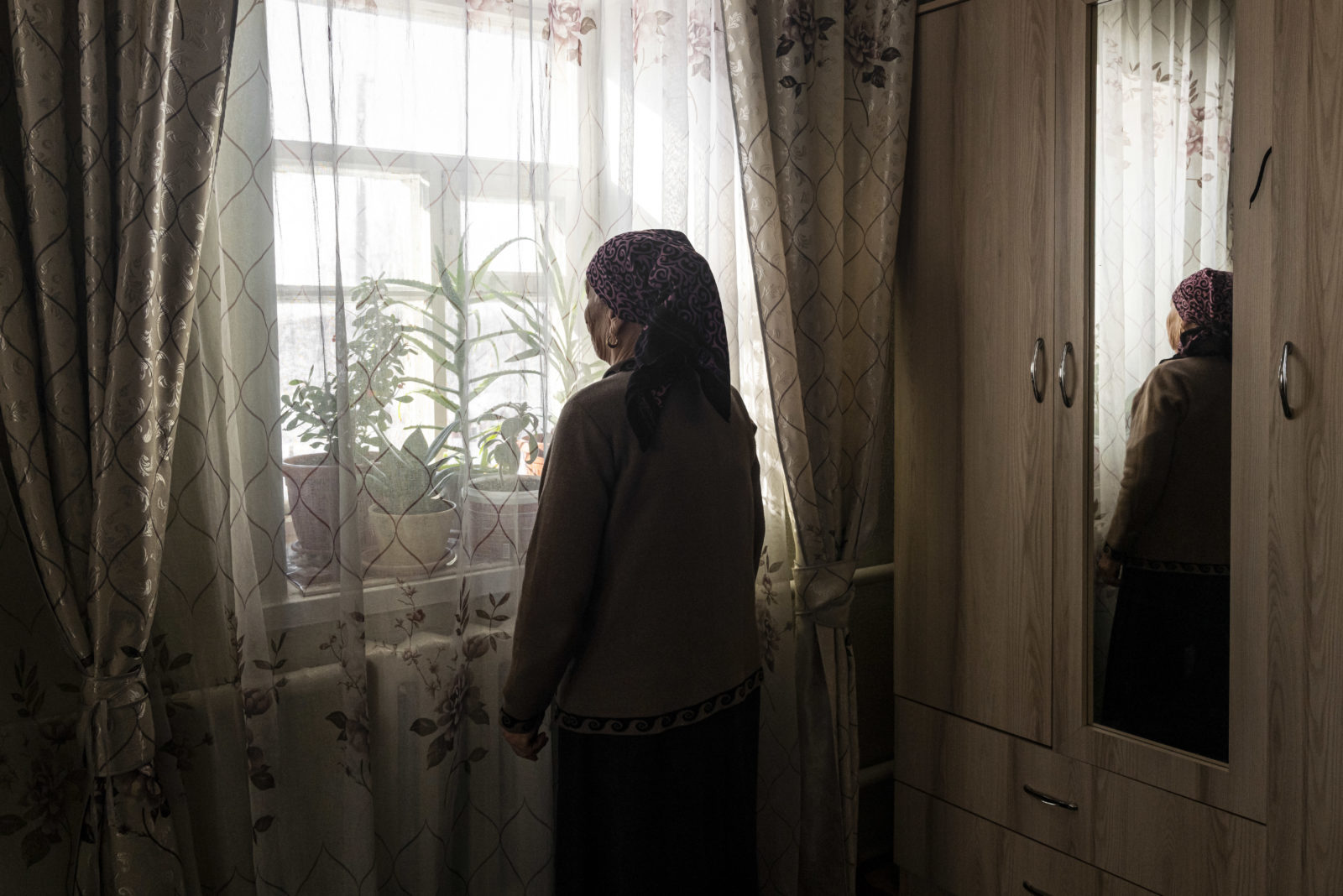
Yerke in the living room of her home in Kazakhstan on 4 January 2023 | Robin Tutenges
Yerke mourns the loss of her son with every passing day. The reason she can only testify anonymously today is that two of her children still live in Xinjiang and are waiting to join her in Kazakhstan. “When all my children are here, I’ll speak openly, and I’ll demand compensation from the Chinese,” she exclaims. “I hope times will change and the regime will fall. The world has forgotten the Kazakhs, but we must not stop our fight.”
Broken bodies
The former prisoners who denounce Chinese repression consider themselves fighters, but they are fighters with broken bodies. Yerke, who was in good health before being sent to the re-education camp, now struggles to sleep because of the pain in her legs. “Upon my return to Kazakhstan, I was diagnosed with many illnesses. I have neurological problems, high blood pressure, my legs are always cold, my ears hurt… It’s very hard for me to stay focused: whenever people talk a lot, I get disorientated, I try not to stay in noisy environments,” she says.
Ospan*, who spent a year in a re-education camp and seven months under house arrest, is worn down by his numerous stints in the “tiger chair” [a form of restraint and immobilisation, ed.] and the psychological torture he endured while detained in China. At the age of 50, this former shepherd, who has found refuge with his family in a small village in eastern Kazakhstan, is no longer able to work. Although physically exhausted and subject to constant headaches, it is above all his memory that is failing him:
“Before I went to the camp, I had an excellent memory, I could remember everything: numbers, roads… When I got out, I started to forget everything. Sometimes I lose touch with reality, I get lost, I can’t remember how to get home. I used to know a lot of songs and loved to sing, I knew poems by heart, but now I can’t sing anymore because I can’t remember any words. If someone wants me to make a speech, it’s very hard for me to say one or two sentences,” he explains with difficulty.
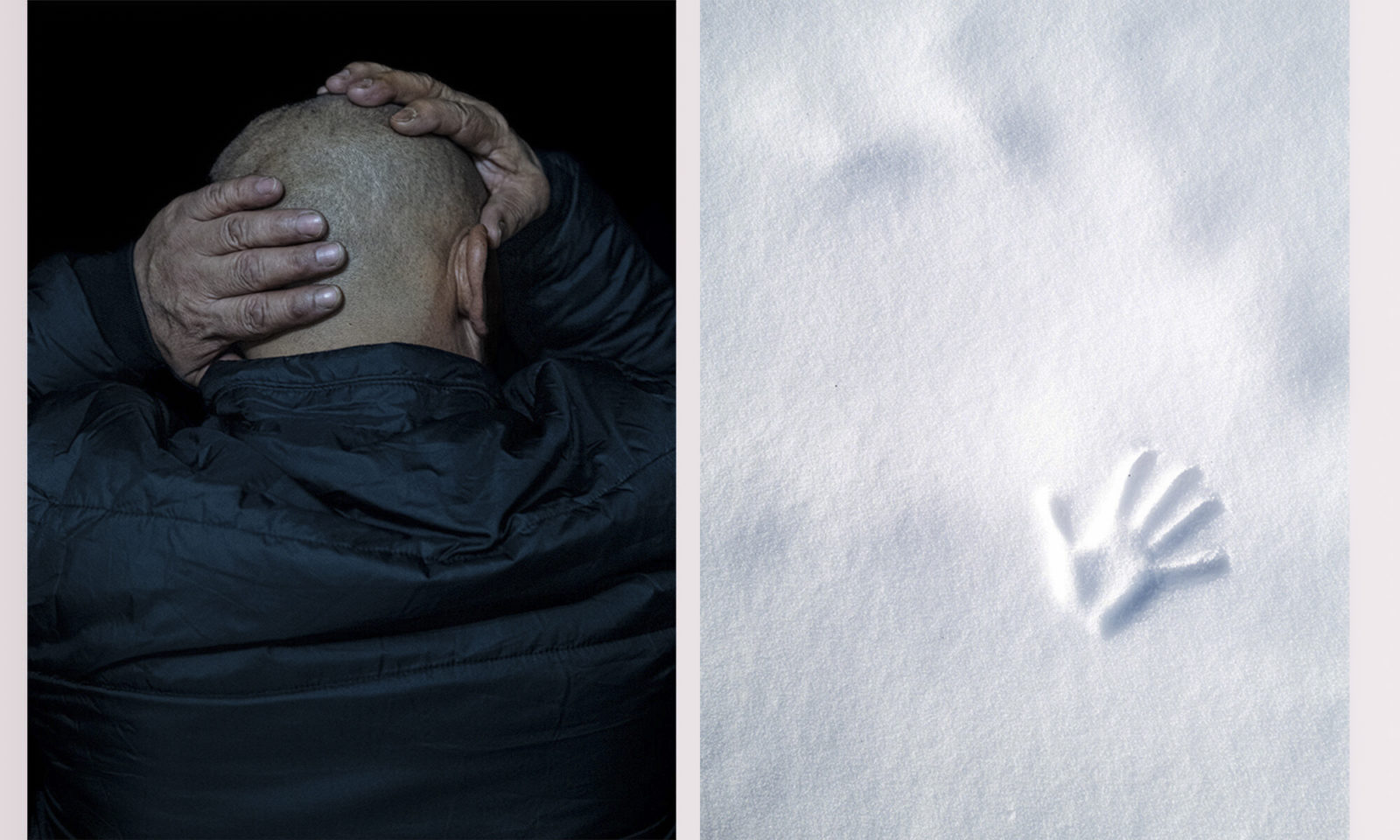
Ospan, pictured here in Kazakhstan on 3 January 2023, still has bears psychological scars from his repeated stints on the “tiger chair” in Chinese camps. | Robin Tutenges
Beside him, his wife completes his testimony: his vision has also deteriorated due to the constant blinding light in the cells, and he suffers from auditory and pulmonary problems. Upon his return to Kazakhstan, after months of waiting, Ospan was able to consult a neurologist, who told him that he was prone to stress and prescribed him medication, something “for the blood vessels in the brain.” He doesn’t know exactly what it is, but he takes it every day. His wife brings a box: they are simple vitamins, like those that Yerke was given.
Medical ordeals
In Kazakhstan, medical care for camp survivors is often poor, if it exists at all. The vast majority of returnees do not receive proper care and must settle for consulting a family doctor, who most of the time will only confirm symptoms without identifying a specific illness.

Ospan and his wife tell the story of the survivor’s difficult return, showing one of the medications he regularly takes. 3 January 2023, Kazakhstan | Robin Tutenges
Many rely on traditional medicine, like Yerke, who was advised to have a dog butchered and wrap the still-warm skin around her legs — on the third attempt, she noticed an improvement. More traditionally, remedies based on herbs or specific diets are common, and are used to treat memory loss, post-traumatic stress disorders, sleep disorders, lower back pain, liver or lung disease and even infertility — all common afflictions among camp survivors.
In any case, the cost of more substantial treatments cannot be borne by the patients, all of whom have experienced a downgrade upon leaving the camps. In the absence of access to suitable care facilities, survivors find themselves condemned to suffer without necessarily knowing the ailment that afflicts them. The luckiest may have access to humanitarian aid, which is as rare as it is precious.
It was through a fundraiser initiated by the researcher and activist Gene Bunin, the founder of the Xinjiang Victims Database (Shahit), that Tursynbek Kabi could finance the hearing aid he needed after his eardrum was perforated by prison guards during a violent altercation.
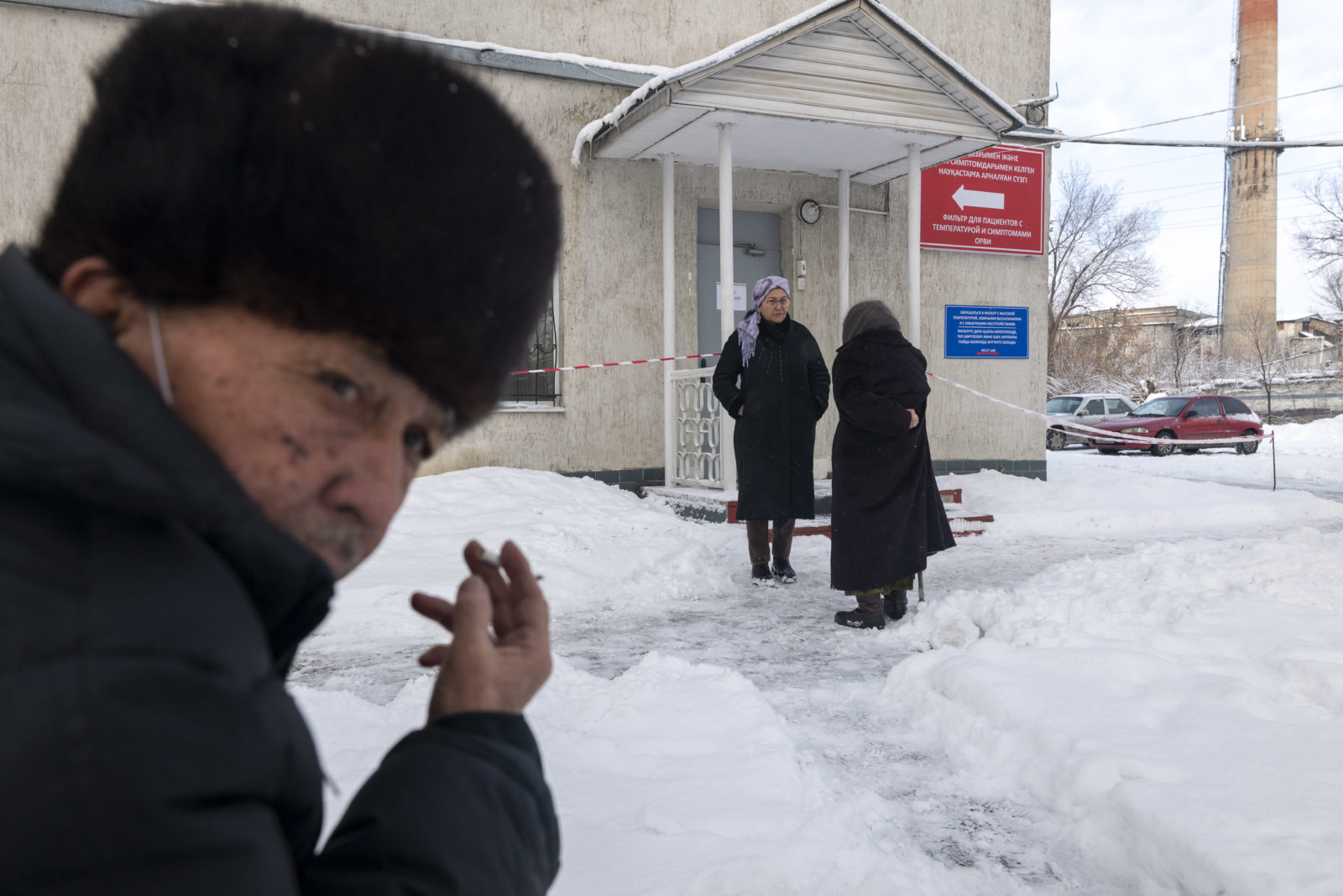
Karima Abdrakhmanova, a member of Atajurt Partiasy, a Kazakh human rights organisation, talks to Saule (facing away) outside a hospital where the camp survivor is to be treated for multiple health problems on 4 January 2023. | Robin Tutenges
Rebuilding trust
For its part, an organisation such as the International Legal Initiative (ILI), which supports requests for the release of people detained in Chinese camps, has been working since 2019 to develop a medical support pathway for certain victims, based on the recommendations of Médecins Sans Frontières (Doctors without Borders):
“We organise an initial consultation with a doctor to determine what medical tests the victims should have, then we redirect them to specialists, who propose a treatment that we cover. But one of the big problems in Kazakhstan, which is a legacy of the Soviet Union, is that the doctors speak Russian, while the victims only speak Xinjiang Kazakh. It was a disaster five years ago, but now things are a bit better,” explains Aina Shormanbaeva, lawyer and director of ILI.
However, the language barrier is a barrier to care; as things stand, mental health remains the blind spot in the care offered to victims because almost no interpreters are willing to accompany them to a psychologist or psychiatrist. “Even when a translator is provided, some patients don’t dare speak. They have significant psychological problems, but they can’t say everything they’d like to,” laments Anara*, a doctor in a Kazakh hospital who has examined about 50 camp survivors since 2020.
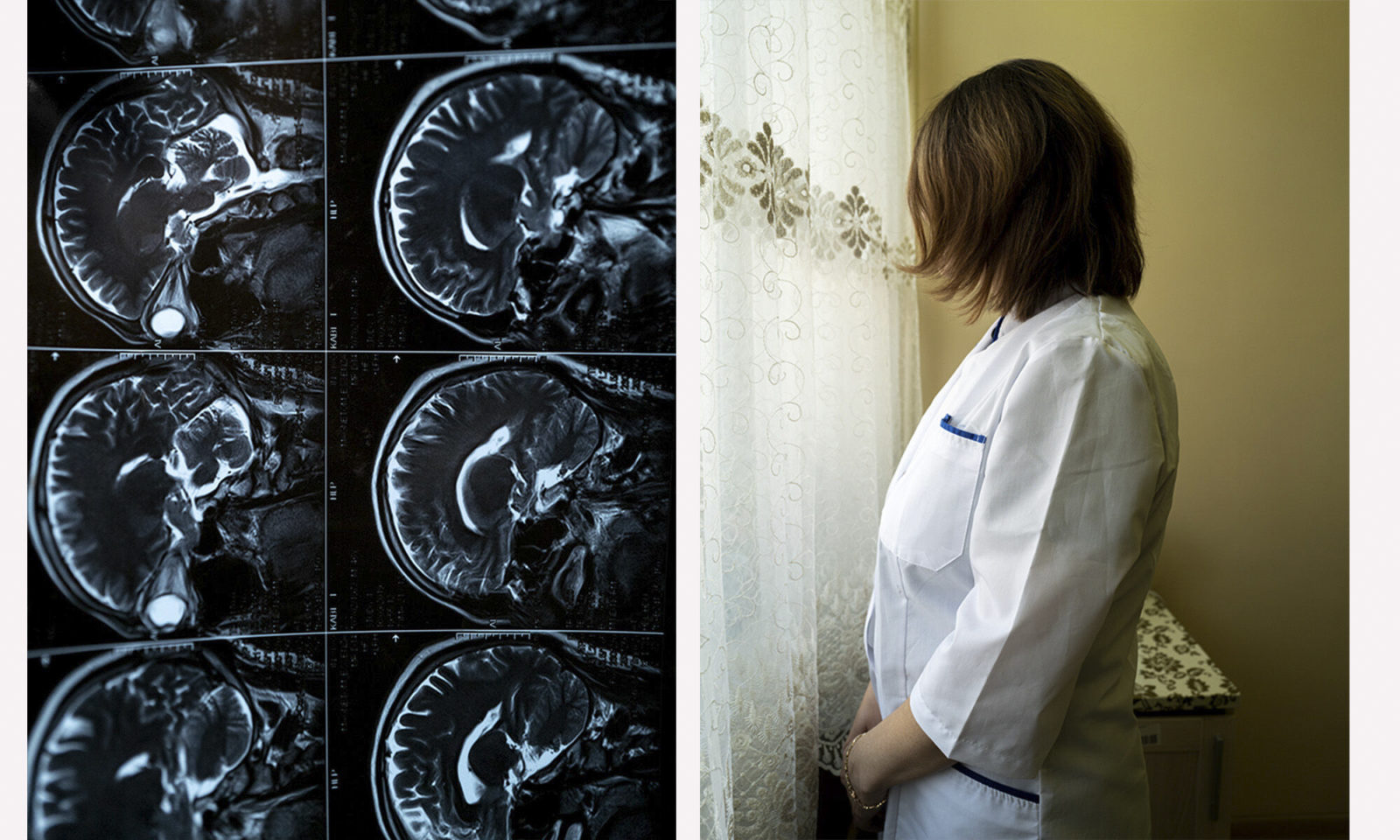
An X-ray fragment of the skull of Tursynbek Kabi (left), a survivor of the Chinese camps. On the right, Anara, a doctor in a Kazakh hospital in January 2023, who has examined dozens of survivors of the Chinese camps since 2020. | Robin Tutenges
Also, a relationship of trust that must be established between the practitioners and the victims, even though the latter have been immersed in a regime of terror in Xinjiang, subjected to non-consensual medical treatment involving injections (supposedly against the flu), pills hidden in the food, and sometimes even surgical operations. “The first survivors who came did not tell us that they had been to the concentration camps, because they were afraid. It was only through word of mouth, seeing that we wanted to help them, that more of them came and confided in us,” Anara explains.
As an endocrinology specialist, Anara has noticed recurring problems of sterility among her patients: “Many of them, both men and women, have damaged genitalia. Some told me they had been given medication, others said they had been raped. Since they didn’t come to see us just after being released from the camps, but instead sometimes two years later, we have no way of knowing what products were administered to them in Xinjiang.”
Living again, elsewhere
Between chronic pain and memories of the camps, one still has to continue living. However, it is far from easy for the survivors to return to their families. Years of distance, difference in experiences, misunderstandings, difficulty communicating, and sometimes resentment impair reunions that are not always joyful.
When Rahima Senbai returned to Kazakhstan after more than a year’s absence, she faced silence from her husband, who, seven days after her return, left the family home and filed for divorce. Rahima, who underwent a forced abortion before being sent to a camp in 2017, sighs: “He heard a lot of stories about women released from the camps: many were raped, tortured… Maybe that was the reason he left. After that, he remarried another woman, with whom he had a son.”
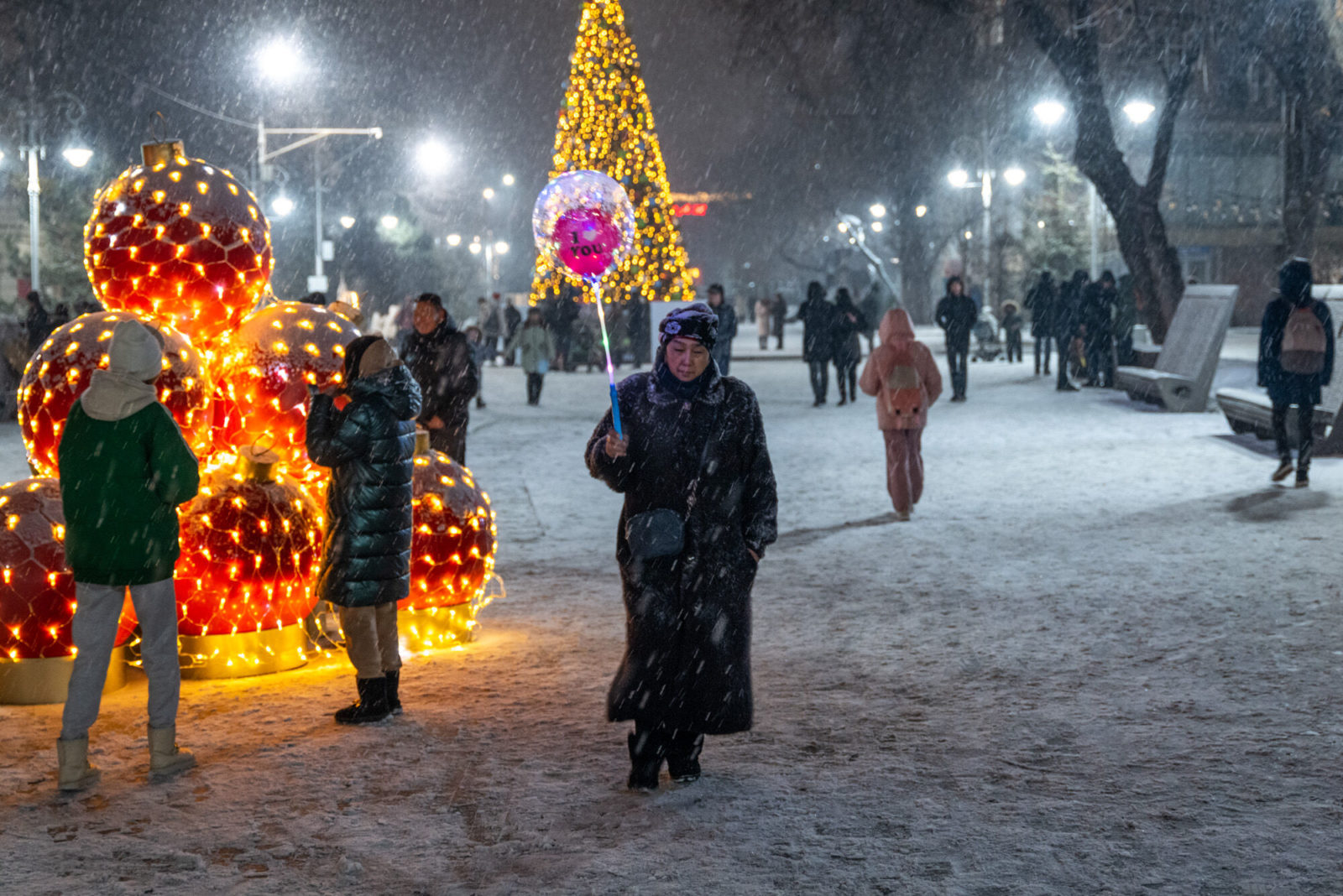
A woman walks alone in the streets of Almaty, Kazakhstan, on 31 December 2022. | Robin Tutenges
For Ospan, supported by his wife who worked for his release, it was the gaze of his former friends that was the most painful: “After arriving in Kazakhstan, I felt under pressure. Everyone who knew me came to visit me and asked me why I’d been in the camps, what crimes I had committed. It was hard for me to say anything. In their eyes, I could see they didn’t believe me. At first it was very hard, but as time went by, more and more people were sent to the camps and came back, and they began to understand that it was linked to deceptive Chinese policies.”
But coming out of the camps also meant being left out in the cold: lost employment, unable to work, suspended pension, frozen accounts… and no aid specifically provided by the Kazakh government for the survivors or their families. Having left Xinjiang, the persecuted minorities now find themselves in the strange situation where all the violence they have endured is not recognised, and seems to exist only in their private lives: denied by the Kazakh authorities, generally ignored by civil society, invisible to the medical community. Now they must ‘get over it’ in silence.
In the face of general indifference, it is within small circles of survivors who have gone through similar ordeals that the returnees from Xinjiang can find support and help each other when needed. Recently, Ajar happened to encounter one of her former cellmates while shopping in a small village. It was only by the sound of their voices that they recognised each other: physically, neither of them looked the same.
*For security reasons, some names have been changed, as most of the witnesses have relatives living in Xinjiang.
The article nominated for the award is the fifth of a series of 8 episodes entitled “Kazakhstan-Xinjiang, the border of tears”