

The logbook of Moria
This investigation was conducted in collaboration with Investigate Europe and Reporters United.
Editor: Elisa Simantke
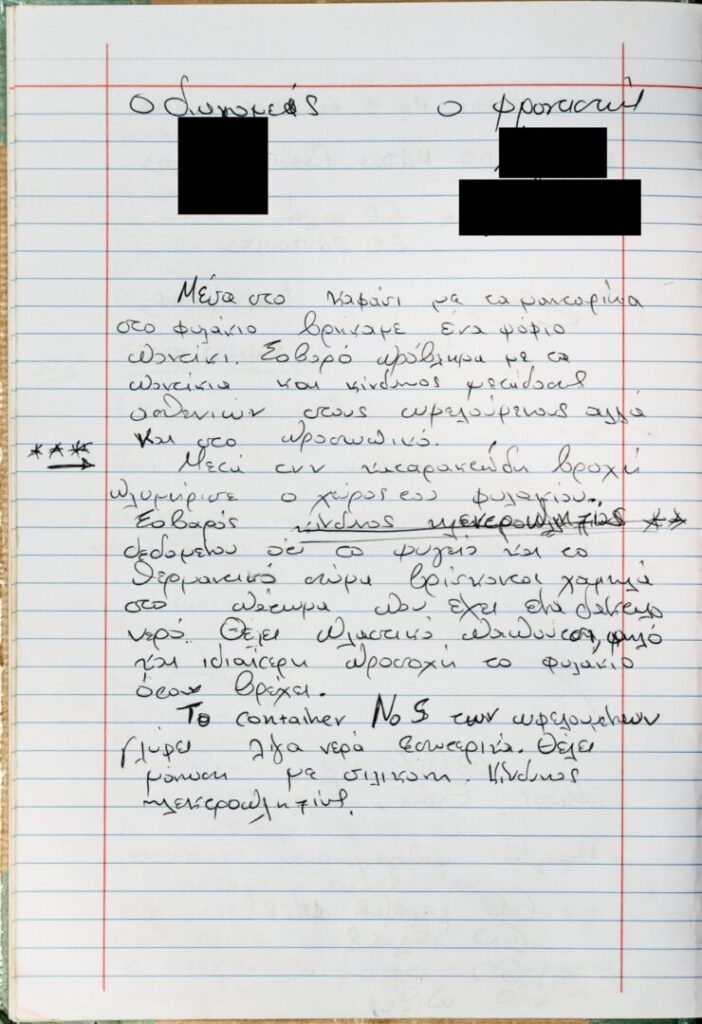
It’s a cold morning in November 2018, when a care worker in Moria’s “safe zone” makes a revolting discovery. Fanis* walks into the guardroom to pick up a box of mandarin oranges for the children. Inside the box, among the fruit, he finds a dead rat.
It’s not the first time this has happened. “Serious problem with the rats, and danger of infusion of diseases to the beneficiaries and the personnel,” the care worker notes down in a hardcover logbook at the end of his shift.
This was not his only concern that morning.
The massive rainfall of the night before has flooded the guardroom, Fanis goes on to write; it is the room where the fridge and the heating unit are located. The rain has also seeped into ‘Container No 5’, which houses some of the unaccompanied minors in the camp.
Without silicone insulation and protection, he warns, the situation remains unsafe and puts lives in danger. “Major danger of electrocution,” the social worker writes, before he puts his pen away and shuts the notebook.
Text in English:
18/11/2018 Inside the box with the mandarin oranges we found a dead rat. Serious problem with the rats and danger of infusion of diseases to the beneficiaries and the personnel. After the torrential rain the space inside the guardroom flooded. Major danger of electrocution given that the fridge and the heating body are positioned low on the floor which has a finger of rain. When it rains, a pair of high plastic shoes and peculiar attention are needed. Container No5 of the beneficiaries is absorbing some water inwards. It needs insulation with silicone. Danger of electrocution.
A notebook that documents Moria’s horrifying story
Till the evening of September 8, 2020, when multiple fires razed it to the ground, Moria had been Europe’s most notorious refugee facility, synonymous for years with dehumanising and dangerous conditions for its thousands of residents.
Walking around the burnt periphery of the camp — which is located on the Greek island of Lesvos — in the aftermath of the fire, in what used to be the so-called “jungle” (a former olive grove surrounding the initial structure on which hundreds of makeshift tents were set up), one of the two authors of this article, reporter Stavros Malichudis, found a notebook. It was nestled in the ground, amid destroyed tents, burnt possessions, and soot that painted the area black.
The hardcover exterior of the book possibly helped it survive the fire. Its contents cover a time span of roughly six months, from November 3, 2018 to May 7, 2019.
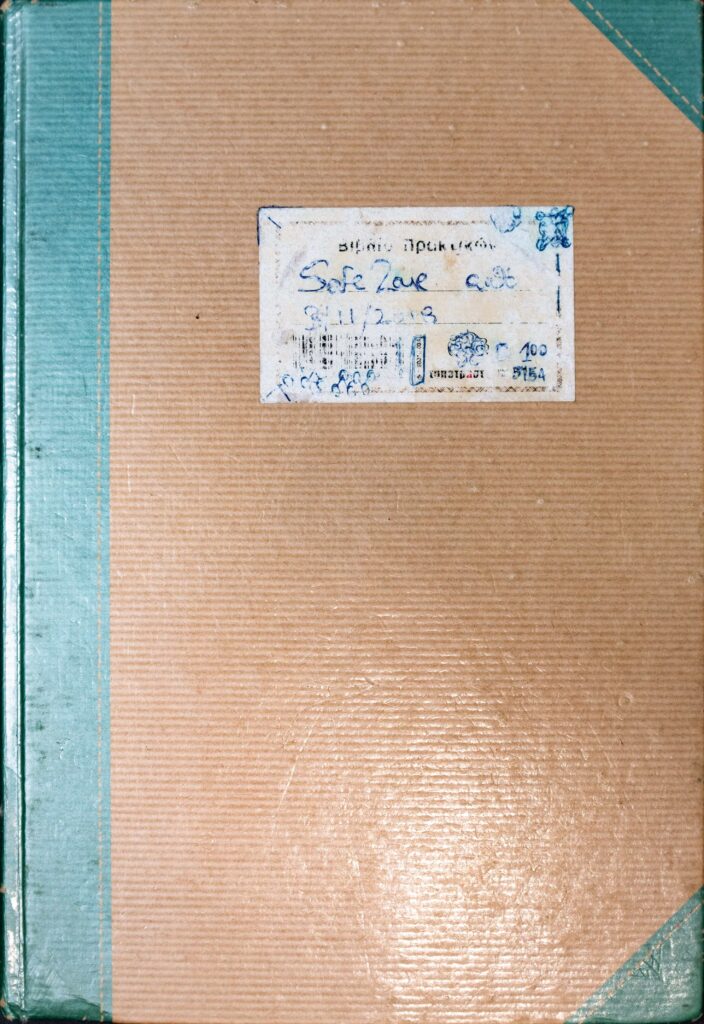
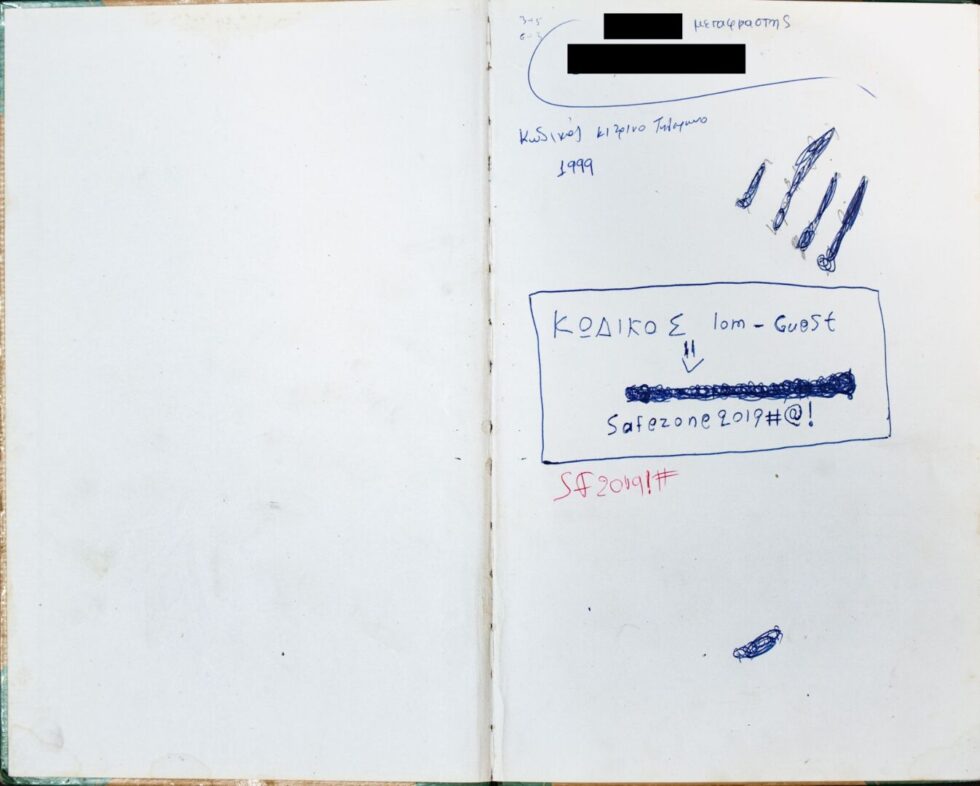
It turns out to be the day-to-day diary that was maintained by eleven employees of the “International Organization for Migration”, an intergovernmental organization that is affiliated with the United Nations and was responsible for the so-called “safe zone” in Moria.
According to IMO, its team at the safe zone consisted of “child protection workers, psychologist, lawyers, caregivers, nurses [and] interpreters to assist children and cover all of their needs.”
The safe zone was where the unaccompanied minors in the camp lived under supervision, often for months, while they waited to be transferred to the Greek mainland or to other European countries. The fenced area was set up to provide these minors with better protection than was available in the rest of the camp. They were allowed to leave during the days, but should stay inside at night.
Moria’s unsafe living conditions have been reported extensively. At the beginning of 2020, Investigate Europe — together with the Greek investigative network Reporters United — published an investigation about the jailing of minor migrants who were made to live across European countries. As part of this investigation, IE also reported about the unsafe conditions in Moria.
Solomon has reported extensively on the precarious living conditions of Moria camp. In January 2020, Solomon published an investigation into the causes that led to “a dozen deaths foretold” in a refugee facility, in which its inhabitants admitted that “security here is a big issue”.
The entries of the notebook, discovered in the ashes of Moria, confirm the shocking reality that Europe’s most vulnerable asylum seekers were left to endure. Written from the perspective of the people who were there to protect the unaccompanied minors, it reveals their helplessness and inability to do so. Care workers, like Fanis, also used the book to raise an alarm and complain about the inaction of the authorities.
When the minors were outside of the protected area, almost anything could happen to them.
The logbook reveals the constant, never-ending technical insufficiencies, the deep psychological struggles that the minors experienced because of their confinement in Moria, and the dangers awaiting them in every corner — not just outside the safe zone, but inside it as well. It depicts a reality in which the danger of electrocution seemed not only to be embedded in everyday life, but was far from being the sole concern.
How we worked
The personnel signed the pages of the logbook with their names; most of the time, they used only their first names, but sometimes, they included their last name. The care workers referred to the minors by their full names. We are only publishing the initials of the minors’ first names, and have altered the names of the care workers, in order to protect their privacy. All quotes are attributed exactly as they were written by the social workers (translated from Greek), and all underlined words and punctuation follows the original text by the care workers in the logbook.
Constant darkness over the safe zone
Lack of electricity — caused by heavy rainfalls or other incidents — is an issue that often appears in the 190 pages of the notebook. Sometimes, the problem was not fixed for days.
An absence of electricity at night meant that the staff were unable to supervise the two sides of the barbed wire, which is what separates the safe zone from the rest of the facility. Checking who attempts to enter or exit the safe zone was an important task. After all, it was the caretakers’ task to make sure the minors were safe while they were in the safe zone.
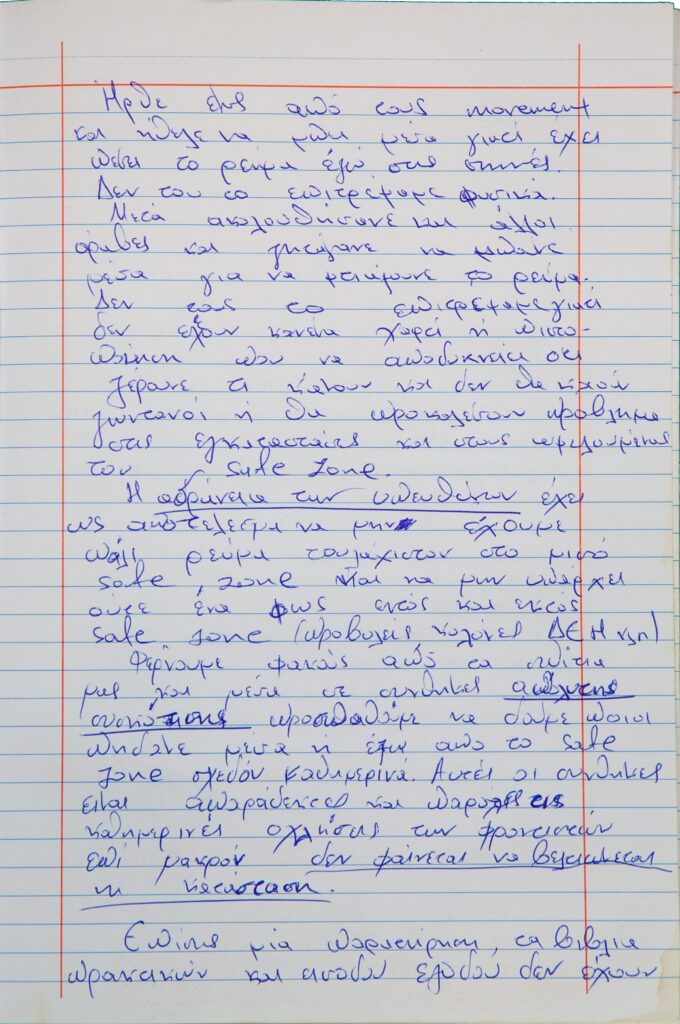
So, on November 24, 2018, with a power shortage that has already lasted several days, the care worker on shift opens the notebook. It is the shift of Fanis, Maria and Giannis. Their tone sounds desperate.
“The inaction of the people in charge is resulting again in us not having electricity, and not having even one light inside and outside of the safe zone,” the note says. “Almost daily, we bring torches from our houses, and in conditions of full darkness, we try to see who jumps inside and who jumps outside of the safe zone. These conditions are unacceptable, and no matter the daily complaints of the care workers for long, the situation does not seem to be improving.”
The writers’ worry seemed well-warranted. When the minors were outside of the protected area, almost anything could happen to them.
Text in English:
[…] The inaction of the people in charge results to us again not having electricity at least in the small safe zone and to not having even one light inside and out of the safe zone (floodlights, electric pillars etc). We bring torches from our homes and in conditions of full darkness we try to see who jumps inside or outside of the safe zone almost daily. These conditions are unacceptable and no matter the daily complaints of the care workers for long the situation does not seem to be improving.
A Christmas note…
On the top of the page, a “Merry Christmas!!!” in big, clear letters stands out among other notes that appear to be hastily written. It is 25 December 2018 and S., a female minor who resides in the safe zone, has just passed a piece of paper with a name on it to the social workers.
It is the name of her abuser. The care workers jot the name down on the book with a pencil, among other notes made with a blue pen.
“It’s someone who beat her outside of the safe zone while he was drunk,” they add. “We called the police, the officer sent the patrol officers. Let’s see what will happen.” The entry is signed by Fanis and Dimitris — their resigned tone indicating that they don’t actually expect much action to be taken.
Earlier that day, a man had approached the entrance of the safe zone (it’s not clear from the log whether it’s the same man). While talking with the care worker, he accused the minor girl, S., of stealing money from him. The man had given her money on many instances, he claimed, “in exchange for things that can’t be described…”
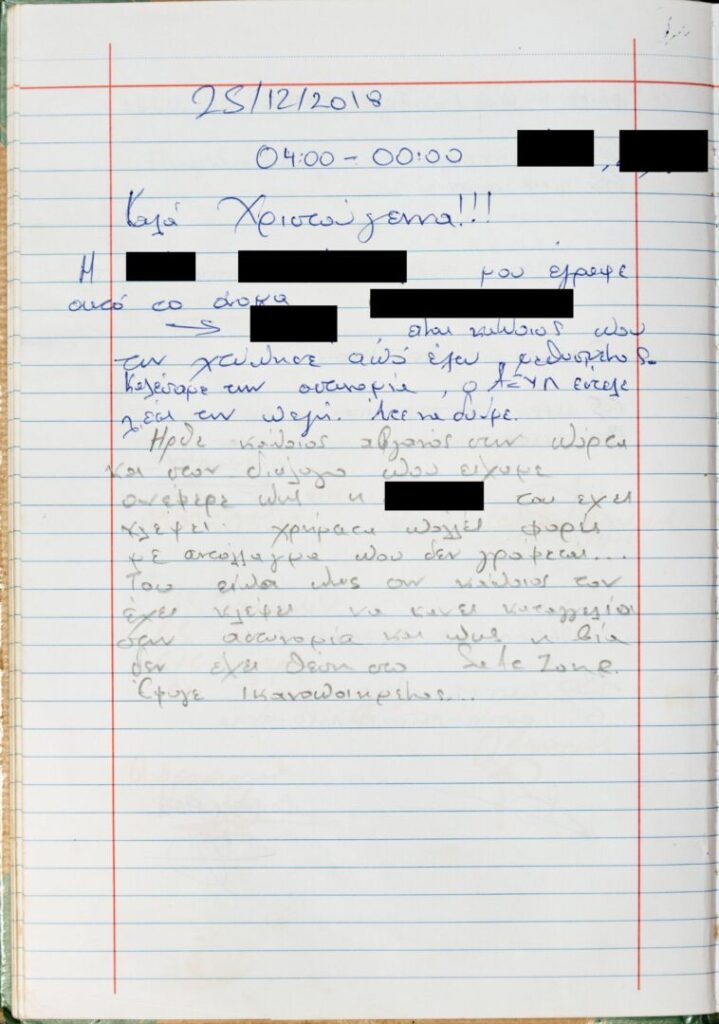
Text in English:
25/12/2018 Merry Christmas!!! S. wrote this name for me. It’s someone who beat her outside of the safe zone while he was drunk. We called the police, the officer sent the patrol officers. Let’s see what will happen. Some Afghan man came to the door and in the discussion we had he mentioned that S. had stolen money from him many times in exchange for things that can’t be described… Signed by: Fanis, Dimitris
The social workers had sent him away, telling him that if someone had stolen money from him, he should go to the police, and that violence has no place in the safe zone. “He left satisfied…,” the notes say, leaving it unclear whether there were consequences for the man or whether the abused girl received the necessary help.
In related questions addressed to IOM from Solomon, Investigate Europe and Reporters United, IOM answered that “psychological support to children to prevent or address any arising conflicts” was granted under its supervision.
… and minors’ encounter with Moria’s reality
Sexual exploitation, as implied in the above incident, is one of the dozens of dangers that minors face from the moment they cross the fence to enter the safe zone. Other major problems include alcohol or drug abuse or getting involved in serious fights.
On the evening of April 6, 2019, male minor N. is reported to “have made inhalations of the liquid used to refill lighters, as usual, and started to act in a weird way”. After some time, he starts pelting stones at the containers, smashing windows. “The officer was informed, they came quite quickly, but N. jumped off the fence and left,” states the entry.
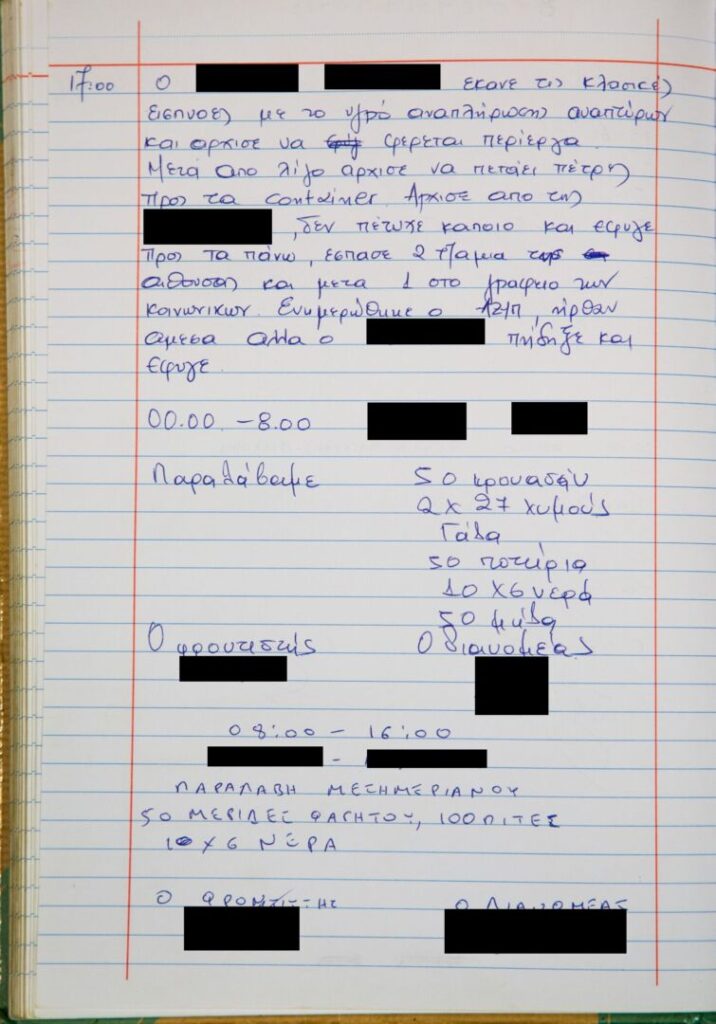
Text in English:
17:00 N. did the usual inhalations with the liquid of refilling lighters and started to behave weirdly. After a while he started throwing stones to the containers. He started from Amelias’s, didn’t hit one and went upwards, broke two windows of the room and one at the office of the social workers. The officer on shift was informed and came quickly but N. jumped and left. Signed by: Antonis, Maria
There are numerous cases reported in the logbook, sometimes on consecutive days, describing minors who return to the safe zone drunk or stoned. In some cases, they cause disturbances to the other residents or care workers, engaging in altercations.
“Fuck Moria!”
Sometimes, the care workers appear to be unable to handle a situation and need to ask for the intervention of the police present in the camp to calm things down.
“*We are still alive!!!*” a note signed by the care workers Dimitris and Iosif concludes on the night of December 6, 2018. “As Q., H. and A. came back from outside, they were probably drunk (maybe even high) and insulted us by saying ‘fuck you, fuck police, Moria’ etc.”
Verbal insults are not the only thing that take place that night. The logbook provides a detailed description of the events that happened before the police — after trying for 40 minutes — finally managed to calm down the minors, eventually taking the three boys to the police station.
“It’s nice to be crazy,” the minor named Q. keeps on shouting to the care workers. His outburst is translated into a number of damages: “There are 13 windows broken, we did not check the closets, but estimate three or four of them too, and rubbish bins are also among the broken items.
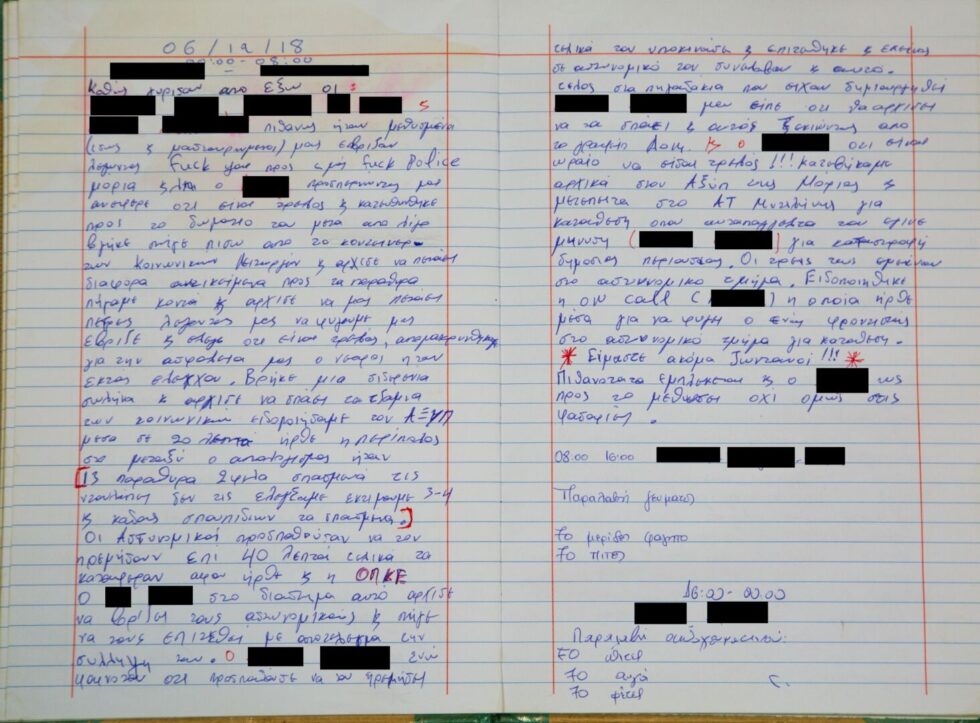
Text in English:
6/12/18 As Q., H. and A. came back from outside, they were probably drunk (maybe even high) and insulted us by saying ‘fuck you, fuck police, Moria’ etc. While crossing us I. said that he is crazy and went to his room. After a while he got outside, went behind the containers of the social workers and started to toss various objects to the windows. We went close to him and he started to throw stones to us telling us to leave. He was calling us names and was saying that he is crazy. We walked away for our safety, the young boy was out of control. He found an iron tube and started to smash the windows of the social workers’ [containers]. We contacted the officer on shift. In 20 minutes the walking patrol came. […] The Policemen were trying to calm him down for 40 minute. In the end they managed it after the special unit came too. A. in this period of time started to call names the policemen and tried to attack them, resulting in his arrest. A. while he seemed to be trying to calm him down, in the end he was inciting him and he attacked an officer too and he was also arrested. Finally, in the discussions that followed A. told me he would start smashing things too starting from IOM’s room. And S. [told] that it is nice to be crazy!!! We firstly went to the officer in shift of Moria and later to the Police Station of Mytilini to testify, where a sue against I. for damage to public property was made. The three stayed at the police station. The on call colleague was informed and came on time so one of the care workers could go to the Police station to testify. *We are still alive!!!* Possibly S. is also involved in getting drunk but not in the events that followed. Signed by: Dimitris, Iosif
Tensions among the minors
Previously, Solomon, Investigate Europe and Reporters United have extensively recorded that the overcrowded and dire conditions at the Moria camp fuelled tensions between residents of different ethnic and national groups.
In the winter of 2020, Investigate Europe and Reporters United published findings about the dire conditions endured by minor asylum seekers across the continent, including at Moria.
“They stand in line. There are queues in front of the toilets. There are queues to shower, often in cold water,” we wrote in our report. Swedish aid worker Patric Mansour, who had worked in Moria since the early launch of the camp, told us that the high levels of stress and frustration were created by an everyday life that was governed by “delays in all areas”.
And now that Moria has burnt to ashes – has the situation for the minor asylum seekers arriving on Lesvos improved?
“All the frustration is placed on the individual, who lives in uncertainty,” he said. “There is violence and crime. People fight for little things because of stress.”
“We don’t have anything specific to do during the day here and that’s what drives us crazy. That’s why people end up arguing with each other,” people who lived at Moria told Solomon when we visited Lesvos last February. Most of the people we met had witnessed violent incidents.
The logbook shows that minors were also affected by the violent conditions in the camp and violence is transcribed as part of everyday life. For example, on November 26, 2018 a fight among two boys leads to one more getting involved, and finally ends with one of them being taken to the doctor.
A week later, on December 2, 2018, two brothers attacked a third boy with an iron and a wooden pole. Incidents like the ones above are often mentioned in the care workers’ entries, with a tone that shows that they are not surprising.
Health issues in the safe zone
Sometimes though, the minors direct the violence towards themselves.
On November 6, 2018, the female minor S. — who would later report about the abuse — harms herself with a razor inside the girls’ showers, and is brought to the doctor. “The wound was deep,” says the entry. On March 8, 2019, another female minor, mentioned as A., also cuts herself and is brought to the local hospital to be seen by a psychiatrist.
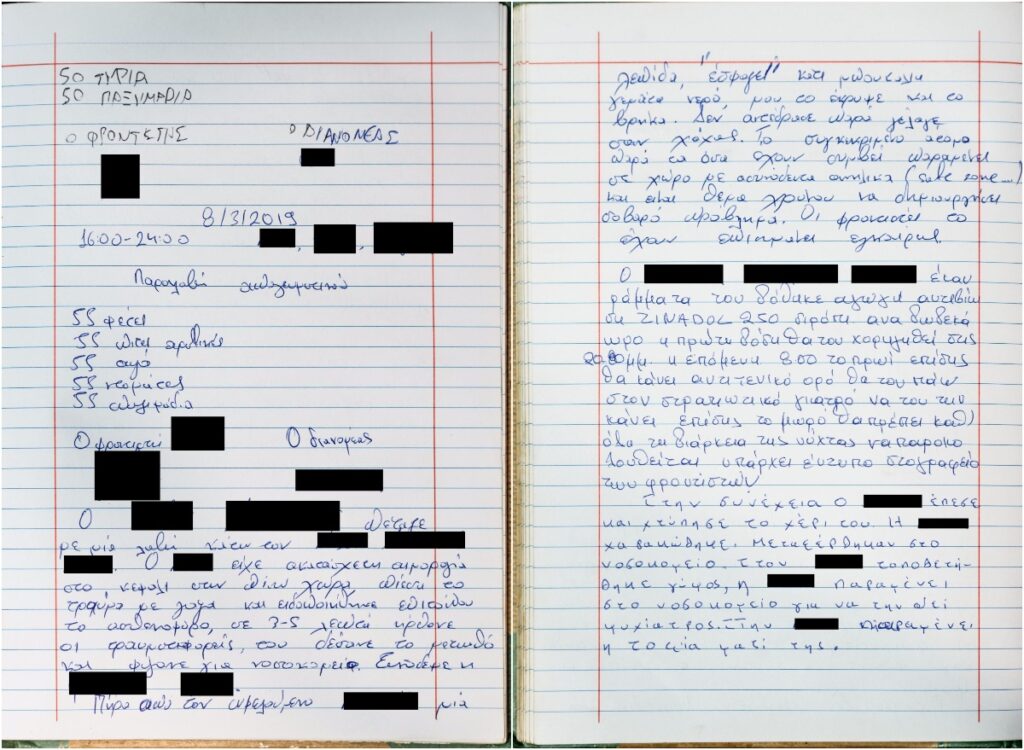
Text in English:
I took a blade from beneficiary N., he was “stabbing” some bottles of water, he hid it from me and I found it. He didn’t react but he was only laughing. The specific person no matter what has happened remains in a place with unaccompanied minors and it’s a matter of time to create a serious trouble. The caregivers have mentioned that on time. […] Then, N. fell down and hurt his hand. M. cut herself. They were taken to the hospital. N. had plaster put on his hand, while M. remains at the hospital to be seen by a psychiatrist. On call colleague is with her. Signed by: Fanis
Other entries in the notebook similarly highlight the psychological traumas experienced by the children in the camp.
Intervention by the camp’s military doctor is often needed, and in a number of cases, minors have to be escorted to the island’s hospital. Even so, they do not always receive the help they need.
On the night of December 1, 2018, a baby who lives with her teenage mother in the girls’ section does not stop crying. “We took [the baby] to the military doctor of the camp, but he told us that he has no expertise on babies and that someone should see it tomorrow,” the care worker writes, adding that the baby could possibly have chicken pox.
That night, the work in the safe zone is once more affected by the power shortage, making it unable to provide the baby with any heating against the cold December night.
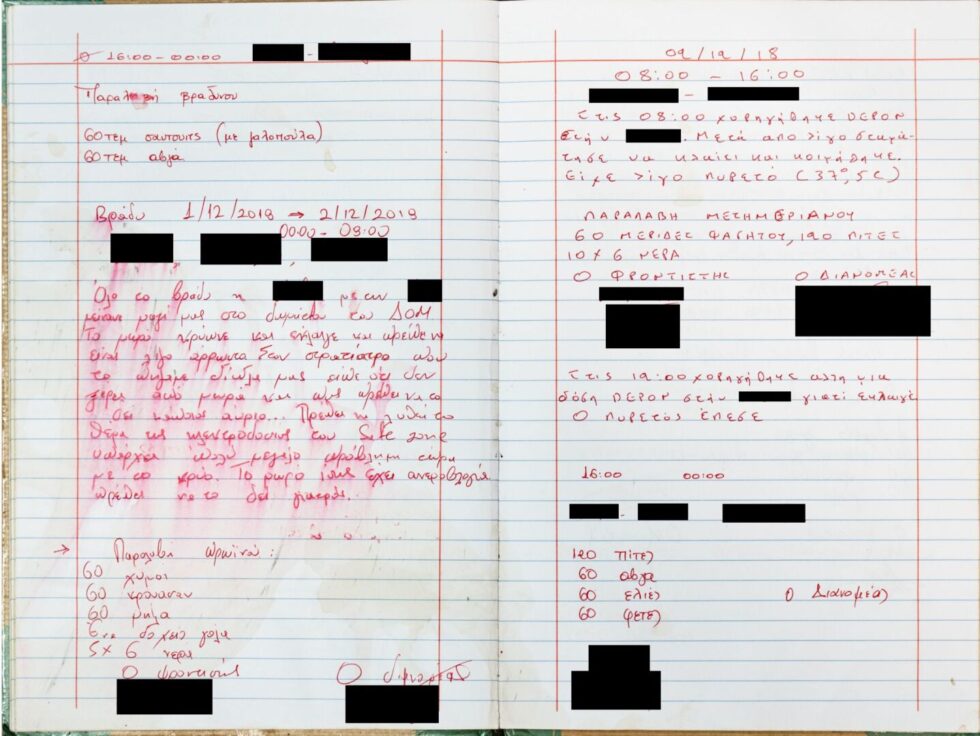
Text in English:
All night long S. and H. stayed with us in IOM’s room. The baby was cold and crying and it must be a little sick. We took [the baby] to the military doctor of the camp, but he told us that he has no expertise on babies and that someone should see it tomorrow. A solution should be given to the issue of electricity in safe zones. There is a very big problem now with the cold weather. The baby might have chickenpox. It should be seen by a doctor. […]
Repeated warnings fall on deaf ears
The log of December 7, 2018, is somewhat longer than that of most days, and includes two different kinds of warnings — spanning two pages — from Fanis, the social worker on shift.
Regarding events that took place the previous night — which resulted in police intervention — Fanis writes, “It is obvious that there is a great inactivity in the management and supervision of the section, despite our constant complaints and warnings. We will keep informing and working in unprecedented and unacceptable conditions, and let us all wish that there will not be more serious incidents with beneficiaries and colleagues.”
The care worker goes on to add that ten more Afghan boys were transferred to the safe zone the day before, and warns that transfers of this volume could fuel tensions in the small community of the safe zone.
“The ‘old ones’ feel that they need to prove something, and the ‘newcomers’ feel the pressure of the new society in which they have entered. Transfers of beneficiaries should take place gradually, as their number as well as their nationality matter, otherwise events like that of yesterday will continue to overturn the reality of the safe zone.”
But that is not the only concern the care worker expresses that day. Fanis notes that older boys, involved in acts of violence in the past, appear to remain in the safe zone, causing anxiety to the caregivers. In the logbook, they chronicle encounters with them, and warn of similar events happening in the future.
“In the least, it is problematic to see mothers with babies, unaccompanied young boys and criminal elements, even persons holding knives and makeshift weapons, living together for months in the same place. The role and the cause of existence for the safe zone needs to be redefined and this is a discussion that has to take place with no further delay,” the note concludes.
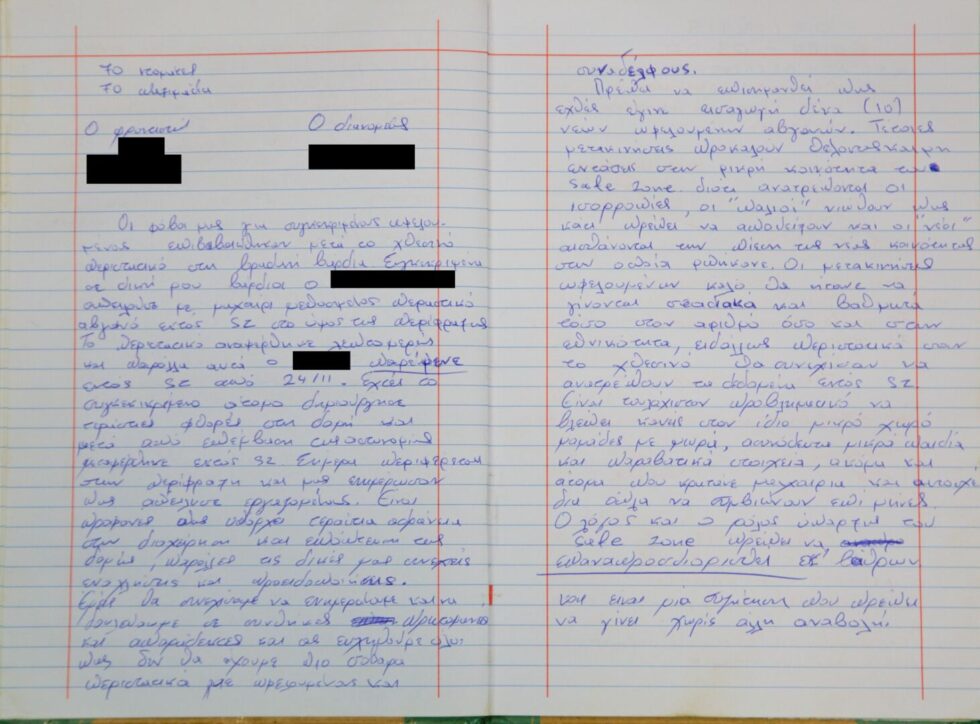
Text in English:
7/12/2018 Our fears for specific beneficiaries were confirmed after the event that took place in yesterday’s night shift. Specifically, on my shift I. was drunk threatening a passerby Afghan outside of the SZ (safe zone) close to the barbed wire. The event was reported in detail and despite this I. was remaining in the safe zone since 24/11. Yesterday this person created huge damages to the facility and only after the intervention of the Police was he taken out of the SZ. Today he was walking around the barbed wire and we got informed that he threatened personnel. It’s obvious that there is a huge inaction in the management and supervision of the structure, despite our constant complaints and warnings. We will keep to inform and work in unprecedented and unacceptable conditions and let us all hope that we will not have more serious incidents with beneficiaries and colleagues. (…) It’s at least problematic to see mothers with babies, unaccompanied young children and outlaws, even people holding knives and makeshift weapons at the same place living together for months. The cause and the role of existence of the safe zone needs to be redefined from deep and this is a discussion that needs to take place without further postponement. Signed by: Fanis
It appears from the logbook that the competent authorities did not take the required action. Incidents, including violent conflicts between minors, do not stop after this entry, but continue for as long as the book covers.
Answering the questions we asked, IOM stressed that they worked “in close coordination and under the guidance of the Reception and Identification Center (RIC)” which means that the responsibility for any important decisions lies with the Greek authorities. The Ministry of Immigration and Asylum did not respond to any of our questions.
On the day of the last entry — May 8, 2019 — there were 4,752 people living at Moria, even though its capacity at the time was only 3,100. The safe zone had a capacity of about 150 unaccompanied minors but in the time span of the logbook, there were between 300 and 600 living there.
Just three months after that last entry, on the night of August 25, 2019, another incident took place. Just like the care workers had feared, violence erupted. A 15-year-old boy from Afghanistan was stabbed to death in the safe zone.
No provision for unaccompanied minors in Moria 2.0
And now that Moria has burnt to ashes – has the situation for the minor asylum seekers arriving on Lesvos improved?
In the aftermath of the fire, Solomon was present on the island, providing on-the-ground reporting on the troubled conditions in which thousands of victims of the fire were left to endure for about a week.
After the destruction of the structure, the 400 unaccompanied minors that were then living in the safe zone of Moria were transferred to the mainland. According to the UNHCR, to date seven countries in the European Union have accepted 321 of them.
As new arrivals are happening in Lesvos again, it is unclear at this time where the unaccompanied minors arriving on the island will be accommodated.
The new structure, often referred to as “Moria 2.0”, has been set up in a former shooting range of the Greek army. The people who live there today are only provided with food once a day, and although eight weeks have passed since the camp was created, there are still no showers.
Residents told Investigate Europe, Reporters United and Solomon that they have to shower in the open, while parents bathe their children in the nearby sea. The families live in tents, without beds or solid foundation, which were flooded by the season’s first rain storms, while up to 100 single males share big tents, sleeping on bunk beds.
So far, there is no area in which unaccompanied minors can live separately from the rest of the population. As of publication, the Greek ministry has not responded to Solomon’s request for comment.
However, for the time being, in this new reality for the most vulnerable among people seeking refuge in Europe, there isn’t even a “safe zone” anymore.
—
* The reporting for this article was done in a collaboration between Investigate Europe, Solomon and Reporters United. Other media partners for this story include Tagesspiegel, Vice (Germany), openDemocracy, Publico, Mediapart, WP Magazyn, Klassekampen, infoLibre, Rheinpfalz.
Sarajevo-Jerusalem
SARAJEVO-JERUSALEM 1 | 6
The Ordinary Heroes of the “Jerusalem of Europe”
Through the history of Sarajevo’s Jews, a journey in two cities on a quest for universality, symbols for the people of the Book, and epicentres of modern conflict. A journey towards a certain idea, real or imaginary, of coexistence. Today we look at the courage of a handful of men and women during the wars of the 20th century.
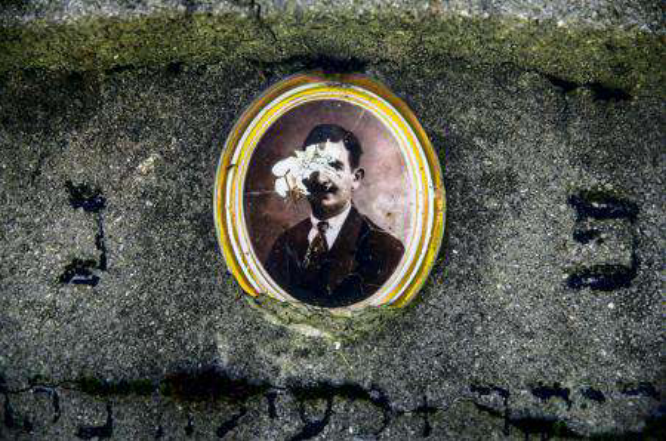
A stele in the Jewish cemetery in Sarajevo in May.
Photo: Damir Sagolj for Le Monde
It’s a day like any other during the Siege of Sarajevo. A Saturday in February with no snow or rain. A morning a little on the cold side, like any other morning in winter, and a little sad, like any other morning of the siege. Accompanied by her daughter Aida, her son-in-law and her granddaughter, Zeineba Hardaga has just got onto a bus that will take her away from her birth town forever. Servet Korkut has also got on this coach. No one knows if these two women know each other. Yet an invisible thread connects their lives.
It’s an ordinary Saturday in 1994, among the 1395 days of a besieged city at the edges of a Europe that is, at the end of the 20th century, overwhelmed with war, carnage and drama. That day could have been forgotten, like so many before and after. In Sarajevo, it was not.
Around midday, a Serbian army gun position launches a round of mortar shells from one of the surrounding hills. After grazing a roof, the 120mm mortar shell comes crashing down on the Markale market, on Marsala-Tita street. The explosion rips apart the bodies of the sellers and the onlookers. Not that there was much on sale that day in the surrounded and starving city but, when the morning is calm and even if they know the bombing always returns, Sarajevans walk around, share a cigarette and discuss the news from families and frontlines.
That mortar shell enters into History as being the deadliest of the war: 68 dead, 144 wounded. While the lengthy investigation of the International Criminal Tribunal concludes that it was a deliberate strike by the Serbian army on Markale market, and some of its generals would later be sentenced for the war crime, the gunner himself probably has no idea that on this day he will set a gruesome record in artillery history: 212 people scythed by one single mortar shell.
The horror of the carnage and the international reverberations divert attention away from what was happening right at the same moment, that February 5th, 1994, just five hundred metres away on Dobrovoljacka Street. Buses are setting off, transporting Zeineba Hardaga, Servet Korkut and three hundred other Sarajevans away from the city. While the journalists are busy rushing from the market to the hospital, from the hospital to the morgue and from the morgue to their satellite phones, this story goes unnoticed.
That day could have been forgotten, like so many before and after. In Sarajevo, it was not.
A lot of the passengers on this bus know each other: they are the last Sarajevan Jews fleeing hell, thanks to this eighth and final evacuation convoy of the war. Zeineba Hardaga has a particular status amongst the group. Not only can she not name any Jewish ancestors amongst her relatives but she is a Muslim and the only passenger to be an honorary guest of Israel, the final destination of these refugees. She is due to be met by Prime Minister Yitzhak Rabin. The other elderly woman, Servet Korkut, is also a Muslim with a particular attribute but, as opposed to Zeineba Hardaga, she doesn’t know it yet. Her destination is Paris, where her son Munib has taken refuge at the end of the first year of the war.
If, on this morning, these two women find themselves with hundreds of others fleeing the “Little Jerusalem” or “Balkan Jerusalem”, as some of them like to call Sarajevo, it is because this is not their first war.
The other conflict they have lived through also started in April, when the German army and its Croatian Ustachi allies entered Sarajevo in 1941, fifty-one years before the collapse of Yugoslavia. The city is used to invaders, and is used to not worrying too much about them. Its Ottoman then Austro-Hungarian past has shaped a very particular identity, between East and West. The Sarajevan natural inclination towards indolence means that they have always viewed each new pretender to power with wariness, without hate or prejudice towards them. The other trait of this provincial city with a majority of Muslims, tucked away in the mountains and neither possessing the strategic or economic attractions of Constantinople or Salonika, is that it is a very Jewish city.
The good neighbour as way of life
The story of the Sarajevan Jews is that of the Spanish Sephardim – before some Ashkenazi Jews joined them coming from the north during the Austro-Hungarian Empire. A little after the end of the Reconquista and the Catholic armies’ entry into Toledo in 1942, the Spanish sovereigns, Ferdinand and Isabelle, offered Jews the choice of either conversion or exile, brutally drawing to a close what Sephardi history holds as its Iberian golden age. As a community fleeing Christian Europe, they went on to take refuge in the heart of Muslim lands, from North Africa to the Balkans and to the Middle East.
The first fifteen Jewish families of Sarajevo are merchants from Salonika who arrive in 1565. They speak Ladino (also called Judeo-Spanish), a language close to Castilian which they will retain as a community and family language until the 20th century. The Ottomans allocate them a neighbourhood in the old town and permit them to build their first synagogue (the town would have up to six sites of Jewish worship in 1941). The neighbourhood, which translates as “The Courtyard” (Cifut Han in Turkish, Il Kurtijo in Ladino) is not a ghetto and is populated only by the poor. Other Jews come and live in the Bjelave neighbourhood, then elsewhere in Sarajevo.
Over the centuries, even though some of the administrative rules are discriminatory, no political power, be it Ottoman, Austro-Hungarian or Yugoslavian, persecutes the Sarajevan Jews.
In April 1941, the German army and its Croatian Ustachi allies, enter Sarajevo. The tracking of the Jews begins
By all accounts, this is a town that welcomes them. And far from the modern terminology making Sarajevo a “multi-ethnic” symbol during the war of the end of the 20th century, its inhabitants have always cultivated what they call komsiluk, which is to be a good neighbour. Nothing here (the nation, the community, or religion) in times of peace and even during periods of political tension or war, can take precedence over the relationship with komsije, with the neighbours. Generally accepting about whoever is in charge in Constantinople or Vienna, it reflects how Sarajevans live side by side with respect for each other’s communities, religions and traditions.
In that month of April 1941, Zeineba Hardaga is with her husband, Mustafa Hardaga, and she barely gives a thought to what is going on in the capitals of their new masters, Berlin and Zagreb. In any case, how could they imagine the unimaginable? Especially since this town like a lost island is where, above and beyond its Muslim, Christian and Jewish traditions, the real religion could only ever be the gentleness of co-existence, the only city in Europe able to claim to have never had a Jewish ghetto. Who could imagine Auschwitz here? The Hardagas have only ever worried about their family, and their neighbours.
In their case, their neighbours are called the Kabilios, and they are Jewish. Mustafa Hardaga and Josef Kabilio like to sit and talk together, they have become genuine friends. In When Neighbours Were Real Human Beings (University of Sarajevo, 2010), the historian Eli Tauber gives an account of the good neighbour relationship that is typically Sarajevan: “Each family maintains a high level of respect for the customs of the other. The Hardaga family women would not clean or dust their rugs on the shabbat, in order not to disturb the atmosphere of rest and celebration that reigned in the synagogue next door. The Kabilios were careful not to have too many festive activities during Ramadan, mindful not to make fasting any more difficult for the Hardaga family.”
When the persecutors begin hunting down Jewish people, the Hardagas take the Kabilios into their home. Josef Kabilio quickly gets his family to safety in Mostar, in the Italian occupation zone. There, in Herzegovina and Dalmatia, Jews are discriminated against and put in detention camps but they are not exterminated and the majority will survive the war. But Josef Kabilio becomes overconfident and returns on his own to Sarajevo. He is arrested by the occupiers, manages to escape and yet again takes refuge with the Hardagas, who hide him for months before he can get back to his family.
Atheists, communists and not very Jewish
After the war, Zeineba Hardaga spoke about how they and the Kabilios formed “one single family” during those troubled times, how the women took off their veils for the first time in front of a stranger, and received into their home a neighbour who had become a brother. When the Kabilios return to Sarajevo in 1945, they stay with the Hardagas again. They find their hidden-away box of rings carefully watched over for them, ensuring they can emigrate to Israel and start a new life. Josef Kabilio will give his testimony to Yad Vashem, the Jerusalem memorial paying tribute to Gentiles who saved Jews during the Holocaust, and Mustafa and Zeineba Hardaga will be awarded, in 1984, the honour of “Righteous Among the Nations”.
The story of the Hardagas and the Kabilios is far from being a unique one in Sarajevo. On that bus of 5th February 1994, Servet Korkut’s life is also an echo of Zeineba Hardaga’s, again casting a light on the Second World War.
They find their hidden-away box of rings carefully watched over for them, ensuring they can emigrate to Israel and start a new life
One morning in the winter of 1942, after having spent a night sleeping on a bench in Sarajevo, a young Jewish woman called Mira Papo meets a neighbour from before the war. As opposed to the huge majority of Sarajevan Jews, hers is a unique story. She has managed to evade the roundups and deportations through escaping to the mountains and joining the Partisans, Tito’s communist guerrillas. One day, her commander made the decision to expulse the thirty-two Jewish fighters in the unit, ordering them to return to occupied Sarajevo. “Apparently it was a one-off event in the Partisans and when told about it, Tito himself gave the order that it should never happen again”, the son of Mira Papo, Davor Bakovic, explains. Today, he lives in the Moshav (community village) of Neve Ilan, in Israel. “Of those thirty-two Jews, only my mother survived.”
The neighbour insists that Mira Papo waits in the park for him. He comes back accompanied by a very elegant man wearing a fez. The man introduces himself: he is called Dervis Korkut and is the librarian of the museum. He lives with his wife Servet and their newborn, Munib. He offers to conceal Mira Papo and takes her back to his home. To neighbours and visitors, they make out that she is a cousin from the countryside, who has come to help Servet look after the house and baby. The young woman cannot say a word in front of anyone, because the Korkut family only speaks Albanian, Servet’s native language, at home. People would be confused if the cousin from the countryside were to speak Serbo-Croatian. “My mother gave Mira Papo a Muslim veil and together they would walk around Mejtas”, a neighbourhood in the centre of Sarajevo, Munib Korkut explains in his house perched upon a rock overlooking the Adriatic sea, in a village north of Dubrovnik called Zaton, in Croatia.
The young woman hides with the Korkuts for six months. After this, another neighbour, also party to the adventure, supplies her with false documents to leave the city and re-join the resistance movement, where she will stay until the end of the war.
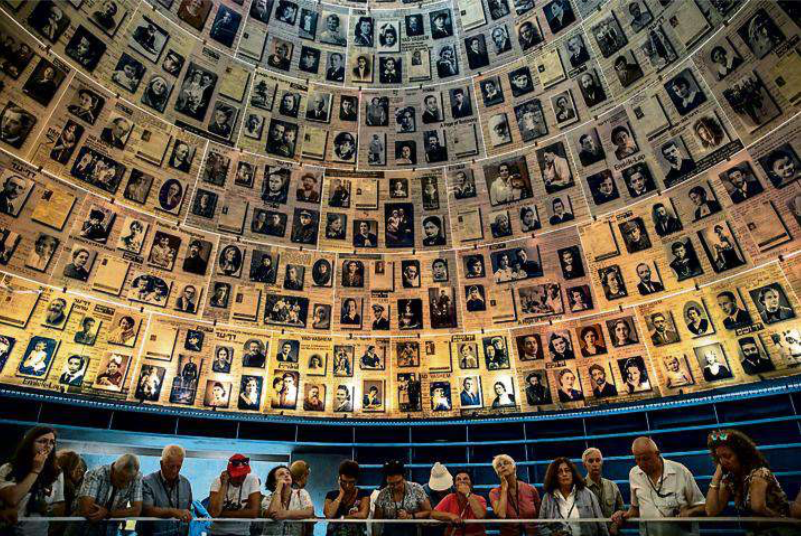
Museum of the History of the Shoah, Jerusalem, May 28.
Photo: Damir Sagolj for Le Monde
Escaping the deathly grasp of a Holocaust that killed 10,000 in Sarajevo, both the Kabilios and Mira Papo eventually headed for Jerusalem, in different eras and for different reasons. Not all Sarajevan Jews responded in exactly the same way to the founding of Israel. For some, it was an immediate call to leave a genocidal Europe, for others, the temptations of a new life, a promised-filled adventure. In Mira’s case and others like her, who were atheist, communist and not very Jewish, it proved to be a long journey towards their rediscovery of Judaism.
Mira had two boys, Daniel and Davor, with her officer husband Bozidar Bakovic only to become widowed soon after the war. Afterwards, Mira devotes herself to Tito’s Yugoslavian project, continuing her career in the army. An officer, she is transferred to Split, then Zadar, before settling for two decades in Rijeka, where she raises her children. It is there, on the Dalmatian coast, that she discovers her Jewish identity. It is not that this hardened socialist suddenly finds God or that she begins to attend religious services fervently. It is more about the pleasure she takes in educating her sons through contact with the community’s cultural activities, so much so, after their military service and university studies, when they are at an age to make the decision, they emigrate to Israel. Davor remembers his mother’s discovery of Jerusalem. “It was a dream for her. She lived there for the last twenty years of her life. The city reminded her of Sarajevo, and mostly, she spent her time with Yugoslavian friends.”
What her son has no idea about for a long time, is that Mira harbours a secret pain, “the great regret of her life”, he says. In 1945, in Sarajevo, a woman had stopped her in the street. It was Servet Korkut who revealed to her that her husband, Dervis Korkut, who had been such an honourable man and had saved Mira, had been arrested by the Yugoslavian police and was about be tried for collaborating with the Nazis. “The truth is my father was an anti-communist and did not hide it”, Munib Korkut says. Mira promised to come to the trial to testify in his favour but her son, Davor Bakovic, explains: “My father, an officer, convinced that she would be executed if she dared to contradict the official version, forbade her from going to the courthouse and locked her at home for several days. My mother was sure that Korkut was an extraordinary man and that he would be unfairly executed. She lived with the guilt of never having testified.”
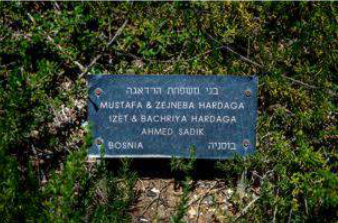
Yad Vashem memorial in Jerusalem: the plaque dedicated to the Hardaga family, who hid their Jewish neighbors during the Second World War
Photo: Damir Sagolj for Le Monde
“Righteous among the nations”
It is only at the end of her life, when war once again ravages Sarajevo, that Mira Bakovic learns by chance, from a newspaper article about the Sarajevo museum, that Dervis Korkut had not been condemned to death. In fact, he was freed from prison six years later and passed away peacefully in 1969. Still eaten away by guilt, and in the meantime having learnt of the existence of Yad Vashem memorial, she writes her testimony.
In its archives, Yad Vashem preserves all documents relating to the Righteous and the people they have saved. Recorded on a typewriter and signed by hand, Mira Bakovic-Papo’s letter, dated 20th February 1994, recounts the adventure of how her life was saved thanks to the Korkuts. Ten months later, on December 14, 1994, after an investigation, Yad Vashem bestowed the title of “Righteous among the Nations” to Dervis Korkut posthumously and to Servet Korkut, who will be handed her medal by the Israeli ambassador to France. Her son lived in Paris at the time and she was joining him as she steps on that bus in Sarajevo. Munib Korkut then receives a phone call from Jerusalem, from Mira, who shares with him how she “carried this weight all her life” and how happy she is that his father is honoured in this way, even if many years after his death.
And by these bonds forged through five centuries of communities living together, through some people’s heroism during the Second World War, the rescue operation of Jews during Sarajevo’s siege and the buses carrying the Righteous Zeineba Hardaga and Servet Korkut along with many other towards new horizons, something else was forged. Above and beyond the waves of immigration between the cities, it created a special tie between Sarajevo and Israel.
“My son, we didn’t save Jews, we saved our neighbours”
– Zeineba Hardaga, Muslim from Sarajevo
These individual destinies, and so many others, make you go on a journey through the history of Sarajevo’s Jewish community and then on to a certain idea, real or imaginary, of coexistence. To explore these two cities is to understand their symbolism for the people of the Book but also for the fractured world of today: Sarajevo, the last “Jerusalem of Europe”, the first place to have been a target of the return of nationalist ideology in Europe thirty years ago, a city besieged at the end of the 20th century; Jerusalem, the centre of the world, holy city of three monotheistic peoples, the epicentre of the tumult in the Middle East and of the Israeli-Palestine conflict. Two Jerusalems both on a quest for, but also refusing, a hypothetical notion of “cosmopolitanism”. Two cities often mired in hatred, war, nationalist division and religious intolerance. Depending on the era, two cities that embody the destruction or gentleness of life. Two cities at the ends of the world, islands but also bridges. Two cities that attract the world’s attention and tell a universal story.
Zeineba Hardaga died in the Holy Land, which, in principle, had never been promised to her. “When she arrived in Israel, we, as Jews of the former Yugoslavia, went to the airport to greet her, recalls Eliezer Papo, the rabbi of Sarajevo, who lives in Jerusalem and at the time was a student in Judaism. A minister made a fine speech on how Israel would never forget those who had rescued the Jews during the worst time in history for the Jewish people. Zeineiba had these words for the minister: “My son, we did not save Jews, we saved our neighbours.” We were all deeply moved. It was magnificent, so humble, and it was the truth.”
Her daughter Aida, born from Zeinaba’s second marriage, converted to Judaism and became Sara, a name chosen as a homage to Sarajevo. She works in the archive department of Yad Vashem, the institution which praised her mother and allowed her family to escape the hell of Sarajevo and come to Jerusalem in search of a better life.
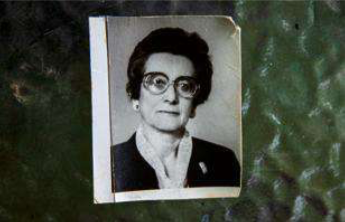
Portrait of Mira Papo, a Jew from Sarajevo who was saved by the Korkuts, a Muslim Sarajevo family.
Photo: Damir Sagolj for Le Monde
Full circle
As for the Korkuts, it did not take long before their descendants also took the road to Jerusalem. Having married the Kosovan Vllaznim Jaha, their eldest daughter, Lamija, lived in Pristina, unaffected by the siege of Sarajevo. But then the war reached her in 1999, when Belgrade, fighting against Kosovan guerrillas, deported non-Serbian Kosovans on a massive scale.
Having sent her children in advance to safety with a friend in Budapest, she flees to Skopje, Macedonia, with her husband. On her arrival, she shows leaders of the Jewish community the Yad Vashem certificate honouring her parents. The Jewish centres of Skopje and Budapest work together to organise the couple’s passage to Israel, their children following a few days later. As they arrive at Ben-Gurion Airport, amongst the crowd of officials and journalists, an unidentified man steps forward and addresses Lamija Jaha in Serbo-Croatian. “Hello, my name is Davor Bakovic, and I am the son of Mira Papo.”
One war later, destiny has come full circle. Fifty years after Dervis Korkut met Mira Papo on a bench in Sarajevo and took her into his home, Davor, a Sarajevan become Israeli, receives Lamija, a Sarajevan become Kosovan, in the land of Israel. The Bakovics help the Jahas to settle in. “For the only time in my life, I felt a closeness and an immediate friendship”, says Davor, in an emotion-filled voice.
And yet it is not for Mira Papo’s rescue that the museum librarian Dervis Korkut, dead long before his name was inscribed on the Wall of Remembrance in Yad Vashem’s Garden of the Righteous, remains in the memory of the city. It is an act far more mysterious and today much more famous that propelled him into the legend of Sarajevo.
SARAJEVO-JERUSALEM 2 | 6
Saving the Sarajevo Haggadah
Coveted by the Nazis in 1942 then threatened by Serbian bombs in the Bosnian War, this fabled 14th century manuscript recounting the Hebrews’ exodus from Egypt had to be hidden several times. Today, it takes pride of place in the town’s national museum.
When the German General Johann Fortner introduces himself to Jozo Petrovic, the director of the Sarajevo Museum in 1942, he knows exactly what he is looking for. His orders are clear: in the name of Nazi Germany, the general must lay his hands on the Sarajevo Haggadah, the museum’s masterpiece and one of the most precious Hebrew manuscripts in the world.
In Berlin, three competing institutions share the task of plundering Jewish treasure across Europe: The Reichsleiter Rosenberg Taskforce, led by Hitler’s close associate and chief ideologue of national-socialism, Alfred Rosenberg; the Ahnenerbe presided over by the Reichsführer Heinrich Himmler; and last, the Sonderkommando Künsberg. Under the guise of archaeological, cultural and anthropological studies, their objective is to prove the Aryan race’s superiority. Suffice to say, although he is already handling the deportation of six thousand Sarajevan Jews and the communist resistance rearing its head in the surrounding mountains, General Fortner, Commander of the 718th Infantry Division based in the region and mandated by the Einsatzstab Rosenberg, is undoubtedly not taking it lightly.
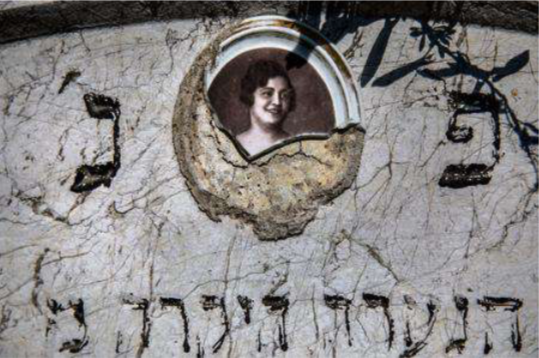
A stele in the Jewish cemetery in Sarajevo in May.
Photo: Damir Sagolj for Le Monde
The Sarajevo Haggadah is an illuminated manuscript containing the text of the Haggadah, the story of the Hebrew exodus from Egypt, read for two thousand years on Passover, the Jewish Easter. Its richness and perfectly preserved illustrations make it the most precious Sephardic Haggadah in the world.
Its story is one of a thousand mysteries and it inspires as many legends. Even its place and date of creation are unknown. According to experts, it was most likely created in Aragon, in the north of Spain, in the 14th century. The details of how it survived the Expulsion of 1492, which saw the Catholic kings drive the Jews out of Spain and destroy their heritage, are equally unknown. No doubt a family took it with them as they headed for exile towards the east. Historians have put forward possible theories about its passage to Dubrovnik or Salonika, without ever being able to furnish evidence. The only viable information that has emerged since its re-apparition in Sarajevo is that it passed through the hands of a catholic priest, Giovanni Domenico Vistorini, in the Venice region, in 1609. He appended his signature to the manuscript, saving it from the Church’s censorship.
It is a man named Josef Cohen who brings the Haggadah to the Sarajevo Museum, in 1894. Poor and needing to feed his family, it is with a heavy heart that he decided to give up the book after the death of his father. He sold it to the museum for 150 Austro-Hungarian crowns. The manuscript is then sent to Vienna to be evaluated. Viennese curators concluded it was masterpiece, one of a kind, which did not stop them from giving it a brand new and tacky cover. At least the evaluation ensured the book acquired the name it bears to this day, Die Haggadah von Sarajevo. The Hebrew manuscript was returned to its place in the Sarajevan museum collection, where it would seldom be exhibited for a century.
When, in 1942, General Johann Fortner presented himself to Jozo Petrovic, the museum director, unable to speak German, asked the librarian Dervis Korkut to join them in his office. The German officer’s visit having never been officially reported, the only account of it is that given by Dervis Korkut and his wife Servet, after the Second World War.
Its story is one of a thousand mysteries and it inspires as many legends.
Dervis “Efendi” Korkut is a man of a certain status in Sarajevo. His integrity and erudition have earned him the trust of both the museum’s director, Petrovic, and its curators. Before becoming guardian of the books in the museum, he had studied Islamic theology in Istanbul and Oriental languages in Paris. He speaks twelve languages. He loves history and traditions. “He was a living encyclopaedia and he was very respected in Sarajevo”, his son, Munib Korkut, says. Before the war, this pious man, decent and respectful of others, had written a text warning of the rise of antisemitism and praising his city’s inter-community relations.
So, when General Fortner asks to see the Haggadah, for Korkut, no worse fate could have befallen him. The museum’s director and the librarian know perfectly well of the priceless value of the manuscript. Dervis Korkut, a courageous man with profound anti-fascist convictions, loathes those who lack culture, who profane the sacred and who hunt down Jewish treasures. He cannot hand over the Haggadah to the Nazis.
Nestled amongst the Korans
In Zaton, a village by the Adriatic sea, where he retired after having been a refugee in Paris, Munib Korkut opens — after having served a welcome loza (grape brandy) — a bottle of dalmatian white wine and recollects. “My father told me the story of the Haggadah when I was an teenager, after the war. He said to me: “One day, a German officer arrived at the museum, and as Jozo Petrovic could not speak German he called me. The officer asked to see the museum. During the visit, he requested to see the Haggadah. So, I answered: “I’m sorry but another German officer came two hours ago and took away the Haggadah.” Furious, the officer left.”
What became of the Haggadah after General Fortner, who must have searched for ever for the identity of the other officer who had taken the treasure, left? “My father brought the Haggadah to our house, explains Munib Korkut, still wandering through his adolescent memories. A few days later, he entrusted it to a hodja (imam) who hid it in a village mosque near the Treskavica mountains. After the war, the hodja came to return the book and my father brought it back to the museum.”
In Sarajevo, countless stories circulate the city about the fate of the Haggadah during the Second World War. The mosque referred to by Dervis Korkut was said to be in Treskavica, or Bjelasnica or Igman, all three neighbouring mountains west of Sarajevo, however no one has ever found the village, the mosque or the imam.
“My husband had returned home with the Haggadah hidden under his jacket. He said to me: “No one should know, or they will kill us and destroy the book”.”
– Servet Korkut
Popular legends gladly add intriguing details: the Hebrew book could have been hidden in the mosque’s library, amongst the Korans, a Holy book among other Holy books, or have been buried in the mosque’s garden under a tree. When met and asked about it in Jerusalem, Eliezer Papo, the Rabbi of Sarajevo says, “Dervis Korkuk was an intellectual, an erudite man and would have never buried the Haggadah under a tree”.
Dervis Korkut was not a man to boast about his achievements. In fact, after the war, he never spoke to anyone about his act of hiding the young Jewish woman Mira Papo which would see him honoured as “Righteous Among the Nations” posthumously in Jerusalem. Nothing indicates that he ever spoke about his rescue of the Sarajevo Haggadah either, other than to his wife and on one occasion to his son Munib.
The other known details come from Servet Korkut, who spoke about the story after her husband’s death in 1969, first to her children, then in the last ten years of her life to a range of visitors, journalists and historians as the Sarajevo Haggadah became famous worldwide due to the Bosnian war (1992-1995).
In particular, she met the Australian journalist and novelist Geraldine Brooks who, before writing a novel inspired by the story of the Haggadah (People of the Book, Viking Penguin, 2008) published the interview in the New Yorker (“The Book of Exodus”, 3rd December 2007). The version recorded by Brooks matches with that given by the son: “My husband came back home for lunch with the Haggadah hidden under his jacket. He told me: “Say nothing to anyone. No one must know or they will kill us and destroy the book.” That afternoon, he went to Visoko, where one of his sisters lived, under the pretext of visiting her. From there, he took the book to a village tucked away in the Treskavica mountains, where his friend was the hodza of a little mosque. The Haggadah was hidden among the Korans and other Islamic books for the duration of the war”.
The youngest daughter of Servet, Lamija Jaha, lived, between two exiles in Israel and then in Canada, in Sarajevo with her mother during the last four years of her life. She often heard her mother telling the story to visitors. However, she recounts a detail that contradicts previous versions on one point, which would throw light on why the location of the Haggadah’s hiding place has never been found: “I always heard my mother say my father brought back the Haggadah to the house, hidden in his clothes. She then said that he had entrusted it to a friend who lived near the village of Travnik.” The fact that Dervis Korkuk was born in Travnik, a small town in central Bosnia and previously the Pachaluk (headquarters) of Bosnia when it was part of the Ottoman empire, gives credence to the hypothesis that he entrusted the treasure to a childhood friend who had become an imam is not an implausible one.
Sarajevo on the brink of collapse
The really funny side to the story is that while Sarajevo is a city brimming with one legend more spectacular than the next about the Haggadah, a great number of museum professionals do not believe a word of the Korkut family’s story. It is as if they cannot bring themselves to admit that their predecessors, such humble and serious professionals, could have let this jewel slip through their hands during a few troubled years. Mirsad Sijaric, the current director of the museum, who fought to defend the city during the siege before returning to his history studies, bats away all such stories. He wants it to be known: “I am sure the Haggadah never left this museum. We have a library of over 350,000 books and had maybe 100,000 books during that era. What better place than here to hide a book? We do not have any official documents proving the Haggadah was hidden elsewhere.”
This opinion, founded on the absence of archived documents, does not explain why Servet Korkut remembers her husband bringing home a book so precious that it could endanger their lives, or why Dervis Korkut, a man of integrity, would have lied to his adolescent son. Either way, the Sarajevo Haggadah is part of the museum collection in 1945. After having survived the destruction of Jewish treasures in Spain in the 15th century and eluding the Nazis in the 20th century, this was not, however, the end of its tumultuous destiny…
In the spring of 1992, war comes back to Sarajevo. This time, no enemy officer is on a quest for Jewish treasures, but the Serbian army bombs the city relentlessly. Sarajevo shakes, burns and threatens to collapse. The Haggadah is once again in danger as the national museum finds itself on the frontline. While, all around the city, those laying siege have positioned their canons on the surrounding hills, this is the place where the frontline descends to the city centre and skirts the Miljacka river, at the edges of the Grbavica neighbourhood. To reach the frontline, rather than crossing areas exposed to sniper shots, the city’s defenders pass by the museum’s gardens. If the Austro-Hungarian building just about survives the war’s mortar shells, it is nevertheless hit, gutted, and progressively abandoned in the death throes of the conflict. Pipes explode, water invades the basement. The museum is in a state of absolute desolation. Five hundred centuries of national history risk being washed away.
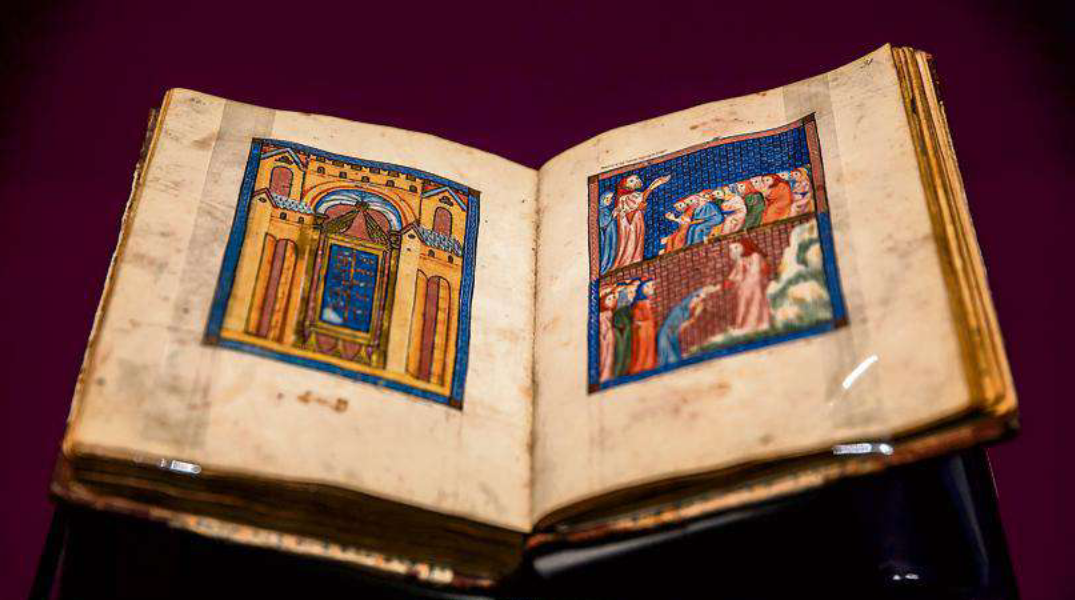
The Haggadah of Sarajevo is today preserved in the National Museum of Sarajevo. The richness and preservation of its illustrations make it the most precious Sephardic Haggadah in the world
Photo: Damir Sagolj for Le Monde
Enver Imamovic is an archaeologist and historian who teaches at the philosophy university next door to the museum. After two months of war, he is the first person to have the idea and the courage to try, at all costs, to save the Sarajevo Haggadah.
One June morning, he runs into Hamo Karkelja, a museum curator. He shares his idea of rescuing the Haggadah and asks the curator to join him. Both know that, after its extraordinary adventure in the Second World War and in addition to at least one theft attempt during the Yugoslav era, it is now kept in a secret place only known to the museum director, who, ill and bedridden, has now disappeared. Enver Imamovic therefore needs an ally who knows every nook and cranny of the building, to find where the manuscript might have been hidden.
The two men first go to the Ministry of Culture and Sciences where another professor from the philosophy faculty, acting as deputy minister in that period’s chaos, signs a document giving an official character to the mission. They then go see a police captain, asking him to assign them a combat unit to assist getting to the museum, and if necessary break open any safe. “The police officer asked me: “What is this damn book? Is it really worth someone dying for it?!” I replied that in my opinion, yes”, says Enver Imamovic.
This is why, as dawn broke on June 6, 1992, the historian Imamovic, the curator Karkelja, the officer Hajrudin Alispahic and two other policemen set off for the Marindvor neighbourhood and the museum. The bombings are intense. They get to the museum around 8.30am and find two other curators as well as the guard, Meho Mulic. Having continued to live there with his two young children, he has devoted the first weeks of the war single-handedly transporting antiquities and works of art from different pavilions down to the basements, to shelter them from the bombs.
“What is this damn book? Is it really worth someone dying for it?!”
The historians start their investigation in the director’s office: a safe has already been opened and pillaged; a policeman promptly opens a second safe. In it, they find antique gold and silver jewelry, as well as a Haggadah. Enver Imamovic, who has never seen the real Sarajevo Haggadah, quickly realises, because of the paper’s texture, that it is a reproduction.
Their trek continues to the museum basements, one room at a time, in the dark, with water up to their ankles. “Then, in a little room, I saw an old Austrian safe”, remembers Enver Imamovic. The policeman cannot do anything when confronted with this ancient safe with an unknown mechanic device. His keys and modern tools are powerless in the face of its Austro-Hungarian robustness.
The improvised commando unit of police and intellectuals are forced to attack the safe with chisels and axes. After a couple of hours, around 4.30pm, the door finally yields. Inside sits another safe also closed by key. The policeman is able to force open this lock without too much difficulty. Using a lighter, Enver Imamovic takes out the Haggadah and studies it, leafing through its illuminated pages. He touches the paper. “I sniffed the book and said: “Guys, this is the real Haggadah!””.
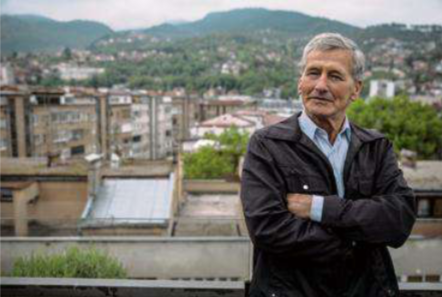
Archaeologist and historian Enver Imamovic teaches at the Faculty of Philosophy, next to the museum. In the spring of 1992, when the Serbian army bombed Sarajevo, he was the first to have the idea and the courage to try, at all costs, to save the Haggadah. Here in Sarajevo on May 15.
Photo: Damir Sagolj for Le Monde
Its rightful place in the museum
After a night under guard in the police headquarters, the Sarajevo Haggadah is placed by Enver Imamovic and his fellow accomplices in a safe of the central bank — the most secure place of the besieged city — where the new independent Republic of Bosnia & Herzegovina keeps its treasures, its money, and where, apparently, on certain nights of particularly violent bombardment, the president Alija Izetbegovic (1925-2003) sleeps for a few hours, sheltered from the war.
The problem is that, at the time, no one knew this story. A policeman indeed went the next day to notify the city’s Jewish community leaders Ivan Ceresnjes and Jakob Finci that the Haggadah was rescued but the Jewish representatives did not see it or talk to anyone about it. Hence, during the siege, as in the Second World War, the Haggadah is once again deemed to have disappeared, at least to the common man.
Because disappearances prompt fantasies and mysteries sometimes lead to lies, the unknown fate of the Holy book even caused a journalist to rashly write that the Muslim Bosnian authorities had sold it to buy arms. Rumours spread so quickly that, in the last year of the conflict, Ceresnjes and Finci suggested to President Izetbegovic to authorize a public display of the Haggadah for Passover.
“Izetbegovic asked me: “Where is it, this Haggadah?” I replied to him: “We have been told in a safe at the national bank”, Jacob Finci recalls. As Izetbegovic didn’t know who could get access to it, he called the Culture Minister, Enes Karic, who didn’t know either. Then he called the Prime Minister, Haris Silajdzic, and told him he had to sort out finding the Haggadah. Silajdzic oversaw the operation. We presented the Haggadah in the synagogue for Passover in April 1995, in the presence of Izetbegovic.”
The precious manuscript arrives at the synagogue in an armoured military vehicle. Rarely had so many military security forces been deployed during the siege in one place, even for the visit of a foreign head of state: the Bosnian special forces’ soldiers and policemen, the president’s security officers, UN “blue helmets” and US embassy guards.
In April 1995, the Sarajevian Jews take back ownership of a missing treasure, saved by a Muslim historian from bombing, and brought to the Synagogue by a Muslim president.
On that day, many of the officials present, including Jewish dignitaries, see the Haggadah for the first time in their lives. Before the Hazzan of Sarajevo, David Kamhi, celebrates the religious service and leads the prayer, many cannot help but leaf through the pages of the book, so long hidden from sight. The emotion of Jewish Sarajevans is palpable. Once again, they are taking possession of a lost treasure, rescued from the bombing of the museum by a Muslim historian and brought to the synagogue by a Muslim President. It is one of the siege’s powerful moments, a brief respite of peace during the war, and a symbol and testament to the fact that the city’s inter-community relations have been perhaps stronger than its attackers’ fascism.
Two rescues in a century
Today, the Haggadah has finally found a proper home, in room 37 of the national museum. It is on show on some of the visiting days. Touching and leafing through its pages as occurred in the spring of 1995 is out of the question. Sophisticated security protects the manuscript. Mirsad Sijaric, the director, opens the room and shows how the manuscript, kept under glass, can disappear, thanks to a special mechanism, and be replaced by a reproduction in two minutes.
The story of this Hebrew manuscript is then the story of the exceptional bond between a book and a city. Mirsad Sijaric still smiles remembering the amazement of the most recent expert who came to examine it, Israeli art historian, Shalom Sabar, from the Hebrew University of Jerusalem and author of “The Sarajevo Haggadah: History and Art (The National Museum of Bosnia Herzegovina, Sarajevo, 2018).
After a few days in the city, the historian confided to the museum director: “Which Londoner, Parisian or Viennese knows the value of the manuscripts buried within the depths of their city’s museums? In Sarajevo, I have not yet met a taxi driver who doesn’t talk to me passionately about the Haggadah!”
Many in Sarajevo are certain they know where Dervis Korkut hid the Haggadah during the Second World War, or how Enver Imamovic saved it during the Bosnian War. The most incredible tales circulate about the illuminated Jewish Sephardic manuscript’s two rescues in one century, illuminated again because of a Muslim librarian and then a Muslim historian. Even when the truth is sublime, this is how legends are made.
***
Parts 1 and 2 are translated by Sarah Robertson for the European Press Prize
SARAJEVO-JERUSALEM 3 | 6
The Jewish musketeers of the siege of Sarajevo
Throughout the Bosnian war, Sarajevo Jews find themselves at a new crossroad of history and their community launched an incredible humanitarian operation, organizing the evacuation of 2500 Sarajevans and providing assistance to the besieged. Israel, on the other hand, witnessed the arrival of hundreds of Sarajevan so little Jewish.
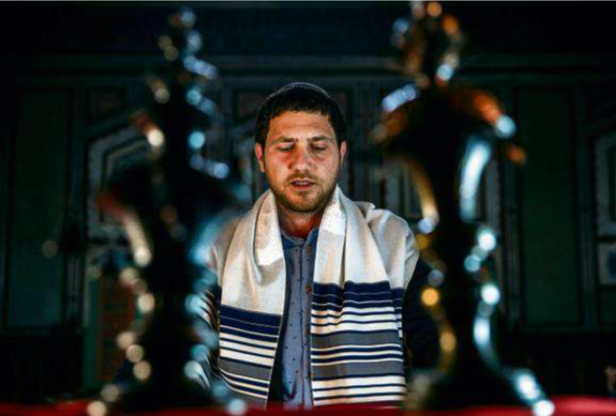
Igor Kozemjakin, whose father, Boris, was one of the organisers of the evacuation in the Bosnian war. Hazzan of his community, every Friday, Igor officiates for the Sabbath, in the only synagogue still in operation in Sarajevo.
Photo: Damir Sagolj for Le Monde
SARAJEVO-JERUSALEM 4 | 6
The peculiar customs of Sarajevo’s rabbis
Similar to the last Yugoslav rabbi Cadik Danon, a line of religious leaders, today personified by Eliezer Papo and Igor Kozemjakin, takes liberty with Jewish laws and traditions and represents, according to the current rabbi, “the true values of Judaism”. A vision of Judaism adjacent to Sarajevo’s spirit.
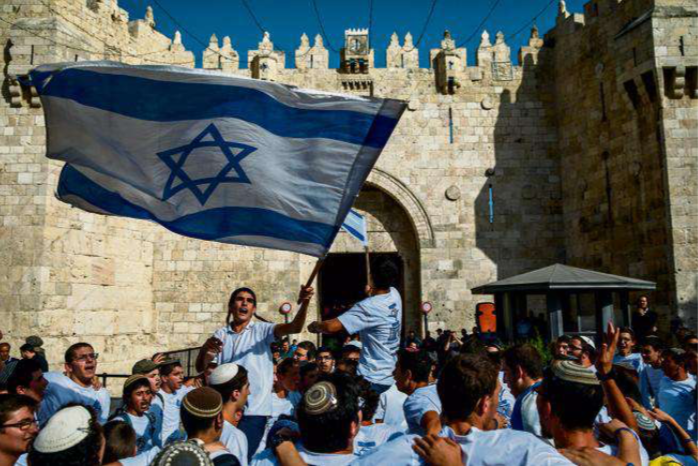
Young Israelis – outside the Damascus gate – celebrate the ‘Jerusalem Day’, which marks the takeover of the Holy City by the Israeli army during the 1967 war.
Photo: Damir Sagolj for Le Monde
SARAJEVO-JERUSALEM 5 | 6
From “Sarajevan education” to the Palestinian cause
A daughter of a Bergen-Belsen survivor from Sarajevo, Amira Hass has been the only Israeli citizen living in the Palestinian Occupied Territories for the last 25 years. Very critical towards Israeli colonizers, the journalist and columnist of the daily newspaper Haaretz continuously defends the Palestinian cause.
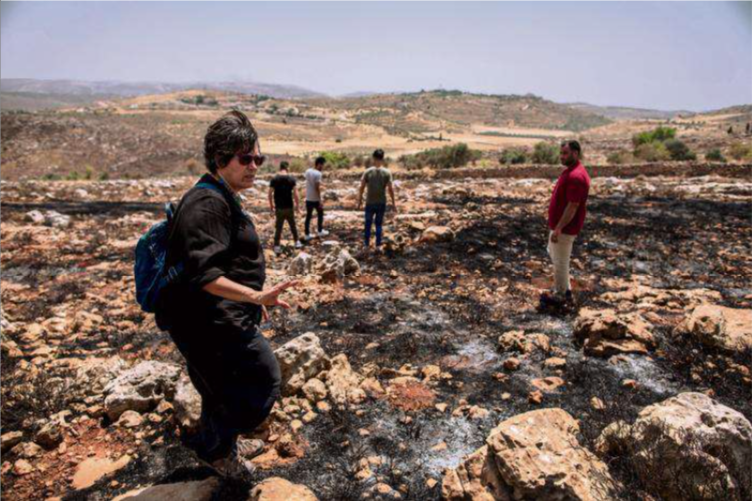
Amira Hass, Israeli journalist famous for her reports and editorials published in the daily newspaper “Haaretz”, chose to live in Ramallah, in the West Bank. Here, on June 7, she discovers the fields of olive trees of the Ibrahim family burned down by Israeli settlers the day before.
Photo: Damir Sagolj for Le Monde
SARAJEVO-JERUSALEM 6 | 6
Sarajevo-Jerusalem, two cities, two destinies
As opposed to Sarajevo which resisted the ethnic division of the city with the strength of despair, the inhabitants of Jerusalem live separately today, and the holy city is more fractured than ever.
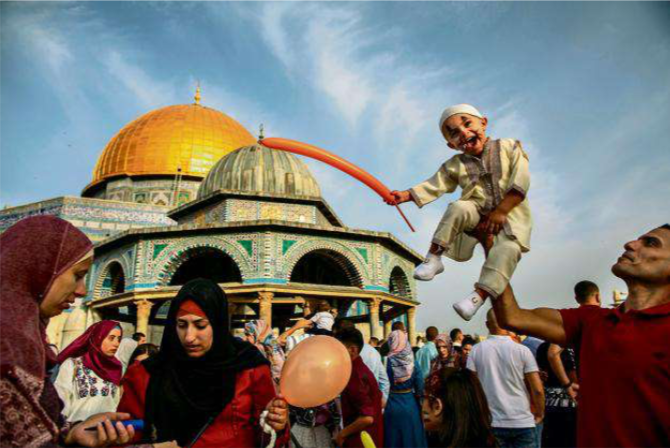
Palestinians celebrate the end of Ramadan at the Dome of the Rock in the Old City of Jerusalem on June 5.
Photo: Damir Sagolj for Le Monde