

‘I’ve seen death in this city, but nothing as sad as this’: how a ferry disaster exposed the corruption devastating Iraq
As protests against a rotten system continue, the families of 128 drowned civilians await justice.
Early in the morning on 21 March, in Mosul’s flat and dusty al-Baker neighbourhood, a school principal named Ustad Ahmad went to see his mother. It was the start of the new year holiday of Nowruz, and she asked if they could go to the cemetery to visit his father’s grave. Ahmad had other ideas. He was planning to take his wife and children to an amusement park, as a reward for the boys’ full marks in their recent exams. Besides, he told his mother, he didn’t want to be reminded of death on such a beautiful spring day.
Back home, after breakfast with the boys, Ahmad sat on a wooden chair in the bathroom for his weekly shave. Then, preparing to go out, he put on his new summer blazer, a pair of jeans and the wraparound sunglasses his wife had recently bought for him. Tall and burly, Ahmad was a very proud man – proud of his status among his colleagues, the comfort and neatness of his house, his smart and witty boys, his beautiful baby daughter and above all, his clever, outgoing wife, who loved to travel. At around 1pm, the family caught a taxi to the amusement park, and Ahmad gave the boys enough money to go on every ride. He even joined them for a round on the bumper cars.
Things hadn’t always been as comfortable for Ahmad as they were now. When Islamic State took over Mosul in 2014, he had been deemed “unreliable” and expelled from his teaching job. For three years he was unemployed and unable to provide for his family. He sold his wife’s gold and some of their furniture, borrowed money from his mother and brother, and became dependent on whatever his wife’s family could spare them. Friends and neighbours nagged him to go out and find work as a day labourer, or get himself a pushcart and work in the vegetable market. But how could he? A school principal can’t work in the market, he felt. He rarely left the house and sank into depression, arguing with his wife and children, who stopped going to school. Now, two years after the liberation of Mosul, he was proud to be a respectable principal once more, even if the city was still in ruins and his school barely functioning.
Mosul is a city broken by war and corruption. Today, the early euphoria of liberation from Islamic State is dissolving as the failure of reconstruction efforts becomes increasingly apparent. Pledges to rebuild the city remain unfulfilled, while the five bridges spanning the river Tigris have either collapsed or are strung together by military pontoons. Hundreds of thousands of people who were driven out of their homes during the fighting are still living in camps. The security situation is deteriorating and Islamic State cells are re-emerging. Across Iraq, anger against political elites is rising. In recent weeks, hundreds of thousands of Iraqis have taken to the streets of Baghdad to demand a complete overhaul of the political system. After two months of demonstrations, in which 400 were killed and thousands injured, the prime minister resigned, but the crowds are still camping out in main squares across the country, waiting for the rest of their demands to be met.
At the same time, what endures is the tenacity and resilience of the people of Mosul, their love of life and entrepreneurial spirit. During the later stages of the war, as the city was being retaken block-by-block by the Iraqi army, liberated neighbourhoods would spring back to life quickly. Families returned to their homes and teams of young volunteers cleared rubble from their streets. Even as the fighting raged just a few blocks away, someone would start selling cigarettes, a grocer would reopen with a box of half-rotten tomatoes and canned beans, and refurbished shops and restaurants would spring up, albeit without water or electricity. Those who could raise a bit of money began rebuilding their homes, while still waiting for the compensation their government had promised them. People allowed themselves the small reward of a meal out with their families.
It was close to 2pm when Ahmad’s family settled down to have their lunch, but there were no shaded areas in the park. The boys suggested that they go to Umm Rabaen, a pleasure island on the Tigris River. It was cooler by the water and there was a picnic area, and another amusement park. Ahmad called another taxi and they headed to the island.
He didn’t want to be reminded of death on such a beautiful spring day
Umm Rabaen embodies the mixture of ruin and resurgence that defines Mosul. It was first turned into a pleasure island during the late 80s, when riverside cafes, restaurants, chalets and the pyramid-shaped Oberoi hotel were built as part of a grand development plan. The hotel is now a ruined shell, and most of the trees have been chopped down for firewood. But cafes and restaurants have been restored and reopened, and on weekends, the people of Mosul flock to the island to sit at white plastic tables, drinking tea or eating grilled kebabs. The familiar sight of the Tigris flowing beside them, fast and muddy, is a reminder of the endurance of their city, just as the view of the ruined buildings on the opposite bank brings back memories of the vicious war that they only just survived.
Like many businesses in Mosul, since the liberation of the city from Isis, the island was part-owned by a member of the economic wing of a powerful militia. Earlier this year, a parliamentary commission reported that armed groups, working through their economic wings, have secured public contracts for businesses, in return for large kickbacks. They control the multimillion-dollar scrap metal trade and oil smuggling operations, as well as imposing illegal tolls on commercial traffic. The businesses they own are unaccountable, their funding is untraceable and, through a combination of fear and corruption, there is almost no oversight. The result, for the people enjoying their new year holiday in Mosul, was disaster.
That same morning, in a different part of Mosul, a woman named Shahla woke up feeling cheerful and decided to take her mother to a new restaurant for brunch. Tomorrow would be her mother’s 72nd birthday and Shahla and her two sisters had bought gifts, ordered cakes and sweets, and stuffed aubergines, zucchini and vine leaves with meat and rice, arranging them in a large dolma pot for the family feast. Today, though, Shahla had her mother to herself.
The two women shared a particularly close bond after living as virtual prisoners under the rule of Islamic State. Their prison had been their two-storey house, which sat in a quiet neighbourhood, nestled among olive, tangerine and eucalyptus trees, not far from the eastern banks of the Tigris. Shortly after June 2014, when Isis officially declared its caliphate, the 13 Christian families that lived in the neighbourhood were expelled, their doors marked with the letter N (for Nazrites) and their houses redistributed to the organisation’s senior foreign fighters. A Chechen commander lived across the street, while a Russian woman moved in next door and shouted at Shahla and her mother to cover their eyes even in their own garden. She would also send over her Egyptian husband to demand some of Shahla’s mother’s food.
When the battle to liberate Mosul began in September 2016, the houses of the foreign fighters in the neighbourhood became a target. Three were levelled in airstrikes that shook Shahla’s home and shattered their windows. Russian snipers set up a base in a house across the street. Other fighters fired their rocket-propelled grenades at the approaching Iraqi armoured vehicles from barricades at the end of the road.
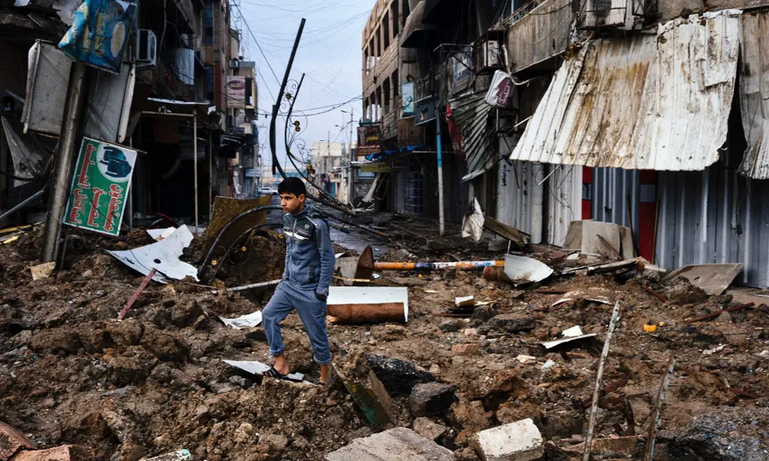
A street near Mosul University after fighting between the Iraqi counter-terrorism service and Islamic State, January 2017.
Photograph: Dimitar Dilkoff/AFP/Getty Images
Towards the end of the battle, as the fighting intensified and Iraqi troops got closer, Islamic State fighters came knocking at their door in the middle of the night. They ordered them to leave their house and go with them: they would be human shields for the retreating fighters. The women gathered their belongings in small bags, piled food into an old wheelchair and set out. Distant explosions shook the ground under their feet. At the end of the street they came across other neighbours who had slipped away from the Isis fighters, and together they hid in the basement of an abandoned house. Twenty-five women and children hid in that dark basement for three nights, while above, battle raged. When finally they heard on the radio that their neighbourhood was liberated, they remained trapped in their hiding place. They could hear fighters in the house, searching for civilian hostages to ensure their safe retreat. In the basement, the families crouched in darkness, holding their breath. Not until they heard the roars of army trucks and armoured vehicles had they dared to move.
After their brunch, Shahla was in the kitchen preparing a pot of sweet Turkish coffee, while her mother sat reading in the garden, when Umm Yussuf, a friend of her mother, called to invite them for tea at the pleasure island that afternoon. Shahla didn’t want to go out. She thought that on a sunny public holiday the island would be too crowded. But her mother wanted to go – the weather was beautiful, and she hadn’t seen Umm Yussuf for weeks, so Shahla eventually agreed. She prepared a basket of food and a flask of coffee and they set off.
It took Shahla and her mother 20 minutes to walk from their house to the river. Her mother was glad to be out, and her cheeks were flushed from the warm afternoon sun. When she saw the large crowd that had gathered at the river bank, Shahla thought the whole of Mosul must be here. She didn’t like crowds, and she was trying to ask her mother if they could leave, when Umm Yussuf found them. The two old women hugged and the three of them slowly headed towards the ferry to the island.
Umm Rabaen island is connected to the east bank of the Tigris, less than 100 metres across the water, by two cable-pulled flatbed ferries, which were owned and maintained as part of the amusement park and island. The ferry allegedly had no safety provisions, security staff were reportedly unskilled and inept, and the service was rarely, if ever, subject to inspection.
As the crowd waiting for the ferry swelled, a short man with alert, beady eyes watched with growing unease. Omar was sitting nearby in an old motorboat whose white fibreglass coating had turned yellowish-brown with age. He noticed that in the past couple of hours the water had risen quickly. The lower decks of the riverside cafes, where he had moored his boat, had been submerged, and plastic tables and chairs taken to higher decks.
The day before, the river police had told the ferry management that it would need to suspend operations because of the unusual quantity of water being released from the Mosul dam higher up the river, after heavy rainfall. Everyone who lived or worked along the river had been informed – boatmen, cafe owners, even the farmers who raised water buffalos on the southern edge of the city. But the ferry was running as normal.
The ferry allegedly had no safety provisions, security staff were reportedly unskilled and inept, and the service was rarely, if ever, subject to inspection
At 3pm, it docked at the jetty on the eastern bank, and a single line of people descended, squeezing their way through the families waiting to board. The two crowds intermingled in a sea of coloured headscarves, pushing, and moving slowly. Everyone was in their holiday clothes, young men and boys wore suits and bow ties, girls wore dresses with frills.
Shahla went down the steps on to the ferry carrying her bag, the food basket and her mother’s handbag. She noticed that the water level was very high. Her mother and Umm Yussuf walked behind her slowly, holding hands. Ahmad and his family climbed down the steps backwards with the pram, one step at a time. The back of the ferry was full, but more people pushed to enter. By the time it started moving, nearly 300 people were crammed onboard.
The ferry was a contraption made from two sections of an old pontoon bridge welded together and decorated with arches that rose high on either side. Steel wires stretched between the arches above a row of benches. Motors mounted on opposite sides of the river pulled cables connected to the front and back of the ferry. A third, guiding cable resisted the push of the currents and maintained the ferry on a straight course.
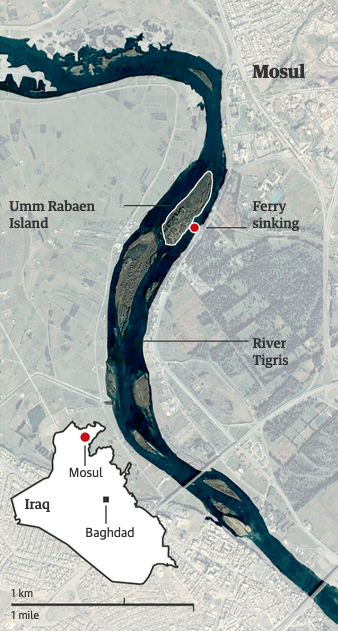
Guardian graphic.
Image: Google Earth, 2004
The ferry shook and shuddered as it moved. The strength of the current pushed it downstream before the cable pulling it corrected its path and it shifted slightly upstream. The operator, standing in the back, noticed the ferry was tilting and started walking to the front, telling people to move away from the listing right side. The back of the ferry was being dragged by the current, pulling the ferry off its line. As the ferry jerked and swayed, a few kids climbed over the right-side railing, trying to see what was going on.
A small wave gushed over the deck, covering Shahla’s feet. Growing scared, her mother said that the three of them should go back and sit in a cafe on the shore, as if they could still walk away. Shahla tried to reassure her, but she could see that people were frightened. Elsewhere on the ferry, where Ahmad was standing, women were crying. He stuck by the railing, assuring his wife and children that the ferry would right itself, while clutching the pram handles tightly.
A second, bigger wave surged in. The ferry began listing to the right. The boys hanging on the right side railings threw themselves into the frothing water. Just over a minute into the crossing, the ferry had tilted so far that one third of the deck was underwater, and most of the people were clambering on the other side, but the ferry couldn’t right itself. Ahmad, standing in water up to his neck, held on to the pram, trying to keep the baby above water. Then he heard a loud grinding noise and saw that the ferry was turning over and people were sliding down towards him. He gripped the handles of the pram tightly but it sank, pulling him underwater, his baby daughter disappearing into the darkness of the river.
At this point, the cable pulling the ferry snapped. The left side of the hull, standing almost vertical now, hit the cable pulling the second ferry back from the island, and started to turn over. People fell on top of each other. Shahla was pushed into the water. She was still holding her mother’s hand. She managed to get her head above the water, but a body fell on her, she sank again, and lost her mother’s hand. When she got back to the surface, a woman in a black robe grabbed her, desperate to stay afloat, and tried to climb on top of her, pushing Shahla down again. Shahla took a breath and sank underwater, allowing herself to be dragged downstream.
The hull stood vertical; people were trapped between the jaws of the arches and the rods connecting them. As it turned over, the arches closed like giant fangs on the people below. The ferry flipped, a green floating whale drifting downstream, chasing after dozens of bobbing heads.
Deep under the water, Ahmad lost the pram. He saw a boat nearby and swam to it, trying to grab on to the engine at the back. He shouted for help but no one heard him, or they were too absorbed in pulling people from the water. The owner of the boat came down to the stern, where Ahmad was still clinging desperately to the engine, and, ignoring the man hanging on to the propellor, pulled a cord to start the engine. It roared into life and the blades cut into Ahmad’s sides. He screamed as the propellor cut his flesh.
He let go. He knew he had lost his family. Better to die, he thought, as he sank into the water. But his body would not let him die, and involuntarily he kicked his way to the surface. He wept and mumbled thanks be to God, thanks be to God, his tears sinking into the water that carried him downstream, past riverside cafes where people stood, watching and filming.
He reached another boat, and clutching on to the reeds, stretched out his hand and asked for help. Two men grabbed him by his arms, and a third pulled him by his belt and swung him over the edge. The body of a woman lay in the bottom of the boat, next to two dead children. The men hauled in another woman and a child, and started the engine, setting off towards the island.
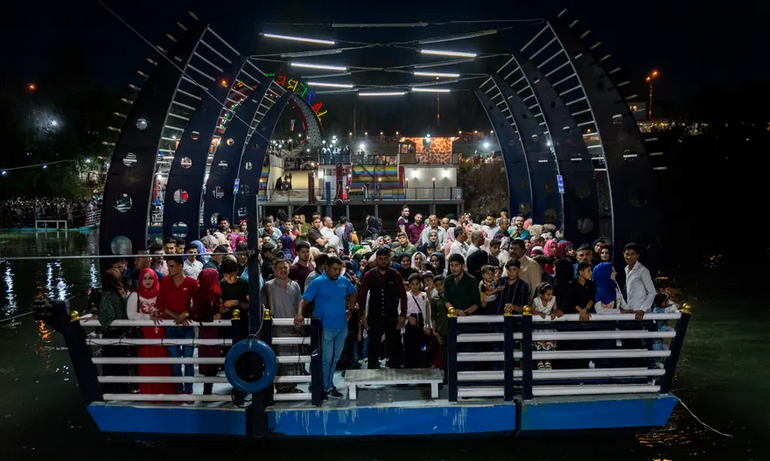
A ferry taking people to the Umm Rabaen island amusement park in Mosul, June 2018.
Photograph: Claire Thomas
By now, a handful of fishing boats had driven into the middle of the river to try to pull survivors out of the water. Omar, the boatman who had been anxiously watching the crowds waiting for the ferry earlier, steered towards the drowning crowd. Among the people hauled on to his boat was Aya, a young woman a few days short of her 20th birthday, who had gone to the island with her mother and sister, along with some of her aunts and cousins. Sitting in the boat, with the shock of air flowing back into her lungs, Aya recovered enough to scream. A large man, with his son hanging on his back, grabbed the side of the boat and it started teetering dangerously. Aya begged him to let go, in case he flipped the boat and drowned them all, but the man held on with all his might. A young man bent over and pulled the child hanging on the man’s back into the boat. They all tried to pull the man, but he was too heavy. Too tired to hang on, he was dragged away by the current.
In the water, Shahla was bumped and rammed by objects and bodies. She looked for her mother among the people screaming and struggling around her, but the water was pushing her fast. She saw white gulls, so loved by the people of Mosul, circling overhead. Oh lord, she thought, is it possible that they are feeding on the bodies of the dead? She had been in the water for half an hour by now. The water was cold, her winter clothes were getting heavy, her headscarf was choking her, but she hung on tightly to her mother’s green bag. She didn’t want her mother to lose her ID card and go through the hassle and the humiliation of long queues.
Her chest was contracting, and she couldn’t breathe, she knew that if she didn’t keep swimming, she would die. She managed to catch on to a boat. She hauled herself over the side and collapsed into the bottom of the boat.
From the safety of the boat, Shahla was able to see the extent of the disaster. Bodies floated all around them, many of them children. There was a tiny boy, three or four, dressed in a onesie and floating on his back: it reminded her of the game she played as a child, with her sisters, floating their dolls in the bathtub. To her relief, she saw that the gulls were not feasting on the dead bodies, but the food people had brought for their picnics.
The boat dropped Ahmad on the island, where he wandered along with other survivors, and watched families still enjoying their picnics. Someone gave him water, another offered him a chair. A neighbour and his wife spotted him; they took him to the island’s administration office, but it had been abandoned. When the ferry sank, most of the staff had run away, fearing they would be arrested and anticipating the anger of the victims’ families. The neighbours took off Ahmad’s jacket and shirt and cleaned the three long cuts in his side with a piece of cloth soaked in antiseptic. At that point, he started to cry.
An officer from the Mosul Swat police unit arrived on the island in a large civilian motorboat they had commandeered and arrested everyone who was still working there – including vendors selling coffee and burgers – but the owners and directors of the island were nowhere to be seen. The officer took pity on Ahmad and gave him a lift back to the eastern riverbank.
Meanwhile, Omar brought Aya to the jetty and went back with his motorboat to see if he could rescue more people. She stood there shivering, her hair soaked in mud and her dress dripping with water. She was surrounded by a crowd of spectators and policemen who had gathered to watch the disaster unfold, their phones pointed at her. When Aya spotted a young policeman standing nearby, she began screaming at him. “My family, where is my family?” The bewildered policeman looked at her as if she were mad.
“My family, where is my family?”
In front of Aya, the ineptitude and failure of the Iraqi state seemed to be laid bare. In oil-rich Iraq, the Mosul River police department had just one boat, which had sat broken for many months; they had no ropes, and no lifejackets to throw to the people drifting and drowning in front of them. While the chief of the river police had jumped in one of the civilian boats and went to help with the rescue, some of his men just stood there staring. They didn’t know what to do; most of them had never trained for such a crisis and some didn’t even know how to swim. In the highly corrupt Iraqi security services, many of those policemen had paid a bribe to be appointed to a comfortable job by the river, rather than one of the more dangerous posts outside the city.
Once Shahla had been deposited back on land, a policeman stopped a passing car and told the driver to take her to the hospital. When she arrived, she searched out her mother and Umm Yussuf – first among the survivors, and then, with trepidation, among the bodies in bags. She didn’t find them. She was wet, shivering and exhausted, but she didn’t want to be in the hospital, which was packed with crying women and children. She collapsed on the pavement outside. “There was chaos, and no one was in control,” she recalled. “The bodies were dumped in the back of ambulances and pick-up trucks like they were sacks of garbage, while the policemen and the crowds filmed with their mobile phones.”
Later in the day, Shahla spoke to her brother on the phone. He was weeping. Before he said anything, she knew that her mother was dead.
The most organised institution in Mosul is the morgue. Two years after the war, it continues to receive the black and festering remains of corpses buried under mounds of debris and destroyed houses. The staff, who are efficient and thorough, compare DNA samples with their records and try to identify the victims among the thousands still missing.
The short, stocky young director, Hassan Watheq, who has a pencil moustache and wears rimless glasses, was having his lunch when he received a phone call from a friend to tell him about the ferry. He could hear the sounds of screaming families on the phone. He hurried to the morgue, knowing that the bodies would quickly begin to disintegrate, making identification very difficult. He knew all too well the chaos that would ensue, with families pushing and shoving, trying to reclaim their dead relatives. He called for a police guard to be stationed around the morgue.
Soon the bodies started arriving. Within an hour, there were 65 bodies in the refrigerators and hundreds of families gathering outside, women wailing, men pleading with the policemen to be allowed in. The director went outside, flanked by policemen, and climbed on top of a police truck. In his calm voice, he pleaded with the people to give him time.
The most organised institution in Mosul is the morgue
The majority of the bodies that arrived from the ferry were women and children. Even the staff of the Mosul morgue, accustomed to the sight of death, were weeping. “I saw a woman clutching a five month-old child,” recalled the director. “Both were dead, and I thought of my own two girls and started crying, even though death had become normal for us.”
He began posting headshots of the victims on the morgue’s gate. Where ID had been found with the body, he was able to post the names of the dead. His other priority was preventing bodies from being stolen. “Iraqi law doesn’t recognise the missing as dead until five years have passed,” he explained to me, “and all this time they can’t get pensions or any rights. So a lot of people tried to register their missing as dead in the ferry disaster.”
Of the 128 confirmed dead, 57 were women, and 44 children. Another 69 are still missing. The latest body to be found was brought in on 11 September, almost six months after the ferry sank.
Even in a nation accustomed to fanatical militias, occupying armies and mad dictators, the ferry disaster was shocking. “I have seen death in this city,” the morgue director said, “but nothing as sad as this. People dressed for holidays lined up in body bags.” When the public discovered that the River Authority had issued a warning about the dangers of operating the ferry that day, grief turned to anger. People were enraged by the failure of the state and the apparent recklessness of the pleasure island’s owners.
The prime minister arrived in Mosul on the evening of the disaster and announced three days of mourning. He also formed an investigation committee and declared all the victims as martyrs, to be added to the hundreds of thousands of Iraqi martyrs killed in the war. The president came the following day, and was booed by a crowd protesting against political corruption. He was bundled into a police pick-up while crowds pressed around, banging on the car.
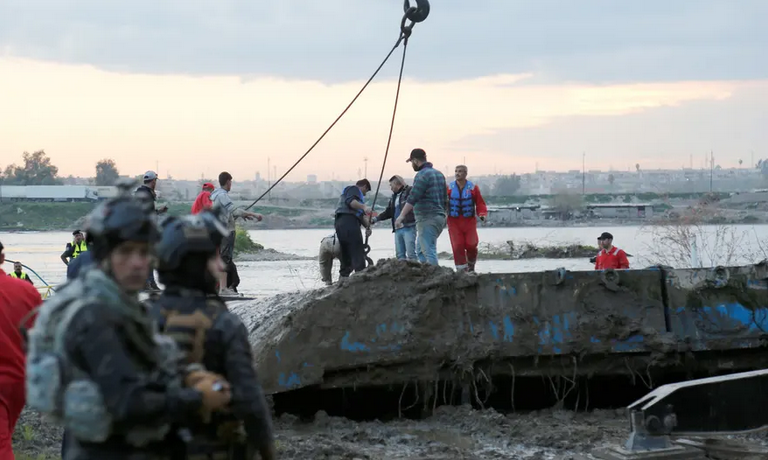
Iraqi civil defence workers recover the ferry that sank in the Tigris, 23 March 2019.
Photograph: Anadolu Agency/Getty Images
Within days, the media was reporting that there was a connection between the owner of the island, Ubaid al-Hadidi, and a notorious militia commander. Before the ferry disaster, people in Mosul had felt too scared to speak openly about the activities of the militias’ economic arms. Now there were protests and sit-ins. On 24 March, the governor of Mosul, Nufal Hammadi, already under investigation for embezzlement of public funds and international aid, was sacked. He was accused of involvement with the militias’ business enterprises, of raiding public funds and annexing public land. The governor told a press conference: “I deny that I received a single cent or dinar from any party.”
A member of Mosul city council, who was on the investigation committee, told me the ferry had been overcrowded and sailing in very fast waters. “The official regulations specified that the ferry was allowed to work in [river speeds] that do not exceed 700 metres per minute, preferably between 400-300 metres, with a maximum capacity of 80 people on board. On the day it sank, it was carrying 287 people, and the current speed was 1,400 metres per minute,” he said.
The councillor, who asked to remain nameless, said the owners and management of the island bore direct responsibility for the incident, having apparently ignored the safety warnings. “[The owner] was informed by the river police the night before, and he signed the memo. But he saw a vast crowd, and he wanted to load as many people as possible. The state institution that was supposed to monitor the work of the ferry failed in their responsibility.”
The fact that the island’s owners were backed by a leader of the economic wing of one of Iraq’s fiercest militias, Asa’ib Ahl al-Haq, would have made it less likely that the rules would be enforced against them. Shirwan Dubadani, MP for the city of Mosul, Shirwan Dubadani, who also sat on the parliamentary fact-finding mission last year, told me that during a meeting he attended between the former governor of Mosul, the president of Iraq and the speaker of parliament, the governor confirmed that one of the militia’s most powerful men, Hayder al-Sa’edy, was a partner in the island, and his men provided security. Since the liberation of Mosul, al-Sa’edy had been in charge of the lucrative scrap metal business, running companies as fronts for the militia and its political party that were awarded public contracts by the governor.
“I imagine all that happened as a dream; I talk about it as if it was a story that happened to someone else.”
The owner of the island, Ubaid al-Hadidi, was a mid-level contractor before the fall of Mosul. Under the Isis occupation, he made a fortune buying and selling residential and agricultural lands confiscated from Christian residents expelled from the city. In 2015, he bought the concession for the island and ran it for a year and a half before he was forced to close it because of the lack of electricity and the approaching war. After the liberation of Mosul, a warrant was issued for his arrest on terrorism charges. But after al-Sa’edy allegedly intervened, the charges against al-Hadidi were dropped. In return, according to MPs and intelligence officers who spoke to me about the disaster, al-Hadidi paid a “contribution” of 5bn Iraqi dinars and gave al-Sa’edy a 30% share in the island.
The day after the ferry sank, al-Hadidi claimed in a phone interview with an Iraqi TV station that he and his son had not been in Mosul when the disaster occurred. The reason, he said, was that an Asa’ib Ahl al-Haq security representative had threatened them and demanded a large payment. “We would always shut the island if the water level climbed, but we haven’t been in Mosul because of the threats we received,” he said. Three days later, al-Hadidi and his son were arrested in Erbil and taken to a prison in Mosul. In an interview with an Iraqi TV network, a representative of Asai’ib Ahl al-Haq’s political wing said: “Even if we accept that someone connected to the movement is a partner in the island, that does not mean that Asa’ib are responsible for what happened.”
When they brought the body of Ustad Ahmad’s wife to his house on the night of the accident, he refused to see her. He did not attend her funeral. The body of his eldest boy was found the day after the ferry sank, trapped under the capsized hull. His other son and baby girl will never be found.
After the disaster, Ahmad could not stand to see his boys’ toys and school bags. “I asked my mother to remove all their belongings and give them away,” he said. “I don’t want to remember them. I want to forget their memories.” As he spoke, his voice was breaking. “I imagine all that happened as a dream; I talk about it as if it was a story that happened to someone else.” He was sitting in his mother’s house, the confident pride of the school principal was gone. He looked old and tired, his back bent and face sagging.
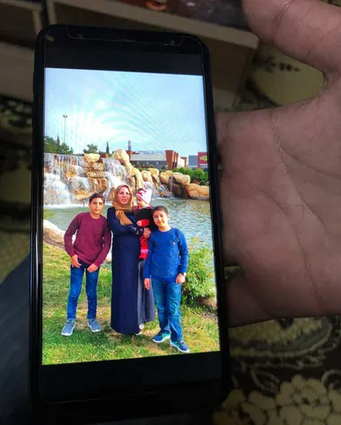
Ustad Ahmad’s wife, sons and baby daughter.
Photograph: Ghaith Abdul-Ahad
“You know, we had lost another baby girl two years ago, she was the same age, a mirror image of this one, same laughter, the same face,” he said. Two years earlier, when their house was struck by an Isis mortar, Ahmad had run into the street carrying the other daughter, his wife and boys following him. His brother and neighbours rushed to help them. His brother pulled the baby from his arms, while Ahmad and his wife went back to the house to collect their valuables. When the couple were back in the house, another mortar exploded. Ahmad ran outside to find his brother and 10 of the neighbours dead. His baby daughter was dead. “Maybe it was in our fate to die on that day, but we missed death, and it caught up with us on the ferry,” he told me.
Ahmad does not blame incompetence or corruption for the ferry disaster. “Yes,” he said, “there was negligence, but what can I do about the owner, how can I get my justice from him? Is he much worse than the people who stood watching while people were floating in front of them? No one came to save us; no one volunteered to come down into the water; people just stood watching. No one helped. When they took me back to the island, I saw people sitting eating their picnics. This unfeeling attitude – is it because of all the death the city had seen?”
In the autumn, I visited Aya at her aunt’s house. “What caused the ferry to sink was corruption and negligence; treating the people as if they are nothing,” she told me. She spoke forcefully, her grief mixed with the bitterness of being abandoned by the state. “My mother said after this war, the destruction, the savagery of the killings, nothing worse would happen to us. We were liberated in March 2017, and in March 2019 she died.”
“No one cares this happened here,” she said. “The ferry will be forgotten just like all these other deaths were forgotten.” In October, Aya started receiving phone calls from prominent tribal elders, pressuring her to accept an offer of blood money from the owner of the island. Al-Hadidi was offering bereaved families 10m Iraqi dinars and a plot of land on the outskirts of the city, if they would drop any charges against him and his son. The elders told her that all the other families had accepted and she was one of the last holding out. “I was refusing to sign, but all the families had signed, they tell me that they won’t get anything from the state and they need the money. I don’t know what to do,” said Aya.
I called the MP Shirwan Dobadani to ask him about the compensation offer. He told me that it was true – two prominent tribal sheikhs had intervened as intermediaries. “If the families wait for the judicial system to give them justice, they won’t get anything,” Dobadani said. “There are thousands of cases of murder and assassination that haven’t been solved. The worst disaster in Iraq is forgotten after 72 hours.”
Ghaith Abdul-Ahad
Ghaith Abdul-Ahad was selected for the 2020 European Press Prize shortlist with ”I’ve seen death in this city, but nothing as sad as this’: how a ferry disaster exposed the corruption devastating Iraq.’
Ghaith Abdul-Adad was born in 1975. He is an Iraqi foreign correspondent for the Guardian newspaper. He began working after the U.S. invasion of his country in 2003. Abdul-Ahad has also studied Architecture at the University of Baghdad.
He has won the Martha Gellhorn Prize for Journalism (2005), the James Cameron Memorial Trust Award (2007), the British Press Awards’ Foreign Reporter of the Year (2007), the Orwell Prize for Journalism (2014), and both the News & Documentary Emmy Awards for Best Story in a News Magazine as well as Outstanding Coverage of a Breaking News Story in a News Magazine (2017).
Abdul-Ahad is currently living in the Middle East.