

Killing for the photo
“Perhaps you can help me understand something which appears very bewildering to me,” Fouad Abdel-Moneim Riad asked the witness. At 71 years-old, the Egyptian judge had a wealth of international legal experience and an inquisitive mind.
“We have here at least ten pictures which I wondered how they were taken,” he said. “It is pictures taken of an execution, step by step. How can a person who is killing in this way take a photographer with him to picture it?”
It was Wednesday, September 22, 1999, almost a year into the trial of Bosnian Serb Goran Jelisić at the International Criminal Tribunal for the former Yugoslavia, ICTY, in The Hague.
Jelisić, 31-years-old at the time, had pleaded guilty to the murder of 13 people in Bosnia and Herzegovina, among other charges.
That morning, the court was shown a series of photographs that appeared to show Jelisić killing a man in cold blood in Brčko, northern Bosnia, in 1992. They were taken by a professional photographer and published worldwide by Reuters, a major international news agency.
Jelisić listened attentively to the trial in a green patterned knitted sweater, his expression timid.
British prosecutor Geoffrey Nice described the first image: the accused is on the right in a blue, short-sleeved shirt, a gun fitted with a silencer in his lowered right hand; to his left, a man in military uniform with an automatic rifle; in front of them, two men, one in a brown suede jacket, the other in a beige pullover; they are moving along a short cul-de-sac, at the end of which can be seen a number of dead bodies.
The next photograph shows Jelisić pointing the gun at the back of the man in the brown jacket; in the next, Jelisić has raised the gun level with the man’s head, pulled into his shoulders; in the next, the man is bent over at the waist, his hands raised to his head as if trying to protect himself. He is still walking.
Then the man is on the ground, one leg in the air, Jelisić behind him, gun still raised. In the photographs that follow, the man is face-down on the concrete but, from the various positions of his arms and legs, clearly still alive. Jelisić is still pointing the gun at him.
The next image shows the man in the beige jumper lying on his side on the ground, a pool of blood spreading from his head. The next captures both men on the ground, bleeding heavily. Another image shows corpses tossed into a pit, one on top of the other, limbs intertwined. Some of the faces are visible. There are at least 12, all men. Above the grave stands a truck, presumably used to transport the bodies, and an excavator poised to cover them with earth.
Before the witness, ICTY investigator Paul Anthony Basham, could answer Judge Riad’s question, Nice asked that the trial be moved into closed session. The transcripts, therefore, do not reveal how the photographs came about. Those photographs, entered as exhibit P67, were important in the trial as proof; there was no examination of how they had been taken. Only Judge Riad was bothered by that.
This story offers an answer to Judge Riad’s question. It is the story of how those photographs came to be – the only images from years of war in the former Yugoslavia that captured the actual act of execution.
Such images are rare in the annals of professional war photography. None, for example, have yet emerged from the war in Ukraine.
Like Judge Riad, I had long wondered about the unsettling proximity of the camera, how it captured the precise moment of death. I wanted to know whose gaze, and what kind of gaze, mediated the sequence for those of us who would view it.
How could a photographer capture a murder from so close, and in so many frames? Didn’t the killer see the camera? Why did he allow the photographs to be taken? And why did he let the photographer keep the film?
Professional war photography is an act of non-interference. Does the act of taking pictures in this case constitute a form of participation? Does the camera’s proximity encourage what is happening? Did Judge Riad’s question weigh on the minds of the Reuters editors who bought and distributed the photos worldwide? Or on the jury of the World Press Photo awards, which decorated the photographer in 1993? Was there any doubt among the Dutch media that feted him as a journalistic hero when he fled Belgrade for Amsterdam the same year? And what were other photographers covering the conflict thinking?
To truly understand what was photographed and, most importantly, how, we need to zoom out, to retrace the steps backwards from image to reality. For while a photo might evoke a thousand emotions, it cannot speak a thousand words.
The wars in Yugoslavia unfolded in front of the eyes of the world’s media, yet this did little to shorten their duration: four-and-a-half years in Croatia, almost four in Bosnia and Herzegovina, and more than a year in Kosovo. Over 2,500 articles, recordings, and photographs were used as evidence at the ICTY, according to data from the Media Centre in Sarajevo.
But of all these images and recordings, those of Jelisić in Brčko are the only professional photographs to capture an execution as it unfolded.
One of the most iconic news photographs of the 20th century was taken in 1968 in Saigon, showing South Vietnamese police chief Nguyen Ngoc Loan shooting from point-blank range at the head of Viet Cong guerrilla Nguyen Van Lem. It was taken by the American photographer Eddie Adams for the Associated Press and earned him a Pulitzer Prize and World Press Photo award. The police chief permitted Adams to take the photograph, convinced of the righteousness of his act. Adams’s photograph fuelled anti-war protests in the United States, much to his dismay; he was a former Marine and supported American involvement on the side of the South Vietnamese. The dead man had murdered American soldiers.
The circumstances surrounding the creation of Adams’s image are well-documented. After all, there were many witnesses. In Brčko, however, there were none. Two killers, two victims, two photographers. Or was someone else present?
The photographs were taken on May 6 or 7, 1992. The exact date was never established during the trial. At the time, Brčko had a population of 41,046; Bosniaks were the majority and Serbs the biggest minority. The war in Bosnia was a month old. It reached Brčko at dawn on April 30, along with Goran Jelisić, a Serb volunteer fighter from nearby Bijeljina. At 23, he had a young son, a primary school diploma and a job driving tractors.
Three months earlier, Jelisić had been released from prison after serving time for forging cheques. He had a fondness for money, as the trial would demonstrate, and would steal money, watches and jewellery from Bosniak detainees. In Brčko, he was issued with a blue Yugoslav police uniform, a Scorpion pistol fitted with a silencer, and a Motorola radio. His codename was Adolf. During the trial, a protected witness identified as Witness L recalled Jelisić saying:
“Hitler was the first Adolf. I am the second.”
As Serb soldiers, police officers and paramilitaries poured into the town, Bosniak and Croat males between the ages of 16 and 60 were rounded up; some were taken to the police station in the town centre, where roughly 20 were held in Room 13.
It was from Room 13 that Jelisić took the man in the brown jacket. Why him, specifically, remains unclear. Was he the first person Jelisić laid eyes on when he opened the door? Was he wearing an expensive watch? Did someone have it in for him? Jelisić said it was his first murder but couldn’t recall how many shots he fired.
“Maybe two or three bullets,” he said.
The killing established a pattern: all Jelisić’s other known victims were executed with a silenced Scorpion, from close range and from behind. Later, there would be less blood than in the photographs. Jelisić would instruct his victims to bend their heads over a drain cover so their blood would drain away, minimising the cleanup.
Jelisić was convicted of murdering 13 people. How many he killed in total during the three weeks he spent in Brčko in May 1992 was never established. Since he confessed to the murders he was charged with, the prosecution did not pursue his responsibility for any further victims. According to Witness L, Jelisić claimed he needed to execute twenty to thirty people before he could have his morning coffee. Another, Witness A, vividly recalled Jelisić’s voice because he heard him ten to fifteen times a day giving the order:
“Lie down and put your head over the drain!”
Some former detainees testified that they witnessed Jelisić’s killings and were ordered by him to stack the bodies for transport in a meat truck to a mass grave. Some witnesses said bodies were also taken to an animal feed factory, where they were processed into animal meal. One, Witness N, recalled seeing around a hundred bodies “piled up like logs ready for the furnace”. Prosecutors estimated Jelisić’s death toll at around a hundred, maybe more.
The war in Bosnia and Herzegovina produced many killers. Teachers, policemen and farmers before the war became war criminals during it. But few killed so prolifically or systematically as Jelisić, one after another after another. That’s why the sentence he received was, at that point, the longest ever handed down at the ICTY: forty years in prison.
One witness described Jelisić in terms that might apply to anyone: “A young man in his twenties, brownish hair, medium height, medium build, rather lively.”
Bojan Stojanović was 22 years-old at the time, a photographer from Belgrade working for the daily newspaper Večernje novosti [Evening News]. He photographed all sorts, from sports to daily life. He also sometimes worked for Reuters. In early May 1992, Stojanović and his friend and Večernje novosti colleague Srđan Petrović were heading to Sarajevo on assignment for Reuters but ended up in Brčko.
Reuters photographer Emil Vaš was the first to receive the photographs. “When I saw them, I couldn’t believe it,” he said in an interview. “You can’t believe that someone would take pictures like that. We didn’t even know if it was real. We didn’t know what to do with them.”
Petar Kujundžić, then the chief photographer at Reuters in Belgrade, said his first thought was that they had been staged. He asked Stojanović and Petrović how they had taken them. They replied that they had simply been passing and ran into the killings. “I was suspicious because I knew no one in their right mind would allow such a thing to be photographed,” Kujundžić said. He remembered seeing at least two rolls of film. He also saw those taken by Petrović and recalled that they were much the same.
Kujundžić took the shots to Donald Forbes, the Reuters bureau chief for Yugoslavia at the time. In written communication for this story, Forbes did not dwell much on how the photographs were taken but stated in general terms that photographs were accepted based on trust. He remembered Stojanović as a good photographer but a loose cannon. “At one point, he got a white Golf stolen from the VW factory in Bosnia and put a UN sign on it on his own initiative, which got both himself and the Reuters Sarajevo office in trouble with the UN,” he recounted. Although he initially said he “would certainly have been involved in the decision to use” the photographs, he later wrote that the decision to publish was made by the Reuters editorial team in London and that it was up to them to assess the ethics of doing so.
At the time, Pat Benic was Reuters Photo Editor in London, responsible for Europe, the Middle East and Africa. When I asked Benic if there were any doubts in London regarding the photos, he said: “I recall there was a hold in London on those graphic images until we could verify everything via Belgrade before we transmitted them. The hold lasted hours, not days, as the information was verified.” He did not clarify what was done to “verify” the images.
From May 9 onwards, the photographs were published worldwide, credited variously to Bojan Srdjan/Reuters and Srdjan Bojan/Reuters. They were released under very slight variations of the following caption: “A Serbian policeman executes a Muslim sniper with a shot to the back of the head after he was captured near Brčko and accused of shooting at a Serbian refugee convoy.”
Stojanović submitted one of the Brčko photos to the World Press Photo competition. In February 1993, he was declared winner in the Spot News category. The same month, Stojanović left Serbia for the Netherlands. He never returned.
In the Netherlands, Stojanović sought political asylum, claiming he faced persecution from the Serbian authorities and that his life was in danger. Judging by the Dutch media coverage, he was welcomed as a dissident. The public broadcaster even compared him to Salman Rushdie. In interviews, Stojanović explained how the photographs came about. Each version differed slightly from the last, but he maintained he managed to take them unnoticed, and that he slipped away also unnoticed.
Stojanović claimed that after the images were published, a bomb was thrown at the building in Belgrade where he lived with his parents. He told De Stem: “The leader of a Serbian militia has put a price on my head, $20,000. Because I am a traitor to the country. The search warrant against me was shown on Serbian television and appeared in the newspapers.” He said he was arrested in November 1992 and accused of the attempted murder of a woman whom he claimed he didn’t even know. In another interview, he said he was arrested for “alleged robbery” and that, while in custody, he was interrogated about the photographs and accused of espionage. On release two months later, he claimed all his photography equipment, 4,000 negatives, and documents had been taken from his apartment. That was when he decided to flee, but since he didn’t have a passport, he said he crossed illegally into Bulgaria on the roof of a train. In several interviews, Stojanović said that Reuters helped him escape.
In response to an inquiry, the Second Municipal Public Prosecutor’s Office in Belgrade said it could find no record from 1992 or 1993 of an attack on Bojan Stojanović. None of the people I spoke to – journalists and photographers close to him – knew anything about bombs being thrown at his building. Forbes, the Reuters bureau chief in Belgrade, also said he did not recall seeing anything on television about a warrant issued against Stojanović.
Forbes and Benic both denied that Reuters helped Stojanović escape. “It was a company rule that if a staff member was wanted by the authorities in any country for any reason, they would remain in place to provide full cooperation. I never received any official approach in Serbia regarding either photographer or the photographs,” Forbes told me in 2022. He died in February 2025.
In April 1993, Dutch media reported that two Serbs had kidnapped and tried to kill Stojanović in Amsterdam. NRC Handelsblad reported: “Threatened with a gun, he was forced to get into a car. The kidnappers drove the journalist to the Mauritskade. There they tried to strangle him with a piece of steel wire. The 23-year-old Stojanović hit the men with his camera. He managed to escape his killers by diving into the canal.”
The same year, Dutch public broadcaster VPRO produced and aired a half-hour documentary about Stojanović titled De prijs (The Price). In the film, Stojanović is seen eating salad and toast, chewing loudly while he shows his photographs from the war in Bosnia – wounded soldiers, the bodies of civilians. Of the award-winning photograph from Brčko, he says: “This guy is a Muslim. Why he died, I don’t know. I was just there, and it all happened in a moment.” He repeats his claim that the killers didn’t take any notice of him even though, he says, he was just three metres behind Jelisić.
The film follows Stojanović to the World Press Photo exhibition, where he observes the enlarged version of his winning photograph, accompanied by a caption based on the original under which it was published. Addressing a man who appears to be involved in organising the exhibition, Stojanović says: “Actually, this man wasn’t a sniper. He was just a civilian.” The man nods and replies: “Yeah.” He betrays no surprise at learning that that image is perpetuating a lie about a murdered man.
I spoke to the film’s co-director, Thomas Doebele. He said the film crew assumed Stojanović was a legitimate photographer, his credibility backed by the fact he had won such a prestigious award. Doebele did not recall the identity of the man whom Stojanović told that the victim wasn’t a sniper. Neither did anyone at the World Press Photo Foundation.
For years, the caption accompanying the winning photograph on the WPP website read: Ruthless killing in the streets in early summer. Accused of firing on a Serbian refugee convoy, a Muslim sniper is captured by a uniformed Serbian policeman and shot in the back of the head. After I sent the documentary footage to WPP, they changed ‘sniper’ to ‘civilian’ in the caption on their website – thirty years after the falsehood had been aired on Dutch public television.
Now, next to the photograph and the corrected caption, there is a note that reads: “This caption previously identified the victim as a sniper. We have been provided a video where the photographer says this is not correct. Therefore the caption was edited on 21 July 2022.”
In checking Stojanović’s claims from 1993, it emerged that he had indeed been in detention in Belgrade at the end of 1992. So too had his colleague, Petrović. Not because they were falsely accused, but because Stojanović, Petrović, and two other men were convicted of robbing an elderly woman in Belgrade, as confirmed by the Higher Court in Belgrade. Of the four, Stojanović was handed the longest sentence – 16 months.
Photographer Kamenko Pajić told to me that he witnessed Stojanović confess to the Reuters bureau chief, Forbes, saying he had robbed “a grandma” and didn’t want to go to prison. Nor did he. Because he fled to the Netherlands and never returned.
Stephen Mayes was head of the jury for the 1993 World Press Photo awards when Stojanović won the Spot News prize. He remembers the photograph, but not any discussion among the jury members about it. That year, according to the World Press Photo Foundation, 1,969 photographers from 84 countries submitted 19,428 pictures for consideration. The Spot News category covered everything from celebrity weddings to elections. Mayes said that in the first round of judging, the nine jury members spent perhaps a second on each photo. It’s “bang bang bang, yes or no”, he said. In the next round, they had a few seconds per photograph, and only in the third and final round, which included just a few dozen photos, did the jury receive any information about the actual images and the photographers behind them. “It’s ‘noise’ from a crowd of photos, and those that break through that noise usually have some instant drama,” Mayes said.
More than once in the past decade, the credibility of documentary images has been called into question, usually over accusations of manipulation and post-processing of digitally produced photographs. Only in 2015 did WPP introduce a code of ethics stating, among other things, that photographers must ensure captions are accurate and must be open and transparent about how their images came about.
Halfway through my research, I was given a confidential excerpt of the record taken during Goran Jelisić’s 1998 interrogation by two ICTY investigators. Part of it reads:
“On May 6 or 7, 1992, Goran was called into the chief’s office, where the police chief Dragan Veselić, Đorđe Ristanić, and Enver, known as ‘Shock,’ were present. Veselić told him that he would have his ‘baptism by fire,’ and then Đorđe Ristanić explained how many things had been done in Brčko that needed to be corrected, and then told him and Enver that two journalists (Srđan and Bojan) were waiting for them outside to photograph how the two of them would kill two Muslims, and that these photographs would be used as propaganda material, ‘to show how Muslims kill Serbs,’ after which they would go in front of the station where an empty coffin had been placed and mourn for the supposedly killed Serbs, which the journalists would also photograph. Jelisić further stated that Enver took two unknown Bosniaks out of room no. 13, whom they then led to the crafts center, and on that occasion, Goran shot one of them with a Scorpion, and Enver shot the other with an automatic rifle, which the journalists photographed. Then they returned to the front of the station to the empty coffin and joined a girl named Violeta, who was crying and lamenting for the supposedly killed Serbs.”
Can the word of a mass murderer be trusted? John Ralston, who at the time was the chief investigator at the ICTY’s Office of the Prosecutor, told me in an interview that there was no reason for Jelisić to lie. There were enough witnesses and evidence against him, even without those photographs. Twenty-five took the stand against him.
The man in the brown suede jacket was listed in the trial in The Hague as unidentified. His name, however, was Husein Kršo. When he was killed, Husein was 34 years and five months old. He was a waiter in Brčko. He wasn’t a member of any party, organisation, or army. Husein was married. His oldest son was nine years old. A month after his death, his second son turned six. Seven months after his death, his wife Džana gave birth to their third son. His brother had brought him the brown suede jacket from Switzerland, Husein’s middle son, Mustafa Kršo, told me when we met in Brčko. Mustafa came instead of his mother, who he said was not up to discussing what happened.
In May 1992, as Brčko fell, the Yugoslav People’s Army separated men from women and children. The family wanted to flee, but Husein wasn’t allowed to leave. They last saw him a few days before he was killed. Mustafa remembered saying goodbye to his father near the military garrison. They were all in tears. His father gave his mother some money and said, “Don’t worry about anything.”
They didn’t know what happened to Husein until 1993, when his eldest son Nedžad, then 10 years-old, was watching TV and screamed, “Mom, there’s dad!” Dad’s gait, dad’s jacket, dad’s shirt, dad’s loafers. There was no doubt.
“The first information about dad’s fate came to us through Bojan Stojanović’s photograph,” Mustafa said.
The man in the beige sweater, who was killed alongside him, was a friend of Husein’s. Hajrudin Muzurović. He was 39 years-old, a talented floorer. Hajrudin had planned to marry in May 1992, the month he was killed. An ordinary civilian, like Husein. The man in the camouflage uniform who killed Hajrudin was Enver Stravički, known as “Shock”. He was a volunteer from Serbia, who later died.
Mustafa knew only what was reported in the media about his father’s death. But he wondered: Was his father killed because the photographer was there? Maybe he would have been killed anyway. On another day, or maybe never. Some detainees were released from the police station. Many were taken to a detention camp, from which some escaped. Many were tortured and then killed. He would prefer to think his father wasn’t tortured, that he died quickly.
“If the photographer paid for the murder, to me he’s the same as Jelisić,” Mustafa said.
The story that Stojanović and Petrović paid Jelisić for the murder has circulated in Belgrade photography circles for years. It originated with Srđan Ilić, a photographer who worked for the Associated Press during the Yugoslav wars. I called Ilić in 2019; he didn’t want to talk about it. I called him again in 2022; he said he had decided not to talk about the wars anymore. I told him I would use instead a previous comment attributed to him, in which he claimed that the photographers had paid Jelisić. I asked him if he still stood by what he was quoted as saying. Ilić said to leave him out of the text entirely, if possible, and if not, to use that earlier comment, in Sandra Vitaljić’s 2013 book War of Images: Contemporary War Photography. In the book, Ilić is quoted as saying: “Stojanović showed up at the Writers’ Club restaurant in Belgrade with a pile of printed pictures of that event and talked at the table about how they paid that Adolf 500 marks to kill those few Muslims.”
Every photographer I spoke to knew about the story, but no one else said they had heard it directly from Stojanović or Petrović. Only Srđan Ilić.
Stojanović claims to be deeply disturbed by the accusation that he and Petrović paid for the photographs.
I tracked him down months after I had been told he was no longer alive. He has been living in Spain for the last decade. He moved there from the Netherlands because of his partner. When I got in touch, Stojanović said he wanted us to “get to know each other first” and see whether or not I use my brain. He asked if I was married. Did I have children? Did I have a lover? When I mentioned Srđan Ilić, he became angry. He said Ilić made up the story about the payment because he was jealous. “It’s such naïve stupidity that I can’t believe people accepted it,” he said.
The account Stojanović gave me about how he came to photograph the murders differed from those he gave to Dutch media in 1993. This time, he said Jelisić knew he was being photographed. In fact, Jelisić spoke to him briefly afterwards. Stojanović said he and Petrović knew that people would be killed. I told him what Jelisić had told the investigators in The Hague, that the shooting was staged to portray Serbs as the victims of Muslims. Stojanović laughed and said it was “new information” to him. He said that he and Petrović thought the photographs would change the world for the better, maybe even stop the war.
So why did Jelisić permit himself to be photographed in the act?
“Because he was proud to defend the Serbian ideology,” Stojanović replied. “It was done by a Serb who was crazy.”
“Why didn’t anyone else in the whole war allow such a thing?” I asked.
“How should I know? Probably they were smarter than Jelisić.”
“Of all the war criminals, Jelisić is the dumbest?”
“You said that.”
Petrović also fled to the Netherlands. Like Stojanović, he was granted political asylum but eventually returned to Serbia, where he built a career flying private jets. Petrović hasn’t given up photography and now shoots Formula 1. I called him in September 2023, and we talked over the phone. He said that the day before they left for Bosnia, he and Stojanović heard that something was happening in Brčko and decided to go. In the town centre, they saw two men leading two others somewhere. Petrović said he asked the one in the police uniform – whom he later learned was Jelisić – where they were taking them. “He said, ‘We’re taking them to a wedding,’ and grinned,” Petrović recalled. Speaking about the man he was about to kill, Jelisić then added, according to Petrović: “This is my 180-something; let me make it two hundred and go home.” They were two metres away from him, Petrović said. The wide-angle lens confirms it. When the shooting started, Petrović and Stojanović began to take pictures. He said they were shocked.
“You know how journalists go to war? They sit ten kilometres away from the battles, get drunk, and make up stories,” Petrović told me. “We always pushed to go where the action was. We were young, brave, crazy, and ambitious. We got the chance to work for a big company, finally paid properly, everything we dreamed of.”
While in ICTY custody, Jelisić became friendly with Bosnian detainee Esad Landžo, who was later convicted of war crimes against Serbs. When we met two years ago in Bosnia and Herzegovina, Landžo recalled an occasion when Jelisić grew angry because he hadn’t received certain documents from the police in Brčko that could have helped his case. According to Landžo, he began ranting and raving and claimed that “a journalist paid him to film that murder”. Landžo said he remembered the outburst “one hundred percent,” but didn’t know the details – whether Jelisić was paid to kill the men or he was going to kill them anyway and was paid to be photographed in the act.
In 2003, Jelisić was transferred from The Hague to Italy to serve his prison sentence. I spent ten months trying to get permission to visit him. I was rejected by both the prison and the Italian Ministry of Justice. During April 2023, after he was transferred to Belgium, he called me often from a phone in his cell. He was polite, open to questions, and hopeful that he would be granted early release despite already being denied twice. He claimed that the photographing of the murder in Brčko was arranged as propaganda. It happened on May 6, he said. Jelisić was in the office of police chief Dragan Veselić, who, along with Brčko’s mayor, Đorđe Ristanić, arranged for the murders to be portrayed to the world as Muslims killing Serbs. Veselić was later killed. Ristanić has refused to speak to journalists.
Jelisić told me a girl was also present. She was hired to mourn the supposed Serb victims.
Violeta. She was 16 years old at the time. Originally from the nearby town of Bijeljina, she came to Brčko in 1992 to be with her boyfriend, a soldier.
Violeta was also mentioned during Jelisić’s trial in The Hague. “I just remember she was carrying a camera and standing next to him,” a protected witness said. “Then she said, ‘Goran, is this your 53rd or 54th?’” As she spoke, the witness said, Violeta raised her hand and mimicked pulling a trigger.
Violeta’s boyfriend was killed that same year, 1992. Her mother came to Brčko at the time to take her home.
I found Violeta’s mother on her porch in the village of Međaši, near Bijeljina. It was June 2023 and Slobodanka Zarić, known as Seka, was 67 years old. She received me without prior notice because I arrived with an acquaintance of hers, a lawyer and fellow Međaši resident called Duško Tomić, who has handled war crimes cases for decades. Seka denied being in Brčko in May 1992. I read her the write-up I had received of Jelisić’s interrogation by ICTY investigators. She said she had never seen Jelisić in person. I showed her the photographs of the murder. She shook her head and said she had never seen them before. Both Tomić and I came away believing she was telling the truth. That night, I travelled back to Zagreb.
Early the next morning, Seka went to Tomić’s house and told him that, in fact, she had been in Brčko at the time of the murders and that they had unfolded as I described. Her daughter, Violeta, had been hired to mourn the supposed Serb victims.
I called Violeta. She never picked up.
Additional reporting: Ruben Brugnera and Natalija Jovanović
The investigation was supported by Journalismfund
The Baku Connection
The following article is part of a wider project: The Baku Connection. Find the project website including several more stories here.
Since November 2023, six journalists and members of Abzas Media have been arrested in Azerbaijan for allegedly smuggling foreign currency. Previously targeted by the authorities, Abzas Media had recently been reporting on torture against detainees in Azerbaijan’s prisons, which benefit from European funding.
On November 20th, 2023, Sevinc Vaqifqizi, a 34-year-old journalist with Abzas Media, a digital investigative media outlet, recorded a video for social media from the Istanbul airport. Hours earlier, Vaqifqizi’s colleague, Ulvi Hasanli, the 36-year-old director of Abzas Media, had been arrested in Baku, Azerbaijan’s capital, when police stormed his home.
As Vaqifqizi prepared to board her flight back to Baku, she had little doubt she would share the same fate as her friend. Still, she took the risk, and through her smartphone, highlighted the ongoing and unprecedented crackdown on Azerbaijani media. “We would like to inform you that the order for Ulvi’s arrest comes directly from President Ilham Aliyev, she said.
She used her last moments of freedom to send a message to the Azerbaijan regime: “People will pick up where we left off even if they arrest Ulvi, or me, or any of us. Don’t let them think they can stop these investigations by arresting us, it won’t happen,” she said in the video. “I can’t just leave Ulvi inside and lead a comfortable life,” she continued.
Upon her arrival in Baku, at Heydar Aliyev Airport–named after the late leader of the former Soviet Republic and father of current president Ilham Aliyev–authorities apprehended Vaqifqizi and detained her.
According to law enforcement, 40,000 euros in cash was allegedly seized at the newspaper’s headquarters in central Baku. Before his arrest, Hasanli had briefly confided in reporters that he believed the money was planted by officials as supposed evidence to charge him with smuggling foreign currency.
According to what Vaqifqizi recounted, Hasanli was allegedly beaten and assaulted upon his arrest. “Why do you cover corruption instead of our victory in Nagorno Karabakh,” authorities allegedly asked Hasanli, referring to the disputed territory between Armenia and Azerbaijan. “Don’t you have better stories to tell?”
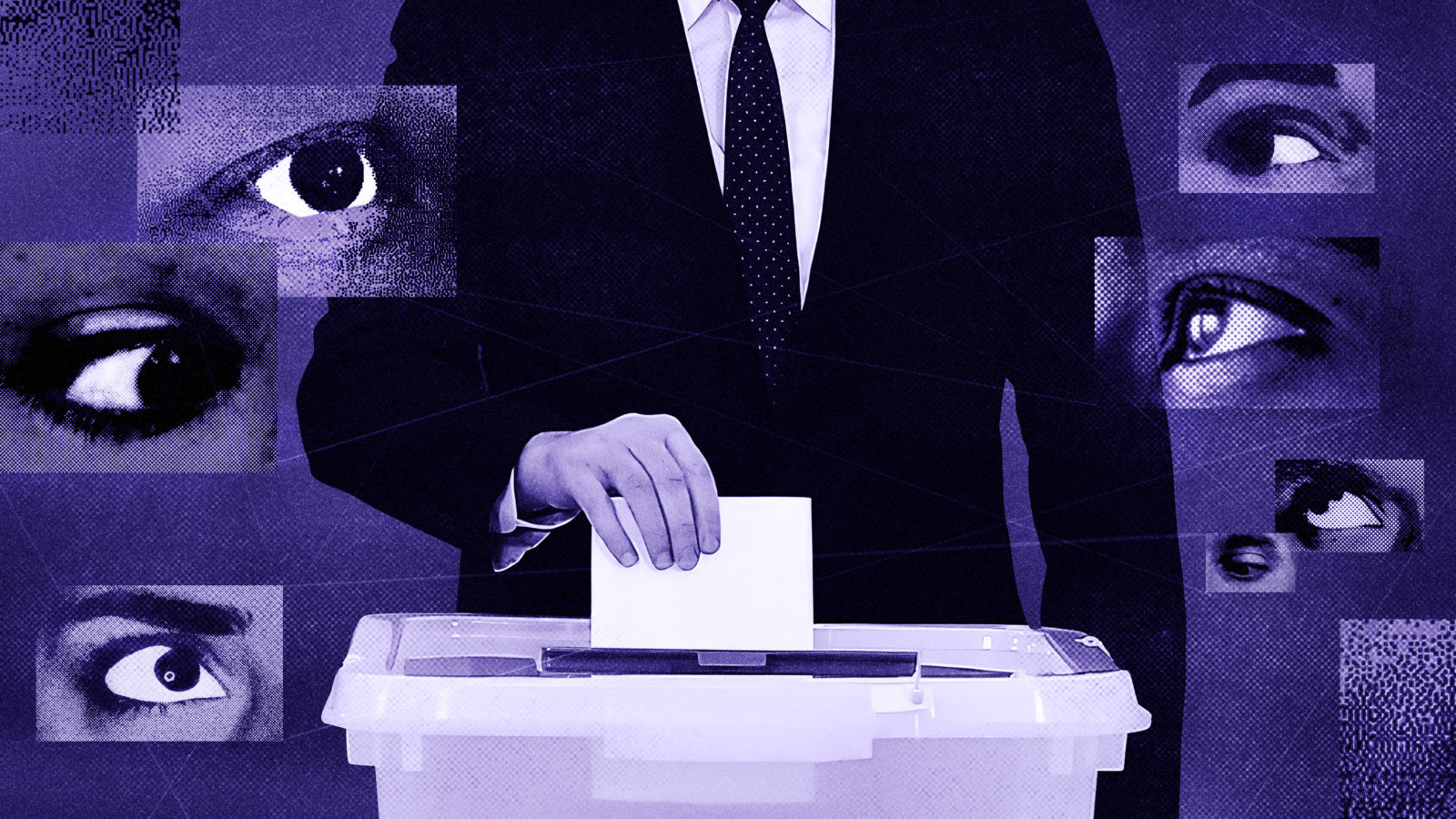
Four other journalists and regular collaborators with Abzas Media–Mahammad Kekalov, Nargiz Absalamova, Elnara Gasimova, and Hafiz Babali–were imprisoned over the last few weeks. In the wake of this mounting and unprecedented media crackdown, President Aliyev ordered a snap presidential election for February 7th, eight months earlier than originally scheduled.
Credit: Mélody Da Fonseca
Questioned by Forbidden Storiesand its partners at the Plenary Assembly of the Council of Europe on January 22nd, 2023, the representatives of the Azerbaijan delegation denied the existence of political prisoners in Azerbaijan, including Abzas Media journalists. “Maybe you have [political prisoners], but we don’t,” Samad Seyidov, a member of parliament said.“We have persons who violated the rules, and we are fighting for the rule of law,” Seyidov said.
Azerbaijan, a Caucasus country overlooking the Caspian Sea, ranks 151 of 180 on Reporters Without Borders’ Media Freedom Index. In a country ubiquitous with persecuted journalists and political prisoners, Abzas Media is among the rare few tackling the corruption of high-ranking officials and the hidden assets of President Aliyev’s entourage. This work earned Hasanli a spot on the extensive list of journalists targeted by the Pegasus spyware, as revealed by Forbidden Stories and its partners in July 2021.
Forbidden Stories met with Sevinc Vaqifqizi and her colleagues on several occasions in the past, including in 2023 at the Global Investigative Journalism Conference, in Sweden. On her way to Baku, in November, Vaqifqizi also contacted Forbidden Stories. In her messages, she said, “we believe [Hasanli’s arrest] is directly related to our investigations.” Upon their arrests, Vaqifqizi and other Abzas Media journalists requested other journalists pursue their investigations.
To cover hard-hitting investigations, like the practice of torture in Azerbaijan–including the “Terter case,” a torture scandal that implicated the military and resulted in over ten dead–Abzas Media relied, in part, on European funding.
In 2001, Azerbaijan became a member of the Council of Europe–an international organization dedicated to upholding human rights, democracy, and the rule of law in Europe. Since then, the European Court of Human Rights, the Council of Europe’s court, found Azerbaijan violated the European Convention of Human Rights or its protocols 263 times. 33 of these breaches included charges of “torture” or “inhumane and degrading treatment.” In its 2017 report, the Committee for the Prevention of Torture (CPT) reported numerous instances of ill-treatment in prisons, upon visiting several of them, including “slaps, punches, kicks, truncheon blows, blows inflicted with a wooden stick, a chair leg, a baseball bat, a plastic bottle filled with water or with a thick book.” CPT also listed more severe forms of torture, such as “truncheon blows on the soles of the feet (often while the person was suspended) and electric shocks.”
The Baku Connection project, a consortium of 12 media partners created to continue the work of Abzas Media, collaborated with Forbidden Stories to investigate the practice of torture, among other violations, and financing of Azerbaijan’s carceral system–a thread that directs us to the heart of European institutions.
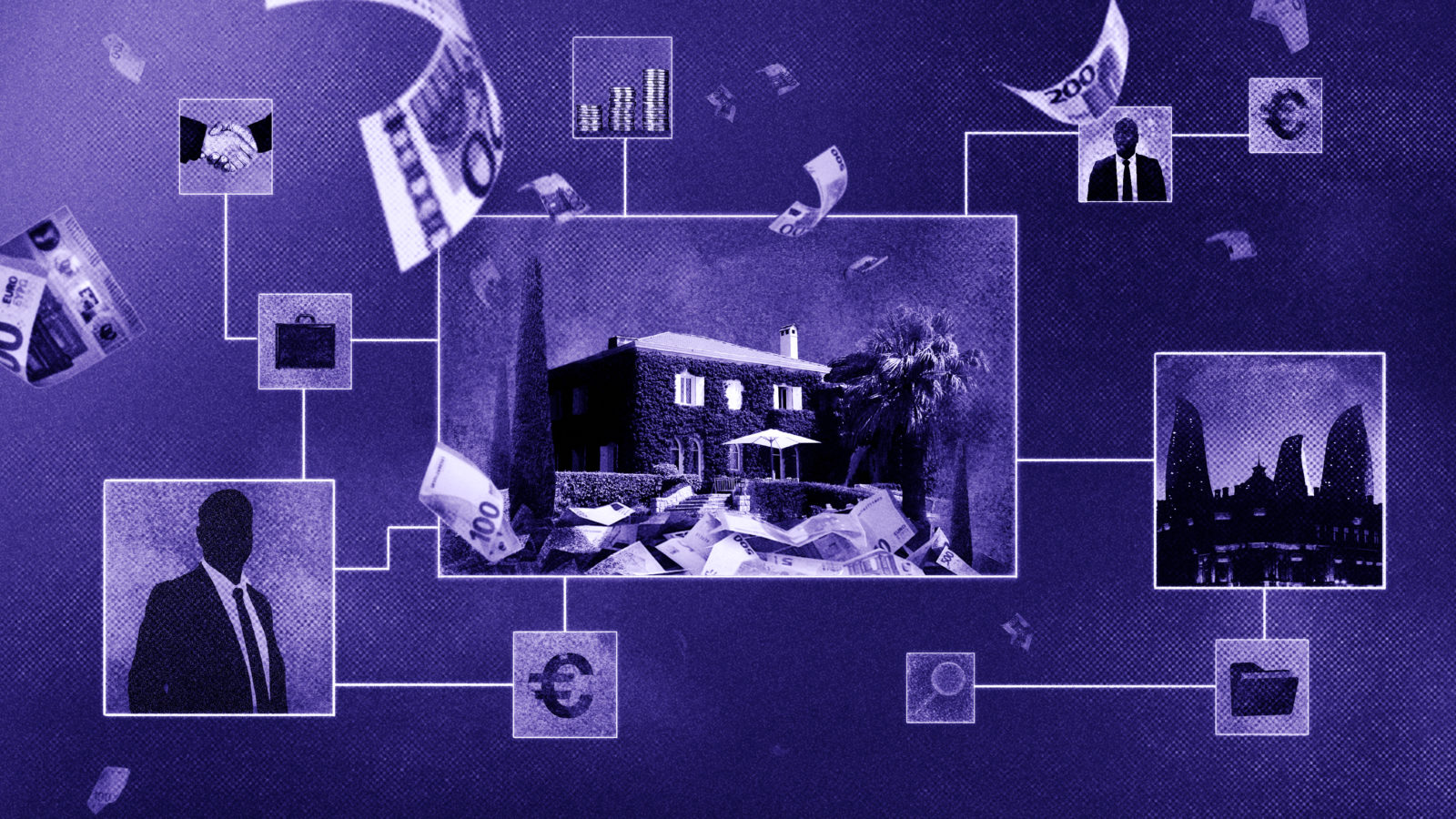
Our findings suggest that since 2014, over 23 million euros have been transferred from the Council of Europe to finance several development programs in Azerbaijan, according to public documents reviewed by Forbidden Stories. These funds, which originated mostly from the European Union’s budget, were meant to generate “capacity building of the judicial system,” “training for staff,” “increased oversight of prison conditions,” and “action to improve transparency and prevent corruption,” among others. But monitoring what happens inside Azerbaijani prisons is more opaque.
“They tied my arms to the ceiling”
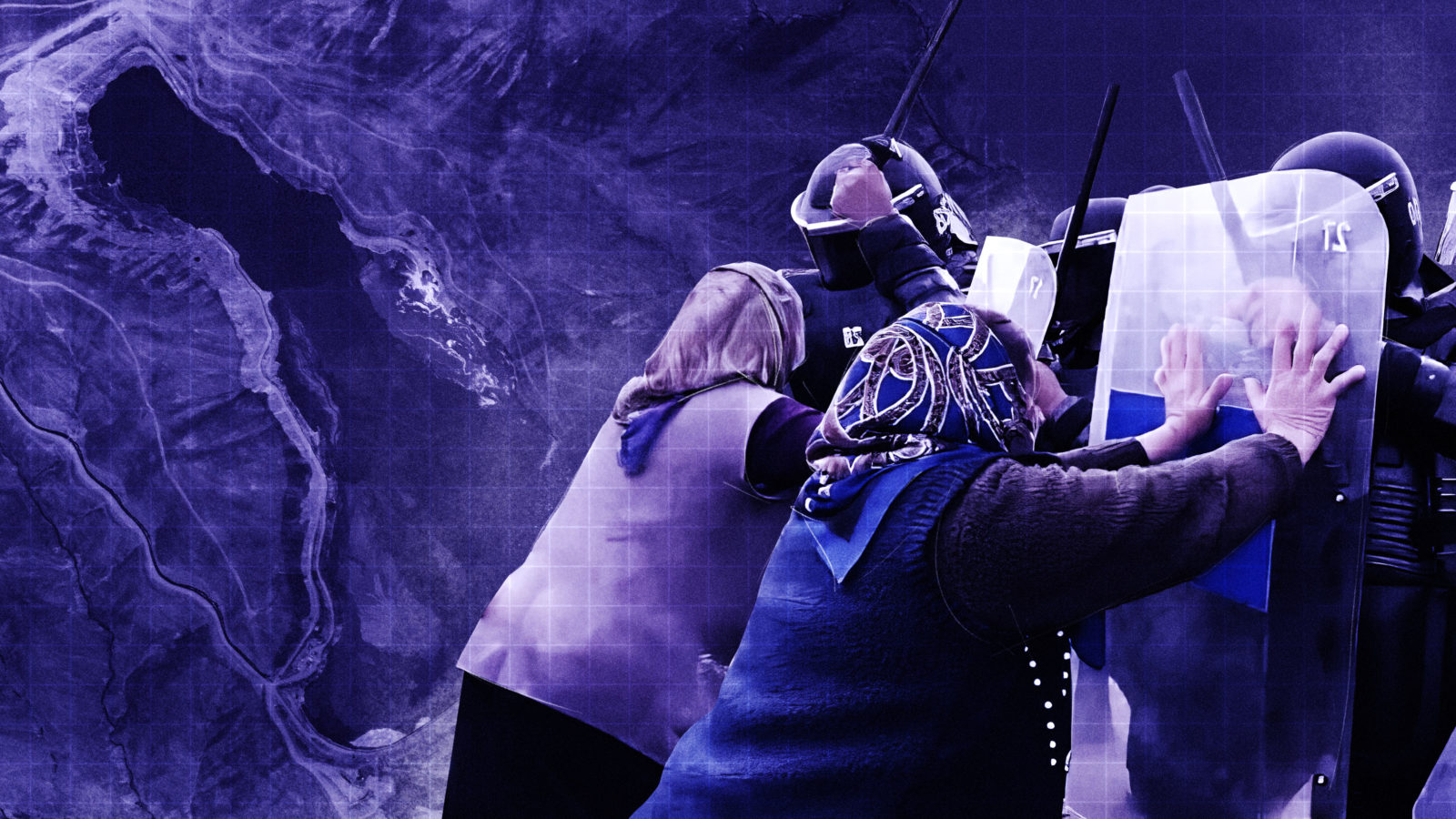
For 30 years, the human rights defenders Arif and Leyla Yunus, have documented the wrongdoing of the Aliyev clan, commonly referred to as “the Corleones” in a diplomatic cable from the US State Department released by Wikileaks. They became the face of resistance against the Azerbaijani regime. On July 30th, 2014, they were arrested and charged with treason, then sentenced to up to eight years in prison before fleeing the country.
Credit: Mélody Da Fonseca
Arif, now 69 years old, and his wife, Leyla, live in an undisclosed location in The Netherlands. Leyla, 68, weighed down by illness and the long months spent in prison, wears her Légion d’Honneur proudly as she welcomed Forbidden Stories into her sun-drenched home. From exile, the Yunuses continue to receive and document reports of human rights violations in Azerbaijan. “Sometimes calls are made directly from the cells,” Arif says.
Though it has been several years since he was released from prison and fled Azerbaijan, Arif still bears the psychological scars from his time spent underground, where he was tortured for two months. “They tied my arms to the ceiling, but this time my feet couldn’t reach the floor. It was very painful. My arms were so numb that they no longer obeyed my commands. My left hand was particularly sore where the handcuff pressed on the tendon,” Arif wrote in a 2024 book in which he recounted his experience in prison. “I wanted to scream out in pain, but I didn’t have enough air.” He recalls being asked repeatedly, “Now, are you going to tell us about your visits and your criminal links with the Armenians?” “I didn’t have the strength to speak. I shook my head with difficulty in refusal,” he said.
During our visit with the Yunuses, we presented them with our findings. Aside from the 23 million euros transferred from the Council of Europe to Azerbaijan, one project drew our attention. The European Union and the Council of Europe co-financed a project called SPERA, a 1.3 million euro initiative focused on reforming Azerbaijan’s penitentiary system. The program included Zoom meetings to discuss “organizational security,” workshops to “coach” Azerbaijani prison guards, and a “case study” visit to a prison in Spain.
When presented with a screenshot of the last Zoom meeting held on October 28th, 2021, the Yunuses appear shocked. They instantly recognize Iftikhar Qurbanov, a doctor taking part in the SPERA program, who they claim is connected to special services. “He personally intimidated me and Leyla,” Arif said.
Elnur Abbasli, one of the people overseeing prison 16, is also pictured. The Yunuses say bartering is commonly practised in prison 16, and higher-ups sign off.
Also invited to take part in the work to improve Azerbaijan’s penitentiary system is the director of a “GONGO” or governmental NGO, the acronym widely used in Azerbaijan to designate pseudo-nonprofits controlled by the state. The director’s name appears on a list of 640 NGOs that congratulated President Ilham Aliyev on November 9, 2020 for the signing of the ceasefire agreement between Azerbaijan and Armenia. “Dear Commander in Chief, I warmly congratulate you on the historic victory day of November 8… We are proud of you and wish you success in your historic mission of freedom,” the text reads. The Council of Europe confirmed in an e-mail to Forbidden Stories that it provided funds to the NGOs participating in the SPERA 2 program.
“It’s just a front. They just do seminars”
Participants in programs like SPERA can “go and visit prisons in Norway or elsewhere. But it doesn’t change anything. It’s all pointless,” Arif Mammadov, the former Azerbaijani ambassador to the Council of Europe, said. “The system remains absolutely the same,” Mammadov, who is now an opposition figure in exile in Brussels, said.
“This allows Azerbaijan to say it’s working with Europe, and European bureaucrats take notes. Afterwards, everyone congratulates each other and goes to a restaurant to celebrate. Azerbaijan can say that it has laid off a certain number of people, or that it has convicted some sixty people in a case… But the system remains the same, and it works on both sides. In the end, it’s good for both sides,” Mammadov said.
In its progress report, the Council of Europe specifies that in Azerbaijan, “a number of offences were decriminalised, alternative punishment was introduced, as were non-custodial measures of restraint.” The Council also noted the “reduction in number and length of pre-trial detentions,” and the April 2019 “Presidential Decree,” which allegedly introduced judicial and legal system reforms. But to human rights experts in the country, it is all for show. “It doesn’t matter what kind of regulations are passed, especially when it’s related to political prisons,” Yalchin Imanov, an Azerbaijani lawyer, said.
“You know, it’s like the buildings in Azerbaijan. The façades have been repainted, but when you go around them and look at the building from behind, they’re still old and degraded Soviet-style buildings. It’s the same with law,” he said.
The Council of Europe progress report highlighted training “85 new candidate lawyers” to “increase their awareness on Council of Europe standards.” As for Yalchin Imanov, he was disbarred in 2017, after filing a complaint for the torture of one of his clients.
“It goes without saying that we can’t force them to work in a certain way,” a Council of Europe official said embarrassingly. “Both are invited to put a little water in their wine.”
Some 20 parliamentarians from the Council of Europe sounded the alarm in June 2019, when they signed a motion for resolution stating that “The funds from the Council of Europe and the European Union are used by the GONGOs and government agencies for projects and programs that do nothing to help the Azerbaijani civil society or its people.”
Cypriot Constantinos Estafios, a member of the parliamentary assembly, said, “this is the failure of the Council of Europe. 70 years after its creation, which was based on legal order, democracy and respect for human rights, we are still discussing fundamental and elementary situations.”
When contacted by Forbidden Stories, the Council of Europe’s press office gave no further details on the evaluation procedures for programs financed in Azerbaijan. As for the risk of using bogus NGOs, the Secretary General’s office said it works with NGOs selected on the “basis of a public and transparent tendering procedure.”
“You have to understand that one day you will be arrested”
For the Yuneses, the arrest of Abzas Media journalists was no surprise. Arif, who knows the risks of investigating the regime’s wrongdoing, had previously warned the young team. “I told them, ‘be careful, you have to understand that one day you will be arrested,” Arif recalls. Vaqifqizi said she knew of the risks, but, “this is our homeland, our country. We have to fight for the future of our country,” she said.
The same allegedly reformed penitentiary and judicial system, previously called out in Abzas Media’ reporting, is the same system now holding them behind bars and has now frozen their bank accounts.
According to Djordje Alempijević, a former member of the CPT who visited Azerbaijan on 3 occasions, the practice of torture inside Azerbaijan’s prisons is “endemic and resistant.” “Our findings have not convinced us that progress has been made in resolving the problem.”
Records of visits to Azerbaijan by the CPT can only be found until 2018, despite two visits in 2020 and 2022. The Committee, which depends on the Council of Europe, cannot make its reports public without Azerbaijan’s consent. “The authorities don’t like the content of our reports… they don’t want these facts to be made public,” Alempijević said, somewhat embarrassed.
The rule in force at the Council of Europe is paradoxical: Whoever is overseen by the CPT has the right to censure it. Constantinos Estafios said the process is “far too political. It’s more politics than a humanitarian approach.” In a resolution from last January 24th, he called for a policy change. (The director of the Committee for the Prevention of Torture denied our interview requests.)
An ally for the autocrats
Gerald Knaus, President of the European Stability Initiative, said such policies indicate that the Council of Europe “is becoming an ally of autocrats.” “Being silent, being cowardly, not speaking out, not saying that white is white and black is black, is incredibly useful to autocrats,” the head of the Berlin-based think tank that investigated Caviar Diplomacy says.
When asked about the possible suspension of the Azerbaijani delegation from the Parliamentary Assembly of the Council of Europe (PACE), Dunja Mijatović, Commissioner for Human Rights, claims, “That has nothing to do with me, that is a PACE issue.” On the question of torture, Mijatović said, “that’s the CPT, that’s clear.” On the funds transferred to Baku from the Council of Europe, she said, “Oh, that’s the Secretary General.” Only when the issue of press freedom arose, were we advised to “send an email,” in response to which we were denied an interview.
Baku’s strong connection to Europe, some point out, might be related to the quantity of gas flowing between Azerbaijan and the EU. Following the suspension of gas exports from Russia, in 2022, Ursula von der Leyen, President of the European Commission, signed a supply contract with Ilham Aliyev for at least 20 billion cubic meters per year.
From the presidential palace gardens, von der Leyen praised a “trustworthy and reliable partner,” referring to Aliyev. “It would be an understatement to say that this announcement comes as a shock to anyone familiar with the way in which the dictatorship ruling Azerbaijan uses the proceeds of its gas revenues,” reads a tribune signed by some fifty elected representatives in the French newspaper Le Monde.
Credit: Mélody Da Fonseca
Contacted by Forbidden Stories, Peter Stano, spokesman for the President of the European Commission, insisted by phone. Ilham Aliyev is reliable. “The President of the commission said this in relation to the Memorandum of Understanding on Energy,” Stano said.
Stano said the European Commission calls for the release of “those imprisoned for exercising their fundamental rights,” including journalists, but said there is validity in European-funded programs in Azerbaijan. “The logic of this engagement, of the projects in this area, is also to raise awareness, to compare standards, to tell them ‘look, you can do things differently.’ You need to start somewhere. This is a country that emerged from 70 years of a communist totalitarian regime. And they are still in a semi-autocratic regime. If you want to change it, you can either ignore them or engage with them,” Stano said.
At the Council of Europe, many have been increasingly critical of Azerbaijan following its military intervention in Nagorno-Karabakh, which forced over 100,000 Armenians to flee the region. On January 24th, the PACE voted (76 to 10) to revoke Azerbaijan’s credentials for failing to comply with its obligations as a member state. Azerbaijan, whose membership has not yet been challenged, pre-emptively left the Parliamentary Assembly, denouncing the “current unbearable atmosphere of racism, Azerbaijanophobia and Islamophobia within PACE.”
Contacted by Forbidden Stories and its partners, the Presidency of the Republic of Azerbaijan declined to answer our questions.
Just a few days before the Presidential elections, Abzas Media’s website is no longer accessible in Baku. Hasanli’s last written words are dated December 30th, 2023. In a note he wrote from his prison cell, which has since been made public, he wrote, “ou probably know that we–Sevinj Vaqifqizi, Nargiz Absalamova, Hafiz Babali, Mahammad Kekalov, and myself–are completely isolated. No telephone conversations or meetings with our families are allowed. We are not even allowed to call our lawyers, the ombudsman, nor write letters to our loved ones. Members of the government should understand that it is impossible to completely prevent criticism and freedom of expression,” he wrote. To sign off, Hasanli borrowed Einstein’s words: “Truth is subtle, but it is not malicious.”
Further Credits:
- Publishing coordinators: Clément Le Merlus, Louise Berkane
- Fact-checkers: Sofía Álvarez Jurado, Emma Wilkie
- Copy editors: Simon Guichard, Christopher Knapp
- Translators: Amy Thorpe, Leyla Mustafayeva, Mariana Abreu, Phineas Rueckert, Sophie Stuber
- Communication: Clarisse Jacq, Emma Chailloux, Matthieu Gerrer
- Videos: Anouk Aflalo Doré, Vincent Bourre
- Graphic designer: Mélody Da Fonseca
- Front-end developer: Thibault François