

The Poet’s Army
A Buddhist monastery emerges from the darkness of the night. “We’re stopping here,” orders commander Maung Saungkha, his eyes bulging with fatigue. The 4x4s switch off their headlights, as the light could give them away. The Burmese air force is on the prowl. The exhausted convoy spits out its passengers, soldiers from the Bamar People’s Liberation Army (BPLA), coated in sweat and dust. These kids, barely 20, wearing helmets and carrying assault rifles, burn their boredom away with flimsy cigarettes. Maung Saungkha, 31, the poet they blindly follow, unhooks a Glock pistol from his belt. His men have stretched his hammock between two wooden pillars. The war chief, a small man with dark, mischievous eyes, wraps his belly with a black sheet and rocks from side to side, humming a Burmese pop tune.
The commander has stopped in a small town in eastern Burma, in the north of Karen State, a province the size of Belgium where fighting against the junta is a daily occurrence. A month ago, in March 2024, the biggest town in the area, Hpapun, was conquered by Maung Saungkha’s troops and his Karen guerrilla allies, who are now seeking to seize neighbouring bases. At first, the battle seemed lost: on one side, the insurgents — “terrorists” according to Burmese authorities — holed up in the jungle with no experience of warfare; on the other, a state army, equipped with fighter planes and supported by Russia and China. But the tide has turned. Hpapun and dozens of towns have fallen into the hands of the resistance, which claims to control more than half of Burma’s territory. In revenge, the junta is bombing civilians suspected of supporting the armed groups. A month earlier, it destroyed a monastery housing refugees. The attack left eight people dead and around fifteen injured. “Don’t worry, nothing will happen,” Maung Saungkha tells me. Suddenly I hear him snore. When I wake up, the dawn is grey and sticky. The night has been interrupted by the muffled sounds of drone strikes ten kilometres away. The commander rejoices in the morning: “Those were our bombs! Their last bases won’t last long.”
He had never carried a gun
I find it hard to recognise the staunch pacifist who has taken part in all the anti-conflict demonstrations and whom I have interviewed several times. Three years earlier, Maung Saungkha didn’t give a damn about drones or military strategies. He had never carried a gun. He was a poet with an immense aura, in a country where the art of shaping rhymes makes the powerful tremble. Poetry has long played a political role in Burma, at least since the struggle for independence at the end of the 19th century, when pamphlets against the British colonists were passed around in secret. Maung Saungkha is the author of several collections — the most famous of which, Hidden Hurts, was written in prison (none of his works have been translated into French). The Burmese love his unbridled style, which mixes politics, art, Van Gogh, and Cat Power with potty jokes and sex stories.
No one in this world is exempt from hurts
I want to piss at hurts
The thing is
my piss always misses its target
These days, the poet is running dry. He hardly writes at all. “I’m too busy, mentally and physically. I don’t even have time to watch a film on Netflix,” he sighs while squeezing a lime. This anti-stress ball ends up in hot water to lower his high blood pressure, which worries him. His sense of humour has waned. His laughter, a childish chuckle, is seldom heard. He says he sleeps too little. Sadness bites, weariness too, but his men don’t know anything about that: “I’m their leader. I keep myself in check.” It’s already been three years since the war swallowed him up.
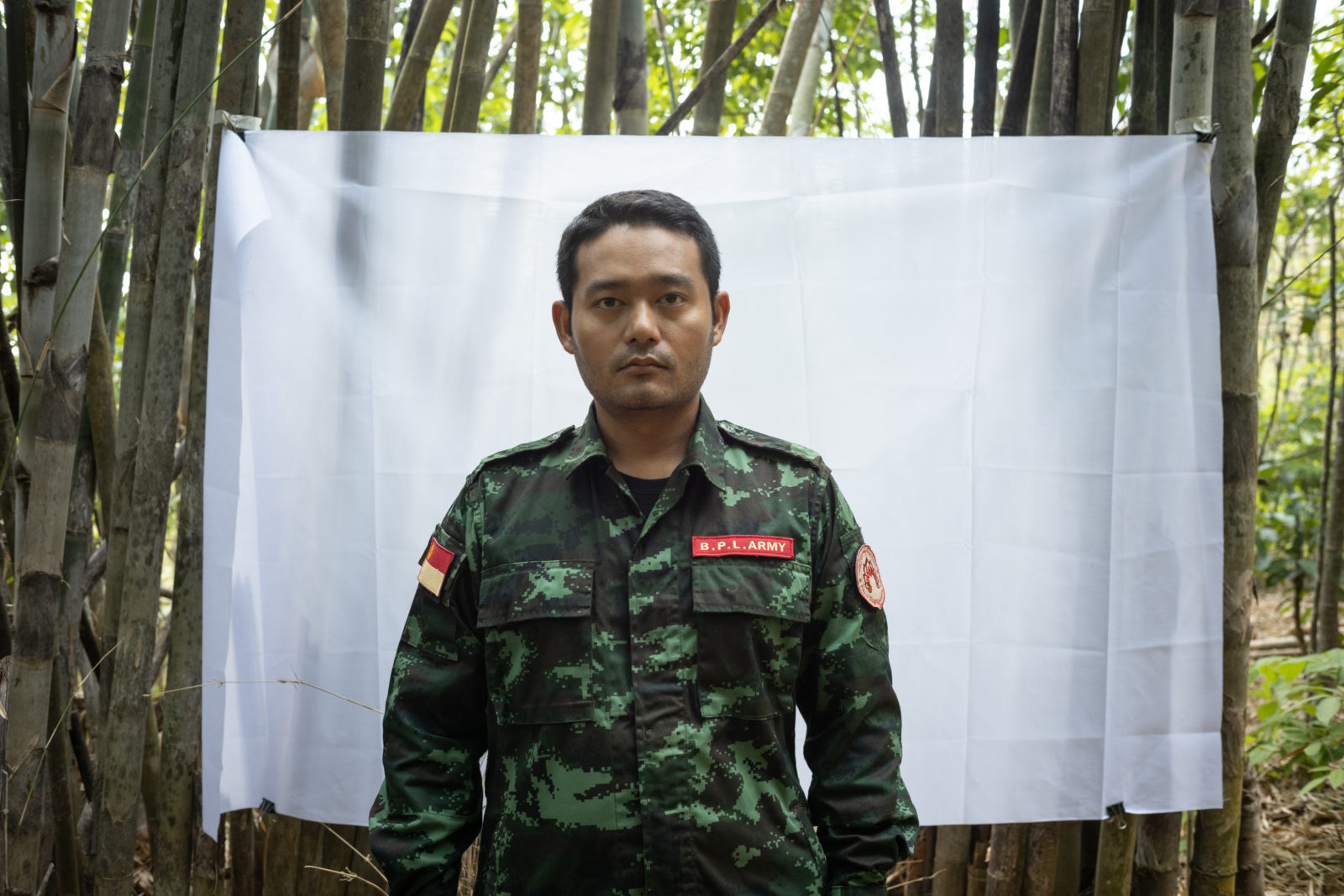
The Bamar People’s Liberation Army (B.P.L.A.)’s commander-in-chief, Maung Saungkha, poses for the photograph in his basecamp in Kayin state, Myanmar. Photo: Ta Mwe
His life and Burma’s destiny came together on the night of 1 February 2021, when the army overthrew Aung San Suu Kyi’s government. A former dissident and Nobel Peace Prize winner, the State Councillor — her official title — was thrown into prison along with dozens of politicians, activists and artists. General Min Aung Hlaing’s coup put an end to ten years of transition to democracy, during which the Burmese population, estimated at 54 million, had seen free elections, an end to censorship and an opening up of the economy. Everywhere, hundreds of thousands of demonstrators demanded the departure of the military, but their peaceful processions were dispersed with live ammunition. A brutal return to dictatorship.
To continue the struggle, many young people joined the ethnic minorities who, in the border regions, had been fighting the central government for over half a century. These communities took in those who had fled and trained them to fight the junta, which had become their common enemy. Maung Saungkha found refuge with the soldiers of the Karen National Liberation Army (KNLA), the oldest guerrilla group in the world, which emerged in the country’s east in 1948, shortly after independence. With their support, the poet created his own group, the Bamar People’s Liberation Army (BPLA), inspired by his role models, Mao Zedong and Che Guevara. In combat, his troops act as reinforcements for the KNLA, never acting alone. “We’re a bit like the KNLA’s baby,” laughs the thirty-year-old.
Appreciated by the Bamar majority — Saungkha’s ethnicity, representing two-thirds of the Burmese population — as well as by the ethnic minorities, he is one of the rare figures capable of uniting these two worlds, which have been torn apart since the country was founded. “Our success is not measured by the number of outposts we take or the number of junta soldiers we kill, but by our ability to build trust,” stresses the influential commander. He is fighting to establish a federal and democratic state, free from the grip of the military. A new Burma, he claims.
To reach his camp — the location of which is kept secret — one has to cross the border into Thailand, travel up the muddy waters of the Salouen River and land in the west, in Karen State, then cross rivers and pass through hamlets emptied by the war, standing on the hills like so many graves, carefully skirting the positions of the Burmese army. Perched on a pick-up truck, looking cool behind his Ray-Bans, Maung Saungkha acts as a tour guide, handing out new caps and energy drinks that taste like cough syrup. “I’ll show you everything,” he had promised in a message sent a few months earlier.
A bamboo table as HQ
After spending the night at the monastery, the road disappears into a dreadful valley, filled with collapsed hillsides, mounds of stone, and gaping holes. The ground looks as if it has been ploughed by the hands of an angry giant. In reality, it’s the voracious appetite of the gold diggers. When the convoy passes, the miners barely raise their heads. The feast goes on: this war has nothing to do with them. At their feet flows a river full of mercury or arsenic. The trickle of poisoned water has the colours of the rainbow. The poet’s camp has sprung up nearby, on abandoned rice fields. A Karen guerrilla loan. During the monsoon, the mist hides the huts and their earthen bunkers under its fluffy mantle.
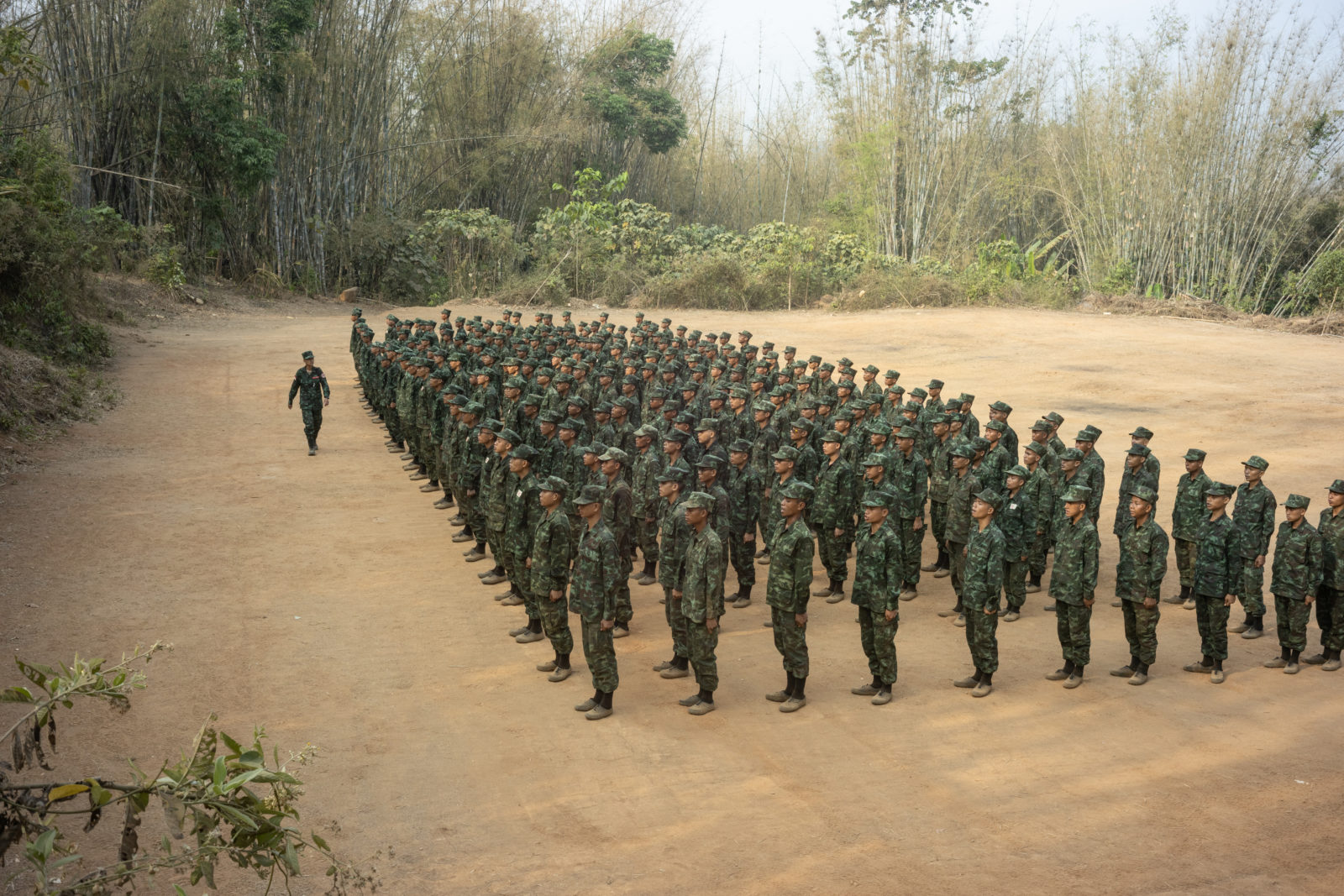
Newly recruited soldiers assemble for morning training at the B.P.L.A.’s secret training ground in Kayin State. Most of the youths who joined this latest batch are those who fled from the Myanmar military’s forced conscription, which was legalized in February 2024. Photo: Ta Mwe
The headquarters where the commander spends most of his days, bent over his Dell computer, consists of a bamboo table covered in oilcloth. Behind him is a whiteboard with a timetable and some of his maxims. This week it reads: “If you do what you believe in, there’s no point blaming those who don’t take part.” His eyes shining with pride, he shows me what he brought back from Hpapun after the military rout. Radio batteries and a frequency jammer. Five school notebooks scribbled in pen, “with their entire strategy.” The centrepiece: a Burmese intelligence notebook, which he lets me leaf through. It contains the names of the junta’s spies, their faces and even their e-mail addresses. The poet regains his thunderous laugh: “You really must be an old fart to print something like that!” He can rejoice. Maung Saungkha is no stranger to military success in Karen State, but also further north, in Shan State. The strategist has managed to place some of his troops alongside a powerful alliance of armed groups. On 27 October 2023, their joint offensive, dubbed “Operation 1027,” along the Chinese border, drove the junta out of the region and tipped the conflict in favour of the resistance.
A stranger in the hills
The poet’s army is said to number around a thousand soldiers, making it one of the largest groups to emerge after the coup. Most of them are young city-dwellers who have left their cosy beds and families for malaria, scorpions and jungle life. They are anything but warriors: students of Russian or Korean, rappers, engineers, designers, a tattoo artist… Other poets too. Lynn Htike, 23, met Maung Saungkha at a literary festival. “I liked his poems,” says this shy soldier, whose leg was wounded by a mortar round. But, more than his poetry, it was the leader’s political plan that convinced him: to finally found an armed group for the Bamar, the majority Buddhist ethnic group. The aim was not so much to defend their rights — they had monopolised power for decades — as to free them too from the grip of the military. The junta recruits its cadres from among the Bamar and, in the name of a supposed superiority of this ethnic group over the others, massacres, rapes and pillages minorities. “It’s our responsibility to eradicate this despicable system,” Maung Saungkha pledges. “We can’t let other ethnic groups do the work for us.”
The poet knows that he remains a temporary resident, a stranger in the hills. One day, a senior member of the Karen forces said to him: “To become chief of a village, you have to own a house there.” He was stung by the phrase. He could see himself leaving the jungle and conquering a piece of territory in the centre of the country, the stronghold of the Bamar ethnic group. There, between the arms of the Irrawaddy River, the land is flat and as red as blood. Maung Saungkha knows it inside out. He was born there on 5 January 1993.
Living near Bagan, an ancient city with thousands of temples, his parents ran a teahouse for many years. It was an institution where the men, huddled on plastic stools, debate world issues while toasting cheroots, cheap stinky cigars. In the early 1990s, Burma was suffocating under the boot of dictator Than Shwe, a superstitious general. There were no cars and no tar in the countryside, where life depended on the gnarled shoulders of the buffalo. The precious beasts did everything, turning over fields and pulling carts. “No one dared eat beef. It was like eating a member of our family,” remembers Maung Saungkha.
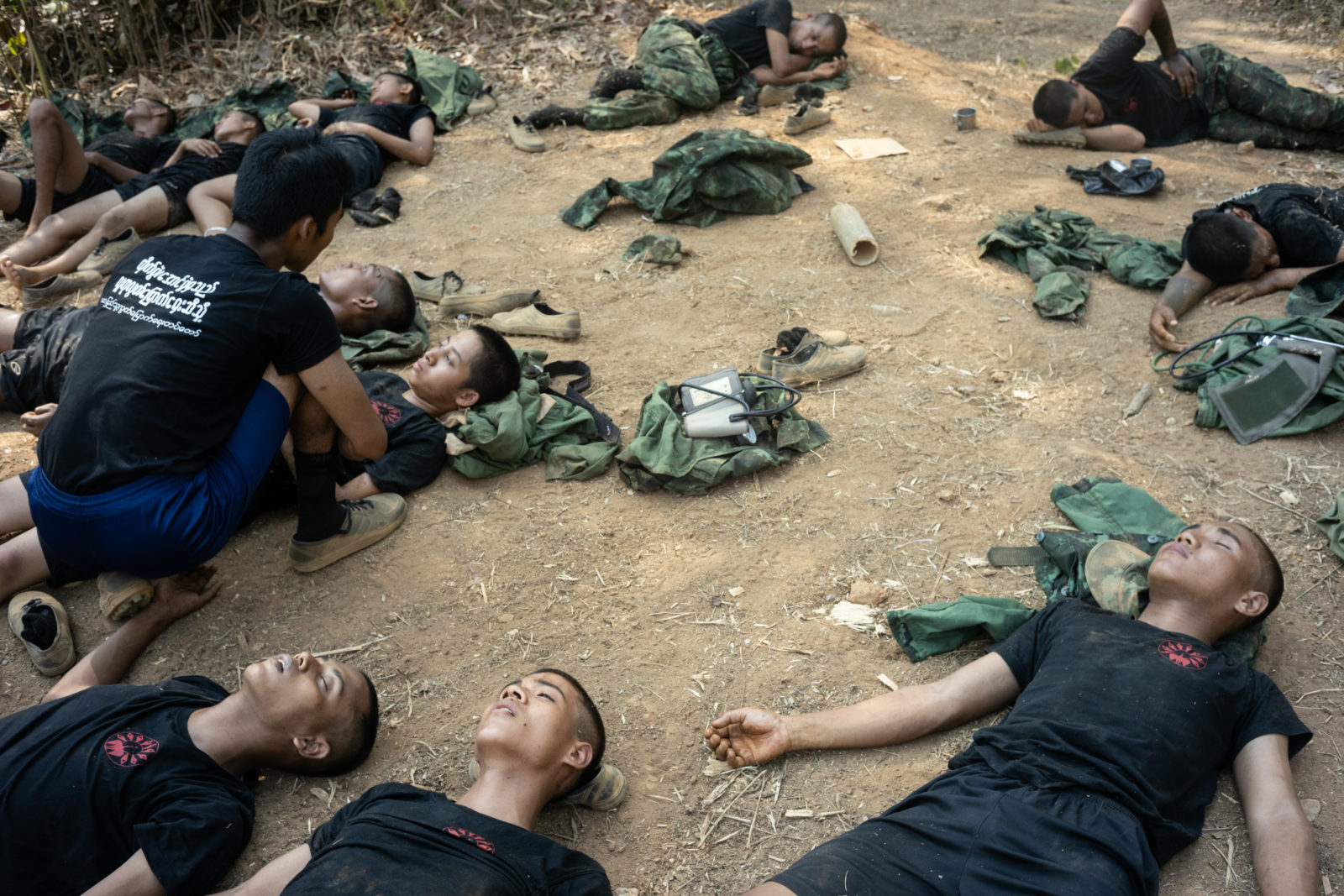
Newly recruited soldiers suffer from heatstroke and faint as temperatures soar to 38°C during the summer in the area. Photo: Ta Mwe
The father had big plans for his four sons, especially the youngest, a bit of a dreamer, who was already publishing poetry in local gazettes. The child was 13 when his family moved to Rangoon — a fallen capital since Than Shwe chose Naypyidaw in 2005, following the advice of an astrologer. But the teeming city remained the beating heart of Burma, a shock for the young country boy, who was studying industrial chemistry at university. Literature had passed him by. In the Burmese education system, only the best students choose their course of study; the others have to make do with the crumbs. The student admired Aung San Suu Kyi, an inflexible rival of the military under house arrest, and was active in the youth wing of her party, the National League for Democracy. In 2012, the dissident, who had been released two years earlier, managed to win a seat in Parliament. Maung Saungkha, on the other hand, found readers on Facebook. On the evening of 8 October 2015, the 22-year-old published a new poem entitled Image.
On my manhood is tattooed
A portrait of Mr President
My beloved discovered it
After our wedding
She was disgusted
Inconsolable
His humour sparked a national storm. A police officer filed a complaint against him on behalf of the scorned president, Thein Sein, former general and successor to Than Shwe, invoking Article 66(d) of the Telecommunications Act. Criticised by human rights activists, this law makes defamation punishable by imprisonment. After a brief escape during which, on Facebook again, the suspect continued his provocations (You can arrest poets / Not poems / Never), Maung Saungkha went on trial. Absurd weeks. No matter how much he denied it, everyone asked him if he really had his penis tattooed. He was sentenced to six months in Insein, the dilapidated Rangoon prison where dissidents are crammed together. “The guards were afraid of us because we could make a mess,” laughs the poet. “I had a great time. I had time to think in my cell. I read 200 books!”
Once outside, the former prisoner founded his association, Athan (“voice” in Burmese), to defend freedom of expression. Wearing an “I love peace” bandana, he organised rallies denouncing the army’s abuses against ethnic minorities. In 2016, after the historic legislative elections, Aung San Suu Kyi finally acceded to the government. But the hope was short-lived. The following year, the former opposition leader defended the military accused of carrying out genocide against the Muslim Rohingya minority. In 2018, she incriminated two Reuters journalists, sentenced to seven years in prison for investigating a massacre committed by the army. By sharing power with the military, the Nobel Peace Prize winner seems to have come to terms with their misdeeds. “She broke my heart,” says the poet, who quit the party in a huff. In 2020, the agitator attracted attention to himself once more by unfurling a banner in the centre of Rangoon to denounce the cutting off of Internet access in a western province where the military was fighting a rebel group, the Arakan Army. This time he avoided prison by paying a fine. The pandemic brought the Burmese economy to its knees. To earn a living, Maung Saungkha set up a campsite and rented tents by the roadside.
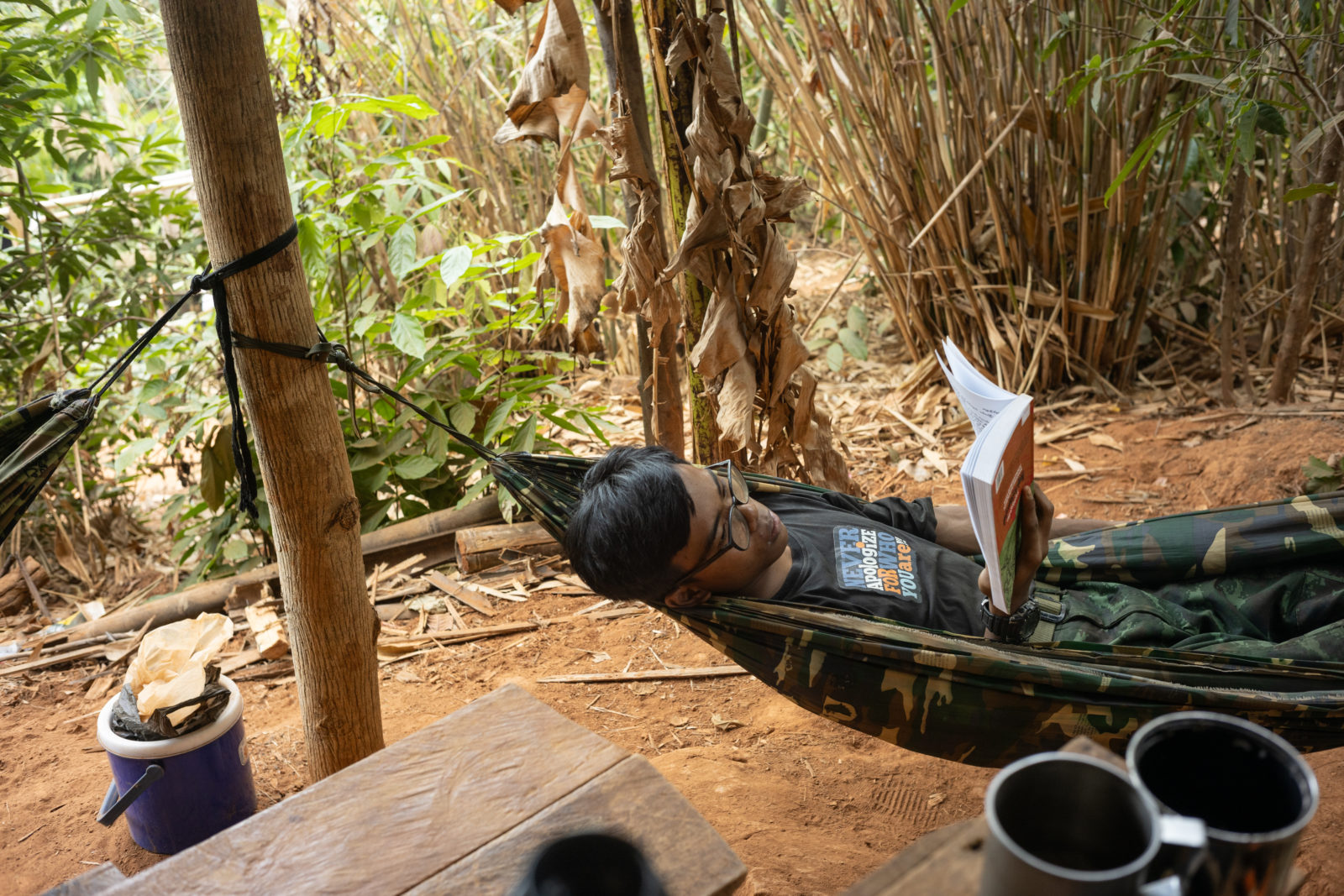
A soldier from the Bamar People’s Liberation Army (B.P.L.A.) rests in the camp as he is off duty. Photo: Ta Mwe
In the early hours of the morning on the day of the coup, two soldiers accompanied by policemen searched the campsite to arrest him, but found only the caretaker. Maung Saungkha had slept at his girlfriend’s place that night: “A stroke of luck. No customers had booked.” A warrant was issued for his arrest, but he reappeared in anti-Junta marches, uncatchable, galvanising the crowd with his loudspeaker. K Za Win, a 39-year-old poet, led the rebellion in Monywa, in the Sagaing region. “He’s my brother,” says Maung Saungkha, who finds it hard to talk about him in the past tense. During a demonstration on 3 March 2021, his friend was shot in the head. One of his poems had captured the military perfectly:
They love their country
Just the way they love to grate a coconut
from inside out,
for coconut milk.That’s who they are.
A video shows two policemen dragging the corpse of K Za Win through the street, scraping the blood-stained asphalt, before throwing it into a van.
That’s who they are.
Five days later, Zaw Myat Lynn, a respected member of the National League for Democracy and headmaster of a school where Maung Saungkha taught, was massacred in prison. His skin melted and so did his tongue. The soldiers poured acid or a boiling liquid into his mouth. The poet saw photos of the deceased: “His face looked like a zombie’s.”
That’s who they are.
The peaceful struggle is a dead end, thinks Maung Saungkha. If I stay, I’ll be next. Some Karen soldiers told him they were ready to welcome him. He came up with an idea, which he shared on Facebook: “Don’t you understand we have to counter-attack? You can draw a hundred swords, but you won’t be able to do anything against such a well-equipped army. If you want to fight guns with guns, contact me.” The message elicited mocking comments. Even his father doubts him. “Dad, I’m not doing this for show,” the son insists over the phone. “I’m going to see it through.”
Negotiating skills
At first, only sixteen people joined him. In their pockets, a few thousand kyats (a handful of euros). A single rifle. But Maung Saungkha’s reputation and negotiating skills did the rest. By talking on Zoom, he managed to convince the Arakan Army to send emissaries to train his team in combat. The rebel group in the west has never forgotten that Maung Saungkha was one of the rare Bamars to plead for their rights, notably in 2020, when their province, deprived of the Internet, was cut off from the world for nineteen months. In April 2021, the poet, unrecognisable, stripped of his long hair and fifteen kilos — since regained — created the Bamar People’s Liberation Army. The first battles were fierce, and the dead were hastily buried where they fell. The survivors persisted. Sai Min, 21, carries water cans across the camp. This amiable, chubby boy has a bad limp, but doesn’t balk at anything. One Thursday in February 2022, in a fit of bravado, he shouted to Maung Saungkha: “I’m going in front of you.” His right leg was blown off by a landmine. His leader, moved, carried him in his arms. “For the first time, I could see his tears,” says Sai Min. “He was crying. He was crying for me.” Sai Min doesn’t want to give his real name. His family doesn’t know he’s disabled; he’s never dared tell them.
At lunchtime, cold plates arrive. Sticky rice, dried fish, cooked and re-cooked, which Maung Saungkha smells “to see if it’s still fresh.” The meals are sparse, the jungle stingy. “Last year, we tried growing cabbage, beans and cucumbers, but it didn’t work out, so we buy tins,” laments Htet Wai Lynn, 23, who looks after three shelves of a bookcase where the chief’s poems sit alongside Homer’s Odyssey and Simone de Beauvoir’s The Second Sex. This wiry man with tattooed arms writes a monthly newsletter that he distributes around the camp. In the evenings, he gives classes on gender equality, federalism and international law. Maung Saungkha likes well-filled heads.
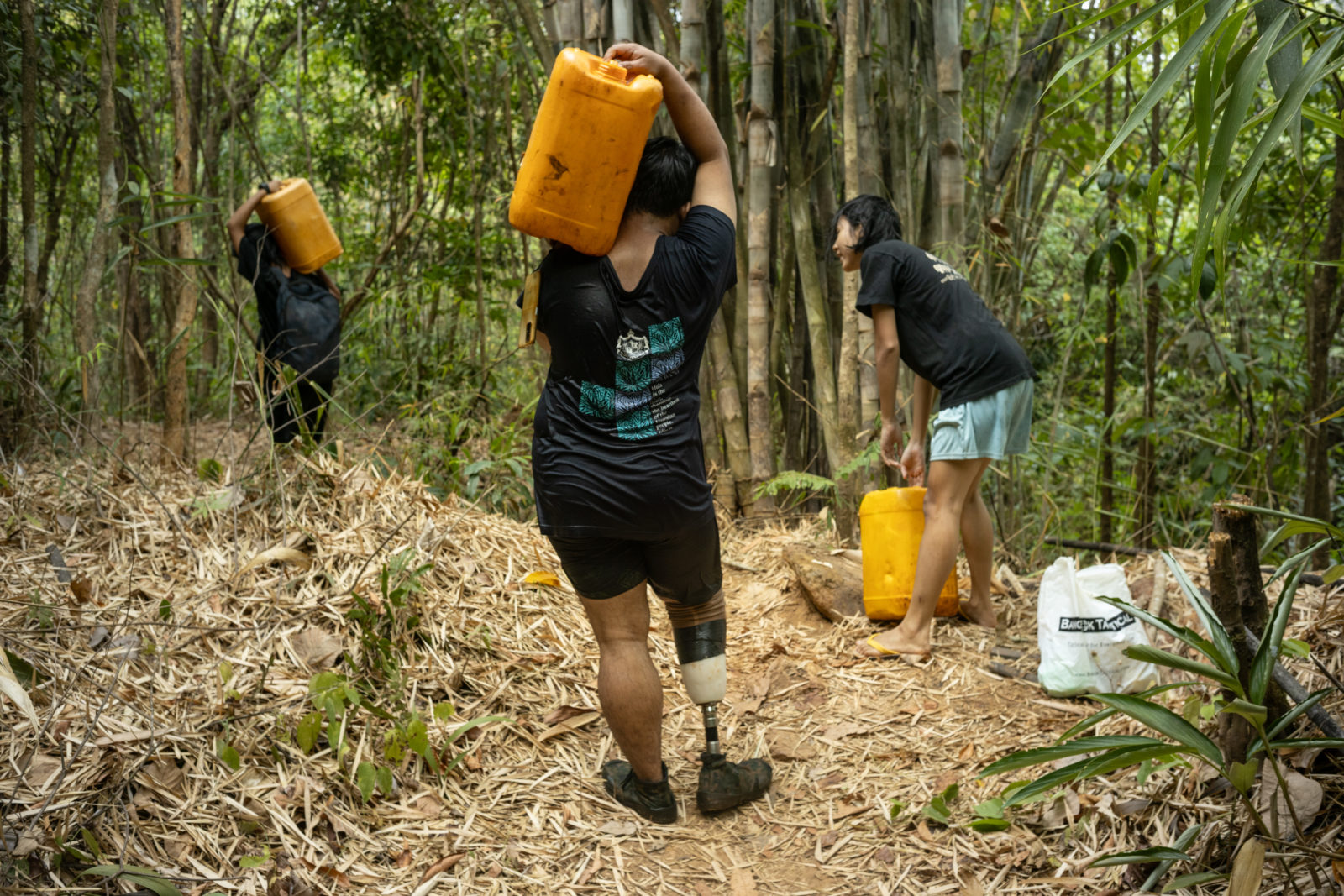
As summer temperatures reach record highs in the area, stream and water shortages become a problem for the rebel forces. Photo: Ta Mwe
In the clearing that serves as the training ground, the latest recruits, tall children with oily skin and shaven heads, stand stiff as daggers. Beaten down by the sun, they grimace and sweat out what remains of their innocence. Since the junta declared military service compulsory in February 2024, future conscripts have been flocking to the poet. More than 2,000 applicants have contacted him. After a drastic selection process, only 250 were chosen, including around twenty women. It was impossible to recruit more: each soldier was a mouth to feed, an arm to arm, and resources are limited. Thanks to donations, mainly from the Burmese diaspora, Maung Saungkha collects 50 million kyats (around €9,000) every month. He also sells t-shirts bearing the BPLA logo, as well as his poetry collections, even though he can no longer get them reprinted. “It’s not enough,” he says. “We’re spending more and more.” Weapons arrive in dribs and drabs from the Shan state. The group has only a few ramshackle motorbikes and two cars, one of which has been broken down for some time. The reality of war is humbling. On their way to the front, the Karen soldiers pick up Maung Saungkha’s troops like a school bus.
Straight to the stomach
Recruit training lasts three months. “Stand up straight! Your uniform is dirty,” screams a small woman with a deep voice called Thuta. She strikes her victim’s chest, sending a cloud of dust into the air. “They’re not up to par,” grumbles the trainer. “Well, it’ll come, it’s only their second day.” Her colleague delivers a few punches to the stomach. The punching bags don’t budge. It’s forbidden to complain, to flinch, to eat or drink, or even to speak, unless the instructor gives the order. “We don’t practise democracy,” admits Maung Saungkha. “I still believe in human rights, but we are an army, and that requires discipline and sacrifice.”
Cries escape from the small infirmary. Behind the training ground, the war has already begun. Twisted bodies line the floor. A bespectacled nurse, gasping for breath, juggles glucose drips and attempts to resuscitate recruits shattered by heat and exertion. One girl is convulsing with excruciating moans, a plastic cannula stuck in her throat. Three youngsters are finally hoisted into the only working car and evacuated to a hospital. The others wonder what’s in store for them. Maung Saungkha shrugs his shoulders: “Tomorrow, we’ll have the exercises done in the shade.”
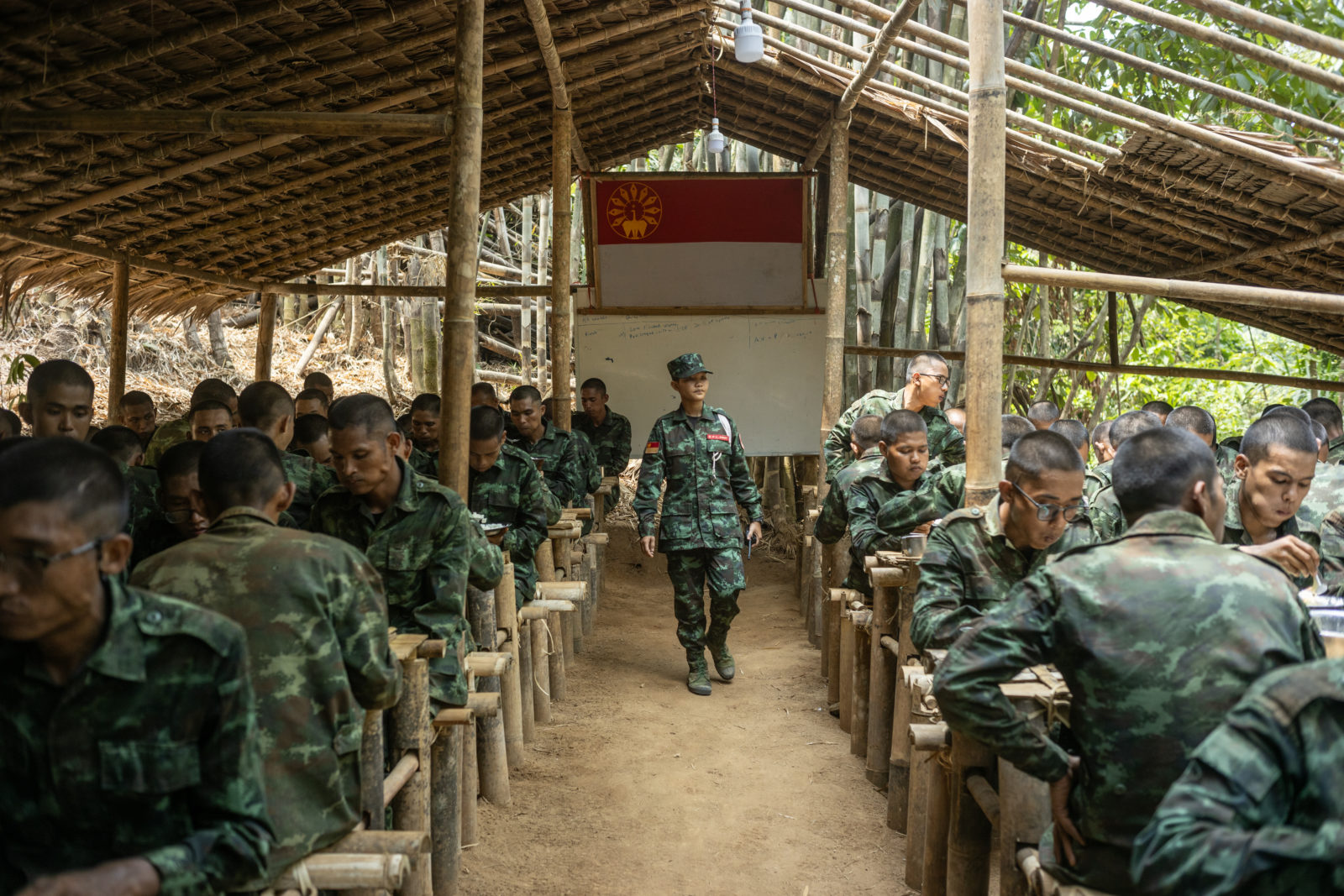
Newly recruited soldiers are seen during the lunch break at the B.P.L.A’s training camp. Photo: Ta Mwe
The poet has other things on his mind. Tonight, he is receiving Sayar John, an important guest. His scraggly beard, bony chest and necklaces down to his navel make him look like a castaway. The jungle is not his natural environment. Sayar John has just arrived from Rangoon, where he heads a so-called “urban guerrilla unit,” which assassinates soldiers, civil servants, businessmen close to the junta and suspected informers in the name of the resistance. The headquarters is a hive of activity. People drink warm beer, smoke, have fun. Sayar John has made the long journey from the economic capital to obtain weapons.
Assassinations are a controversial practice within the resistance. “There is collateral damage,” admits Maung Saungkha. The mother of one of his friends was killed by a commando. She was walking in the arms of her brother, a retired soldier; the gunmen mistook her for his wife. A dark night envelops the camp. Drinks are brought in by torchlight. Suddenly, the whole table stands up as one, gazing up at the stars. Who heard it first? A junta plane flies overhead. A Chinese Harbin Y-12, designed for transport, but hijacked to kill. “They’re dropping bombs by the door”, Saungkha warns me. An attentive silence settles in. From the ground, the lethal device looks like a toy.
The dinner was a success for Sayar John, who left with a Panzer pump-action shotgun, “very effective at close range,” and 257 rounds of ammunition. The poet did not want him to pay. “Is it a gift?” I ask. “More like an investment,” replies the commander. “You never know when you’ll need help.”
The next day, Maung Saungkha wakes me up at 4am. As I am leaving the camp, he has an idea. He leans over to the driver: “Go through Hpapun. Show him victory.” A few hours later, the town conquered by the resistance a month ago appears at the end of a bridge covered in rubble. In the deserted streets, the driver speeds up, forehead pressed against the windscreen, one eye on the sky and its deadly planes. With the engine off, you could hear the birds, if they had the heart to sing. The junta was relentless, bombing shops, gardens and large houses reduced to concrete confetti. I see an ambulance with broken windows. A child’s bicycle lying on the pavement. The poet spoke of victory, but only fear inhabits this damned city. The new Burma is growing on ruins. The junta will never let go of the country’s reins without destroying it.
Further Credits: “I would like to credit Burmese photographer Ta Mwe. He works under a pseudonym because of the safety issues for Burmese reporters in Myanmar and Thailand. I submitted his name to XXI because I really like to work with Burmese photographers. He took fantastic pictures but suddenly, he also had to do more : our fixer/translator didn’t feel well and left us after a few days. He stepped in and translated conversations for me.”
The Baku Connection
The following article is part of a wider project: The Baku Connection. Find the project website including several more stories here.
Since November 2023, six journalists and members of Abzas Media have been arrested in Azerbaijan for allegedly smuggling foreign currency. Previously targeted by the authorities, Abzas Media had recently been reporting on torture against detainees in Azerbaijan’s prisons, which benefit from European funding.
On November 20th, 2023, Sevinc Vaqifqizi, a 34-year-old journalist with Abzas Media, a digital investigative media outlet, recorded a video for social media from the Istanbul airport. Hours earlier, Vaqifqizi’s colleague, Ulvi Hasanli, the 36-year-old director of Abzas Media, had been arrested in Baku, Azerbaijan’s capital, when police stormed his home.
As Vaqifqizi prepared to board her flight back to Baku, she had little doubt she would share the same fate as her friend. Still, she took the risk, and through her smartphone, highlighted the ongoing and unprecedented crackdown on Azerbaijani media. “We would like to inform you that the order for Ulvi’s arrest comes directly from President Ilham Aliyev, she said.
She used her last moments of freedom to send a message to the Azerbaijan regime: “People will pick up where we left off even if they arrest Ulvi, or me, or any of us. Don’t let them think they can stop these investigations by arresting us, it won’t happen,” she said in the video. “I can’t just leave Ulvi inside and lead a comfortable life,” she continued.
Upon her arrival in Baku, at Heydar Aliyev Airport–named after the late leader of the former Soviet Republic and father of current president Ilham Aliyev–authorities apprehended Vaqifqizi and detained her.
According to law enforcement, 40,000 euros in cash was allegedly seized at the newspaper’s headquarters in central Baku. Before his arrest, Hasanli had briefly confided in reporters that he believed the money was planted by officials as supposed evidence to charge him with smuggling foreign currency.
According to what Vaqifqizi recounted, Hasanli was allegedly beaten and assaulted upon his arrest. “Why do you cover corruption instead of our victory in Nagorno Karabakh,” authorities allegedly asked Hasanli, referring to the disputed territory between Armenia and Azerbaijan. “Don’t you have better stories to tell?”
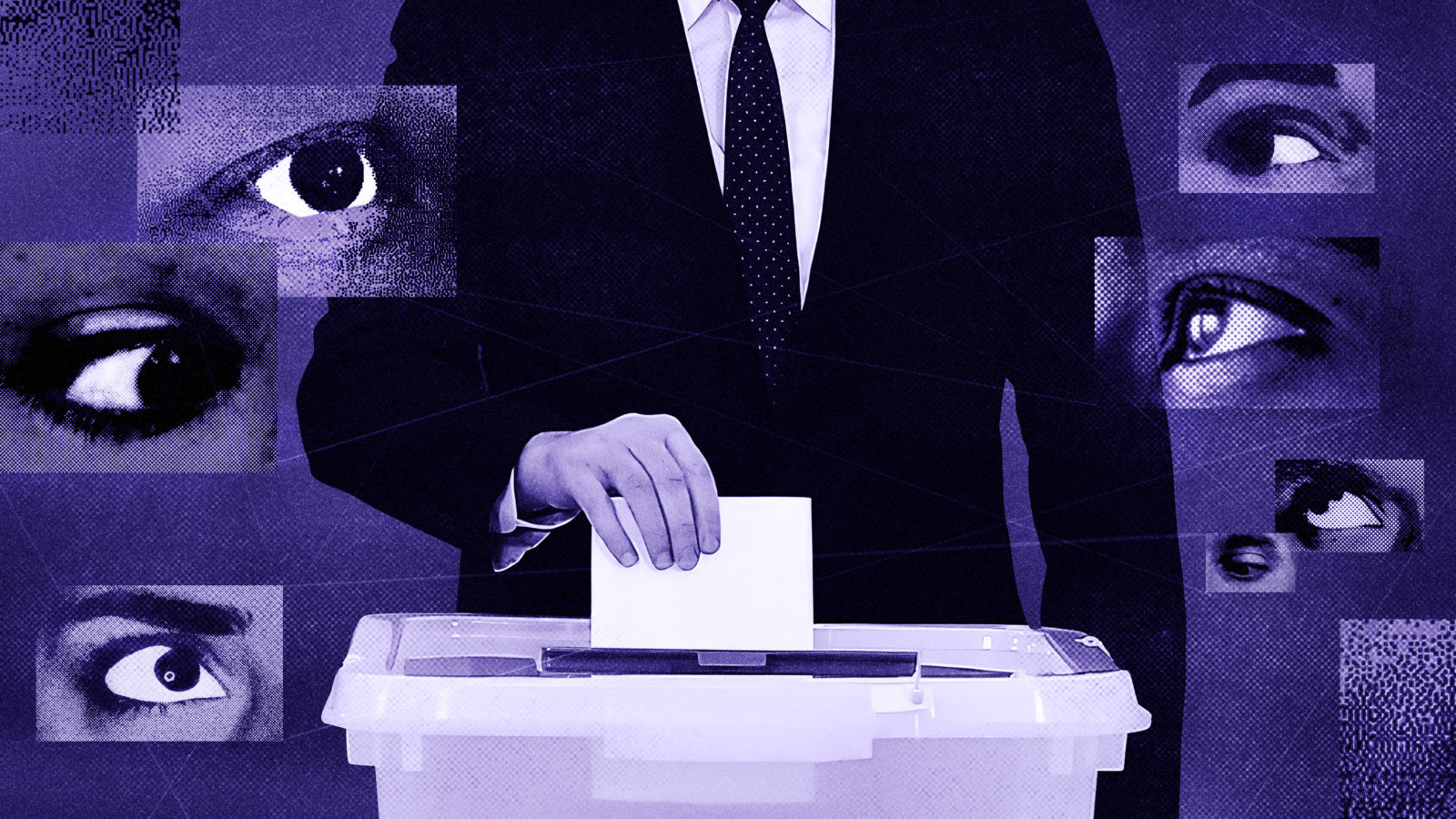
Four other journalists and regular collaborators with Abzas Media–Mahammad Kekalov, Nargiz Absalamova, Elnara Gasimova, and Hafiz Babali–were imprisoned over the last few weeks. In the wake of this mounting and unprecedented media crackdown, President Aliyev ordered a snap presidential election for February 7th, eight months earlier than originally scheduled.
Credit: Mélody Da Fonseca
Questioned by Forbidden Storiesand its partners at the Plenary Assembly of the Council of Europe on January 22nd, 2023, the representatives of the Azerbaijan delegation denied the existence of political prisoners in Azerbaijan, including Abzas Media journalists. “Maybe you have [political prisoners], but we don’t,” Samad Seyidov, a member of parliament said.“We have persons who violated the rules, and we are fighting for the rule of law,” Seyidov said.
Azerbaijan, a Caucasus country overlooking the Caspian Sea, ranks 151 of 180 on Reporters Without Borders’ Media Freedom Index. In a country ubiquitous with persecuted journalists and political prisoners, Abzas Media is among the rare few tackling the corruption of high-ranking officials and the hidden assets of President Aliyev’s entourage. This work earned Hasanli a spot on the extensive list of journalists targeted by the Pegasus spyware, as revealed by Forbidden Stories and its partners in July 2021.
Forbidden Stories met with Sevinc Vaqifqizi and her colleagues on several occasions in the past, including in 2023 at the Global Investigative Journalism Conference, in Sweden. On her way to Baku, in November, Vaqifqizi also contacted Forbidden Stories. In her messages, she said, “we believe [Hasanli’s arrest] is directly related to our investigations.” Upon their arrests, Vaqifqizi and other Abzas Media journalists requested other journalists pursue their investigations.
To cover hard-hitting investigations, like the practice of torture in Azerbaijan–including the “Terter case,” a torture scandal that implicated the military and resulted in over ten dead–Abzas Media relied, in part, on European funding.
In 2001, Azerbaijan became a member of the Council of Europe–an international organization dedicated to upholding human rights, democracy, and the rule of law in Europe. Since then, the European Court of Human Rights, the Council of Europe’s court, found Azerbaijan violated the European Convention of Human Rights or its protocols 263 times. 33 of these breaches included charges of “torture” or “inhumane and degrading treatment.” In its 2017 report, the Committee for the Prevention of Torture (CPT) reported numerous instances of ill-treatment in prisons, upon visiting several of them, including “slaps, punches, kicks, truncheon blows, blows inflicted with a wooden stick, a chair leg, a baseball bat, a plastic bottle filled with water or with a thick book.” CPT also listed more severe forms of torture, such as “truncheon blows on the soles of the feet (often while the person was suspended) and electric shocks.”
The Baku Connection project, a consortium of 12 media partners created to continue the work of Abzas Media, collaborated with Forbidden Stories to investigate the practice of torture, among other violations, and financing of Azerbaijan’s carceral system–a thread that directs us to the heart of European institutions.
Our findings suggest that since 2014, over 23 million euros have been transferred from the Council of Europe to finance several development programs in Azerbaijan, according to public documents reviewed by Forbidden Stories. These funds, which originated mostly from the European Union’s budget, were meant to generate “capacity building of the judicial system,” “training for staff,” “increased oversight of prison conditions,” and “action to improve transparency and prevent corruption,” among others. But monitoring what happens inside Azerbaijani prisons is more opaque.
“They tied my arms to the ceiling”
For 30 years, the human rights defenders Arif and Leyla Yunus, have documented the wrongdoing of the Aliyev clan, commonly referred to as “the Corleones” in a diplomatic cable from the US State Department released by Wikileaks. They became the face of resistance against the Azerbaijani regime. On July 30th, 2014, they were arrested and charged with treason, then sentenced to up to eight years in prison before fleeing the country.
Credit: Mélody Da Fonseca
Arif, now 69 years old, and his wife, Leyla, live in an undisclosed location in The Netherlands. Leyla, 68, weighed down by illness and the long months spent in prison, wears her Légion d’Honneur proudly as she welcomed Forbidden Stories into her sun-drenched home. From exile, the Yunuses continue to receive and document reports of human rights violations in Azerbaijan. “Sometimes calls are made directly from the cells,” Arif says.
Though it has been several years since he was released from prison and fled Azerbaijan, Arif still bears the psychological scars from his time spent underground, where he was tortured for two months. “They tied my arms to the ceiling, but this time my feet couldn’t reach the floor. It was very painful. My arms were so numb that they no longer obeyed my commands. My left hand was particularly sore where the handcuff pressed on the tendon,” Arif wrote in a 2024 book in which he recounted his experience in prison. “I wanted to scream out in pain, but I didn’t have enough air.” He recalls being asked repeatedly, “Now, are you going to tell us about your visits and your criminal links with the Armenians?” “I didn’t have the strength to speak. I shook my head with difficulty in refusal,” he said.
During our visit with the Yunuses, we presented them with our findings. Aside from the 23 million euros transferred from the Council of Europe to Azerbaijan, one project drew our attention. The European Union and the Council of Europe co-financed a project called SPERA, a 1.3 million euro initiative focused on reforming Azerbaijan’s penitentiary system. The program included Zoom meetings to discuss “organizational security,” workshops to “coach” Azerbaijani prison guards, and a “case study” visit to a prison in Spain.
When presented with a screenshot of the last Zoom meeting held on October 28th, 2021, the Yunuses appear shocked. They instantly recognize Iftikhar Qurbanov, a doctor taking part in the SPERA program, who they claim is connected to special services. “He personally intimidated me and Leyla,” Arif said.
Elnur Abbasli, one of the people overseeing prison 16, is also pictured. The Yunuses say bartering is commonly practised in prison 16, and higher-ups sign off.
Also invited to take part in the work to improve Azerbaijan’s penitentiary system is the director of a “GONGO” or governmental NGO, the acronym widely used in Azerbaijan to designate pseudo-nonprofits controlled by the state. The director’s name appears on a list of 640 NGOs that congratulated President Ilham Aliyev on November 9, 2020 for the signing of the ceasefire agreement between Azerbaijan and Armenia. “Dear Commander in Chief, I warmly congratulate you on the historic victory day of November 8… We are proud of you and wish you success in your historic mission of freedom,” the text reads. The Council of Europe confirmed in an e-mail to Forbidden Stories that it provided funds to the NGOs participating in the SPERA 2 program.
“It’s just a front. They just do seminars”
Participants in programs like SPERA can “go and visit prisons in Norway or elsewhere. But it doesn’t change anything. It’s all pointless,” Arif Mammadov, the former Azerbaijani ambassador to the Council of Europe, said. “The system remains absolutely the same,” Mammadov, who is now an opposition figure in exile in Brussels, said.
“This allows Azerbaijan to say it’s working with Europe, and European bureaucrats take notes. Afterwards, everyone congratulates each other and goes to a restaurant to celebrate. Azerbaijan can say that it has laid off a certain number of people, or that it has convicted some sixty people in a case… But the system remains the same, and it works on both sides. In the end, it’s good for both sides,” Mammadov said.
In its progress report, the Council of Europe specifies that in Azerbaijan, “a number of offences were decriminalised, alternative punishment was introduced, as were non-custodial measures of restraint.” The Council also noted the “reduction in number and length of pre-trial detentions,” and the April 2019 “Presidential Decree,” which allegedly introduced judicial and legal system reforms. But to human rights experts in the country, it is all for show. “It doesn’t matter what kind of regulations are passed, especially when it’s related to political prisons,” Yalchin Imanov, an Azerbaijani lawyer, said.
“You know, it’s like the buildings in Azerbaijan. The façades have been repainted, but when you go around them and look at the building from behind, they’re still old and degraded Soviet-style buildings. It’s the same with law,” he said.
The Council of Europe progress report highlighted training “85 new candidate lawyers” to “increase their awareness on Council of Europe standards.” As for Yalchin Imanov, he was disbarred in 2017, after filing a complaint for the torture of one of his clients.
“It goes without saying that we can’t force them to work in a certain way,” a Council of Europe official said embarrassingly. “Both are invited to put a little water in their wine.”
Some 20 parliamentarians from the Council of Europe sounded the alarm in June 2019, when they signed a motion for resolution stating that “The funds from the Council of Europe and the European Union are used by the GONGOs and government agencies for projects and programs that do nothing to help the Azerbaijani civil society or its people.”
Cypriot Constantinos Estafios, a member of the parliamentary assembly, said, “this is the failure of the Council of Europe. 70 years after its creation, which was based on legal order, democracy and respect for human rights, we are still discussing fundamental and elementary situations.”
When contacted by Forbidden Stories, the Council of Europe’s press office gave no further details on the evaluation procedures for programs financed in Azerbaijan. As for the risk of using bogus NGOs, the Secretary General’s office said it works with NGOs selected on the “basis of a public and transparent tendering procedure.”
“You have to understand that one day you will be arrested”
For the Yuneses, the arrest of Abzas Media journalists was no surprise. Arif, who knows the risks of investigating the regime’s wrongdoing, had previously warned the young team. “I told them, ‘be careful, you have to understand that one day you will be arrested,” Arif recalls. Vaqifqizi said she knew of the risks, but, “this is our homeland, our country. We have to fight for the future of our country,” she said.
The same allegedly reformed penitentiary and judicial system, previously called out in Abzas Media’ reporting, is the same system now holding them behind bars and has now frozen their bank accounts.
According to Djordje Alempijević, a former member of the CPT who visited Azerbaijan on 3 occasions, the practice of torture inside Azerbaijan’s prisons is “endemic and resistant.” “Our findings have not convinced us that progress has been made in resolving the problem.”
Records of visits to Azerbaijan by the CPT can only be found until 2018, despite two visits in 2020 and 2022. The Committee, which depends on the Council of Europe, cannot make its reports public without Azerbaijan’s consent. “The authorities don’t like the content of our reports… they don’t want these facts to be made public,” Alempijević said, somewhat embarrassed.
The rule in force at the Council of Europe is paradoxical: Whoever is overseen by the CPT has the right to censure it. Constantinos Estafios said the process is “far too political. It’s more politics than a humanitarian approach.” In a resolution from last January 24th, he called for a policy change. (The director of the Committee for the Prevention of Torture denied our interview requests.)
An ally for the autocrats
Gerald Knaus, President of the European Stability Initiative, said such policies indicate that the Council of Europe “is becoming an ally of autocrats.” “Being silent, being cowardly, not speaking out, not saying that white is white and black is black, is incredibly useful to autocrats,” the head of the Berlin-based think tank that investigated Caviar Diplomacy says.
When asked about the possible suspension of the Azerbaijani delegation from the Parliamentary Assembly of the Council of Europe (PACE), Dunja Mijatović, Commissioner for Human Rights, claims, “That has nothing to do with me, that is a PACE issue.” On the question of torture, Mijatović said, “that’s the CPT, that’s clear.” On the funds transferred to Baku from the Council of Europe, she said, “Oh, that’s the Secretary General.” Only when the issue of press freedom arose, were we advised to “send an email,” in response to which we were denied an interview.
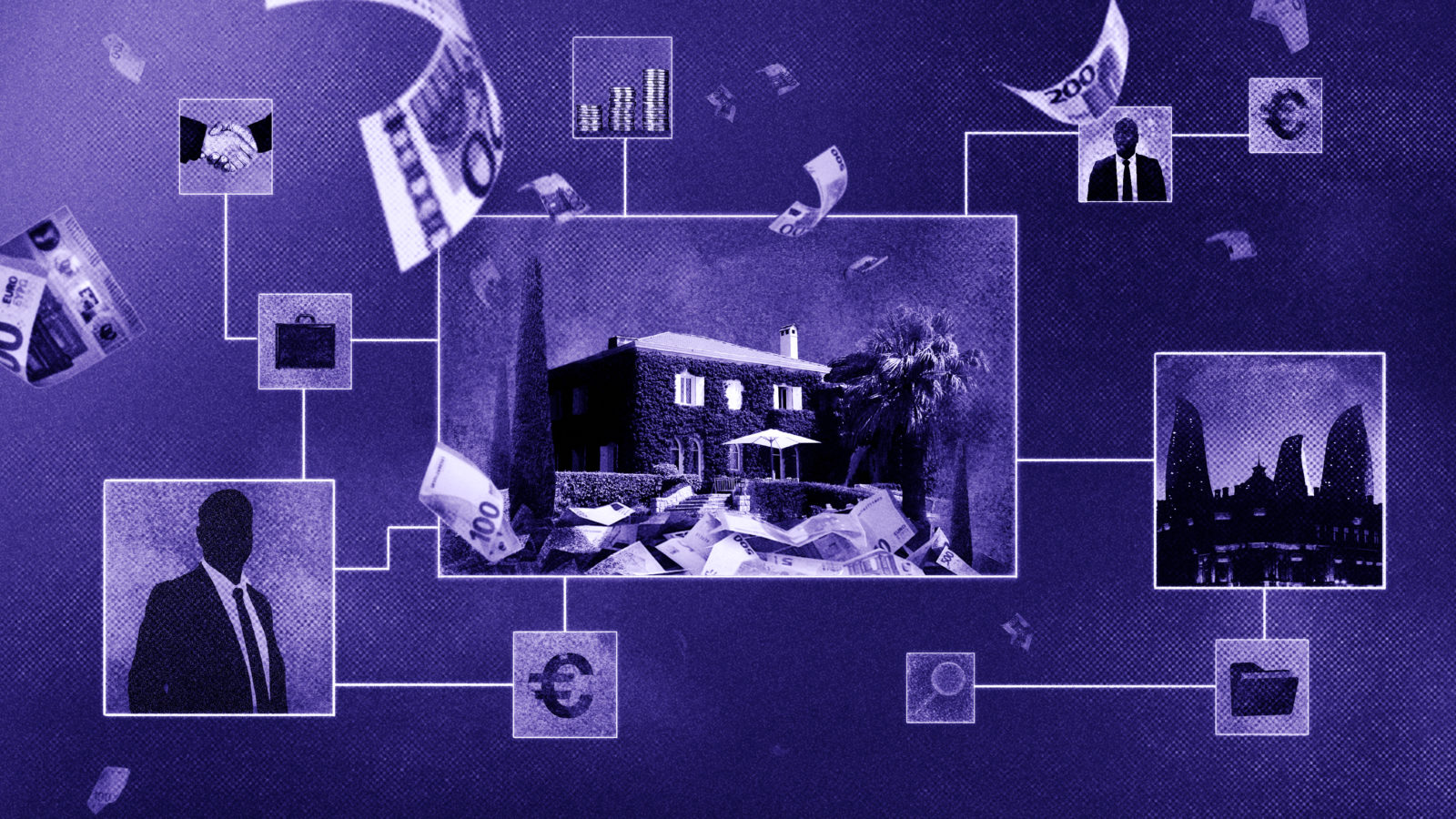
Baku’s strong connection to Europe, some point out, might be related to the quantity of gas flowing between Azerbaijan and the EU. Following the suspension of gas exports from Russia, in 2022, Ursula von der Leyen, President of the European Commission, signed a supply contract with Ilham Aliyev for at least 20 billion cubic meters per year.
From the presidential palace gardens, von der Leyen praised a “trustworthy and reliable partner,” referring to Aliyev. “It would be an understatement to say that this announcement comes as a shock to anyone familiar with the way in which the dictatorship ruling Azerbaijan uses the proceeds of its gas revenues,” reads a tribune signed by some fifty elected representatives in the French newspaper Le Monde.
Credit: Mélody Da Fonseca
Contacted by Forbidden Stories, Peter Stano, spokesman for the President of the European Commission, insisted by phone. Ilham Aliyev is reliable. “The President of the commission said this in relation to the Memorandum of Understanding on Energy,” Stano said.
Stano said the European Commission calls for the release of “those imprisoned for exercising their fundamental rights,” including journalists, but said there is validity in European-funded programs in Azerbaijan. “The logic of this engagement, of the projects in this area, is also to raise awareness, to compare standards, to tell them ‘look, you can do things differently.’ You need to start somewhere. This is a country that emerged from 70 years of a communist totalitarian regime. And they are still in a semi-autocratic regime. If you want to change it, you can either ignore them or engage with them,” Stano said.
At the Council of Europe, many have been increasingly critical of Azerbaijan following its military intervention in Nagorno-Karabakh, which forced over 100,000 Armenians to flee the region. On January 24th, the PACE voted (76 to 10) to revoke Azerbaijan’s credentials for failing to comply with its obligations as a member state. Azerbaijan, whose membership has not yet been challenged, pre-emptively left the Parliamentary Assembly, denouncing the “current unbearable atmosphere of racism, Azerbaijanophobia and Islamophobia within PACE.”
Contacted by Forbidden Stories and its partners, the Presidency of the Republic of Azerbaijan declined to answer our questions.
Just a few days before the Presidential elections, Abzas Media’s website is no longer accessible in Baku. Hasanli’s last written words are dated December 30th, 2023. In a note he wrote from his prison cell, which has since been made public, he wrote, “ou probably know that we–Sevinj Vaqifqizi, Nargiz Absalamova, Hafiz Babali, Mahammad Kekalov, and myself–are completely isolated. No telephone conversations or meetings with our families are allowed. We are not even allowed to call our lawyers, the ombudsman, nor write letters to our loved ones. Members of the government should understand that it is impossible to completely prevent criticism and freedom of expression,” he wrote. To sign off, Hasanli borrowed Einstein’s words: “Truth is subtle, but it is not malicious.”
Further Credits:
- Publishing coordinators: Clément Le Merlus, Louise Berkane
- Fact-checkers: Sofía Álvarez Jurado, Emma Wilkie
- Copy editors: Simon Guichard, Christopher Knapp
- Translators: Amy Thorpe, Leyla Mustafayeva, Mariana Abreu, Phineas Rueckert, Sophie Stuber
- Communication: Clarisse Jacq, Emma Chailloux, Matthieu Gerrer
- Videos: Anouk Aflalo Doré, Vincent Bourre
- Graphic designer: Mélody Da Fonseca
- Front-end developer: Thibault François