

DNA for sale? The untold story of Greece’s newborn screening scandal
The original investigation was published in Greek on 11 April 2025 under the title “Adonis Georgiadis grants private companies access to newborns’ DNA.” This is a shorter English version of that first report, updated to include the full scope of the civil society campaign sparked by the initial exposé.
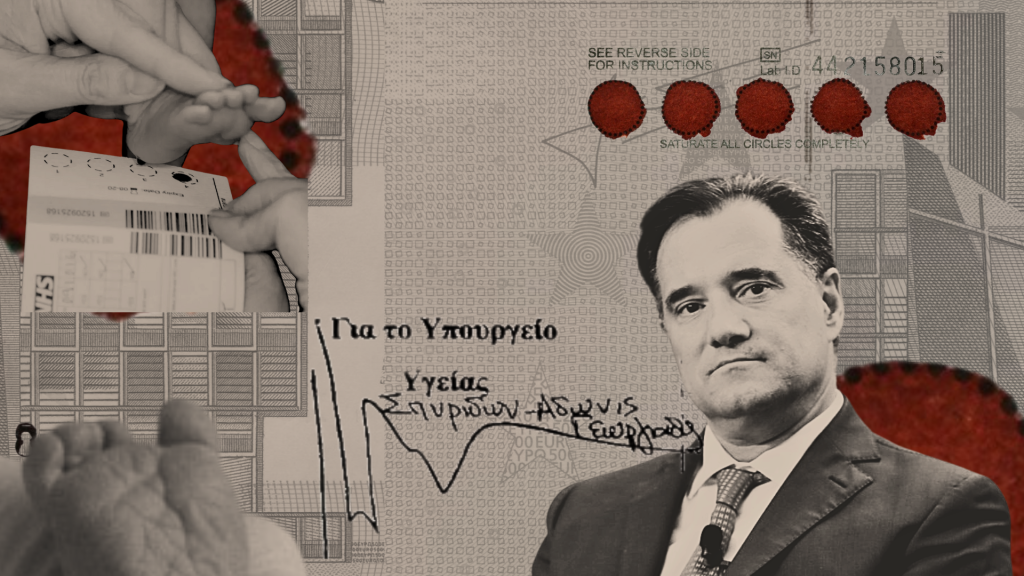
Illustration: Konstantina Maltepioti
It seemed as if Greece had stepped into a remake of ‘Gattaca’ – a world where every child’s future is predetermined by genetic analysis – infused with a hint of ‘Orphan Black’ in the veil of secrecy surrounding it.
Only this wasn’t science fiction; it was present-day reality straight out of a dystopian nightmare.
The Greek government had secretly agreed to allow two private companies full access to the DNA of newborns in Greece through a massive genomic screening project. Conspicuously missing from the project agreement: clear terms and conditions, safeguards to protect highly sensitive personal data, any requirement for parental consent, let alone revocable consent.
Compared to existing biochemical screening of newborns (five drops of blood screened for specific diseases) the difference would be huge. The secret program would introduce whole genome sequencing, an experimental technique raising significant technical and bioethical concerns.
Research data obtained from newborns’ DNA analysis would be the “exclusive property” of the private companies.
A strict confidentiality clause ensured the relevant contract was never published on the state transparency portal, Diavgeia, and that the Greek people would remain unaware that their genetic profile had been handed over to business entities.
Indeed, the genetic material of 100,000 people born in Greece risked ending up in the hands of private US-based actors, without clear terms or safeguards. This project would result in an immensely valuable genetic profile registry — something of significant interest to powerful corporations such as those in the pharmaceutical and insurance industries.

Illustration: Konstantina Maltepioti
The secret agreement
The 15-page Programmatic Agreement (in Greek, here) was signed on 17 May 2024 by Greece’s minister of Health Adonis Georgiadis and the companies RealGenix and Beginnings, represented by clinical geneticist Petros Tsipouras, a Greek national and permanent resident of the United States.
Both companies are registered in Greece. Real Genix is a wholly owned subsidiary of PlumcareRWE, headquartered in the US.
The agreement’s aim was to introduce universal whole-genome screening for newborns in Greece by 2029. Titled ‘First Steps’, the project was set to start in January 2025 and be conducted in two phases drawing DNA from 100,000 newborns – 25%–30% of the babies expected to be born in Greece over the five-year period of the agreement – and potentially expanding to all newborns should the program be officially adopted in the future.
The agreement explicitly stated that the research results from the sequencing of the newborns’ genomes shall “constitute property of RealGenix.”
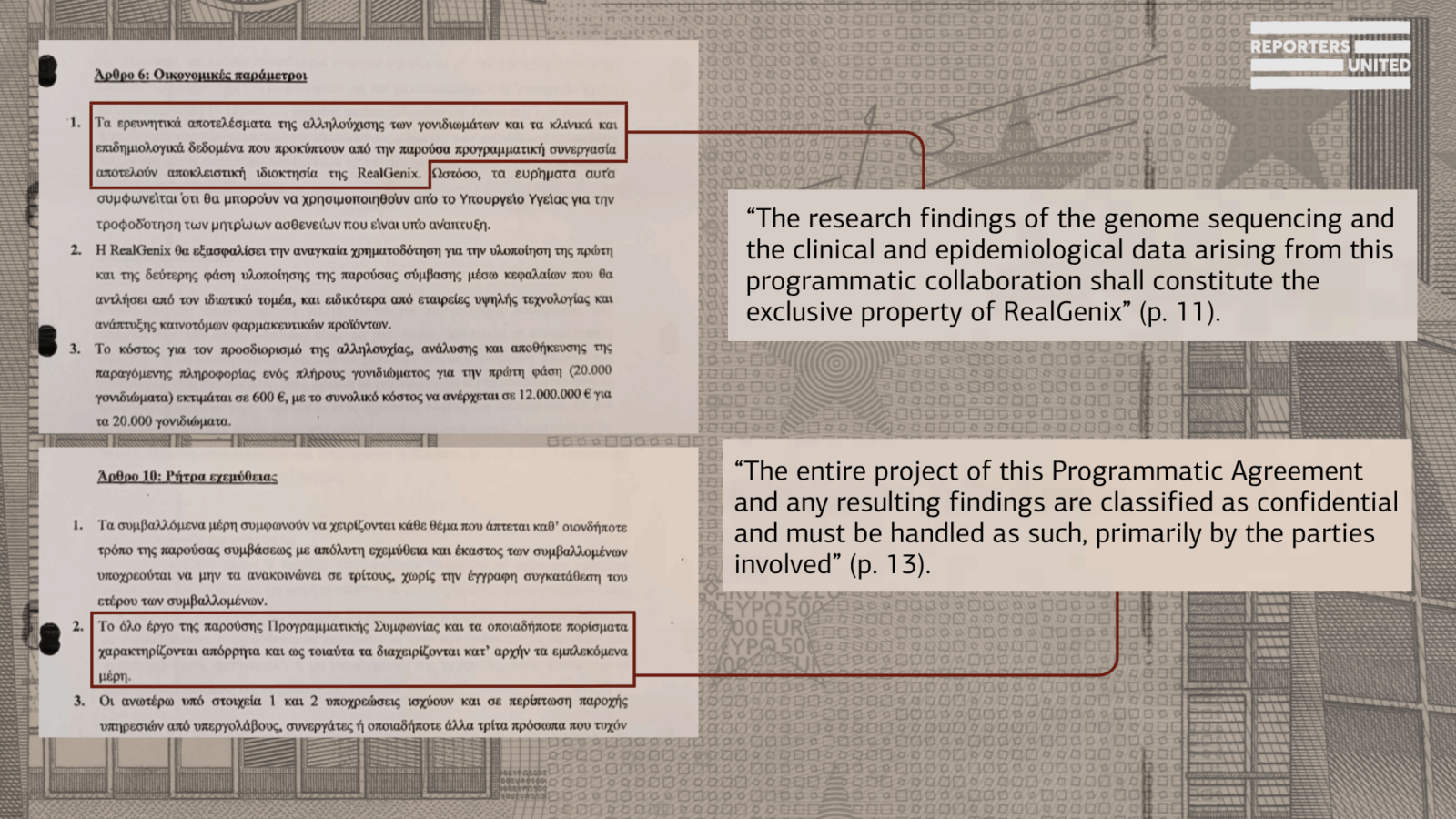
Illustration: Konstantina Maltepioti
The agreement stated that the research findings “will be fully disconnected from the subjects’ personal data,” yet it did not specify concrete safeguards to ensure this commitment. Εven anonymised, this data, the genetic profile of a nation, would be an extremely valuable asset in the hands of the private company involved, experts said.
The estimated cost for the sequencing, analysis, and storage of 100,000 full genomes was stated in the agreement as €56 million, which would be covered by the companies – at no cost for the Greek state. The companies would then retain “exclusive ownership of the research findings.”
According to the agreement, project financing would come “from the private sector, specifically from high-tech and innovative pharmaceutical development companies”. There were no clear clauses prohibiting commercial exploitation, data monetisation, etc.
The companies did not provide any information or guarantees on how they planned to raise the millions needed to fund this project (RealGenix and Beginnings have a cumulative initial capital of only €8.000, according to the Hellenic General Commercial Registry). In an interview (in Greek) with Reporters United, Mr Petros Tsipouras claimed that funding for the initial phase in 2025 was nearly secured through donations from charitable foundations, with no involvement from tech or pharmaceutical companies. (This statement contradicts the provisions of the agreement.) He refused to disclose further details, citing confidentiality.
By 31 March 2025, the ICH was required to provide all samples collected during the first quarter of 2025 — an estimated 20,000 (that is, all projected births in the country), in exchange for €10 per infant paid by RealGenix.
This never happened. The ICH refused to divert blood collected for regular biochemical screening and to do so in total opacity, without parental consent.
Less than two weeks later, Reporters United and EfSyn broke the story, revealing the existence and the contents of the agreement.
The Institute of Child Health acts as guardian of newborns’ genetic data
This privatisation of newborn screening was being advanced without prior clear and valid scientific evaluation by any competent body.
Quite the contrary. The agreement was fiercely opposed by the ICH’s Scientific Council due to unresolved ethical, legal, and scientific issues.
In its unanimous October 2024 decision, which was revealed in April 2025 by Reporters United, the Council warned that giving away three out of the five routinely collected blood spots could compromise the existing newborn screening. It outlined major flaws in First Steps, stressing that genomic screening remains under international review, with no consensus on its broad adoption. Unlike biochemical tests, DNA sequencing creates lifelong data that could be reused — for forensics, insurance, and more — posing major risks of misuse and data exploitation, the Council stated.
You can read the ICH’s decision in full [here, in Greek].
A Health Minister acting more like a broker
The entire initiative increasingly appeared to be the minister’s personal venture. Adonis Georgiadis signed the agreement, reportedly bypassing standard procedures within his own ministry.
In October 2024, in a video address at the International Conference of the International Consortium on Newborn Sequencing (ICoNS), Georgiadis promoted First Steps-genomic screening as if it were an established medical practice, free of any risks or bioethical concerns. It is a “revolutionary technology providing personalised and timely care for newborns,” he said.
The minister stuck to the same line of argument after the project was exposed: “Ιf I can save even one child, I will,” he said.
He also claimed that the Supervising Committee – established by his own ministerial decision on 9 January 2025 – was the project’s ethics watchdog. However, our reporting revealed that four of the committee’s seven members were representatives of the two contracting companies, and one was appointed directly by the minister.
Lessons Greece chose to ignore
The global initiative ICoNS features a map with 13 locations in Europe, the USA, and Australia where pilot genomic screening projects are run by its “contributing partners” – including First Steps.
Seven out of the 13 ICoNS projects have not been approved by Institutional Review Boards, research ethics bodies protecting the rights and welfare of the people recruited to participate in research studies.
One of them is First Steps.
Μost genomic newborn screening projects follow roadmaps and protocols approved by competent authorities. They are studies or pilot programs — none is implemented population-wide or integrated into a national health system as an approved preventive medicine program. First Steps is the only one that states it “aims to establish universal newborn genomic screening (NGS) as the standard of care within five years.”
Perhaps the most extensive such research study in Europe has been conducted in the United Kingdom. It is the Generation Study in partnership with the NHS, which started in 2023 and aims to sequence the genomes of 100,000 newborns. A very strict roadmap has been followed, including “extensive consultation with the public, parents and families affected by rare conditions as well as healthcare professionals, policy makers and scientists.” A detailed protocol was approved by the Health Research Authority, while the results will be reviewed by the NHS to “inform future decisions on using whole genome sequencing to support newborn screening.”
The specifications set by British scientists fully align with the remarks of the Scientific Council of Greece’s ICH. But none of these prerequisites have been met in the Greek First Steps program.
‘For Our Children’s DNA’: Scientific outcry
A series of seven articles by Reporters United and Efimerida ton Syntakton, dozens of social media posts and direct exchanges with the minister sparked widespread outcry which in turn led to a civil society campaign that minister Georgiadis was unable to stop.
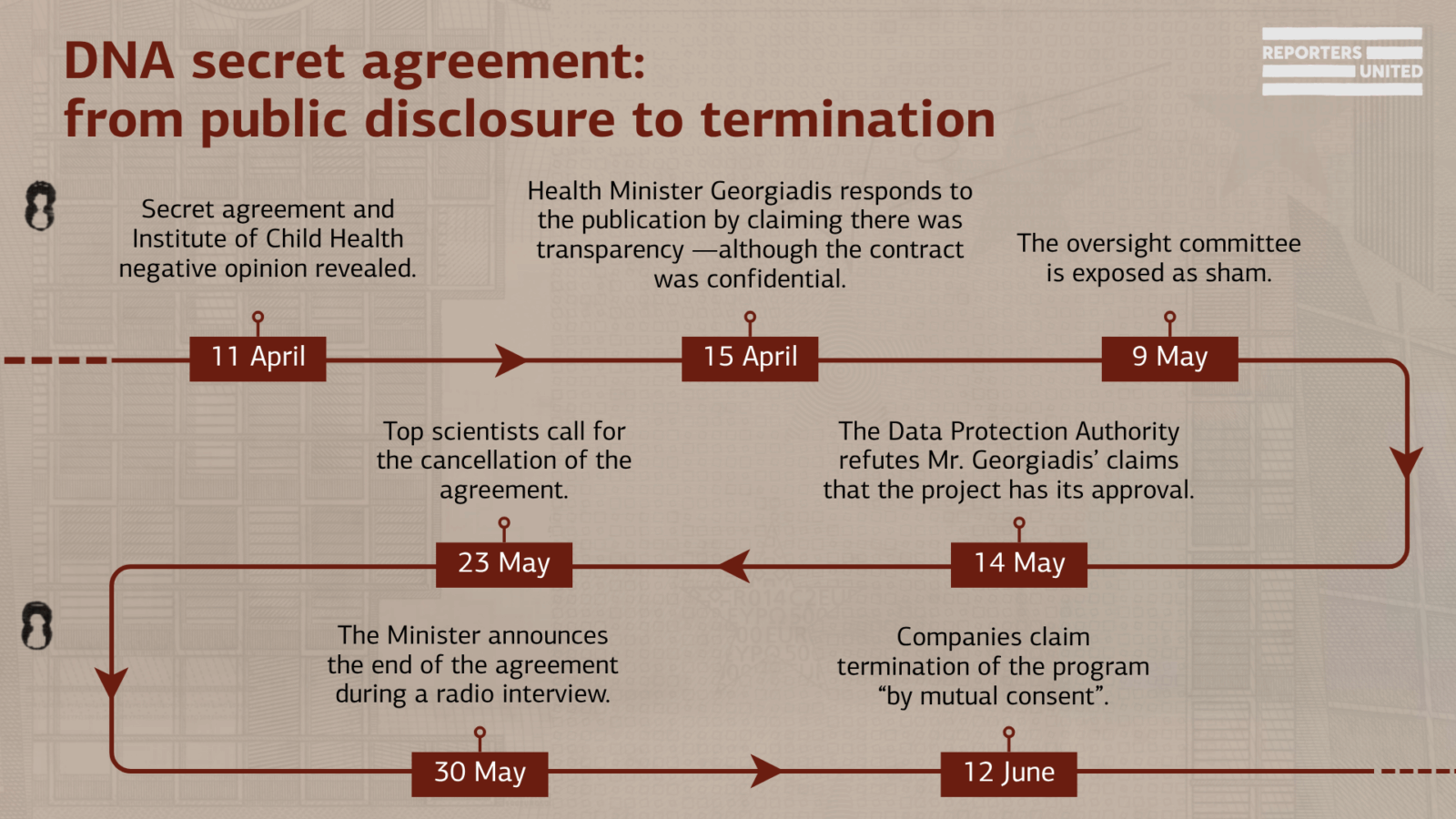
Illustration: Konstantina Maltepioti
Scientific associations, unions and digital rights organisations issued press releases urging caution or/and calling for the cancellation of the agreement.
On 23 May an open letter titled ‘For Our Children’s DNA’ signed by 195 leading scientists from key fields such as biology, genetics, medicine, health sciences, law, bioethics, and social sciences, as well as engaged citizens, detailed the flaws of the agreement and urged the government to cancel it. The call collected more than 4,000 signatures within a few days (the letter in English here).
Spyros Artavanis-Tsakonas, Professor Emeritus of Cell Biology at Harvard University, a signatory, held the “utterly unacceptable agreement” as evidence that “in Greece anyone can do as they please”. There is a “complete lack of understanding of scientific matters,” he lamented.
Leading experts who signed the petition include Stylianos Antonarakis, John Christodoulou, Argiris Efstratiadis, Manolis Kogevinas, Elias Kouvelas, Haralampos Moutsopoulos, Charalambos Savakis, Nektarios Tavernarakis, Jan Traeger-Synodinos and others.
Bolstering the movement’s scientific momentum, the European Society of Human Genetics (ESHG) –a non-for profit with 3,500 members, headquartered in Vienna, and a founding member of the International Federation of Human Genetics Societies– also weighed in.
The ESHG warned in a statement on 11 June that applying broad genetic testing to newborns outside a research framework is “irresponsible,” as the method’s risks and benefits remain largely unknown. The lack of transparency, they argue, “could affect the trust of the public in newborn screening and in healthcare more widely – and not just in Greece.”
Notably, despite Reporters United reaching out to all scientists reportedly involved in ‘First Steps’, not a single one responded to publicly defend the programme. The only outspoken supporters have been minister Adonis Georgiadis and the scientific lead of ‘First Steps’ Petros Tsipouras, who is also the manager of RealGenix, co-founder and CEO of its parent company Plumcare, and co-manager of Beginnings.
Professor of Computer Science at MIT Constantinos Daskalakis, who until recently appeared on Plumcare’s website as Chief Technology Officer, has now been removed from the website. Mr. Daskalakis did not respond to a question by Reporters United about this.
By the end of May, the issue had reached mainstream politics, as six opposition parties tabled questions on the matter to the Greek Parliament and the European Commission.
The Institute of Child Health was meanwhile flooded with messages of concern from anxious parents of newborns. Some even submitted formal requests demanding the destruction of their babies’ blood samples — samples taken as part of the standard screening program designed to detect life-threatening conditions early, where swift diagnosis can mean the difference between full recovery and irreversible harm.
In response, the Administrative Committee of the ICH issued a press release on 28 April ensuring the public they are not handing away blood samples entrusted to them unless explicit written parental consent is obtained.
First Steps suffered further discredit when Rady Children’s Institute for Genomic Medicine (USA) and the BeginNGS Consortium denied in a statement to Reporters United any involvement in newborn screening programs in Greece.
Plumcare, the parent company of Real Genix, had previously advertised a partnership with Rady Institute “to establish the first international site for BeginNGS (a pilot newborn genomic screening programme) in Greece.” Although talks collapsed in 2022, the supposed collaboration continued to be locally promoted in Greece in what appeared to be an attempt to bolster First Steps’ credibility.
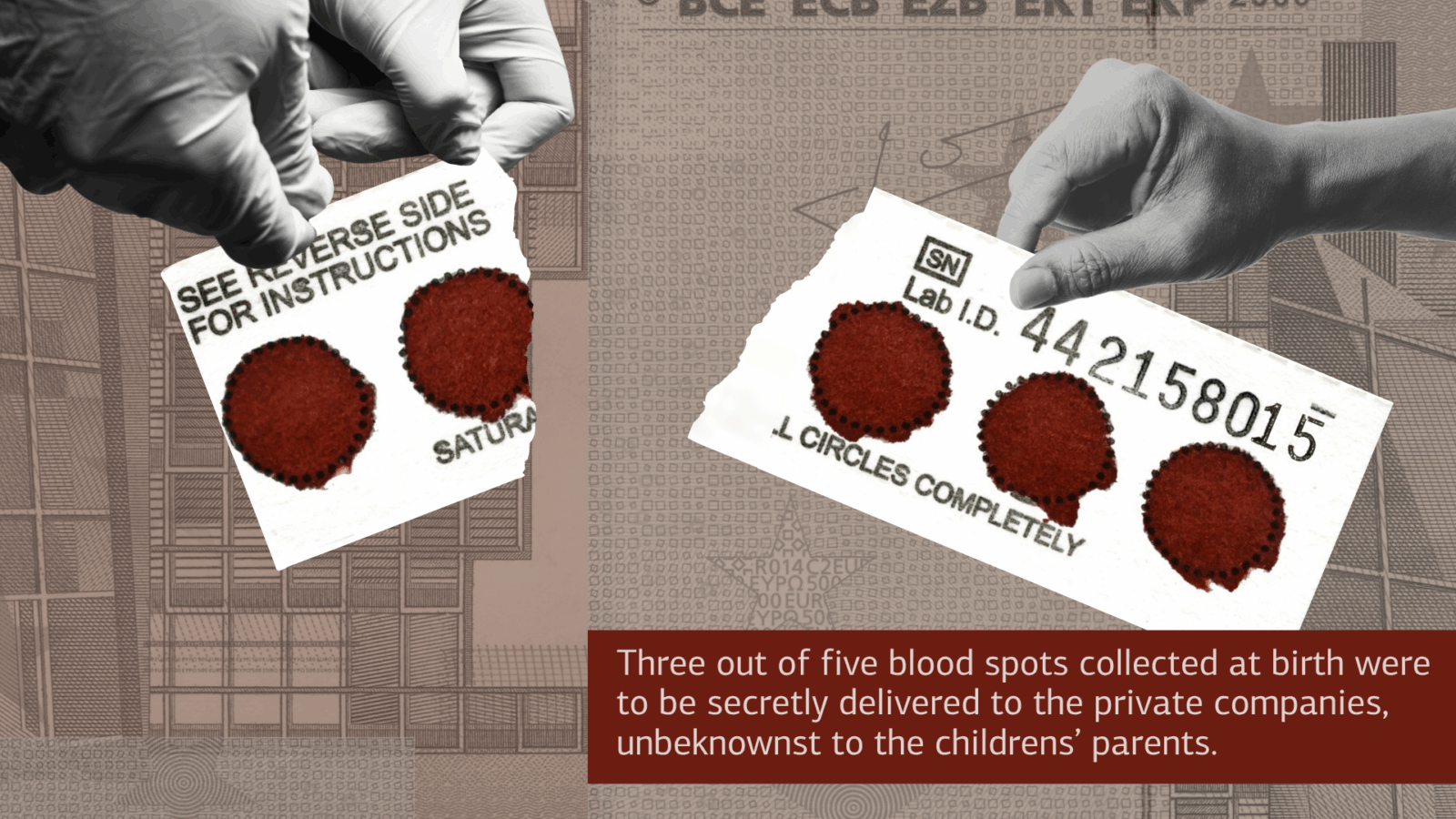
Illustration: Konstantina Maltepioti
From Soloist to Silent: The minister’s ‘Greek’ Retreat
Then came the spectacular U-turn, live on air. We were grilling Adonis Georgiadis together with radio host Yorgos Avgeropoulos in a two hour-long show when he abruptly changed tack “…it seems that we are not making any progress with this specific team… So, there’s really no point in arguing anymore,” he acknowledged.
It was May 30th, the battle had gone on for 49 days.

Illustration: Konstantina Maltepioti
On 12 June, First Steps announced the termination of its agreement with the ministry of Health “by mutual consent”.
“We will remain vigilant in case there are attempts to implement this approach, possibly under a different guise,” says Takis Panagiotopoulos, Emeritus Professor at the National School of Public Health, a paediatrician – epidemiologist, and leading member of the “Initiative For Our Children’s DNA”. After his change of heart, Mr Georgiadis had invited the scientists to come up with proposals for a proper regulatory framework. Dr Panagiotopoulos says they intend to do exactly that. “We plan to initiate a public discussion among experts and the wider society on the scientific, ethical, and societal implications of using human genome sequencing” he says. “We must shed light on existing gaps in the country’s legal-ethical, research, and healthcare regulatory frameworks, and propose solutions.”
Update 21.11.2025: Strict recommendation by the Hellenic National Committee on Bioethics and Technoethics
On 21 November 2025, almost five months after Health minister Adonis Georgiadis’ (so far only verbal) disavowal of the secret Programmatic Agreement, the Hellenic National Committee on Bioethics and Technoethics issued a Recommendation “on the bioethical dimensions of neonatal genetic screening through whole-genome sequencing.” The Recommendation was issued after the Institute for Child Health (ICH) submitted the controversial agreement to the Committee for examination. Striking at the heart of the contested agreement and dismantling its problematic framework, the Recommendation marks a pivotal milestone for neonatal genetic screening, establishing a clear and binding point of reference that no actor can bypass.
Update 10.3.2026: Article published in the international journal European Journal of Human Genetics
On 10 March 2026, a scientific commentary published in the prestigious European Journal of Human Genetics raised serious ethical and clinical concerns about introducing Whole Genome Sequencing (WGS) into established newborn screening programs. The commentary was prompted by our investigation, which it cites as its starting point. According to the authors Athina Ververi, Manolis Kogevinas, Takis Panagiotopoulos, Charalambos Savvakis, and Manousos Papadakis, Greece has become a cautionary case study, highlighting issues that extend beyond national borders: the blurring of lines between research and public health, inadequate preparation of health systems for genetic counseling and long-term follow-up, and the risk of commercialising genetic data at the expense of the public interest. They conclude that while genomic newborn screening may have a role in the future, its implementation must be gradual, transparent, and aligned with public health principles – otherwise, they warn, public trust in both genomic medicine and newborn screening could be undermined.
- Scientific Consultant: Takis Panagiotopoulos
- Illustration: Konstantina Maltepioti
- Editing of the English version: Eurydice Bersi
Surveillance secrets
The men who can monitor almost anyone are hard to find. Their company has existed for more than 20 years, yet hardly anyone knows it. What they offer remains invisible and mostly unnoticed: their technology can locate mobile phones worldwide. From afar and in secret, it allows one to query who was where, when, and for how long.
There are hardly any traces of the company’s managing director and co-owner on the internet, not even a photo. In a video call, he is the only one who does not turn on his camera. He seems like a phantom spying on the world from the shadows.
Officially, his company First Wap is based in Jakarta, the capital of Indonesia, and in Dubai. But in early summer, the managers traveled to the most important trade fair of their industry in Prague. The “ISS World Europe” is a closed event. Journalists are not welcome.
But undercover reporters from a team coordinated by the investigative organization Lighthouse Reports managed to enter using a cover story. The journalists posed as brokers on a shopping tour for clients from West Africa — for example from Niger, one of the poorest countries in the world. After a military coup in 2023, the EU imposed strict sanctions on the junta. In Germany and other EU states, export licenses are required for the delivery of surveillance software. Buyers from Niger would be excluded.
The reporters’ target was the First Wap booth in one of the back rooms. There, the company advertised, among other things, “Location Tracking,” meaning the locating of target persons. Their system, which can do even more, is called Altamides. Users only have to enter a phone number, and the program immediately spits out the location of the device.
As soon as particularly delicate questions came up at the booth, the responsible staff quietly switched from English to their native language, German. The discreet managing director introduced himself as Jonny G., born in Passau. His head of sales is Günther R., who has been with the company only for a few years. He is Austrian, as was the company’s founder Josef F., who died in 2024. F. came from a mountain village in Tyrol, worked for Siemens, and then built a globally operating surveillance company.
A large dataset now shows: the software Altamides was used for many years for unethical or even illegal purposes. The explosive dataset is one of the largest yet from the sealed-off surveillance industry. It documents more than 1.5 million tracking attempts in 168 countries and regions around the world, mainly between 2007 and 2014. Around 14,000 mobile numbers were located with First Wap technology during that period — some sporadically, some hundreds of times — including in Germany and Austria.
The marketing narrative of the industry has always been: they sell only to governments — for the legal use of the technology in law enforcement, for the hunt for terrorists and criminals. The reality is darker. Software from the Israeli NSO Group has repeatedly been found on the phones of government critics, human rights activists, and journalists, including in Hungary and Greece. As recently as this spring, spyware from the Israeli manufacturer Paragon was found on the mobile phones of Italian journalists.
The list of targets in the First Wap dataset also suggests massive abuse of the surveillance technology. Lighthouse, DER SPIEGEL, ZDF, and other investigative partners were able to match around 1,500 monitored numbers to their users and spoke to more than 100 of them.
“This shocks me, I find it unacceptable.”
Among them are international investigative journalists, prosecutors, and ministers. A former prime minister of Qatar is on the list, as is Asma al-Assad, the wife of the former Syrian ruler. Also oligarchs, diplomats, bankers, and top managers. For example, U.S. entrepreneur Anne Wojcicki, founder of the start-up 23andMe and ex-wife of Google founder Sergey Brin, who was tracked around 1,500 times. A board member of the Italian oil company Eni, a senior Airbus employee, and a well-known Formula 1 blogger were also located. Even culture was not spared: the number Hollywood actor Jared Leto uses for his Snapchat account is on the list — as is that of Austrian singer Wolfgang Ambros.
They were all located with First Wap’s Altamides system, sometimes resulting in extensive movement profiles. None of the victims likely suspected that their privacy had been violated for years; most reacted surprised and outraged. “This shocks me, I find it unacceptable,” said a German TV producer and director. He now wants to examine legal steps.
There were a total of 4,264 tracking attempts for German numbers during the years covered by the material, 1,276 of them inside Germany. One query led to the Paul-Löbe-Haus in Berlin, directly next to the Reichstag. Members of parliament have their offices there; Bundestag committees meet inside. Another location query took place in or directly adjacent to a BND (Federal Intelligence Service) building in Berlin. In both cases, the numbers could not be assigned to a specific owner. Often, however, this was different. One trail even led to the Vatican.
The Hunt for the Vatican Whistleblower
The subject lines of internal emails show that, in spring 2012, panic suddenly broke out. “Urgent,” they said, and: “Drop everything!” An Italian intermediary had found a promising new Altamides prospect who requested a demonstration of the surveillance technology. Sometimes the employees who were to enable this discreetly abbreviated the potential new customer as “V,” sometimes they wrote it out. “Vatican visit,” one email read.
The intermediary reported to his colleagues that he was asking the church officials for sample numbers for a test run. Apparently, he received them promptly.
Four days later, tracking of two mobile phones began. Both belonged to Gianluigi Nuzzi, an Italian investigative journalist. His specialty is revelations from the Vatican. A few years earlier, his book “Vatikan AG” had made headlines worldwide, exposing corruption and scandalous financial dealings at the Vatican Bank.
Now he was on the verge of publishing his next bombshell. “His Holiness” was based on secret letters from the German pope Benedict XVI, which had disappeared from his apartment. Nuzzi described intrigues and power struggles. The scandal became known as “Vatileaks.” Tension around St. Peter’s Basilica was correspondingly high.
Nearly 200 times, the author’s whereabouts were queried in the following days, at times automatically every hour. Just under a week later, Vatican police arrested Nuzzi’s most important source — the pope’s then-butler. The next day, the continuous surveillance of Nuzzi ended — interest seemed to have faded. Whether there was a direct connection between the locating operations and the arrest cannot be determined from the data and emails.
In summer, DER SPIEGEL met the journalist in an elegant private club in Milan and showed him his movement profile from the First Wap data. Nuzzi recognised his former home address, various places in Rome, even locations near the Vatican. He had been shocked after his source was arrested, he said. He had, of course, taken precautions and expected to be monitored — but not in this way.
“This method was more productive than sending a van with agents to follow me.” It was good, he said, that the operation was now becoming public. “This is disturbing — we should be locating our enemies, not journalists.”
The German managing director of First Wap could at least have known about the surveillance of the Vatican whistleblower. He was personally involved by email: An employee would “set up the tracking for the two +39 numbers,” he wrote to the intermediary. After the meeting with Vatican officials, the intermediary reported back that the presentation had gone well, the potential customer was “happy.”
The Vatican left an inquiry about the matter unanswered. In a video call with the reporters, the First Wap managing director said he had no idea who Nuzzi was and knew nothing about any connection to the Vatican. The head of the intermediary company explained that his firm certainly had not offered the program to the Vatican; he knew nothing of meetings with Vatican officials.
First Came the Pings, Then the Killers
Damning traces from the material also lead to Africa. According to the First Wap data, numbers in South Africa were repeatedly queried in spring 2012. One belonged to the driver and bodyguard of Rwanda’s former intelligence chief. That man had fled to South Africa after a dispute with ruler Paul Kagame. Another number was that of the wife of a former Rwandan general, who also lived in exile there — and who, together with his compatriot, organised political resistance against the regime.
The First Wap technology was apparently to be used to determine the habits and locations of the exiles. A Rwandan informant from the army told the investigative team that he had received an assassination order from Rwanda’s then-military intelligence chief targeting the compatriots in South Africa. But the job was apparently carried out by someone else. A little more than a year after the Altamides location operations, the ex-intelligence chief was found strangled in a hotel in Johannesburg. Apparently, it was a contract killing by the Rwandan regime.
Rwanda has always denied this. A government spokesman also said the country had never possessed such software nor sought to acquire it.
From internal emails and numerous conversations with former First Wap employees, further deals and discussions emerge with countries in which human rights, freedom of expression, and freedom of the press are threatened or virtually nonexistent.
“Gallery of Rogue States”
Belarus is among them, as are Azerbaijan, Malaysia, and Indonesia, but also Nigeria and the United Arab Emirates. Several former employees interviewed named additional problematic clients. “We had to trust that our customers would use the product for ethical purposes,” one former employee said. Another said that First Wap’s leadership had barely any concerns or restrictions regarding customers: “There were no red lines.”
Internal emails from a British company, which at one point attempted to act as an intermediary — for example with the rulers of Syria, Algeria, Morocco, and Thailand — support this view. Particularly revealing is a message regarding support for the ruling family in Bahrain. Shortly before, organisers had canceled a planned Formula 1 race in the country due to political unrest. With the Altamides software, authorities could identify “negative elements” in the country or elsewhere, the email said, helping to “combat the very negative press and media.”
Ronald Deibert, one of the world’s leading experts on surveillance technologies, calls it a “gallery of human rights–abusing rogue states.” First Wap apparently had no scruples about acting as a service provider to despots.
First Wap rejected all accusations when asked, most recently through a lawyer: “We emphatically reject allegations that we offer an unlawful business model or promote, support, or enable unlawful use.” They said they sell their products only to state entities that have a “legal mandate.” In any case, the programs are operated by clients; after installation, the company has “no access.” As a company, they had “not made presentations to states such as Rwanda, South Africa, or the Vatican.” Even for resellers, there had been “strict conditions.” If violations had occurred, there was reason “to investigate them and sanction them accordingly.”
The British company also denied being involved in the sale or use of “inappropriate surveillance programs.”
The Red Bull Trail
In fact, Altamides was also used in the private sector. More than 20 mobile numbers can be matched to current and former employees of the Austrian beverage giant Red Bull. Most were executives; all worked for a media subsidiary of the energy drink corporation, the Red Bull Media House. The company operates, among other things, the television channel Servus TV.
Almost 1,000 successful queries can be documented, spanning nearly six years. The location operations took place in the USA, Thailand, Italy, and Mauritius — but primarily in Austria and Germany. The affected individuals were tracked not only during working hours but also while on vacation, visiting friends. With some, the queries were automated, every three hours.
One person was spied on particularly intensively: Andreas Gall, then Chief Technology Officer of the Red Bull media subsidiary — and, alongside company founder and now-deceased billionaire Dietrich Mateschitz, one of the managing directors. Gall’s number alone was queried more than 200 times, 166 of those successfully.
On an autumn day, he met DER SPIEGEL in a café in Munich and followed his own traces on a world map: Las Vegas, Madrid, Darmstadt, and again and again Fuschl am See, the headquarters of the company.
“This is eerie and shocking,” Gall said. “Something like this needs to be punished.”
“I would have stopped it.”
Who spied on him and the other Red Bull employees is not revealed by the material. What seems clear is that the years-long surveillance within the Mateschitz corporate empire was not based on any court-approved monitoring order. It was therefore likely illegal under both German and Austrian law.
“Altamides is dangerous,” said a former First Wap employee. “For anyone who has access to it, it is very tempting to misuse it for personal purposes.”
There are indications that First Wap’s Austrian founder Josef F. and Red Bull patriarch Mateschitz knew each other. Several people from the Red Bull orbit remember “Josef” or “Sepp.” Former managing director Andreas Gall says the location technology had been used at sporting events. But he had “of course no idea” that it had been used against him and his colleagues — “I would have stopped it.”
Red Bull stated that First Wap had supported its media house in 2008 and 2009 on three small projects. Motorcycles and snowmobiles had been tracked using transponders, and one project involved a “small market analysis.” All assignments and services amounted to around €6,000 in total. “Any collaboration beyond this is not evident to us.” Moreover, there were “no documents” indicating that “Red Bull, the Red Bull Media House, or Mr. Mateschitz had knowledge of the alleged monitoring of employees.”
In a video call with the reporters, the German First Wap chief also denied this case: One could not locate anyone in Europe, he said. It was illegal, and in any case they did not have the necessary access.
The dataset, however, suggests the opposite. According to the data, there were close business ties until recently with the state-run Liechtenstein telephone provider Telecom Liechtenstein. Its network apparently served for decades as an entry point for First Wap’s location queries — including in Europe. Vatican whistleblower Nuzzi, Red Bull manager Gall, and numerous other victims were, according to the dataset, tracked via Liechtenstein.
When confronted with this, a spokesman for Telecom Liechtenstein said that “due to the serious allegations,” the company had “immediately suspended” its business relationship with First Wap and “blocked all services until the allegations can be clarified.” Should they prove true, the cooperation would be “terminated without notice.”
Business ‘in the dark grey area’
Back to Prague, to the surveillance trade fair where First Wap hopes to win new customers and does not expect undercover reporters. Has the company changed its course since the earlier surveillance scandals? Does it still sell its location-tracking technology? Even to highly problematic customers?
The First Wap bosses have arrived. Even the German managing director Jonny G. is present — the man about whom hardly anything can be found in public sources. The phantom. After the death of the flamboyant founder, he is the company’s new power figure. The Austrian head of sales Günther R. stands at the booth as well. Two inconspicuous middle-aged men, muted business suits, ties.
The supposed broker for West African clients reports a problem. There are protests in front of a mining site, disrupting business. The head of sales immediately enters the negotiation. He wants to know whether the ringleaders are known or need to be identified through surveillance. They have solutions for that as well.
What is important, he says, are good connections to the ruler and the ability to install their technology at local network operators. Regarding a potential deal with sanctioned Niger, the First Wap salesman says: “We are the only ones who can deliver.” The Jakarta location made that possible. And what about the export license required for a country under sanctions? “We’ll find a way.”
To discuss this, the salesman and his boss switch briefly from English to German.
“If we don’t know anything about it…” R. says, looking meaningfully. They agree to handle the deal through employees in Jakarta. Otherwise, the managing director says, it is too “sensitive.” He calls it a deal in the “dark grey area” and laughs.
“I could go to prison.”
The men talk at length at the booth about how best to conceal the arrangement, especially the payments. No money from Niger may flow into First Wap accounts. The intermediary could establish a front company in South Africa, for example. That company would then receive contractual authorisation to sell into an additional, unspecified country — that is the idea. This way, they could deny knowing the actual end customer.
As an Austrian, the salesman says, “I could go to prison,” and the same applied to his German boss.
When the reporters later confronted the two managers in a video call with these statements, they emphasised that they had never finally agreed to the problematic deal. Through their lawyers, they said that “misunderstandings” had apparently occurred at the Prague booth, which “may have led to incorrect interpretations.” First Wap also stressed that all customers were vetted before any contracts were concluded.
At the booth in Prague, though, there seemed to be little hesitation about arranging the deal. The salesman even joked about a competitor who had declined multimillion-euro contracts:
“Cool! I want to have such a moral standpoint too.”
What mattered to him was staying under the radar, minimising the risks. As a cautionary example, he mentioned Israeli providers offering far more sophisticated espionage technology. But those companies were “all so public now, you can read about them in the newspapers.”
His verdict: “That is not good.”
Other contributors: Elena Debre, Bashar Deeb, Tomas Statius, Sabrina Slipchenko, Sarasvati Nagesh Thuppadolla, Tessa Pang, Wael Eskandar, Ariadne Papagapitos, Daniel Howden, Antonella Napolitano, Dayo Aiyetan, Morgan Childs, Abdou Malah, Michela Wrong, Maria Christoph, Dajana Kollig, Frederik Obermaier, Hakan Tanriverdi, Lorenzo Bodrero, Henrik Bøe, Jim Briggs, Beatrice Cambarau, Olivier Clairouin, Artis Curiskis, Jörg Diehl, Benjamin Dyrdal, Per Øyvind Fange, Verdiana Festa, ZDF Frontal, Janine Große, Nadia Hamdan, Pavla Holcova, Tobias Holub, Uwe Jürgens, Monika Köstinger, Al Letson, Undine Meinke, Ruth Murai, Sophie Murgaia, Christoph Neuwirth, Lu Olkowski, Yosea Arga Pramudita, Kamila Ramezani, Daniel Retschitzegger, Morten Rød, Lea Rossa, Per-Kåre Sandbakk, Avi Scharf, Daniel Schulman, Marianne Szegedy-Maszak, Taki Telonidis, Praga Utama, Caroline Utti, Sam Van Pykeren, Adam Vieira, Anne Vinding, Swantje Wehr, James West, Zsolt Wilhelm