

The Forever Lobbying Project
The Forever Lobbying Project was selected for the 2026 Shortlist with PFAS: The Forever Lobbying Project.
Summary:
For over a year, the Forever Lobbying Project investigated an ongoing orchestrated lobbying and disinformation campaign by the PFAS industry and its allies, with the aims of watering down an EU proposal to ban “forever chemicals” and shifting the burden of environmental pollution onto society.
Coordinated by Le Monde, the cross-border, interdisciplinary investigation revealed for the first time the staggering cost of cleaning PFAS contamination in Europe if emissions remain unrestricted: €2 trillion over a 20-year period, an annual bill of €100 billion. In January 2026, a study commissioned by the European Commission extensively cited our findings and concluded that, depending on the scenarios considered, the cost could range from €330 billion to €1.7 trillion by 2050.
If the polluters do not pay, then who will?
Manufactured by a handful of companies, PFAS (per- and polyfluoroalkyl substances) are a family of over 10,000 man-made chemicals. Almost indestructible without human intervention and persistent in living organisms, humans included, PFAS have been linked to a dozen illnesses.
According to scientists, regulators and civil society, the “poison of the century” has created the worst pollution crisis humanity has ever faced.
Since February 2023, a draft PFAS ban is being considered by the EU. In response, hundreds of industry players defending the interests of around 15 sectors have been lobbying decision makers across Europe to undermine, and perhaps kill, the proposal.
The team subjected the key arguments deployed by lobbyists to a “stress test”, and discovered that many of them are fearmongering, false, misleading, or potentially dishonest. The investigation described how lobbyists resort to influence tactics typical of the corporate world, used throughout the decades to defend tobacco, fossil fuels, and other chemicals and pesticides. The public debate on PFAS has now been polluted by these “Merchants of Doubt”.
The investigation built on the concept of “expert-reviewed journalism”, pioneered in 2023 with the Forever Pollution Project, this time involving 18 international academics and lawyers in Zurich, Stockholm, Toronto, Rotterdam and elsewhere, from the field of environmental chemistry to criminology.
The journalists developed the methodology to stress test the lobbying arguments with Gary Fooks (University of Bristol, UK), and the remediation costs methodology with Ali Ling (University of St. Thomas School of Engineering, US) and Hans Peter Arp (Norwegian University of Science and Technology and Norwegian Geotechnical Institute).
In collaboration with EU lobby watchdog Corporate Europe Observatory and the PFAS Project Lab, the team collected over 14,000 unpublished documents on PFAS, constituting the world’s largest collection to date on the topic. The unique trove of documents is now available to the public in the Industry Documents Library at the University of California, San Francisco, home of the famous “Tobacco Papers”, and in the Toxic Docs database of Columbia University, New York, and the City University of New York.
Credits
Team members
Stéphane Horel (Le Monde)
Raphaëlle Aubert (Le Monde)
Luc Martinon (Freelancer / Forever Lobbying Project)
Romane Bonnemé (RTBF)
Zuzana Vlasatá (Deník Referendum)
Staffan Dahllöf (Investigative Reporting Denmark)
Tiina Lundell (YLE)
Léopold Salzenstein (Arena for Journalism in Europe)
Émilie Rosso (France Télévisions)
Jose Miguel Calatayud (Freelancer)
Daniel Drepper (NDR, WDR and Süddeutsche Zeitung)
Catharina Felke (NDR)
Johannes Edelhoff (NDR)
Lea Busch (NDR)
Nadja Tausche (Süddeutsche Zeitung)
Jana Heck (WDR)
Andrea Hoferichter (MIT Technology Review Germany)
Sarah Pilz (Freelancer/Forever Lobbying Project)
Eurydice Bersi (Reporters United)
Marco Boscolo (Facta.eu)
Elisabetta Tola (Facta.eu)
Laura Fazzini (Lavialibera)
Marta Frigerio (Freelancer / L’Espresso)
Gianluca Liva (Freelancer / L’Espresso)
Anna Violato (Freelancer / L’Espresso)
Jasper Been (Financieele Dagblad)
Lisa van der Velden (Financieele Dagblad)
Bijou van der Borst (Investico)
Simon Dequeker (Investico)
Emiel Woutersen (Investico)
Tarjei Leer-Salvesen (Klassekampen)
Samo Demsar (Oštro)
Matej Zwitter (Oštro)
Antonio Delgado (DATADISTA)
Ana Tudela (DATADISTA)
Aleksandra Pogorzelska (Dagens ETC)
Daniel Värjö (Sveriges Radio)
Felicitas Flohr (SRF)
Maj-Britt Horlacher (SRF)
Cemre Demircioğlu (The Black Sea)
Zeynep Sentek (The Black Sea)
Craig Shaw (The Black Sea)
Leana Hosea (Watershed Investigations / The Guardian)
Rachel Salvidge (Watershed Investigations / The Guardian)
Editorial and overall coordination
Stéphane Horel (Le Monde) / Project & Lobbying
Raphaëlle Aubert (Le Monde) / Cost
Eurydice Bersi (Reporters United) / Cost
Website coordination
Jose Miguel Calatayud (Freelancer / Forever Lobbying Project)
Eurydice Bersi (Reporters United)
Stéphane Horel (Le Monde)
Documents and Data coordination
Luc Martinon (Freelancer / Forever Lobbying Project)
Léopold Salzenstein (Arena for Journalism in Europe)
Stress test of the lobbying arguments
Stéphane Horel (Le Monde)
Gary Fooks (University of Bristol, UK)
Jose Miguel Calatayud (Freelancer / Forever Lobbying Project)
Daniel Värjö (Sveriges Radio)
Sarah Pilz (Freelancer / Forever Lobbying Project)
Evaluation of remediation cost
Raphaëlle Aubert (Le Monde) / Cost
Eurydice Bersi (Reporters United) / Cost
Ali Ling (University of St. Thomas School of Engineering, United States)
Hans-Peter Arp (Norwegian University of Science and Technology and Norwegian Geotechnical Institute, Norway)
EXPERT GROUP
Stress test of the lobbying arguments
Gary Fooks, University of Bristol, UK
Evaluation of remediation cost
Ali Ling, University of St. Thomas School of Engineering, United States
Hans Peter H. Arp, Norwegian University of Science and Technology and Norwegian Geotechnical Institute, Norway
PFAS experts
Rob Bilott, attorney, Taft Stettinius & Hollister LLP, United States
Ian Cousins, Stockholm University, Sweden
Joost Dalmijn, Stockholm University, Sweden
Jamie DeWitt, Oregon State University, United States
Romain Figuière, Stockholm University, Sweden
Gretta Goldenman, Global PFAS Science Panel, Belgium
Philippe Grandjean, University of Southern Denmark, Denmark
Dorte Herzke, Norwegian Institute for Air Research, Norway
Marcel Riegel, German Water Center, Germany
Martin Scheringer, ETH Zürich, Switzerland
Historical documents
Lauren Richter, University of Toronto, Canada
Lieselot Bisschop, Erasmus University of Rotterdam, The Netherlands
Sammie Verbeek, Vrije Universiteit in Amsterdam, The Netherlands
AI analysis
Hugo Subtil, University of Zürich, Switzerland
Juliette Jahan de Lestang, École des Mines de Paris, France
PUBLICATIONS
English:
https://foreverpollution.eu/lobbying/
Le Monde
PFAS: The astronomical cost of depolluting Europe
PFAS: How Le Monde estimated the cost of decontaminating Europe
PFAS: In France, the cost of decontamination is vastly underestimated
PFAS, a family of 10,000 ‘forever chemicals’ contaminating all of humanity
PFAS: How the chemical industry is derailing a ban on ‘forever chemicals’
The plastics lobby’s disinformation campaign to defend PFA
When industry manipulates science to prevent a PFAS ban
Lobbying campaign against PFAS ban highlights opacity of European decision-making
The Guardian
Cost to clean up toxic PFAS pollution could top £1.6tn in UK and Europe
Industry using ‘tobacco playbook’ to fend off ‘forever chemicals’ regulation
RAF bases are hotspots of ‘forever chemical’ groundwater pollution, MoD documents show
High-risk sites’: where are the UK’s ‘forever chemical’ hotspots?
The Guardian view on chemical pollution: the UK can’t ignore the risks from PFAS
Bloodletting recommended for Jersey residents after PFAS contamination
UK farmland being contaminated by ‘forever chemicals’ linked to cancers
Revealed: UK drinking water sources polluted with forever chemicals
UK failing to match EU in fight against ‘forever chemicals’, say scientists
Otters among UK wildlife carrying toxic ‘forever chemicals’, analysis shows
Sveriges Radio
Eye-watering costs of global PFAS clean-up
The Black Sea
Inside the unprecedented lobbying effort to sway the EU on PFAS “forever chemicals”
The Conversation
Czech:
Deník Referendum
Odhaleno: Evropský chemický průmysl podkopává snahy zakázat „věčné znečištění“
Chemický průmysl brání zákazu „věčných chemikálií“. Ve hře je lidské zdraví
Danish:
EUbureauet.dk
Novo Nordisk moidarbejer dansk initiativ til PFAS-forbud i EU
Investigative Reporting Denmark
Novo Nordisk advarer om produktionsstop og medicinmangel ved et PFAS-forbud
Dutch:
De Groene Amsterdammer
Investico
Het Financieele Dagblad
Het opruimen van pfas gaat overheid miljarden kosten
De vervuiler betaalt? In Helmond en Doetinchem weten ze wel beter
‘Pfas zonder zorgen’: zo ondergraaft de chemische industrie een naderend verbod
Opruimen PFAS-vervuiling kost nu al bijna 70 miljoen euro
Finnish:
Yle
Ikuiset kemikaalit myrkyttivät joen
French:
Le Monde
PFAS : le coût vertigineux de la dépollution de l’Europe
PFAS : comment « Le Monde » a évalué le prix de la décontamination
PFAS : en France, le coût de la décontamination largement sous-estimé
Les PFAS, une famille de 10 000 « polluants éternels » qui contaminent toute l’humanité
PFAS : comment l’industrie chimique fait dérailler l’interdiction des « polluants éternels »
La campagne de désinformation du lobby du plastique pour défendre les PFAS
Quand l’industrie manipule la science pour empêcher l’interdiction des PFAS
Les PFAS, révélateurs de l’opacité de l’action publique en Europe
PFAS : l’impossible décontamination des polluants éternels
RTBF
La pollution éternelle des PFAS, “le plus grand crime du siècle”
100 milliards d’euros par an ‘à perpétuité’ pour décontaminer l’Europe de tous les PFAS
Les manœuvres de l’industrie chimique pour torpiller une interdiction historique des PFAS
“Science bidon” et réalité plastique de l’industrie chimique pour défendre les PFAS
France 2 / Complément d’enquête
PFAS : la grande intox de l’industrie
France 3 Rhône-Alpes
PFAS et lobby : les stratégies d’influence “éternelles” d’Arkema et de l’industrie chimique
France Info
Scandale des polluants éternels : à Anvers, l’utopie de la dépollution des sols face aux PFAS
German:
ARD
Vergiftet – die Macht der Chemie-Lobby
PFAS im Skiwachs: Schnell, aber tödlich?
NDR/WDR/SZ-Recherchen über die Lobbying-Schlacht um PFAS
Tagesschau/ARD
Wie Habeck der Chemie-Lobby auf den Leim geht
Drohende Milliarden-Kosten wegen PFAS-Verschmutzung
Süddeutsche Zeitung Online
MIT Technology Review
Fluorchemikalien PFAS: Der harte Kampf einer Industrielobby gegen die EU
“Die Unternehmen haben die Gefahr aktiv vertuscht”
Was du über die umstrittenen Chemikalien wissen musst
Der Anwalt, mit dem alles begann
„Der alte Mensch ist eine Art Endlager für diese Stoffe“
SRF
Wer bezahlt die Milliarden? – Streit um PFAS-Sanierungen
So viel könnten PFAS die Schweiz kosten – exklusive Schätzung
PFAS-Sanierungen werden Milliarden kosten
PFAS-Sanierungen: So steht es in Ihrem Kanton
Schweizer Akteure lobbyieren in Brüssel gegen PFAS-Verbot
Ewigkeits-Chemikalien PFAS: Wer haftet?
Streit um PFAS-Sanierungen – wer bezahlt?
PFAS: Mit diesen Tricks lobbyieren Schweizer Firmen
Greek:
Reporters United
2.000.000.000.000: Το αβάσταχτο κόστος των αιώνιων χημικών PFAS
17 PFAS σε κάθε αυγό: Η άγνωστη Ελλάδα των αιώνιων χημικών
Italian:
L’Espresso
PFAS, la lobby che difende i veleni
RADAR Magazine
I nuovi mercanti di dubbi che difendono i PFAS
Sul bando dei PFAS, si scontrano interesse privato e benessere pubblico
Il Bo Live
PFAS: il conto salato pagato dai cittadini per avere acqua pulita
PFAS: ripulire, risanare, vietare?
Lavialibera
Pfas in Europa: 40 anni di inquinamento, ma il profitto vince su tutto
Miteni e l’assicurazione contro le richieste di risarcimento danni da parte dei dipendenti
Norwegian:
Slankemiddelgigant truer med utflagging
Renner over av kjemikalier som aldri forsvinner
Slovenian:
Oštro
Plastična industrija z zavajajočimi argumenti nasprotuje ukinitvi ‘večnih kemikalij’ v EU
Spanish:
DATADISTA
Alerta PFAS: 70 años de engaños de la industria química que ya han llegado al grifo y a tu sangre
elDiario.es
Alerta PFAS: 70 años de engaños de la industria química que ya han llegado al grifo y a tu sangre
Swedish:
Dagens ETC
“Enorma kostnaden för Sverige – för att bli kvitt de farliga kemikalierna”
Så lobbar Northvolt för att EU ska stoppa begränsning av PFAS
Han är förgiftad av PFAS: ”Industrin har dolt sanningen och förvillat oss”
Granne med PFAS-fabriken: ”Tickande bomb i våra kroppar”
Stort genomslag för internationell PFAS-granskning
Rödgröna reaktioner: ”Den gröna omställningen måste göra sig fri från PFAS”
Efter PFAS-granskning: ministern kallas till miljöutskottet
PFAS-förgiftade förtjänar att få svar från Romina Pourmokhtari
PFAS-kritik efter ministerns besök: ”Regeringen tar inte sitt ansvar
Sveriges Radio
Del 1: PFAS-gifternas svindlande miljardnota
Del 2: PFAS-striden i EU och industrins missvisande kampanjer
Växande kemikalieskandalen – rena vatten kan kosta miljardbelopp
Kemikaliekris höjer vattenräkningen – så påverkas Sverige
Cancersjuka Lollo hoppas på kemikaliestopp i EU
Faktafel kan vilseleda EU i beslut om giftförbud
Regeringen vill ha strikt PFAS-förbud i EU
Stora kostnader för sanering från PFAS-kemikalier
Så missbrukas ”gröna” argument för att hindra kemikalieförbud i EU
Kemilobbyn kan ha fått genomslag i EU-kommissionen kring PFAS-förbud
75 000 ton PFAS släpps ut i EU per år – hur ska det förbjudas?
Kemikalieindustrins lobbytaktik: ”Styr forskningen”
Skadliga PFAS-ämnena – mötena i Kallinge fick Daniel att granska industrin
Turkish:
The Black Sea
Sonsuz Kimyasalların Gücü: Avrupa’daki Lobi Savaşı
Dying for gold: Who killed the miners of Buffelsfontein?
The miners had known hunger before, but never like this. Afterwards they would talk of cracked skin, sores that would not heal, an emptiness that stopped you from sleeping or ever being fully awake. George and Alfred called it “the grief of hunger”, a numbness that engulfed you from within. Once they didn’t eat for 18 days. Although what was a “day” anyway, when they had not seen sunlight for months?
Their job was to sit in one of the middle tiers of the 37-level Buffelsfontein gold mine, about a kilometre underground, collecting the food that was lowered through the concrete shaft on a rope, then sending it on to the levels below. In the good times, the miners could get almost anything they desired, albeit at inflated prices: maize porridge, pilchards, biltong, milk, biscuits, mayonnaise, Coca-Cola, beer, whisky, cigarettes, even buckets of chicken from the local KFC.
As well as food, the rope carried humans in and out. The elevator cage had stopped working when Buffels, as everyone called it, had closed down in 2013. So had the ventilation fans and cooling system. At the mine’s deepest point, 3km underground, the natural temperature of the rock was 58.6°C. Not for nothing were the men who dug illegally in the labyrinth of abandoned tunnels known as “zama-zamas”, the ones who “try their luck”.
Much of what the zama-zamas mined was sold to licensed dealers, pawnbrokers or even to small mining companies. Its illicit origins erased, the gold percolated into global markets, eventually making its way into wedding rings and bullion vaults. The higher the gold price soared, the deeper the miners went. In 2015 a troy ounce of gold had cost just over $1,000. In late 2024 it was nearing $3,000 for the first time in history.
But the world of commerce meant little to the men who were trapped underground, slowly starving to death. One day in August 2024, George and Alfred (not their real names) waited for the rope to descend, but it never did. It didn’t come the next day, either. At first the zama-zamas weren’t especially concerned – the food deliveries had paused before. But this time the days turned into weeks, then months. Even with strict rationing, their reserves were getting alarmingly low.
“Being in jail is much better than being in this jail of the mine.”
With no mobile-phone signal, the men were cut off from the outside world. In November a fellow zama-zama entered the mine on a rope and told them that the South African police were camped at the top of the shaft and had taken control of what went in and who came out. By cutting off supplies, the police hoped to force the miners to the surface. But they had also blocked access to the clandestine rope crews that the men relied on to pull them out.
The police said the miners could walk underground to another shaft, where it was possible to leave, and that they were refusing to come out because they feared arrest. The miners said the other shaft was unreachable – a claim supported by the mine’s owners – and that they were desperate to reach the surface. “Everyone wanted to come out,” Alfred said later. “They were like, ‘Being in jail is much better than being in this jail of the mine.’”
Later in November the police finally let residents from a nearby township send a rope down. It took 20 men about 40 minutes to haul up one miner; in the summer heat they could retrieve just a few a day. They also lowered modest amounts of porridge and mageu, a drink made from maize.
But the supplies were too sparse, the rescue too slow. Underground the men fought each other for food, tumbling to the floor, scooping up anything that spilled. They were dying: some from hunger, some from sickness, some from falling after trying to climb to safety. George and Alfred said that a number of the miners started eating the dead, trading three grams of gold for a piece of flesh. One miner, who had already taken his ration of porridge, begged his bosses for another cup, but they refused. Half an hour later, he was dead.
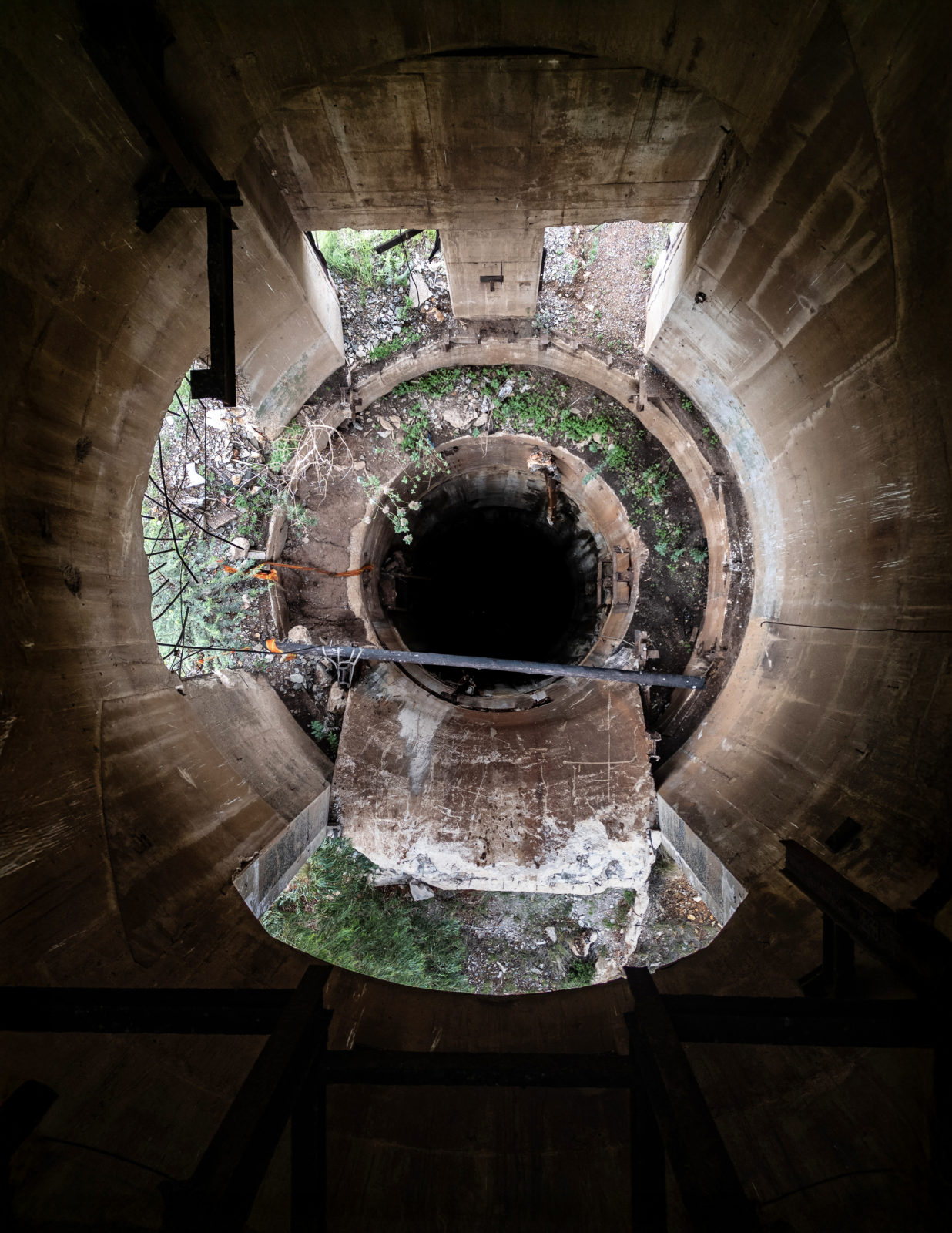
Most of the miners were migrants from Mozambique, Lesotho or Zimbabwe, but George and Alfred were South Africans. All along they had consoled themselves that their government would never kill them. Now they were not so sure. Peering down the endless concrete shaft,
Alfred wondered why he should endure a prolonged death from starvation when he could simply jump.
Credit: Tommy Trenchard
When gold was discovered in 1886 on the Witwatersrand, a ridge of rocky hills on the high-veld above what is now Johannesburg, the biggest problem was finding people to dig it up. Working in a mine was poorly paid, physically gruelling and dangerous: miners faced a high risk of dying in an accident or from lung diseases such as pneumonia or silicosis. White politicians, under pressure from the mine-owners, decided that the solution to this labour shortage was to force black Africans off their farms and underground. The mining companies also recruited workers from neighbouring countries, housing them in prison-like compounds near the shafts. In Lesotho, a mountain kingdom from which huge numbers of men migrated to work in South Africa, singer-poets described the train to the mines as a millipede, carrying labourers across “the wilderness of the republic…where people live through unceasing work”.
In the compounds and townships of Johannesburg, the “city of gold”, a rough-and-ready culture took root. The migrants developed a genre of music that combined poetic lyrics with concertinas, accordions and homemade drums fashioned from car tyres and paraffin tins. Women danced alluringly as they played, and the music became known as “famo”, from the Sesotho phrase ho re famo, which means “to lift up the skirts”.
Gold-mining was deeply exploitative and highly productive: by some estimates, South Africa has contributed 40% of the gold ever mined. Buffels, which opened in 1953, was one of several mines clustered around the small city of Klerksdorp, a two-hour drive south-west from Johannesburg. In its six decades of operation it produced 2,200 tonnes of gold.
A corporate brochure for Buffels published in 1983 celebrates an operation that was both a feat of engineering and an entire social world. Each month the mine consumed 93m kilowatt hours of power, 600 tonnes of food and enough water to fill 4,000 swimming pools. Nearly 18,000 people were employed there. The black workers played in 40 different football teams. The white ones joined the golf club.
But the boom times couldn’t last. In 1985 South Africa’s gold mines employed more than 500,000 people. By 2022 that figure had fallen below 90,000. The decline had many causes, one of which was that the gold was getting harder to reach. When Buffels closed in 2013 its owners said it still had 54 tonnes of reserves – worth $5.8bn at today’s prices – but it was not profitable enough to extract them. The deposits were so far from the shafts that it took miners hours of their shift just to reach them.
This didn’t put off the zama-zamas, who were prepared to live underground for months at a time. They moved in as soon as the mining companies moved out. Security footage released in 2015 shows scores of men, some carrying machineguns, ransacking buildings at Buffels for scrap metal. At some point they took over the tunnels. It was not hard to do, if you had a very long rope and a head for heights. Some of the shafts had been capped with concrete slabs, which could be blasted away; others were still open to the sky.
Some of the men were familiar with the maze of tunnels because they and their forefathers had helped to dig them. “Nobody today knows the mine better than the miners who built it,” said a police officer who requested anonymity. “If we try to chase them underground they literally disappear.”
Statistics about informal mining are guesswork. In 2019 the Global Initiative against Transnational Organised Crime, an NGO, estimated that there were 30,000 illegal miners in South Africa extracting about $1bn’ worth of gold annually. Gwede Mantashe, the government minister responsible for mines, has said that illicit trade in precious metals was worth 60bn rand ($3.3bn) last year. Many zama-zamas are unlawful migrants, often working under violent gangs from nearby countries who control access to the shafts.
The gangs force miners to pay exorbitant prices for food, equipment and sometimes even entry to the mine. In some cases the gangs refuse to hoist a miner to the surface until he has found enough gold to pay off his debts. Three teenage zama-zamas told journalists last year that they were given false promises of work, then forced into Buffels at gunpoint. Other miners interviewed by police said that the going rate to be pulled out was 25 grams of gold, worth about 25,000 rand ($1,400) at black-market prices.
Khuma, a township near Buffels, was ruled by a faction of Terene (the Train), one of the most feared gangs in Lesotho. Terene, like the other gangs from Lesotho that control the mines, is ostensibly a syndicate of famo musicians. In the old days the famo singers serenaded the gangsters. But over the years, the gangsters and their troubadours became more closely entwined. “You can’t differentiate the famo gangs and the illegal miners. They are working together now,” explained Lesotho’s deputy police commissioner, Moqhebi Likhama. There’s a widespread assumption in Khuma that the gangs have bought off and intimidated police officers, security guards and magistrates.
Rival famo gangs insult each other in song and kill each other on the streets, pursuing vendettas and fighting over the mineshafts. The mob in Khuma was in a turf war with another in Kanana, a township about 20km away. Last year a group of men walked into a tavern there, asked for “the Basotho” (as people from Lesotho are known), and shot eight people dead. There are stories of grotesque violence: murders celebrated like a football triumph, corpses found with severed genitals, tunnels booby-trapped with explosives. “These are not Robin Hoods trying to help the community,” said a mining engineer from Klerksdorp who used to work on Buffels. “They are vicious fucking murderers.”
George and Alfred entered the mine on separate nights in July 2024, the hole merging with the winter sky. They told me little about how they were recruited. George mentioned a chance encounter on a football pitch with a man who offered to take him underground, “so you can put something on your table for your kids”.
The two old friends lived in Khuma and were in their 30s. They were both fathers, and mindful of their responsibilities. “As we all know in South Africa there are no jobs,” said George. He used to work at a slime dump, a site where waste from gold extraction is disposed of, but had been laid off. George wanted to buy satchels and school uniforms for his children. Alfred was already worrying about Christmas. They could make 9,000 rand ($500) a month working the ropes underground – three times as much as they would get frying fish in the local shopping mall. They wouldn’t have to do it for long. The entrance to the shaft was just across a river from their homes; the tunnels probably lay beneath their feet.
There were a dozen shafts in the area, many of them used by zama-zamas. Hundreds of kilometres of tunnels ran off from the shafts, like the roots from a tree trunk. George and Alfred would be working in shaft 10. They dropped into it on a rope, trying not to think about the 17 seconds they would fall if the rope snapped. Below them, at a depth of 1,500 metres, an old rail track led laterally to shaft 11, about 3km away. These two shafts, as far as they knew, were cut off from the rest.
From then on, the details of their story are hard to verify. Almost all the surviving miners were migrants who were kept in police custody. Only a few South Africans, such as George and Alfred, have been released on bail. The picture they paint of the conditions they endured is consistent with accounts from mines elsewhere. The men lived shirtless in the heat, their way lit by head lamps, their beds fashioned from discarded rope. One abandoned tunnel was designated as a toilet. Another was used to wash in. It was never hard to find water, which flowed everywhere, even when it was not raining above ground.
For the first few months, before the police came, George and Alfred worked the ropes for up to six hours a night. It was not arduous, they said. There was time to talk about music, family, the things they would do when they got out: get a driving licence, perhaps, or take their kids to McDonald’s. They did not dig, but others did, with hammers, chisels and explosives in the levels below. Those were dangerous places, where the rock could give way unpredictably and bury a man alive.
The miners were forbidden from fighting, stealing or even moving without a torch. Their bosses collected fines in gold, the currency of the underworld, measured out in bottle caps. Zama-zamas compared their lives to soldiers, moulded by discipline. “If we had to live by those rules here on the surface it would be a perfect world,” said a miner who had been down a different shaft. Another told me how an ill-fated experiment to bring sex workers into a mine was abandoned when men started fighting each other out of jealousy. This harsh regime could easily slide into abuse. Police would later accuse one of the underground gangsters, nicknamed “Tiger”, of assault, torture and murder, based on testimony from survivors.
Each shaft had a “shop”, run by the gang that controlled the mine, in which miners could buy food, alcohol and medicine. The shop at shaft 10 was a few hundred metres below where George and Alfred worked, in a cavernous space as big as a church. At these depths, a sixpack of Heineken went for the equivalent in gold of 800 rand ($40). The miners were partial to BronCleer, a cough syrup containing codeine. “You just black out and sleep like a baby,” said George.
Twice a month everyone would gather at the shop for a meeting, where they aired grievances and received instructions. It was also a social occasion, when the men would feast on fried chicken, hook up speakers to a generator, and dance to the beats of Makhadzi, a singer from Limpopo. There was a television, on which they watched pirated copies of “Outlaws”, a drama about two feuding families in the Lesotho borderlands. On those days, the mine almost felt like home.
Those who knew the old Buffels regarded zama-zamas like George and Alfred with a mixture of horror and awe. The mining engineer from Klerksdorp described the conditions as “Dante’s inferno, two kilometres underground”. When I called Bernard Swanepoel, a former boss of Village Main Reef, the company that owned the mine when it closed, he was astonished that anyone was there at all. “I’ve worked on mines all my life,” he said. “If you told me that you could swing someone down a kilometre on a rope I’d have told you exactly how mad you are.”
The sheer danger of mine shafts is one reason why the law mandates them to be “rehabilitated” after they close. The headframe at the top should be demolished, the metal sold for scrap, the rubble pushed down the hole. Finally a concrete plug should be set into the top of the shaft, ideally to a depth of ten metres or more. That is enough, in theory, to stop anyone from getting back in.
That work was never completed at Buffels. The mine changed hands four times after 1997, bundled together with other assets, until it was acquired in 2015 by a Chinese-backed firm, Heaven-Sent Gold. The new buyers were interested in another mine that came as part of the package, which was still operational, but grudgingly took on the defunct shafts as well. They later blamed the delay in rehabilitation on rising costs, illegal mining and the “inconsistent flow of funds” from the government, which they said had not released 48m rand ($2.7m) from a fund set aside for the purpose.
This story was not unusual: mines had been closed in lackadaisical fashion all over South Africa. Roads in Johannesburg were sinking into the ground, as the city of gold was literally undermined by zama-zamas in tunnels below.
South Africa’s government worried that its authority was being undermined too. Cyril Ramaphosa, the president, who first rose to prominence as the leader of a mining union, wrote last November that illicit mining cost the economy billions of rands in “export income, royalties and taxes”. That might have been true where zama-zamas were stealing gold from operational mines, bribing or tunnelling their way in, but was less so at Buffels, where no company was interested in digging. The president also condemned the criminality associated with illicit mining. He alluded to a notorious incident at a mine dump in Krugersdorp, where eight women were gang-raped after going to shoot a music video; furious locals had stoned and beaten the zama-zamas they deemed responsible.
In December 2023 the government launched a nationwide crackdown, calling it Vala Umgodi, or “Close the Hole”. The idea was to force the miners to surface by cutting off their supplies – to “smoke them out”, as one minister put it. The police considered this the only way to clear the tunnels without engaging armed miners in dangerous battles underground.
When I arrived at Buffels in early December the operation had settled into a sullen siege. Dozens of police officers sat beneath gazebos at the top of shaft 11. Occasionally, as if to break the monotony, they patrolled the area on horseback. The hole itself – technically a ventilation shaft – was an unfenced void, ringed by rubble. It was hard to get a sense of its scale, because sunbeams did not reach far down its sheer concrete walls. Peering over its lip induced none of the vertigo of a cliff edge, only the blackness of invisible depth, like the sea.
Beneath some trees, across a silent road, young men in bucket hats passed round a joint. One of them picked through nearby stones, wetting them with saliva, searching for a glint of gold. The others were watching a video of a politician who said that Nelson Mandela had sold out to white capitalists. As far as they were concerned, South African mining had been one long larceny, from start to finish.
Most of these men had worked as zama-zamas before, although some disliked the term, with its whiff of criminality. Now they had come from Khuma to pull out miners. Helping to mobilise the rescuers was Mandla Charles, who had emerged from another shaft in October and said he could not leave his comrades to die. Another organiser was Mzwandile Mkwayi, known as Shasha, a burly ex-convict who had served time for robbery and wanted to prove he had changed.
The homespun mission had been funded by neighbours, charities and online well-wishers. The police grudgingly let it proceed, on orders from the courts, while complaining that sending supplies to the miners “defeats the purpose of our ongoing operations”. In December a professional rescue service had given a quote of 11.3m rand ($620,000) to pull the men out using a mobile mechanical cage. But the government and the mine-owners were bickering about who should pay for it.
The police also said that miners could resurface at another shaft called Margaret, about 7km north as the crow flies, where there was still a working lift. Hundreds of zama-zamas had done so since the start of the operation, walking underground from other tunnels. But it appears this option was not available to those in shafts 10 and 11. An affidavit filed in December by Harmony Gold, which part-owns Margaret shaft, said that the connecting tunnels had collapsed and flooded, making it “impossible” for the miners to get there. Those who tried had turned back.
For now, the only lifeline was the rope. The rescuers from Khuma looped it through a pulley which was suspended over the shaft, then ran it around a pipe held fast with rubble. Under the watchful eyes of the police they lowered down packets of maize porridge, bundled in plastic wrap. Then they began to pull something up. A dozen men hauled at a time, vigorously at first, then slower, their shouts and chatter sapped by the heat.
The coils of dead rope piled higher as they worked. Only when the heap reached waist height, after 40 minutes of toil, did we glimpse a gaunt figure dangling from the other end, a Mozambican in a yellow raincoat, blinking in the sun. On his face was a look of astonishment – or was it fear? – and for some reason I thought of a newborn pulled from the womb into a world of dazzling light. The police chased me and another journalist away, as though embarrassed by the scene. They arrested the man while paramedics hooked him up to a drip. The rescuers were relieved: on some days, they had pulled out corpses.
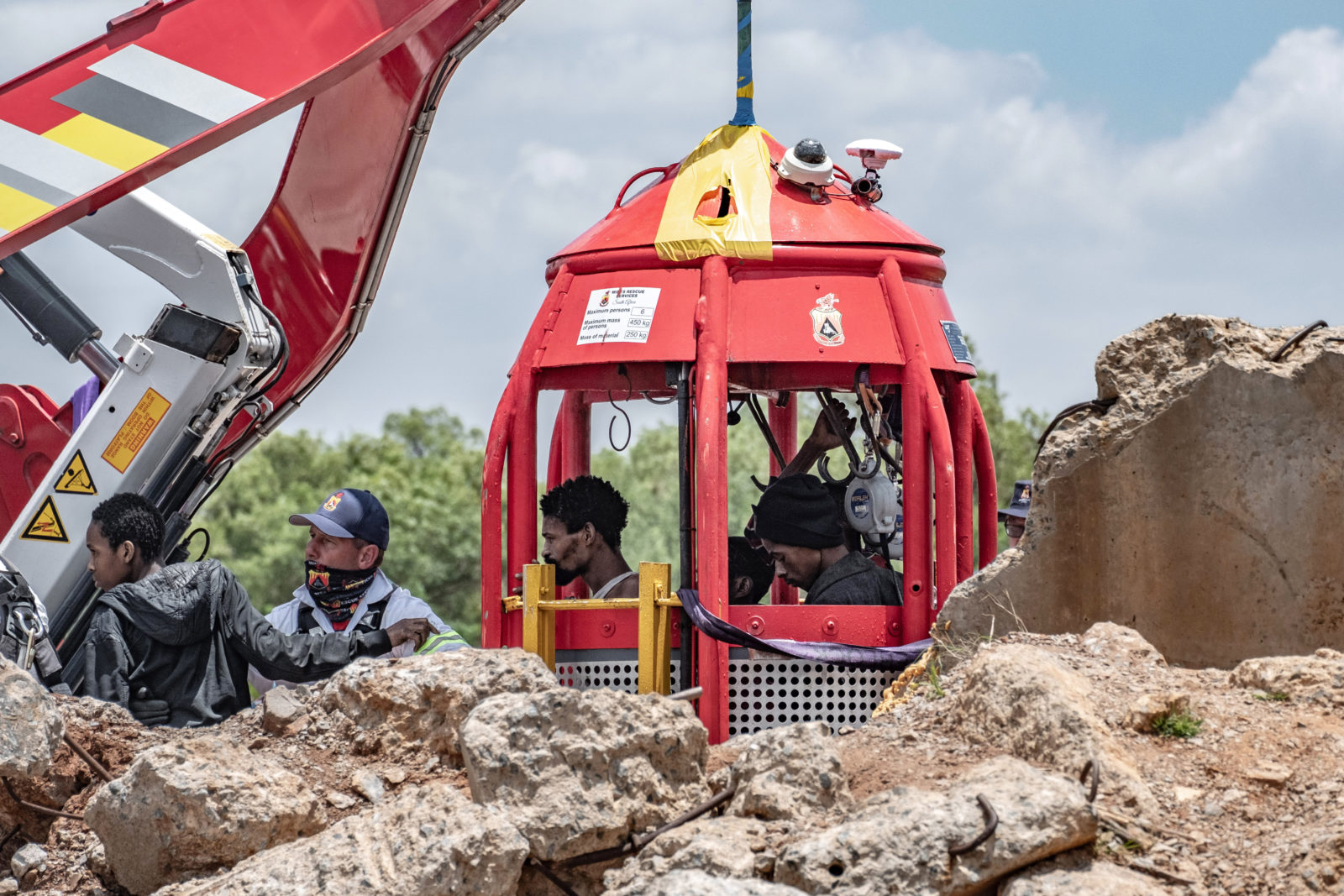
Gold miners are hauled to the surface during a rescue operation at Stilfontein, South Africa. The men had been trapped underground for months during a police operation targetting illegal mining.
Photo: Tommy Trenchard
As this drama unfolded George and Alfred were still underground, a mile beneath our feet. Like most of the other miners they had come to shaft 11, which was the only place where rescuers were sending down food. They had walked for hours to get there, balancing on top of a pipe in the flooded tunnel where locomotives once ran. Now they shared a plate, a blanket and a bed.
When the makeshift rescue began a letter was sent down saying that the dead, the sick and South Africans would be pulled out first. A man from Mozambique told George and Alfred not to go, because when the last South African left nobody would care anymore and the rest would be abandoned to die. One day in December it was Alfred’s turn. He could already imagine himself outside, in the sunlight, but could not show his joy to George, who would remain behind.
George watched him go, thinking his turn would come soon. But as the days passed his hopes dwindled. “I said, ‘God, please help me, I’m not going to die here, my grave’s not going to be here.’” If the rope would not come for him, he would have to escape himself.
There was another way out, so perilous that only a starving man would risk it. Back in shaft 10 were the remains of the metal frame which had once carried a mechanical cage. It might just be possible to climb up the rusted ruins, a vertical ascent of more than a kilometre. George had seen other men try it, tying loops of rope into dangling steps. He had also heard some of them fall.
Fourteen men began the journey with him. In George’s telling, they climbed short sections at a time, resting in alcoves that had once housed electrical transformers. In one they found a soggy packet of potato crisps, which they dried on a fire of burnt rope. Otherwise they consumed nothing but water and a little salt. They slept when their watches told them it was night. The next morning they stood in a circle and prayed, before setting off again.
On the first day one of the men fell. In the darkness, the others could not see what became of him. As they climbed they passed the bodies of nine men who had tried this way before, only to slip or succumb to exhaustion: a tangle of rope and metal and bones, suspended above the void. George whispered to the spirits of the dead men as he passed. “Please guys, we are not the one that caused this,” he said. “We are not responsible for your death, but if your spirit catches us, guide us to the surface so that we can tell what is happening in here.”
On the fifth day, George said, he and his 13 surviving comrades reached the surface. Their limbs were scratched and bruised. Their hands were rigid with cramp. A waiting policeman pointed a gun at them, even though they had no strength to run. “The miners possess the means to exit independently”, said a police statement, “as demonstrated by those who have surfaced in recent days.”
On Christmas Eve the rescuers from Khuma sent down a final package of food. Their funds were running out. Three days later the mine-owners levelled the ground around the shaft, in
anticipation of professional rescue equipment arriving, although that would not happen for weeks. In the process they removed the boulders that secured the rudimentary pulley mechanism.
Nothing more would be heard from the men underground until January 9th. That day, after receiving some more donations and rebuilding the pulley system, the men from Khuma lowered a rope. A letter came back, written in neat Sesotho: “There are 109 corpses in here and people are dying every hour…We are weak and have no energy left.” A man who was pulled out had videos on a phone, showing scores of bodies, shrouded in plastic and bound with rope. In Pretoria, where the High Court was deliberating over what should be done, a judge warned that the crisis could become “the darkest point in our history”.
Only now did the government contract Mines Rescue Services, a specialist company, after agreeing to split the cost with the mining industry. Mannas Fourie, who led the operation, told me later that saving people from abandoned shafts is “one of the most extreme rescues or
recoveries that one can go into”. His team was working blind, because detailed plans of the shaft had been lost. They would drive a 45-tonne mechanical winder onto the site, but they could not even be sure that the ground by the hole would support it.
On January 13th the team used the winder to lower a cage. Nobody from the police or Mines Rescue wanted to go down, fearing the miners were armed, so Shasha and Mandla, the rescuers from Khuma, volunteered to go instead. They were greeted like gods, said Mandla later, although his overriding memory was the stench of the corpses on his hands. The cage would normally hold six people, but the survivors were so thin that 13 could fit at a time. Even so, it would take days to get everyone out.
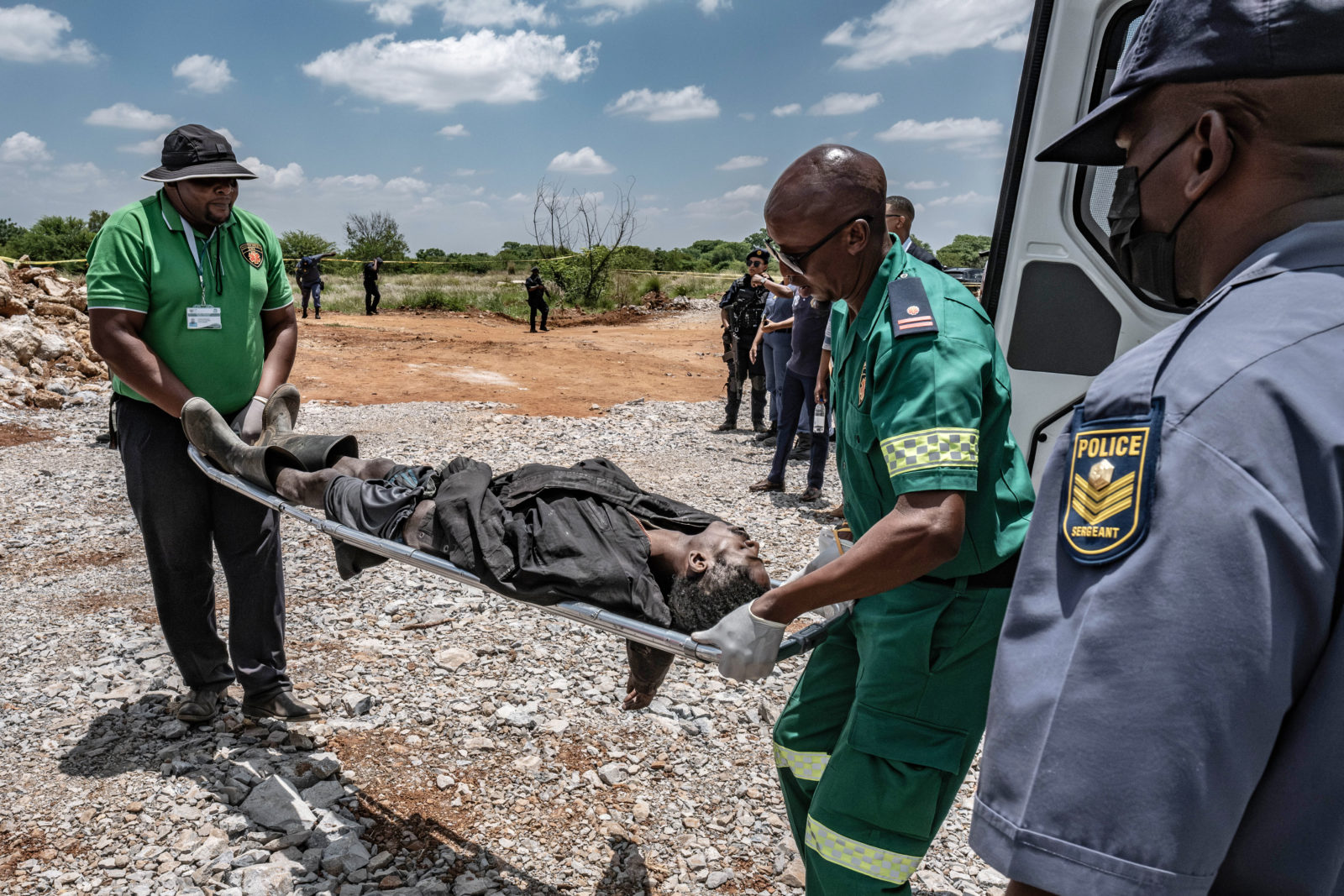
A man is carried by paramedics to a waiting ambulance after being rescued from a disused mineshaft in Stilfontein, South Africa. A police operation to combat illegal mining aimed to force zama zamas to the surface to face arrest, but resulted in dozens starving to death underground.
Photo: Tommy Trenchard
On the second day, a team of officials arrived to address the media. “A train is coming, you step on the rail line, and a train runs over you…is that a humanitarian issue?” asked Gwede Mantashe, the minister. Most people involved in illegal mining were not South Africans, he continued. “It’s a criminal activity, it’s an attack on our economy by foreign nationals.” As he spoke the cage was still clanking up and down, a yo-yo in the void.
Then the officials climbed back into their cars without talking to anyone from Khuma. A few people shouted in frustration at their black windows. I caught sight of George watching from beneath the shade of a tree. “Why are they here?” he asked. “Are they only here to greet the dead bodies?”
By the third day there was nobody left to rescue. Of the 246 survivors, 128 were from Mozambique, 80 from Lesotho, 33 from Zimbabwe and just five from South Africa. They were detained and charged with crimes including mining without permits and entering the country illegally. Four of them died in hospital. The cage also retrieved 78 decomposing bodies. Others will never be recovered, like the corpses that George passed on his escape.
Who killed Supang and the 90 other men who are known to have died in Buffels? The famo gangs took the shafts by force. The mine-owners did not do enough to seal the holes. The government dallied over a rescue. The police knowingly starved the miners and suggested, falsely, that they could easily come out if they chose. The economy offered few other opportunities for the “ones who tried their luck”.
The South African Human Rights Commission has launched an inquiry into what happened, although a date for the hearings has not been set. A coalition of civil-society groups is calling for criminal charges against the officials they consider responsible for the “mass murder” of the miners. But there is little public outrage; on social media some suggested the miners got what they deserved. Ramaphosa has said nothing about the deaths.
As for George and Alfred, their days of going underground are done. “I’ve seen all these things, they’re all in my head,” said George, while the laughter of his daughter tinkled through the window. Here at his modest home in Khuma is where he wanted to be now, with his mother’s pot plants and his children’s school certificates and the Orlando Pirates playing football on television. He has since been convicted of illegal mining and spent four days in prison before gathering the money to pay a 7,000 rand ($400) fine. Alfred’s case is ongoing.
Sometimes, in my conversations with them, the two old friends spoke of ubuntu, a traditional African philosophy that encourages people to find their humanity through helping others. They did not deny that they had broken the law. But they wondered what ubuntu meant to the ministers and the police, who had punished those crimes with a de facto death sentence. “I’m not going to lie,” said Alfred, as though ushering up the voices of the dead. “They killed us.”
Photographer: Tommy Trenchard