

When I met Craig he was 13 and homeless. I still thought his life might turn around. I was tragically wrong
No one was looking for him or the other dozen children who congregated on the market square. Most of them had absconded from care, some were dodging school. A few, like Craig’s mate Mikey, just didn’t bother going home. The youngest runaway, Mark, claimed he’d been missing from foster care for months and had spent his 12th birthday on the run. They were glad to have found each other and for a week or so they slept together in an alleyway. Craig organised bedding. He had picked up some tips from the experienced rough sleepers, he told me, as he collected cardboard he’d stored behind a bin. “Keeps the cold off your bones,” he said, without confidence. That was his first taste of being homeless.
It was 1998 and I was in Nottingham filming Staying Lost, a documentary series for Channel 4. The number of runaways in the UK was at crisis point. A Children’s Society report estimated that 100,000 children ran away every year. Our series set out to follow some, like Craig, who survived on the streets, existing outside the system. We documented his life as he stumbled from one precarious situation to the next. On the face of it, he seemed unfazed by the chaos around him.
He was often quiet, watching as street dramas played out in front of him. It was difficult to read what he was thinking and just how lost he felt.
Once in a while, Craig would catch the bus four miles up the road to the 1970s estate where he grew up. I went there with him one day, half hoping I would find out the truth about why he’d ended up in care in the first place. Craig was pleased to show me round his “manor” as he called it. Teenagers cruised up and down on bikes that were far too small for them and there were trainers strung up over telephone wires. “Thrown up there for a laugh. There’s not much to
do round here,” Craig admitted, although he seemed genuinely pleased to be back.
We went into his mum’s. And if I was expecting some clues to his past the carefully wiped surfaces and dusted ornaments gave nothing away. The house was full, he explained to me. His sister and her baby lived there although his older brother had his own place now. His mum made me a cup of tea, but had little to say to her youngest son. According to her, he was “a nightmare” and his antics, as she called them, were too much for her. He’d had his last chance and she’d put him in care. No one could deal with him, she told me. It was unclear how much anyone had tried.
Our visit was short lived. If he’d ever had a room, it was no longer available. In fact, there was no sign left that he’d ever lived there. No point in sticking around when you don’t feel wanted. So 13-year-old Craig jumped on the bus back to town and began the search for where he would sleep that night.
The novelty of a cardboard mattress had worn thin and Craig started to seek out more sheltered places to hide. He called me once from a half-derelict squat near the station. A bloke called Jock was letting him crash in an old armchair but it was too noisy to sleep. Mates of Jock’s turned up unannounced at all hours, with unexplained bloody noses and unpredictable tempers.
When the weather was OK Craig tried “camping out” on the Forest recreation ground but it was too “on top” as he called it. The nearby red-light district was busy and punters cruising past made for an uneasy atmosphere. Shadows slipped in and out of the headlights and Craig knew that girls from the children’s homes were working there. He’d heard stories of young boys selling sex in the public toilets. It was the 90s and exploited children were still prosecuted and labelled as “child prostitutes” or “rent boys”. After a couple of nights, Craig headed back into town.Every now and again the police would come across Craig in town and take him back to the children’s home. Protesting half-heartedly, he would allow himself to be put in the back of the van. A few hours later he’d be back. Nobody at the home stopped him leaving. And nobody asked what he was running from.
“He was trying to escape,” Jodie Young told me recently. “You risk something worse happening to you when you run off but you still feel anywhere’s better than care.” Jodie had been spat out of the care system herself and at 18 she was addicted to heroin, putting in long hours begging near the Midland Bank cashpoint. She became an unlikely protector of Craig and the others, letting them stay at the flat she shared with her boyfriend, Dave, and their Jack Russell, Penny. “I knew they were scared,”she said.“I wanted to give them somewhere safe.”
A few years earlier, Jodie had spent some time at Beechwood House, the residential home Craig was missing from. If anyone knew why he had run, it was Jodie. Neither of them talked about life in the home. Whatever the truth was, they had an unspoken understanding to bury it. For a while, Jodie’s flat was a safe place. They had proper mattresses on the floor and sometimes bought Pot Noodles to eat together in the evening. Jodie warned the young runaways against heroin, although she was losing that battle herself. Above all, there was a feeling that everyone in the flat was in the same boat. They’d been let down by everyone whose responsibility was to care for them. It was up to them to look out for each other.
By the time filming was coming to an end, this temporary stability was over. Jodie and Dave had been evicted, the little dog, Penny, taken away and the flat boarded up. Now 14 and a good foot taller, Craig once more found himself with nowhere to go. Even the police had given up taking him back to care. It felt like a dangerous crossroads, so I took a chance and suggested a visit to his mum’s. After an awkward start she grudgingly agreed that he could stay on the sofa for a while. Rules were laid down, promises made and a spare duvet was found. But I didn’t hold my breath. Things didn’t work out and soon enough Craig called letting me know he was on the move again.
For 18 months, Craig had trusted us to film the reality of his life as a runaway, when suddenly Nottingham city council stepped in claiming they were responsible for him and we had no right. They sought an injunction to stop the documentary from airing but after a gruelling few days being cross-examined in the Royal Courts of Justice, the judgment went in our favour. Craig was entitled to have his story told and Staying Lost was broadcast in April 2000, when he was almost 16.
I still hoped that things might turn around for him, but in the year after the film aired, the police started picking Craig up for minor crimes and before long he landed up in a young offender institution. I visited him during that first stint inside. He got me a cup of coffee from a machine in the corner of the visitors’ room. He had an idea of training to be a mechanic but first he’d have to find somewhere to live. He wasn’t sure how he’d manage that. He was almost a grown man by now, not a priority for housing. And statistics on the fate of care leavers were stacked against him. It wasn’t long before he knew his prison number by heart.
At first he was still seeing how far he could take things. When he was about 19, he came up with the idea of robbing a small supermarket by pretending he had a gun in his pocket. The terrified cashier handed over the contents of the till and he legged it with the lot. But it wasn’t Craig’s style. He was back in the morning to turn himself in. “I just couldn’t get it out of my head,” he told a friend later. “I’d scared the life out of that woman and I couldn’t live with that.”
Steven Ramsell first encountered him in 2004. “I have a memory of sitting opposite Craig in the old dingy Bridewell police station,” Ramsell, who is a solicitor advocate, told me. “He was one of the first people I represented. If you looked at the outer husk you’d see a shop thief, a pest. Yes, he’d commited a load of crime, but it was low level stuff, and it was the only thing he knew.” Craig drew the line at house burglary but had become expert at lifting phones and purses.
By the time he was 25, Craig was a regular client and, according to Ramsell, almost incapable of functioning in modern society. “While I was out there I just did not know how to live normally,” Craig wrote to me in 2017 from HMP Nottingham. “I felt awkward and out of place all the time. It’s no excuse for the crimes I did. But I just don’t know where or how to start.”
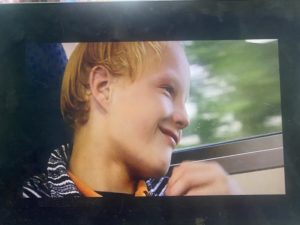
Craig at 13 years old. Credit: Pamela Gordon
There were people who tried to help him in those early years. People who remembered him as a kid let him use the shower or get his head down for a few nights. Some let him stay longer. But then Craig would “pay back the favour” by filling the fridge with stolen food, the police would turn up at the door, patience would wear out, and he’d be on his way again. “Craig is his own worst enemy,” people would say.
Over the next 10 years I often lost track of whether he was in or out. Then out of the blue I would answer my phone to an automated voice. “This call is from a person currently in a prison. All calls are recorded and may be listened to by a member of prison staff. If you do not wish to accept this call, please hang up now.” Then Craig would come on the line, explaining the complex mess of arrests and outstanding warrants, recalls and remand hearings that had resulted in him being locked up again. “How are you doing, Pam?” he would never fail to ask. And I would try to find little things to tell him, all too aware that he’d find it hard to imagine the life I led. He liked to hear where I’d been and how my family were and he knew I was relieved to hear from him.
Often, he would ask me to send another DVD copy of Staying Lost. He was proud of the film. He always said it was the only thing he’d ever really finished. He tried to show it to prison officers and volunteers on
the inside. I think he hoped that by watching it they would get some idea of how much he’d been through and that maybe one day someone would come up with the answer to how he could sort his life out. But officers were neither inclined nor equipped to ponder prisoners’ life stories. “You should make a follow-up documentary on me, Pam,” he’d often say. “That’d show people what it’s like, what happened to me next.” But TV had moved on. I was told by one executive that Craig just didn’t have a “TV face”.
Time and again Craig would walk out of the prison gate with no address. He’d leave with the best intentions of going to see his probation officer. But those appointments were often fraught and filled with forms and applications he couldn’t handle. And they usually led to a dead end. So, he’d find a mate to stay with. Someone who was doing him a favour. I could sometimes hear the chaos of those places in the background if he called me. “It’s sound here,” Craig would reassure me. But things would soon unravel.
I remember how often Craig lost his few possessions, left in a hostel or at a mate’s house. There was usually a stereo, a “really good one” that he’d not been able to carry. And always a pair of trainers he’d managed to leave behind, even though the ones he was wearing were ready for the bin. During one particularly freezing winter, his stuff was lost when he was transferred between jails and he was released into a bitter morning outside HMP Hull with nothing more than the regulation sweatshirt and trackies he was wearing. I’d called the prison and tried to ask them to find clothes for Craig but as usual it was impossible to get through. It was only thanks to the resourceful and dedicated chaplaincy team that someone was able to meet him at the gate with a coat and scarf from the lost property.
No one wakes up in the morning and decides to become a heroin addict, Jodie once told me. And I’m certain it wasn’t a decision Craig made, but that’s what happened. During his longer stints in prison, he’d sometimes get on to a drug reduction programme and get clean. But drugs are easy to score behind bars, and all too often offered a way to cope. “I run back to the drugs,” Craig once wrote to me, “cos I know how to be a druggie, I know what I have to do, or have to act, where other situations I haven’t a clue. Things get too emotional for me. I even panic when I’m just attending appointments whether it’s the jobcentre or whatever I just panic in my head. I feel like I’m 13 years old again when I’m out.”
By the time he was 33, Craig had 170 offences on his record and was spending less and less time on the outside. “He was institutionalised,” Ramsell told me. He’d been round the system so many times. Any support he got was never strong enough to spark a change. “There should be another option, but there wasn’t,” Ramsell said. “And Craig always knew what was coming. Back on the merry-go-round.” So, in the spring of 2018 the door of Nottingham prison revolved for Craig again and he was back on the wing.
During the months that followed, Craig was in touch more than usual. At the time, Nottingham was one of the worst prisons in the country. It had recently been issued an urgent notification from the chief inspector of prisons – essentially, the institution has been put into special measures. The tensions that had simmered on the wings for years had finally reached boiling point. Drugs, especially the noxious synthetic cannabinoid spice, were freely available. Over an 18-month period, 12 prisoners took their own lives.
“I don’t even escape my problems when I’m asleep,” Craig wrote from his cell. “I live a nightmare in the days and when I sleep. I just don’t know if I can cope no more. My head is a mess and the days are just getting worse for me. I want a rest from myself.” His phone calls became desperate, and his letters got longer. I worried if I didn’t hear from him every day. Chaplain John Seeney was instrumental in getting Craig through that sentence. “We have to hang in there with Craig,” Seeney would say to me. Every Tuesday, Craig would ask to be let off the wing to attend the prison chapel where Seeney and the small multi-faith team offered a place to talk and be heard. Craig was there without fail and even started writing some poems singing the praises of the support he’d found.
And, as if by way of a small miracle, when Craig was released in early 2019, Seeney managed to negotiate him a room in a house connected to a church group in Ilkeston, a small town outside Nottingham. I travelled up on the train and he met me from the station.
He’d been swimming, he told me, and he’d been to the library to try to learn how to use a computer. He had the key to his shared house on a long string and opened the door. He had milk in the fridge, and he made me a cup of tea. We spent a normal afternoon in the sunny back yard, and I still have a photo of him with a glimmer of hope in his eye.
Before I got the train home, he took me to the church where he was volunteering, helping with their daily pop-in cafe. The other volunteers, who were much older, busied themselves with an antiquated tea urn and plastic boxes full of biscuits. There was
a confusion about the “tea-towel rota” and Craig stepped up and offered to take his turn. A woman handed over a plastic bag full of towels and dish cloths with a slightly quizzical look in her eye. I remember worrying as we left the church hall about whether he had a washing machine or knew how to use it.
A few weeks later, there was trouble. Rules for ex-prisoners are tough and trust is hard won. He ended up being chucked out for inviting “friends” round and throwing a kettle across an empty room. No more cups of tea. He was recalled to prison.
We often talked about that afternoon, and I always said that now he’d managed to live in his own place once, he could do it again. But although he listened, I believe he knew his chances were running out.
At 35, Craig was looking at a longer sentence than usual after the recall. On the positive side, it meant he might have access to some of the support that was unavailable during shorter stretches. A woman named Tara Tan had recently started working as an art psychotherapist in Nottingham, partly thanks to the efforts of the ever- resourceful John Seeney. The chaplain hoped that art therapy might be a good fit for Craig, helping him express things he couldn’t find words for. “He liked to use colour pencils,”Tan recalled.“He would colourin, and sometimes he would draw. But I think he used the space more for somewhere he could let out frustrations with no fear of judgment.”
At the start, Craig told me he didn’t feel anything but numb and that worried him. “I’m closed off emotionally to everything,” he told me on the phone. “That’s been as far back as I can remember.” Tan noticed this, too. “He found it difficult to open up for fear of being hurt more,” she told me. “You need to make sure you leave the sessions on a positive because you’re sending someone back to the wing knowing they’ll be locked up in their cell alone.”
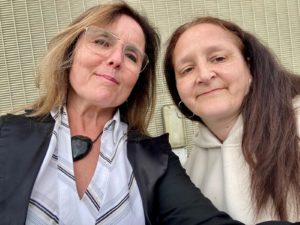
Pamela with Craig’s friend Jodie Young before attending the memorial taken outside the walls of HMP Nottingham. Credit: Pamela Gordon
Then in July 2019, while Craig was working with Tan, the independent inquiry into child sexual abuse published its investigation into how Nottingham council had responded to allegations of sexual abuse from children in care. “For decades, children who were in the care of Nottinghamshire council suffered appalling sexual and physical abuse, inflicted by those who should have nurtured and protected them,” announced Prof Alexis Jay, chair of the inquiry. “Those responsible for overseeing the care of children failed to question the extent of sexual abuse or what action was being taken.”
Beechwood House, where Craig had been placed between the ages of 13 and 14, received a special mention. Violence was common and sexually abusive staff members were allowed free rein. Children’s allegations were ignored. Beechwood had finally been shut down in 2006, seven years after Craig’s time there. It turns out that there had been an awful lot to run away from.
The last time I saw Craig in person was in autumn 2019. He invited me up to HMP Nottingham for a ceremony celebrating the end of a training course he’d completed on staying straight. In the 12 sessions he had been taught skills for “a life free from offending and drug misuse”. Although I was a bit unclear about what magic key Craig had been given to help him avoid his past mistakes, it was a proud day. John Seeney was there, of course, and Tara Tan. An ex-prisoner gave a talk about how you could turn things around, about how much was possible if you tried hard and wanted it enough. I watched Craig step up to receive his certificate as he smiled, half full of hope.
But over the next few years, fresh starts became harder and ended sooner. There was a sense that time was running out. Earlier this year, on 10 May, Craig spent another birthday behind bars. I heard from him as usual just before he was released.
“Hiya Pam, it’s me, Craig here on the pen. Well now, I’m officially 41. Just 16 more days to go till I’m back in the big wide world. I just hope it stays that way and I can finally get my life turned round …”
In that email he said he was hopeful of getting somewhere to live when he got out at the end of
May. He’d had an assessment for housing a few days before and thought that with the council’s help, for once, he wouldn’t be on the streets again. And so the countdown began to another release, another clean slate. He promised to call when he got to probation to sort his benefits out.
It wasn’t a surprise when he didn’t call. After a week or so of not hearing from him, the usual worry began. I called a few people in Nottingham to find out if anyone had seen him. No one had. So, I waited for him to show up as he always had before. Waited for him to call, probably from someone else’s phone, saying that he’d messed up his appointments or that he had no money for the bus to get to probation. Or that he’d just been sleeping for days and that he was sorry.
The call never came. On the night of 29 June 2025, Craig was found dead. A passerby found him slumped on some steps outside a house, the police told me. He was only a mile from the alleyway where he had slept rough as a 13-year-old.
It’s not clear yet which new set of statistics Craig will be added to. He will definitely be counted in this year’s homeless deaths, which numbered 1,600 last year. And he might join the UK drug deaths total, which reached 5,565 last year, the highest number since records began in 1993. It’s possible that he was a casualty of synthetic opioids. The number of those deaths has almost quadrupled in England and Wales, from 52 in 2023 to 195 in 2024. Or perhaps the drugs that contributed
to his death won’t be recorded at all. The Office for National Statistics admits that figures for drug misuse are more than likely undercounted. Whatever the case, statistics like this can only explain in the narrowest way why Craig died.
I later found out that Craig had been released, that final time, into emergency accommodation, rather than the longer term residence he was hoping for. He’d been offered a bed through The Community Accommodation Service, which provides short- term housing for prisoners released with no fixed address. It’s a last resort when “nothing else has been achieved”, someone from the Probation Service told me. Craig had apparently burned most of his bridges with them. “He struggled to engage,” they said. “But there are a lot of unanswered questions.”
I emailed Steven Ramsell and told him the news. “It was a sad day in our office,” Ramsell said when he called me later. He asked about the funeral and I told him that Craig’s immediate family had opted for a public health service, which would be arranged and paid for by the council. “A paupers’ funeral,” said Ramsell. “The final tragedy in a tragic life.”
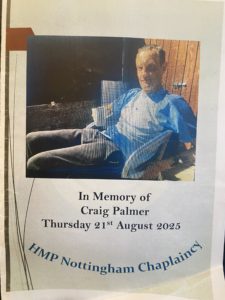
Craig’s order of service printed by the Chaplain for the memorial in August 2025. Credit: Pamela Gordon
Craig’s cremation took place on 11 August. Not wanting it to go unmarked, John Seeney went and was allowed to say a few words. He told me he gave Craig’s coffin a little pat, as a goodbye from us all. Ten days later, Seeney and I organised a memorial for Craig inside Nottingham prison. Jodie Young, Tara Tan and about 20 of the current in mates were there.
Seeney had made an order of service on the chaplaincy printer. My photo of Craig smiling in that back yard in Ilkeston was on the cover. I brought in another photo of him from when he was 13. I remember the moment it was taken. Craig was talking about blackberry picking with another runaway. Even then, it had felt so distant from the life he was living.
A couple of the prisoners stood up and shared memories of Craig. One, Jayden, who remembered robbing crack houses with him, shook his head in amazement that he’d survived a chaotic life on the streets and Craig had not. We laughed as people recounted the wilder stories from Craig’s life, like the time he leapt off a bridge while being chased by police and fortunately landed on a passing train. He always maintained to the chaplain that God had scheduled it to arrive just in time.
Jodie was too upset to speak. After 30 years of heroin use, she will mark her two-year anniversary of being clean this December. She works as a drugs peer mentor. “My heart feels like it’s been smashed to pieces,” she told me quietly.
Craig used to say how he’d love to donate his body to science, how they’d learn a lot from him. And it’s true that no stone is being left unturned to try to work out what combination of longtime drug use, poor health, despair or neglect killed him in the end. The postmortem is under way, and an inquest is planned. In an extremely unusual move, the pathologist has retained the whole of Craig’s brain to enable them to carry out a detailed examination. So many resources are being spent now that he’s gone.
In the chapel, Seeney played some music, a kind of mystical South American track which felt strangely comforting and we sat in silence with our own memories. As we got ready to leave that afternoon and officers were called to take the prisoners back to the wings I thought about how Craig would feel to see us all here. That he’d never believe how missed he is.
The Guardian Long Read Editor: David Wolf
What the wounds are telling us
To view the full article in English in its original layout, including all images and graphics, please follow this link. Please note: the original publication contains explicit and disturbing images and text.
To read the slightly shortened English text without images and graphics, continue below.
It is swelteringly hot as American doctor Feroze Sidhwa walks into the intensive care unit of the European Hospital in Gaza. On the hospital grounds, the air smells of sewage and spent explosives. Inside it smells like rot. And dead bodies.
Sidhwa is a 43-year-old trauma surgeon and critical care physician from California, based at a hospital in Stockton. Among colleagues, he’s held in high regard — not just for his clinical expertise, but also for his international work. He never takes more than a week off, unless it’s for a humanitarian mission. He has worked in crisis zones like Zimbabwe and Haiti, and trained surgeons in Ukraine and Burkina Faso. He wants to go where he’s needed most.
It is March 2024, and this is his first day. A Palestinian nurse is guiding him through the hospital. Then, suddenly, his gaze lands on two young boys lying utterly still in their beds. They look no older than eight or ten, he estimates. Their heads are swathed in bandages. They are on ventilators. The rest of their bodies are intact.
“What happened?,” he asks.
The nurse barely speaks English. But she points to their heads. “Shot, shot,” she says.
At first, Sidhwa assumes she’s mistaken. Are they shooting at children? Minutes later, looking at the scans, he sees she was right.
When they step into a second room, they find two more boys, in the same condition.
“I thought: what the hell?” he says over the phone to de Volkskrant, his deep voice steady. “How is it possible that, in this small hospital, four children are lying here with gunshot wounds to the head — all admitted within the past 48 hours?”
The four boys are all slowly dying. That evening, Sidhwa makes a note in the diary on his phone. But there’s no time to reflect. Not yet.
In the thirteen days that follow, he sees nine more children with single gunshot wounds to the head or chest — children who were likely shot deliberately. “I started to wonder if my hospital was near some crazy sniper,” Sidhwa says. “Or a drone team killing children just for fun.”
Back home, at a medical conference, Sidhwa meets an American colleague who had worked in another hospital in Gaza just before him. When Sidhwa brings up the children, the man nods. “To my surprise, he said: ‘Yeah, I saw that too — almost every day.’’”
The doctor in question, Thaer Ahmad, confirmed this account to de Volkskrant.
“That was the moment,” Sidhwa says, “when I decided: I have to find out what’s really happening here.”
The last witnesses
Feroze Sidhwa is not the only doctor who, after returning from Gaza, feels compelled to speak out.
For nearly two years, physicians like him have borne witness, from their operating rooms, to the brutality of Israel’s assault on Gaza. They have learned how to hold dying toddlers as they choke on their own blood — because there is no ventilator. They have found the strength to drive a scalpel into a teenager’s chest without anaesthesia — because there is no time, and another patient is already waiting. They have adapted to keep moving as the floor beneath them fills with the bodies of children.
Some doctors have been left numb. But others have chosen to speak out.
These physicians are among the last international eyewitnesses, as Israel does not allow foreign journalists into Gaza.
They can speak from first-hand experience about the consequences of the genocidal violence, which, with the levelling of Gaza City, has entered its next pitch-black phase.
That role comes with a heavy dilemma. Nearly all of them want to return to Gaza. But going public with what they’ve seen increases the risk that Israel will deny them reentry. According to the United Nations, more than one hundred foreign medical workers have been turned away since March 2025 — often without any official explanation.
Many doctors have come to accept this threat. Being silent is not an option.
Over the past few months, de Volkskrant spoke with seventeen doctors and one nurse from the United States, the United Kingdom, Australia, Canada, and the Netherlands. Since October 2023, they have worked in six hospitals and four clinics across Gaza, often returning once or even twice. Most of them have extensive experience working in crisis zones such as Sudan, Afghanistan, Syria, Bosnia and Herzegovina, Rwanda, and Ukraine.
At the paper’s request, they handed over hundreds of photos and videos of patients, X-rays, medical notes, and diary entries. They talked for hours. They laid bare what they saw in their operating rooms. And they all faced the same question: what are the wounds telling us about the war?
An absolute hell
British transplant surgeon and professor Nizam Mamode, 63, was already semi-retired when, in the summer of 2024, he received a call from the aid organisation Medical Aid for Palestinians. They asked if he could go to Gaza in August. “I had the time, and I knew I had the skills,” Mamode says. “I’d worked in Rwanda, Sudan, Lebanon — so I said yes. Some people say it was a brave decision, but it wasn’t. To be honest, I had no idea what I was getting myself into.”
It wasn’t until he was riding through Gaza in armoured vehicles with more than thirty others from the UN convoy that reality kicked in. “The doors were locked,” he says. “We were instructed: when you set off, do not unlock them — if the Israeli army shoots at you and orders you out, do not get out of the vehicle.”
“Try not to get killed,” the convoy leader told them.
“Two weeks later, the same vehicles were fired upon by Israel,” says Mamode.
Just before that, at a checkpoint, their luggage was searched by men in black uniforms. In Gaza, there is a shortage of nearly all medical supplies. That’s why doctors bring basic items with them. But often, everything is taken away — even baby formula. It has happened on multiple missions, the doctors told de Volkskrant.
The British plastic surgeon Sarmad Tamimi, who crossed into Gaza on June 24 this year, had already been warned by colleagues about confiscations. But he was also aware of the starvation in Gaza and the devastating consequences for babies. “I took baby nutritional supplements out of their boxes and packed only the foil in my luggage,” he says. “To the soldiers, I said I was taking them for myself.”
American emergency physician Mimi Syed managed to smuggle two laryngoscopes under her clothes—indispensable tools for intubating patients. “I was scared,” she admits. “But as a doctor, I need them to save lives. Normally, you throw a laryngoscope away after one use. In Gaza, I used it on at least fifty patients. I had to wipe it and use it again in different patients.”
“I don’t understand why baby food is confiscated from doctors crossing the border,” says British plastic surgeon Victoria Rose. “I don’t understand why doctors’ medicines are taken away. I don’t understand why half of the doctors are denied entry. There are so many things I don’t understand.”
In a response, the IDF stated the claims about baby formula being confiscated are “entirely incorrect.” The military stated that it was, in fact, working to facilitate the entry of humanitarian aid. According to the IDF, since May 19, 2025, “approximately 5,000 tons of infant formula alone have been transferred into the Gaza Strip, in addition to extensive quantities of other humanitarian aid.”
The doctors interviewed by de Volkskrant worked throughout the war in various hospitals and field clinics, including Nasser, Al-Aqsa, the European Hospital, and Al-Shifa. Some worked with Médecins Sans Frontières and with organisations that asked not to be named, fearing that identification might prevent them from continuing their work. They include general surgeons, orthopaedic surgeons, intensivists, plastic surgeons, trauma surgeons, and emergency physicians. A few were still in Gaza at the time of the interviews. The newspaper also spoke with a trauma nurse with war experience.
The situation in Gaza’s hospitals, many of which have been largely destroyed, is far worse than the doctors had anticipated. “I had to cut off a woman’s leg with scissors,” says emergency physician Syed. “Without pain medication. I had no other choice.”
The wards are heavy with the smell of burnt limbs. “We constantly heard people screaming,” recalls Rotterdam doctor Salih el Saddy. “In our hospital, we had anaesthetics, but no painkillers. Patients woke up after amputations with extreme pain. There was nothing we could do for them.”
In the operating rooms, staff are busy keeping flies away from patients who have been cut open. Nizam Mamode watches as a fellow doctor in the intensive care unit tends to a child whose ventilator is not working properly. When he removes the tube from the child’s throat, he sees it’s clogged. “Full of maggots,” says Mamode, “coming from the child’s throat.”
The MRI and dialysis machines, doctors say, are beyond use—riddled with bullet holes. Some operating rooms have been set ablaze. The cables of ultrasound machines have been cut.
There’s little time for reflection. Yet at times, without warning, a sense of disbelief creeps in. Mamode experienced this while operating on an 8-year-old girl. “She was bleeding out, so I asked for an abdominal gauze swab to soak up the excess blood and locate the wound,” he recalls.
He was told there was no gauze.
“Suddenly, I thought about the irony of it,” he says. “The word ‘gauze’ supposedly comes from Gaza, because Gazans were famous for their linen. So there we were, in the home of gauze — and I couldn’t get any. I had to scoop the blood out of her body with my hands.”
Emergency physician Adil Husain recorded a video message for his young daughter before his departure, in case they would never see him again. Others arranged their wills. All the doctors interviewed by de Volkskrant felt a strong intrinsic urge to go.
“I’m a surgeon. I want to go where the need is greatest,” says a doctor who will soon return to Gaza and prefers to remain anonymous out of fear of repercussions from Israel. “My work there matters. It’s a signal to the people in Gaza: we have not forgotten you.”
International doctors usually stay in Gaza for two to six weeks—then they are rotated out. Many of them sleep in the hospital and barely leave it for weeks on end. At Nasser Hospital, around fifteen surgeons share a room on the fourth floor, close to the operating theatres. At night, the heat can climb to a 100 degrees.
Surgeon Nizam Mamode sought relief on the stone staircase next to the ward. “I slept on those stairs every night, hoping it would be safe from the drones,” he says. Last month, he witnessed the upper part of that same staircase being destroyed by an Israeli strike — an attack that drew international attention because there was video footage capturing the moment when aid workers and journalists were killed.
The vast majority of injuries come from bomb and shell explosions: people are hit by the blast waves, the heat, flying shrapnel, and collapsing buildings. Shards tear straight through tents. And through the bodies of countless children—who make up more than forty percent of Gaza’s population.
“I’ve seen numerous children with brain matter hanging out,” says MSF-nurse Jack Latour. “I’m sorry—I know no one wants to hear that. But that is what’s happening here.”
The first time surgeon Goher Rahbour found himself in a mass casualty event, he saw a five-year-old girl without a foot. “It was on the floor. The child next to her was also just a kid. Her leg was gone from the knee. Then came another. I froze. I thought: this is absolute hell.”
According to Gaza’s health authorities, more than 64,000 Gazans have died so far, including nearly 20,000 children. Israel questions the reliability of these figures, arguing that the ministry is controlled by Hamas. A group of international researchers concluded in the medical journal The Lancet that the figures from that ministry actually represent an underestimation
Of all the patients, there is one group that shocks doctors most: children with gunshot wounds to the head or chest — and bodies otherwise untouched.
A single bullet to these areas is a strong indication that the child was deliberately targeted. That constitutes a war crime. In other conflict zones, the doctors rarely encountered such cases.
On August 14, 2024, doctor Mimi Syed writes in her journal. The sentences are short. Staccato.
14 August 2024
Girl, 7 years old. Gunshot wound to the chest. Dead on arrival. Tried to save her. Part of a larger mass casualty incident. On the floor, no cots. Nearly slipped in blood. Can’t eat for two days. Can’t swallow anything. Will I be normal again?
Dr. Mimi Syed
Syed is an American emergency physician who spent two four-week rotations in Gaza, working at Nasser Hospital in Khan Younis and Al Aqsa in Deir al-Balah. “Like most people, I was following the war through livestreams on my phone,” she says. “But I couldn’t do it anymore. I’m a mother. I couldn’t just watch and do nothing.”
She describes Mira, a 4-year-old girl she saw at Nasser. Her parents bring her in. “They said she’d been shot by a quadcopter [armed drone, ed.] while walking around in the humanitarian zone declared by Israel. I was told to just let her die by my colleagues. The assessment was, unfortunately, that there wasn’t much we could do. But she was still moving a little bit. She was very young. A little girl. I just couldn’t look away. There was something in her face that struck me. So I took a chance.”
Syed intubates the girl using the laryngoscope she had smuggled in herself. Moments later, she stared in disbelief at the scan of Mira’s head: there’s a bullet lodged inside.
With the help of her colleagues, Syed manages to keep Mira alive. Later, the little girl will wake up and begin to speak again—a small miracle. Much later, another doctor will remove the bullet from her head.
But Mira is not the only child with a bullet in the head that Syed encounters. She decides to take pictures of them. “I thought: I have to document this. I realised—these are war crimes.” Under extremely stressful conditions, she photographs eighteen children who had been shot in the head or chest. All of them were single shots, she says.
De Volkskrant asked doctors how many children aged 15 and under they had seen with a single gunshot wound to the head and/or chest. The question was deliberately limited to this age group, as children of that age are, in most cases, visibly and unmistakably children.
Fifteen out of seventeen doctors said they had encountered children aged 15 or younger with such gunshot wounds. Taken together, they reported 114 children—many of whom did not survive.
Some doctors took photos or made notes; others relied on memory. At the newspaper’s request, they gave the most conservative possible estimates: any cases they were unsure about were excluded. Children who had also been shot in other parts of the body were not included in the count either, as such injuries offer less certainty of deliberate targeting.
The doctors suspect that the total number of children shot in the head or chest is many times higher than the number they personally witnessed. Children who died instantly, they say, often never made it to their departments. Moreover, the doctors were not working in all of Gaza’s hospitals — and only for a limited period of time.
At the newspaper’s request, doctors provided self-taken photos and videos as evidence. In total, de Volkskrant reviewed images of dozens of children with gunshot wounds to the head or chest. The majority of these images will not be published, as they are too graphic.
De Volkskrant presented dozens of images of children with gunshot wounds and various X-rays to two forensic pathologists. They confirmed that the injuries were caused by bullets, not by flying shrapnel.
“It is highly likely that these are long-distance shots aimed at the head and/or neck using military-grade ammunition,” says forensic pathologist Wim Van de Voorde, emeritus professor at the University of Leuven. According to Van de Voorde, the photos are not of sufficient quality to draw legal conclusions — “which is understandable, given the extremely difficult local circumstances.”
Forensic pathologist Frank van de Goot says: “On the X-ray images, I see children’s heads with bullets lodged inside. The bullets must have lost a lot of energy along the way, because children have thinner skulls than adults — otherwise, the bullets would have gone straight through. So these children were shot from a considerable distance.”
That finding is consistent with eyewitness accounts, in which civilians told doctors that the bullets were usually fired by armed drones or snipers of the Israeli military (IDF). Snipers are capable of targeting specific individuals from long distances — sometimes over a thousand meters away. The IDF declined to answer questions about snipers shooting at children.
According to former commander of the Dutch Army, Mart de Kruif, the likelihood that these are accidental hits is virtually zero, given that the doctors describe more than a hundred such cases. “Just think about how small the head is compared to the rest of the body,” he says. “If you’re seeing a high number of gunshot wounds to the chest area and the head, that’s not collateral damage — that’s deliberate targeting.”
Israeli Prime Minister Netanyahu and the military leadership have consistently denied that soldiers deliberately shoot at Palestinian civilians. However, anonymous soldiers have repeatedly admitted in the Israeli newspaper Haaretz that this does happen. Breaking the Silence, an Israeli organisation of military veterans, also revealed—based on hundreds of interviews with soldiers—that they were ordered to shoot anyone entering a certain area. “Adult, male — kill,” says a captain in the investigative report The Perimeter.
Israeli Prime Minister Netanyahu and the military leadership have consistently denied that soldiers are deliberately targeting Palestinian civilians. But anonymous soldiers have repeatedly admitted otherwise in the Israeli newspaper Haaretz.
In August, the BBC published the findings of an investigation into more than 160 children who were shot in Gaza. In 95 of those cases, the bullet struck the head or chest. The BBC spoke with eyewitnesses in 59 instances. In 57 of them, the shot was attributed to the Israeli military. In just two cases, the bullet was said to have come from Palestinian fire.
Most of the doctors interviewed by de Volkskrant said they wished they had gathered more evidence afterward, but in the chaos of Gaza this simply wasn’t possible. Or they didn’t dare to try. Orthopaedic surgeon Mark Perlmutter (69), who has carried out forty humanitarian missions, said: “I wish I had had the presence of mind to document more.”
“This is my biggest regret,” adds American anaesthesiologist and intensivist Ahlia Kattan. “But I was treating patients. At that moment, it simply wasn’t at the top of my mind. I wish someone had told me beforehand that I should not only act as a doctor, but also as a journalist.”
“Beforehand, the NGOs told us: don’t document anything, don’t take notes, don’t take photos,” says Feroze Sidhwa. “They’re terrified that Israel will then bar them from entering Gaza.”
But their memories of the children are sometimes remarkably detailed.
“During a mass casualty incident, I was walking through the emergency department,” Perlmutter recalls. “Children were everywhere. I was turning them over, trying to see who I could still help. And then I saw those two little boys. They were dead. They had both been shot—through the chest and the head. Six or seven years old. I examined them. I asked the medical assistant to take photos.” The photos are in possession of this newspaper.
Perlmutter remembers hearing the man who brought in one of the boys screaming. “He couldn’t understand why a shooter had hit this child—and not him, the adult.” Moments later, he sees the man, probably the father of the child, sobbing. The man sits in shock on the floor, while the child is taken to the morgue. Perlmutter takes out his iPhone and snaps a photo.
Anaesthesiologist and intensivist Ahlia Kattan tells the story of a small girl brought in by her mother:
“She was not even two years old,” she says. “She was very pale, and she looked perfect, so I assumed she had an internal bleeding.
“She was dead. But her mother was screaming—heartbreaking cries. She had spent years and years trying to have a child. So we started CPR, and I intubated her. I wanted to show the mother that I had done everything I could. We often do that with very young children. While I was working on her, someone handed me the scan. And then I saw it: a bullet in her head. I saw the blood. A perfect shot to the temple.”
“I took a photo from the foot of the bed,” Kattan says. “It’s one of the very few photos I took in Gaza. But I was so surprised. I thought: no one is going to believe me otherwise.”
The longer the doctors stay in Gaza, the more they realise: these are not isolated incidents — this is systemic. These bullets were fired deliberately.
Research by the New York Times
Feroze Sidhwa reached the same conclusion in the fall of 2024. After attending a conference in the U.S., where he learned that another doctor had observed the same things he had, he began an investigation in collaboration with The New York Times. They asked 64 American healthcare workers who had worked in Gaza to complete a questionnaire.
The findings, published on October 9, 2024, are deeply concerning. In the article titled “65 Doctors, Nurses, and Paramedics: What We Saw in Gaza”, 44 respondents reported having seen multiple children aged 12 or younger who had been shot in the head or chest. 25 said they had seen healthy newborns return to the hospital—only to die from dehydration, starvation, or infection. 52 reported seeing young children who were suicidal, or who said they wished they had died.
At the time, Joe Biden was still President of the United States. Doctors had already expressed their concerns in an open letter to him, alarmed by the high number of young children dying. But Biden—caught between opposing views within his own Democratic Party—did not respond.
Sidhwa expected the New York Times article to change that. “It’s extremely rare for 65 American healthcare professionals to speak out so publicly,” he said. “Their job is to focus on saving lives.” The article was read millions of times, he says.
But the publication did not trigger the storm of outrage Sidhwa had anticipated. Nor did it lead to a shift in political direction. “It was, in effect, simply ignored by the Biden administration.”
Gamification of warfare
For a brief moment, there is a flicker of hope in Gaza, when a ceasefire takes hold for two months at the start of 2025. But in the early hours of March 18, around 2:30 a.m., that hope is shattered. With large-scale airstrikes, Israel launches an intensified phase of its campaign of destruction — a phase that continues to this day, marked most notably by the full-scale assault on Gaza City.
Doctors watch the situation in the hospitals deteriorate by the day. Mass casualty events are becoming increasingly frequent — sometimes several in a single day. Many of the patients arriving already bear scars from previous bombings. Starvation is leaving both patients and medical staff severely weakened.
Wounded children who no longer have a single surviving family member become an official medical classification: WCNSF — Wounded Child, No Surviving Family.
Feroze Sidhwa, in the middle of his second mission, wakes up that night as the door to the sleeping quarters is blown open. Israel has broken the ceasefire with a wave of large-scale airstrikes. In the dark, the doctors sit groggy and silent, staring into nothing for nearly a minute. They listen to the bombs falling.
“We need to go downstairs,” one of them says.
Within hours, hundreds of patients arrive. Sidhwa begins his shift that night in the emergency department.
“We were just pronouncing small kids dead for the first ten minutes,” he says.
“And the worst thing about this is: they weren’t. Most of them weren’t actually dead yet. Their hearts were still beating. But we picked them up and handed them to a family member. I don’t speak Arabic, but there was one word I came to know: khalas—it means ‘enough’. We had to make choices, so we could treat others. It meant they had to be taken to another part of the hospital—to die there.”
Mark Perlmutter is at Al-Aqsa Hospital that same night and he sees a young boy, lying on the ground. Covered head to toe in grey dust.
‘He was lying in a pool of his blood. He didn’t have a leg. I tried to walk past him. Suddenly he reached up and grabbed my leg pant. He couldn’t talk, but he looked right at me. I watched the pool around him getting bigger and bigger. I had to pull my leg away from him — so I could help another child.”
On the phone, he begins to cry. “I had to step over him,” he says. He hasn’t been able to get the boy out of his mind.
During mass casualty events, doctors are overwhelmed by severely injured patients, making it difficult to maintain an overview. Yet amid the chaos, two patterns continue to stand out to the doctors—patterns that potentially point to war crimes committed by Israel. They find evidence suggesting the use of highly controversial weapons and signs of the gamification of warfare.
Among the many people with mutilations and burns, doctors notice patients arriving with small wounds who are nevertheless in very poor condition.
It turns out they’ve been struck by tiny fragments of metal, shaped like cubes or cylinders. These pieces are so small — just a few millimetres — that doctors sometimes can’t even find an entry or exit wound. But inside the body, they cause what doctors describe as “horrific damage”: organs are pierced, nerves and blood vessels are hit. As a result: patients suffer fatal internal bleeding or are forced to undergo major amputations.
According to Thaer Ahmad, an emergency physician from Chicago, the entry wounds are so subtle that some patients were initially sent home. “Some came back with abdomens full of blood. One of them died while waiting for surgery.”
Nine doctors told de Volkskrant they had encountered these cube- or cylinder-shaped fragments in patients. Some shared photos and videos of these patients hit by fragments with the newspaper.
Earlier, weapons experts cited in the British newspaper The Guardian stated that the injuries are consistent with Israeli-made fragmentation weapons — explosives packed with large quantities of small, cube-like metal particles.
Mark Perlmutter, vice president of the International College of Surgeons, says he regularly found these fragments. “I operated on at least ten people who had them.” He states that he smuggled two metal fragments out of Gaza in his luggage. “I handed them over to the International Criminal Court.”
According to Perlmutter, the fragments are made of tungsten.
Tungsten is an extremely hard metal, nearly twice as heavy as steel. Because of this, it can cause significant damage when scattered after an explosion. Its use in densely populated areas like Gaza is highly controversial, as it is designed to inflict maximum casualties and does not distinguish between civilians and combatants. Amnesty International has long accused Israel of using such weapons in Gaza.
According to the IDF, the claim that Israel uses weapons causing fragmentation injuries is “a blatant falsehood.” “The IDF does not possess or deploy any such weapons. This claim has no basis in fact and represents a deliberate distortion of reality.”
Since early March, Israel has completely blocked aid to Gaza. Two months later, nearly all supplies in the area have been exhausted, and more and more people are dying from systematic starvation. International criticism of Israel is mounting.
In response, starting at the end of May, Israel opened four controversial food distribution points in Gaza, where Palestinians must travel to receive aid. From the very beginning, these proved to be deadly locations. Civilians waiting in line were randomly shot.
Soldiers even admitted this in the Israeli newspaper Haaretz: under orders from their commanders, they fired on groups of civilians who posed no threat. “It’s a killing field,” one soldier said. “Our form of communication is gunfire”. According to him, civilians “know” they can approach the food distribution point once the shooting stops. Another soldier said that among themselves, they refer to this as a well-known children’s game called Salted Fish [Red Light, Green Light, ed.], where children try to approach the “it” player without being caught moving.
Each time a food distribution point opens, doctors in the hospitals see dozens of civilians arriving with gunshot wounds. Most are boys—teenagers and young adults. They are brought in large groups at once on donkey carts. Some still carry empty food bags.
Several doctors notice a pattern in the injuries. The targeted body part differs each day, as if it’s coordinated work, they suggest.
British surgeon Goher Rahbour says he saw five or six patients in one day who had been shot in both arms and both legs, reportedly by the IDF according to eyewitnesses. “Was this for fun?” Rahbour wonders. “Are the soldiers playing a game?”
Renowned British oesophageal and stomach surgeon Nick Maynard from the University of Oxford experienced this as well, when he had to operate on four people in quick succession who had been shot in the abdomen.
Maynard began asking other doctors if they had seen the same. “Every doctor I discussed this with at Nasser Hospital recognised this,” he says. “One day, they saw mostly gunshot wounds to the head and neck. The next day, it was the chest. The other day it was the limbs. Then the abdomen. Or even the testicles. A urology resident told me he had four boys in a single day who had been shot in the groin.” Due to the chaotic conditions in Gaza, Maynard says it was impossible to keep a daily record of which body parts were hit—and how often.
In the past, there have been indications that Israeli snipers experienced game-like elements when shooting at certain body parts. In 2020, Israeli snipers anonymously told the newspaper Haaretz how they tried to break ‘records’ by hitting as many knees as possible in a single day. One of them scored 42.
The IDF does not respond substantively to questions about the pattern observed by doctors. According to the military, it is Hamas that is ‘creating dangerous conditions for civilians’.
Yet doctors keep coming forward with different accounts.
Early-August, American emergency physician Adil Husain has just returned from Nasser Hospital, when he speaks to a crowd in Texas. He points to the absence of foreign journalists in Gaza. “So it falls on us, the health care workers who have been there” he says, “to bear witness.” He says that he feels as his “our duty to speak” for the people in Gaza. In two weeks, he says, he witnessed hundreds of deaths in his ER.
He tells about Ahmed, a 10-year-old boy who returned from a food distribution point with empty bags. “He was brought to my ER, with gunshot wounds to the head, the neck and his abdomen,” Husain says. He tells de Volkskrant that he gave the boy ketamine in his final moments to ease his passing. “I held him closely. And I whispered in his ear: I’m sorry.”
Doctors leaving the region are almost universally consumed by guilt — because they get to leave, while everyone else is left behind.
“After my first mission, I kept in touch with my Gazan colleagues and asked how they were doing,” says Sarmad Tamimi, who returned at the end of July from his second deployment. “But I can’t do that anymore. Because I’m afraid of what they’ll say.”
Their moral duty
It is May 28, 2025, and at the United Nations headquarters in New York, Sidhwa addresses the Security Council. The invitation came at the last minute, forcing him to cancel all his patients at the hospital in Stockton.
“I’m not here as a policymaker or a politician,” says Feroze Sidhwa, tracing the text on the paper before him with his index finger. “I am a physician bearing witness to the deliberate destruction of a healthcare system, the targeting of my own colleagues, and the erasure of a people.”
A month and a half earlier, Sidhwa had returned from his second mission to Gaza. Now, dressed in a gray suit with a green tie, he sits here, giving voice to things that defy description. He looks composed, focused.
‘My patients were 6 year-olds with shrapnels in their heart and bullets in their brains. And pregnant women whose pelvises had been obliterated and their foetuses cut in two, while still in the womb.’
In fact, he would later tell de Volkskrant, his original speech had been “much harsher.” But on the advice of a trusted confidant, he had toned down his words — not to stray too far from diplomatic convention.
Nearly all of the doctors who spoke to de Volkskrant described feeling the same pull as Sidhwa. They go to Gaza to help — to treat the wounded, to save lives. But when they witness the scale of devastation, the number of innocent civilians killed, and how few lives they are truly able to save, they come to realise their task does not end when they return home.
From neutral caregivers, they have become — sometimes reluctantly — public witnesses. So they can tell as many people as possible what their eyes have seen.
It happens to Nizam Mamode, when in the autumn of 2024, he testifies before a British parliamentary committee. During the session, which is broadcast live, the 63-year-old surgeon breaks down.
In the middle of recounting how children, after a bombing, were left lying on the ground — only to be shot at by armed drones, “this happened day after day after day” — Mamode falls silent. He closes his eyes. His lip begins to tremble.
His silence is gently filled by the chair of the committee. “I feel…,” she says, “because you cannot unsee what you have seen.”
For nearly thirty years, Mamode was a member of the Labour Party. He even campaigned for them during the last election. “But now I’ve cut up my card and stopped being a member,” he tells de Volkskrant, “because I’m ashamed of our Labour government. I think they have a moral obligation to act—and they show no signs of doing that. I believe that one day, they are going to be judged very harshly on that.”
It’s a burden nearly all the doctors carry: they come from countries that are traditional allies of Israel. Countries that—even after hearing their eyewitness accounts—have failed to act decisively enough to make Israel stop. And, in the case of the United States, continue to supply the very weapons that make the bloodshed possible.
In Gaza’s hospitals, the doctors try not to think about it. But sometimes, they can’t help it.
When Israel broke the ceasefire on March 18 with a wave of bombings, the corridors of Nasser Hospital quickly filled with bodies and the wounded. “I remember a five-year-old girl,” says Feroze Sidhwa. “Her name was Sham. She was the first kid I could actually save that day. I was sitting beside her on the floor, trying to help her breathe. A piece of shrapnel had gone through her brain and I was just looking at this little trickle of blood coming out of it.’
Amid the chaos, with the screams of children echoing around them, Sidhwa could only think of one thing: “Did I pay for that piece of shrapnel? Was it my neighbour? Or his neighbour? Which American can I email to let them know their grenade has been found?”
ABOUT THIS STORY
Over the past months, de Volkskrant spoke extensively with 17 international doctors and a nurse about what they witnessed in Gaza. Where possible, they supported their testimonies with photos, X-rays, medical notes, and excerpts from diaries. The newspaper saw images of dozens of children with gunshot wounds to the head or chest.
De Volkskrant compiled this photo selection after careful consideration, because the images form an essential part of this investigation. They vividly illustrate the doctors’ testimonies about the patterns of injuries they observed. Where possible, the doctors who took the images consulted with relatives. In some cases, this was not possible, but the doctors shared the images anyway, believing the public interest to be significant: they suspect war crimes. de Volkskrant possesses many more images, but most are considered too graphic for publication.
The newspaper approached doctors who had previously worked in international crisis zones, allowing them to compare the situation in Gaza with past experiences. They are also the last international eyewitnesses.
de Volkskrant asked the doctors to count how many children aged 15 and under they saw with a single gunshot wound to the head or chest—an important indication that they were deliberately targeted. Some doctors had notes or photos; others relied on memory. The newspaper used the most conservative count, excluding children about whom the doctors were uncertain. Children who also had gunshot wounds in other body parts were not included, as deliberate targeting is less certain in those cases. This also applies to the two young boys described by orthopaedic surgeon Mark Perlmutter, who were shot in both head and chest.
Some doctors worked at the same hospital simultaneously, so duplicates cannot be entirely ruled out. However, the doctors consider this very unlikely, as they generally did not see the same patients. The number of children with gunshot wounds that a doctor encountered depended heavily on location and timing. For example, American trauma surgeon Feroze Sidhwa saw thirteen children on his first mission, and none on his second, which partly took place during a ceasefire.
de Volkskrant asked the Israeli army (IDF) about the doctors’ findings. The IDF responded, but questions about deliberately shooting at children were not answered.
Willem Feenstra and Maud Effting: text, main authors
Judith Baas and Rowin Ubink: images
Titus Knegtel and Adriaan van der Ploeg: design
Eleanor Mohren: graphics
Erik Verwiel and Laurie Treffers: data
Joyce Brekelmans: final editing
Corto Blommaert, Anne van Driel, Xander van Uffelen and Monique Wijnans: coordination