“Our profession has a simple but essential task: To show reality” – Veronika Munk
How can high-quality journalism contribute to Europe’s rapidly-changing media landscape without being left behind amid the upheaval?
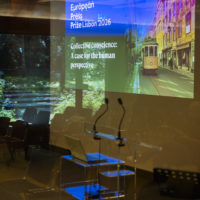
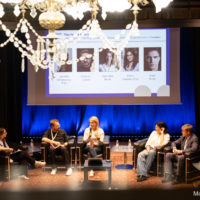
This was a core focus of an engaging keynote speech delivered by Veronika Munk – award-winning Hungarian journalist and member of the Preparatory Committee – at the European Press Prize 2026 in Lisbon.
For those who could not be there with us in Portugal, you can now read the full speech below.
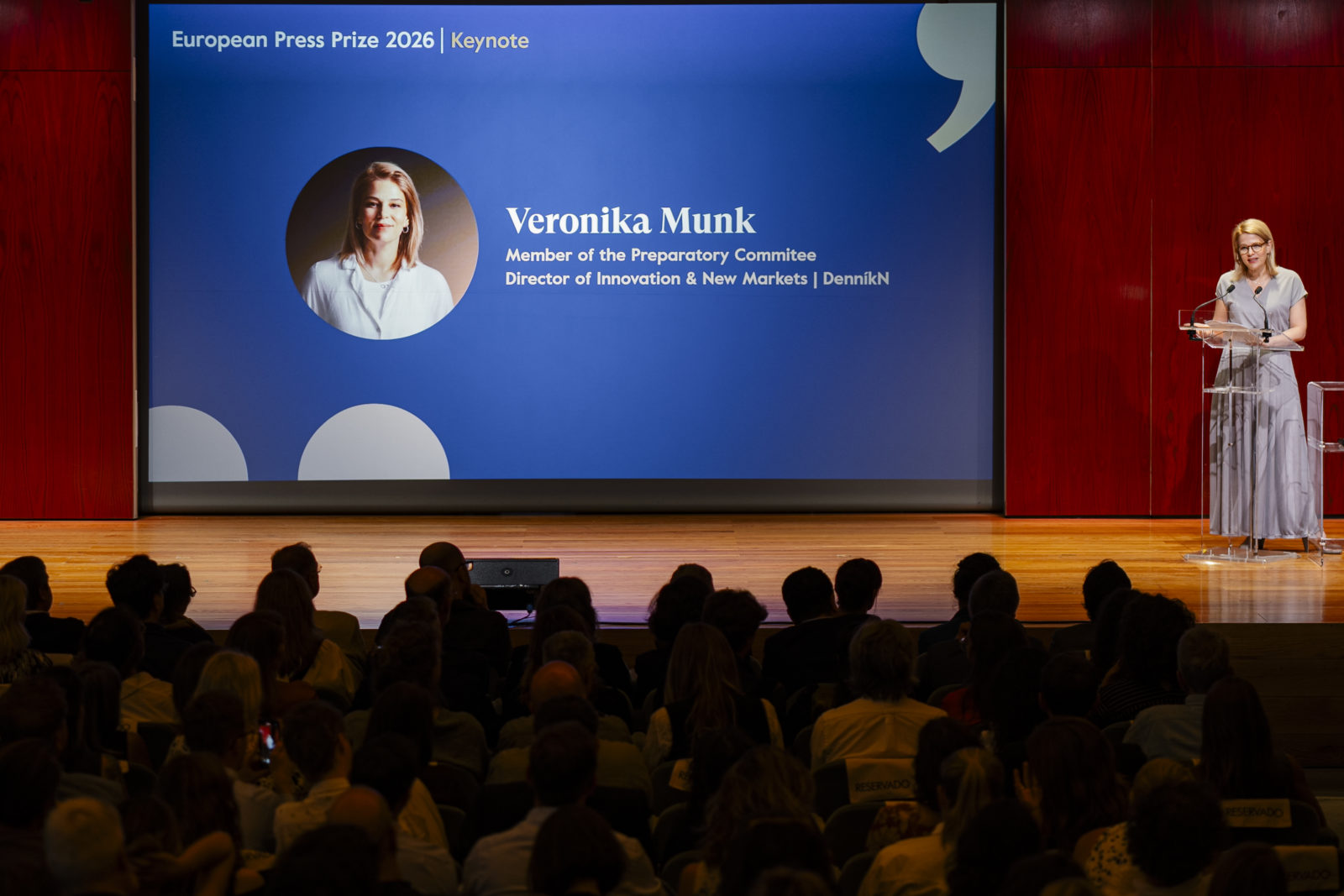
Photo: Bárbara Monteiro
Ladies and Gentlemen,
Dear colleagues,
Tonight, we celebrate quality journalism.
We celebrate the stories that are told best. The investigations that uncover abuses others wanted to keep hidden. The discovery and publication of facts. The vivid and powerful interpretation of our complex world. The innovative approaches that push the boundaries of journalism. And the outstanding work that portrays migration with nuance, humanity, and sensitivity.
We celebrate work that helps the members of our European community live more informed, wiser, and freer lives.
I grew up in Hungary.
Until my teenage years, I lived in a country where, under the communist regime, the idea of receiving information from a free press simply did not exist.
Perhaps that is why, after the democratic transition of 1989, and blessed with a somewhat stronger sense of justice than average, it felt completely natural to me that as an adult I wanted to be where things happen – and to tell those stories.
I wanted to understand how the world works.
And I wanted to help others understand it too.
I spent more than twenty years working as a journalist and editor in Hungary.
Sixteen of those years were spent during a period when the country’s leadership, headed by Viktor Orbán, used a wide range of tools to weaken critical voices, including the independent press.
In recent years, I have been working in Slovakia.
The situation there is not yet as severe as it became in Hungary, but the pattern feels familiar.
The Prime Minister labels journalists and newsrooms as enemies – including the newsroom where I work – while simultaneously seeking to reshape public media for political purposes.
And yet, they have not succeeded in silencing critical voices or quality journalism.
Hungary and Slovakia are not the first examples in history to demonstrate that when power seeks to silence criticism and independent reporting, excellent journalism still finds a way forward.
It finds new platforms.
It finds new formats.
And it finds the people who need it.
Our profession has a simple but essential task:
to show reality.
To make visible the people, problems, and connections without which a society cannot make free and informed decisions.
Independent journalism is not important because it can always change the course of history.
It is important because it documents history.
It preserves facts.
It bears witness to what is happening around us.
And in doing so, it allows communities to remember how they arrived where they are today.
That is especially important in times of profound political and social change.
We often speak these days about media and journalistic resilience.
But the truth is – and I say this from personal experience – that journalists do not actually want to be resilient.
We want to write good stories.
We want to ask important questions.
To uncover facts.
To explain.
To make complex realities understandable and engaging.
Just like the remarkable colleagues whose work has been recognised on the Longlist and Shortlist of the European Press Prize.
Each of them has served their readers.
They went where events were unfolding.
When they were pushed out through the door, they found another way in.
They became the extended eyes, ears, and voice of their audience.
They asked the questions that mattered.
That is the job of a good journalist.
And that is what serves democracy and free choice.
And perhaps that is why I believe that when we talk about resilience, we are not really talking about heroism.
We are not talking about whether we can survive one more attack, one more smear campaign, one more financial crisis.
Resilience is something quieter than that.
It is the ability to return to our fundamental task the next day, despite everything.
To ask questions.
To verify.
To listen.
To go to the field to talk to people.
To try to understand even those with whom we disagree.
And to rebuild our connection with people whose trust sometimes seems to be slipping away.
Because trust is born from consistent work, repeated day after day.
Trust is not created by communication campaigns.
It is a by-product of journalism itself.
People place their trust in us when they feel, once again, that we are there for them.
These values are also at the heart of the European Press Prize Community.
And this is why I believe the future of journalism lies in returning to its foundations – and applying those foundations in a changed world.
We go into the field.
We report.
We explain complex realities in language people can understand.
We remain persistent, even when we face strong headwinds.
We do not merely tell people what happened.
We help them understand why it happened and what its consequences may be.
At the same time, we also need smart and sustainable technology.
Technology that does not replace journalism, but helps bring it to audiences and supports a direct relationship between newsrooms and the people they serve.
Because ultimately, that relationship is what matters most.
And that relationship is exactly what we celebrate tonight.
Dear colleagues,
I would especially like to address those whose outstanding work was selected for the Shortlist from among more than eight hundred entries by the Preparatory Committee of the European Press Prize.
Thank you for helping to build a more informed, freer, and better Europe through your reporting.
Thank you for showing the entire European journalism community what excellence looks like.
Thank you for your curiosity, your perseverance, and your courage.
And thank you for reminding us, again and again, why journalism matters.
Congratulations to all of you on your nomination.
And thank you for your attention.