

Migration
Journalism
Award
My parents, my heroes


On April 30, 1975, almost exactly 50 years ago, the Vietnam War ended — with a traumatic defeat for the United States and a triumph for the Communists. The international protest movement of 1968 finally achieved its goal: peace through the withdrawal of the United States.
But for those in Vietnam who had believed in the US, in a democratic country, it was far from over. They suffered under the repression of the new regime, leading miserable lives in a country devastated by decades of war. Many fled. So did my family.
I wasn’t there — I was the seventh and last child, born only later in Austria. But of course, I have known my family’s escape story for as long as I can remember. It begins as early as 1954. That year, the war between the Vietnamese independence movement and the colonial power of France ended, with France withdrawing. The country was divided: in the north, the Communist part supported by China and the Soviet Union; in the south, the counterpart backed by the US. The Cold War at its purest.
My mother, still a child at the time, fled from the north to the south with her parents and siblings to escape Communist control. These were dark times, and soon the Vietnam War plunged the country back into violence. They settled on the coast in Phan Thiết and tried to build a new life. As best as they could.
The heavy fighting of 1968
The year 1968 stands out vividly in her memory. While people in Western countries tend to associate that year with Flower Power and student protests, in Vietnam the fighting was especially fierce then. To this day, when my mother sees something about war on the news, she is usually reminded of 1968.
She met and fell in love with my father while still in school — he was from the small fishing village of Phan Rí Cửa. They married and had children, but then he was drafted, and in 1972 was sent to fight in Phù Cát, in central Vietnam.
“The soldiers around me died one after another,” he would recall later. So, after two months, he deserted. He hid for two weeks on a ship that took him back home. There, he remained undiscovered until the end of the war.
In 1975, the Communist north triumphed, the US left the country. Those with good connections or financial means were flown out. The rest were left behind, with their dreams shattered — left in hunger and poverty, while the new regime sent hundreds of thousands to re-education camps where torture and death awaited.
Fear of another war
At that time, my father was a fisherman. He owned a boat with a crew of ten. My mother sold the fish at the village market; they managed to get by reasonably well. But fear was ever-present. What new repressions might come and strike them? And when would the next war begin, perhaps one in which their sons would be sent to fight? (In 1978 the Cambodian–Vietnamese War began, followed a year later by the Sino–Vietnamese War.)
Like many others, my family decided to flee. Escaping by land was hardly possible, so they tried by sea. In 1977 my father made a first attempt. The plan was that he would bring the family over later. But he was caught, and spent six months in prison. When asked what it was like there, he remains tight-lipped. Perhaps I do not really want to know.
The most stubborn man I know
My father is a stubborn man — perhaps the most stubborn person I know. In May 1979, a favorable opportunity arose and he tried again, this time with the entire family. With his boat and crew he waited near Saigon, which the Communists had by then renamed Ho Chi Minh City. We Hoangs still say Saigon, like many others.
The rest of the family — my mother and five children — took a bus from Phan Rí Cửa to Saigon. Relatives and friends came along as well. But at the agreed meeting point on the shore that night, there were far more people waiting than planned. Word of the escape had spread. My father tried to fit as many as possible aboard his ten- to twelve-meter fishing boat. He knew all too well that anyone caught would end up in prison.
In the end there were 138 people on board, including three pregnant women — one of them my mother. There wasn’t nearly enough space.
All those aboard thus became part of the so-called “Boat People” fleeing Vietnam by sea. In total, around 800,000 would reach another country; some estimates put the number at 1.5 million or even more. Another 200,000 to 600,000, the UN Refugee Agency (UNHCR) would later roughly estimate, did not survive the journey.
Without wanting to downplay anything — just for context: in the Mediterranean, which for years has been considered one of the world’s deadliest escape routes, the death rate has never even come close to that of the Boat People. No matter which numbers you consider.
Day five: everyone still alive
My family almost didn’t make it either. My mother, heavily pregnant with my youngest sister, was constantly nauseous. She could only lie down and could hardly eat the rice — the only food on board. On the second or third day, the other two pregnant women gave birth. Two healthy boys, who would later live in the US.
Then the Thai pirates came for the first time. They waited in the South China Sea for easy prey: the many Boat People who had taken their valuables with them. Armed with knives and rifles, they searched everything and took the little money, jewelry, and watches.
Only my mother was left alone. Attacking a pregnant woman is said to bring bad luck. My mother knew this, and was able to hide at least a little money under her clothes. It was also lucky, she says, that there were few women on board — it was said that pirates often abducted them.
When my mother talks about the escape, she usually does so in a matter-of-fact, almost emotionless manner. Perhaps that’s the only way; otherwise, it would overwhelm her. Since the escape 46 years ago, she hasn’t slept through a single night.
Thoughts of death during a typhoon
Day four at sea was particularly terrible: a huge typhoon approached. On board, says my devout mother, everyone prayed together — Christians, Buddhists, it didn’t matter. They cried a lot, thinking they would all end up dead in the sea.
On day five everyone was still alive, and a ship approached. They assumed help was coming and deliberately damaged their own boat so that the ship would have to rescue them and take them to a refugee camp. That’s what they’d been instructed to do before fleeing.
But it was Thai pirates again. Finding little to steal, they quickly moved on, leaving the now 140 people behind.
Now water was seeping into the boat through the hole they had made themselves. At the same time, the engine broke down, and another storm arose — though not as bad as the day before. Panic spread. Once again they saw themselves as corpses at the bottom of the sea. But my father and his crew calmed everyone down, patched the hole, and repaired the engine.
The boat must be destroyed
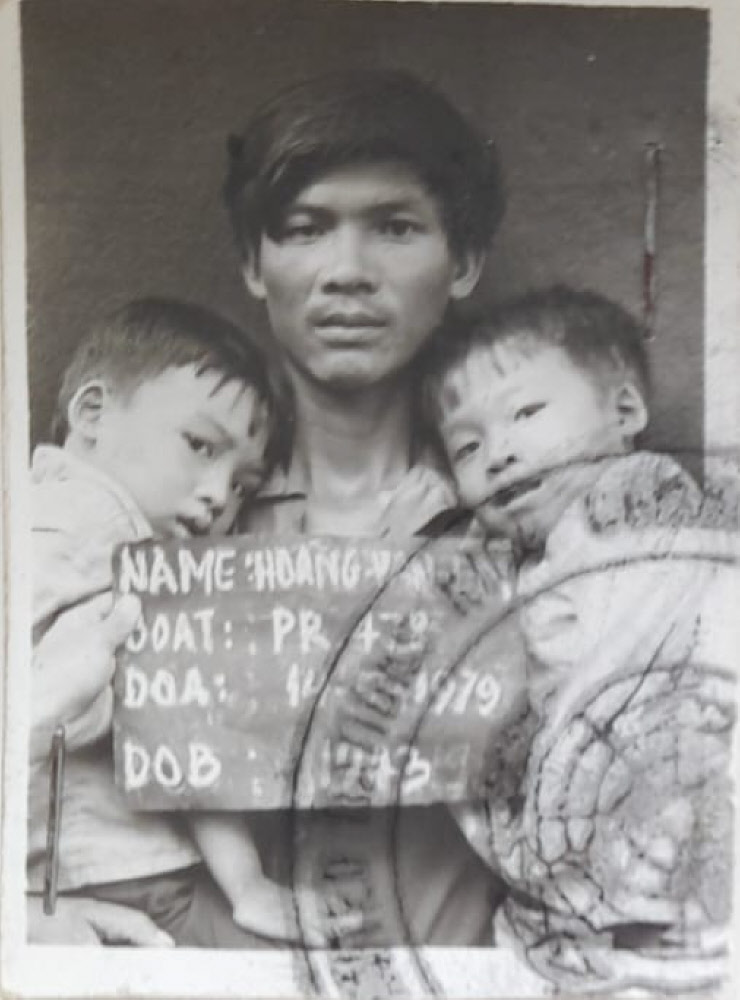
On the seventh day, at six in the morning, they spotted many lights in the distance: a refugee camp in Malaysia. At last, their destination. Two men swam ashore. There they were told that no more refugees could be taken in — they were already over capacity. They would have to sail on. Other refugees, also from Phan Rí Cửa, gave them a tip: destroy the boat. Then no one could send them away. And that’s exactly what they did.
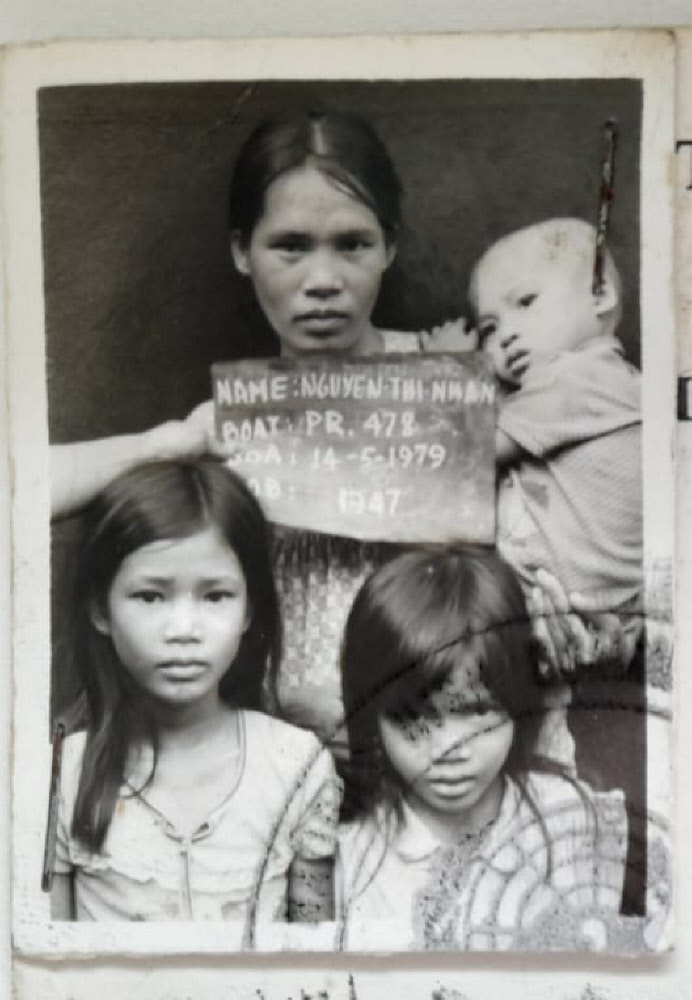
At that time, the Boat People were already unwelcome in the countries of the region — there were simply too many of them. Pulau Bidong, where my family arrived, is a small island of about two and a half square kilometers off Malaysia’s east coast. At its peak, including in 1979, around 40,000 refugees lived there — though it was designed for 4,500. I once read somewhere that, at the time, it was the most densely populated place on earth. That’s where my youngest sister was born, perfectly healthy. To this day I still find that hard to comprehend.
Shortly after their arrival in Pulau Bidong in July 1979, the UNHCR organized a conference in Geneva. The aim was to coordinate an international effort to care for the many Vietnamese Boat People. There was no question that they all had reasons for fleeing their country. The United States and other Western countries finally agreed to accept refugees for resettlement as part of the Orderly Departure Program (ODP).
Credit: Hoang
The “Hell Island” of Pulau Bidong
The conditions on Pulau Bidong were dreadful; residents called it “Hell Island.” Many babies and small children died, my mother says. She was terribly worried about my newborn sister and wanted to leave as quickly as possible.
Loudspeakers on the island constantly announced when resettlement places became available. Five spots for the US. Seven for Australia. Twelve for France. It sounded like a bizarre lottery.
My parents were asked where they wanted to go. They said Austria, because they had relatives already living there. My uncle and his family drew Switzerland. Other relatives ended up in the United States, in Arizona. Getting everyone into the same country was simply not possible on short notice.
After about four months on Pulau Bidong, in September 1979, it was finally time. At Kuala Lumpur airport, they waited for their flight to Vienna. There, a woman asked my mother, in full seriousness, whether she could buy the baby in her arms — my sister. You can imagine the answer.
In Austria, their first stop was the refugee camp Thalham, in St. Georgen im Attergau, Upper Austria. Then, parish communities across the country took care of the new arrivals, with help from Caritas as well. In my family’s case, it was the parish of Niederalm near Salzburg. Above all, it was the Novy family who remained at the side of the traumatized and utterly exhausted Hoangs.
Added to this was the culture shock, which of course also had its amusing sides. Among other things, my family wondered: that white stuff on the mountains — is it salt, or do Austrians wash their mountains with soap?
No Krampus — just to be safe
The Novys and other families arranged housing for my family and visited them in Thalham to get to know them better and to tell them they’d soon have a new home. But conditions in the camp were so dreadful that they spontaneously packed all eight Hoangs and two Vietnamese friends into their car and took them to live in their own house. Suddenly, sixteen people were living under the Novys’ roof instead of six.
Sleeping places were set up in the converted attic. The Novys and my family could only communicate with gestures, but they managed. For St. Nicholas Day, they left out the Krampus, just to be safe.
After two weeks, the Hoangs moved into accommodation provided by the Gollhofer family in Niederalm. One day later, my father was already working. The job market for fishermen in Austria was, of course, limited, so he found work in a carpet company’s warehouse. My siblings were quickly given places in kindergarten and school. I can’t even imagine what would have become of my family without all that support.
Then my mother became pregnant with me — it was unplanned, of course. Everyone in the family was shocked, my oldest sister later told me. The last thing they needed in that situation was another baby to take care of. But when I was born at the end of 1980, everyone was happy after all. Because I was so cute. At least that is what my eldest sister says. I am inclined to believe her.
Credit: Hoang
Too small, but it works
In 1982 we moved into a larger apartment in Salzburg. By Western standards, it was far too small for nine people, but we managed. It was a good life, though also hard and full of deprivation. Seven children to care for, a new culture to adapt to, a new language to learn, and a father doing completely different work. I only realized all this later — as a small child, I was just happy to always have someone to play with. And that I always got the most Christmas presents.
At home, my mother took care of everything, while my father worked. She also learned German and got her driver’s license. She organized life for this family of nine, while my father never seemed to really settle in. He only opened up when Vietnamese friends visited — then he was loud, cracking one joke after another. I always tell my wife I got my bad jokes from him (besides, they’re not bad at all).
We children soon spoke only German and integrated, while my parents mostly tried not to stand out. “Better to stay quiet, fit in,” was their motto. Maybe that’s why I liked to rebel and question authority — a quiet protest against that endless bowing and conforming.
That’s why, as a teenager, I clashed with my father more and more often. That changed when he suffered a stroke in 1998. He soon recovered physically, but was never quite the same. The fire in him, it seemed to me, was gone — and it only ever returns in Vietnam.
My father, the sheriff
We have held Austrian citizenship since 1986. We see Salzburg as our home. Only about my father I’m not so sure. Since Vietnam opened up in the early 1990s, my parents have occasionally flown back. And there, he transforms completely. The loud joker returns. “He’s like a sheriff,” my brother-in-law once said after seeing him in Vietnam — confident, taking charge. Just like before.
My parents were also in Vietnam when my youngest brother died in 2009 from a congenital heart defect — a father of two, only 31 years old. My mother had been pregnant with him when my father was in prison after the failed escape attempt. She says that her great fear for him caused my brother’s heart defect.
He had never made it back to Vietnam since the escape. Yet he had desperately wanted to show the country to his two sons when they were older. Whenever I think about it, a dull feeling creeps into my stomach. But it’s getting better.
Never truly left Vietnam
There, in Vietnam, during the few moments I shared with my father, I realized that in his mind he had never truly left that country. That he would have preferred to continue his simple fisherman’s life. And that he endured the escape and all the hardships that followed only to give us children a safe and better life.
All the children completed their education, all of them work, are well integrated and live relatively stable lives. Under those circumstances, that is an achievement that cannot be valued highly enough. We Hoangs often don’t even realize that.
Which reminds me — I’ve never thanked my parents for what they did for us.
Cám ơn. Thank you. For everything.