

Public
Discourse
Award
Unhappy, lonely, and unable to talk about it: Why men are losing friends


It took me a long time to admit to myself that I was lonely. I was always surrounded by people – friends, acquaintances, colleagues. What’s more, my work as a journalist gives me plenty of opportunities to meet and talk to people. It didn’t seem like loneliness, of all things, should ever be a threat to me. But it was.
Over time, I realised that it wasn’t the quantity of contacts that I was missing, but their quality. I missed something that had been completely normal while growing up.
I spent my childhood in a housing estate in the city of Martin, in Slovakia, and I was lucky to have a great group of guys around me. There were six of us and we would hang out almost every day. We could sit for hours on the stairs or in our basement gym, which also served as our clubhouse. We played hockey and basketball together in the parking lot, which was almost empty at the time. Today, there are so many cars there that you couldn’t even play hacky-sack or pogs.
We were also passionate about computer games, and even before the internet became a common feature in households, we connected our computers with cables so that we could communicate and play together. Some of the cables were stretched along lightning rods, so whenever a storm was approaching, we would disconnect them from our computers. It was silly and irresponsible – exactly the kind of thing teenagers do.
We built absolute trust and understanding between us. We no longer have to pretend in front of each other. We know how awkward we were in our youth and what blunders we made. We share a huge amount of private humour and funny memories, which we always recall when we meet and laugh about all over again.
Sadly, we almost completely stopped seeing each other.
Our story is not really original, and many people know it well. We scattered to different colleges and jobs, moved to different cities. Add to that the pandemic, our own families, health problems, the hustle and bustle of everyday life – and it’s understandable that old friends began to drift apart.
Of course, people find new friends, but some relationships cannot be easily replaced.
However, this article will not be just about loneliness. That was the starting point, but exploring it led me to other unpleasant discoveries. The result is a new perspective on the past and a reevaluation of priorities. I also gained a keen sensitivity to male weaknesses that I had completely overlooked in the past.

Illustration 2. Author – Midjourney, Filip Struhárik
Loneliness is as harmful as smoking
According to surveys, one in four people in Slovakia experience significant feelings of loneliness. This means that hundreds of thousands of people in our country alone are burdened by this feeling. We used to associate loneliness mainly with older people, but today it also affects younger ones.
A US study from last year showed that only 26 percent of men have six or more close friends, compared to 55 percent of men in 1990. In addition, up to 17 percent of men said they had no close friends – in 1990, it was only three percent.
Young men in the US spend almost 60 percent of their free time alone, which is more than retirees.
The loneliness epidemic has been the subject of public debate for some time. In 2023, US Surgeon General Vivek Murthy published a major study on the subject. In it, he warned that the negative effects of loneliness are comparable to those of tobacco or obesity.
The problem is also recognised elsewhere; the United Kingdom and Japan, for example, already have their own Ministers for loneliness.
Solitude and loneliness are not synonymous. A person can be surrounded by people and still feel lonely. On the other hand, someone can spend a lot of time alone and feel content.
The bottom line is that virtually all research shows that friends and healthy social relationships are one of the most important factors in happiness and health. Let’s mention at least a few of them:
- Loneliness is strongly associated with an increased risk of depression and anxiety.
- People experiencing chronic loneliness show increased levels of stress hormones, which can disrupt brain function and contribute to the development of mental disorders.
- A Swedish study from the 1990s already pointed out that strong social ties contribute to a reduced risk of heart attack or fatal ischemic heart disease.
- A large meta-analysis has shown that loneliness and social isolation are associated with a higher risk of mortality.
- In addition, loneliness significantly increases the risk of dementia to a degree comparable to physical inactivity or smoking.
- Lonely people also have a weaker immune response and greater inflammation compared to those who do not feel lonely.
- A lack of social contact can have as negative an impact on health as smoking 15 cigarettes a day.
In short, the more isolated and lonely you are, the unhappier you are and the more likely you are to die earlier.
Perhaps during check-ups doctors should not only ask patients whether they exercise, eat healthily, smoke, or drink alcohol, but also inquire about the quality of their social network.
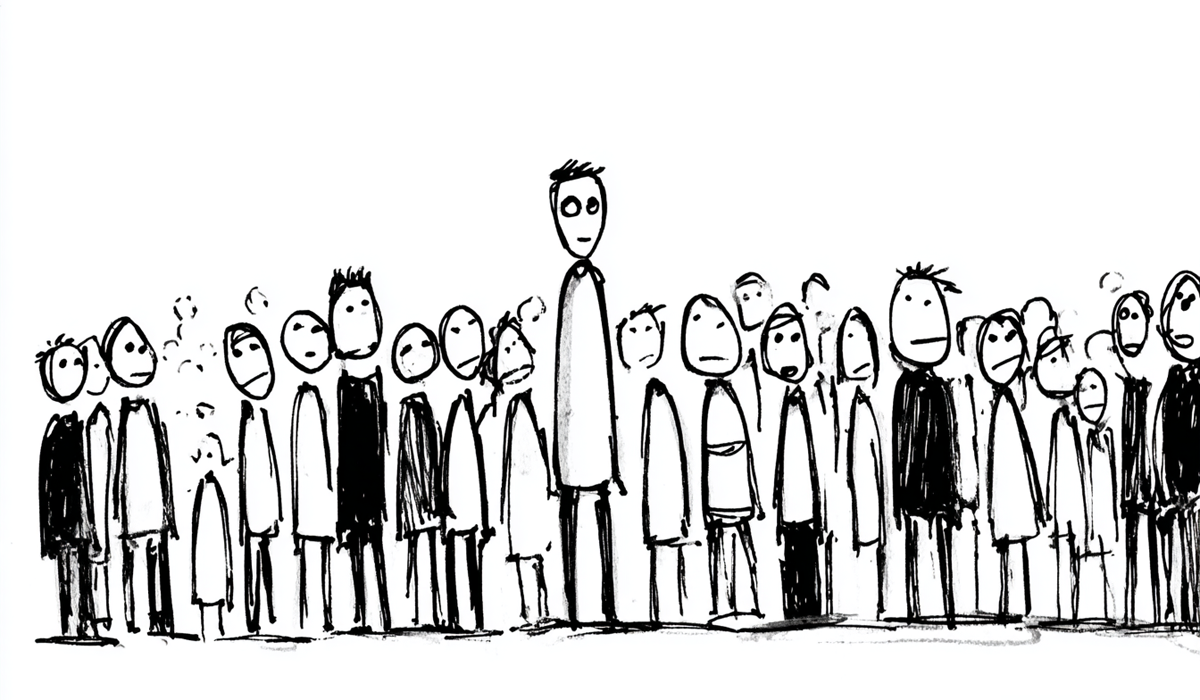
Illustration 3. Author – Midjourney, Filip Struhárik
The feminist who kicked me into action
At a time when I was beginning to realise my own loneliness, books by feminists helped me the most. Thanks to them, I understood some important things. For example, that my own loneliness is not just a personal failure, but may have deeper roots in how society shapes men.
Experts – or rather, female experts – warn that boys are raised differently than girls. “It starts when we equate emotion with weakness and direct boys to display strength no matter what. It shows up in the way we expect and encourage girls to show their true emotions while we demand that boys hide them from us. It reveals itself in the way we’re more comfortable with the image of a boy playing with a toy gun rather than a boy playing with a toy doll,” writes feminist and activist Liz Plank. Her book For the Love of Men became a gateway for me to topics and reflections I had completely missed until then.
Plank claims that we teach boys stoicism instead of authenticity and dominance instead of empathy. “Boys become fluent in emotional self-censorship. They become anaesthetised to feelings to avoid getting caught having any,” she writes.
Author and feminist bell hooks saw things similarly when she wrote The Will to Change: Men, Masculinity, and Love twenty years ago. In it, she claims that only one emotion is valued in men, and that is anger. “Real men get mad. And their madness, no matter how violent or violating, is deemed natural – a positive expression of patriarchal masculinity. Anger is the best hiding place for anybody seeking to conceal pain or anguish of spirit.”
One could argue that today’s parents instil different values in their children, but bell hooks is convinced that everything changes as soon as children start school. “Those rare boys who happen to live in anti-patriarchal homes learn early to lead a double life: at home they can feel and express and be; outside the home they must conform to the role of patriarchal boy. Patriarchal boys, like their adult counterparts, know the rules: they know they must not express feelings, with the exception of anger; that they must not do anything considered feminine or womanly,” hooks argues.
Professor of developmental psychology Niobe Way, who has been studying teenagers for almost 40 years, has come to similar conclusions. In her latest book, Rebels with a Cause, she describes how younger adolescents are not shy about talking about the need for close friends they love and with whom they can share their secrets. Boys also understand that close friendships are important for their mental health. They talk openly about the potential problems that could arise if they did not have such friendships.
However, as they get older, this changes, and boys begin to have difficulty finding and maintaining close friendships with men. “As the boys in my longitudinal studies became men, they began to sound like masculine stereotypes with their ‘I don’t care’ and ‘whatever’ responses to the very same questions concerning friendships about which only a year earlier they had cared deeply,” writes Way.
“As the boys in my studies reached middle to late adolescence, their language in their interviews began to shift from love and desire to frustration, anger, sadness, and/or simply indifference,” she adds in her book.
When talking about their friends, the boys also emphasise to researchers that it’s all “no homo”, because they fear that someone might label them as gay. They understand that in our society, close male friendships and displays of affection are often misinterpreted as signs of homosexuality.
Way writes that boys quickly recognise the cultural pressure to “act like a man” and not to behave in ways that others might consider “girlie and gay”.
One of the saddest moments when reading her book was when she quoted seventh grader Mark. When asked what was good about being a girl, he replied, “Maybe hanging out with your mum more.”
These words reveal the tragedy of traditional masculinity. A child of only 12 or 13 years old understood the unwritten rule that “real men” keep an emotional distance from their mothers, whom they still need very much.
Already as children, we learned to pretend that we don’t need each other. The saddest thing is that many of us believed it. We can’t even imagine how much we are losing.

Illustration 4. Author – Midjourney, Filip Struhárik
Loneliness as a male problem
These thoughts prompted me to analyse my own friendships. I won’t engage in public therapy here and describe the conclusions I came to. It will be more interesting if each reader reflects on their own and answers questions such as:
What did you talk about most with your friends? Could you talk about really important things together? What topics were taboo among your friends? What did you never talk about, even though it was important? Who could you talk to about your real feelings? Did you even have anyone like that? Do you remember ever crying in front of your mates? Was it okay to show such emotions in the group? Do you have someone to call in case of a crisis? Are there men in your life with whom you share your feelings?
Our daily experience and data show that female and male friendships are different. Almost half of women (48%) and less than a third of men (30%) had a private conversation with a friend in the past week during which they shared personal feelings, according to a 2021 American Perspectives Survey. In addition, men are much less likely to receive emotional support from friends. As many as 41 percent of women said they had received it in the past week, compared to only 21 percent of men.
Women are also more likely to tell their loved ones that they love them. Over the past week, 49 percent of women and 25 percent of men expressed such feelings. Men who also have female friends have an advantage. They are more likely to receive emotional support and share their personal feelings more often.
We teach women to be more caring and more relationship-oriented. We lead men in a different direction and then wonder why they lack certain skills in life.
“Men have fewer friends and less in-depth friendships and become increasingly isolated with age. Loneliness is a disproportionately male problem,” warns Liz Plank.
According to her, it is also risky for men to have a close relationship only with their partner, because this puts enormous pressure on them. “Sure, your partner should be a source of support, but if they are your exclusive source of assistance it can be problematic.”
This was well illustrated by a sketch from a 2021 Saturday Night Live comedy show, which depicted women taking their partners to a “man park” so they could meet other men. “It’s like a dog park, but for guys in relationships, so they can make friends and have an outlet besides their girlfriends and wives,” the video says. The absurd sketch became popular also because it was painfully true.
For some men, their partners have become their only emotional confidants. Often, they even take on all the social work in the relationship – organising meetings with loved ones, maintaining contact with family, planning social activities, and ensuring that their man does not end up completely isolated.
This is not just the case with our fathers’ generation. I myself have been in situations where women planned time for their partners and children. They organised for fathers to get moving and take their children to some activity together. Even in those rare moments when mothers could have time to themselves, they worked on the well-being of their partners and children.
This imbalance puts pressure on women, who, in addition to their own emotional needs, also have to deal with their partners’. This can lead to exhaustion and frustration. For men, this means that in the event of a relationship crisis or breakup, they suddenly lose their entire emotional support network, which further deepens their loneliness and vulnerability.
It appears that breakups can indeed have much greater consequences for men than for women. “While the woman may have other relationships she can rely on for support, her partner has often lost the sole source of support he had. Although the stereotype is that men take breakups much more lightly, men are more likely to suffer both physical and mental health issues and have suicidal thoughts than women after a breakup,” explains Plank.
We are reading ever more articles in the media about how many women have decided to be single by choice. Thanks to their greater independence, they no longer have to tolerate relationships that do not meet their needs. Moreover, according to a recent study by the University of Toronto, single women feel greater satisfaction with life than single men.
A recipe for disaster
I once heard this joke: Are men okay? You’ll probably never know, because they’ll never tell you.
Liz Plank is convinced that some men suffer from mental illness but are completely unaware of it. According to her, we teach men not to be emotional, not to feel anything, and to deal with everything on their own. But then we can’t be surprised when they can’t cope with something they’re not even supposed to feel. They can’t even understand or name it.
“The way we raise boys and men is a recipe for disaster. And a disaster it has become,” claims Plank.
We don’t have to be experts on gender issues to see that women have devoted a lot of time and intellectual effort to understanding how gender affects their lives. Men have clearly never been that concerned with this issue.
For a long time, we ignored the harmful impact of stereotypical masculinity on men themselves. There was no reason to worry – after all, men were promised that patriarchy would ensure their dominance. But they also dominate the statistics on loneliness, depression, and suicide.
However, it does not end there. Boys lag behind girls at school and are in the minority at universities. They face new obstacles in the labour market because it has changed, and typical male jobs are taking one hit after another. Men feel a cultural change that challenges their status, but they don’t know what to do about it.
Elites and politicians offer men no new agenda. The loudest voices are those promising a return to the good old days when men ruled everything. Toxic influencers and representatives of the manosphere promote such a plan – and they are very popular because many boys and men are truly suffering and desperately seeking guidance on how to move forward.
But the solutions to these challenges are not to be found in the past. It does not help to tell boys and men to “man up” or “toughen up”. On the contrary, such advice clearly harms them even more – or hurts the people around them.
“All this time we’ve focused on the changing role of women inside the workplace and inside the home, not realising that this would also shift men’s. We updated what it means to be a woman, but we didn’t update what it meant to be a man. We’ve had articles, books, entire conferences, dedicated to helping women navigate these new shifting roles while expecting men to figure it out all on their own,” writes Liz Plank.
According to her, the solution may lie in mindful masculinity. In practice, this means that men should discover what makes them good people. And they should get rid of harmful ideas about what it means to be a “real man”.
Research shows us that some male behaviours are not innate and immutable, but learned and changeable. The concept of mindful masculinity is about taking back control of ourselves. It is not about rejecting masculinity, but about expanding and enriching it with the full range of human possibilities.
According to bell hooks, feminism can help in the crisis of masculinity. “There needs to be more feminist work that specifically addresses males. They need feminist blueprints for change,” she wrote in her book. Men cannot change if they do not know how to do so.
The obstacle is that many men think feminism is irrelevant to them, if not even harmful. Since they only know it through media caricatures and extreme examples, they perceive it as something that labels them as “bad”. They have no idea how much some feminist ideas could help them.
The search for a new model of masculinity is not about men giving up their worldview. But when we see that they are no longer doing well in several senses, we must start looking for ways to improve their lives.
The troubles men face today were not caused by feminists, progressives, or some kind of insidious “woke movement”. All evidence suggests that they are caused by a culture that differentiates human abilities, interests, and behaviour based on gender and sexual orientation. The problems are caused by a society in which important human values and competencies are labelled as women’s issues that men do not need to concern themselves with.
Psychologist Niobe Way criticises the fact that today we mainly treat symptoms such as loneliness or mental illness, but we do not address the root cause. “Thus our solutions are not as effective as they could be if we focused on changing the culture rather than simply changing the individual,” she wrote in her book.
Illustration 5. Author – Midjourney, Filip Struhárik
It’s high time we talked about it
Feelings of loneliness have sometimes led me to question the quality of my friendships. After all, they don’t even text me to ask how I am. When they’re around, they don’t come to see me. When we finally meet after a year, we kill half an hour debating which Fast and Furious movie was the best (I had no idea there were so many).
I didn’t want to admit that I wasn’t the perfect friend either. I also didn’t get in touch very often; I didn’t show enough interest in their lives – and, most importantly, I didn’t tell them how I felt and didn’t try to revive our fading relationships.
It took me a long time to realise that I am the only one responsible for my needs, and therefore I cannot wait for someone else to take care of them. That friendship is not something you have, but something you do.
I remember writing to my childhood friends about how much it bothered me that we weren’t as close any more. It didn’t yield a miraculous turnaround for the better, but I now meet up with some of them regularly, and we have interesting and deep conversations again.
At the same time, I have developed other friendships, and today I realise that even short encounters with loved ones are often the best moments of the day.
I used to think that my problem was loneliness. Today, I am convinced that it is the way we learn to be men.
It is high time we talked more about this.