
Distinguished
Reporting
Award
One day in Gaza


12:00 a.m.
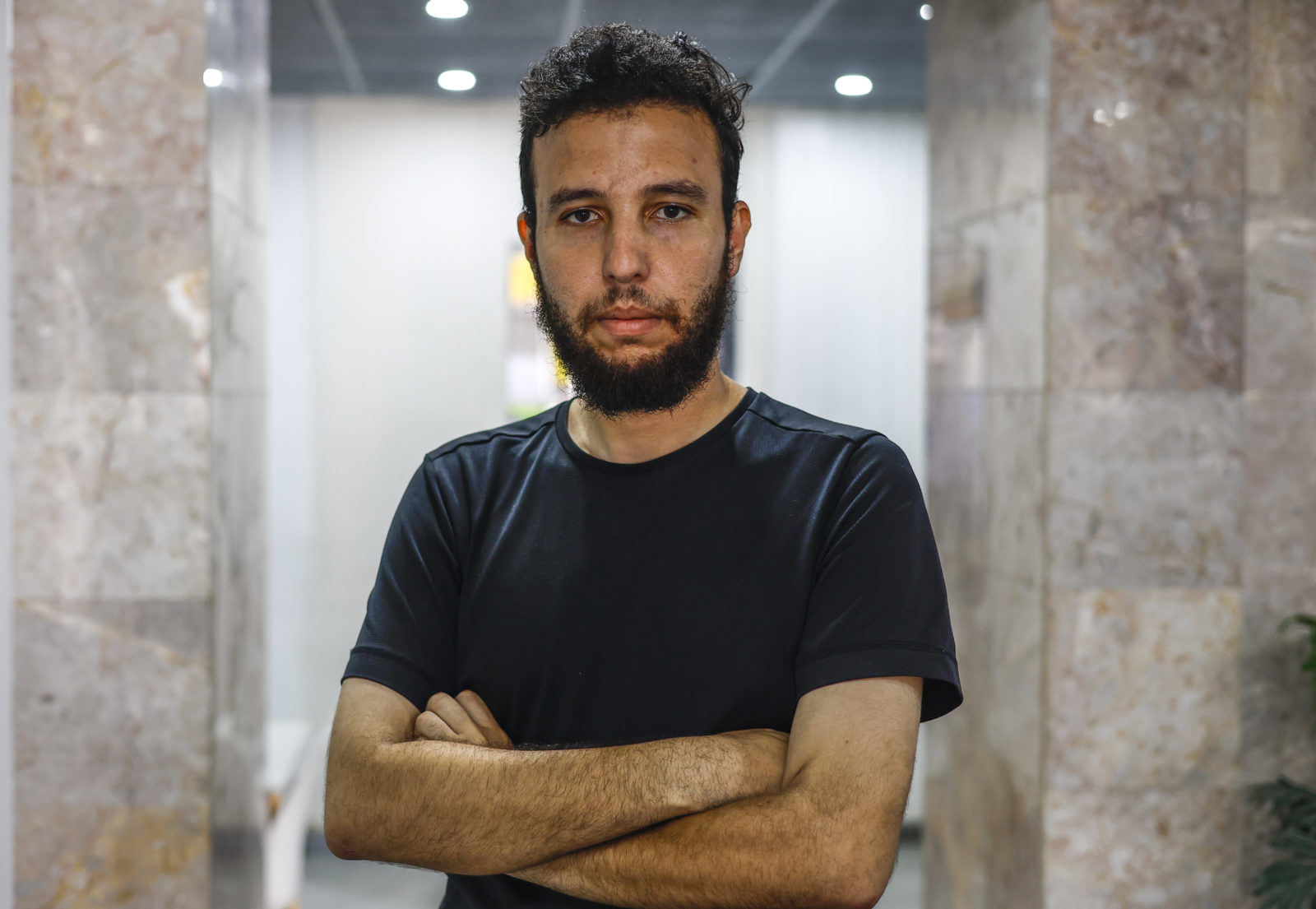
In the first minutes of the new day, Bashar Khattab arrives at his destination. The 18-year-old electrician has been walking through the darkness for two hours; now he reaches the bridge near the small town of Nuseirat, in the middle of the Gaza Strip, and sits down. A few hundred metres away, behind a checkpoint of the Israeli army, is a food distribution centre that will open in nine hours. Bashar hopes to get food for himself and his family there. He is not the first to wait; hundreds of people are already huddled along the embankment at the foot of the bridge, and hundreds more are still to come. The people have piled up a sand wall for protection, behind which they hide. They are repeatedly fired upon from the checkpoint. Strictly speaking, no one is allowed to stay here. But Bashar has learned from experience that only the fastest get any food. And from here, he doesn’t have far to go when the centre opens. Bashar will later send Die Zeit video footage of the waiting crowd. He will say that he leaned his back against the sand wall and tried to doze off a little.
2:00 a.m.
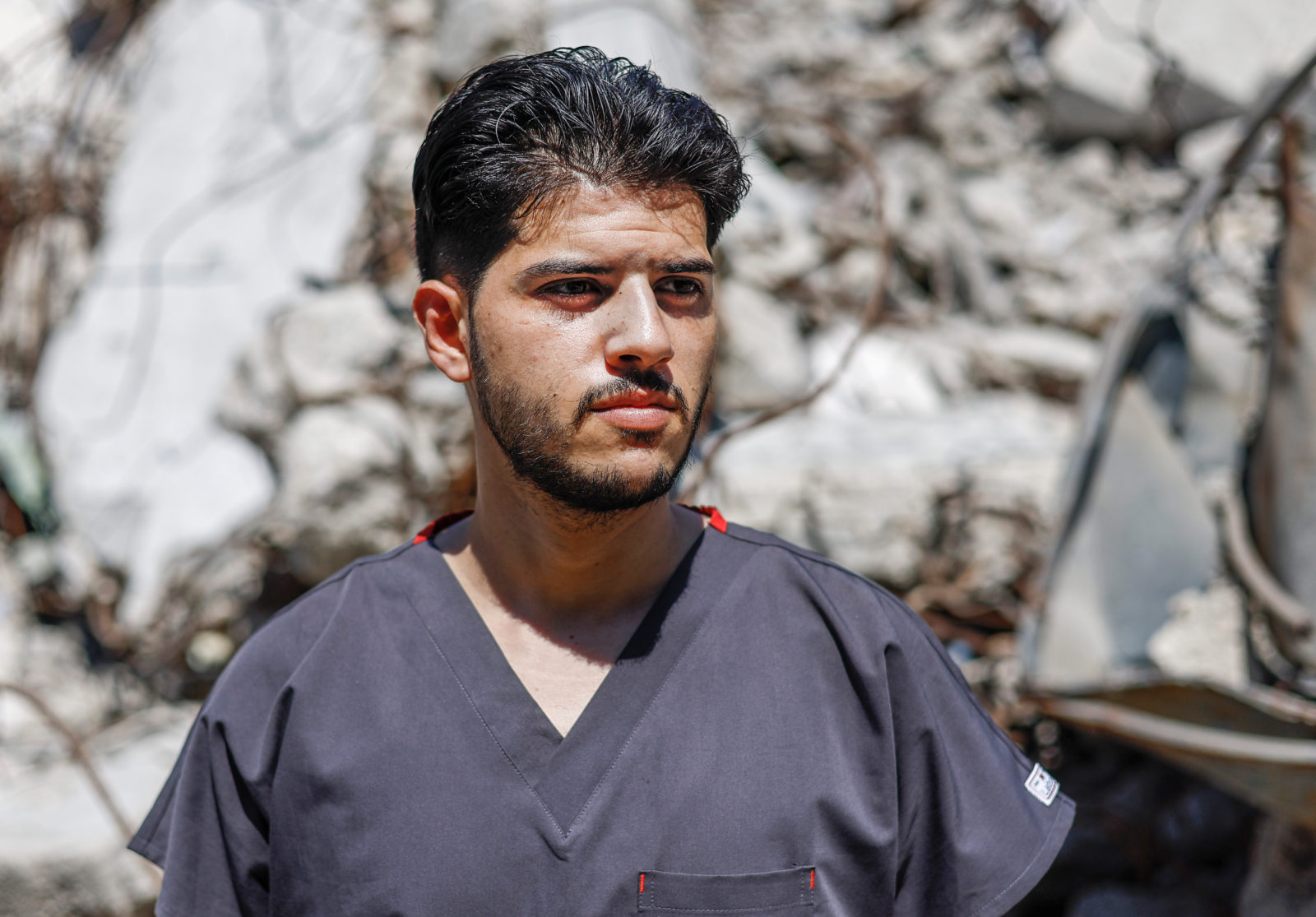
About three kilometres away, on the second floor of a house in Bureij, the town next to Nuseirat, an explosion rouses 23-year-old Jamil Mahmoud from his sleep. After a moment of disorientation, he stumbles outside, together with his sister and her two children. From the street, they see that the fifth, top floor of their house has been destroyed. That is where Jamil’s cousin and uncle live.
©Mahmoud Issa
Jamil Mahmoud will later tell Die Zeit that he immediately ran back into the house, up the stairs, smoke rushing toward him. He sees collapsed walls, smashed furniture, what he believes to be parts of a rocket. Then he finds his uncle, trapped under the bed, which was apparently knocked over by the blast wave from the explosion. His uncle is conscious but bleeding from a head wound. Jamil bandages it with a T-shirt lying on the floor. A little later, someone films his uncle being led out of the house in a daze, supported by several people. His upper body is bare; he has a cloth wrapped around his waist. Jamil Mahmoud stays upstairs on the fifth floor. He goes into the next room and sees a lifeless body. It is his cousin. He was 25 years old and due to get married next week.
5:00 a.m.
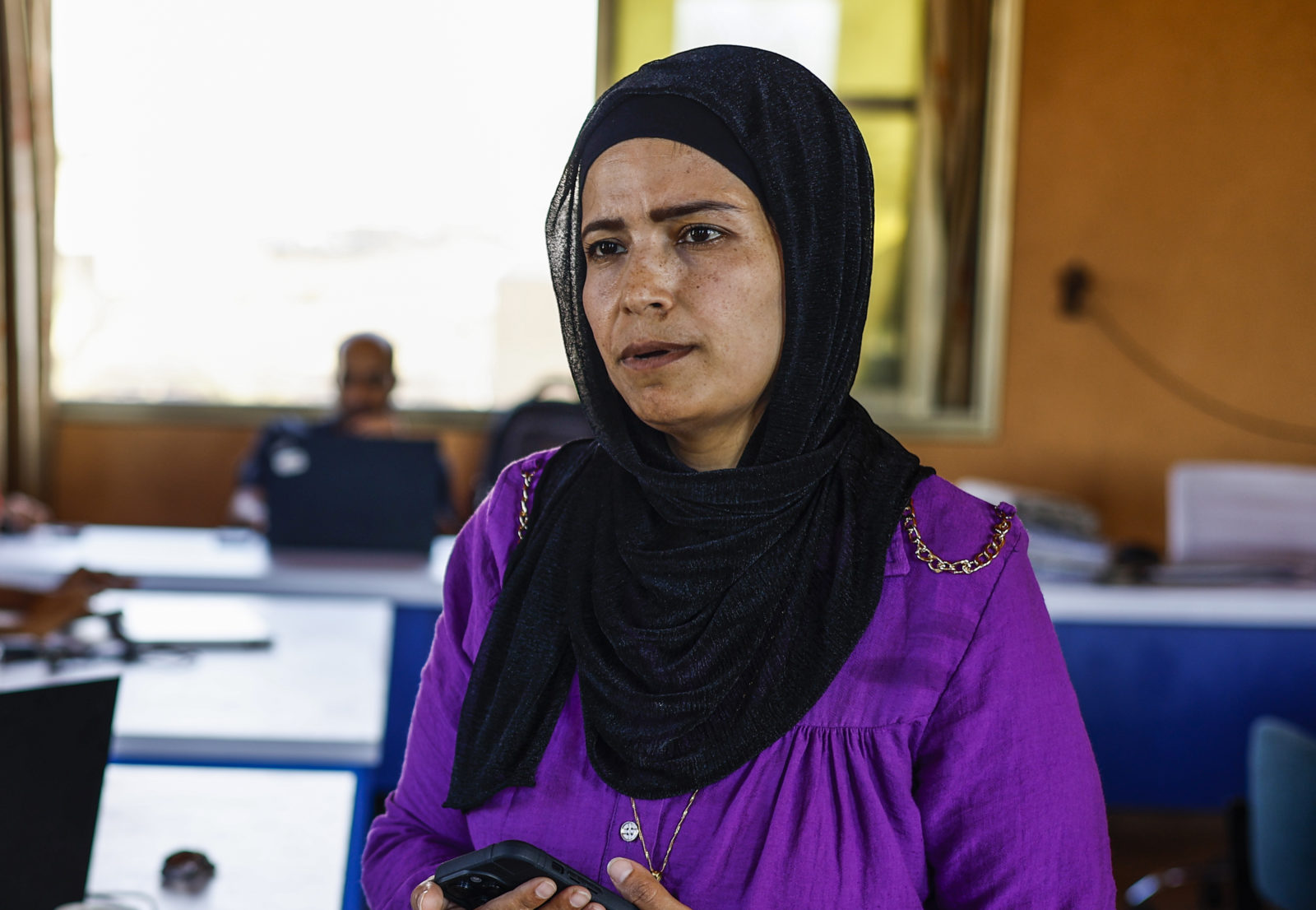
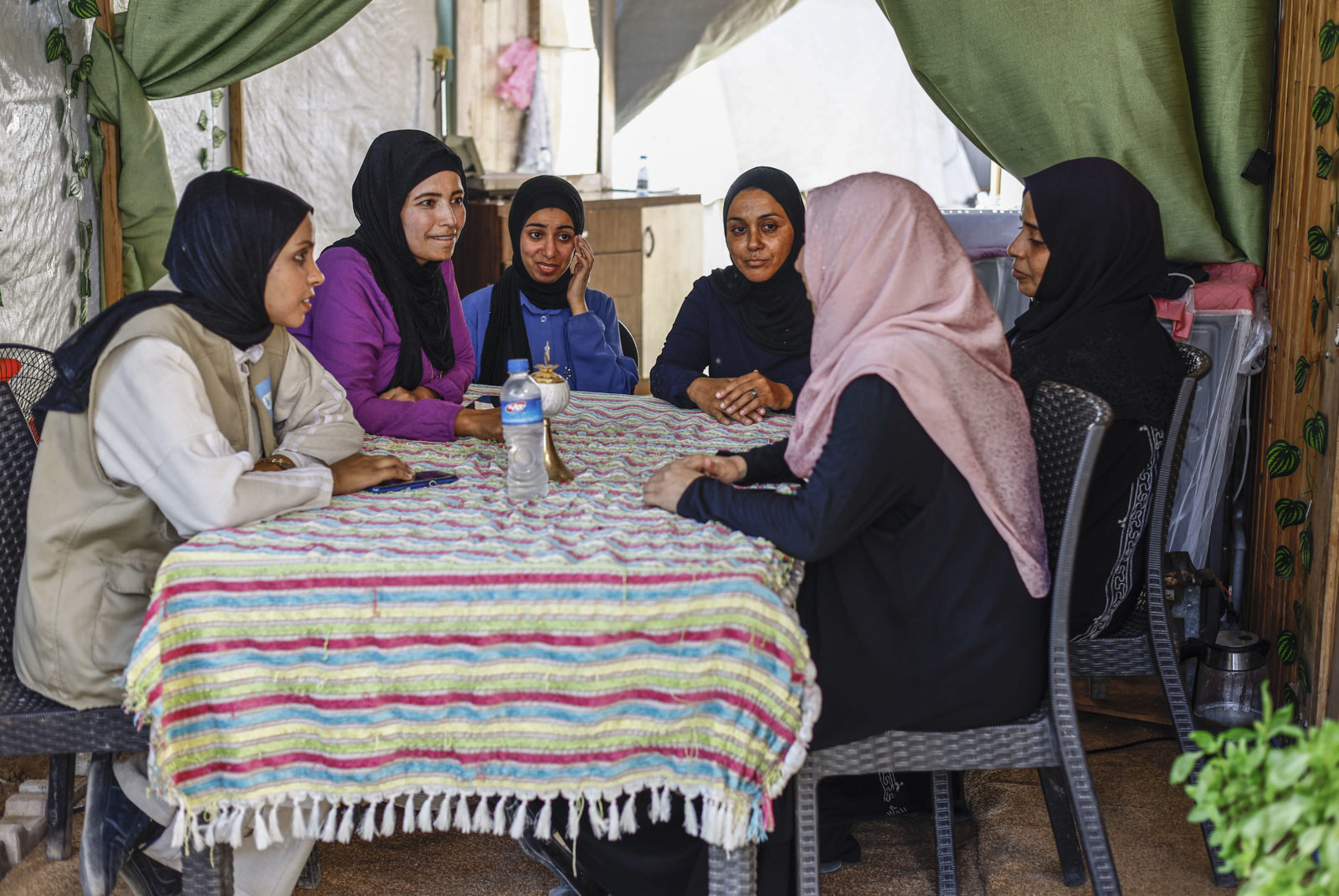
In Al-Mawasi, a small town in the south of the Gaza Strip, Reem Alreqeb, 37, steps out into the darkness. She lives in a fenced and guarded camp made up of tents and wooden trailers. This is where SOS Children’s Village has found a temporary refuge. It was originally located in Rafah, on the border with Egypt, but the town was almost completely destroyed by the Israeli army last year. Reem Alreqeb is the director of the village. Together with her team, she looks after sixty children and young people, most of them war orphans.
©Mahmoud Issa
This morning, they are saying goodbye to four girls and four boys between the ages of 16 and 18 who had been staying with them temporarily. Today, they are to be given the opportunity to do something almost impossible: leave the Gaza Strip. The teenagers have received scholarships for boarding schools in Bosnia, Tanzania, and South Africa. UNICEF vehicles will take them to Jordan, from where they will continue their journey. Reem Alreqeb hugs the girls goodbye and shakes hands with the boys. “As soon as they are in Jordan,” Reem Alreqeb will say later, “we will hopefully hear from them.”
©Mahmoud Issa
This dossier recounts the events of 10 September in the Gaza Strip, a completely normal, randomly chosen day in this war, described from the perspective of ordinary people: small business owners, students, mothers, pensioners.
Israel does not allow journalists to enter the Gaza Strip, at least not for independent reporting. It was therefore impossible for the authors of Die Zeit to get a picture of the situation on the ground. Instead, months ago they began establishing contact with people in the Gaza Strip. They accompanied these people remotely through 10 September by means of phone calls, video calls, text messages and voice notes.
Wherever possible, Die Zeit verified their accounts by making inquiries with the Israeli army and the Palestinian Red Crescent, conducting interviews with other eyewitnesses, reviewing photos and videos, and with the help of the Palestinian photographer Mahmoud Issa, who works for renowned agencies and visited some of the people featured here.
6:00 a.m.
In her flat in Gaza City, Alaa Albana, 33, has got up early, quietly so as not to wake her husband and their five children. The whole family sleeps in one room. Now Alaa Albana is mixing wheat flour, yeast, salt, and water into bread dough in the kitchen. There are no more bakeries in this part of town. Her son will take the dough outside in a moment. Some neighbours have built homemade clay ovens in which they bake bread over an open fire and earn a little money that way.
For several days now, since the bombing has become so intense, Alaa Albana says she has been unable to shake a thought: What if I am killed? That is why she is trying to teach her eldest daughter, Tala, everything she needs to know so that, in case of emergency, she can look after her younger siblings. Tala is twelve, and the day before yesterday she did homework for the first time on her own with her seven-year-old sister and her nine-year-old brother. She washed the youngest sibling, a three-year-old girl. Today, Alaa Albana has decided to show Tala the most important things in the household.
7:00 a.m.
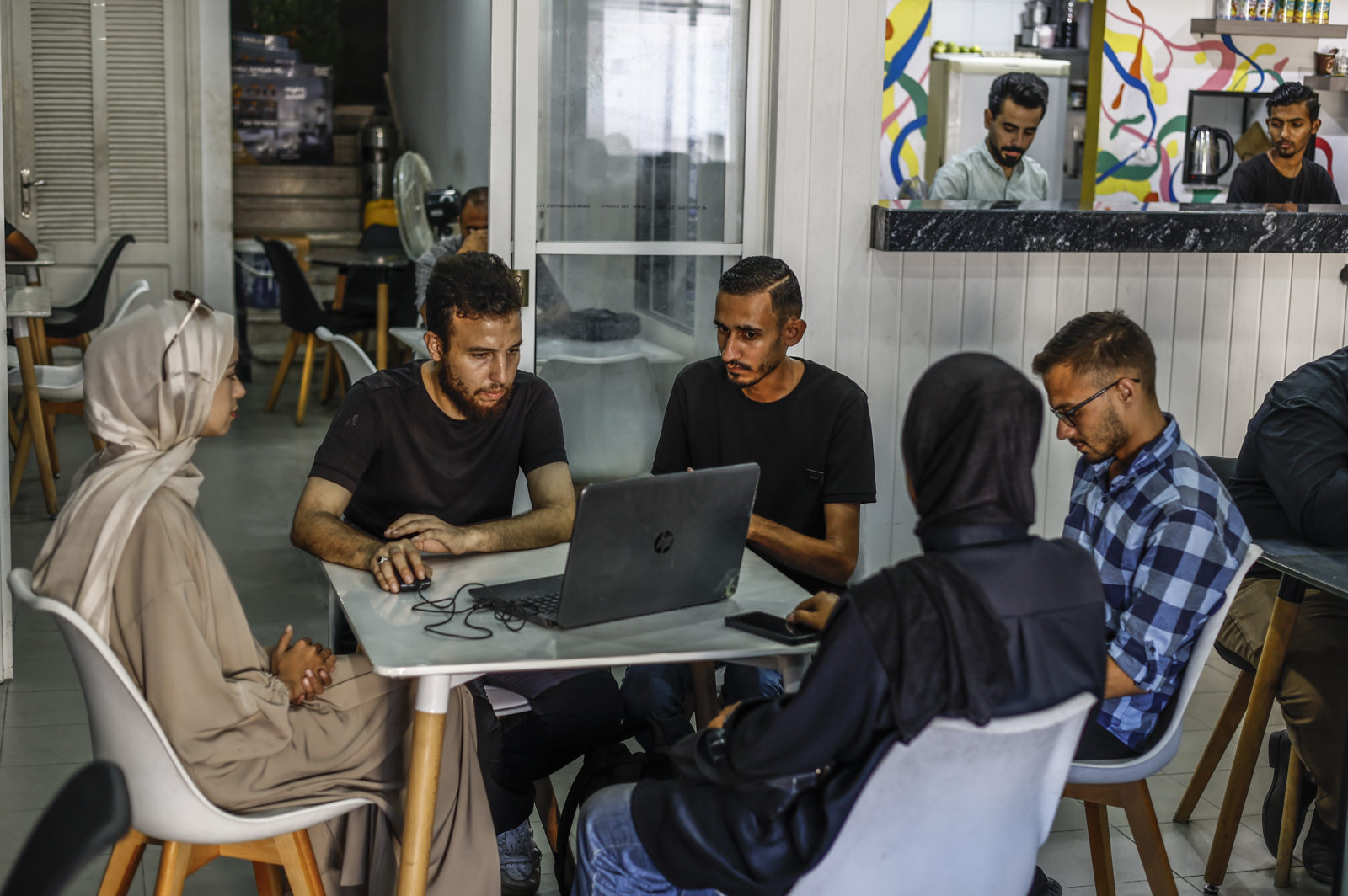
On Rimal Street in the centre of Gaza City, Rami Bolbol, 28, rolls up his mattress and unlocks the door to his internet café, where he also lives. It’s called Techno Time; he only opened it at the beginning of the year, during the brief ceasefire between Israel and Hamas. Bolbol says he put all his savings into the project. Through his phone camera, he shows Die Zeit the interior of the café: a large room with desks, walls painted in bright colours, a spotless floor, and a few potted plants.
©Mahmoud Issa
Rami Bolbol’s wife fled to Egypt at the beginning of the war. He wanted to follow her, but then the border was closed. When the power supply in Gaza City collapsed and almost no one had stable internet at home anymore, Rami Bolbol decided to open the café. Here, petrol-powered generators run all day. Bolbol charges the equivalent of two dollars per hour for internet use. Today, he already knows, it will be busy.
10 September, which was supposed to be a normal day, happened to be the day after the largest evacuation order of the war. On 9 September, the Israeli army dropped thousands of leaflets over Gaza City, where one million people live. They read: “To all residents of Gaza City. The Israeli forces are determined to destroy Hamas and will act with great severity in the Gaza City area, as they have already done in other parts of the Gaza Strip. For your safety, proceed immediately to the humanitarian zone in Al-Mawasi. It is extremely dangerous to remain in this area.”
8:00 a.m.
In their flat in Gaza City, Shorouq Elgherbawi, 32, and her husband have already begun packing. Early tomorrow morning, a lorry will come to take them and their three children to the south of the Gaza Strip, to Al-Mawasi, as ordered by the Israeli army. Shorouq Elgherbawi and her husband have the possibility of renting a tiny plot of land there. But they still need a tent to live in, which they plan to get today. Now they are filming themselves dismantling their furniture. The video shows cupboard panels, drawers and doors lying scattered on the floor.
They chop up the furniture that doesn’t fit on the truck bed into firewood, which they will also take with them. Their one-and-a-half-year-old daughter toddles across the screen in a watermelon dress. The three-year-old throws a board onto a pile of wood. The five-year-old bangs on a piece of wood with a hammer. Behind him, you can see down to the street; the outer wall is missing.
The five-year-old: “Are we leaving Gaza City?”
The mother: “Yes, we’re leaving.”
The five-year-old: “Why?”
The mother: “Because it’s become dangerous, there is bombing. Didn’t you hear today how much bombing there was? We’re going somewhere far away.”
The three-year-old: “There’s the sea.”
The mother: “Do you want to stay here in Gaza City?”
The three-year-old: “Yes.”
The mother: “Hopefully we’ll come back. Say: ‘Hopefully we’ll come back!’”
The three-year-old: “Hopefully we’ll come back!”
9:00 a.m.
Bashar Khattab has been sitting under the bridge for nine hours now. Suddenly there is a loud bang, the signal for those waiting: the distribution centre has opened. Hundreds of people start running up the embankment and onto the street. They stream into the fenced-off area, whose gate is now open. Behind it are packages. People rush over, tear them open, and take whatever they can carry. Bashar grabs something from the ground. Three packs of lentils, three packs of macaroni, five packs of flour. With the parcels in his arms, he runs back.
Fifteen kilometres away, in Rami Bolbol’s internet café in Gaza City, around the same time about fifty schoolgirls and female students arrive. They sit down at the tables, some open their laptops, others connect their cell phones to the Wi-Fi. Some are taking their high school exams; others their university exams.
Rami Bolbol decided long ago to allow exclusively girls and women into his café. With men, he says, you never know whether the Israeli army might accuse them of having ties to Hamas. He hopes this will reduce the risk of an attack.
Bolbol has actually agreed with his wife in Cairo that he will leave the city as soon as the Israeli army asks him to. The income from his café affords him privileges that few people in Gaza City have. As a precaution, Bolbol has rented a basement in the south of the Gaza Strip where he can store the tables, chairs, and cabinets from the café. He has also arranged two lorries for the move. Now that the leaflets have been dropped, he should really call the drivers. But he doesn’t. At least today, he wants to stay and keep the café open. How else are the schoolgirls and students who are now sitting at their laptops supposed to take their exams?
For the young women, today will determine whether they are allowed to study or admitted to the next academic year. It is the first time since the beginning of the war that exams are being held again. This time digitally, as most schools have been destroyed. Classes have also been held online in recent months. Rami Bolbol will later say that many of the women were visibly nervous. Bolbol checks the internet connection and makes sure the generators are running.
10:00 a.m.
The 23-year-old medical student Nour Nofal is standing in operating room 6 of Nasser Hospital in the city of Khan Yunis, the largest clinic in the southern Gaza Strip. Nour is in her sixth year of study and today she is assisting the surgeon. Nour Nofal later reports that a large man was lying on his stomach on the operating table. She estimates him to be around his mid-thirties. The man has a gunshot wound to his lower back. Nour Nofal cannot say exactly where the injury came from, but as she understands it, he was shot a few days ago while queuing for food. The bullet pierced two lumbar vertebrae. Nour Nofal hands the surgeon the instruments; she is the only woman in the operating room. Today, she is also allowed to insert a screw, which she is doing for only the second time. Later, she says that during the operation a fly landed on the surgeon’s glove. “A fly in the operating room – that’s not acceptable!”
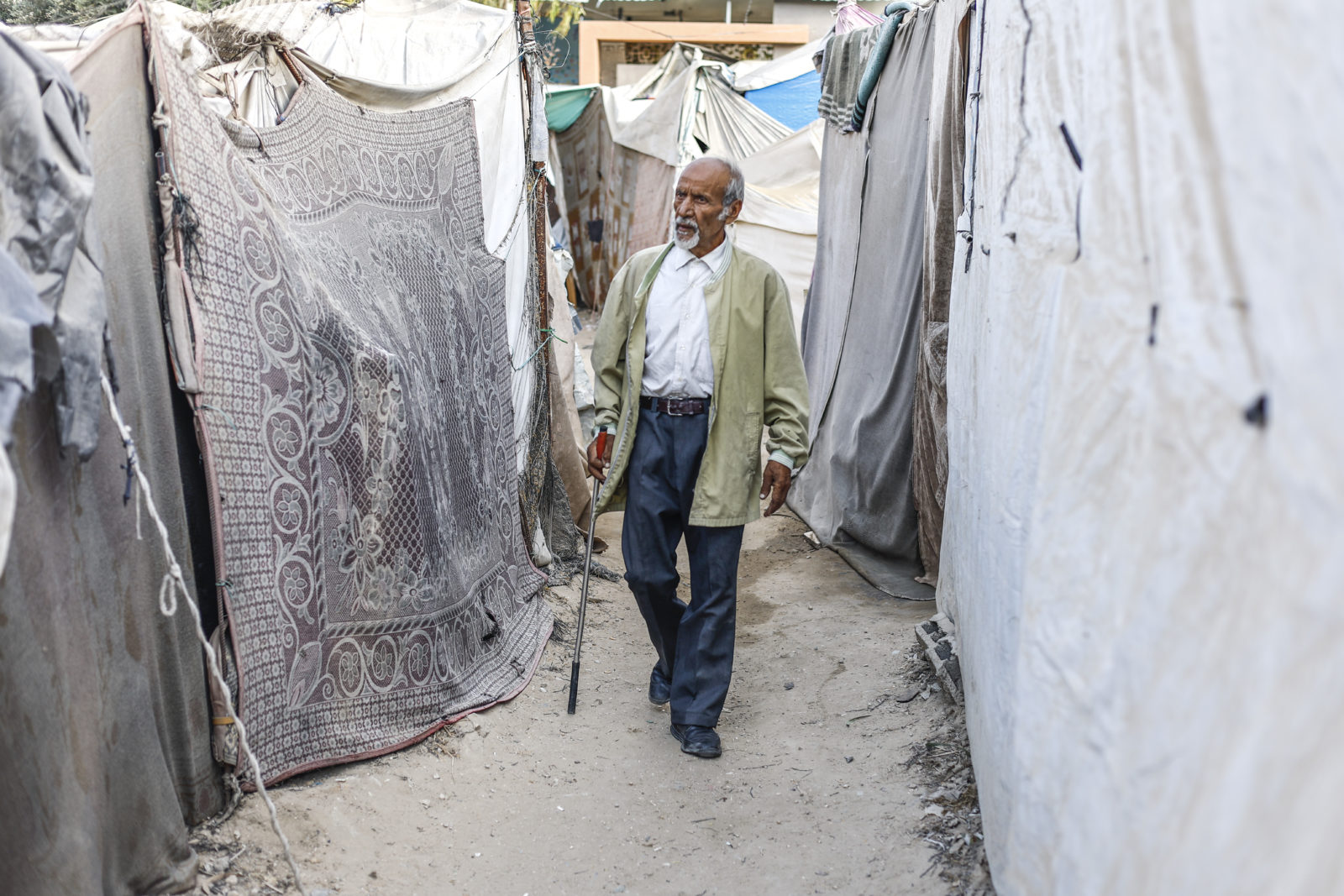
While Nour Nofal is operating in Khan Yunis, twenty kilometres to the north, near the small town of Nuseirat, Mohammed Khattab is standing on the street. He is wearing a light blue shirt, has a Palestinian scarf wrapped around his head, and is leaning on a crutch.
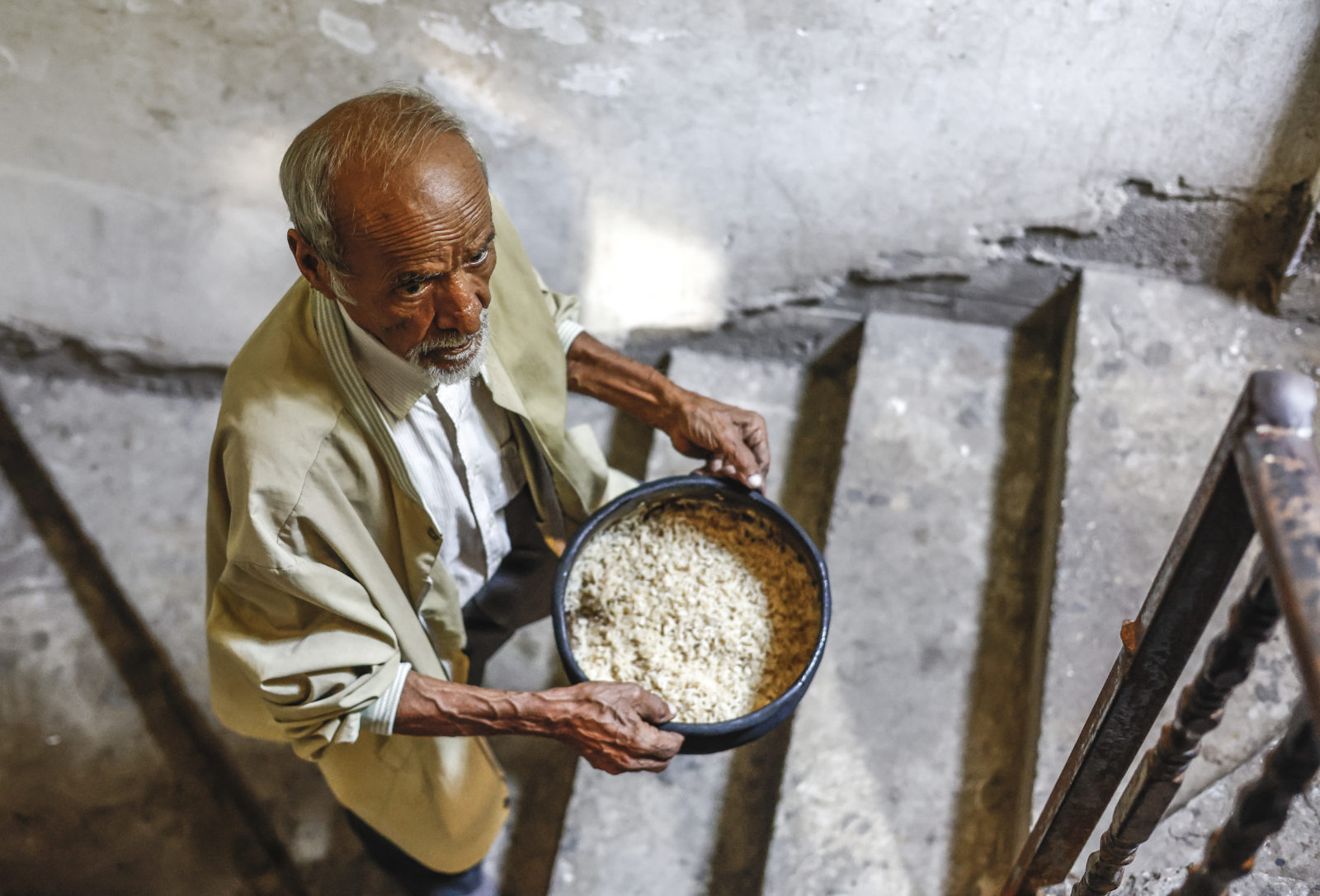
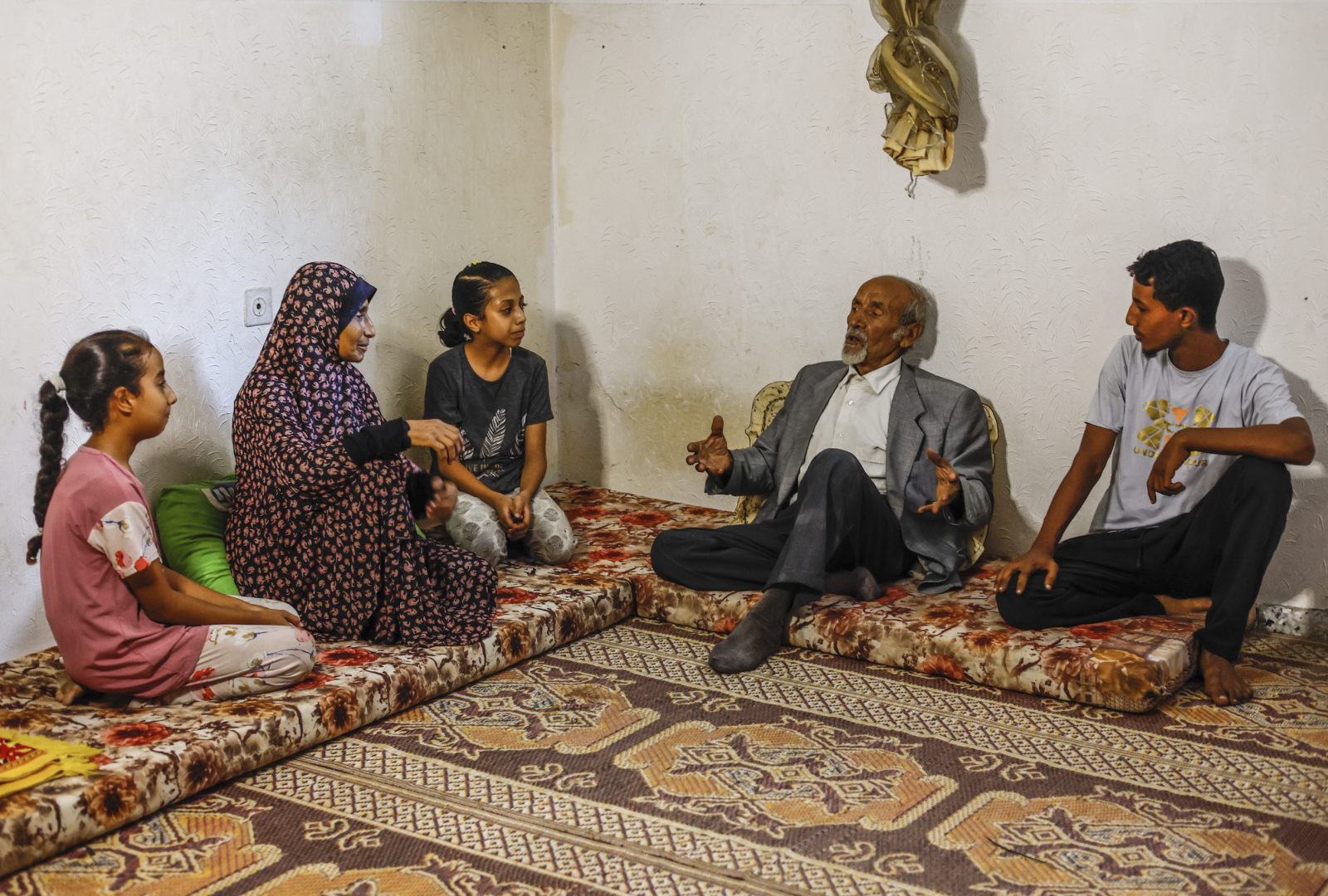
Khattab is 80 years old and has a grey beard. He is the father of Bashar Khattab, who waited under the bridge for nine hours that night until the distribution centre opened. The father is not sure whether his son was there, but he suspects so – and he is angry. Bashar had already been to the distribution centre the day before and came back completely distraught. He said he had been robbed and that one of his best friends had been shot and killed.
Mohammed Khattab forbade his son from going back to the food distribution centre. Apparently, Bashar did not obey. Now the father has come to a street corner to look for his son. Bashar should pass by here on his way back from the distribution centre. Mohammed Khattab is with one of his daughters, 21 years old, who is filming him standing on the street. In the video, he calls the food distribution centre the “death distribution centre.”
©Mahmoud Issa
Bashar’s friend is not the only person to have been killed while waiting for food. On 10 September alone, at least nine people are reported to have been killed near the distribution centres in the Gaza Strip, as the Palestinian Ministry of Health was later to report. According to UN figures, between the end of May and the beginning of August 860 Palestinians were killed while searching for food.
Mohammed Khattab sees people returning from the distribution centre with large white sacks. Most are walking, some are sitting on carts pulled by donkeys. Some of the passers-by greet him; Mohammed Khattab is a well-known man in this area. He is a professor of medicine who studied and worked in Germany, in Düsseldorf and Bochum. He has been back in the Gaza Strip since 1995. He does not see his son Bashar.
A few kilometres away, a body is being carried through the streets of Bureij, wrapped in a white cloth. It is the body of Jamil Mahmoud’s cousin, who was killed early in the morning on the fifth floor of his house. Family, friends, and neighbours have gathered; dozens of people sing and shout “Allahu Akbar.” Jamil’s uncle, the father of the deceased, is also there. In videos of the funeral procession, he can be seen with crutches and a bandage around his head.
The cemetery, located just outside the city, is in a so-called “red zone,” a restricted area controlled by the Israeli army. Anyone who enters such a zone risks being shot without warning. Most of the people in the funeral procession stay behind, but Jamil Mahmoud and about twenty others continue on. They bury the cousin next to an oleander bush. Later, Jamil will send a photo of the grave and say that after the funeral he told his dead cousin: “Go to my brother and tell him that Jamil misses him.” His brother was killed in June last year, says Jamil Mahmoud, also in an attack by the Israeli army. At the funeral, his cousin was still standing next to him.
11:00 a.m.
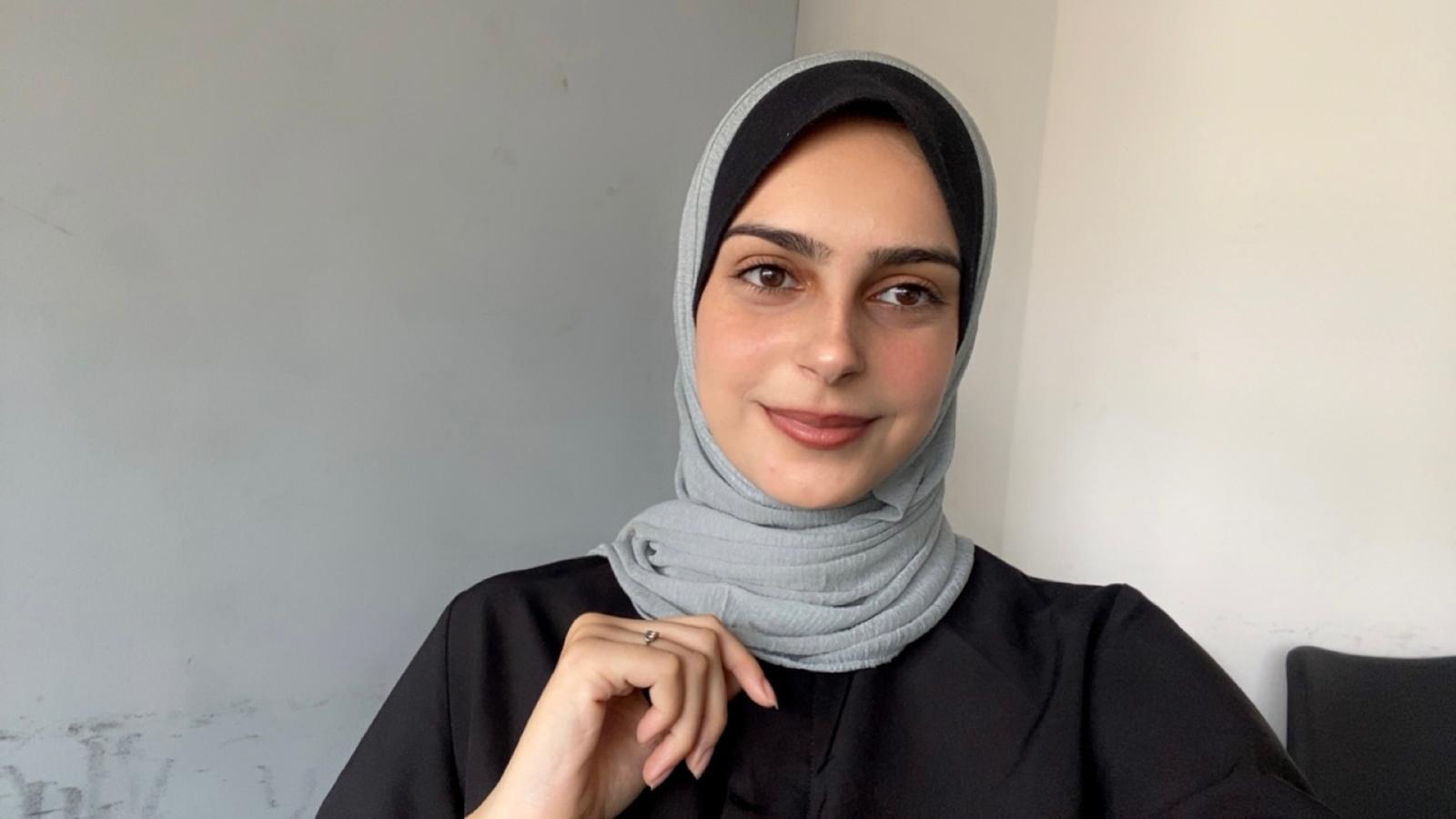
In Rami Bolbol’s internet café, Malak Lafi, 19, is sitting her final exam for her first year at university. Multimedia Studies. Actually, she will say later, this is how she imagined studying would be: first a coffee in the morning, then taking the bus to class. But there is no longer a lecture hall; the university has been destroyed. Malak studies at home or in the internet café, watching videos that her professors send her – recordings in which you can sometimes hear a bomb going off in the background. Or she experiences moments like this: “You’re watching a lecture, you think the professor is great, you love the course, and then you get a message that she was killed in an Israeli attack.” Malak Lafi has studied a lot in the past few weeks; her exam will last three hours. She is due to receive the results later today.
©private
In Al-Mawasi, Mahmoud al-Shaer, 35, watches the long line of refugees. Al-Shaer is a writer. Before the war, he ran two cultural centres, one in Rafah and one in Gaza City, both of which have been destroyed. Now he lives in Al-Mawasi, in the south of the Gaza Strip. This is where, according to the leaflets distributed by the Israeli army, people from the north are supposed to flee to. Al-Shaer sees the road clogged with lorries, cars, and donkey carts. In a video call, he says that friends from Gaza City have been calling him all morning, asking if he can help them find a place to stay. He starts making phone calls.
12:00 p.m.
Mohammed Khattab, Bashar Khattab’s elderly father, has been waiting in vain at the street corner for two hours. Now he comes home and sees packs of lentils, macaroni, and flour on the table. Bashar is back, then – he must have taken a different route home. The father finds his son asleep on a mattress. “I can’t describe how relieved I was that nothing had happened to him,” the father says on the phone in German. “I tell my children that they mustn’t go there anymore. It is completely forbidden.”
©Mahmoud Issa
In the internet café, Rami Bolbol is on the phone with his business partner. They are discussing whether they should close the café and flee. They wonder if they will ever be able to return to Gaza City. Gaza City is Rami’s home. This internet café, he later tells Die Zeit, is his workplace, his source of income, his creation. Bolbol says he has hardly left the café in three months. “I wouldn’t just be leaving my dream behind. I would be leaving Rami behind,” he says.
On the call, Bolbol and his partner settle on a compromise. The day after tomorrow, they plan to move half of the furniture to the basement in the south that Bolbol has rented. For the time being, they themselves will remain in Gaza City with the rest of the furnishings.
After three hours, medical student Nour Nofal leaves the operating room in Khan Yunis. In the end, she was even allowed to suture the wound. The patient survived, but he will never be able to walk again. Now, during her lunch break, she says on the phone that during the operation she forgot the worries with which the day had begun. Nour Nofal lives with her family in a tent not far from the clinic. The tent belongs to a man from Gaza City. This man wrote to her saying that he might have to follow the Israeli army’s orders and leave the city. In that case, he would need the tent for himself.
If that happens, Nour Nofal would have to find new accommodation for herself, her parents, and her three sisters with their children. She plans to call the man after work.
1:00 p.m.
Alaa Albana, the mother who is trying to prepare her twelve-year-old daughter Tala to take care of the family in an emergency, is standing on the roof of her house in Gaza City. She is cooking lunch on an open fire. Tala helps her, adding wood and seasoning the soup with salt, onion powder, and chili. She sets the table.
Jamil Mahmoud’s family has returned from his cousin’s funeral. While his mother makes coffee for the mourners in the kitchen, Jamil sits in the bedroom and says on the phone that the funeral was difficult to bear. Just two days ago, he had talked to his cousin about his planned wedding. His cousin had been very excited and joked, “Jamil, don’t make any other plans for that day.”
After the phone call, Jamil’s mother comes into the room and asks him to fetch some firewood so she can cook lunch. Later, Jamil Mahmoud sends a video showing him chopping the family’s old red-and-gold lacquered television cabinet into small, burnable pieces with an axe. His mother cooks a stew for the mourners.
2:00 p.m.
In the internet café in Gaza City, it is very quiet. Everyone is concentrating on their exams. Suddenly, there is a loud bang and the walls shake; a rocket has struck somewhere nearby. The students stand up and go to the window. Rami Bolbol later finds a photo of the impact on social media. It shows a column of black smoke about 500 metres from his café. The young women sit back down at their tables. “It doesn’t affect us anymore. We’ve lost that feeling,” Bolbol says on the phone.
©Mahmoud Issa
Malak Lafi finishes her exam. Despite the generators, the internet went briefly down twice, but she was able to complete all the tasks. Now she is waiting for the results.
3:00 p.m.
In Gaza City, Ali al-Joujou, 39, sits in the place where he says he can still be himself. A photo shows him in a small room lined with chipboard. It is the warehouse of a music store. Guitars and Arabic string instruments hang on the walls. In the middle is a keyboard with a laptop on top.
Ali al-Joujou is a music producer. Before the war, he wrote music for films and commercials in the United Arab Emirates and Jordan. He had a studio and his own equipment. He says it has all been destroyed.
Since then, he has been recording music in this room. Last night, for example, he recorded a song he wrote, sung by a friend. Now he is busy mixing it on his laptop. Al-Joujou says he just needs to open his laptop, plug in the sound card, and he feels better. “When I’m working, I’m happy for a moment. The rest of the time, I’m like a zombie.”
In his song, Ali al-Joujou wrote:
“I am in pain, even though the tears have dried.
The pain is still there.
Longing burns in my heart.
I wait for the morning to break.”
4:00 p.m.
Jamil Mahmoud’s father complains of chest pains. Jamil sees that he is sweating profusely. He asks his father if he has taken his blood pressure medication. His father says no, he hasn’t, because of the chaos in the morning, the rocket strike, the funeral. So Jamil Mahmoud goes to the pharmacy to buy Concor, a medication that slows the heartbeat and lowers blood pressure. It is not in stock in Bureij. Jamil later says that he then walked on to a neighbouring district, where he was able to get it, for 60 shekels – about 18 dollars.
5:00 p.m.
Mohammed Khattab, the elderly professor, sits with his six children drinking tea – they talk about the day, about the situation at the food distribution centre. His daughter writes down what he says: “As we walked down the street toward the death distribution centre, I kept telling my daughter to walk to my left. That way, if a bullet came from the east, I would be hit and not her. My daughter cried when she saw tens of thousands of young people forced to go to the death distribution centre just to get a little food. The scene was shocking and extremely sad.”
©Mahmoud Issa
Malak Lafi receives an email. She passed the exam at the internet café with 92 out of 100 points and has been admitted to the next academic year.
It is the third phone call that day with Rami Bolbol, the internet café owner. The schoolgirls and students have left. Only now does he mention that today is his birthday. He is turning 28. Two of his friends are still there; he now tells them as well that it is his birthday. Jokingly, he asks them: “Will you bring me something sweet?”
6:00 p.m.
Alaa Albana’s twelve-year-old daughter bakes bread on her own for the first time. Tala kneads the dough, shapes the loaves, and fills them with cheese. Then she goes down on her own to the neighbours with the makeshift clay oven.
7:00 p.m.
After finishing her shift at the hospital, the medical student Nour Nofal calls the man from Gaza City whose tent she is sharing with her family. He reassures her, saying that he will not come immediately to take back the tent for himself, but probably in about ten days. Nour Nofal goes home and tells her parents and three sisters about this. One of her sisters says she has a camping tent; it is too small, but in the worst case, they could use it.
8:00 p.m.
In Gaza City, Shorouq Elgherbawi, who is preparing to flee with her family, has returned home after a day of packing and running errands. Her husband has bought wood, nails, and tarpaulins to build two tents for the family in the south – one for sleeping, one as a bathroom. Buying ready-made tents was too expensive, with one currently costing at least 1,000 dollars.
A lorry has been ordered for the next morning to take them all south to Al-Mawasi. They have prepared mattresses, water tanks, toilet bowls, the toddler’s cot, and the chopped-up furniture.
Shorouq Elgherbawi sends a voice message: “I just want this day to end. I want us to be able to sleep peacefully, just sleep, like human beings. And wake up like human beings. And I want us to just drive south and be safe there. It’s such a terrible feeling to leave your own home, even if it’s half destroyed. To move into a tent. Then we’ll be living on the street.”
In Bureij, in the middle of the Gaza Strip, Jamil Mahmoud’s family is trying to find some peace. The fourth and fifth floors of the house are uninhabitable. Jamil’s injured uncle will stay with a brother that night. His father is doing a little better after his heart problems. Jamil writes: “I’m trying to lift the family’s spirits, but I have nothing to lift my own. I’m completely exhausted. Now I’m trying to sleep.”
Die Zeit asked the Israeli army why Jamil’s family’s house was bombed. As of the editorial deadline on Tuesday evening, there had been no response.
9:00 p.m.
In Al-Mawasi, the writer Mahmoud al-Shaer sits in the dark in front of his computer. The light from his phone’s flashlight falls on his face. He says he called about fifty people in the area today, asking if they have land or an apartment for his friends from Gaza City. No luck. No one has room. He sends photos showing tents lined up close together. “There are already so many people here. I just can’t imagine how they plan to accommodate another million.” Reem Alreqeb, the director of the SOS Children’s Village, which is also located in Al-Mawasi, confirms this.
Al-Shaer says that rents here in the south have also risen dramatically. His uncle is currently living in a building shell, without electricity or water. Previously he paid 800 dollars a month; now the landlord wants 2,000. His uncle will move out at the end of the month.
10:00 p.m.
Rami Bolbol and his two friends, who will be staying with him overnight in the internet café, have laid mattresses on the floor. They talk, all of them glancing at their phones from time to time. They ate crêpes that evening. Rami Bolbol got them at a café next door. It was the only sweet treat they could find at short notice. A few days earlier, he had already bought a jar of Nutella, he said, for 100 dollars. The three men eat the whole jar.
11:00 p.m.
Alaa Albana lies in bed and cannot sleep. Through the window she sees flares lighting up the sky, fired by the Israeli army. Albana says that the flares are often followed by bombs. And indeed, she now hears explosions from the neighbouring district.
Albana wonders whether it is right to stay in Gaza City. Her sister-in-law decided to leave today, taking her five children and her sick father-in-law. Of the 25 people in Albana’s apartment, seven will probably soon be gone. Her daughter wants to organise a farewell party for her cousins. Outside, Albana hears the sounds of lorries and cars. It is almost midnight, but the streets are full of people fleeing. The next morning, she says she lay there for a while and wondered: Shouldn’t we leave after all?
Six days have passed between 10 September and the editorial deadline for this issue. During this time, Reem Alreqeb has learned that the eight teenagers from the SOS Children’s Village have arrived safely in Jordan. They have since travelled on to their respective countries.
Bashar Khattab defied his father’s ban again on 11 September. His brother sent Die Zeit a photo of the food Bashar brought back. He wanted to sell some of it on the street.
Jamil Mahmoud’s injured uncle is now living with him on the second floor of the damaged house.
Shorouq Elgherbawi and her family fled Gaza City in a lorry on 11 September as planned.
Rami Bolbol has stored not only half of the furniture from his internet café, but almost everything. In a few days, he plans to move to the south himself.
Nour Nofal and her family unexpectedly had to vacate the tent belonging to the man from Gaza City on 11 September. Since then, she has been sleeping in the small camping tent with her mother, her three sisters, and niece. The men sleep outside on the sand.
Alaa Albana and her family are still in Gaza City. Two of her brothers were injured in a bombing on 14 September, and one is in critical condition.
Malak Lafi has not been reachable by phone since the day of her exam.
On the night of 15–16 September, Israeli forces intensified their attacks, with tanks advancing into Gaza City. An army spokesperson said that more than forty percent of the city’s residents had left.
Musician Ali al-Joujou was at home on Sunday when an explosion shook the building where he lives. He was thrown from the second floor onto the street. He survived, but his right wrist and all the fingers on his right hand are broken. On the phone, his wife says that he will probably never be able to play the piano again.